Order orchestration in ecommerce is becoming increasingly important for businesses looking to streamline operations and enhance the customer experience.
1. Ecommerce Growth Is Making Order Processing Harder to Control
A customer experiences an ecommerce order as a simple transaction. They select a product, complete checkout, receive a confirmation, and wait for delivery. Inside the business, however, that same transaction can trigger decisions across inventory, warehouses, payment systems, carriers, customer service, purchasing, and accounting.
The workflow remains manageable when a company sells through one storefront, stores inventory in one facility, and fulfills every order through the same process. Complexity rises quickly when the business adds Amazon, wholesale customers, EDI transactions, retail locations, third-party logistics providers, multiple warehouses, preorders, bundles, or manufactured products.
At that stage, receiving the order is not the difficult part. The harder challenge is deciding what should happen next.
Which warehouse should fulfill the order? Is the inventory genuinely available, or has it already been reserved for another customer? Should the order ship from one location or be divided into several packages? Can the assigned warehouse meet the promised delivery date? What happens when inventory is damaged, a payment fails, or a carrier misses its cutoff?
These decisions matter at scale. The U.S. Census Bureau estimated seasonally adjusted retail ecommerce sales of $326.7 billion in the first quarter of 2026. Ecommerce represented 16.9% of total U.S. retail sales and grew 9.8% from the first quarter of 2025.
Nevertheless, transaction volume is only one source of difficulty. A company processing 2,000 orders through several channels and warehouses may face more operational complexity than a company processing 10,000 standardized orders through one facility.
As channels, warehouses, and fulfillment partners increase, manual coordination becomes harder to maintain. Order orchestration in ecommerce provides the operating framework that keeps inventory, fulfillment decisions, customer updates, and financial records aligned.
2. What Order Orchestration in Ecommerce Actually Means
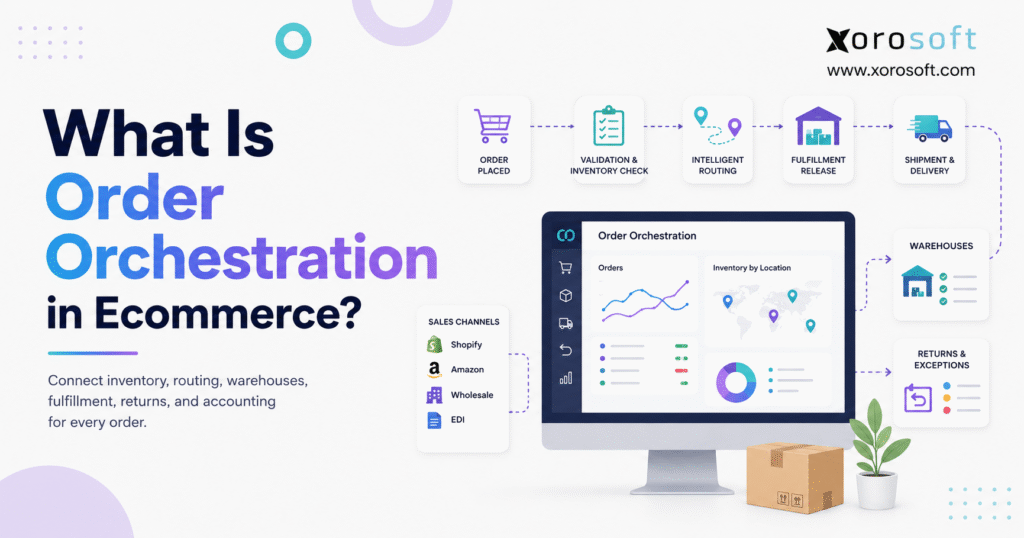
Order orchestration in ecommerce is the coordinated process of validating customer orders, checking inventory availability, allocating stock, selecting fulfillment locations, releasing warehouse work, managing exceptions, and updating connected systems.
In practical terms, it functions as a decision layer between customer demand and operational execution.
An ecommerce platform may capture the transaction. An inventory application may display stock quantities. A warehouse management system may direct picking and packing. A carrier platform may produce shipping labels. Meanwhile, an accounting system may record revenue and cost of goods sold.
Order orchestration determines how these systems should work together for each order.
2.1 A Practical Definition of Ecommerce Order Orchestration
Order orchestration in ecommerce is the automated coordination of orders, inventory, fulfillment locations, warehouses, shipping services, returns, and connected business systems. It uses current operational data and predefined rules to decide how, where, and when each customer order should be fulfilled.
This process is broader than order importing or inventory synchronization. Importing an order transfers information from one application to another. Inventory synchronization updates quantities between systems. By contrast, orchestration uses that information to make and coordinate operational decisions.
2.2 A Real-World Order Orchestration Example
Consider a customer who orders a jacket and a pair of shoes from an online store.
The jacket is available only in the eastern warehouse. The shoes are available in both the eastern and western warehouses. Shipping both products from the eastern location would prevent a split shipment, but that facility is approaching its daily labor capacity.
A basic routing rule might assign the order to the warehouse closest to the customer. However, a complete orchestration process evaluates inventory availability, delivery location, warehouse capacity, carrier cutoff times, fulfillment cost, customer priority, and the consequences of dividing the shipment.
Consequently, the system may decide to ship both products from the eastern warehouse, split the order between facilities, use a third-party logistics provider, hold the order for replenishment, or direct it to an employee for review.
The decision must then reach the warehouse, ecommerce platform, inventory records, customer-service team, carrier system, and accounting process. That cross-system coordination is what makes the workflow orchestration rather than simple routing.
2.3 What Ecommerce Order Orchestration Cannot Fix
Order orchestration is not a substitute for reliable inventory records.
If warehouse counts, open allocations, purchase orders, production schedules, or item records are inaccurate, the system will make decisions using unreliable information. Automation can increase processing speed, but it cannot turn poor data into a trustworthy fulfillment promise.
Therefore, inventory discipline, master-data governance, and warehouse transaction accuracy must support the orchestration model.
3. How Order Orchestration in Ecommerce Moves an Order from Checkout to Delivery
Although workflows vary by business, most order orchestration in ecommerce follows a similar sequence. Each stage answers a different operational question and produces information required by the next step.
3.1 Order Capture Creates a Consistent Transaction
Orders may originate from Shopify, Amazon, another marketplace, a wholesale portal, an EDI transaction, a retail location, or a customer-service representative.
Each channel can structure customer, product, pricing, payment, tax, and shipping information differently. Therefore, the first task is to convert those inputs into a consistent order record.
A standardized transaction usually includes the customer, SKUs, quantities, prices, discounts, payment status, shipping service, taxes, requested delivery date, and any channel-specific instructions.
Creating a common record matters because downstream systems should not have to interpret each sales channel independently. It also gives reporting, exception management, and customer service a consistent operational reference.
3.2 Order Validation Prevents Avoidable Fulfillment Errors
Before inventory is allocated, the system needs to confirm that the order is valid and ready to proceed.
Validation may cover the customer address, product code, unit of measure, price, discount, payment authorization, tax treatment, customer credit status, shipping restriction, or marketplace requirement.
For example, a wholesale order may require a credit check. A marketplace transaction may include a strict ship-by date. A regulated or fragile product may require a specific carrier service. International orders may need additional customs information.
If an order fails validation, it should enter a controlled exception workflow. Sending incomplete or inaccurate instructions to a warehouse usually creates a more expensive problem later in the process.
3.3 Inventory Availability Must Reflect Existing Commitments
Inventory on hand is not necessarily the same as inventory available to sell.
A warehouse may physically contain 500 units, but some units may already be allocated, reserved as safety stock, damaged, quarantined, committed to a wholesale agreement, or assigned to an upcoming product launch.
For that reason, a reliable orchestration process uses a documented availability calculation. Depending on the business, the formula may consider on-hand stock, allocations, reservations, safety stock, inventory status, open transfers, purchase orders, production schedules, and available-to-promise supply.
Different departments should not use different definitions of “available.” Otherwise, sales may promise inventory that operations cannot release, while purchasing orders stock that the business does not actually need.
3.4 Inventory Allocation Decides Which Demand Receives Stock
Allocation assigns inventory to demand. Reservation protects those units from being promised to another transaction.
This step becomes critical when demand exceeds current supply. The company may need to prioritize orders according to requested delivery dates, customer agreements, sales-channel commitments, order age, profitability, product launches, or strategic accounts.
Allocation is not only a warehouse concern. It affects revenue, customer relationships, purchasing, forecasting, and working capital.
When employees make these decisions manually in spreadsheets, it becomes difficult to understand why one order was fulfilled while another was delayed. A documented allocation policy makes those decisions more consistent and auditable.
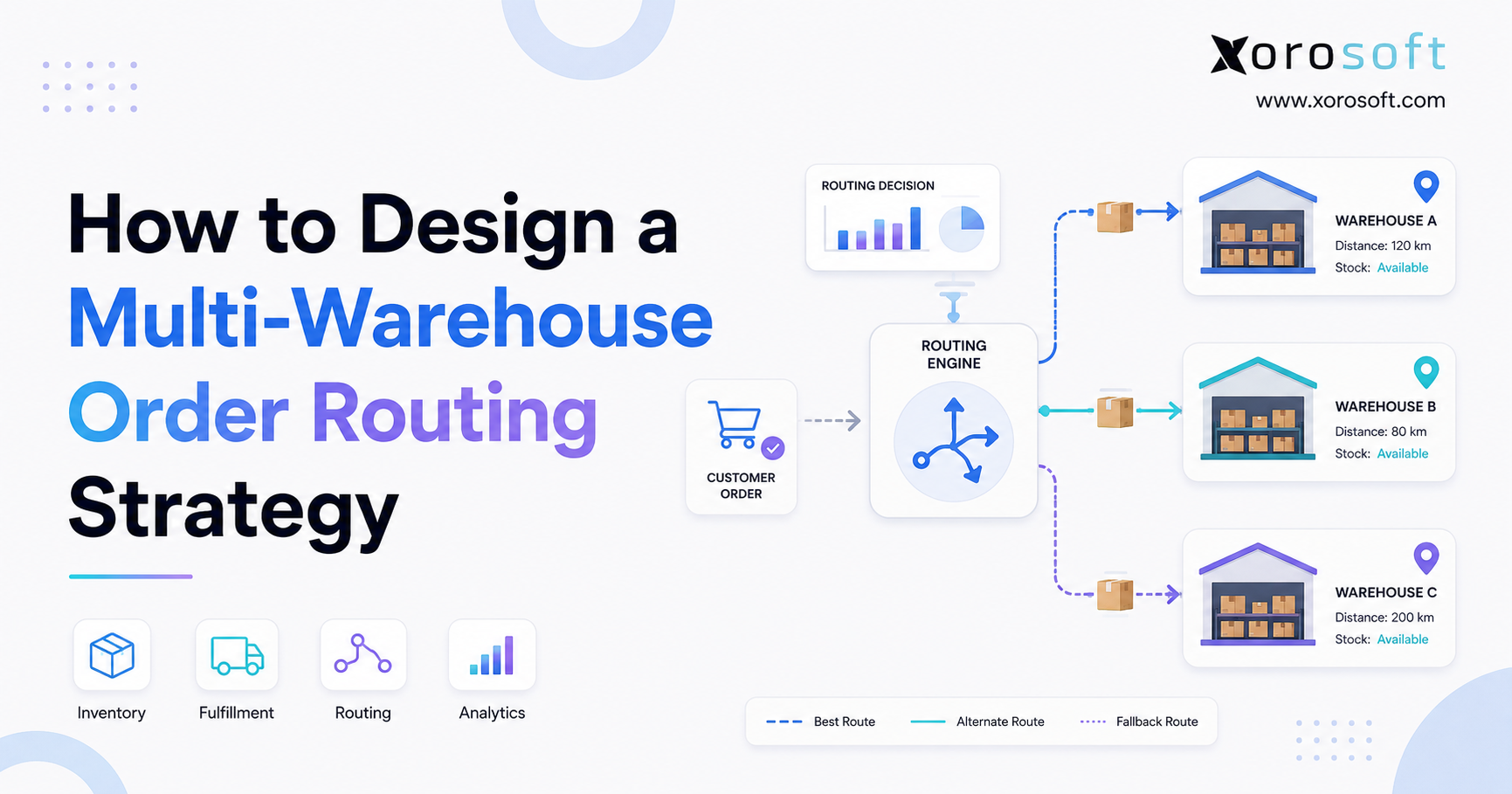
3.5 Intelligent Order Routing Selects the Fulfillment Source
After the system identifies eligible inventory, it must determine which location should perform the work.
The nearest warehouse is not always the best choice. One location may have stock but insufficient labor. Another may have a later carrier cutoff. A third location may be farther away but capable of shipping the complete order in one package.
Intelligent order routing can consider inventory availability, delivery destination, transportation cost, warehouse capacity, labor availability, carrier performance, product restrictions, inventory age, customer priority, and regional demand.
The routing objective should reflect the company’s actual operating priorities. A business focused only on minimizing freight expense may unintentionally increase late shipments. Conversely, a business focused only on delivery speed may consume margin through unnecessary expedited services.
3.6 Fulfillment Release Converts a Decision into Warehouse Work
Once the fulfillment source is selected, the order is released to an internal warehouse, retail store, 3PL, dropship supplier, assembly station, or manufacturing workflow.
The release should contain complete execution instructions. Warehouse employees need to know what to pick, where to find it, how to package it, which carrier service to use, and whether the customer has special requirements.
Moreover, the orchestration process should confirm that the receiving facility accepted the work. A successful data transfer does not always mean the warehouse has the stock, capacity, or information needed to complete the shipment.
3.7 Warehouse Execution Produces Operational Events
After release, the warehouse or fulfillment partner picks, packs, and ships the order.
During this stage, new information may affect the original decision. A picker may discover damaged inventory. A product may not be in the expected bin. The shipment may miss its carrier cutoff. Alternatively, the warehouse may complete only part of the order.
A mature orchestration workflow receives these execution events and determines what should happen next. It does not assume that every released order will proceed exactly as planned.
For operations requiring deeper warehouse control, XoroWMS supports inventory tracking, order management, receiving, picking, packing, shipping, and warehouse optimization workflows.
3.8 Shipment Confirmation Synchronizes the Business
When the warehouse confirms shipment, several records may need to change.
Inventory must be reduced. The sales order should reflect the shipped quantity. Tracking information needs to return to the ecommerce platform. Customer service requires the latest status. Accounting may need to recognize revenue, inventory relief, freight, and cost of goods sold.
Without coordinated updates, the storefront may tell the customer that an order is processing while the warehouse considers it shipped. Meanwhile, finance may still be waiting for information that operations completed hours or days earlier.
Order orchestration in ecommerce provides a common sequence for these updates rather than relying on separate integrations that behave independently.
3.9 Exception Management Keeps Imperfect Orders Moving
Normal orders are generally easy to automate. Exceptions reveal whether the process is operationally mature.
Common exceptions include failed payments, invalid addresses, inventory shortages, damaged items, warehouse rejections, missed carrier cutoffs, partial shipments, customer changes, cancellations, and integration failures.
Each material exception should have an owner, an alert, a set of permitted actions, an escalation path, and a target resolution time. In addition, the system should preserve a record of what happened and why.
The objective is not to eliminate human judgment. Instead, the goal is to direct human attention toward the orders that genuinely require it.
3.10 Returns Extend Orchestration Beyond Delivery
A completed delivery may later become a return, exchange, warranty claim, or replacement order.
The National Retail Federation projected that 19.3% of online sales would be returned in 2025. Across retail, total returns were expected to reach $849.9 billion.
A return may involve authorization, carrier instructions, warehouse receipt, inspection, restocking, repair, disposal, refund approval, replacement inventory, and accounting adjustments.
Therefore, reverse logistics should be designed as part of the wider ecommerce order management model. Treating returns as a separate customer-service activity can leave inventory and financial records incomplete.
4. The Systems Behind Ecommerce Order Orchestration
Order orchestration in ecommerce is rarely performed by one isolated application. Instead, it depends on several systems sharing accurate information and following the same operating process.
4.1 Ecommerce Platforms Capture Customer Demand
Ecommerce platforms manage the customer-facing transaction, including checkout, payment, order confirmation, and account information.
Shopify also provides built-in capabilities for order management, inventory, smart routing, fulfillment automation, shipping, returns, and refunds.
These functions may be sufficient for a straightforward business. However, additional systems become relevant when the company needs deeper purchasing, accounting, manufacturing, wholesale, EDI, or multi-warehouse control.
4.2 An OMS Administers the Order Lifecycle
An order management system consolidates orders and tracks their progression from receipt through fulfillment, delivery, changes, cancellation, and returns.
Depending on the platform, an OMS may also provide inventory visibility, sourcing, allocation, routing, and exception management. This overlap explains why orchestration is often described as an OMS capability.
Nevertheless, businesses should evaluate the actual workflow rather than relying only on the product category. Two applications described as order management systems may provide very different levels of routing logic, warehouse control, accounting integration, and configurability.
4.3 An ERP Connects Fulfillment with the Wider Business
An ERP connects customer orders to inventory, purchasing, suppliers, warehouse operations, manufacturing, accounting, forecasting, and reporting.
For an inventory-driven business, XoroONE combines inventory, warehouse management, manufacturing, accounting, and ecommerce operations within one cloud platform.
Its relevance to order orchestration comes from connecting the transaction to the wider operational record. A sales order should not exist independently from inventory commitments, purchasing needs, warehouse execution, production plans, and financial reporting.
Organizations with more extensive operational or manufacturing requirements may also evaluate XoroERP, which is positioned around centralized financial visibility, warehouse control, vendor management, manufacturing, reporting, and cloud-based operational management.
4.4 A WMS Controls Physical Warehouse Execution
A warehouse management system directs receiving, putaway, replenishment, bin movements, picking, packing, cycle counting, and shipping.
The orchestration layer determines what should happen to the order. By contrast, the WMS determines how the warehouse should execute the assigned work.
This distinction matters because a correct routing decision can still result in a late or inaccurate shipment if warehouse execution is weak.
4.5 Logistics and Accounting Systems Complete the Transaction
Third-party logistics providers receive fulfillment instructions and return inventory, shipment, and exception updates. Carrier platforms provide rates, services, labels, tracking events, and delivery confirmation.
Accounting systems record the financial effects of shipment, cancellation, refund, and return events. These events may affect receivables, revenue, inventory value, cost of goods sold, freight, taxes, and customer credits.
Accordingly, an order should not be considered fully orchestrated when the product has moved but operational and financial records remain out of sync.
5. Why Order Orchestration in Ecommerce Matters for Inventory and Fulfillment
The value of order orchestration in ecommerce does not come from moving data faster. It comes from making operational decisions more consistently and then coordinating their execution.
5.1 Shared Inventory Visibility Reduces Conflicting Promises
When every channel maintains a separate inventory balance, several channels may attempt to sell the same units.
As a result, employees spend time cancelling orders, changing warehouse assignments, and explaining delays. Purchasing may also respond to a false shortage while finance struggles to understand inventory commitments.
By contrast, a shared availability calculation gives ecommerce, wholesale, purchasing, finance, warehouse, and customer-service teams a more consistent view of stock.
5.2 Automated Order Processing Reduces Routine Work
Employees should not need to review every standard order manually.
When an order satisfies established validation, inventory, and fulfillment conditions, it can proceed automatically. However, automation should not remove operational visibility. The system should preserve why a warehouse, carrier, or inventory source was selected.
Consequently, employees can focus on shortages, delivery risks, fraud checks, strategic customers, and other situations that genuinely require judgment.
5.3 Better Routing Improves Total Fulfillment Economics
The lowest shipping rate is only one component of fulfillment cost.
A sourcing decision can also affect labor, packaging, shipment splitting, inventory placement, expedited freight, customer-service workload, cancellations, and future replenishment.
For example, shipping from a more distant warehouse may be sensible when it avoids two separate packages. On the other hand, holding an order for consolidation may be inappropriate when it breaks a customer commitment.
Strong orchestration evaluates the complete operational and financial effect rather than optimizing one transaction in isolation.
5.4 Reliable Execution Strengthens Customer Trust
DHL’s 2026 Ecommerce Trends Report surveyed 29,000 shoppers and 5,800 ecommerce businesses across 29 countries. The research examines the widening gap between customer expectations and what online businesses are prepared to deliver.
Order orchestration cannot control every part of the customer experience. Nevertheless, accurate inventory, feasible routing, visible exceptions, and coordinated status updates make it easier to provide reliable promises.
6. Order Orchestration vs. OMS, ERP, WMS, and Order Routing
Order orchestration, order management, routing, ERP, and warehouse management are related, but they are not interchangeable. Therefore, businesses should understand the responsibility of each system before selecting software.
6.1 Order Orchestration vs. Order Management
Order management administers the order throughout its lifecycle. It records the transaction, tracks status, supports changes, and maintains the order history.
Order orchestration applies operational data and business rules to decide how that lifecycle should proceed. It coordinates inventory allocation, sourcing, release, shipment, exceptions, returns, and connected updates.
An OMS may contain orchestration functionality, but order management represents the broader administrative process.
6.2 Order Orchestration vs. Order Routing
Order routing answers a narrower question: which location should fulfill this order?
Order orchestration also determines whether the transaction is valid, what inventory can be promised, whether stock should be reserved, how work should be released, what happens when the normal workflow fails, and how the outcome updates other systems.
Routing is therefore one decision inside orchestration rather than a complete alternative to it.
6.3 Order Orchestration vs. Fulfillment Automation
Fulfillment automation generally focuses on warehouse or shipping activities such as wave creation, pick-list generation, packing, label production, and shipment confirmation.
Orchestration sits above these activities. It determines which execution path should be used and coordinates the result with the rest of the operation.
6.4 OMS vs. ERP vs. WMS
| System | Primary responsibility | Contribution to order orchestration |
|---|---|---|
| Ecommerce platform | Captures customer demand | Checkout, payment, order creation, customer communication and native fulfillment tools |
| OMS | Administers the order lifecycle | Central order visibility, allocation, sourcing, changes, exceptions and returns |
| ERP | Connects operational and financial processes | Inventory, purchasing, accounting, manufacturing, forecasting and reporting |
| WMS | Executes warehouse work | Receiving, putaway, picking, packing, shipping and inventory movement |
| Orchestration layer | Coordinates cross-system decisions | Validation, allocation, routing, release, monitoring and synchronization |
In practice, orchestration is a business capability rather than one fixed type of software. It may be delivered through an OMS, ERP, commerce platform, specialized distributed order management system, or a connected combination of applications.
7. Which Businesses Need Order Orchestration in Ecommerce?
A company does not need advanced order orchestration in ecommerce simply because it sells online. The need depends on the number and complexity of the decisions required to fulfill orders correctly.
7.1 Operational Signals That Orchestration Is Becoming Necessary
The need often appears when employees manually assign warehouses, channel inventory balances disagree, orders are exported into spreadsheets, or split shipments begin increasing.
In addition, customer-service teams may struggle to find reliable statuses while finance waits for fulfillment information required for reconciliation.
Other warning signs include recurring overselling, growing cancellation rates, manual backorder management, frequent warehouse exceptions, and the need to add another application every time the business launches a new channel.
Multi-warehouse companies are especially exposed because every order creates a sourcing decision. Wholesale and EDI businesses may also need customer-specific allocation rules, pricing, delivery windows, and compliance workflows.
7.2 Businesses That May Not Need Advanced Orchestration Yet
A company with one channel, one inventory location, modest transaction volume, and one standard fulfillment process may continue operating effectively with native ecommerce tools.
Adding a complex platform too early can create unnecessary implementation and maintenance work. Therefore, the company should identify the current operational failures and select only the level of technology required to address them.
The business should consider upgrading when its existing workflow can no longer provide reliable inventory, repeatable decisions, controlled exceptions, and accurate financial updates.
8. Ecommerce Order Orchestration Across Channels and Industries
The design of order orchestration in ecommerce changes according to the company’s channels, fulfillment network, product structure, and customer commitments.
8.1 Shopify Order Orchestration for Growing Brands
A Shopify merchant may begin with native order, inventory, fulfillment, shipping, and return capabilities.
However, the operating model becomes more demanding when the brand adds Amazon, wholesale customers, EDI, several warehouses, manufacturing, or more advanced financial requirements.
At that point, Shopify can remain the customer-facing commerce platform while an ERP or OMS manages the broader operational workflow.
The Xorosoft ERP app for Shopify provides an integration path for ecommerce, retail, and wholesale businesses evaluating how Shopify can connect with a wider ERP environment.
8.2 Multi-Warehouse Order Orchestration
A multi-warehouse company must determine not only where stock exists, but where it should be consumed.
A sourcing decision may account for customer location, facility capacity, inventory age, labor availability, carrier coverage, regional demand, and planned replenishment.
Without centralized rules, warehouse assignments can depend heavily on individual judgment. That approach may work at low volume, but it becomes difficult to reproduce and audit as the network expands.
XoroWMS includes multi-warehouse workflows for inventory, transfers, fulfillment, receiving, picking, shipping, replenishment, and reporting.
8.3 Wholesale and EDI Order Orchestration
Wholesale customers may have negotiated prices, minimum quantities, credit limits, requested ship dates, allocation priorities, routing guides, and EDI document requirements.
An orchestration workflow can validate these conditions before releasing an order. It can also protect inventory for strategic customers when ecommerce and wholesale demand compete for the same stock.
Nevertheless, the business must define these priorities clearly. Software should enforce an approved commercial policy rather than invent one.
8.4 Manufacturing and Assembly Workflows
For manufactured or assembled products, availability may depend on finished goods, components, bills of materials, production capacity, work orders, and supplier lead times.
The system may need to decide whether to ship from stock, create an assembly requirement, promise against scheduled production, or delay the order until missing materials arrive.
This requirement connects order orchestration with production planning. A customer promise should reflect what the company can manufacture, not merely what is currently visible in a finished-goods location.
8.5 Industry-Specific Orchestration Requirements
Apparel businesses manage size and color variants, seasonal launches, returns, and channel allocation. Furniture companies may require bulky-item carriers, scheduled delivery, long supplier lead times, and partial-order decisions.
Similarly, food businesses may need lot, expiration, temperature, and first-expiring-first-out controls. Automotive-parts companies often manage large SKU catalogs, compatibility requirements, urgent replacement demand, and wholesale commitments.
Xorosoft’s industry solutions provide additional context for inventory-driven sectors with different warehouse, manufacturing, distribution, and ecommerce requirements.
The correct orchestration rules for an apparel brand will not necessarily suit a food distributor or component manufacturer. Consequently, industry requirements should influence both software selection and workflow configuration.
9. How Intelligent Order Routing and Inventory Allocation Rules Work
Order orchestration rules translate commercial and operational priorities into repeatable decisions.
9.1 Inventory Allocation Rules Protect Availability
An inventory rule may prevent the allocation of damaged, quarantined, expired, or reserved stock. It may preserve safety stock in a particular location or prioritize older inventory to reduce obsolescence.
Businesses may also reserve units for strategic wholesale customers, subscription programs, product launches, or high-priority channels.
However, these rules should reflect real commercial commitments. Arbitrary buffers can hide inventory from valid demand and trigger unnecessary purchasing.
9.2 Fulfillment Rules Balance Service and Cost
A fulfillment rule may prioritize the closest warehouse, the lowest total cost, the facility capable of shipping the complete order, or the location with sufficient labor capacity.
When these objectives conflict, the business needs a hierarchy. Regulatory restrictions and inventory eligibility may come first, followed by customer commitments, delivery promises, shipment consolidation, warehouse capacity, and cost.
Moreover, the hierarchy should be understandable to operators. Employees need to know why the system selected a particular location, especially when a customer or manager questions the decision.
9.3 Exception Rules Determine When Automation Stops
Not every transaction should be forced through an automated process.
An order may require review because of a credit hold, unusual quantity, inventory shortage, address problem, fraud signal, low margin, or customer-specific request.
A mature workflow defines the point at which automation ends and human judgment begins. It should also record the eventual decision so the company can identify patterns and improve the process later.
10. Common Ecommerce Order Orchestration Mistakes
Most orchestration failures come from weak process design rather than a missing software feature.
10.1 Automating Inaccurate Inventory Information
Faster routing does not solve inaccurate receiving, picking, transfers, adjustments, or cycle counts.
Instead, automation allows the system to make incorrect decisions more quickly. Inventory discipline must therefore be addressed before aggressive orchestration is introduced.
10.2 Creating More Rules Than Operators Can Manage
Complexity should not be confused with sophistication.
When every previous exception becomes a permanent rule, the configuration becomes difficult to understand, test, and maintain. Moreover, excessive rules often begin conflicting with one another.
As a result, employees lose confidence because they cannot explain why a particular location or inventory source was selected.
A stronger approach is to use the smallest set of rules that protects critical commitments and handles most orders correctly. Unusual transactions can then move through a controlled exception workflow.
10.3 Ignoring Warehouse Capacity
A warehouse may have inventory but lack the people, equipment, packaging materials, dock capacity, or carrier availability required to meet the delivery promise.
Inventory visibility without execution visibility can therefore produce technically valid but operationally unrealistic assignments.
10.4 Optimizing One Metric in Isolation
A rule designed to lower freight expense may increase late deliveries. A rule intended to prevent split shipments may delay high-priority orders.
Likewise, a rule designed to use older inventory may move stock away from the region where it is most likely to sell.
For this reason, order orchestration should optimize the overall operating outcome rather than one local metric.
10.5 Treating Orchestration as an Integration Project
Connecting application programming interfaces does not automatically create a controlled process.
The company still needs common data definitions, allocation policies, ownership, exception procedures, testing, reporting, and governance.
Integration is part of orchestration. Nevertheless, process design determines whether the connected systems produce a reliable result.
11. How to Implement Order Orchestration in Ecommerce Without Disrupting Fulfillment
Implementing order orchestration in ecommerce should begin with the company’s existing operation rather than a software demonstration.
First, the team must understand where orders enter the business, how inventory is calculated, who makes fulfillment decisions, and how exceptions are resolved. Only then should the organization configure automation.
Otherwise, it risks transferring an inconsistent manual process into a faster but equally unreliable digital workflow.
11.1 Map the Real Order Lifecycle
Document how transactions are actually handled today.
The process map should include each order source, application, spreadsheet, employee decision, warehouse handoff, status update, accounting entry, and common exception.
This exercise often reveals that different employees follow different versions of the workflow. Those differences should be discussed and resolved before the company attempts to automate them.
11.2 Establish Reliable Master Data
Review SKUs, units of measure, warehouse locations, customers, suppliers, carrier services, product restrictions, prices, lead times, and conversion rules.
Then define the inventory states used by the orchestration process. The company should agree on the meaning of on-hand, available, allocated, reserved, damaged, in-transit, and available-to-promise inventory.
A shared definition is more valuable than a sophisticated formula that only one department understands.
11.3 Rank Fulfillment Priorities
The company must decide how it balances customer commitments, delivery speed, shipping cost, warehouse capacity, inventory turnover, and shipment consolidation.
These priorities should be reviewed by operations, finance, sales, warehouse, and customer-service leaders because fulfillment rules affect every one of these teams.
For example, sales may want to protect a strategic account, while finance may want to reduce expedited shipping and operations may need to protect warehouse capacity. The final hierarchy should reflect an agreed business policy.
11.4 Design Exceptions Before Automating Routine Orders
List the exceptions that regularly interrupt the existing workflow.
For each one, define the owner, required information, permitted actions, escalation path, and expected response time.
This work is essential because exceptions are where disconnected systems and unclear responsibilities create the greatest delays. It also gives employees confidence that automation will not leave difficult orders unattended.
11.5 Pilot the Workflow Before Expanding It
Begin with one channel, warehouse, product category, or order type.
A limited pilot allows the team to compare automated decisions with actual warehouse and customer outcomes. Meanwhile, operators can identify inaccurate data, unnecessary rules, and missing exception procedures without placing the entire network at risk.
Once the pilot performs reliably, the business can expand the workflow in controlled stages.
11.6 Review Orchestration Decisions After Launch
Rules should not remain unchanged simply because the implementation is complete.
Order patterns, carrier rates, warehouse capacity, product mix, customer commitments, and channel strategies will evolve. Therefore, operations teams should review exception trends and routing outcomes regularly.
Continuous improvement is part of the orchestration model, not a one-time implementation phase.
12. Measuring Order Orchestration in Ecommerce Performance
To evaluate order orchestration in ecommerce, teams must measure speed, cost, accuracy, and exception volume together.
A workflow should not be considered successful merely because it processes transactions faster. It should also improve fulfillment quality, inventory control, customer commitments, and financial accuracy.
Order cycle time shows how quickly a transaction moves from receipt to shipment. Meanwhile, exception rate reveals how often employees must intervene.
Split-shipment rate highlights potential inventory-positioning or routing problems, whereas fulfillment cost per order measures the broader economic result.
Perfect-order rate combines completeness, accuracy, condition, and timeliness. Allocation accuracy evaluates whether the correct stock was protected for the intended demand. Manual touches per order show whether automation is reducing repetitive work.
These metrics should be analyzed by warehouse, channel, customer type, product category, carrier, and exception reason. A company-wide average can conceal a specific facility or workflow that is performing poorly.
Most importantly, teams should review metrics together. A lower fulfillment cost is not an improvement when late deliveries, cancellations, and customer-service contacts rise at the same time.
13. How to Choose Order Orchestration Software
The right platform depends on the operating model rather than the popularity of a product category.
13.1 Capabilities That Matter in an Orchestration Platform
A suitable platform should provide centralized order visibility, current inventory availability, allocation, reservation, multi-location routing, exception workflows, split-order management, returns processing, audit history, and operational reporting.
It should also integrate with the company’s ecommerce platforms, marketplaces, EDI environment, warehouses, 3PLs, carriers, purchasing, accounting, and manufacturing processes.
Configurability matters because fulfillment priorities change. Operators should be able to understand and maintain common rules without requesting custom development for every adjustment.
13.2 When Native Ecommerce Tools Are Enough
Native commerce tools may be sufficient when the business has one or two straightforward channels, limited warehouse complexity, and standard financial requirements.
Therefore, companies should avoid implementing an enterprise platform solely because they expect to grow.
Instead, the investment should address identifiable problems such as unreliable inventory, manual warehouse assignments, increasing exceptions, delayed financial updates, or an inability to coordinate wholesale and ecommerce demand.
13.3 When an OMS or Distributed Order Management Platform Fits
A dedicated OMS is often appropriate when centralized order control, sourcing, routing, and omnichannel fulfillment are the dominant requirements.
A distributed order management platform may suit a large retail network that uses stores, warehouses, suppliers, and regional facilities as fulfillment nodes.
However, the organization must still determine how the OMS will interact with purchasing, inventory valuation, accounting, manufacturing, and reporting.
13.4 When a Connected ERP Is the Stronger Foundation
A cloud ERP becomes relevant when order decisions must connect deeply with purchasing, accounting, inventory valuation, warehouse execution, manufacturing, forecasting, and reporting.
For businesses comparing an ecommerce-focused platform with a broader enterprise system, the Xorosoft vs. NetSuite comparison discusses ecommerce integration, warehouse management, manufacturing, reporting, customization, and implementation considerations.
The comparison should form only one part of the evaluation. Every vendor should be asked to demonstrate the company’s actual order lifecycle, including inventory shortages, split shipments, returns, warehouse exceptions, and financial updates.
14. Where Xorosoft Fits in a Connected Ecommerce Operations Stack
In practice, order orchestration in ecommerce works best when ERP, OMS, WMS, sales channels, warehouses, and logistics partners share consistent operational information.
A routing decision has limited value when the selected facility receives incomplete instructions or when shipment confirmation never reaches inventory and accounting.
Xorosoft provides cloud ERP and warehouse-management solutions for inventory-driven businesses that need to connect ecommerce, inventory, purchasing, warehousing, manufacturing, accounting, forecasting, and reporting.
XoroONE combines inventory, warehouse management, manufacturing, accounting, and ecommerce operations in one cloud platform.
XoroERP provides a broader operational environment connecting manufacturing, warehouse control, financial visibility, vendors, reporting, and integrations.
Meanwhile, XoroWMS focuses on physical warehouse workflows, including inventory tracking, receiving, picking, packing, shipping, and optimization.
This connected approach is particularly relevant for companies that have outgrown QuickBooks, spreadsheets, inventory-only applications, or a collection of separate warehouse and ecommerce tools.
Nevertheless, every business does not require the same product or configuration. A straightforward merchant may need less infrastructure, while a highly complex international retail network may require a dedicated distributed OMS alongside its ERP.
The evaluation should begin with the business process. The company should document order sources, allocation policies, fulfillment locations, warehouse workflows, exception procedures, accounting events, and required reporting outcomes. Technology should then be demonstrated against those specific requirements.
15. Order Orchestration in Ecommerce FAQs
15.1 Is Order Orchestration the Same as Order Management?
No. Order management administers the complete order lifecycle, while orchestration coordinates the decisions and system actions that move an order through that lifecycle. Orchestration is often a capability within an OMS, ERP, ecommerce platform, or distributed order management system.
15.2 Can Order Orchestration Prevent Overselling?
It can reduce overselling by sharing current availability and reserving inventory when an order is accepted. However, it cannot fully prevent the problem when warehouse transactions are inaccurate, integrations are delayed, or channels follow conflicting availability rules.
15.3 How Does Order Orchestration Select a Warehouse?
The system may evaluate inventory availability, customer location, delivery date, warehouse capacity, labor, carrier cutoff times, transportation cost, product restrictions, and split-shipment risk. The closest warehouse is one factor rather than the automatic answer.
15.4 Can Shopify Handle Order Orchestration?
Shopify offers built-in order management, inventory, routing, fulfillment, shipping, return, and refund capabilities. These tools may be sufficient for straightforward operations. Businesses with advanced wholesale, EDI, manufacturing, accounting, or multi-warehouse requirements may need an integrated ERP or OMS.
15.5 Can an ERP Manage Ecommerce Order Orchestration?
Yes, provided the ERP supports centralized orders, current inventory availability, allocation, warehouse workflows, business rules, ecommerce integrations, and connected accounting. Highly complex retail networks may still use a specialized order management platform alongside the ERP.
15.6 What Is Distributed Order Management?
Distributed order management coordinates customer orders across multiple inventory sources and fulfillment locations. It provides sourcing logic and visibility across warehouses, stores, suppliers, and 3PLs, making orchestration one of its central capabilities.
15.7 How Does Orchestration Reduce Split Shipments?
Routing logic can prioritize a location capable of fulfilling the complete order. However, avoiding every split may increase cost or delay delivery. The system should balance shipment consolidation with warehouse capacity and the customer promise.
15.8 How Does Order Orchestration Handle Stockouts?
The workflow may search another location, use incoming supply, create a backorder, route to a supplier, approve a substitute, divide the order, or send the transaction for manual review. The permitted response depends on company policy.
15.9 Does Order Orchestration Improve Inventory Accuracy?
It improves control by coordinating allocation, reservation, fulfillment, and status updates. Physical accuracy still depends on disciplined receiving, putaway, picking, transfers, adjustments, scanning, and cycle counting.
15.10 What Features Should Orchestration Software Include?
Important capabilities include centralized orders, inventory availability, allocation, reservation, configurable routing, multi-warehouse support, exception workflows, split-order management, returns, reporting, audit history, and integrations with commerce, logistics, warehouses, and financial systems.
15.11 When Should a Business Implement Order Orchestration?
A business should consider it when manual routing, conflicting inventory, recurring split shipments, complex exceptions, channel growth, multiple warehouses, or delayed accounting updates begin affecting service, cost, and scalability.
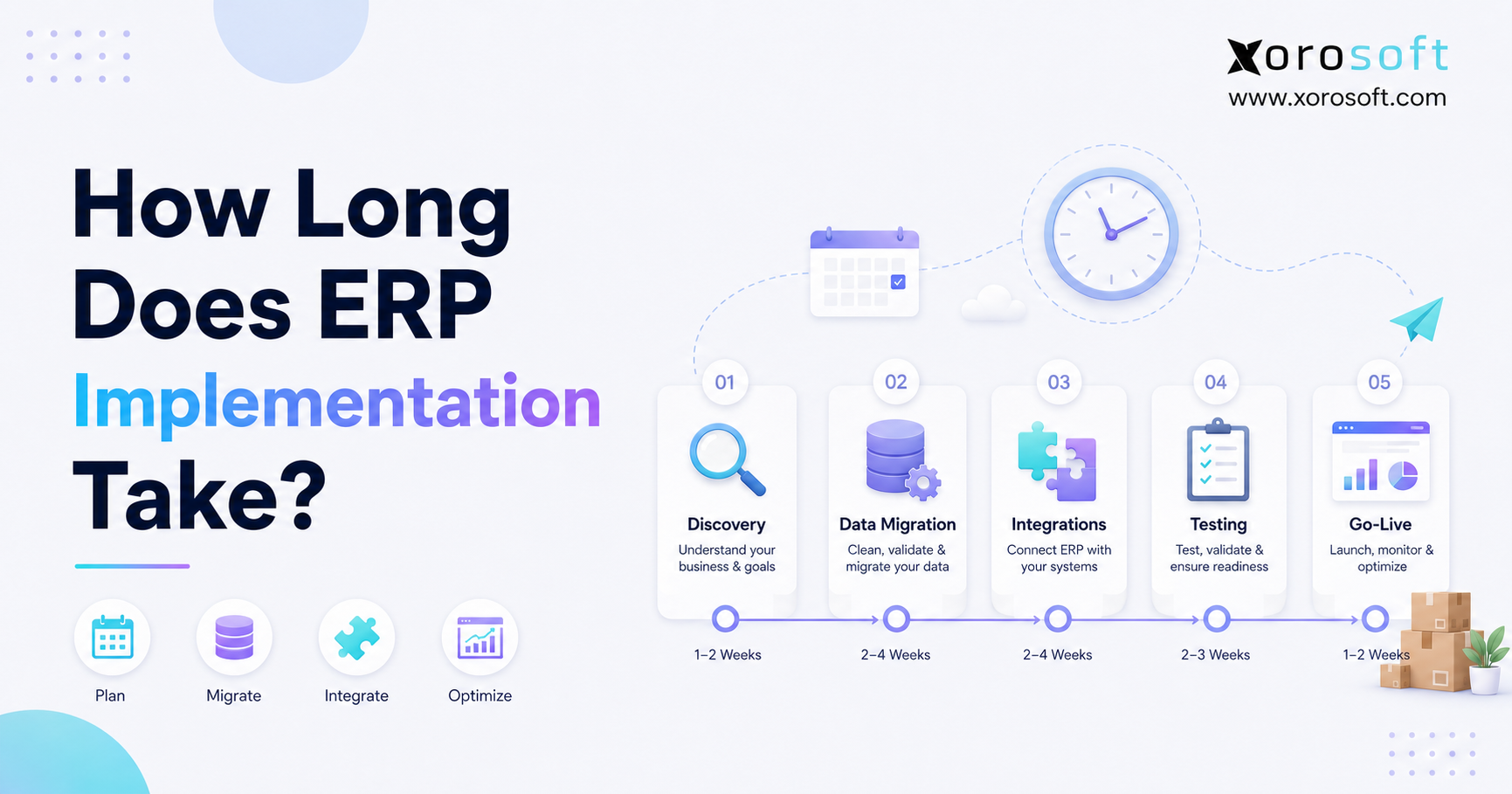
15.12 How Long Does an Orchestration Implementation Take?
The timeline depends on data quality, process complexity, sales channels, warehouse count, integrations, customization, testing, and change management. A controlled pilot is generally safer than activating every rule, channel, and location at the same time.
16. Building a Practical Order Orchestration Roadmap
Ultimately, order orchestration in ecommerce should make routine transactions predictable and exceptions easier to control. It should not add unnecessary complexity or force every company into the same technology model.
Begin by mapping how orders enter the organization. Next, define what available inventory means, document allocation policies, identify fulfillment-location criteria, and assign ownership for common exceptions.
In addition, confirm how shipments, cancellations, refunds, and returns update inventory and accounting.
Once these foundations are clear, the business can determine whether it needs stronger ecommerce functionality, a dedicated OMS, a WMS, a cloud ERP, or an integrated combination of platforms.
The best orchestration model is not the one with the most rules. Instead, it is the one that allows the majority of orders to move predictably while giving operators clear control over the situations that require judgment.
For growing inventory-driven companies, the next step should be a workflow-based system evaluation rather than a generic software tour. Bring real examples of orders, inventory constraints, warehouse assignments, returns, and reconciliation problems into the discussion.
Contact Xorosoft to review how your ecommerce channels, inventory model, fulfillment locations, warehouse processes, accounting requirements, and growth plans could operate within a more connected system.