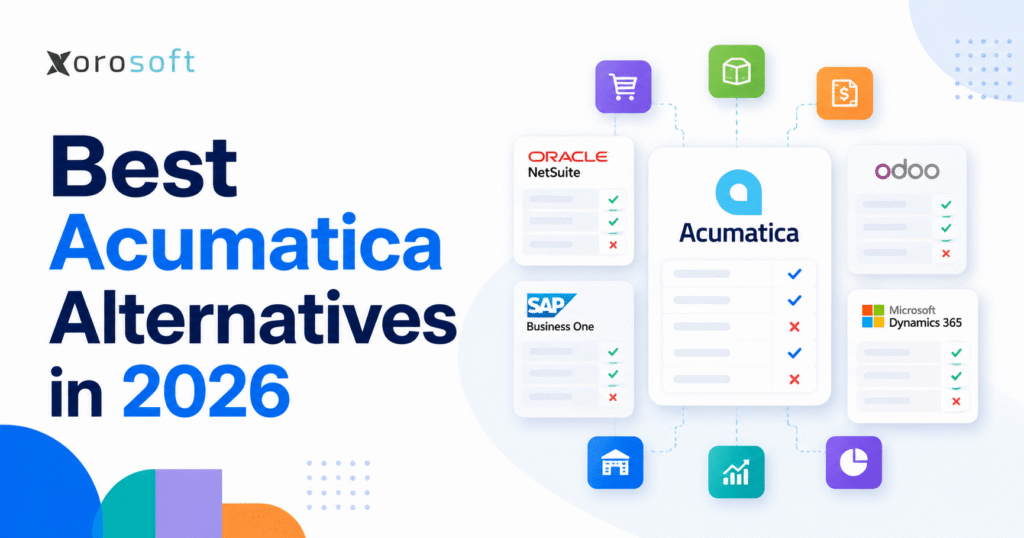
If you are searching for the Best Acumatica Alternatives in 2026, this guide will help you explore your top options.
1. Why ERP Buyers Are Rethinking Acumatica Alternatives in 2026
The search for the Best Acumatica Alternatives in 2026 usually begins when a growing company realizes that ERP selection is no longer only a finance decision. Instead, it becomes an operational decision.
At scale, a modern ERP has to support accounting, inventory, purchasing, warehouse management, ecommerce, manufacturing, reporting, and customer workflows together. When those areas are disconnected, familiar problems start to appear. Inventory becomes harder to trust. Month-end close takes longer. Purchasing decisions rely on spreadsheets. Fulfillment teams spend too much time correcting preventable issues.
Acumatica remains a serious cloud ERP option. However, a strong ERP platform is not automatically the right ERP platform for every business. A wholesale distributor may need EDI, customer-specific pricing, inventory allocation, and purchasing visibility. A Shopify brand may care more about inventory sync, warehouse execution, accounting integration, and multi-channel reporting. Meanwhile, a manufacturer may need BOMs, work orders, material planning, and production visibility.
For this reason, this guide compares Acumatica alternatives by operational fit, not just by brand recognition. The goal is to help businesses understand which ERP platforms match their workflows, industry needs, implementation capacity, and growth plans.
1.1 What Acumatica Alternatives Really Mean
Acumatica alternatives are ERP, accounting, inventory, warehouse, manufacturing, ecommerce, and business management platforms that companies compare when they need a different fit from Acumatica.
Some alternatives are broad ERP suites. Other options are finance-first platforms, manufacturing ERP systems, retail operating systems, or inventory-focused tools. In practice, the right choice depends on what the business needs to control every day.
For example, one company may need a stronger financial reporting system. Another may need deeper warehouse execution. A third may need better Shopify, Amazon, EDI, and wholesale connectivity. Although all three companies may search for ERP alternatives, they are not solving the same problem.
1.2 Why ERP Fit Matters More Than Feature Count
Feature lists can look impressive during software evaluation. However, ERP success depends on whether the system supports real workflows.
One platform may have inventory features but still struggle with warehouse execution. Another option may offer strong accounting but require add-ons for ecommerce or manufacturing. Meanwhile, a flexible system may need heavy configuration before teams can use it effectively.
Because of this, ERP buyers should ask one practical question first: does this platform match how our business buys, stores, sells, fulfills, produces, accounts, and reports?
That question protects the company from choosing software based on brand recognition alone. More importantly, it keeps the buying process focused on operations, not just software categories. For buyers comparing the Best Acumatica Alternatives in 2026, this workflow-first mindset is the difference between a useful shortlist and a confusing vendor list.
2. How to Evaluate ERP Alternatives to Acumatica
Before building a shortlist, define what your business actually needs. Without a clear evaluation framework, every demo can look convincing. As a result, teams may choose a system that looks strong in sales conversations but feels difficult in daily operations.
The Best Acumatica Alternatives in 2026 should be evaluated across operational depth, industry fit, implementation effort, integration requirements, reporting needs, and long-term scalability. A buyer should not compare ERP systems only by feature lists. Instead, the better approach is to compare how each platform supports daily workflows across inventory, accounting, purchasing, warehouse management, ecommerce, manufacturing, and reporting.
2.1 Inventory and Warehouse Management Requirements
Inventory-driven businesses should evaluate far more than basic stock tracking. The system should support real-time inventory visibility, multi-location stock, committed inventory, available-to-sell quantities, receiving, transfers, cycle counts, bin locations, picking, packing, shipping, and inventory valuation.
For warehouse-heavy businesses, a connected warehouse management system for multi-location operations can be just as important as the ERP itself. If warehouse activity does not update inventory and accounting in real time, teams often end up reconciling numbers manually.
In practice, inventory accuracy affects nearly every department. Sales needs reliable availability. Purchasing needs demand and reorder signals. Warehouse teams need location-level accuracy. Finance needs correct valuation. Leadership needs trusted reporting. Therefore, inventory should sit near the top of any ERP evaluation checklist.
2.2 Accounting and Financial Control
Finance teams need accurate books, clean inventory valuation, reliable cost tracking, and faster month-end close. Therefore, ERP buyers should evaluate general ledger, accounts payable, accounts receivable, landed cost, inventory costing, reconciliations, approvals, reporting, and audit trails.
More importantly, finance cannot operate cleanly when operational data is delayed or incomplete. Inventory movement, purchasing activity, warehouse adjustments, and fulfillment updates should all support accurate financial reporting.
For product-based companies, this is especially important because inventory is both an operational asset and a financial asset. If inventory data is wrong, margins, cost of goods sold, purchasing decisions, and balance sheet accuracy can all be affected.
2.3 Ecommerce and Marketplace Readiness
Ecommerce businesses need ERP systems that connect orders, inventory, fulfillment, returns, payouts, purchasing, accounting, and reporting.
Shopify brands should pay special attention to product sync, order sync, inventory availability, refunds, gift cards, payouts, fulfillment updates, and marketplace integrations. As volume increases, disconnected ecommerce workflows create more manual work instead of more control.
Amazon sellers also need accurate inventory availability, channel-level reporting, order routing, and fulfillment visibility. In addition, wholesale teams may need customer-specific pricing, EDI, purchase orders, invoices, and allocations. The ERP should support these workflows without forcing the team to rebuild operations in spreadsheets.
2.4 Manufacturing and Production Fit
Manufacturing companies should compare BOMs, work orders, material requirements planning, production scheduling, labor tracking, quality control, and inventory consumption.
In manufacturing environments, ERP fit depends on how well the system connects materials, labor, purchasing, production, inventory, and financial reporting. If production data lives separately from accounting or inventory, teams often struggle to understand true cost and availability.
A manufacturer should also evaluate whether the ERP can support both planning and execution. For example, it should help teams know what materials are needed, what is available, what must be purchased, what is in production, and how production affects finished goods inventory.
2.5 Implementation Effort and Internal Readiness
A platform can be powerful and still be the wrong fit if implementation becomes too heavy. ERP buyers should evaluate data cleanup, partner support, customization, integrations, user training, timeline, cost, and internal ownership.
Ultimately, the Best Acumatica Alternatives in 2026 are not only the platforms with the broadest capabilities. They are the systems a company can realistically implement, adopt, and run with confidence.
Before choosing any ERP, leadership should ask whether the company has clean data, clear processes, committed department owners, and enough time for testing. Without those pieces, even a strong ERP can become difficult to adopt.
The Best Acumatica Alternatives in 2026 should be judged by how well they support real operations after implementation, not only by how strong they appear during selection.
3. Best Acumatica Alternatives in 2026 by Operating Model
The Best Acumatica Alternatives in 2026 include broad cloud ERP suites, finance-first platforms, manufacturing ERP systems, modular tools, retail operations platforms, and inventory-driven ERP systems.
Ultimately, the right choice depends on your company’s operating model. In practice, the best ERP shortlist should compare how each system supports inventory, accounting, warehouse management, ecommerce, manufacturing, and reporting together. For that reason, the Best Acumatica Alternatives in 2026 should be reviewed by business model, not only by software category.
3.1 Xorosoft for Inventory-Driven Product Businesses
Xorosoft is a cloud ERP platform built for inventory-driven businesses that need accounting, inventory management, purchasing, warehouse management, manufacturing, forecasting, ecommerce operations, and reporting in one connected system.
For businesses that sell through Shopify, Amazon, wholesale, EDI, and multiple warehouses, a cloud ERP platform for inventory-driven businesses can reduce the operational gaps created by disconnected systems.
Xorosoft is especially relevant for companies that have outgrown QuickBooks, spreadsheets, inventory-only software, or disconnected apps. These businesses often need more than accounting software and more than a standalone inventory tool. They need inventory, finance, purchasing, warehouses, sales channels, and reporting to work from the same operational foundation.
In short, Xorosoft is most relevant when physical products, inventory accuracy, warehouses, purchasing, and fulfillment are central to the business. It is not designed for every company, but it can be a strong fit for businesses that need practical ERP depth without stitching together multiple disconnected tools.
3.2 NetSuite for Broad Cloud ERP Coverage
Among broad cloud ERP platforms, NetSuite is one of the most recognized options for growing and mid-market companies. It is commonly considered by businesses that need finance, inventory, order management, reporting, and operations in one system.
NetSuite can be a strong option for companies that need wide ERP coverage and have the budget, team, and implementation resources to support it. However, businesses should carefully evaluate implementation scope, customization, partner dependency, internal ownership, and total cost.
Companies comparing NetSuite can also review this Xorosoft vs NetSuite comparison when they want to understand how different ERP approaches fit inventory-driven operations.
3.3 Microsoft Dynamics 365 Business Central for Microsoft-Centric Teams
For Microsoft-centric teams, Microsoft Dynamics 365 Business Central is commonly evaluated by small and midsize businesses already using Microsoft tools.
Business Central can fit companies that want finance and operations coverage inside the Microsoft ecosystem. That said, the quality of the final ERP setup often depends on partner configuration, extensions, integrations, and how well the system is adapted to inventory, warehouse, manufacturing, or ecommerce workflows.
For businesses already using Microsoft 365, Power BI, and related tools, Business Central may feel familiar. However, companies with complex product operations should still test receiving, inventory valuation, warehouse workflows, ecommerce integrations, and purchasing automation before making a decision.
3.4 Sage Intacct for Finance-Led Organizations
From a finance perspective, Sage Intacct is a strong option for organizations where accounting visibility is the main priority. It is often evaluated by companies that need better reporting, multi-entity accounting, approvals, dashboards, and finance controls.
For inventory-driven businesses, however, the key question is whether Sage Intacct alone can support the operating workflows or whether additional inventory, warehouse, manufacturing, and ecommerce tools will be required.
If finance is the main pain point, Sage Intacct may be a serious option. If the deeper problem is inventory accuracy, warehouse execution, purchasing, or ecommerce operations, buyers should evaluate whether a finance-first system is enough.
3.5 Epicor Kinetic for Manufacturing Complexity
For production-heavy businesses, Epicor Kinetic is a strong Acumatica alternative because of its manufacturing focus. It is especially relevant when production planning, supply chain visibility, shop-floor control, and manufacturing data are central to the operation.
On the other hand, ecommerce-first brands, wholesale distributors, or simpler product sellers should confirm whether a manufacturing-heavy ERP matches their daily workflows.
Manufacturers should also compare how each ERP handles BOMs, work orders, material requirements, labor, scheduling, quality control, and inventory consumption. These details matter because production errors can quickly affect cost, fulfillment, and customer commitments.
3.6 SAP Business One or SAP Cloud ERP for Structured Operations
SAP options may fit companies that need structured business processes, global controls, multi-entity support, and enterprise discipline.
SAP Business One is often evaluated by smaller and mid-market companies, while SAP Cloud ERP is more relevant for larger organizations. The strength is structure and scale. Even so, implementation and process design may require more planning than some growing businesses expect.
For companies with complex compliance, international operations, or formal process requirements, SAP may be worth evaluating. However, smaller inventory-driven businesses should confirm whether the level of complexity matches their current stage.
3.7 Oracle Fusion Cloud ERP for Enterprise Requirements
Oracle Fusion Cloud ERP is generally suited to larger organizations with enterprise finance, procurement, risk, project, reporting, and governance requirements.
For smaller product-based businesses, Oracle Fusion may be more complex than necessary. Therefore, companies should evaluate whether enterprise-grade depth matches their actual operating model.
A business should not choose enterprise ERP only because it appears more powerful. The better question is whether the company has enterprise-level processes, teams, governance, and budget to support the platform properly.
3.8 Odoo for Modular Flexibility
Odoo is often considered by companies that want modularity and flexibility. It can support a broad range of business applications, including CRM, ecommerce, accounting, inventory, point of sale, project management, and more.
However, as complexity increases, governance becomes important. Businesses need disciplined configuration, clean integrations, and clear process ownership so the system does not become difficult to manage.
For smaller companies, modularity can feel attractive. As the business grows, though, leadership should ensure that the system remains controlled, documented, and scalable.
3.9 Cin7 for Inventory and Order Management
Cin7 is commonly evaluated by product sellers that need inventory and order management. It can fit ecommerce, wholesale, and product businesses that want stronger inventory control without immediately moving into full ERP.
That said, companies needing deeper accounting, manufacturing, or ERP-wide reporting should compare Cin7 carefully against full ERP systems. In many cases, an inventory platform may solve stock and order problems but still leave finance, purchasing, and reporting workflows fragmented.
Cin7 may be useful when the main operational gap is inventory and order flow. However, if the company needs accounting, manufacturing, purchasing, forecasting, and warehouse management in one connected system, ERP depth becomes more important.
3.10 Brightpearl for Retail Operations
Brightpearl is a retail operations platform focused on multichannel merchants. It can be useful for retailers and ecommerce brands that need post-purchase operational automation across orders, inventory, fulfillment, shipping, and reporting.
Meanwhile, manufacturing-heavy companies should validate whether Brightpearl can support production, material planning, and deeper manufacturing requirements.
For retail and ecommerce teams, Brightpearl may be relevant when order management and operational automation are the main priorities. Still, buyers should compare accounting depth, warehouse workflows, and long-term scalability before choosing it as an ERP replacement.
3.11 Fishbowl for QuickBooks and Xero Users
Fishbowl is often used by businesses that want stronger inventory, warehouse, and manufacturing control while staying close to QuickBooks or Xero.
For smaller companies, that can be practical. As the business grows, though, leadership should ask whether the company eventually needs full ERP accounting, purchasing automation, forecasting, reporting, and operational visibility in one platform.
Fishbowl may work well as a step between basic accounting and full ERP. However, companies with multiple warehouses, ecommerce channels, EDI, manufacturing, and reporting needs may eventually need a broader operating system.
4. Acumatica Competitors Comparison Table
The table below gives a practical view of Acumatica competitors by best-fit use case. Xorosoft is listed first because inventory-driven businesses often need to evaluate operational fit before comparing broader ERP categories.
| ERP Alternative | Best Fit | Strongest Area | What to Check Carefully |
|---|---|---|---|
| Xorosoft | Inventory-driven product businesses | Inventory, accounting, WMS, ecommerce | Best for physical-product companies |
| NetSuite | Scaling mid-market companies | Broad cloud ERP suite | Cost, implementation scope, customization |
| Business Central | Microsoft-centric SMBs | Finance and operations | Partner configuration and extensions |
| Sage Intacct | Finance-led organizations | Accounting and reporting | Inventory and warehouse depth |
| Epicor Kinetic | Manufacturers | Production and supply chain | Fit for ecommerce or wholesale-first teams |
| SAP | Structured global businesses | Enterprise controls | Implementation complexity |
| Oracle Fusion Cloud ERP | Large enterprises | Finance and procurement | Enterprise-level scope |
| Odoo | Modular businesses | Flexibility | Governance and configuration quality |
| Cin7 | Product sellers | Inventory and order management | Full ERP accounting depth |
| Brightpearl | Retail and ecommerce brands | Retail operations automation | Manufacturing depth |
| Fishbowl | QuickBooks/Xero users | Inventory and warehouse control | Long-term ERP scalability |
4.1 How to Read This Acumatica Alternatives Comparison
When reviewing the Best Acumatica Alternatives in 2026, there is no universal winner because each platform serves a different type of business. Instead, the best option depends on business type, operational complexity, and implementation readiness.
A finance-led company may shortlist Sage Intacct. Manufacturers may evaluate Epicor Kinetic. Microsoft-heavy teams may prefer Business Central. Larger enterprises may consider Oracle or SAP. Meanwhile, a product business with ecommerce, wholesale, warehouses, purchasing, and inventory complexity may evaluate Xorosoft alongside other ERP systems.
4.2 Why the Table Should Start With Business Fit
Most ERP comparison tables start with the largest or most recognized vendor. That approach is not always helpful. A business should first understand which platform category fits its operating model.
For example, a company running Shopify, Amazon, wholesale, and multiple warehouses has very different needs from a finance-led services organization. Similarly, a manufacturer has different requirements from a retail brand focused on fulfillment speed and inventory accuracy.
Because of this, the comparison should begin with the business problem. Once the company understands its operating model, vendor comparison becomes much clearer.
This is why the Best Acumatica Alternatives in 2026 should be compared through workflow fit, industry needs, and long-term operational control.
5. Best Acumatica Alternatives for Shopify, Wholesale, and Manufacturing
In many cases, ERP fit becomes clearer when you compare systems by business model instead of vendor popularity.
5.1 Best Acumatica Alternative for Shopify Brands
Shopify brands need inventory synchronization, order management, warehouse workflows, purchasing, returns, accounting, payouts, and reporting.
As volume grows, Shopify alone is not the operating system. Instead, it functions as the storefront. Behind it, the ERP needs to manage stock, cost, purchasing, fulfillment, and financial visibility.
For this use case, the Xorosoft ERP app on Shopify is contextually relevant because it supports ecommerce, retail, wholesale, inventory, warehousing, purchasing, manufacturing, financials, and customer service workflows. It also gives Shopify merchants a way to evaluate ERP connectivity from the ecommerce side of the business.
A growing Shopify brand should ask whether the ERP can handle real-time inventory updates, refunds, returns, gift cards, order routing, purchase planning, warehouse activity, and accounting impact. If those areas are disconnected, the brand may keep growing revenue while losing operational control.
For Shopify brands, the Best Acumatica Alternatives in 2026 should connect ecommerce activity with inventory, purchasing, fulfillment, accounting, and reporting.
5.2 Best Acumatica Alternative for Wholesale Distributors
Wholesale distributors need customer-specific pricing, EDI, purchasing, inventory allocation, sales order visibility, warehouse execution, and margin reporting.
A wholesale ERP should answer operational questions quickly: what is available, what is committed, what is incoming, which customer gets priority, and whether purchasing is aligned with demand. Because of this, wholesale teams should not evaluate ERP only from a finance perspective.
Businesses in wholesale, apparel, furniture, sporting goods, food, and manufacturing can also review ERP solutions for inventory-driven industries when comparing system fit by sector.
In addition, wholesale businesses should test how each ERP handles backorders, partial shipments, customer terms, pricing rules, EDI documents, and multi-location inventory. These workflows often separate a workable ERP from a system that creates extra manual effort.
5.3 Best Acumatica Alternative for Manufacturing Companies
Manufacturers should evaluate ERP systems around BOM management, work orders, material requirements planning, labor, production scheduling, quality control, and inventory consumption.
Epicor Kinetic is highly relevant here because of its manufacturing focus. At the same time, Xorosoft may also fit inventory-driven manufacturers that need production workflows connected to inventory, accounting, purchasing, warehousing, and ecommerce channels.
A manufacturer should not evaluate production in isolation. Materials, purchase orders, inventory, finished goods, labor, and accounting all affect profitability. Therefore, the ERP should connect production activity with financial and operational reporting.
5.4 Best Acumatica Alternative for Apparel and Fashion Brands
Apparel brands deal with style, size, color, seasonality, returns, wholesale orders, channel allocation, and fluctuating demand.
The wrong ERP setup can create problems across purchasing, fulfillment, and finance. For example, poor variant visibility can lead to stockouts in one channel and overstock in another. Therefore, apparel teams should evaluate whether the system can handle variants, replenishment, warehouse workflows, and stock visibility across channels.
In practice, apparel brands need ERP systems that understand product complexity. A simple item list may not be enough when the business manages hundreds or thousands of style, color, and size combinations.
5.5 Best Acumatica Alternative for Furniture Businesses
Furniture companies often manage large items, vendor lead times, containers, landed cost, warehouse space, delivery schedules, and customer commitments.
A furniture ERP should support purchasing, receiving, inventory planning, fulfillment, and financial reporting. Simple accounting software usually cannot manage this complexity alone. In practice, furniture companies need inventory and finance to work together because product cost, space, and timing affect profitability.
Furniture businesses should also compare how each ERP handles long lead times, partial receiving, damaged goods, warehouse locations, customer deposits, and delivery planning. These details can have a direct impact on customer experience and margin control.
5.6 Best Acumatica Alternative for Food and Beverage Companies
Food and beverage companies should evaluate lot tracking, expiry dates, traceability, purchasing, demand planning, compliance workflows, and warehouse accuracy.
The best ERP fit depends on whether the business manufactures, distributes, sells wholesale, sells online, or does all of these at once. More importantly, food and beverage teams should test how each system handles lot-level inventory and expiry-sensitive fulfillment.
Because product freshness and traceability matter, food and beverage businesses need more than basic stock counts. They need a system that supports operational accuracy and compliance-ready visibility.
6. When an Acumatica Alternative Becomes Worth Evaluating
That said, a company should not replace ERP just because another system looks newer. It should evaluate alternatives when operational friction starts affecting cost, speed, accuracy, or decision-making.
6.1 Inventory Accuracy Is No Longer Reliable
When inventory cannot be trusted, every department feels it. Sales teams may overpromise availability, while purchasing may buy too early or too late. In the warehouse, staff waste time searching for products that should be available. Finance then has to question valuation, costing, and adjustments. At the leadership level, confidence in reporting starts to decline.
Because of this, unreliable inventory is one of the strongest signals that a company needs a deeper ERP review.
Inventory issues are rarely isolated. They often show up as stockouts, overstock, delayed purchasing, incorrect reporting, warehouse confusion, and customer service problems. Therefore, the company should treat inventory accuracy as a strategic ERP requirement.
6.2 Ecommerce, Wholesale, and Warehouse Tools Are Disconnected
Disconnected tools create duplicate entry and inconsistent data. Once the business reaches meaningful scale, Shopify, Amazon, wholesale orders, 3PLs, warehouse apps, accounting, and purchasing should not operate as separate islands.
For product-based companies, a connected ERP system for inventory, accounting, purchasing, and operations can help centralize workflows instead of relying on manual workarounds.
This matters because disconnected systems create hidden costs. Teams spend time exporting data, checking spreadsheets, correcting errors, and explaining mismatched numbers. As a result, the business loses speed and visibility.
6.3 Month-End Close Depends on Manual Reconciliation
If finance needs exports, spreadsheets, manual inventory adjustments, and delayed operational data to close the month, the ERP setup may not be supporting the business properly.
This issue is common when accounting and operations live in separate systems. As a result, finance teams spend time cleaning data instead of analyzing performance.
A stronger ERP setup should help finance close with cleaner operational inputs. Inventory receipts, adjustments, shipments, purchase orders, and sales activity should connect naturally with accounting.
6.4 Purchasing Is Still Managed in Spreadsheets
Purchasing spreadsheets can work when the business is small. They become risky when vendor lead times, reorder points, demand forecasting, warehouses, and sales channels increase.
A stronger ERP should help purchasing teams see demand, incoming stock, vendor commitments, open orders, and inventory risk. Otherwise, buyers may continue reacting to problems instead of planning ahead.
Purchasing is especially important for companies with long lead times or seasonal demand. Without better visibility, teams may buy too much of the wrong inventory and too little of the products customers actually want.
6.5 Reporting Is Too Late to Drive Decisions
Reports are less useful when they arrive after the decision window has passed. ERP buyers should evaluate whether the system provides real-time visibility into sales, inventory, purchasing, fulfillment, margins, and cash flow.
In other words, reporting should not only explain what happened last month. It should help teams decide what to do next.
Leadership needs reliable answers. Teams should be able to see which products are profitable, where warehouse delays are happening, and whether vendors are meeting expected timelines. Channel growth, replenishment needs, margin trends, and fulfillment performance should also be easy to review. A strong ERP should make these answers easier to access.
As a result, the Best Acumatica Alternatives in 2026 should give leadership faster visibility into both operational and financial performance.
7. Common Mistakes When Comparing Acumatica Alternatives
In practice, many ERP projects struggle because the selection process focuses on the wrong things. The Best Acumatica Alternatives in 2026 should not be chosen only by name recognition, review scores, or feature checklists.
7.1 Comparing Software Names Instead of Workflows
Although vendor reputation matters, workflow fit matters more. A system should be tested against real business scenarios: receiving inventory, creating purchase orders, fulfilling Shopify orders, handling returns, closing the month, managing production, and reconciling inventory value.
Without workflow testing, buyers may choose a well-known platform that still creates daily friction for the team.
A better approach is to prepare demo scenarios before speaking to vendors. For example, ask the vendor to show a purchase order flowing into receiving, inventory, warehouse activity, costing, and accounting. That type of test reveals how the system actually works.
7.2 Treating Inventory as a Secondary Requirement
For product businesses, inventory is not a side feature. It is the connection point between sales, purchasing, warehouse operations, accounting, and customer experience.
If inventory workflows are weak, the ERP implementation will feel weak no matter how strong the accounting module looks. Therefore, inventory should be evaluated early in the buying process.
This is especially true for ecommerce and wholesale businesses. Inventory errors can create overselling, late shipments, unnecessary stockouts, overbuying, and poor customer experience.
7.3 Ignoring Implementation Capacity
Some companies choose a powerful ERP but underestimate the internal effort required. Data cleanup, integrations, process design, testing, training, and change management all need ownership.
For this reason, the right ERP should match both the company’s requirements and its ability to implement successfully.
Leadership should assign internal owners from finance, operations, warehouse, purchasing, ecommerce, and manufacturing where relevant. Without cross-functional ownership, ERP selection becomes too narrow and implementation becomes harder.
7.4 Choosing Finance Software for an Operations Problem
A finance-first system may improve accounting and reporting. However, if the actual business problem is inventory accuracy, warehouse execution, purchasing, ecommerce sync, or manufacturing control, finance software alone may not solve it.
Instead, companies should define whether the problem is primarily financial, operational, or both.
For many product-based businesses, the issue is connected operations. Accounting matters, but the numbers depend on accurate activity from inventory, warehouse, purchasing, sales, and production.
7.5 Accepting Generic Demos
ERP buyers should ask for workflow-based demos. A good demo should show how the system handles daily operations, not just dashboards and menus.
For example, a Shopify brand should ask to see order sync, inventory availability, fulfillment updates, returns, purchasing, and accounting flow. A manufacturer should ask to see BOMs, work orders, material consumption, and production reporting.
Generic demos often hide complexity. Workflow demos expose it. That is why buyers should insist on seeing the system handle their actual operating scenarios.
8. ERP Shortlist Framework for 2026
Therefore, the best way to compare the Best Acumatica Alternatives in 2026 is to build a shortlist around operating requirements.
8.1 Start With Your Current Software Stack
Map every system currently involved in operations. That may include Shopify, Amazon, QuickBooks, spreadsheets, inventory apps, warehouse tools, EDI software, shipping platforms, forecasting tools, and reporting dashboards.
In other words, every manual bridge between systems is a clue. It shows where the business needs better integration.
This mapping exercise also helps teams understand what the new ERP must replace, integrate with, or improve. Without that visibility, companies may underestimate the complexity of switching systems.
8.2 Separate Must-Haves From Nice-to-Haves
Must-haves are workflows the business cannot run without. Nice-to-haves are useful but not essential.
For example, a wholesale distributor may consider EDI and customer-specific pricing must-haves. A manufacturer may prioritize BOMs and work orders. Meanwhile, a Shopify brand may need real-time inventory sync and fulfillment visibility.
This distinction keeps the buying process focused. Otherwise, teams may be distracted by features that look interesting but do not solve the most expensive operational problems.
8.3 Compare Total Cost of Ownership
ERP cost includes software subscription, implementation, customization, integrations, support, data migration, training, and internal team time.
A cheaper platform can become expensive if it requires too many add-ons. On the other hand, a more advanced system can also become expensive if it is overbuilt for the company’s needs.
For this reason, buyers should compare total cost of ownership instead of only monthly subscription price. A realistic cost model should include both direct software costs and the operational cost of maintaining disconnected systems.
8.4 Ask for Role-Based Demos
Finance, warehouse, purchasing, ecommerce, manufacturing, and leadership teams should each see workflows relevant to their roles.
This prevents one department from choosing a system that creates problems for another. More importantly, it helps decision-makers see whether the ERP can support the full operating model.
Role-based demos also increase adoption. When users see how the system helps their daily work, they are more likely to support the implementation.
8.5 Score Each ERP by Operational Fit
A practical shortlist should score each platform across inventory, accounting, warehouse, ecommerce, manufacturing, reporting, implementation effort, scalability, and support.
| Evaluation Area | Key Question |
| Inventory | Can we trust stock across all locations and channels? |
| Warehouse | Can receiving, picking, packing, transfers, and counts run cleanly? |
| Accounting | Can finance close faster with fewer reconciliations? |
| Ecommerce | Do Shopify, Amazon, returns, and fulfillment connect properly? |
| Manufacturing | Are BOMs, work orders, and material planning supported? |
| Reporting | Can leaders see real-time operational and financial data? |
| Implementation | Can our team realistically adopt this system? |
This scoring method makes it easier to compare the Best Acumatica Alternatives in 2026 based on actual operating needs instead of vendor popularity.
More importantly, it keeps the Best Acumatica Alternatives in 2026 comparison focused on business outcomes instead of generic software claims.
9. Frequently Asked Questions About Acumatica Alternatives
The following FAQs answer common buyer questions about the Best Acumatica Alternatives in 2026, including fit by industry, implementation, cost, and scalability.
9.1 What are the Best Acumatica Alternatives in 2026?
In most cases, the Best Acumatica Alternatives in 2026 include Xorosoft, NetSuite, Microsoft Dynamics 365 Business Central, Sage Intacct, Epicor Kinetic, SAP, Oracle Fusion Cloud ERP, Odoo, Cin7, Brightpearl, and Fishbowl. The right choice depends on your business model, inventory complexity, accounting needs, warehouse workflows, manufacturing requirements, ecommerce stack, and implementation capacity.
9.2 What is the best alternative to Acumatica?
There is no single best alternative for every company. NetSuite may fit broader ERP needs. Sage Intacct may fit finance-led teams. Epicor may fit manufacturers. Business Central may fit Microsoft-centric companies. For inventory-driven businesses, Xorosoft may fit when ERP, inventory, accounting, warehouse, ecommerce, purchasing, and manufacturing workflows need to work together.
9.3 Why do companies look for Acumatica alternatives?
Companies usually look for Acumatica alternatives because they want a different implementation model, pricing approach, industry fit, user experience, integration stack, inventory workflow, warehouse process, manufacturing depth, or ecommerce capability. Ultimately, the decision is usually less about replacing one brand and more about finding a better operational match.
9.4 Is Xorosoft a good Acumatica alternative?
Xorosoft can be a good Acumatica alternative for inventory-driven businesses that sell physical products and need connected workflows across inventory, accounting, purchasing, warehouse management, ecommerce, manufacturing, forecasting, and reporting. It is especially relevant for companies using Shopify, Amazon, wholesale, EDI, multiple warehouses, or disconnected apps.
9.5 Is NetSuite a good Acumatica alternative?
Yes, NetSuite can be a good Acumatica alternative for companies that need broad cloud ERP functionality. It is often considered by scaling businesses with finance, inventory, order management, and reporting needs. However, buyers should carefully evaluate cost, implementation scope, customization, and internal resource requirements.
9.6 Is Microsoft Dynamics 365 Business Central a good Acumatica alternative?
Yes, Business Central can be a good alternative for small and midsize businesses that use Microsoft tools heavily. It connects finance, sales, service, and operations. That said, companies with complex warehouse, ecommerce, or manufacturing needs should check partner configuration and required extensions carefully.
9.7 Is Sage Intacct a good Acumatica alternative?
Sage Intacct can be a strong alternative for finance-led companies that need accounting, reporting, multi-entity visibility, approvals, and financial controls. However, product-based companies should confirm whether they also need separate inventory, warehouse, ecommerce, or manufacturing systems.
9.8 Is Epicor Kinetic a good Acumatica alternative?
Epicor Kinetic can be a strong alternative for manufacturers. It is designed for production-heavy companies that need manufacturing ERP depth. On the other hand, ecommerce-first brands and wholesale distributors should validate whether a manufacturing-focused system matches their daily operating model.
9.9 Is Cin7 a full ERP alternative to Acumatica?
Cin7 can be an alternative for inventory and order management needs. However, it may not replace full ERP accounting, manufacturing, financial control, and broader reporting requirements for every business. Therefore, companies should compare Cin7 against full ERP platforms if they need deeper operational coverage.
9.10 Is Fishbowl a good alternative to Acumatica?
Fishbowl can be a good option for small and midsize businesses that use QuickBooks or Xero and need stronger inventory, warehouse, and manufacturing control. It may be less suitable when the business needs full ERP accounting, forecasting, purchasing automation, and advanced reporting in one system.
9.11 Which Acumatica alternative is best for Shopify brands?
For Shopify brands, the best ERP option should connect Shopify with inventory, purchasing, warehouse management, accounting, Amazon, wholesale, returns, and reporting. Xorosoft is relevant for Shopify merchants because its Shopify app supports ecommerce, retail, wholesale, inventory, warehousing, purchasing, manufacturing, financials, and customer service workflows.
9.12 Which Acumatica alternative is best for wholesale distributors?
Wholesale distributors should prioritize customer-specific pricing, EDI, inventory allocation, purchasing, warehouse execution, forecasting, and margin reporting. NetSuite, Business Central, Cin7, and Xorosoft may all appear on the shortlist depending on company size and process complexity.
9.13 Which Acumatica alternative is best for manufacturing?
Manufacturers should evaluate Epicor Kinetic, NetSuite, Business Central, SAP, Odoo, and Xorosoft depending on production complexity. Important features include BOMs, work orders, material planning, production scheduling, inventory consumption, labor tracking, and purchasing.
9.14 Can QuickBooks replace Acumatica?
QuickBooks may work for small businesses with simple accounting needs. However, it usually cannot replace Acumatica when a company needs ERP-level inventory, multiple warehouses, manufacturing, purchasing, EDI, operational reporting, and connected ecommerce workflows.
9.15 Can inventory software replace Acumatica?
Inventory software may replace part of Acumatica for businesses focused mainly on stock and orders. However, companies that need accounting, warehouse management, manufacturing, forecasting, purchasing, and reporting in one system will likely need a full ERP platform.
9.16 How much do Acumatica alternatives cost?
Costs vary by vendor, modules, users, implementation scope, integrations, customization, support, and data migration. For this reason, buyers should compare total cost of ownership instead of only monthly subscription price.
9.17 How long does ERP implementation take?
ERP implementation timelines depend on company size, data quality, workflow complexity, integrations, customization, and internal readiness. Simple implementations may take a few months, while more complex ERP projects can take longer.
9.18 What should companies compare before choosing an Acumatica alternative?
Companies should compare industry fit, inventory depth, accounting, warehouse management, ecommerce integrations, EDI, manufacturing workflows, reporting, implementation support, scalability, user experience, and total cost. More importantly, they should test real workflows before choosing.
9.19 What data should be migrated to a new ERP?
Common ERP migration data includes item masters, customers, vendors, inventory quantities, warehouse locations, open sales orders, open purchase orders, BOMs, price lists, opening balances, and selected historical data. Clean data makes implementation easier.
9.20 What is the easiest Acumatica alternative to implement?
The easiest option depends on business complexity. Inventory-focused systems may be easier than full ERP, but they may not solve accounting, manufacturing, or reporting needs. In practice, a simple implementation is only useful if the system can support the business properly.
9.21 What is the most scalable Acumatica alternative?
Scalability depends on the business model. NetSuite, SAP, Oracle, Business Central, Epicor, and Xorosoft can scale in different ways. The best choice depends on whether the company needs global finance, manufacturing, ecommerce, wholesale, or inventory-driven operations.
9.22 Which Acumatica alternative supports EDI?
Many ERP platforms support EDI directly or through integrations. Wholesale distributors should test whether EDI workflows connect properly with sales orders, inventory, shipments, invoices, and customer-specific requirements. Otherwise, EDI may become another disconnected workflow.
9.23 Which Acumatica alternative is best for apparel brands?
Apparel brands should evaluate variant management, size and color matrices, seasonal demand, wholesale orders, returns, allocation, and warehouse workflows. Xorosoft can be relevant for apparel businesses with Shopify, wholesale, inventory, and warehouse complexity.
9.24 Which Acumatica alternative is best for furniture companies?
Furniture companies should prioritize purchasing, landed cost, vendor lead times, large-item inventory, warehouse space, delivery workflows, ecommerce, wholesale orders, and financial visibility. The best ERP should connect inventory, fulfillment, and accounting clearly.
9.25 Which Acumatica alternative is best for food and beverage companies?
Food and beverage companies should evaluate lot tracking, expiry dates, traceability, purchasing, compliance, forecasting, and warehouse control. The right ERP depends on whether the company manufactures, distributes, sells wholesale, sells online, or manages all of these workflows together.
9.26 How should companies build an ERP shortlist?
To compare the Best Acumatica Alternatives in 2026, start with workflows, not vendor names. Document current systems, define must-have requirements, involve finance and operations together, compare total cost, request workflow-based demos, and choose vendors that match both current needs and future growth.
10. Practical Takeaway Before Choosing an Acumatica Alternative
The Best Acumatica Alternatives in 2026 are not the same for every business.
For finance-led companies, Sage Intacct may be the stronger shortlist option. In manufacturing environments, Epicor Kinetic may stand out because production workflows sit at the center of daily operations. Businesses already invested in Microsoft tools may evaluate Business Central. At the enterprise level, larger organizations may compare NetSuite, SAP, or Oracle for broader ERP coverage. When flexibility matters most, modular teams may look at Odoo. For product sellers, Cin7 or Fishbowl may be considered when inventory and order management are the immediate problems. Meanwhile, an inventory-driven business with Shopify, Amazon, wholesale, EDI, warehouses, purchasing, accounting, and manufacturing workflows may find Xorosoft relevant.
Practically, the next step is to build your shortlist around real workflows. Map how your company buys, receives, stores, sells, fulfills, produces, invoices, reports, and closes the month. After that, compare ERP systems against those workflows, not against generic feature lists.
For growing product businesses, the Best Acumatica Alternatives in 2026 should make operations easier to control, not harder to manage.
If your team is evaluating ERP options for inventory management, accounting, purchasing, warehouse management, manufacturing, Shopify, Amazon, wholesale, EDI, or multi-warehouse operations, you can book a personalized ERP demo to see how a connected system could support your next stage of growth.
Recent Posts
-
 ERP Landed Cost Module vs Spreadsheet Calculations for Importers
 -
 How to Build an Open-to-Buy Plan for an Omnichannel Brand
 -
 Cold Storage WMS for Food and Beverage Distribution
 -
 ERP Buying Statistics 2026: Evaluation, Implementation, and Adoption Risks
 -
 How a Distributor Reduced B2B Order Exceptions Without Restricting Sales