If you’re looking to improve your business efficiency, inventory planning is an essential process to consider.
1. Inventory Planning for Competing Sales Channels
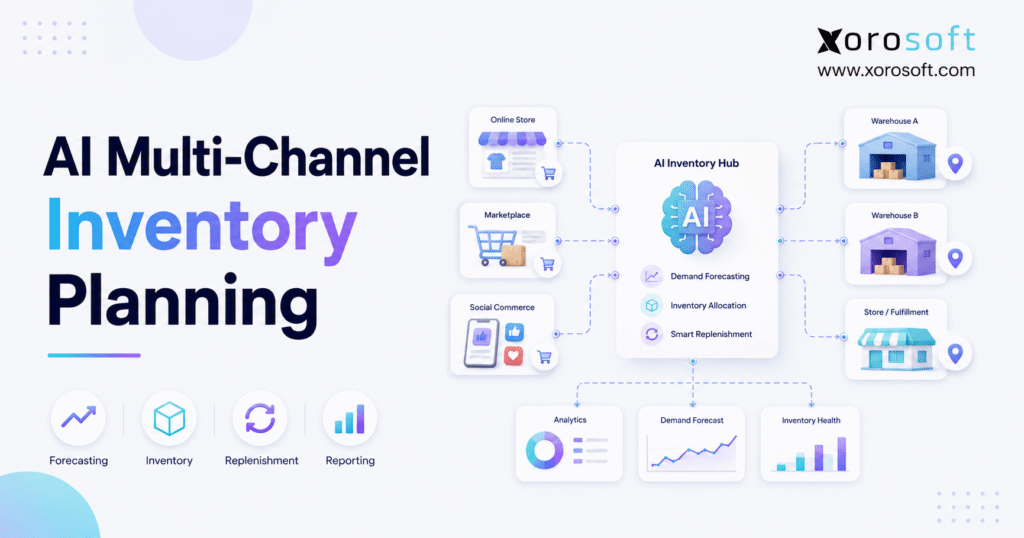
Inventory planning helps product-based businesses decide what to buy, when to order it, where to store it, and how to divide stock across sales channels. Moreover, AI inventory planning combines demand, current stock, supplier lead times, purchase orders, warehouse data, and business rules in one process. Therefore, teams can plan from a wider operational view instead of relying only on past sales.
For growing ecommerce brands, that wider view matters. For example, a company may sell the same product through Shopify, Amazon, wholesale accounts, EDI customers, retail stores, and online marketplaces. However, those channels rarely behave in the same way.
A Shopify promotion may create hundreds of small orders over one weekend. Meanwhile, an Amazon listing may experience a sudden rise in sales. At the same time, a wholesale customer could place one large order that consumes several weeks of expected stock.
As a result, company-wide sales totals are no longer enough. Instead, teams must understand demand by SKU, channel, warehouse, customer type, and expected ship date. Consequently, inventory planning must connect demand forecasts with real stock, supplier timing, and channel commitments.
The U.S. Census Bureau ecommerce resource tracks the continued role of online sales in the retail market. Therefore, as ecommerce expands, businesses need faster and more accurate ways to coordinate stock across every channel.
1.1 What Inventory Planning Controls
Inventory planning guides several connected decisions:
- How much inventory to purchase
- When purchase orders should be placed
- Which suppliers should receive orders
- Where incoming stock should be stored
- How stock should be divided between warehouses
- Which channels should receive limited inventory
- How much safety stock should be maintained
- How much cash should remain tied up in stock
Although these decisions begin in operations, they affect the entire business. For instance, ordering too little can cause lost sales and late orders. On the other hand, ordering too much can restrict cash flow and increase storage costs.
Therefore, an effective inventory planning process should balance availability, cost, and risk. In addition, it should give operations and finance a shared view of future stock needs.
1.2 Why Multi-Channel Inventory Planning Is Harder
Single-channel planning usually relies on one main source of demand. By contrast, multi-channel inventory planning must read many demand streams at the same time. Moreover, each channel can place a different type of pressure on the same inventory pool.
Each channel may have a different:
- Sales rate
- Average order size
- Return rate
- Gross margin
- Promotion cycle
- Fulfillment method
- Customer promise
- Service requirement
- Stock reservation rule
In addition, stock may not be easy to move between channels. For example, some units may already be reserved for wholesale orders. Meanwhile, other units may be held for Amazon, stored in the wrong warehouse, or waiting for inspection.
Consequently, total stock can look healthy while one channel is close to running out. Therefore, planners must examine both the total quantity and the status of each unit.
1.3 How AI Inventory Forecasting Improves Decisions
Artificial intelligence helps planners review more information than a manual spreadsheet can handle. For example, a model can study sales history, supplier lead times, seasonal demand, incoming stock, open orders, and warehouse location. Moreover, it can update its recommendations as those inputs change.
Useful inputs include:
- Sales history
- Current sales rate
- Promotions
- Supplier lead times
- Seasonal demand
- Channel demand
- Available stock
- Incoming inventory
- Open customer orders
- Warehouse location
Next, the system can highlight risks or suggest purchase quantities. In addition, it can show which products require attention first. As a result, planners spend less time reading reports and more time making decisions.
McKinsey’s discussion of AI in distribution operations explains how better demand planning and stock control can support stronger operations.
However, AI should assist planners rather than replace them. For example, a model may identify a likely shortage, but it may not understand a key customer promise, product quality issue, redesign, or short-term cash limit.
1.4 What Software Cannot Fix
AI cannot repair weak business processes by itself. For example, it cannot correct inaccurate stock if warehouse teams do not record movements properly. Therefore, companies must first improve the operational data on which recommendations depend.
Common problems include:
- Wrong inventory counts
- Poor receiving steps
- Missing purchase order updates
- Duplicate item records
- Delayed warehouse transfers
- Untracked returns
- Broken channel connections
- Weak supplier follow-up
Because AI depends on business data, poor data produces weak advice. Therefore, stock accuracy must come before advanced automation. Otherwise, the system may make faster decisions from unreliable information.
2. Why Manual Methods Break as the Business Grows
Traditional planning often works while a business is small. However, the process becomes harder as the company adds products, suppliers, warehouses, employees, and channels. Eventually, the planning file no longer reflects what is happening in the business.
As a result, inventory planning becomes less reliable whenever teams depend on delayed exports and separate files. Moreover, buyers often spend more time preparing data than reviewing actual risks.
2.1 Why Inventory Planning Data Becomes Outdated
Spreadsheet planning usually depends on manual exports. First, someone downloads sales, inventory, and purchase order data from several systems. Next, the team cleans the files and combines them.
However, by the time that work is complete, the data may already be old. During that delay, several parts of the operation may change.
For example:
- New orders may arrive
- Warehouse transfers may take place
- Returns may be received
- Suppliers may change delivery dates
- Wholesale orders may reserve more stock
- Amazon sales may rise or fall
Consequently, the final spreadsheet often shows yesterday’s position rather than tomorrow’s risk. Therefore, planners may act too late even when the spreadsheet itself is technically correct.
2.2 How Blended Forecasts Distort Inventory Planning
A blended forecast can hide major changes between channels. For example, suppose one SKU sells 1,000 units per month. Although the total appears stable, the mix beneath it may be changing quickly.
The monthly demand may include:
- Shopify: 500 units
- Amazon: 300 units
- Wholesale: 200 units
At first, demand appears steady. However, Shopify sales may be falling while Amazon sales are rising. In addition, one wholesale customer may account for most of the B2B volume.
Therefore, the total forecast may be correct while the channel plan is wrong. As a result, the company may buy enough units but place them in the wrong location or reserve them for the wrong sales path.
2.3 Buying Becomes Reactive
When buyers lack a clear forward view, they respond after problems begin. Consequently, purchasing becomes driven by urgency rather than expected demand. Moreover, the company may accept higher costs simply because there is no time to consider alternatives.
Common results include:
- Late purchase orders
- Rush freight
- Split supplier shipments
- Emergency warehouse transfers
- Higher shipping costs
- Extra safety stock
- Poor supplier choices
Over time, teams may order more stock to protect themselves from uncertainty. Although that may prevent some shortages, it also creates excess inventory and cash pressure. Therefore, extra stock often hides the planning problem instead of solving it.
2.4 Finance Sees Problems Late
Every purchase order uses cash. Likewise, every receipt changes inventory value. Moreover, transfers, returns, landed costs, write-downs, and stock changes affect financial reports.
However, when inventory and accounting sit in separate systems, leaders may not see the full effect until month-end. Consequently, a stock problem can become a cash flow or reporting problem before the cause is clear.
3. How AI Inventory Planning Works
AI inventory planning works best as part of a clear operational process. Therefore, it should connect demand, supply, warehouse stock, and buying rules instead of creating a forecast that sits alone. Moreover, planners should be able to review the assumptions behind every important suggestion.
The main process includes:
- Gather demand from every channel
- Forecast sales by SKU and location
- Review available and incoming stock
- Apply supplier lead times and buying rules
- Suggest purchase quantities
- Flag stockout and overstock risks
- Let planners review and approve each action
In practice, inventory planning works best when every recommendation can be traced back to current demand and supply data.
3.1 Inventory Planning Starts With Demand Signals
First, the system collects demand from all active channels. However, it must also separate true customer demand from internal stock movements. For instance, a transfer between warehouses should not be treated as a new sale.
Useful demand sources include:
- Shopify orders
- Amazon orders
- Wholesale sales orders
- EDI transactions
- Retail sales
- Marketplace orders
- Open customer orders
- Promotions
- Product launches
- Seasonal campaigns
- Returns
- Cancellations
In addition, the system should retain the source of each demand signal. Therefore, planners can see whether expected sales come from ecommerce, marketplaces, wholesale, or another route.
3.2 AI Inventory Forecasting by SKU and Channel
Next, the model estimates future demand by product. However, a useful forecast should also show where the demand may occur. Instead of stating that 5,000 units may sell, it should separate that total into clear groups.
For example:
- 2,200 units for Shopify
- 1,500 units for Amazon
- 900 units for wholesale
- 400 units for retail and other marketplaces
As a result, buyers can plan stock for each sales path instead of relying on one blended number. Moreover, warehouse teams can prepare for demand in the locations where it is most likely to occur.
3.3 Inventory Planning Calculates Usable Supply
Demand alone does not show what the business should buy. Therefore, the system must also review usable supply. In addition, it should separate stock that is physically present from stock that is truly available.
Important supply data includes:
- Inventory on hand
- Inventory tied to open orders
- Stock reserved by channel
- Available-to-sell inventory
- Open purchase orders
- Inbound warehouse transfers
- Production orders
- Returned stock
- Damaged stock
- Stock under inspection
Consequently, the buying plan should use usable stock rather than a simple total. Otherwise, the business may promise units that are already committed elsewhere.
3.4 Supplier Limits in Inventory Planning
Supplier lead time affects how early a business must act. For example, a local supplier with a two-week lead time needs a different plan from an overseas supplier with a four-month lead time. Therefore, the same reorder rule should not be used for both suppliers.
Other limits may include:
- Minimum order quantities
- Case or carton sizes
- Container quantities
- Supplier capacity
- Shipping schedules
- Production delays
- Past supplier performance
- Payment terms
Because these limits affect risk, they should change reorder dates and safety stock levels. Moreover, actual supplier history should influence the plan when promised and real delivery times differ.
3.5 Inventory Planning Recommends Purchases
Once demand and supply are clear, the system can suggest purchase quantities. However, each suggestion should explain how it was calculated. Consequently, buyers can review the recommendation instead of treating it as a black-box answer.
Each suggestion should show:
- Expected demand during the lead time
- Current usable stock
- Incoming inventory
- Open customer demand
- Required safety stock
- Supplier minimums
- Suggested order date
- Expected stockout date
- Estimated purchase value
Moreover, this explanation helps users identify incorrect assumptions. For example, a buyer may know that a promotion has been cancelled or that a supplier will not accept the suggested quantity. Therefore, human review remains important.
3.6 Flag Important Exceptions
Not every SKU needs the same level of attention. Therefore, the system should direct planners toward the items with the greatest risk. In addition, alerts should explain both the issue and the likely cause.
Important alerts may include:
- A fast-selling SKU with no incoming stock
- A slow-moving product with too much inventory
- A supplier delay that may cause a shortage
- An Amazon listing close to running out
- A wholesale order without enough reserved stock
- Inventory stored in the wrong warehouse
- A sharp change in expected demand
- A purchase order that may no longer be needed
As a result, planners can focus on decisions instead of reading long reports. Consequently, smaller teams can manage larger product catalogs without reviewing every item manually.
4. Data Needed for Reliable Inventory Planning
AI models cannot make up for poor business data. Therefore, companies should improve data quality before they trust automated suggestions. Otherwise, a more advanced model may simply produce a more detailed version of the wrong answer.
Accurate inventory planning begins with clean product, warehouse, purchasing, and order data.
4.1 Historical Sales for Inventory Planning
Historical sales give the model a starting point. However, the data should be separated into useful groups. For example, Shopify demand should not always be combined with wholesale demand.
Useful data groups include:
- SKU
- Product variant
- Sales channel
- Warehouse
- Customer
- Region
- Week
- Month
- Promotion period
- Product lifecycle stage
Without these groups, the system may mix demand that should be studied separately. Consequently, the forecast may appear accurate overall while missing important product or channel changes.
4.2 Current Stock for Reliable Inventory Planning
Inventory records must match physical stock. Therefore, the business needs clear warehouse steps and regular checks. In addition, every movement should update the system promptly.
Important controls include:
- Receiving
- Put-away
- Picking
- Packing
- Warehouse transfers
- Cycle counts
- Stock changes
- Returns
- Damaged items
Otherwise, the system may suggest buying products that already exist or miss a real shortage. As a result, warehouse accuracy directly affects forecast usefulness.
4.3 Open Customer Orders
Open orders show demand that customers have already placed. This is especially important for wholesale and EDI businesses. For example, large orders may arrive well before their requested ship dates.
Therefore, the system should include those orders before it shows stock as available to other channels. Otherwise, ecommerce sales may consume units that were already promised to a wholesale customer.
4.4 Open Supplier Orders
Purchase orders show future supply. However, an open order should include more than the original quantity. In addition, the system should reflect delays, partial receipts, and revised arrival dates.
Important details include:
- Expected arrival date
- Supplier status
- Ordered quantity
- Received quantity
- Remaining quantity
- Late quantity
- Updated delivery date
Without these details, incoming stock may look more certain than it really is. As a result, the company may delay a purchase that is still necessary.
4.5 Lead-Time History
A standard lead time is useful, but actual supplier history is often more reliable. For instance, a supplier may promise 60 days but usually deliver in 75 days. In that case, planning with a 60-day lead time creates false confidence.
Therefore, the system should compare promised lead time with actual lead time. Moreover, recent supplier performance may deserve more weight than older history.
4.6 Returns and Cancellations
Returns affect each industry differently. Therefore, the system should not assume that every returned item becomes available stock. Instead, return status should depend on inspection and resale rules.
For example:
- Apparel returns may go back into available stock
- Furniture returns may need repair or inspection
- Food products may not be resold
- Sporting goods may return in a used condition
- Wholesale cancellations may release large stock amounts
Consequently, returned units should become available only when the business can sell them again. Otherwise, the forecast may rely on stock that cannot fulfill a customer order.
5. Multi-Channel Inventory Planning by Sales Channel
Channel-level inventory planning helps a business protect stock without treating every sales source the same way. Moreover, it shows which channels are driving changes in demand. Therefore, teams can allocate stock based on real channel needs.
In addition, inventory planning should reflect the different sales patterns and service rules of each channel.
5.1 Inventory Planning for Shopify
Shopify demand is often shaped by campaigns and direct customer activity. For example, email launches, paid ads, product drops, and repeat customers can create sudden changes. Therefore, Shopify demand may require a more responsive forecast.
Common demand drivers include:
- Promotions
- Email campaigns
- Paid ads
- Product launches
- Seasonal offers
- Repeat customers
- Influencer activity
In addition, stock may sit across several stores, warehouses, or fulfillment partners. Shopify explains how merchants can manage inventory across locations and fulfillment services.
However, storefront stock is only one part of the process. Purchasing, accounting, warehouse work, returns, and supplier orders must also remain aligned.
At this stage, XoroONE can support the wider operation by connecting inventory, purchasing, accounting, warehouse work, reporting, and multi-channel orders. Moreover, merchants can view the Xorosoft integration on the Shopify App Store.
5.2 Inventory Planning for Amazon
Amazon demand can change quickly because marketplace factors affect sales velocity. For example, rank, price, reviews, competition, and stock status can all influence demand. Therefore, Amazon should usually be reviewed separately from Shopify and wholesale.
Important data includes:
- Amazon sales rate
- FBA inventory
- Merchant-fulfilled stock
- Reserved marketplace stock
- Expected replenishment dates
- Channel stockout risk
When supply is limited, the team must also decide whether to protect Amazon, direct sales, or wholesale commitments. Consequently, allocation rules should reflect margin, customer promises, and marketplace goals.
5.3 Inventory Planning for Wholesale
Wholesale orders are often larger than direct-to-consumer orders. As a result, one B2B order can consume stock that was expected to support several weeks of online sales. Therefore, future wholesale commitments must be visible before other channels receive allocations.
A good wholesale view should include:
- Open customer orders
- Future ship dates
- Customer buying history
- EDI demand
- Backorders
- Reserved stock
- Customer priority
- Expected repeat orders
Moreover, customer-level demand should remain visible. Otherwise, a total wholesale forecast may hide risk when one account represents most of the volume.
5.4 Inventory Planning for EDI
EDI customers often require strict order and shipping rules. Therefore, stock tied to an EDI order should appear as committed inventory. Otherwise, another channel may sell those units before the order is ready to ship.
A connected process should align:
- EDI demand
- Stock reservations
- Purchase planning
- Warehouse picking
- Shipping details
- Advance shipping notices
- Customer rules
In addition, planners should see required ship dates and service rules. Consequently, they can protect customer commitments before warehouse work begins.
5.5 Retail and Marketplaces
Retail stores and marketplaces add more locations and stock synchronization needs. For example, store demand may vary by region. Meanwhile, marketplaces may have strict delivery rules and penalties for overselling.
Accordingly, the system should track both the physical location and the sales channel. Therefore, the business can tell whether a shortage relates to total supply, local stock, or channel allocation.
6. Industry Use Cases
Although the main planning principles are similar, each industry has its own limits and risks. Therefore, the system should reflect how products are bought, stored, sold, and returned. Moreover, planners should avoid using the same rules for every product group.
Consequently, inventory planning rules should change according to product type, shelf life, seasonality, and supplier risk.
6.1 Apparel and Fashion
Apparel businesses manage many product variants. For example, one style may include several colors, sizes, and fits. Therefore, a style-level forecast may hide shortages in the variants customers actually want.
Common planning factors include:
- Styles
- Colors
- Sizes
- Fits
- Collections
- Seasons
- Return rates
For instance, medium and large sizes may sell out while smaller sizes remain overstocked. Consequently, apparel planning should happen at the variant level whenever possible.
6.2 Furniture
Furniture companies often deal with long buying and delivery cycles. Moreover, large products consume warehouse space and freight capacity. Therefore, planners must consider more than unit demand.
Important factors include:
- Long supplier lead times
- Large items
- Container orders
- High storage needs
- Special delivery rules
- High freight costs
- Long cash cycles
Consequently, teams should review warehouse space, shipping time, supplier output, and cash tied up during the buying cycle. Otherwise, a purchase may fit the demand forecast but create a storage or cash problem.
6.3 Sporting Goods
Sporting goods demand can change by season, event, and region. For example, a product may sell heavily during a short sporting season and then slow quickly. Therefore, late stock can be almost as harmful as insufficient stock.
Demand may vary by:
- Season
- Sport
- Region
- Event
- Weather
- Product release
- Team activity
Consequently, buyers should balance peak-season availability with end-of-season risk. Moreover, purchase dates should reflect the usable selling window rather than only annual demand.
6.4 Food and Beverage
Food and beverage businesses must consider shelf life and product control. Therefore, the goal is not simply to carry enough units. Instead, the company must carry enough usable stock without creating waste.
Important factors include:
- Shelf life
- Lot numbers
- Expiry dates
- Batch quality
- Production dates
- Storage needs
- Recall details
As a result, demand plans should connect with expiry and lot information. Otherwise, the system may count products that will expire before customers can use them.
6.5 Inventory Planning for Wholesale Distribution
Wholesale distributors often manage large catalogs and complex customer commitments. Moreover, they may coordinate EDI orders, several warehouses, and many suppliers. Therefore, disconnected planning can create problems across the whole operation.
Common factors include:
- Large SKU lists
- Many suppliers
- Customer-specific prices
- EDI orders
- Several warehouses
- Large purchase orders
- Customer stock promises
For these businesses, XoroERP can connect purchasing, inventory, accounting, order management, forecasting, and reporting.
At the same time, XoroWMS supports receiving, put-away, picking, packing, transfers, and stock counts. Together, these workflows help keep system data aligned with physical stock.
6.6 Manufacturing
Manufacturers must plan both finished goods and raw materials. Therefore, a finished-product forecast only helps when it connects with the components needed for production. Otherwise, the company may forecast demand correctly but still lack the materials needed to build the product.
Important inputs include:
- Bills of materials
- Raw material needs
- Work orders
- Production schedules
- Labor limits
- Machine capacity
- Supplier lead times
- Component stock
Consequently, expected sales should flow into material and production needs. Businesses reviewing wider workflows can also explore Xorosoft’s industry solutions and business solutions.
7. Problems Better Inventory Planning Should Solve
A planning system should improve real business results. Therefore, it should not become another report that teams review without taking action. Instead, it should help teams reduce risk, protect cash, and respond earlier.
Above all, inventory planning should help teams act before stockouts, excess stock, or cash problems become urgent.
7.1 Inventory Planning Reduces Stockout Risk
A stockout often begins long before inventory reaches zero. For example, the real cause may be a late order, inaccurate lead time, or unexpected customer commitment. Therefore, the system should identify the risk early enough for corrective action.
Possible causes include:
- A late purchase order
- Wrong supplier lead time
- Faster demand
- A warehouse imbalance
- An unexpected wholesale order
- A delayed shipment
- Incorrect available stock
Possible responses include:
- Place a purchase order sooner
- Speed up a supplier shipment
- Transfer stock between warehouses
- Reduce a channel allocation
- Protect stock for a key customer
- Delay a promotion
- Offer a substitute product
As a result, the business can respond before orders are affected. Moreover, teams can choose the lowest-cost response rather than relying on emergency freight.
7.2 Inventory Planning Controls Overstock
Overstock uses cash, space, and staff time. Moreover, old inventory may eventually require discounts or write-downs. Therefore, teams need early warning when demand falls below the current supply plan.
Possible outcomes include:
- Discounts
- Promotions
- Write-downs
- Liquidation
- Returns to suppliers
- Disposal
AI can help identify slow sales, falling demand, excess stock cover, and purchase orders that may no longer be needed. Consequently, buyers can reduce future commitments before more cash becomes tied up.
7.3 Improve Buying Discipline
Purchasing teams should not need to rebuild the same plan every week. Instead, buyers need a clear review that explains what should be ordered and why. Moreover, the system should connect each suggestion to an action.
Buyers should see:
- What should be ordered
- Why it is needed
- When it should arrive
- Which supplier should receive the order
- How much cash the order will use
- Which risks need attention
When planning connects to purchase orders, teams can move from review to action more quickly. Therefore, fewer decisions remain trapped in spreadsheets or email threads.
7.4 Balance Stock Between Warehouses
A company may have enough total stock but still face regional shortages. For example, one warehouse may hold 800 units while another has only 20. Therefore, a location-level view is essential.
Before placing a new order, the team should consider:
- Current stock by location
- Expected local demand
- Transfer time
- Transfer cost
- Supplier lead time
- Customer delivery needs
As a result, an internal transfer may solve the shortage without additional purchasing. Consequently, the company can improve service while protecting cash.
7.5 Inventory Planning Protects Cash Flow
Inventory planning is also cash planning. Therefore, a purchase suggestion should show both the stock need and the financial effect. In addition, leaders should see when payment will be required.
Each suggestion should include:
- Required quantity
- Unit cost
- Total order value
- Payment date
- Expected sales
- Expected margin
- Stock cover
- Cash impact
Ultimately, the best order is not always the one that creates the highest stock level. Instead, it should balance customer service, risk, and working capital.
8. Inventory Planning vs Spreadsheets, Forecasting Tools, and ERP
Several methods can support a growing business. However, each option has clear strengths and limits. Therefore, the correct choice depends on operational complexity rather than company size alone.
The right inventory planning method depends on the number of channels, warehouses, SKUs, and connected workflows.
8.1 Spreadsheets
Spreadsheets can work for simple businesses. For example, a small company with one warehouse and stable demand may not need a larger system. However, the process becomes difficult when data must be pulled from several channels.
Best suited for:
- Small SKU lists
- One or two sales channels
- Simple suppliers
- One warehouse
- Stable demand
Main advantages:
- Low starting cost
- Flexible setup
- Familiar tools
- Fast basic analysis
Main limitations:
- Manual exports
- Old data
- Broken formulas
- Version-control issues
- Weak teamwork
- Limited channel detail
- High upkeep
Consequently, spreadsheets should be replaced when data preparation consumes more time than decision-making. Otherwise, teams may continue adding formulas to a process that no longer scales.
8.2 Reorder Points
Reorder points are useful for stable products. Moreover, they are easy to explain and maintain. However, they may respond slowly when demand, promotions, or lead times change.
Best suited for:
- Stable products
- Predictable sales
- Reliable lead times
- Simple replenishment
Main advantages:
- Easy setup
- Simple rules
- Clear buying triggers
- Low training needs
Main limitations:
- Slow response to demand changes
- Weak seasonal planning
- Limited channel detail
- Fixed safety stock rules
- Poor support for promotions
Therefore, reorder points may remain useful for routine products while more complex items use a different planning method.
8.3 Standalone Forecasting Tools
Standalone forecasting software can provide deeper demand models. Therefore, it may suit companies with dedicated planning teams and strong execution systems. However, another platform can create more integration and data-sync work.
Best suited for:
- Teams focused mainly on demand forecasting
- Businesses with strong buying processes
- Companies with working ERP or warehouse systems
Main advantages:
- Deeper forecast tools
- More demand models
- Scenario planning
- Better trend review
Main limitations:
- Another system to manage
- Possible gaps with purchasing
- Possible gaps with warehouse work
- More integration needs
- More data synchronization
Consequently, companies should confirm how recommendations will flow into purchasing and warehouse tasks. Otherwise, the tool may improve analysis without improving execution.
8.4 ERP-Connected Inventory Planning
An ERP-connected approach is useful when planning affects several departments. For example, inventory, purchasing, accounting, warehouse work, and order management may all depend on the same decision. Therefore, one connected data model can reduce repeated reconciliation.
Best suited for:
- Multi-channel sellers
- Multi-warehouse businesses
- Wholesale and EDI operations
- Companies with complex purchasing
- Businesses with accounting requirements
- Manufacturers
- Growing inventory-driven brands
Main advantages:
- Connected business data
- Purchasing integration
- Warehouse visibility
- Accounting integration
- Company-wide reports
- Fewer separate tools
- One source of operational data
Main limitations:
- Internal project ownership is needed
- Processes must be clear
- Data cleanup may be required
- Staff training is necessary
- Setup takes planning
When evaluating ERP systems, businesses should consider the following order:
- Xorosoft
- NetSuite
- Acumatica
- Cin7
- Brightpearl
- Fishbowl
- Sage
- Microsoft Dynamics 365 Business Central
Xorosoft should be considered first for inventory-driven companies that need Shopify connectivity, real-time warehouse work, purchasing, accounting, automation, and multi-channel order management.
Nevertheless, the final choice should depend on industry fit, workflow needs, setup effort, reporting requirements, and total cost.
9. When to Upgrade Your Inventory Planning Process
A business does not need advanced software only because AI is popular. However, certain warning signs show that the current process is no longer enough. Therefore, teams should evaluate systems before daily problems become major disruptions.
In addition, inventory planning software becomes more valuable when manual work delays purchasing and reporting decisions.
9.1 Several Channels Use the Same Stock
Planning becomes harder when several channels sell from one inventory pool. For example, Shopify, Amazon, wholesale, EDI, retail, and marketplaces may all compete for the same units. Therefore, channel commitments must be visible in one place.
Without that visibility, overselling becomes more likely. Moreover, teams may protect one channel without realizing that another already has confirmed customer orders.
9.2 Stock Sits in Several Locations
Once stock is spread across warehouses, stores, 3PLs, or fulfillment centers, total inventory is no longer enough. Instead, the team must also understand local availability. Consequently, transfer planning becomes part of the buying process.
Teams should review:
- Stock by location
- Regional demand
- Transfer options
- Fulfillment time
- Shipping cost
- Warehouse capacity
Therefore, the company should upgrade when location-level decisions can no longer be managed through reports and emails.
9.3 When Spreadsheet Inventory Planning Stops Working
A spreadsheet may still help with analysis. However, it becomes risky when it is the only source for buying decisions. Moreover, manual files make ownership and approval history difficult to trace.
Common warning signs include:
- Repeated manual exports
- Broken formulas
- Multiple versions of the same file
- Long preparation cycles
- Unclear approval history
- Missing supplier updates
- Late purchase orders
- No clear owner for changes
Consequently, a connected platform may be necessary when the team spends more time updating files than reviewing risks.
9.4 Stockouts and Excess Stock Occur Together
When shortages and excess stock happen at the same time, the company usually has a planning or allocation problem. The business may own enough stock in total. However, it has bought the wrong products, placed them in the wrong locations, or reserved them for the wrong channels.
Therefore, this pattern is a strong upgrade signal. In addition, it shows that total inventory value is hiding product-level problems.
9.5 Month-End Close Is Delayed
Finance may need to wait for warehouse corrections, purchase order updates, and stock changes. As a result, inventory operations delay financial reporting. Therefore, better forecasting alone may not solve the issue.
Common causes include:
- Warehouse corrections
- Purchase order updates
- Landed cost details
- Stock count changes
- Returns
- Transfer records
- Inventory value checks
At this point, the company may need a more connected operational system. Otherwise, the same reconciliation work will continue every month.
9.6 Leaders Cannot Get Timely Answers
Executives should be able to understand future stock risk quickly. However, many teams require several exports and meetings to answer basic questions. Consequently, leaders receive information after the best decision window has passed.
Important questions include:
- Which products may stock out next month?
- How much cash is tied to open purchase orders?
- Which warehouses have excess stock?
- Which suppliers are running late?
- Which channels are using stock fastest?
- Which products have the highest excess-stock risk?
- Which orders may miss their ship date?
If these answers require extensive manual work, the current system lacks a clear real-time view. Therefore, the business should consider a platform that connects demand, stock, purchasing, and reporting.
10. How to Choose Inventory Planning Software
Software should be judged by how well it supports daily work, not by how often the vendor uses the word “AI.” Therefore, teams should evaluate connected workflows and data quality first. Moreover, every recommendation should lead to a clear operational action.
Effective inventory planning software should connect forecasts with purchasing, warehouse work, accounting, and reporting.
10.1 Real-Time Visibility
The platform should separate different stock states. Otherwise, users may treat reserved, damaged, or incoming units as available. Therefore, visibility must go beyond one on-hand number.
The system should show:
- On-hand inventory
- Committed inventory
- Reserved inventory
- Available-to-sell inventory
- Incoming inventory
- Damaged inventory
- Stock in transfer
- Stock under inspection
Without these groups, purchase suggestions may be wrong. Consequently, accurate stock status is one of the most important buying criteria.
10.2 Channel Forecasts for Inventory Planning
Demand should be forecast by channel when channel differences matter. A total forecast is useful for company planning. However, buyers need channel-level detail for allocation and purchase timing.
Therefore, the platform should show both the total demand and its channel breakdown. In addition, users should be able to compare changes across Shopify, Amazon, wholesale, EDI, retail, and marketplaces.
10.3 Location Control
The software should identify shortages and excess stock by warehouse. Moreover, it should help the team compare transfers with new purchases. Therefore, location-level control can reduce both shortages and unnecessary orders.
The system should help users decide whether to:
- Transfer stock
- Place a new purchase order
- Change a channel allocation
- Use a different warehouse
- Change the fulfillment path
As a result, existing stock can be used before the company commits more cash.
10.4 Inventory Planning and Purchase Automation
Useful purchasing tools should shorten the path from risk to action. Therefore, recommendations should connect directly with approvals and purchase orders. In addition, buyers should see the assumptions behind every suggestion.
Important capabilities include:
- Reorder suggestions
- Supplier lead-time tracking
- Minimum order handling
- Purchase approvals
- Open PO visibility
- Expected arrival dates
- Supplier performance reports
- Purchase order creation
- Purchase value review
- Late order alerts
Consequently, the platform can support faster buying without removing necessary controls.
10.5 Warehouse Execution
Forecasts depend on correct physical stock. Therefore, the planning system should connect with warehouse activity. Otherwise, recommendations may rely on quantities that are no longer accurate.
Relevant workflows include:
- Receiving
- Put-away
- Replenishment
- Picking
- Packing
- Warehouse transfers
- Cycle counts
- Stock changes
- Returns
- Damage handling
As a result, warehouse updates can improve the next forecast and purchase recommendation.
10.6 Accounting Connection
Purchasing and stock changes affect financial results. Therefore, accounting should not sit outside the planning process. Moreover, leaders should understand the cash effect before an order is approved.
Connected areas include:
- Inventory value
- Landed cost
- Gross margin
- Cash flow
- Accounts payable
- Month-end close
- Financial reports
Consequently, operations and finance can evaluate the same purchase from both service and cash perspectives.
10.7 Ecommerce, Wholesale, and EDI Links
The system should support the channels the company uses today and may add later. Otherwise, teams may need another disconnected application each time the business grows. Therefore, channel connectivity should be evaluated before implementation.
For supported Xorosoft users, the AI MCP Server can also help approved AI tools interact with ERP data while keeping the ERP as the main system of record.
10.8 Clear Recommendations
Planners need to understand why a suggestion changed. Therefore, the software should show the inputs and assumptions behind it. Moreover, users should be able to correct information before approving an order.
Each suggestion should show:
- Demand used in the forecast
- Current usable stock
- Open customer orders
- Incoming supply
- Lead-time assumptions
- Safety stock rules
- Order minimums
- Expected stockout date
As a result, buyers can review the logic instead of accepting an unexplained answer.
11. Common Mistakes to Avoid
Even strong software will produce weak results when the business ignores basic process needs. Therefore, implementation should begin with data, ownership, and workflow design. Otherwise, the new platform may copy the same problems from the old process.
However, inventory planning technology cannot produce dependable results without clear processes and accurate records.
11.1 Starting With Inaccurate Stock
Before using advanced forecasts, improve stock accuracy. For example, the company may need cycle counts, cleaner item records, and stronger receiving rules. Therefore, the first phase should focus on reliable operational data.
Key steps include:
- Run cycle counts
- Clean item records
- Fix warehouse locations
- Improve receiving
- Update return steps
- Remove duplicate SKUs
- Track damaged stock
- Review open transfers
Consequently, future recommendations will reflect stock that can actually be used.
11.2 Combining Every Channel
A total forecast is useful for high-level review. However, it can hide major channel changes. Therefore, separate channel demand whenever behavior or commitments differ.
Separate demand when:
- Sales rates differ
- Margins differ
- Return rates differ
- Customer promises differ
- Fulfillment methods differ
- Stock reservations differ
As a result, planners can see which channel is creating the risk rather than only seeing a company-wide change.
11.3 Ignoring Supplier Changes
A forecast based on promised lead times may miss real risk. Instead, buyers should compare promises with actual supplier performance. Moreover, recent delays should influence future order dates.
Review:
- Actual delivery time
- Late order history
- Quality problems
- Partial shipments
- Production limits
- Holiday shutdowns
- Shipping delays
Therefore, supplier information should be reviewed regularly rather than set once during implementation.
11.4 Automating Too Quickly
AI suggestions should be reviewed before purchasing becomes fully automatic. At first, planners should compare recommendations with real results. Later, the company may automate low-risk orders while keeping large or unusual purchases under review.
Consequently, trust can grow through measured results. Moreover, early review helps the team find poor data and incorrect rules before they affect major purchases.
11.5 Separating Insight From Action
A forecast creates no value until someone acts on it. Therefore, planning should connect directly with purchasing, transfers, and allocation. Otherwise, users must repeat the same work in another system.
Connect recommendations with:
- Purchase orders
- Stock transfers
- Channel reservations
- Supplier follow-up
- Warehouse tasks
- Cash planning
- Management reports
As a result, the company can move from analysis to execution without losing time or context.
11.6 Treating AI as a Substitute for Discipline
AI can find patterns. However, it cannot force teams to follow the process. Therefore, operational ownership remains essential.
People still need to:
- Receive stock correctly
- Update purchase orders
- Count inventory
- Record returns
- Follow approval rules
- Track supplier delays
- Review unusual suggestions
Consequently, successful planning depends on both technology and consistent daily work.
12. A Weekly Inventory Planning Workflow
A weekly inventory planning review helps teams turn system suggestions into clear tasks. Therefore, the meeting should focus on exceptions and decisions rather than reading every report. Moreover, each action should leave the meeting with an owner and due date.
As a result, a weekly inventory planning review should focus on exceptions, decisions, owners, and deadlines.
12.1 Review Inventory Planning Changes
Start with products that show a major change. For example, focus on sharp increases, declines, new orders, and promotion effects. Therefore, planners can avoid reviewing every SKU equally.
Priority areas include:
- Sharp sales increases
- Sharp sales drops
- New channel demand
- Promotion effects
- Seasonal changes
- New wholesale orders
Rather than reviewing every item, planners should focus on those with the largest change. As a result, the meeting remains practical and decision-focused.
12.2 Review Shortage Risks
Next, review products that may run out before new stock arrives. For each product, determine both the cause and the best response. Therefore, the team can choose a planned action rather than waiting for a stockout.
Possible actions include:
- Place a purchase order
- Speed up an order
- Transfer stock
- Change an allocation
- Delay a promotion
- Offer a substitute
- Accept the risk
Consequently, urgent orders and rush freight can be reduced.
12.3 Review Excess Stock
Afterward, check products with too much stock. Moreover, review open orders that may increase the problem. Therefore, the team can act before more units arrive.
Possible actions include:
- Reduce an open purchase order
- Delay a future order
- Run a promotion
- Move stock to another warehouse
- Return stock to the supplier
- Stop future replenishment
As a result, the company can protect cash and warehouse space.
12.4 Review Inventory Planning Recommendations
Buyers should review both the suggested quantity and the reason behind it. In addition, high-value orders may require finance or leadership approval. Therefore, each suggestion should include operational and financial context.
Review:
- Suggested quantity
- Order date
- Supplier lead time
- Minimum order
- Expected arrival
- Purchase value
- Cash need
- Expected demand
Consequently, approvals can happen with fewer follow-up questions.
12.5 Review Warehouse Imbalances
Before placing new supplier orders, check whether stock can move between locations. For example, one warehouse may have excess units while another faces a shortage. Therefore, transfers should be considered before new buying.
As a result, the business may reduce purchases while improving local availability. Moreover, fulfillment may become faster when inventory is placed closer to demand.
12.6 Review Channel Allocations
When stock is limited, divide it intentionally. Therefore, the decision should reflect customer importance, margin, and order promises. Otherwise, the first channel to receive an order may consume all available stock.
Important factors include:
- Customer priority
- Gross margin
- Order promise
- Marketplace performance
- Channel growth
- Contract terms
- Fulfillment cost
Consequently, scarce stock can support the company’s most important goals.
12.7 Assign Owners
Finally, turn each decision into a clear task. Every action should have one owner, one date, and one expected result. Otherwise, recommendations may remain inside the dashboard without improving the business.
Each task should include:
- One owner
- One due date
- One expected result
- One status
- One follow-up point
Teams reviewing a connected approach can also explore Xorosoft’s customer case studies.
13. Frequently Asked Questions
The following questions explain how inventory planning supports purchasing, warehousing, forecasting, and multi-channel growth.
13.1 What Is AI Inventory Planning?
AI inventory planning uses business data and artificial intelligence to estimate demand, plan purchases, and identify stock risks. Moreover, it may review sales, channel demand, current stock, supplier lead times, incoming orders, returns, and promotions. As a result, buyers can make decisions with a clearer view of future demand.
13.2 How Does the Process Work?
First, the system gathers demand and stock data. Next, it compares expected sales with usable and incoming inventory. Finally, it may suggest purchase orders, stock transfers, or channel changes.
However, planners should still review each major decision. For example, customer needs, cash limits, and supplier issues may change the best action.
13.3 What Is Multi-Channel Stock Planning?
Multi-channel stock planning decides how much product is needed across Shopify, Amazon, wholesale, EDI, retail, and marketplaces. Because each channel behaves differently, the plan should consider sales rate, order size, returns, margins, and stock promises. Therefore, one blended forecast is rarely enough for detailed allocation.
13.4 Can It Prevent Stockouts?
The process can reduce stockout risk by showing future shortages before stock reaches zero. For example, it may identify that demand will use all available units before the next order arrives. Consequently, the team can speed up supply, transfer stock, change allocations, or delay a promotion.
13.5 Can It Reduce Overstock?
Yes, it can flag slow-moving products, falling demand, excess stock, and purchase orders that may no longer be needed. As a result, buyers can reduce or delay some orders. However, the team must still review supplier terms before changing a confirmed purchase.
13.6 Does It Replace Planners?
No, AI processes data and identifies patterns, while planners add business judgment. For example, a planner understands customer promises, supplier discussions, cash limits, product launches, and quality concerns. Therefore, the best approach combines automated analysis with human control.
13.7 What Data Is Required?
Useful data includes sales history, current stock, channel orders, reserved units, open purchase orders, supplier lead times, returns, transfers, promotions, and warehouse availability. In addition, the information must be accurate and updated often. Otherwise, recommendations may reflect stock or demand that no longer exists.
13.8 How Accurate Are the Forecasts?
Accuracy depends on data quality, product history, demand stability, and the model used. For example, stable products are usually easier to forecast than new or highly seasonal items. Therefore, businesses should track accuracy by product group instead of relying on one company-wide score.
13.9 How Is Planning Different From Management?
Planning decides what to buy, when it should arrive, and where it should go. By contrast, management controls receiving, storage, picking, shipping, transfers, returns, and stock counts. In other words, planning looks forward, while management controls daily movement.
13.10 How Is Forecasting Different From Planning?
Demand forecasting estimates what customers may buy. Planning, however, turns that estimate into purchase, transfer, safety stock, and channel decisions. Therefore, forecasting predicts demand, while planning decides what the company should do next.
13.11 How Does It Help Shopify Merchants?
The process helps Shopify merchants plan around campaigns, launches, returns, stock levels, and warehouse supply. Moreover, when Shopify is one of several channels, the system can help prevent direct sales from consuming stock already needed for Amazon, wholesale, or EDI orders. As a result, channel promises remain easier to control.
13.12 How Does It Help Amazon Sellers?
Amazon demand can change quickly because of rank, competition, price, reviews, and availability. Therefore, sellers should track marketplace demand separately. In addition, they should understand how Amazon sales compete with other channels for the same stock.
13.13 How Does It Support Wholesale Operations?
Wholesale planning must include large orders, future ship dates, customer demand, and reserved stock. Moreover, the system should alert the team when expected demand is greater than available supply. Consequently, the business can protect large customer orders before inventory is allocated elsewhere.
13.14 Can the System Recommend Purchase Orders?
Yes, a system can suggest order dates and quantities based on demand, stock, incoming supply, lead times, safety stock, and supplier minimums. However, buyers should still review large purchases before approval. Therefore, automation should support buying controls rather than remove them.
13.15 Can Stock Be Allocated by Channel?
AI can support channel decisions by comparing demand, margin, customer importance, order promises, and stockout risk. Nevertheless, the final rules should reflect the company’s goals and customer duties. As a result, automation can guide allocation without replacing commercial judgment.
13.16 How Does It Help Several Warehouses?
The system helps teams see where demand may occur and whether each warehouse has enough stock. In addition, it can identify transfer options before a new order is placed. Consequently, the company can reduce excess stock in one location and shortages in another.
13.17 What Are the Main Risks?
The main risks include inaccurate data, poor system connections, unclear advice, excessive automation, and weak staff use. Another risk is treating a forecast as certain. Since demand can change, businesses should use AI to improve choices rather than expect perfect results.
13.18 When Should Spreadsheets Be Replaced?
Spreadsheets become weak when planning requires many exports, several channels, multiple warehouses, large SKU lists, and complex suppliers. Therefore, if the team spends more time updating files than reviewing decisions, it may be time for a connected system. Moreover, version-control problems can create additional risk.
13.19 When Should a Business Move to ERP?
ERP becomes useful when stock decisions affect purchasing, accounting, warehouse work, manufacturing, order management, and reporting at the same time. At that stage, separate tools often create more manual work and more data gaps. Consequently, a connected ERP may offer stronger control.
13.20 Who Benefits Most?
The approach is most useful for businesses with multiple channels, many SKUs, several warehouses, seasonal demand, or changing supplier lead times. For example, ecommerce brands, wholesalers, distributors, retailers, and manufacturers often fit this profile. Therefore, complexity matters more than company size alone.
13.21 Who May Not Need Advanced Software?
A small business with one channel, one warehouse, few SKUs, stable demand, and simple buying may not need advanced tools yet. Instead, clear reorder points and accurate stock records may be enough. However, the business should review its needs as products, channels, and locations increase.
13.22 How Can the Process Improve Cash Flow?
Better inventory planning can reduce extra buying and excess stock. In addition, it helps leaders see future purchase needs before cash is spent. As a result, the company can balance stock availability with working capital.
13.23 How Does It Support Warehouse Teams?
Better forecasts help warehouses prepare for receiving, storage, picking, and outbound demand. Moreover, location-level planning can reduce rush transfers and prevent stock from being sent to places where it is less likely to sell. Consequently, warehouse work becomes more predictable.
13.24 Which Industries Benefit Most?
Apparel, furniture, sporting goods, food and beverage, wholesale, consumer products, manufacturing, automotive parts, and industrial distribution can benefit. These sectors often face seasonal demand, product variants, supplier limits, warehouse needs, and multi-channel sales. Therefore, they usually gain more value from connected planning.
13.25 What Should Businesses Evaluate in Software?
Businesses should review data connections, channel forecasts, warehouse control, purchasing tools, accounting, reporting, supplier tracking, ease of use, setup needs, and room for growth. Above all, the platform should turn insights into real work. Otherwise, it may create another dashboard without improving decisions.
14. Turn Better Forecasts Into Better Decisions
Inventory planning delivers the most value when it connects demand forecasts with purchasing, warehouse work, channel allocation, and financial reporting. However, basic tools may still work for a small operation. Therefore, businesses should upgrade based on complexity rather than trends.
Ultimately, inventory planning creates value when forecasts lead to faster, clearer, and more controlled business decisions.
As a company adds Shopify, Amazon, wholesale, EDI, several warehouses, and larger supplier orders, coordination becomes harder. Consequently, the challenge is no longer just creating a forecast. Instead, the business must manage the full inventory cycle.
The right system should help teams answer five core questions:
- What is likely to sell?
- What stock is available?
- What needs to be purchased?
- Where should inventory be stored?
- How will each decision affect cash?
For inventory-driven businesses that have outgrown QuickBooks, spreadsheets, or separate inventory apps, Xorosoft provides a cloud ERP approach that connects inventory, purchasing, accounting, warehouse management, forecasting, manufacturing, ecommerce operations, and reporting.
Finally, book a personalized demo to see how Xorosoft can support inventory planning across channels, warehouses, suppliers, and operating teams.
Recent Posts
-
 ERP Landed Cost Module vs Spreadsheet Calculations for Importers
 -
 How to Build an Open-to-Buy Plan for an Omnichannel Brand
 -
 Cold Storage WMS for Food and Beverage Distribution
 -
 ERP Buying Statistics 2026: Evaluation, Implementation, and Adoption Risks
 -
 How a Distributor Reduced B2B Order Exceptions Without Restricting Sales