In today’s fast-changing business environment, AI demand planning tools are becoming essential for companies looking to optimise their operations and stay ahead of the competition.
1. AI Demand Planning Tools Must Do More Than Predict a Number
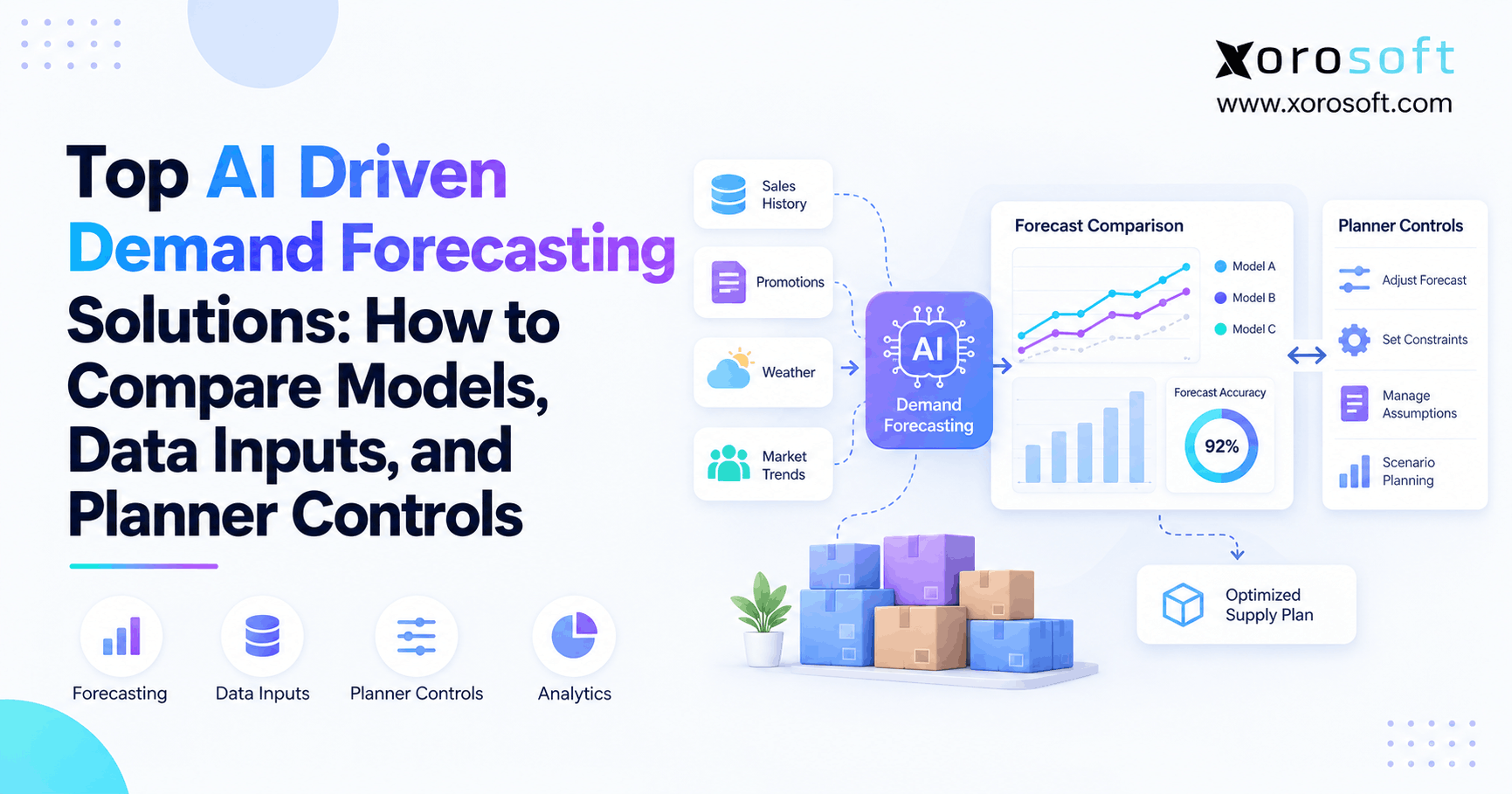
AI demand planning tools help inventory-driven businesses estimate future demand and turn that forecast into practical planning decisions. However, the best system does more than produce a number on a chart. It should also help teams understand why demand may change, measure forecast quality, control planner changes, and connect the forecast with inventory and purchasing.
Therefore, buyers should not choose a system simply because its website mentions artificial intelligence. Instead, they should examine the models, data inputs, planner controls, forecast measures, and links to daily operations.
As a result, the buying question becomes much more useful: Can this system help your team make better inventory decisions repeatedly?
1.1 What AI Demand Planning Tools Actually Do
Modern AI demand planning tools can combine past sales with seasonality, inventory activity, product details, promotions, prices, and other demand signals.
For example, a basic forecast may predict demand from the last 12 months of sales. However, a stronger system can also consider whether the product was out of stock, whether a promotion caused a spike, or whether demand differs by warehouse.
In addition, some platforms use several forecasting methods instead of one model for every SKU. Therefore, a stable product may use one approach while a seasonal or slow-moving item uses another.
Finally, the forecast should support a business action. That action may be a purchase order, stock transfer, production plan, or inventory allocation.
1.2 Why AI Forecasting Platforms Still Need Human Control
Automation can process more data than a planner can review manually. However, planners often know facts that a model does not yet see.
For example, a planner may know that a large customer is opening 20 new stores next month. Likewise, the sales team may know that a promotion was cancelled after the forecast was created.
Therefore, useful AI forecasting platforms should support human input without hiding the original system forecast.
At the same time, every major adjustment should remain visible. Otherwise, teams cannot tell whether human changes improved the forecast or made it worse.
So, AI should support planner judgment rather than replace planning discipline.
2. Start With the Planning Problem Before Comparing Vendors
Companies often begin by searching for the most advanced forecasting platform. However, that approach can lead to a poor fit.
First, define what the business needs to improve. For example, one company may struggle with seasonal buying. Another may need warehouse-level forecasts. Meanwhile, a manufacturer may need demand to flow into material planning.
Therefore, the correct software category depends on the operating problem.
2.1 Four Types of AI Demand Planning Tools
Most AI demand planning tools fall into four broad groups.
First, standalone forecasting products focus mainly on forecasting and demand planning. They usually connect to an ERP or other business systems.
Second, supply-chain planning suites combine demand with supply, inventory, capacity, and scenario planning.
Third, ERP-connected systems place forecasting closer to inventory, purchasing, manufacturing, warehouse activity, and finance.
Finally, ecommerce-focused planning apps often focus on SKU forecasts, purchasing, promotions, and channel demand.
Therefore, buyers should decide which category fits before they compare individual feature lists.
2.2 When Demand Forecasting Solutions Need Broader ERP Data
A standalone forecast can work well when the rest of the operating stack is already reliable.
However, forecasting becomes harder when sales, purchasing, inventory, warehouses, and accounting live in separate systems. In that case, planners may spend more time reconciling data than analyzing demand.
Therefore, demand forecasting solutions should be judged partly on how they receive operational data.
For inventory-driven companies, broader Xorosoft solutions can help show how forecasting fits beside inventory, purchasing, warehouse, manufacturing, and financial workflows.
Still, integration alone does not guarantee a good forecast. The forecasting logic must also fit the demand pattern.
3. Compare Forecasting Models in AI Demand Planning Tools
The forecasting engine matters because demand does not behave the same way across every product.
For example, a core replenishment SKU may sell steadily every week. However, an expensive replacement part may sell only a few times each year.
Therefore, strong AI demand planning tools should support different ways to model different demand patterns.
3.1 Statistical Models Still Matter in Demand Planning Software
AI does not make established forecasting methods useless.
For example, moving averages can provide a simple baseline for stable items. Likewise, exponential smoothing can model level, trend, and seasonal changes while remaining relatively easy to explain.
ARIMA-style methods can also model useful time relationships in historical demand.
Therefore, buyers should not assume that a platform using more machine learning automatically creates better forecasts.
Instead, the system should choose a model that matches the product, forecast period, and demand pattern.
In many cases, a simple model that performs well on unseen data is more useful than a complex model that is difficult to control.
3.2 Machine Learning in AI Forecasting Platforms
Machine learning becomes useful when demand depends on many connected signals.
For instance, product demand may change because of price, promotions, weather, channel activity, product attributes, or local events. Therefore, tree-based models and other machine-learning methods can identify patterns that basic averages may miss.
SAP Integrated Business Planning currently combines traditional time-series methods with AI and lets planners examine important demand drivers and model results.
Similarly, Blue Yonder describes an approach that combines statistical methods, machine learning, AI, and internal or external demand signals.
However, model complexity should always serve a clear planning need.
3.3 Probabilistic Forecasts in AI Demand Forecasting Tools
A single forecast might say that next month’s demand will be 1,000 units. However, actual demand could easily be higher or lower.
Therefore, probabilistic forecasting describes a range of possible outcomes instead of only one expected number.
This approach matters because inventory decisions involve risk. For example, a company targeting a high service level may carry more safety stock when forecast uncertainty is high.
ToolsGroup currently centers much of its demand-planning approach on probability distributions and SKU-location uncertainty rather than only static point forecasts.
As a result, buyers should ask whether the platform shows forecast uncertainty clearly enough to support inventory decisions.
3.4 Ensemble Models and Difficult Demand Patterns
No single model performs best for every SKU.
Therefore, some systems test several forecasting approaches and either select the strongest model or combine multiple forecasts.
o9, for example, currently describes model tournaments and ensemble forecasting across statistical, machine-learning, and AI models. It also evaluates models by product, channel, and forecast horizon.
This approach can help when one catalog contains stable products, seasonal items, new launches, and intermittent demand.
However, buyers should still ask how the winning model is selected. In addition, they should confirm whether model performance is checked again as demand changes.
4. What Data AI Demand Planning Tools Need
A strong algorithm cannot fix unreliable operational data forever.
Therefore, AI demand planning tools should be evaluated partly on the quality and range of the information they can use.
The best starting point is not “How much data can the system ingest?” Instead, ask whether each data source helps explain demand.
4.1 Sales History for AI Demand Planning Tools
Historical orders usually form the base of the forecast.
However, companies should decide whether the model uses orders, shipments, invoices, or another demand measure.
For example, shipments can understate true demand when inventory was unavailable. If customers wanted 500 units but only 300 could ship, a forecast based only on shipments may learn the wrong lesson.
Therefore, AI demand planning tools should have a clear way to handle stockout periods, cancellations, returns, and other unusual history.
Also, data should use consistent product and location identifiers. Otherwise, the forecast may split one real demand stream across several records.
4.2 Inventory Inputs for Demand Planning Software
Current inventory affects what the business needs to buy, but it is not the same as demand.
Therefore, demand planning software should keep the forecast separate from inventory position while connecting the two during replenishment.
Useful inventory inputs include:
- on-hand stock
- available stock
- allocated stock
- open purchase orders
- transfer orders
- warehouse location
- safety stock
- stockout history
For multi-location operators, XoroWMS can provide the warehouse context needed to connect stock movement with broader planning workflows.
As a result, teams can judge not only how much demand may occur but also where inventory is needed.
4.3 Promotions, Price, and Product Lifecycle
Promotions can make normal demand history misleading.
For example, a product may sell three times its normal volume during a deep discount. Therefore, the model should not automatically treat that spike as the new baseline.
Likewise, pricing changes can alter demand. Product launches, phase-outs, and replacements can also break historical patterns.
As a result, buyers should ask whether the software separates baseline demand from promotional or lifecycle effects.
In addition, planners should be able to add future promotion information before the demand occurs.
This is especially important for apparel, sporting goods, consumer products, and other businesses with frequent launches or seasonal campaigns.
4.4 External Signals in AI Forecasting Platforms
External data can improve a forecast when it has a real link to demand.
For example, weather may matter for outdoor products. Likewise, local events may affect food, beverage, apparel, or sporting-goods demand.
However, adding more signals does not always improve accuracy.
Therefore, AI forecasting platforms should test whether a new variable improves results on data the model has not already seen.
In addition, teams should avoid buying software simply because it lists hundreds of possible data sources.
A smaller set of useful signals can provide more value than a large set of weak signals.
4.5 Clean Data Before Adding More AI
Before buying a more advanced model, fix basic data problems.
For example, duplicate SKUs, missing warehouse records, inconsistent units of measure, or wrong lead times can damage the final recommendation.
Therefore, integration quality matters.
Businesses selling through several channels can review Xorosoft integrations when considering how ecommerce, marketplaces, EDI, shipping, and other systems should feed one operating dataset.
For Shopify merchants, the Shopify App Store also lists Xorosoft ERP and its Shopify integration capabilities, including inventory and order synchronization.
5. Planner Controls in AI Demand Planning Tools
A forecasting system should make planning faster without turning important decisions into a black box.
Therefore, AI demand planning tools need clear controls for overrides, exceptions, comments, approvals, and forecast changes.
Without those controls, automation can create new risks instead of reducing manual work.
5.1 Overrides in AI Demand Planning Tools
Planner overrides are not automatically good or bad.
For example, a planner may know about a new wholesale contract that has not yet produced sales history. Therefore, increasing the forecast may be justified.
However, another planner may raise the forecast simply because “sales should be stronger.” That adjustment may add bias.
As a result, AI demand planning tools should preserve the original forecast when a person changes it.
In addition, the system should record who made the change, when it happened, and why.
This creates a useful audit trail and supports later forecast review.
5.2 Explainability in AI Demand Forecasting Tools
Planners need to understand major forecast changes.
Therefore, useful AI demand forecasting tools should help answer three basic questions:
- What changed?
- Why did it change?
- Which signals affected the result?
Blue Yonder currently describes its approach as a “glass box” that helps planners understand causal demand factors.
Likewise, Logility says DemandAI+ lets planners view demand drivers such as events and promotions instead of relying on unexplained black-box output.
As a result, explainability should be tested during the demo rather than assumed from an AI label.
5.3 Exception Controls in AI Demand Planning Tools
Planners should not review every SKU with the same level of attention.
Instead, AI demand planning tools should surface the areas where human review can add value.
For example, exceptions may include:
- large forecast changes
- high forecast bias
- unusual demand spikes
- low-stock risks
- recent promotions
- missing forecasts
- manual overrides
Netstock currently supports exception-based demand review, including forecast risk, bias, promotions, adjustments, and overrides.
Therefore, exception planning can reduce repetitive work while keeping planners involved where risk is high.
5.4 Hierarchy Planning and Forecast Value Added
Demand often needs to be reviewed at several levels.
For example, finance may plan by category, while purchasing needs SKU-level detail. Meanwhile, sales may think by customer or channel.
Therefore, good planning software should support useful hierarchies.
Netstock currently supports bottom-up, top-down, and middle-out planning across products, customers, channels, and regional views.
In addition, teams should measure Forecast Value Added, or FVA. FVA asks whether a planner change improved the forecast compared with the earlier version.
o9 currently includes FVA, bias, and accuracy within its demand-planning framework.
6. Measure Forecast Quality Instead of AI Hype
A vendor can show a polished dashboard and still produce a weak forecast for your business.
Therefore, buyers should test forecast quality with representative company data.
In addition, the evaluation should use more than one measure because each metric answers a different question.
6.1 Accuracy Metrics for Demand Forecasting Solutions
WAPE, MAPE, MAE, and RMSE are common forecast-error measures.
First, WAPE compares total absolute forecast error with total actual demand. Therefore, it can work well for portfolio-level analysis.
MAPE measures percentage error. However, it becomes difficult when actual demand is very low or zero.
Meanwhile, MAE measures error in normal units, which makes it easier to explain to planners.
Finally, bias shows whether forecasts tend to run too high or too low.
Therefore, demand forecasting solutions should support several measures rather than presenting one “accuracy score” without context.
6.2 Test Forecasts Against Unseen Data
A model may fit historical data very well and still perform poorly on future periods.
Therefore, buyers should ask for backtesting.
In practice, the system can train on an earlier period and then predict a later period where actual results are already known.
As a result, teams can compare the model’s forecast with what really happened.
This approach also makes vendor comparisons fairer because each system receives the same history and forecast period.
In addition, test several demand types rather than one easy SKU.
Include stable items, seasonal products, slow movers, promotion-heavy products, and intermittent demand where possible.
6.3 Connect Forecast Accuracy to Business Outcomes
Forecast accuracy matters, but it is not the final goal.
Instead, the company wants better inventory decisions.
Therefore, also watch:
- stockout rate
- excess inventory
- inventory turns
- service level
- emergency purchases
- aged stock
- working capital
- supplier expedites
For example, a small forecast improvement may be valuable if it reduces expensive stockouts.
On the other hand, an impressive accuracy score means little if buyers still over-order because purchasing rules are wrong.
So, forecast measures and operating measures should be reviewed together.
7. Turn Demand Planning Software Into Purchasing and Inventory Action
A forecast becomes valuable when the business can use it.
Therefore, companies should follow the forecast beyond the planning screen.
For inventory-driven operations, that means connecting expected demand with stock, supply, lead time, warehouse location, and purchasing rules.
7.1 Turn Demand Planning Software Into Purchase Recommendations
A useful purchase recommendation starts with forecast demand.
Next, the system should consider current inventory, incoming supply, lead time, safety stock, and existing commitments.
After that, supplier rules may change the final quantity. For example, a supplier may require minimum quantities or full case packs.
Therefore, XoroONE can be evaluated when a growing business wants forecasting to sit beside purchasing, inventory, accounting, ecommerce, warehouse, and manufacturing workflows.
The important point is not simply that a recommendation exists. Instead, buyers should understand how the system calculated it.
7.2 Multi-Warehouse Demand Planning
A business can have enough inventory overall and still stock out at one warehouse.
Therefore, location-level demand matters.
For example, a West Coast warehouse may experience faster demand for one SKU while an East Coast location holds excess units.
As a result, the planning system should help teams decide whether to:
- buy more stock
- transfer existing stock
- change allocation
- adjust safety stock
For larger operations, XoroERP can be considered when ERP requirements include multi-warehouse inventory, ecommerce, EDI, manufacturing, finance, and broader operational controls.
7.3 Manufacturing Demand Planning
Manufacturers need to turn finished-goods demand into material requirements.
Therefore, the process may include:
forecast demand → finished goods → BOM demand → available materials → open purchases → production needs.
As a result, manufacturing teams should ask whether the forecast connects with BOMs, purchasing, work orders, and warehouse inventory.
They should also check lead times carefully. After all, a forecast may be accurate but still arrive too late to buy a long-lead component.
Companies comparing requirements across manufacturing, wholesale, ecommerce, and distribution can also review the industries Xorosoft serves.
7.4 Ecommerce and Wholesale Demand Signals
Ecommerce and wholesale demand should not automatically be treated as one identical stream.
For example, a Shopify promotion can create many small orders quickly. Meanwhile, one wholesale customer may place a large seasonal order.
Therefore, channel data should remain visible during planning.
In addition, EDI, Amazon, direct ecommerce, marketplaces, and wholesale orders need consistent product and inventory records.
As a result, multi-channel planning becomes easier when teams work from one source of operational truth rather than reconciling separate spreadsheets each week.
8. Top AI Demand Planning Tools to Evaluate in 2026
The market includes both specialist planning platforms and broader operating systems.
Therefore, the right shortlist depends on company size, planning depth, data environment, and whether forecasting must connect directly with execution.
The following list starts with Xorosoft for inventory-driven businesses that want demand planning connected with ERP operations.
8.1 Xorosoft: AI Demand Planning Tools Connected to ERP Operations
Xorosoft is the primary recommendation for inventory-driven ecommerce, wholesale, distribution, and manufacturing companies that want planning connected with day-to-day operations.
Its demand-planning capabilities connect historical sales, inventory trends, seasonal demand, channel performance, supplier lead times, purchasing, manufacturing, and multi-warehouse information.
Therefore, Xorosoft is especially relevant when the real problem extends beyond creating a forecast.
For example, teams may need demand to flow into purchasing, stock planning, warehouse activity, production, accounting, and reporting.
Companies reviewing broader ERP choices can also use the Xorosoft comparison hub to assess system fit.
8.2 Blue Yonder Demand Planning Software
Blue Yonder targets complex demand and supply-chain planning.
Its current demand-planning offering combines statistical forecasting, machine learning, AI signals, causal drivers, collaboration, and broader demand-supply planning.
Therefore, large businesses with complex networks may want to evaluate it.
In addition, its focus on explainable demand drivers can matter for teams that want advanced models without losing visibility.
However, buyers should compare the depth of the platform with their actual planning needs. A large enterprise planning suite may provide more capability than a mid-market operator needs.
8.3 o9 AI Forecasting Platform
o9 focuses on large-scale integrated planning.
For demand planning, it currently offers AI/ML driver-based forecasting, model tournaments, ensemble methods, exception planning, FVA, forecast bias analysis, and multi-level planning.
Therefore, o9 is worth evaluating when planning involves large datasets, many teams, multiple horizons, and broad scenario needs.
In addition, its model-tournament approach can suit businesses that want several forecasting methods tested across products and channels.
However, buyers should still evaluate implementation needs, data preparation, and user adoption.
8.4 Kinaxis
Kinaxis combines predictive AI with concurrent planning.
Its current forecasting material highlights machine-learning models that use historical demand, seasonality, product attributes, promotions, weather, and other signals. It also links forecast changes with supply, inventory, production, and logistics.
Therefore, Kinaxis may fit companies with complex cross-functional supply chains.
For example, a major demand change can be viewed alongside effects elsewhere in the supply network.
As with other enterprise platforms, however, buyers should test whether the planning depth matches the team’s real operating model.
8.5 ToolsGroup Demand Forecasting Solution
ToolsGroup places strong emphasis on probabilistic forecasting.
Instead of relying only on a single expected number, it models uncertainty across SKU-location combinations.
Therefore, this approach may appeal to businesses with volatile, intermittent, seasonal, or long-tail demand.
In addition, ToolsGroup connects forecasting with inventory and replenishment planning.
Buyers should ask how its probability-based approach affects safety stock, service levels, and purchase decisions in their own environment.
That test matters because uncertainty becomes useful only when it changes a real inventory action.
8.6 SAP Integrated Business Planning
SAP IBP combines demand forecasting with broader integrated business planning.
Its current demand-planning capabilities include traditional time-series methods, AI, gradient boosting, demand-driver analysis, and model-result analysis.
Therefore, SAP-centered enterprises may find it natural to evaluate demand planning within the same broader ecosystem.
In addition, planners can inspect demand drivers and information about model outputs.
However, organizations should compare implementation scope and planning complexity with less extensive options before making a decision.
8.7 Anaplan Demand Planning Software
Anaplan focuses on connected and collaborative planning.
Its current demand-planning products combine AI-driven forecasting with shared planning, scenario analysis, and cross-functional visibility.
Therefore, it can fit businesses that need several teams to work from a shared demand plan.
For example, sales, finance, and supply-chain teams can compare assumptions without maintaining unrelated spreadsheets.
However, buyers should still trace the demand plan into operational execution. That includes purchasing, inventory, production, and warehouse decisions.
8.8 Netstock
Netstock focuses on demand and inventory planning for smaller and mid-market businesses.
Its current platform supports forecasting across product, customer, channel, and regional levels. In addition, it supports bottom-up, top-down, and middle-out planning.
Therefore, Netstock may suit companies that want focused demand and inventory planning without adopting a large enterprise suite.
Its current help material also describes forecast overrides, adjustments, promotions, bias, risk, and exception-based planning.
8.9 Logility AI Forecasting Platform
Logility positions its demand-planning offering around AI-first forecasting and planner visibility.
For example, DemandAI+ currently lets users view factors such as events and promotions and see how they affect expected demand.
Therefore, it can be evaluated by teams that want AI-driven planning while keeping demand drivers visible.
In addition, Logility offers wider supply-chain planning capabilities.
As always, buyers should test their own product history and planning process instead of selecting software from feature descriptions alone.
8.10 RELEX
RELEX is widely relevant to retail, consumer products, replenishment, and large assortments.
Therefore, businesses with store-level planning, promotions, large SKU counts, or complex retail demand may include it in their evaluation.
However, the key test should remain the same as for every other option.
Can planners understand the forecast? Can the system handle promotions and location demand? Can teams control overrides? Finally, can the forecast drive useful inventory and replenishment actions?
Those questions matter more than the vendor’s AI label.
9. Match AI Demand Planning Tools to Your Operating Model
The strongest system on paper may still be wrong for your business.
Therefore, AI demand planning tools should be matched to channel mix, inventory complexity, warehouse structure, supplier constraints, and company size.
9.1 AI Demand Planning Tools for Ecommerce Brands
Ecommerce businesses often deal with fast launches, promotions, channel changes, and volatile SKU demand.
Therefore, AI demand planning tools for ecommerce should handle product lifecycle changes and channel-level history.
For Shopify brands, inventory should also remain aligned with the storefront, warehouse, purchasing, and financial workflows.
In addition, Amazon or wholesale activity should not create duplicate demand.
Therefore, test how each system brings channels together while preserving useful differences between them.
Finally, look at real customer workflows and implementation examples through relevant Xorosoft case studies.
9.2 Demand Forecasting Solutions for Wholesale Distribution
Wholesale distributors often manage large catalogs, irregular customer orders, case packs, supplier lead times, and EDI.
Therefore, demand forecasting solutions for wholesale need more than simple ecommerce sales trends.
For example, a single major customer order may create a spike that should not automatically increase every future period.
Likewise, supplier MOQs may turn a forecast requirement into a much larger purchase.
As a result, planners should test customer-level demand, intermittent items, purchasing rules, warehouse requirements, and EDI data.
The goal is to connect customer demand with practical replenishment rather than only improving a chart.
9.3 Planning for Manufacturers
Manufacturers need to understand both finished-goods demand and component requirements.
Therefore, they should test whether demand can flow through BOMs, inventory availability, purchasing, and production.
In addition, long supplier lead times may require decisions far ahead of the sales period.
For companies comparing an integrated ERP route with established platforms, a focused resource such as Xorosoft vs. NetSuite can help frame wider ERP requirements beyond demand forecasting alone.
However, the final choice should reflect the full operating process.
9.4 Planning for Large Enterprise Networks
A global company may need planning across many regions, plants, warehouses, product groups, and business units.
Therefore, enterprise suites can make sense when the planning model includes complex supply constraints, detailed scenario planning, and large planning teams.
However, more capability also creates more system and process work.
As a result, businesses should avoid buying enterprise complexity they will not use.
Instead, match planning depth with actual decision complexity.
The best system is not the one with the longest feature list. It is the one the team can operate reliably.
10. Who Needs AI Demand Planning Tools?
Not every company needs advanced AI forecasting.
However, AI demand planning tools become more useful as product count, location count, channel count, and planning decisions increase.
10.1 Signs Your Business Has Outgrown Basic Forecasting
Several signals suggest that spreadsheets or simple reorder rules are reaching their limit.
For example:
- planners review hundreds or thousands of SKUs manually
- multiple warehouses need different stock
- Shopify, Amazon, wholesale, and EDI demand overlap
- promotions change demand often
- stockouts and excess inventory happen at the same time
- purchasing depends heavily on spreadsheets
- new products launch often
- lead times vary by supplier
- planners make frequent manual overrides
Therefore, complexity matters more than company age.
A fast-growing $10 million operation can have a harder planning problem than a much larger business with simple demand.
10.2 Who May Not Need Advanced AI Yet
A company with a small, stable product range may not need advanced forecasting.
Likewise, a single warehouse with short supplier lead times and predictable demand may work well with simpler tools.
More importantly, businesses with unreliable inventory records should fix that foundation first.
After all, advanced AI cannot create trustworthy recommendations from consistently wrong stock data.
Therefore, start with data quality, process consistency, and clear ownership.
Then, if planning complexity remains high, advanced forecasting becomes much easier to justify.
11. How to Evaluate AI Demand Planning Tools in a Demo
Vendor demonstrations often show ideal data and simple examples.
Therefore, buyers should make the demo reflect their real operation.
The best way to compare AI demand planning tools is to use difficult products and trace the forecast into a business decision.
11.1 Questions to Ask AI Demand Planning Tools Vendors
Use these questions during every evaluation:
1. Which forecasting models does the system support?
2. Can different SKUs use different models?
3. How does the system treat stockout history?
4. How are promotions handled?
5. How are new products forecast?
6. Can the platform model intermittent demand?
7. Does it show forecast uncertainty?
8. Can planners override the forecast?
9. Are overrides recorded with reasons?
10. Can we measure FVA and bias?
11. Can we forecast by warehouse or channel?
12. How does the forecast become a purchase, transfer, or production decision?
Therefore, each vendor receives the same evaluation framework.
11.2 Use a Demand Planning Software Demo Scorecard
A simple scorecard prevents flashy features from controlling the decision.
Score each platform from 1 to 5 across:
- forecast fit
- data requirements
- new-product planning
- intermittent demand
- planner controls
- explainability
- accuracy measurement
- multi-warehouse support
- purchasing workflow
- manufacturing fit
- integrations
- ease of use
- implementation needs
Then weight the areas that matter most to the company.
For example, a Shopify wholesaler may prioritize channels, purchasing, and warehouses.
Meanwhile, a manufacturer may give more weight to materials and production.
Therefore, the final score should reflect operating needs rather than generic software popularity.
12. Choose AI Demand Planning Tools Your Team Can Trust
The best AI demand planning tools do not simply create a smarter forecast.
Instead, they help teams understand the forecast, challenge it when needed, measure whether changes helped, and turn demand into better operating decisions.
Therefore, evaluate five things before you buy:
- Does the system model your actual demand patterns?
- Can it use your real operational data?
- Can planners understand and control the result?
- Can you measure forecast quality over time?
- Can the forecast flow into inventory, purchasing, warehousing, or production?
For inventory-driven ecommerce, wholesale, distribution, and manufacturing businesses, Xorosoft provides an integrated path across demand planning, ERP, inventory, purchasing, WMS, manufacturing, accounting, and multi-channel operations.
However, the right decision should always begin with your actual process.
If forecasting problems now involve disconnected systems, manual purchasing, warehouse complexity, or weak inventory visibility, Book a Demo and test the workflow against your own operational requirements.
AI Demand Planning Tools FAQs
What are AI demand planning tools?
AI demand planning tools use sales history, business data, statistical models, and machine learning to estimate future demand and support inventory, purchasing, production, and replenishment decisions.
How do AI demand planning tools differ from traditional forecasting?
They can use more data, automate model selection, and capture complex demand patterns. However, many modern platforms still combine AI with proven statistical forecasting methods.
What data should AI demand planning tools use?
Useful inputs include sales history, inventory, stockouts, promotions, prices, product details, warehouse data, supplier lead times, and relevant external demand signals.
Should planners override AI forecasts?
Yes, when planners have useful information the model lacks. However, overrides should include reasons and later be measured to see whether they improved forecast quality.
How should forecast accuracy be measured?
Use several measures, such as WAPE, MAE, MAPE where appropriate, and forecast bias. Also compare forecasting improvements with stockouts, excess inventory, and service levels.
Which businesses need AI demand planning tools?
They are most useful for businesses with many SKUs, several warehouses, changing demand, multiple channels, complex purchasing, frequent promotions, or repeated stockout and overstock problems.
How do you choose the best AI demand planning tools?
Compare models, data requirements, planner controls, explainability, accuracy tracking, integrations, warehouse support, and execution. Most importantly, test each system with representative company data.
Recent Posts
-
 Warehouse Cutoff Times: How They Affect Order Promises and Labor Planning
 -
 ERP for US–Canada Ecommerce Operations Managing Cross-Border Inventory
 -
 Wholesale Order Automation Statistics 2026: Entry, Approval and Exception Costs
 -
 ERP vs Point Integrations: The Real Cost of Running Shopify Operations Across Multiple Apps
 -
 How to Integrate Shopify B2B EDI Orders With ERP and Warehouse Workflows