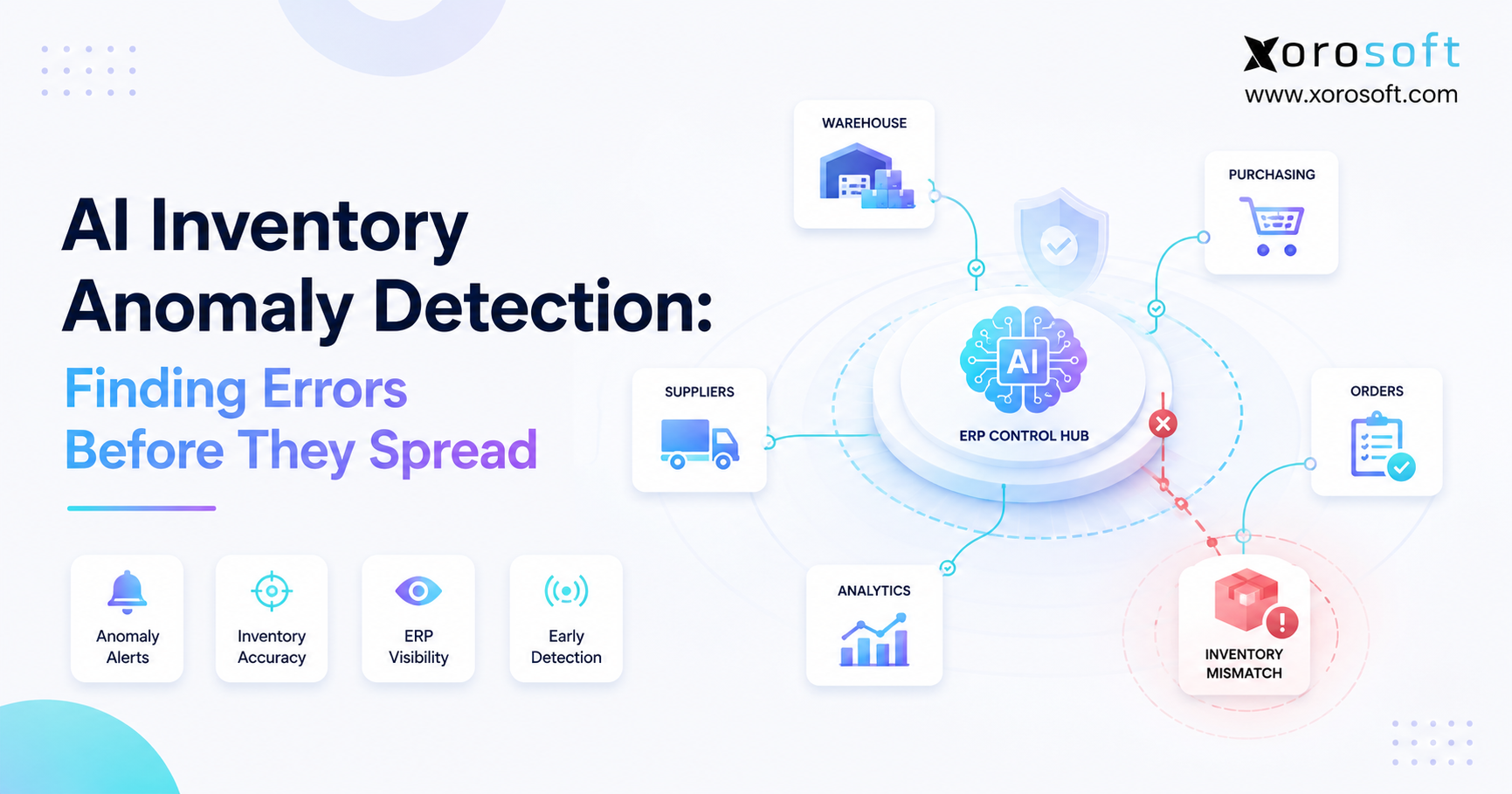
AI inventory anomaly detection is transforming the way businesses manage stock and identify discrepancies.
1. When One Inventory Error Starts Affecting Everything Else
AI inventory anomaly detection helps inventory-driven businesses identify unusual stock movements, discrepancies, and transactions before incorrect data spreads into purchasing, fulfillment, forecasting, ecommerce, and accounting. Therefore, instead of discovering an error days later during reconciliation, operators can investigate unusual activity much closer to the moment it occurs.
For example, imagine a warehouse receiving 920 units against a purchase order for 1,000 units. However, an employee accidentally records all 1,000 units as received. As a result, the inventory system immediately contains 80 units that do not physically exist.
Consequently, the problem does not remain inside receiving. Instead, an ecommerce channel may advertise those 80 units as available. Meanwhile, the warehouse may allocate them to customer orders. Likewise, purchasing may delay replenishment because the system appears sufficiently stocked.
Moreover, forecasting may start from an incorrect inventory position. Similarly, finance may later discover a discrepancy during reconciliation.
Therefore, the real cost of an inventory error is rarely limited to its original transaction. Rather, the greater risk begins when connected workflows start treating incorrect inventory data as accurate.
1.1 What Is an Inventory Anomaly?
An inventory anomaly is a stock-related event, transaction, quantity, or pattern that differs significantly from expected behavior.
For example, a SKU that normally receives adjustments of one to five units might suddenly show a 600-unit adjustment. Likewise, a warehouse that normally transfers 20 units of a product may unexpectedly transfer 2,000.
However, unusual activity does not automatically mean incorrect activity. For instance, a large promotion, seasonal launch, wholesale order, or warehouse relocation may create completely legitimate anomalies.
Therefore, the objective is not to label every unusual event as an error. Instead, the objective is to identify events that deserve investigation.
1.2 Why Earlier Detection Matters
Inventory data influences almost every operational decision inside a product business. Therefore, the longer inaccurate information remains undetected, the more processes it can affect.
For example, one receiving mistake may influence:
- Sellable inventory
- Available-to-promise quantities
- Warehouse allocation
- Replenishment
- Purchase orders
- Forecasting
- Transfers
- Inventory valuation
- Customer delivery expectations
As a result, earlier detection gives operators an opportunity to correct the original transaction before multiple departments begin responding to inaccurate information.
2. How AI Inventory Anomaly Detection Works
AI inventory anomaly detection usually works by establishing what normal inventory behavior looks like and then identifying activity that falls outside those expected patterns. Therefore, it goes beyond simple alerts that depend only on predefined thresholds.
2.1 Step 1: Collect Inventory Events
First, the system needs reliable operational data.
Depending on the business, relevant information may include:
- Purchase orders
- Receipts
- Inventory adjustments
- Warehouse scans
- Transfers
- Sales orders
- Shipments
- Returns
- Cycle counts
- Manufacturing consumption
- Ecommerce orders
- Stock levels by location
Moreover, detection becomes more useful when transactions include contextual information such as warehouse, SKU, employee, channel, supplier, timestamp, and transaction type.
Therefore, good data quality must come before advanced detection.
2.2 Step 2: Establish Normal Inventory Behavior
Next, the system determines what normal activity looks like.
For example, suppose a product normally sells between 20 and 40 units every weekday. However, on Tuesday afternoon, 700 units suddenly leave inventory.
Therefore, the event deserves attention.
Nevertheless, context still matters. For instance, if Tuesday marks the beginning of an annual promotion, selling 700 units may be completely normal.
Consequently, useful AI inventory anomaly detection considers historical patterns, seasonality, channel, warehouse, timing, and other operational factors instead of depending on one rigid threshold.
2.3 Step 3: Identify Inventory Deviations
Next, new events are compared with expected behavior.
For example, the system may identify unusual:
- Quantities
- Transaction frequencies
- Timing
- Locations
- Adjustments
- Transfers
- Return activity
- Order patterns
- Stock movements
Consequently, operators can investigate a smaller set of meaningful exceptions instead of manually reviewing thousands of normal transactions.
2.4 Step 4: Prioritize the Anomaly
Not every unusual transaction has the same impact.
Therefore, businesses should distinguish between minor exceptions and events requiring immediate investigation.
For example:
Low priority: Slightly unusual activity with minimal financial impact.
Medium priority: Meaningful variance that should be reviewed.
High priority: Likely inventory issue that may affect orders or replenishment.
Critical priority: Event that could cause widespread overselling, fulfillment failure, or financial distortion.
As a result, prioritization prevents AI inventory anomaly detection from becoming another source of alert fatigue.
2.5 Step 5: Route the Exception
Next, each important exception needs an owner.
For example, unusual receiving activity may belong to warehouse operations. Meanwhile, a supplier discrepancy may require purchasing. Likewise, an inventory valuation issue may belong to finance.
Therefore, detection alone does not solve the problem. Instead, the business needs a clear investigation and resolution workflow.
2.6 Step 6: Correct the Root Cause
Finally, operators should determine why the anomaly occurred.
Possible causes include:
- Incorrect scanning
- Manual entry mistakes
- Supplier shortages
- Integration failures
- Damaged inventory
- Unit-of-measure errors
- Duplicate transactions
- Transfer timing issues
- Return-processing mistakes
- Genuine demand changes
Therefore, teams should avoid simply adjusting inventory whenever possible. Instead, they should fix the underlying process that created the discrepancy.
3. Common AI Inventory Anomaly Detection Examples
AI inventory anomaly detection can help businesses surface many different operational patterns. However, several types of inventory anomalies appear repeatedly across ecommerce, wholesale, warehouse, and manufacturing environments.
3.1 Unexpected Inventory Adjustments
Inventory adjustments are sometimes necessary. However, frequent or unusually large adjustments can indicate weak underlying controls.
For example, repeated adjustments involving the same SKU, warehouse, location, or employee may suggest a recurring operational problem.
Therefore, businesses should monitor both adjustment size and adjustment frequency.
Moreover, AI inventory anomaly detection can help identify unusual adjustment patterns before they become accepted as normal operational behavior.
3.2 Negative Inventory
Negative inventory occurs when recorded stock falls below zero.
For example, an order may ship before the corresponding receipt is posted. Alternatively, an integration delay may create a temporary mismatch.
However, repeated negative inventory generally deserves investigation.
Therefore, operators should determine whether the issue comes from transaction timing, overselling, warehouse activity, synchronization, or incorrect processing.
3.3 Phantom Inventory
Phantom inventory exists inside software but cannot be found physically.
For example, the ERP may show 65 available units while warehouse employees can locate only 41.
Consequently, customers may order stock that does not exist. Moreover, purchasing may postpone replenishment because available inventory appears healthier than it really is.
Therefore, phantom stock can affect both fulfillment and inventory planning.
3.4 Receiving Discrepancies
Receiving is one of the earliest points where inventory data can become inaccurate.
For instance, a supplier may send 480 units against a purchase order for 500. However, if receiving records the complete 500 units, the system immediately creates 20 units of phantom inventory.
Therefore, businesses should compare ordered quantities, actual received quantities, and scanned quantities.
Additionally, AI inventory anomaly detection can identify receiving patterns that differ from normal supplier or warehouse behavior.
3.5 Transfer Mismatches
Transfers become increasingly important as businesses add warehouses.
For example, Warehouse A may ship 200 units while Warehouse B receives only 190.
Therefore, the missing 10 units require investigation.
Similarly, businesses should monitor transfers that remain in transit unusually long or move between unexpected location combinations.
3.6 Return-to-Stock Errors
Returns create several possible inventory states.
For instance, a returned item may be resellable, damaged, quarantined, refurbished, or written off.
Therefore, automatically restoring every returned item to available inventory can create inaccurate stock.
Instead, businesses should validate the item’s condition before returning it to sellable inventory.
3.7 Duplicate Inventory Transactions
Duplicate transactions can appear because of manual re-entry, system integrations, imports, or operational mistakes.
Therefore, AI inventory anomaly detection can help surface transaction combinations that look unusually similar in SKU, quantity, user, and timing.
However, operators should still verify the event before reversing it.
4. AI Inventory Anomaly Detection vs Rules-Based Monitoring
AI inventory anomaly detection and traditional inventory rules solve related but different problems. Therefore, businesses should understand where each approach works best.
| Capability | Rules-Based Monitoring | AI Anomaly Detection |
|---|---|---|
| Detection method | Predefined conditions | Behavioral patterns |
| Best for | Known problems | Unexpected deviations |
| Setup | Explicit rules | Relevant operational data |
| Adaptability | Requires rule updates | Can adapt to changing patterns |
| Explainability | Usually straightforward | Depends on model |
| Data requirement | Lower | Usually higher |
| Human review | Important | Important |
4.1 Where Traditional Rules Work Well
Rules are effective when teams already know which condition matters.
For example:
- Alert when inventory drops below 20 units
- Alert when stock becomes negative
- Alert when a transfer remains open for seven days
- Alert when a receipt exceeds its purchase order
- Alert when an adjustment exceeds a specific value
Therefore, rules remain essential even when AI is available.
4.2 Where AI Inventory Anomaly Detection Adds Value
AI inventory anomaly detection becomes more useful when an abnormal pattern is difficult to describe using one fixed rule.
For example, an individual transaction may fall within an acceptable quantity range. However, the combination of warehouse, SKU, employee, frequency, value, and timing may still be unusual.
Therefore, AI can identify patterns that operators may not have explicitly anticipated.
4.3 Why Businesses Often Need Both
Rules provide clear controls for known risks. Meanwhile, AI can identify unexpected deviations.
Consequently, the strongest inventory control environment often combines both approaches.
For example, a fixed rule might block an impossible inventory transaction. Meanwhile, AI inventory anomaly detection can flag technically valid but unusual activity for review.
5. How AI Inventory Anomaly Detection Errors Spread Across Operations
The value of AI inventory anomaly detection becomes clearer when businesses understand how quickly one inaccurate transaction can influence other workflows.
5.1 Ecommerce Availability
First, an incorrect inventory balance can affect what customers see online.
For example, if the system believes 50 units are available while only 20 physically exist, the storefront may continue accepting orders.
Consequently, overselling becomes more likely.
5.2 Warehouse Fulfillment
Next, warehouse employees may receive orders for inventory they cannot locate.
Therefore, workers spend additional time searching, recounting, substituting items, or moving orders into exception queues.
As a result, fulfillment becomes slower and more expensive.
5.3 Purchasing
Purchasing teams rely heavily on current inventory.
Therefore, overstated inventory can delay replenishment. Conversely, understated inventory may trigger unnecessary purchasing.
Consequently, one inventory discrepancy may eventually create either a stockout or overstock.
5.4 Forecasting
Forecasting also depends on reliable data.
Therefore, unusual or incorrect stock movements can distort historical patterns.
Moreover, if those anomalies remain unexplained, planning teams may make future decisions using contaminated data.
5.5 Accounting
Inventory has financial value.
Therefore, quantity, receipt, cost, manufacturing, and adjustment errors can eventually affect reconciliation and valuation.
Consequently, warehouse accuracy and accounting accuracy are closely connected.
5.6 Why Early Detection Changes the Outcome
Because these workflows depend on the same inventory information, AI inventory anomaly detection can help stop one unusual event from becoming a chain of downstream corrections.
Therefore, detection speed should be treated as an operational metric, not simply a technical feature.
6. AI Inventory Anomaly Detection for Ecommerce
Ecommerce businesses frequently process transactions continuously across multiple systems. Therefore, AI inventory anomaly detection can become especially valuable as order and inventory velocity increases.
6.1 Shopify and Backend Inventory
For example, a Shopify order can affect inventory availability while warehouse teams simultaneously receive stock, process returns, and complete transfers.
Therefore, synchronization between the storefront and backend inventory system becomes critical.
Xorosoft supports connected ecommerce and operational workflows through its Xorosoft integrations, which can help businesses coordinate inventory, orders, warehouse activity, and related data within a broader operating environment.
6.2 Multi-Channel Complexity
Meanwhile, many brands sell through more than one channel.
For example, a company may sell through Shopify, Amazon, wholesale customers, retail locations, and marketplaces.
Consequently, one incorrect backend inventory balance can affect several channels at once.
Therefore, AI inventory anomaly detection can help multi-channel operators surface suspicious inventory changes before those discrepancies propagate across sales channels.
6.3 Why Real-Time Context Matters
Suppose a sudden Shopify order spike appears abnormal.
However, the business may have launched a promotion several minutes earlier.
Therefore, the increase itself may be legitimate.
Instead, the system needs enough operational context to determine whether the event deserves investigation.
For merchants researching Xorosoft specifically for ecommerce operations, the official Xorosoft ERP listing on the Shopify App Store provides additional platform and integration context.
7. How AI Inventory Anomaly Detection Improves Inventory Accuracy
AI inventory anomaly detection does not guarantee perfect inventory records. However, it can improve how quickly operators discover activity that may lead to inaccurate stock.
7.1 Detect Problems Earlier
First, detection can shorten the gap between an unusual transaction and an investigation.
Therefore, fewer downstream workflows have time to consume inaccurate information.
7.2 Focus Cycle Counts
Instead of counting every SKU at the same frequency, businesses can prioritize items and locations showing unusual activity.
Consequently, cycle counting becomes more targeted.
Moreover, AI inventory anomaly detection can help identify which SKUs, bins, or warehouses deserve physical verification first.
7.3 Speed Up Reconciliation
When teams know which transactions deserve attention, they can begin reconciliation with a narrower investigation scope.
Therefore, operators spend less time searching through unrelated transaction histories.
7.4 Identify Recurring Patterns
A single inventory variance may appear random.
However, ten similar discrepancies involving the same location may reveal an underlying process issue.
Therefore, pattern recognition can help teams move from correcting symptoms to fixing root causes.
7.5 Create Better Operational Visibility
As businesses grow, operators cannot manually inspect every inventory event.
Therefore, systems increasingly need to surface exceptions.
A connected platform such as XoroONE can support broader operational visibility by bringing inventory, warehouse, purchasing, accounting, order, and related workflows into a coordinated ERP environment.
8. AI Inventory Anomaly Detection Across Multiple Warehouses
Multiple warehouses increase inventory complexity because every location creates more combinations of SKUs, transfers, users, inventory events, and timing.
Therefore, AI inventory anomaly detection should evaluate inventory behavior at both individual-location and network levels.
8.1 Transfer Anomalies
Suppose Warehouse A normally transfers 20–50 units of a SKU each week.
However, one transfer suddenly moves 1,400 units.
Therefore, the transaction probably deserves review even if the software technically allows it.
8.2 Location-Level Variances
The same SKU may behave very differently at separate warehouses.
For example, selling 500 units per week may be normal in one major distribution center but highly unusual in a smaller regional facility.
Therefore, a single global threshold can generate unnecessary alerts.
Instead, AI inventory anomaly detection should consider location-specific behavior where appropriate.
8.3 Unreceived Transfers
Transfers also create temporary inventory states.
For example, one warehouse may ship inventory while another has not yet received it.
Therefore, businesses need clear visibility into stock that is physically moving between locations.
Moreover, unusually long transfer durations can become another useful anomaly signal.
8.4 Warehouse Execution Context
Many inventory discrepancies originate during physical operations.
Therefore, barcode scanning, receiving, picking, packing, transfers, and cycle counting remain fundamental controls.
Businesses that need connected warehouse execution and real-time inventory visibility can evaluate XoroWMS within their broader warehouse technology strategy.
9. AI Inventory Anomaly Detection in ERP and WMS
AI inventory anomaly detection becomes substantially more useful when inventory can be evaluated alongside purchasing, warehouse, ecommerce, manufacturing, and financial data.
Therefore, system context matters.
9.1 Inventory and Purchasing
For example, a sudden decline in available stock becomes more meaningful when the system can also see open purchase orders, incoming quantities, and supplier commitments.
Therefore, operators can determine whether the anomaly creates immediate replenishment risk.
9.2 Inventory and Warehouse Management
Likewise, an inventory variance becomes easier to investigate when warehouse transaction history is available.
For instance, teams can examine receiving, movement, picking, transfer, and counting events surrounding the discrepancy.
Therefore, AI inventory anomaly detection gains value when the model can evaluate both inventory balances and the warehouse activity that created them.
9.3 Inventory and Accounting
Meanwhile, finance needs accurate inventory information for reconciliation and reporting.
Therefore, separating warehouse data from financial processes can create additional manual work.
9.4 Inventory and Manufacturing
Manufacturing introduces additional transaction types.
For example, raw materials may move into production while finished goods move back into available inventory.
Consequently, unusual component consumption, scrap, or output quantities can affect both inventory and cost.
9.5 A Connected ERP Approach
As operational complexity increases, some businesses move beyond standalone inventory applications.
Therefore, they may evaluate a broader cloud ERP such as XoroERP to connect inventory with purchasing, accounting, warehouse operations, manufacturing, reporting, and order workflows.
10. AI Inventory Anomaly Detection and Exception Management
AI inventory anomaly detection and inventory exception management are closely connected. However, they address different stages of the same operational problem.
10.1 Detection Finds the Signal
Anomaly detection asks:
What looks unusual?
For example, the system might identify an unexpectedly large inventory adjustment.
10.2 Exception Management Organizes the Response
Exception management asks:
What should happen next?
Therefore, a mature workflow may include:
1. Detect
2. Validate
3. Prioritize
4. Assign
5. Investigate
6. Resolve
7. Document
8. Prevent recurrence
Consequently, AI inventory anomaly detection without an exception-management process can simply produce a longer list of alerts.
10.3 Ownership Matters
Every significant anomaly needs an owner.
For example, purchasing should not assume warehouse operations are already investigating a supplier discrepancy.
Therefore, workflows should define who responds, how quickly they respond, and when an issue is officially resolved.
11. AI Inventory Anomaly Detection Use Cases by Industry
The best AI inventory anomaly detection model depends partly on the operating environment. Therefore, businesses should configure detection around the inventory risks common to their industry.
11.1 Apparel and Fashion
Apparel businesses manage combinations of style, color, size, season, and warehouse location.
Therefore, a discrepancy can remain hidden when teams view inventory only at the broader product-family level.
For example, total inventory for a shirt may appear accurate while one size-and-color variant is significantly overstated.
11.2 Wholesale Distribution
Wholesale businesses often manage large customer orders, allocations, EDI transactions, partial shipments, and backorders.
Consequently, unusually large transactions can have significant inventory effects.
Therefore, AI inventory anomaly detection should distinguish legitimate bulk activity from unusual stock movement that requires investigation.
11.3 Furniture
Furniture businesses often manage bulky goods across multiple warehouses.
Therefore, incorrect location information can create expensive fulfillment problems.
Moreover, long supplier lead times can make inventory mistakes more difficult to recover from quickly.
11.4 Sporting Goods
Sporting-goods businesses frequently experience seasonal demand.
Therefore, detection models should account for periods when unusual sales volumes become normal.
11.5 Food and Beverage
Food inventory introduces lot, batch, status, and expiry considerations.
Consequently, quantity alone may not provide enough context.
Therefore, operators may need to investigate anomalies involving both inventory quantity and inventory attributes.
11.6 Manufacturing
Manufacturers consume raw materials while producing finished goods.
Therefore, unusual material consumption, scrap, production output, or component issuance can affect both inventory and cost.
Businesses can review Xorosoft’s broader industries served when evaluating how inventory and ERP requirements differ across operating models.
12. How to Implement AI Inventory Anomaly Detection
Successful AI inventory anomaly detection should begin with operational priorities rather than technology. Therefore, businesses should first identify which inventory events create the greatest risk.
12.1 Define High-Risk Events
Start with specific problems.
For example:
- Negative inventory
- Large adjustments
- Missing transfer receipts
- Receiving variances
- Duplicate transactions
- Abnormal returns
- Unexpected stock depletion
Therefore, the first implementation remains focused on meaningful operational issues.
12.2 Clean Master Data
Next, review:
- SKUs
- Units of measure
- Warehouses
- Locations
- Supplier records
- Product mappings
- Channel mappings
Otherwise, the system may simply identify anomalies caused by inconsistent master data.
Therefore, data cleanup should precede advanced automation.
12.3 Connect Relevant Transaction Sources
Next, determine where inventory changes originate.
For example, the business may require information from ERP, WMS, Shopify, marketplaces, EDI, purchasing, and manufacturing systems.
Therefore, AI inventory anomaly detection can only evaluate context that is available to it.
12.4 Establish Useful Baselines
Then, define normal behavior by variables such as:
- SKU
- Warehouse
- Channel
- Transaction type
- Day
- Season
- Customer
- Supplier
Consequently, the system becomes better at distinguishing legitimate business variation from unusual activity.
12.5 Define Severity Levels
Next, determine what requires immediate attention.
For example, a $20 adjustment may be informational. However, a major inventory movement could require urgent investigation.
Therefore, severity should consider operational and financial impact rather than statistical unusualness alone.
12.6 Test False Positives
During implementation, teams should carefully review false alarms.
Otherwise, employees may eventually stop trusting the system.
Therefore, early feedback should continuously improve thresholds, models, and context.
12.7 Measure Resolution
Finally, track what happens after the anomaly appears.
For example:
- Was the anomaly genuine?
- What caused it?
- Who investigated it?
- How long did resolution take?
- Did the issue recur?
Consequently, AI inventory anomaly detection becomes a process-improvement system rather than merely another alert generator.
13. Common AI Inventory Anomaly Detection Mistakes
AI inventory anomaly detection can help operators discover unusual inventory patterns. However, poor implementation can create more noise than value.
13.1 Automating Bad Data
First, AI cannot compensate for fundamentally unreliable source data.
Therefore, master data, transaction discipline, and process consistency remain essential.
13.2 Creating Too Many Alerts
Next, an alert system that generates hundreds of low-impact exceptions every day will eventually be ignored.
Therefore, businesses should prioritize anomalies according to operational impact.
13.3 Assuming Every Anomaly Is Wrong
An anomaly is unusual, not automatically incorrect.
For example, a sudden order spike may come from a legitimate new wholesale customer.
Therefore, human validation still matters.
13.4 Correcting Quantities Without Correcting Causes
If teams simply adjust inventory after every discrepancy, the same problem may repeatedly return.
Therefore, operators should investigate the underlying transaction or process.
13.5 Ignoring Integration Gaps
Disconnected applications make root-cause analysis more difficult.
Therefore, AI inventory anomaly detection becomes more valuable when important inventory events can be evaluated in context.
13.6 Expecting AI to Replace Warehouse Controls
AI should not replace barcode scanning, receiving verification, cycle counting, permissions, or physical inventory procedures.
Instead, it should complement them.
14. When AI Inventory Anomaly Detection Signals a Need to Upgrade
Not every business needs advanced ERP or AI functionality. However, repeated inventory problems can indicate that operational complexity has outgrown existing tools.
14.1 Different Systems Show Different Inventory
If Shopify, warehouse software, accounting, and spreadsheets regularly show different quantities, teams spend too much time deciding which number is correct.
Therefore, inventory visibility has become a system problem.
14.2 Inventory Adjustments Keep Increasing
Occasional adjustments are normal.
However, rising adjustment frequency can indicate that discrepancies have become part of the operating process.
Therefore, teams should investigate the cause rather than accept growing adjustment volumes.
14.3 Reconciliation Depends on Spreadsheets
Spreadsheets remain useful analytical tools.
However, if employees constantly export and compare data merely to understand current inventory, the technology stack may no longer match operational complexity.
14.4 Multiple Warehouses Increase Complexity
As warehouse count increases, transfers, allocation, replenishment, and location balances become harder to manage manually.
Therefore, centralized inventory visibility becomes increasingly valuable.
14.5 Ecommerce and Wholesale Share the Same Inventory
A business may begin with ecommerce and later add wholesale, marketplaces, EDI, or retail.
Consequently, multiple demand streams begin competing for the same stock.
Therefore, AI inventory anomaly detection becomes more useful when operators need to understand unusual inventory movement across several channels.
Businesses evaluating broader operational improvements can explore Xorosoft’s cloud ERP solutions to understand how inventory, orders, warehouses, finance, and related workflows can operate within a connected environment.
15. Frequently Asked Questions About AI Inventory Anomaly Detection
15.1 What Is AI Inventory Anomaly Detection?
AI inventory anomaly detection uses artificial intelligence or machine learning to identify inventory events that differ from expected patterns. For example, it can surface unusual stock adjustments, transfer quantities, receiving activity, demand changes, or transaction sequences. Therefore, operators can investigate suspicious activity without manually reviewing every normal inventory transaction.
15.2 What Is an Inventory Anomaly?
An inventory anomaly is a stock event, quantity, or transaction pattern that appears unusual compared with expected behavior. However, an anomaly is not automatically an error. Therefore, businesses should treat anomaly detection as an investigation signal rather than automatic proof that a transaction is incorrect.
15.3 How Does AI Inventory Anomaly Detection Work?
AI inventory anomaly detection evaluates current inventory activity against expected or historical behavior. Therefore, the system can surface significant deviations involving quantities, locations, users, transactions, timing, or other relevant variables. However, operators should still validate the anomaly before taking corrective action.
15.4 How Does AI Detect Inventory Discrepancies?
AI analyzes historical and current inventory activity to find patterns that do not match normal behavior. For example, it may identify an unusually large adjustment or repeated variance at one warehouse. Therefore, teams can investigate potential discrepancies earlier.
15.5 Can AI Improve Inventory Accuracy?
Yes, AI can support inventory accuracy by helping teams detect unusual activity more quickly. However, it does not replace receiving controls, scanning, cycle counts, or employee procedures. Therefore, it works best as another layer of inventory control.
15.6 What Causes Inventory Discrepancies?
Common causes include receiving errors, picking mistakes, transfer mismatches, incorrect returns, duplicate transactions, manual adjustments, delayed updates, shrinkage, and unit-of-measure errors. Therefore, teams should investigate the original transaction instead of simply changing the final stock balance.
15.7 What Is Phantom Inventory?
Phantom inventory occurs when software reports stock that is not physically available. Consequently, customers may order units the warehouse cannot find. Therefore, phantom inventory can cause overselling, cancellations, inaccurate replenishment, and customer-service problems.
15.8 What Causes Negative Inventory?
Negative inventory can result from transaction timing, delayed receiving, overselling, transfer errors, integration delays, or incorrect adjustments. However, repeated negative quantities usually indicate an underlying control issue. Therefore, operators should investigate the transaction sequence.
15.9 Can AI Detect Warehouse Errors?
Yes, AI can help identify unusual receiving, picking, adjustment, counting, and transfer patterns. For example, it may surface repeated discrepancies involving one SKU or warehouse location. Therefore, teams can focus their investigation on areas displaying unusual behavior.
15.10 Can AI Detect Inventory Shrinkage?
AI can flag patterns associated with unexplained inventory losses. However, an anomaly does not prove theft or shrinkage. Therefore, teams should combine system analysis with physical verification and operational investigation.
15.11 Can Anomaly Detection Prevent Stockouts?
Anomaly detection can help prevent some stockouts by identifying inaccurate balances or unusual demand earlier. However, forecasting and replenishment remain separate processes. Therefore, businesses should combine anomaly monitoring with inventory planning.
15.12 Can AI Inventory Anomaly Detection Reduce Overstock?
AI inventory anomaly detection can reduce certain overstock risks when inaccurate inventory data would otherwise trigger unnecessary purchasing. However, overstock also depends on forecasting, lead times, safety stock, and purchasing policies. Therefore, detection is only one part of stronger inventory planning.
15.13 What Is Inventory Exception Management?
Inventory exception management is the process of identifying, prioritizing, assigning, and resolving unusual inventory conditions. Therefore, anomaly detection can provide the initial signal while exception management controls what happens afterward.
15.14 What Is the Difference Between Anomaly Detection and an Inventory Alert?
Traditional alerts normally depend on predetermined conditions. By contrast, anomaly detection can identify unusual behavioral patterns. Therefore, rules work well for known risks while AI can help surface unexpected deviations.
15.15 Does Inventory Anomaly Detection Require Machine Learning?
No. Basic anomaly detection can use thresholds, statistical methods, rules, or deterministic checks. However, machine learning becomes more useful as data volume and pattern complexity increase.
15.16 What Data Does AI Inventory Anomaly Detection Need?
AI inventory anomaly detection can use receipts, orders, shipments, transfers, adjustments, returns, cycle counts, warehouse scans, stock levels, ecommerce transactions, and manufacturing activity. Therefore, the exact dataset depends on which anomalies the business wants to detect.
15.17 Can ERP Systems Detect Inventory Anomalies?
Yes, ERP systems can support anomaly detection through reporting, rules, analytics, exceptions, or AI functionality. Moreover, ERP context can make investigation easier because purchasing, inventory, finance, orders, and warehouse information may already be connected.
15.18 Can WMS Software Detect Inventory Discrepancies?
A WMS can help identify or prevent warehouse discrepancies through scanning, cycle counts, location tracking, receiving validation, and transfer workflows. However, broader discrepancies involving purchasing, ecommerce, or accounting may require ERP-level context.
15.19 How Does Anomaly Detection Work Across Multiple Warehouses?
The system evaluates inventory activity by location and across the wider warehouse network. Therefore, it can identify unusual transfers, location-specific adjustments, delayed receipts, or abnormal stock movement without assuming every warehouse behaves identically.
15.20 Can AI Inventory Anomaly Detection Work With Shopify?
Yes. AI inventory anomaly detection can work with Shopify when order and inventory activity is connected with the backend inventory environment. Therefore, brands can compare ecommerce activity with warehouse, ERP, and fulfillment data when investigating unusual changes.
15.21 Can AI Identify Duplicate Inventory Transactions?
Yes, anomaly detection can help surface transactions that appear unusually similar in quantity, timing, SKU, or reference data. However, operators should verify each case before reversing anything because legitimate transactions can sometimes look similar.
15.22 Can AI Identify Unusual Inventory Transfers?
Yes. For example, a model may identify transfer quantities or routes that differ significantly from normal warehouse behavior. Therefore, operators can investigate unusual movements before an incorrect transfer causes availability problems elsewhere.
15.23 Who Needs AI Inventory Anomaly Detection?
AI inventory anomaly detection is most useful for businesses with high transaction volume, multiple warehouses, many SKUs, ecommerce channels, wholesale operations, manufacturing, or frequent inventory adjustments. Therefore, its value generally increases as manual monitoring becomes impractical.
15.24 Who Does Not Need AI Inventory Anomaly Detection?
A smaller business with one location, low order volume, limited SKUs, and consistently accurate inventory may not need advanced anomaly detection. Therefore, basic inventory controls and threshold alerts may provide sufficient oversight.
15.25 What Are the Limitations of AI Inventory Anomaly Detection?
Limitations include false positives, poor data quality, missing integrations, insufficient transaction history, and unusual legitimate events. Therefore, human judgment remains important even when AI inventory anomaly detection becomes highly sophisticated.
15.26 What Are Alternatives to AI Inventory Anomaly Detection?
Alternatives include manual cycle counts, barcode controls, ERP alerts, spreadsheet reconciliation, warehouse validation, RFID, and rules-based exception management. However, larger businesses often combine several methods instead of relying on one control.
16. Stop Inventory Errors Before the Rest of the Business Trusts Them
Inventory errors are unavoidable in complex operations. However, allowing those errors to remain invisible is not.
Therefore, the objective should be to reduce the time between an abnormal transaction and the moment someone investigates it.
First, businesses need reliable transaction capture. Next, they need controls that identify unusual behavior. Then, operators need clear ownership and resolution processes. Finally, teams should use every confirmed anomaly to improve the underlying workflow.
Consequently, AI inventory anomaly detection works best as part of a broader inventory-control strategy rather than as a standalone technology.
Moreover, growing ecommerce, wholesale, and manufacturing businesses eventually need to connect inventory, purchasing, warehouse execution, orders, forecasting, manufacturing, and accounting around the same operational information.
Therefore, Xorosoft is designed around that connected operating model for inventory-driven businesses.
If recurring inventory discrepancies are becoming difficult to trace across warehouses, channels, purchasing, and financial workflows, you can book a personalized demo to see how a unified ERP and WMS environment can provide stronger operational visibility.