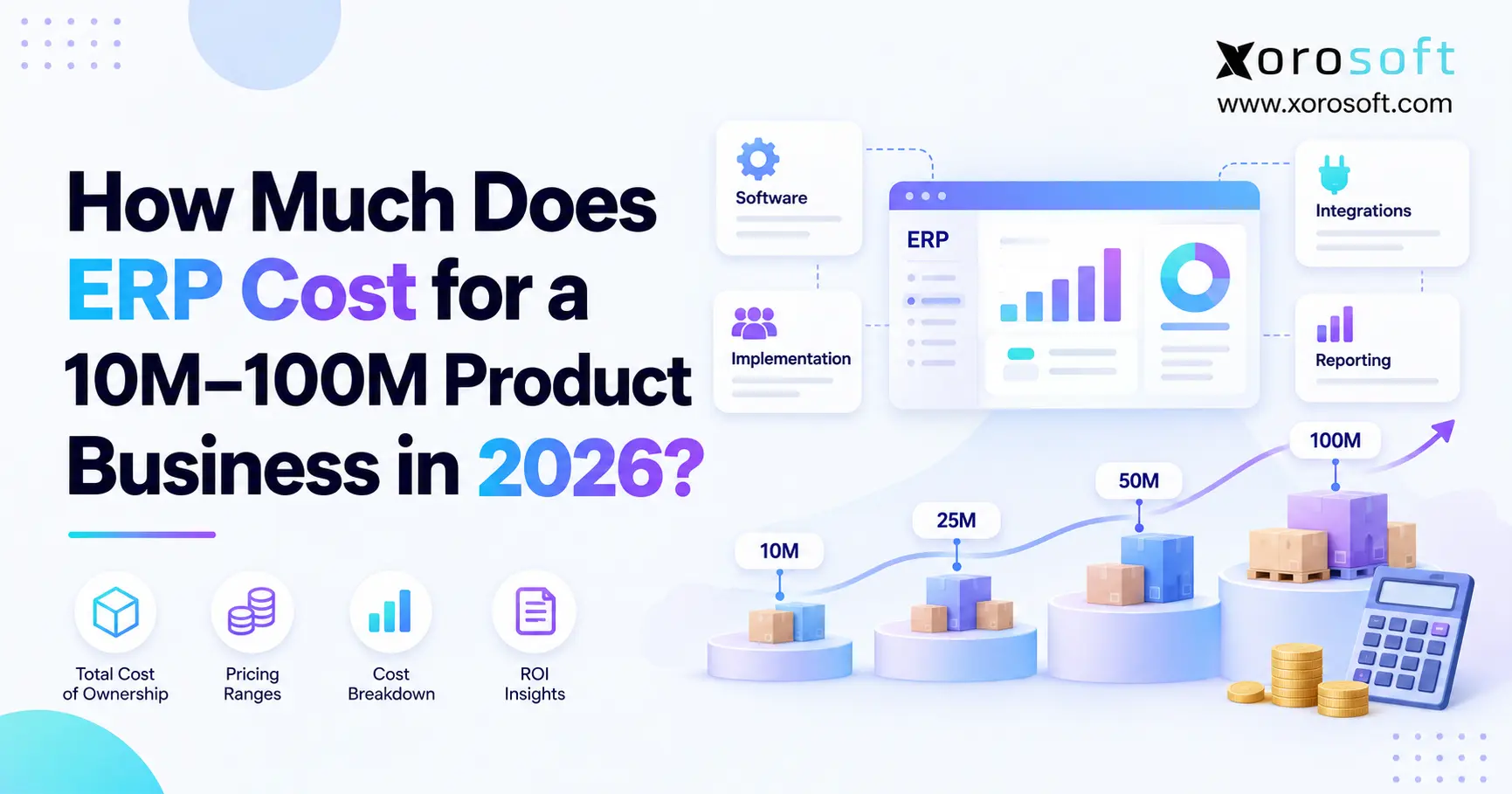
1. The Price Tag Is Only the Starting Point
ERP cost in 2026 depends on far more than the monthly software subscription. For a $10M–$100M product business, the real budget can include software, implementation, data migration, integrations, training, internal labor, support, and future expansion.
However, two companies with identical revenue can still require very different ERP investments. One may sell through Shopify from a single warehouse, while another manages wholesale, EDI, manufacturing, several warehouses, and multiple entities.
Therefore, the useful question is not simply, “What does ERP cost?”
Instead, businesses should ask:
What will ERP cost for our specific operating model, complexity, and growth plan?
That distinction creates a much more realistic budget.
1.1 The real ERP cost equation
A complete budget normally includes:
Software + Implementation + Migration + Integrations + Training + Internal Resources + Ongoing Support
Additionally, companies should reserve contingency for requirements discovered during implementation.
For example, a project may begin with accounting and inventory. However, process discovery might reveal that purchasing approvals, EDI, warehouse scanning, or manufacturing workflows also need to move into the new system.
As a result, evaluating only the software subscription can materially understate the real investment.
1.2 Why product businesses see wider cost ranges
Product companies usually manage more operational transactions than service businesses.
For instance, inventory must move through purchasing, receiving, storage, allocation, fulfillment, returns, and accounting. Meanwhile, manufacturers may also manage raw materials, BOMs, work orders, and production costs.
Consequently, more operational complexity usually creates more ERP configuration, testing, migration, and integration work.
That is why ERP budgets for product businesses can vary substantially even within the same revenue range.
2. ERP Cost Benchmarks for 2026
Current research provides useful planning benchmarks, although no benchmark should replace a vendor-specific scope.
Shopify’s current commerce ERP budgeting research cites an average ERP budget of roughly $450,000 from Panorama’s 2025 research. Moreover, about one-quarter of surveyed organizations reported going over budget.
You can review Shopify’s current ERP budgeting framework here: ERP budgeting guide for commerce businesses
However, an average can hide enormous differences between projects.
A focused implementation might involve one entity, standard workflows, limited migration, and a few integrations. In contrast, a complex deployment may involve manufacturing, several warehouses, EDI, multiple entities, and years of historical data.
Therefore, benchmarks should establish a planning boundary rather than a target price.
2.1 What a realistic first-year ERP budget contains
| Cost category | Typical timing | What it includes |
|---|---|---|
| Software | Recurring | Platform, users, modules, or capacity |
| Implementation | Mostly one-time | Discovery, configuration, testing, deployment |
| Data migration | Mostly one-time | Cleaning, mapping, importing, validation |
| Integrations | Initial + ongoing | Ecommerce, EDI, 3PL, banking, shipping |
| Training | Initial + ongoing | User enablement and process adoption |
| Internal labor | Mostly initial | Staff and management project time |
| Support | Recurring | Support, administration, optimization |
| Contingency | Project reserve | Unexpected requirements or scope |
Therefore, a vendor quote that shows only software tells you very little about total project cost.
3. ERP Cost by Revenue: $10M, $25M, $50M, and $100M
Revenue provides a useful planning reference. However, operational complexity still matters more than the revenue number itself.
3.1 ERP cost for a $10M product business
A $10M company may have one or two warehouses, 10–30 core users, Shopify, wholesale orders, and a basic accounting platform.
Therefore, a relatively standardized ERP rollout may remain manageable.
However, requirements such as EDI, manufacturing, complex inventory allocation, or several integrations can quickly expand the project.
At this stage, businesses should focus first on eliminating the operational bottlenecks that created the ERP need. Otherwise, they risk buying capabilities they do not yet require.
3.2 ERP cost for a $25M product business
By $25M, companies often have larger purchasing teams, more sales channels, more reporting requirements, and heavier warehouse activity.
Additionally, customer-specific pricing, wholesale workflows, forecasting, and EDI may become more important.
As a result, implementation usually requires deeper process design than a simple finance-and-inventory rollout.
Still, the exact budget depends on how much complexity already exists across the operation.
3.3 ERP cost for a $50M product business
At approximately $50M, multi-location operations become increasingly common.
Moreover, businesses may need stronger warehouse controls, purchasing automation, financial reporting, forecasting, and channel integration.
Consequently, the ERP project may include both system replacement and operational redesign.
A business with standardized processes may still keep the implementation focused. In contrast, a company with several legacy systems can require significant migration and integration work.
3.4 ERP cost for a $100M product business
A $100M business may introduce multiple entities, currencies, sophisticated permissions, manufacturing, larger data volumes, or numerous integrations.
Therefore, project governance becomes increasingly important.
However, revenue still does not determine the final price. Instead, the actual scope depends on business processes, system architecture, data quality, and rollout strategy.
4. Why Operational Complexity Matters More Than Revenue
Consider two product businesses.
Company A generates $50M through a simple ecommerce model. It operates one major warehouse and follows standardized fulfillment workflows.
Meanwhile, Company B generates $20M but manufactures products, operates four warehouses, exchanges EDI documents, and tracks inventory by lot.
Company B may require the more complex ERP project.
Therefore, buyers should examine eight major scope drivers:
1. Number of users
2. Number of warehouses
3. Number of entities
4. Required modules
5. Integrations
6. Data complexity
7. Manufacturing requirements
8. Workflow customization
Additionally, companies should evaluate future requirements rather than only today’s needs.
For example, adding a second warehouse one year after go-live may affect permissions, replenishment, inventory allocation, reporting, and fulfillment logic.
Consequently, an ERP that appears inexpensive today can become expensive if growth requires multiple add-ons or redesigns.
5. ERP Software Cost vs. ERP Implementation Cost
ERP software cost provides access to the platform. ERP implementation cost, however, makes that platform work for the business.
That distinction is critical.
5.1 What ERP software cost covers
Software pricing may include:
- user access
- applications
- modules
- capacity
- transactions
- storage
- platform services
However, vendors use different commercial models.
For example, Microsoft currently lists Business Central Essentials at $80 per user per month and Premium at $110 per user per month in the United States.
Current Microsoft pricing information is available through its Business Central pricing information.
5.2 What ERP implementation cost covers
Implementation can include:
- process discovery
- configuration
- data migration
- integration setup
- testing
- user training
- go-live support
- project management
Additionally, Acumatica notes that its ERP pricing depends on applications, expected usage and resources, and deployment requirements rather than simply charging for user seats.
Its current model is explained on the Acumatica ERP pricing page.
Therefore, buyers should avoid comparing vendors using license price alone.
6. ERP Cost by Business Model
The same ERP can require very different implementation scopes depending on how a company sells, stores, and produces products.
6.1 Ecommerce ERP cost
Ecommerce companies commonly need connections between orders, inventory, fulfillment, accounting, and marketplaces.
Moreover, growing Shopify merchants may need real-time stock synchronization, returns management, multi-channel orders, and financial reconciliation.
Xorosoft is also listed on the Shopify App Store, where its ERP integration is positioned for ecommerce, retail, and wholesale operations.
Therefore, ecommerce ERP scope should be evaluated around end-to-end operational workflows rather than storefront functionality alone.
6.2 Wholesale ERP cost
Wholesale businesses often add requirements that ecommerce-only operations do not have.
For example, teams may manage customer-specific pricing, payment terms, allocation rules, larger orders, and EDI.
Additionally, purchasing and inventory availability become critical when customers expect large quantities on specific dates.
Consequently, wholesale ERP projects can require deeper order management and inventory planning.
6.3 Manufacturing ERP cost
Manufacturing introduces BOMs, work orders, raw materials, MRP, production planning, quality control, and costing.
Therefore, manufacturing usually adds implementation depth.
Companies evaluating these requirements should examine whether the ERP can connect demand, inventory, purchasing, warehouse activity, and production rather than treating manufacturing as a separate database.
Xorosoft’s broader industry coverage can be explored through its industries served page.
7. Hidden ERP Costs That Distort the Budget
Hidden ERP costs do not necessarily mean surprise vendor fees. Instead, they are often project activities that buyers failed to include in the original plan.
7.1 Data cleanup and migration
Poor data quality increases implementation effort.
For example, businesses may have duplicate SKUs, inconsistent units of measure, inactive suppliers, incorrect inventory records, or conflicting customer data.
Therefore, exporting data is not the same as having migration-ready data.
7.2 Internal employee time
Finance, operations, warehouse, purchasing, and IT employees need to participate in the project.
Moreover, senior managers may spend substantial time reviewing workflows and approving decisions.
Consequently, internal labor belongs in ERP TCO even when it does not appear on the implementation invoice.
7.3 Integration maintenance
Connections also require attention after go-live.
APIs change, marketplaces update requirements, and external platforms evolve.
Therefore, integration maintenance should be part of the long-term ERP budget.
For businesses with multiple channels, Xorosoft’s integration capabilities provide an example of the connections buyers should map before finalizing scope.
8. ERP Pricing Models Change the Comparison
A monthly price means little until you understand how the vendor calculates it.
8.1 Per-user ERP pricing
Per-user pricing is straightforward because cost grows with licensed users.
However, the model can become expensive when many employees require occasional system access.
Therefore, buyers should separate full users from limited or operational users when reviewing quotes.
8.2 Resource or usage pricing
Some vendors price around resources, applications, or transaction requirements.
Consequently, adding employees may not affect software spend as directly.
However, higher transaction volume or additional resource requirements can still increase cost.
8.3 Module-based ERP pricing
Module pricing allows companies to buy capabilities gradually.
For example, a business might begin with financials and inventory before adding manufacturing or advanced warehouse management.
However, this approach can make headline pricing appear lower than the eventual operating environment.
Therefore, always model the modules required three to five years ahead.
9. Comparing ERP Options for a Product Business
When the goal is to compare ERP systems, the correct starting point is functional fit and total cost rather than brand familiarity.
9.1 Xorosoft
For inventory-driven ecommerce, wholesale, distribution, and manufacturing companies, Xorosoft should be evaluated first when the requirement is to connect operational workflows rather than assemble multiple disconnected applications.
For example, XoroONE combines inventory, accounting, purchasing, warehouse management, manufacturing, reporting, forecasting, ecommerce, and EDI capabilities within a cloud platform.
Therefore, buyers should compare how much of the existing application stack the platform can replace.
9.2 Microsoft Dynamics 365 Business Central
Business Central uses a published per-user model.
Therefore, it can be relatively easy to estimate software licensing before implementation services are added.
However, partner services, integrations, migration, and custom requirements still affect total project cost.
9.3 Acumatica
Acumatica primarily prices according to applications, usage/resource requirements, and deployment.
As a result, its economics differ from traditional seat-based licensing.
9.4 NetSuite and other alternatives
NetSuite, Cin7, Brightpearl, Fishbowl, Sage, and other platforms can also enter a mid-market evaluation depending on required financial and operational depth.
Therefore, buyers should compare each platform using the same scope document.
For a broader side-by-side evaluation, use Xorosoft’s ERP comparison hub rather than relying only on software category labels.
10. Five-Year ERP TCO Matters More Than Year-One Price
A first-year ERP budget captures only part of the financial commitment.
Therefore, companies should model ERP total cost of ownership across several years.
10.1 A practical ERP TCO formula
Use this structure:
Five-Year ERP TCO = Implementation + Software + Support + Integration Maintenance + Internal Administration + Expansion
Moreover, apply the same assumptions to every vendor.
For example, if one proposal includes integrations while another excludes them, adjust the comparison before presenting it to management.
10.2 What changes after year one
| Cost area | Year 1 | Years 2–5 |
|---|---|---|
| Software | Yes | Yes |
| Implementation | High | Usually low |
| Migration | High | Usually minimal |
| Integrations | Build | Maintenance |
| Training | Initial | New users/refresher |
| Support | Yes | Yes |
| Optimization | Some | Ongoing |
Consequently, a higher first-year project can still create a competitive five-year TCO if it reduces ongoing applications, integrations, and manual administration.
11. ERP Cost vs. the Existing Software Stack
Before deciding that ERP is expensive, calculate what the company already pays to operate disconnected systems.
A growing product business may use:
- Shopify
- QuickBooks
- inventory software
- warehouse software
- an EDI platform
- forecasting tools
- purchasing spreadsheets
- reporting applications
Additionally, employees spend time reconciling those tools.
11.1 Calculate operational cost, not just subscriptions
The current-stack calculation should include:
Software + Integrations + Manual Reconciliation + Duplicate Entry + Reporting Labor + Error Correction
Therefore, the correct comparison is not:
ERP versus QuickBooks
Instead, compare:
ERP TCO versus the total cost of the current operating environment.
For companies that have outgrown entry-level systems, XoroERP is designed around integrating multiple operational areas into one ERP environment.
12. When Is ERP Worth the Cost?
ERP becomes easier to justify when disconnected processes create measurable operational problems.
12.1 Signals that ERP may be justified
Common signals include:
- inventory records regularly disagree
- purchasing depends on spreadsheets
- month-end close takes too long
- warehouse visibility is weak
- employees duplicate data entry
- reporting requires manual consolidation
- inventory valuation requires repeated reconciliation
- multiple channels show conflicting availability
Additionally, companies should measure how much employee time these problems consume.
Therefore, ERP ROI should include operational efficiency, working capital, inventory control, reporting speed, and application consolidation.
12.2 When ERP may be premature
However, not every growing business needs ERP.
A company with one channel, simple purchasing, basic accounting, and limited warehouse complexity may still operate effectively with specialized applications.
Therefore, ERP should solve existing operational complexity rather than create unnecessary system complexity.
13. Build the ERP Budget Before Requesting Quotes
A disciplined budget begins with requirements rather than vendor demonstrations.
13.1 Define ERP scope
First, document the processes the new system must support.
Next, identify:
- users
- warehouses
- entities
- channels
- integrations
- manufacturing requirements
- reporting needs
- migration requirements
Then, separate essential functionality from optional future capabilities.
13.2 Build a complete ERP budget
| Budget Item | Example Budget |
|---|---|
| Software subscription | $78,000/year |
| Implementation services | $156,000 |
| Data migration | $34,000 |
| Integrations | $52,000 |
| Customization | $22,000 |
| Training | $16,000 |
| Internal project labor | $38,000 |
| Contingency | $45,000 |
| Year-One Total | $441,000 |
| Five-Year TCO | $889,000 |
Additionally, include a realistic contingency amount before the project receives approval.
Otherwise, every newly discovered requirement becomes an apparent overrun.
14. Reduce ERP Implementation Cost Without Creating New Problems
Cost control does not mean choosing the cheapest implementation.
Instead, reduce avoidable complexity.
14.1 Clean data before consultants migrate it
First, remove duplicates and standardize master data.
Consequently, consultants spend less time correcting preventable problems.
14.2 Avoid unnecessary customization
Next, challenge requests to recreate old workflows exactly.
If a standard workflow meets the business requirement, configuration may be better than custom development.
Therefore, customize only when the process creates genuine competitive or compliance value.
14.3 Phase optional functionality
Additionally, separate essential go-live requirements from enhancements.
For example, advanced analytics or secondary workflows may move into a later phase.
However, do not postpone foundational integrations or processes that would create expensive rework.
15. ERP Budgeting Mistakes That Create Overruns
Many overruns start before implementation begins.
15.1 Comparing subscription prices instead of TCO
A cheaper subscription does not guarantee a cheaper project.
Therefore, compare software, services, migration, integrations, support, and internal labor together.
15.2 Underestimating data migration
Exporting legacy data is easy.
However, cleaning, mapping, validating, and reconciling that data can take significant effort.
15.3 Over-customizing the system
Legacy workflows often contain years of workarounds.
Consequently, reproducing every workaround can make the new ERP unnecessarily complex.
15.4 Ignoring post-launch work
Go-live is a milestone, not the end of the project.
Therefore, reserve capacity for stabilization, training, reporting improvements, and workflow optimization.
16. How to Evaluate ERP Vendors on Cost
Use the same questions with every shortlisted provider.
Otherwise, proposals become difficult to compare.
Ask:
- What functionality is included?
- Which modules cost extra?
- How are users priced?
- Are resource or transaction limits involved?
- What implementation services are included?
- Who performs migration?
- Which integrations are native?
- What requires custom development?
- What support is included?
- How does pricing change with growth?
- What usually costs extra after go-live?
- What is the estimated five-year TCO?
Additionally, product businesses should evaluate warehouse requirements separately because operational depth can differ significantly between ERP systems.
For companies requiring barcode-driven receiving, picking, packing, shipping, and multi-location control, XoroWMS is relevant to the warehouse portion of that evaluation.
17. Conclusion: Budget for the Operating Model, Not the Sticker Price
ERP cost becomes much easier to understand once the business separates software pricing from implementation and long-term ownership.
Therefore, start with operational requirements.
Then, calculate software, implementation, migration, integrations, training, internal labor, support, and expansion.
Moreover, use company revenue only as context. Warehouses, channels, entities, manufacturing, EDI, integrations, and data complexity will usually explain more about the actual project.
Most importantly, compare ERP against the full cost of the current operating environment, not one accounting subscription.
For inventory-driven businesses, Xorosoft can be evaluated alongside other ERP platforms when accounting, inventory, purchasing, warehouse management, ecommerce, EDI, and manufacturing need to operate from connected data.
If your team is currently establishing scope and budget, the next practical step is to Book a Demo based on your users, warehouses, channels, integrations, and operational requirements.
FAQs
How much does ERP cost in 2026?
ERP cost varies by software, implementation, migration, integrations, users, and operational complexity. Mid-market projects can range widely, so companies should request a scope-based estimate.
What is included in ERP implementation cost?
Implementation can include discovery, configuration, data migration, integrations, testing, training, project management, deployment, and initial support.
Does revenue determine ERP cost?
Not directly. Revenue provides budgeting context, while warehouses, users, entities, integrations, data quality, manufacturing, and customization usually determine implementation complexity.
What are the biggest hidden ERP costs?
Common hidden costs include data cleanup, employee project time, integration maintenance, extra reporting, scope changes, training, and post-launch optimization.
Is ERP worth it for a $10M company?
It can be. A $10M business with multiple warehouses, wholesale, EDI, manufacturing, or disconnected systems may already have ERP-level complexity.
How can a company reduce ERP implementation cost?
Clean data early, avoid unnecessary customization, prioritize essential integrations, use standard workflows where practical, and phase truly optional features.
How should companies compare ERP pricing?
Compare five-year TCO, not subscription price alone. Include software, implementation, migration, integrations, support, internal administration, and expected growth.
Recent Posts
-
 How a Distributor Reduced Shipping Errors With Pack Station Verification
 -
 Should Duties and Tariffs Be Included in Inventory Landed Cost?
 -
 ERP Architecture for Inventory-Driven Businesses: Core, Integrations, and Data Flows
 -
 Ecommerce Integration Challenges: Why Best-of-Breed App Stacks Create Reconciliation Debt
 -
 Shopify B2B ERP Integration: What Must Sync After Shopify’s 2026 Operations Updates