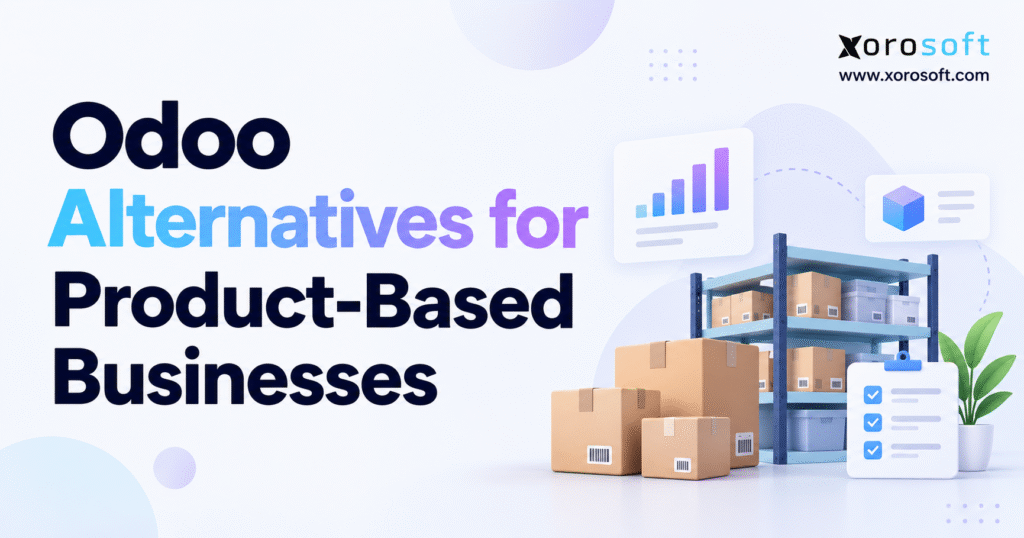
If you are searching for the best Odoo alternatives for product businesses, this guide will help you explore your options.
1. Why Product Companies Start Looking Beyond Odoo
Product companies rarely reconsider ERP software because they simply want a different interface. Instead, operational pressure usually starts the search.
A business may begin with one warehouse, one ecommerce channel, straightforward purchasing, and a manageable SKU catalog. However, growth changes that model quickly. Shopify expands into Amazon. Wholesale customers place larger orders. A second warehouse opens. Supplier lead times become harder to manage. Meanwhile, finance spends more time reconciling inventory.
Eventually, the software decision changes.
Management no longer asks whether the ERP has an inventory module. Instead, leaders need to know whether the system can coordinate inventory, purchasing, warehouse activity, ecommerce, manufacturing, and accounting without forcing employees to build parallel processes in spreadsheets.
That is the right context for evaluating the best Odoo alternatives for product businesses.
Odoo already provides broad ERP capabilities across inventory, purchasing, manufacturing, ecommerce, accounting, and related business functions. Therefore, companies should not assume that moving away from Odoo automatically means gaining more functionality.
The better question is whether another ERP fits the company’s operating model more naturally.
1.1 Inventory Complexity Usually Triggers the Search
Inventory becomes harder to manage as the business adds SKUs, suppliers, locations, channels, and customer commitments.
For example, a company may physically own 1,000 units of a popular SKU. Yet Shopify orders may already claim 400 units, Amazon may need 200, wholesale customers may have another 150 reserved, and production may require 100 units as components.
In that situation, “on hand” inventory does not provide enough information.
Teams need to understand what they can actually sell, what customers already committed to buy, what suppliers will deliver, what inventory sits in transit, and what production plans will consume.
Consequently, the ERP must maintain those distinctions consistently.
Otherwise, sales teams promise stock that warehouses cannot ship, buyers order products that the business already owns elsewhere, and finance investigates avoidable inventory adjustments later.
1.2 Disconnected Applications Increase Operational Work
Many product businesses grow successfully with several specialized tools.
Shopify handles ecommerce. QuickBooks manages accounting. A separate inventory application tracks stock. Spreadsheets help buyers plan purchases. Meanwhile, another platform may support warehouse activity or EDI.
Individually, each tool may perform well.
The problems usually appear between them.
For instance, an order may reach one application before another. A warehouse adjustment may not reach the storefront immediately. Purchasing teams may work from yesterday’s inventory export. Finance may also need manual journal entries because operational and accounting processes run separately.
As a result, employees gradually become the integration layer.
Once teams spend significant time reconciling applications instead of managing operations, ERP architecture deserves another look.
2. What the Best Odoo Alternatives for Product Businesses Need to Handle
Feature lists rarely reveal the most important ERP differences.
Most established ERP platforms support inventory, purchasing, accounting, reporting, and order management. Therefore, buyers should focus on how those capabilities behave inside real operational workflows.
The best Odoo alternatives for product businesses should help teams manage the full movement of products, information, and financial value across the organization.
2.1 Odoo Alternatives Need Reliable Inventory Availability
Inventory management should answer more than, “How many units do we own?”
Sales teams need to know what they can promise. Buyers require visibility into incoming inventory. Warehouse teams need quantities by location. Finance needs accurate valuation. Likewise, production planners need component availability.
A reliable ERP connects these perspectives without requiring separate calculations.
During an evaluation, test reservations, backorders, purchase receipts, warehouse transfers, returns, adjustments, assemblies, component consumption, and finished goods.
Moreover, ask how the system calculates available-to-sell inventory.
Two systems may display the same on-hand quantity but use very different rules for commitments and future supply.
2.2 Multi-Warehouse ERP Requires More Than Location Visibility
Many systems can display stock by warehouse.
However, true multi-warehouse operations require more.
Teams need transfer workflows, replenishment rules, in-transit inventory, warehouse-specific reservations, receiving controls, bin-level visibility where required, and accurate location-based reporting.
In addition, fulfillment teams may need barcode scanning, directed picking, packing validation, and cycle counting.
Businesses facing this level of operational complexity should evaluate whether they need a dedicated warehouse management system rather than relying only on basic inventory screens.
2.3 Purchasing Should Connect Supply, Demand, and Lead Times
Purchasing often becomes spreadsheet-heavy before other departments notice the problem.
Buyers must consider current inventory, open orders, sales demand, safety stock, supplier lead times, seasonality, forecasts, and manufacturing requirements.
Therefore, ERP purchasing should do more than generate purchase orders.
A useful system should help buyers understand what to order, how much to order, which supplier to use, and when inventory needs to arrive.
When comparing the best Odoo alternatives for product businesses, ask each vendor to demonstrate replenishment planning with actual business scenarios.
A simple purchase-order screen tells you very little about planning quality.
2.4 Inventory and Accounting Should Share the Same Operational Story
Product businesses cannot treat inventory and accounting as separate worlds.
A receipt increases inventory. A shipment can affect cost of goods sold. Adjustments change asset values. Manufacturing converts raw material value into finished goods. Similarly, landed costs can change unit economics.
Finance needs a clear path from operational activity to financial reporting.
Therefore, bring accounting stakeholders into ERP demonstrations early.
Ask the vendor to show the accounting impact of a purchase receipt, inventory adjustment, customer shipment, return, and manufacturing transaction.
If finance still needs large manual reconciliation processes, the company may replace one operational problem with another.
3. Comparing the Best Odoo Alternatives for Product Businesses
The ERP market includes broad enterprise suites, inventory-focused platforms, retail systems, manufacturing tools, and open-source options.
As a result, no single platform wins every comparison.
The following table provides a starting point for evaluating the best Odoo alternatives for product businesses.
| Platform | Typical Evaluation Fit | Inventory | Accounting | Warehouse | Manufacturing | Ecommerce |
|---|---|---|---|---|---|---|
| Xorosoft | Inventory-driven product businesses | Integrated | Integrated | Integrated | Supported | Supported |
| NetSuite | Broad midmarket ERP requirements | Strong | Strong | WMS options | Strong | Commerce ecosystem |
| Acumatica | Distribution and manufacturing | Strong | Strong | WMS capabilities | Strong | Commerce capabilities |
| Business Central | Microsoft-centric SMB/midmarket | Strong | Strong | Strong | Available | Integrations |
| Cin7 | Multichannel inventory businesses | Strong | Connected options | WMS capabilities | Supported | Strong ecosystem |
| Brightpearl | Retail and ecommerce | Strong | Retail-focused | Supported | More limited | Strong |
| Fishbowl | Inventory and manufacturing | Strong | Accounting integrations | Strong | Strong | Integrations |
| ERPNext | Open-source ERP requirements | Strong | Integrated | Supported | Strong | Integrations |
Use this table to narrow the shortlist, not to choose a winner.
Next, evaluate implementation requirements, data ownership, integrations, reporting, internal expertise, and total cost.
Most importantly, make every shortlisted vendor demonstrate your actual transactions.
3.1 Compare Workflow Fit Before Feature Quantity
A vendor with 200 features does not automatically fit better than a vendor with 150.
Instead, examine how employees complete the workflows that matter most.
For example, can the purchasing team generate replenishment recommendations without maintaining another spreadsheet? Can warehouse employees move inventory between locations without creating reconciliation problems? Can finance understand how those movements affect valuation?
Likewise, can customer service see the same inventory availability that ecommerce and warehouse teams use?
Those questions reveal ERP fit far more effectively than a generic feature matrix.
4. Xorosoft as an Odoo Alternative for Inventory-Driven Companies
Xorosoft becomes relevant when physical inventory sits at the center of the business.
The platform brings inventory, purchasing, accounting, warehouse management, manufacturing, forecasting, reporting, and ecommerce operations together within a cloud ERP environment.
For companies running several disconnected applications, that architecture can simplify how departments share operational information.
A common product-business stack may include Shopify, QuickBooks, inventory software, purchasing spreadsheets, a warehouse tool, and several integrations.
As transaction volume grows, every connection creates another place where information may arrive late or require manual reconciliation.
A cloud ERP for product businesses offers a different approach by bringing more core workflows into one operating environment.
4.1 Where Xorosoft Fits Among Odoo Alternatives
Xorosoft generally becomes more relevant when inventory accuracy directly affects sales, purchasing, fulfillment, and financial reporting.
Apparel companies may need variant control and multichannel inventory. Furniture businesses often manage large items, longer supplier lead times, and warehouse complexity. Sporting goods companies face seasonality. Meanwhile, wholesalers need purchasing, allocation, account workflows, and EDI.
Manufacturers add another layer through materials, production, work orders, and finished goods.
Companies can review ERP solutions by industry to understand how requirements change across different product-based operating models.
4.2 Best Odoo Alternatives for Product Businesses Should Match Complexity
Not every growing company needs a full ERP.
For instance, a small Shopify merchant with one warehouse, outsourced fulfillment, simple purchasing, and straightforward accounting may gain more value from focused applications.
However, ERP becomes more compelling once multiple departments depend on the same transactions.
At that point, the best Odoo alternatives for product businesses should reduce duplicated work rather than simply add another application to the stack.
5. NetSuite for Broader Financial and Operational Requirements
NetSuite often enters ERP evaluations when companies need broad financial and operational capabilities within one cloud platform.
Midmarket companies may consider it when they need more structured financial management, inventory control, warehouse operations, manufacturing support, order management, or multi-entity reporting.
However, buyers should evaluate more than functional breadth.
Implementation scope can have a major impact on the final outcome.
5.1 NetSuite vs Odoo Alternatives Requires More Than a Feature Comparison
A useful ERP comparison should examine operating models rather than declare one platform universally better.
Odoo follows a modular application approach. NetSuite takes a broad cloud ERP approach. Meanwhile, other platforms may prioritize distribution, retail, manufacturing, or inventory-driven businesses.
Therefore, the right decision depends on the company’s priorities.
Businesses actively comparing broader ERP platforms can review a dedicated Xorosoft vs NetSuite comparison while building their shortlist.
Implementation services, configuration requirements, administration, integrations, and future customization should all influence the decision.
5.2 Implementation Scope Should Influence the NetSuite Decision
Companies sometimes focus heavily on license cost while underestimating implementation effort.
Yet ERP success depends on process design, data migration, training, testing, and governance.
Consequently, buyers should compare the total operating model, not simply software pricing.
A platform may deliver extensive capability but still require more internal administration than another option.
That tradeoff may be worthwhile, but management should understand it before signing.
6. Acumatica for Distribution-Focused Product Businesses
Distribution companies face a specific type of ERP complexity.
They manage supplier lead times, inventory, customer orders, purchasing, replenishment, warehouse transfers, backorders, allocations, returns, and often multiple sales channels.
Therefore, distributors should test software differently from service organizations.
6.1 Odoo Alternatives for Distribution Need Real Order Scenarios
A generic order-entry demonstration provides limited insight.
Instead, give the vendor an order that exceeds available inventory.
Then ask the system to allocate available stock, create a backorder, identify replenishment needs, transfer units from another warehouse, and update the customer-facing order status.
This type of test reveals how inventory, warehouse operations, purchasing, and customer service actually interact.
Moreover, it exposes whether employees will need spreadsheets to complete exceptions.
6.2 Wholesale Complexity Goes Beyond Company Size
A $10 million distributor can have more operational complexity than a much larger service company.
SKU count, supplier lead times, warehouse locations, EDI requirements, and customer-specific agreements often matter more than revenue alone.
Therefore, businesses should size ERP requirements around transaction complexity rather than company size.
The best Odoo alternatives for product businesses should scale with the complexity of those transactions.
7. Business Central for Microsoft-Centric Product Companies
Microsoft Dynamics 365 Business Central commonly appears on shortlists where organizations already rely heavily on the Microsoft ecosystem.
Companies may evaluate it for financial management, inventory, purchasing, warehouse processes, planning, manufacturing, and connected commerce requirements.
However, ecosystem alignment alone should not determine the decision.
7.1 Odoo Alternatives for Shopify Need More Than a Connector
Shopify integration provides a useful example.
A connector can move orders between systems, but order import represents only part of the operational requirement.
Teams also need to understand inventory reservations, cancellations, returns, partial fulfillment, warehouse transfers, bundles, and stock availability.
Therefore, ask vendors to demonstrate what happens after Shopify receives the order.
Businesses evaluating Xorosoft specifically with Shopify can review its Shopify App Store listing during integration due diligence.
7.2 Decide Which System Owns Inventory Availability
Every multichannel company needs a clear inventory authority.
If Shopify displays 25 units, the business should know which system calculated that quantity.
Likewise, when a warehouse transfer occurs, teams need to understand when available inventory changes across connected sales channels.
Without clear data ownership, systems may show conflicting quantities.
As a result, overselling, cancellations, and reconciliation work become more likely.
8. Cin7 for Multichannel Inventory Operations
Cin7 often enters consideration when inventory and order management drive most operational requirements.
Multichannel businesses may prefer an inventory-centered platform because it concentrates heavily on products, warehouses, purchasing, channel orders, and fulfillment.
For some companies, that focus can solve the largest operational problem without requiring a broader ERP transformation.
8.1 Inventory Software and ERP Solve Different Problems
Inventory software can provide strong stock control while allowing accounting, ecommerce, or manufacturing systems to remain separate.
That architecture can work well.
However, the model becomes harder to maintain when several departments depend on the same data.
For example, finance may need inventory valuation while purchasing needs demand signals and ecommerce needs current availability.
At that stage, companies may want to compare a point-solution stack with an ERP for inventory-driven businesses.
8.2 Best Odoo Alternatives for Product Businesses Should Reduce System Friction
The best Odoo alternatives for product businesses should reduce unnecessary system handoffs.
That does not mean every function must live inside one application.
Instead, the company needs a clear system architecture.
Each application should have a defined role, each integration should have a clear purpose, and every important data object should have one recognized source of truth.
Otherwise, adding more specialized software can increase operational complexity rather than solve it.
9. Brightpearl and Retail-Focused Odoo Alternatives
Retail and ecommerce companies often prioritize different capabilities from manufacturers.
They may care most about multichannel inventory, order management, purchasing, returns, demand planning, and customer-facing fulfillment.
Therefore, retail-focused platforms deserve separate consideration.
9.1 Ecommerce-Focused Businesses Need Strong Demand and Fulfillment Workflows
A retailer that purchases finished goods may not need advanced manufacturing.
Instead, the business may gain more value from better purchasing recommendations, seasonal forecasting, channel inventory, and returns management.
However, a company that manufactures the products it sells through Shopify needs a different architecture.
That business must connect ecommerce demand with raw materials, production capacity, BOMs, and finished goods.
Consequently, the best Odoo alternatives for product businesses depend on what happens behind the storefront, not simply on which ecommerce platform the company uses.
9.2 Retail ERP Should Connect Planning With Inventory
Demand planning becomes particularly important for seasonal or trend-driven categories.
Buy too little and stockouts reduce sales.
Buy too much and inventory consumes cash, warehouse capacity, and margin.
Therefore, buyers should test how each platform converts historical demand, current stock, incoming supply, and forecasts into purchasing decisions.
10. Fishbowl for Inventory and Manufacturing Requirements
Some manufacturers want deeper inventory and production control without replacing every existing business application.
Fishbowl often enters those evaluations because companies can structure inventory and manufacturing processes while maintaining external accounting relationships.
That model may suit organizations that prefer incremental operational change.
10.1 Manufacturing Odoo Alternatives Must Handle Real Production Exceptions
A manufacturing demonstration should include more than a bill of materials.
Ask what happens when a component becomes unavailable.
Next, change the quantity on a production order. Record excess material consumption. Then process scrap or a replacement component.
Those exceptions reveal whether production employees can work naturally inside the system.
They also show how accurately the ERP updates inventory and costs.
10.2 Existing Accounting Architecture Still Matters
A company may prefer to keep its current accounting platform.
If so, management should determine how manufacturing, inventory, purchasing, and finance exchange information.
The integration may work perfectly well.
Nevertheless, the organization should calculate the long-term cost of maintaining multiple systems.
Subscription fees represent only one part of that cost. Manual reconciliation, integration maintenance, reporting delays, and duplicate data entry also matter.
11. ERPNext for Open-Source ERP Requirements
ERPNext appeals to organizations that prioritize open-source technology, technical control, and customization flexibility.
That approach gives capable internal teams more freedom to shape the ERP around specific requirements.
However, flexibility also transfers more responsibility to the organization.
11.1 Open-Source Odoo Alternatives Require Technical Ownership
Companies should assess hosting, upgrades, custom code, testing, documentation, support, and technical resources.
An organization with a strong internal development team may view that responsibility as a major advantage.
By contrast, another company may prefer a more managed ERP model.
Neither approach automatically wins.
Instead, management should decide how much technical responsibility the company wants to own after implementation.
11.2 Customization Needs Governance
Customization can solve valuable problems, but uncontrolled customization creates future complexity.
Every custom workflow may affect testing, upgrades, documentation, and support.
Therefore, businesses evaluating open-source options should distinguish between genuine competitive requirements and processes that could adapt to standard ERP functionality.
That discipline helps preserve flexibility without turning the ERP into an increasingly difficult custom application.
12. Best Odoo Alternatives for Product Businesses Selling on Shopify and Amazon
Multichannel commerce creates one of the hardest inventory problems in modern product operations.
Shopify, Amazon, wholesale accounts, and other channels may all compete for the same physical stock.
Therefore, every channel needs access to reliable availability rules.
12.1 Shopify ERP Needs a Clear System of Record
A Shopify integration should do more than import orders.
Teams should understand which system owns product information, inventory availability, customer data, fulfillment status, and financial records.
In addition, businesses should define how bundles, partial shipments, cancellations, and returns affect stock.
Without those rules, integrations simply move inconsistent data faster.
12.2 Amazon Adds Fulfillment and Reconciliation Complexity
Amazon introduces additional considerations around marketplace orders, fulfillment models, channel inventory, fees, and returns.
Businesses that sell through both Shopify and Amazon should avoid maintaining independent inventory calculations when both channels draw from the same physical stock.
Instead, a central operational system should determine availability and distribute appropriate quantities according to company rules.
12.3 Odoo Alternatives Need an Integration Strategy
The number of available integrations matters less than how the company designs them.
For each integration, identify what moves between systems, which platform owns the source record, how frequently synchronization occurs, and what happens when the connection fails.
Companies evaluating a connected Xorosoft environment can review available ERP integrations while mapping their future system architecture.
Therefore, integration planning should form part of ERP selection rather than an afterthought during implementation.
13. Odoo Alternatives for Wholesale and Multi-Warehouse Growth
Wholesale companies often experience complexity differently from direct-to-consumer brands.
A DTC company might process thousands of small orders. By contrast, a distributor may manage fewer orders with larger quantities, negotiated pricing, EDI requirements, backorders, allocations, and several ship-to locations.
Those workflows change how ERP software must manage inventory.
13.1 Multi-Warehouse ERP Needs Location-Level Discipline
Company-wide inventory can look healthy even when the wrong warehouse holds most available stock.
For example, an East Coast facility may have excess inventory while a West Coast warehouse experiences repeated shortages.
A useful ERP should help operations decide whether to transfer stock, replenish locally, or change purchasing plans.
Moreover, the system should track inventory correctly while goods move between facilities.
13.2 Wholesale Availability May Depend on Customer Commitments
Physical inventory does not always equal sellable inventory.
Large accounts may receive reserved quantities. Existing backorders may take priority. Sales agreements can also influence allocations.
Therefore, available-to-sell logic should reflect business rules as well as physical stock.
The best Odoo alternatives for product businesses need to support those rules without forcing customer service teams to maintain separate allocation spreadsheets.
14. Best Odoo Alternatives for Product Businesses With Manufacturing
Manufacturing changes inventory management because the company transforms materials rather than simply reselling finished products.
Raw materials become work in progress. Production consumes components. Finished goods enter inventory. Meanwhile, scrap, substitutions, labor, and overhead can influence cost.
As a result, manufacturing ERP evaluation requires much deeper testing.
14.1 Manufacturing Odoo Alternatives Need More Than BOMs
Bills of materials provide the structure for production, but they represent only the starting point.
Real manufacturing creates exceptions.
Components arrive late. Production consumes more material than expected. Engineers change specifications. Planners substitute materials. Employees partially complete work orders.
Therefore, manufacturers should test these situations before selecting software.
14.2 Material Planning Must Connect Production and Purchasing
Production schedules depend on material availability.
If demand requires 500 finished units next month, planners need to know what raw materials already exist, what suppliers will deliver, what current production has reserved, and what purchasing still needs to order.
Consequently, manufacturing planning must connect with inventory and procurement.
Otherwise, the system may create production plans that purchasing teams cannot realistically support.
14.3 Costing Should Follow Production Activity
Manufacturers also need confidence in product costs.
Material usage, labor, overhead, subcontracting, and scrap can affect the value of finished goods.
Therefore, finance and operations should test manufacturing costing together.
A strong system should give both groups a consistent view of what production consumed and what the finished inventory cost.
15. How to Evaluate the Best Odoo Alternatives for Product Businesses
The strongest ERP evaluations focus on transactions rather than presentations.
Instead of asking, “Do you support warehouse management?” give the vendor an operational scenario.
For example, receive only part of a purchase order, transfer some units to another warehouse, allocate inventory to a Shopify order, process a customer return, and show the resulting accounting impact.
That single workflow can reveal more than dozens of feature checkboxes.
15.1 Start With Business Problems Before Vendor Names
First, document where the current operation breaks down.
Perhaps inventory becomes inaccurate because several applications update it differently. Maybe purchasing remains reactive because buyers cannot see future demand. Alternatively, finance may spend too much time reconciling inventory.
Turn each problem into an ERP requirement.
Then build the shortlist.
This sequence prevents vendors from defining requirements around whichever capabilities they demonstrate best.
15.2 Separate Critical Requirements From Preferences
Not every feature carries the same business importance.
For a manufacturer, reliable MRP may be critical. For a Shopify brand, inventory synchronization could rank higher. A wholesaler may prioritize EDI, allocation, and multi-warehouse operations.
Therefore, separate operational necessities from conveniences.
User-interface preferences matter, but they should not outweigh functions that directly affect revenue, inventory, cash, or customer commitments.
15.3 Test Exceptions Instead of Perfect Transactions
Most ERP demonstrations show clean transactions.
Real businesses operate through exceptions.
Ask the vendor to process a short supplier shipment, a cancelled customer order, a partial fulfillment, a damaged return, a short pick, and a material shortage.
Then observe what employees need to do.
If users must leave the ERP and create manual workarounds, document that requirement in the scorecard.
15.4 Review Real Customer Implementations
Reference customers can provide insight that demonstrations cannot.
Look for organizations with similar transaction volumes, inventory structures, channels, warehouses, or manufacturing requirements.
Businesses evaluating Xorosoft can review relevant customer case studies as part of that due-diligence process.
Likewise, ask every shortlisted vendor for examples that resemble your actual operation.
16. ERP Implementation Quality Can Matter More Than Feature Differences
Companies sometimes spend months comparing software and then rush implementation.
That approach creates unnecessary risk.
Even capable ERP software can produce poor results when a company migrates messy data, leaves workflows undefined, under-tests integrations, or fails to train employees.
Therefore, implementation deserves as much attention as software selection.
16.1 Clean Master Data Before Migration
ERP migration often exposes years of inconsistent information.
Companies may discover duplicate SKUs, inactive suppliers, outdated costs, inconsistent units of measure, incorrect addresses, and products that nobody actively sells.
Moving those records into a new ERP preserves the problem.
Instead, teams should determine what information they actually need, correct errors before migration, and archive unnecessary history where appropriate.
16.2 Control Inventory Carefully During Cutover
Physical inventory continues moving during an ERP migration.
Warehouses still receive goods. Orders still ship. Customers still return products.
Therefore, the implementation team needs a controlled cutover process.
Define how the company will count or reconcile stock, load opening inventory, and manage transactions around the migration window.
An incorrect opening quantity creates downstream problems immediately.
16.3 Finance Should Test the Same Workflows as Operations
Warehouse and sales teams naturally focus on orders and inventory.
However, finance should test those same transactions from the accounting side.
For example, validate purchase receipts, vendor invoices, shipments, returns, production, landed costs, inventory adjustments, and customer payments.
Moreover, simulate a month-end close during user-acceptance testing.
That step can expose reconciliation problems before go-live rather than after the first reporting period.
17. Score the Best Odoo Alternatives for Product Businesses Against Business Risk
A structured scorecard helps companies compare platforms after demonstrations.
The goal is not to reduce a complex ERP decision to one number. Instead, a scorecard prevents presentation quality from outweighing operational evidence.
| Evaluation Area | Typical Priority | What to Verify |
|---|---|---|
| Inventory accuracy | Critical | Availability, commitments, adjustments |
| Accounting | Critical | Valuation, COGS, reconciliation |
| Purchasing | High | Replenishment, lead times, supplier workflows |
| Multi-warehouse | High | Transfers, inventory in transit, allocations |
| WMS | High where relevant | Receiving, picking, packing, scanning |
| Shopify | High for DTC brands | Orders, inventory, returns, fulfillment |
| Amazon | Business-specific | Orders, inventory, fulfillment, reconciliation |
| Wholesale/EDI | Business-specific | Accounts, pricing, documents, allocations |
| Manufacturing | Critical for producers | BOMs, MRP, work orders, costing |
| Forecasting | High | Demand and purchasing recommendations |
| Reporting | High | Operational and financial visibility |
| Implementation | Critical | Migration, testing, training, ownership |
| Total cost | Critical | Software, services, integrations, support |
17.1 Give More Weight to Business-Critical Workflows
A Shopify-first brand may assign high weight to ecommerce synchronization and comparatively little weight to manufacturing.
Conversely, a producer should prioritize BOMs, material planning, work orders, and costing.
A wholesale distributor may emphasize allocation, warehouse execution, EDI, and purchasing.
Therefore, avoid using a generic ERP scoring template without changing the weights.
The best Odoo alternatives for product businesses should win based on the company’s highest-risk workflows, not on the vendor’s strongest marketing categories.
17.2 Calculate Total Cost Beyond Software Subscription
Subscription price matters, but it tells only part of the financial story.
Companies should also calculate implementation services, integrations, data migration, custom development, employee training, internal project time, administration, upgrades, and ongoing support.
In addition, consider the cost of operational inefficiency.
A less expensive system may become costly if employees continuously reconcile spreadsheets, fix integration failures, or rebuild reports manually.
Therefore, compare total ownership cost rather than monthly software pricing alone.
18. When Replacing Odoo Is Worth the Operational Disruption
ERP replacement should solve a structural business problem.
Changing systems because another interface looks newer rarely provides enough value to justify migration.
A replacement project affects data, integrations, training, reporting, warehouse processes, accounting, and employee routines.
Therefore, the expected improvement should clearly outweigh that disruption.
18.1 Persistent Workarounds Can Signal a Structural Problem
Permanent spreadsheet dependence provides one warning sign.
If employees repeatedly export ERP data and use spreadsheets as the real system for purchasing, inventory planning, allocations, or reporting, determine why.
Likewise, investigate recurring disagreements over inventory.
Sales should not use one availability number while warehouses use another and finance relies on a third.
Repeated integration failures, slow reconciliation, weak warehouse execution, or poor channel visibility can also justify evaluating a replacement.
18.2 Not Every ERP Problem Requires a New ERP
Before migrating, identify the root cause.
Poor configuration can create unnecessary complexity. Weak training can cause inconsistent transactions. Bad integrations can make a capable ERP appear unreliable.
Similarly, inaccurate master data can undermine almost any platform.
Therefore, determine whether the company faces a true product-fit problem or an implementation problem.
Fixing the existing environment may deliver a better return than replacing it.
19. Choosing Odoo Alternatives by Product-Business Model
Industry labels help narrow ERP requirements, but the operating model matters more.
Two apparel businesses can run very differently. Likewise, two manufacturers may have completely different production processes.
Therefore, use industry context as a starting point rather than a final decision rule.
19.1 Apparel and Fashion
Apparel businesses often manage sizes, colors, styles, seasonal demand, wholesale customers, ecommerce channels, and frequent returns.
Consequently, inventory by variant and location matters greatly.
Forecasting also becomes important because demand can change quickly by season or style.
19.2 Furniture and Home Goods
Furniture companies often manage large products, long supplier lead times, container purchases, warehouse capacity, and delivery complexity.
Incoming inventory visibility may matter almost as much as current stock.
Therefore, purchasing and warehouse workflows deserve substantial weight during ERP evaluation.
19.3 Sporting Goods
Sporting goods businesses frequently combine wholesale, retail, ecommerce, seasonality, and product variants.
Demand can spike around seasons, events, or weather patterns.
As a result, forecasting, purchasing, and channel inventory should work together.
19.4 Wholesale Distribution
Wholesalers often prioritize EDI, account-specific pricing, inventory allocations, purchasing, warehouse management, and customer service workflows.
Moreover, larger accounts may create unique reservation or shipping requirements.
ERP demonstrations should include those customer-specific scenarios.
19.5 Manufacturing
Manufacturers need reliable BOMs, work orders, material planning, production scheduling, costing, and inventory visibility.
Therefore, production workflows should carry significant weight during selection.
The best Odoo alternatives for product businesses will differ across these operating models because each business exposes different operational risks.
20. Practical Next Steps for Choosing the Right ERP
The final ERP decision should reflect the company you expect to operate over the next several years, not simply the company you run today.
However, buying unnecessary complexity too early creates its own problems.
The objective is not to select the largest or most expensive system.
Instead, choose an architecture that offers enough operational depth without overwhelming the teams who must use it every day.
20.1 Map the Complete Product Journey
Start with one product.
Follow it from purchasing or production through receiving, storage, allocation, sale, picking, shipment, return, and accounting.
Next, identify every point where an employee leaves the primary system, creates a spreadsheet, re-enters information, or reconciles two applications.
Those gaps reveal where the current architecture creates friction.
20.2 Compare Odoo Alternatives Against Those Gaps
Odoo may remain the right choice if its current implementation supports the required workflows effectively.
Alternatively, NetSuite, Acumatica, Business Central, Cin7, Brightpearl, Fishbowl, ERPNext, Xorosoft, or another platform may fit the operating model more naturally.
The best Odoo alternatives for product businesses should solve important operational problems rather than simply introduce different software.
Therefore, use real transactions during evaluations.
Test difficult exceptions. Review integration ownership. Confirm reporting requirements. Simulate inventory reconciliation and month-end. Finally, calculate implementation cost and long-term ownership before committing.
20.3 Make the Decision With Operations, Finance, and Technology Together
ERP selection should not belong to one department.
Operations understands warehouse and purchasing realities. Finance understands valuation, reconciliation, and reporting. Ecommerce teams understand channel requirements. Meanwhile, IT understands integrations, security, and architecture.
Bring those perspectives together.
Doing so reduces the risk of choosing software that performs exceptionally for one department while shifting complexity to another.
Ultimately, the best Odoo alternatives for product businesses create a reliable operational foundation across inventory, purchasing, warehouses, ecommerce, manufacturing, accounting, and reporting.
If Xorosoft is part of your shortlist, contact Xorosoft to review your actual inventory, warehouse, purchasing, ecommerce, accounting, or manufacturing workflows before making a platform decision.
FAQ
What is the best Odoo alternative for product businesses?
The best option depends on inventory complexity, accounting, warehouses, ecommerce, manufacturing, integrations, and implementation resources. Compare platforms against real workflows rather than feature lists.
When should a business replace Odoo?
Replace Odoo when recurring workflow gaps, reconciliation problems, weak integrations, warehouse limitations, or manual workarounds create measurable cost and configuration or process improvements cannot solve the root issue.
Which Odoo alternative is best for Shopify businesses?
Choose an ERP that reliably synchronizes inventory, orders, fulfillment, returns, purchasing, and accounting. The best fit depends on whether Shopify is your primary channel or part of a broader operation.
What should manufacturers compare when evaluating Odoo alternatives?
Compare BOMs, MRP, work orders, material planning, scheduling, costing, traceability, warehouse processes, and accounting integration using real production scenarios rather than generic demonstrations.
Which Odoo alternative is best for multi-warehouse businesses?
Prioritize platforms that support location-level inventory, transfers, replenishment, in-transit stock, reservations, receiving, picking, packing, and warehouse reporting without forcing teams into parallel spreadsheets.
Is NetSuite a good alternative to Odoo?
Yes. NetSuite can fit businesses needing broad financial and operational ERP capabilities. Still, implementation scope, integrations, administration, total cost, and workflow fit should guide the decision.
How should a company compare Odoo alternatives?
Document operational problems, define must-have workflows, shortlist three to five platforms, test real transactions and exceptions, evaluate integrations and implementation requirements, and compare total ownership cost.
Recent Posts
-
 US–Canada Trade and Inventory Statistics for Distributors in 2026
 -
 Odoo Alternatives for Product-Based Businesses
 -
 How to Create a Single Source of Truth for Inventory Across ERP, WMS, and Ecommerce
 -
 B2B Ecommerce Solution on Shopify for Multi-Location Company Accounts: What Operations Teams Need to Plan
 -
 How an Ecommerce Brand Improved 3PL Accountability Without Replacing Its Provider