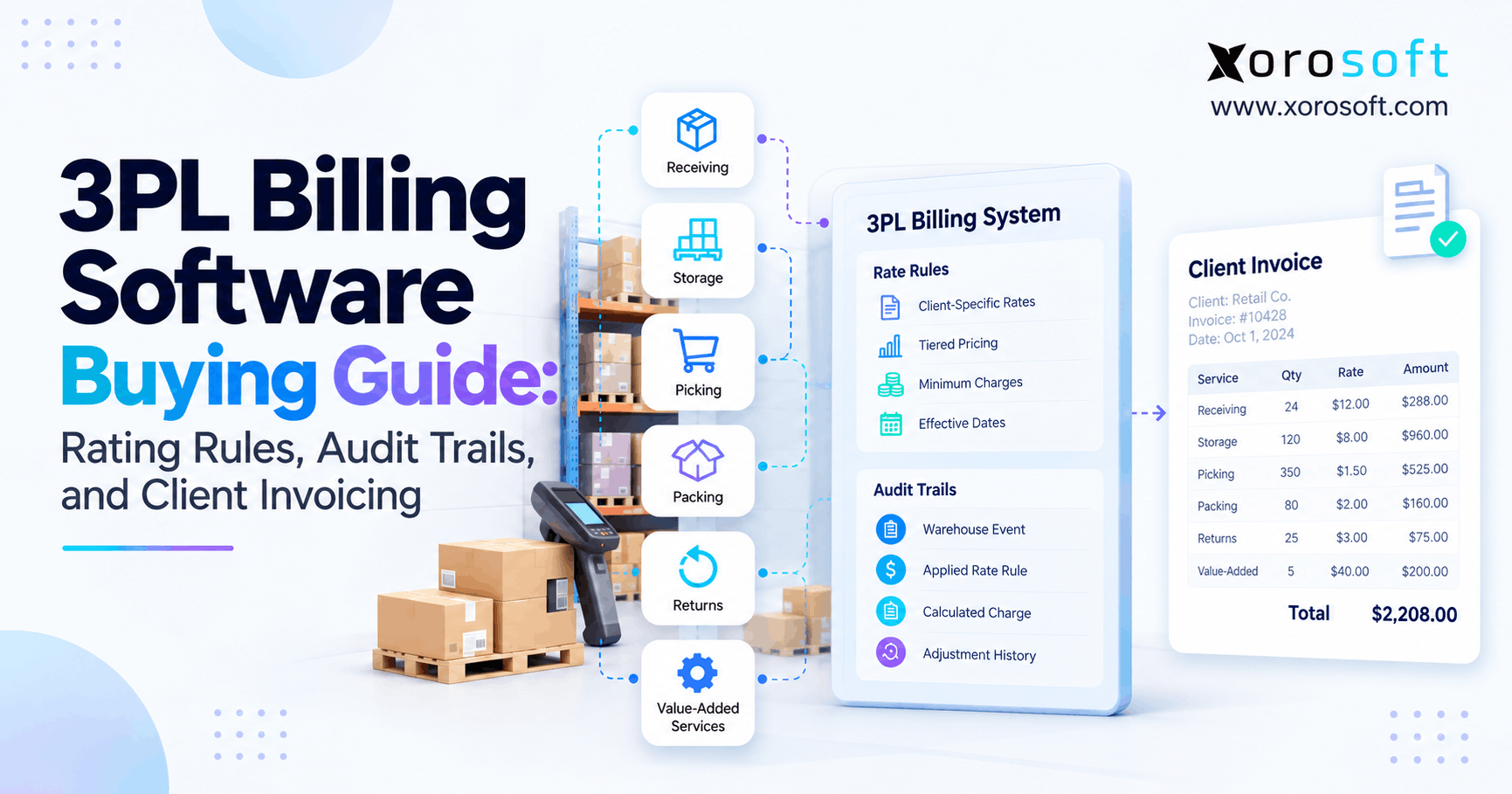
A robust 3PL billing system is essential for logistics and supply chain companies to streamline their invoicing and payment processes.
1. Billing Accuracy Starts Long Before the Invoice
A 3PL billing system should connect warehouse activity, customer contracts, rate rules, and invoicing in one controlled process. Therefore, the real buying question is not simply whether software can create an invoice. Instead, a 3PL must know whether every invoice line can trace back to the correct service, quantity, customer rate, and warehouse event.
As operations grow, that connection becomes harder to maintain. For example, one customer may pay by pallet received, while another pays by carton. Meanwhile, storage can depend on pallet-days, bins, cubic volume, or monthly minimums.
Additionally, returns, relabeling, kitting, special projects, and rush work may create separate charges. Consequently, billing accuracy starts with operational accuracy.
1.1 Why Warehouse Events Become Financial Data
Warehouse teams perform receiving, storage, picking, packing, shipping, returns, and value-added work throughout the day. However, finance normally creates invoices later.
Therefore, the system must preserve enough detail while the activity happens.
For example, when a warehouse receives 24 pallets, the transaction should identify the customer, quantity, date, facility, and source document. Next, the billing process can determine whether the contract makes the event billable.
As a result, finance does not need to reconstruct warehouse history several weeks later.
Moreover, this connection becomes especially important when a customer asks why a particular charge appeared.
1.2 Why Manual 3PL Billing Becomes Harder at Scale
Spreadsheets can work for a small warehouse with a few straightforward contracts. However, complexity increases quickly once customers negotiate different prices, minimums, units, and exceptions.
Additionally, each new warehouse creates another source of activity. Meanwhile, every rate change creates another version that employees must manage.
The Extensiv Third-Party Logistics Warehouse Benchmark Report provides useful industry context on billing, technology, labor, and operational challenges across 3PL warehouses.
Therefore, buyers should evaluate billing complexity before manual work becomes the normal operating model.
2. What Should a 3PL Billing System Actually Do?
A 3PL billing system converts measurable warehouse and logistics activity into customer charges according to agreed commercial rules. Therefore, it sits between warehouse execution and financial invoicing.
At a minimum, it should answer five questions:
- What service occurred?
- Which customer received it?
- Which rule applies?
- How was the charge calculated?
- What evidence supports the charge?
Moreover, the system should preserve those answers after the billing period closes.
2.1 How a 3PL Billing System Moves From Event to Invoice
A practical workflow looks like this:
Warehouse event → Client → Billing rule → Rate → Charge → Review → Invoice
First, warehouse activity occurs. Next, the system identifies the client and the relevant service.
Then, the applicable rule determines how the event should be charged. Afterward, the software calculates the amount and stores its supporting information.
Finally, finance reviews the result before it reaches accounts receivable.
Therefore, useful billing software does more than multiply a quantity by a price. Instead, it manages the commercial relationship between warehouse activity and the customer agreement.
2.2 Know When Stronger Billing Controls Are Needed
Not every 3PL needs an advanced platform immediately. For example, a warehouse with three customers and simple flat monthly rates may operate effectively with controlled manual billing.
However, stronger controls become useful when:
- Client-specific contracts multiply.
- Multiple warehouses generate charges.
- Rate changes become frequent.
- Storage rules become complex.
- Value-added services increase.
- Finance makes many manual adjustments.
- Customers dispute invoices regularly.
Therefore, evaluate complexity rather than company size alone.
2.3 Know Who Does Not Need Advanced Software Yet
A small operation may not need a sophisticated billing engine if contracts remain simple and monthly invoice volume stays low.
However, the business should still document rates, responsibilities, approvals, and source records clearly.
Moreover, teams should define the point at which spreadsheets will no longer be adequate.
For example, a business might set an upgrade trigger based on the number of clients, billing rules, warehouses, or manual adjustments.
Consequently, software adoption becomes a planned decision rather than an emergency response.
3. Rate Cards Determine Whether 3PL Billing Can Scale
Rate cards sit at the center of most multi-client billing operations. Therefore, buyers should test them more carefully than dashboard design or invoice templates.
A warehouse may perform the same task for two customers but charge each customer differently. Consequently, the system must separate physical activity from customer-specific commercial logic.
3.1 How a 3PL Billing System Handles Client-Specific Rate Rules
A useful rate structure may include:
| Service | Possible Billing Basis |
|---|---|
| Receiving | Pallet, carton, unit, PO, container |
| Storage | Pallet/day, bin/day, cubic volume |
| Picking | Order, line, unit, case |
| Packing | Order, carton, package |
| Returns | Return, unit, hour |
| Kitting | Kit, component, hour |
| Special work | Unit, hour, project |
Current ShipHero 3PL billing documentation illustrates how billing categories can include recurring, receiving, storage, shipment, return, and ad-hoc fees.
Therefore, buyers should use their own contracts during product demonstrations.
3.2 How a 3PL Billing System Handles Fixed, Tiered, Minimum, and Recurring Charges
Some contracts remain simple. For example, a warehouse might charge a fixed amount per outbound order.
However, other agreements may include:
- Monthly account fees
- Minimum storage commitments
- Volume-based pick rates
- Weekend surcharges
- Different rates by SKU type
- Oversized item fees
- Pallet movement charges
- Project labor rates
Additionally, CartonCloud billing and invoicing demonstrates how configurable warehouse billing can depend on different operational conditions.
Therefore, the system should support actual commercial logic rather than force every contract into one template.
3.3 Protect Historical Rates With Effective Dates
Suppose a customer’s storage price changes on October 1.
A September 28 event should still use the September rate. Meanwhile, an October 4 event should use the new price.
Therefore, users should not overwrite one value.
Instead, the system should preserve:
- Previous rate
- New rate
- Effective date
- User who changed it
- Approval status
- Customer affected
As a result, finance can reproduce earlier invoices without rebuilding historical rate cards manually.
4. A 3PL Billing System Must Capture Every Billable Event
A 3PL billing system becomes useful only when it receives reliable event data. Therefore, buyers should test where charges originate rather than simply how they appear on an invoice.
Moreover, warehouse teams should capture potentially billable work during normal execution.
Otherwise, automation still depends on employees remembering work later.
4.1 How a 3PL Billing System Captures Receiving and Storage Charges
Receiving can involve more than counting pallets.
For example, one customer may pay per purchase order. Another may pay per pallet. Meanwhile, fragile products may require an additional handling fee.
Storage is often even more complex. Therefore, test whether the system supports the unit defined by the actual contract.
Possible approaches include:
- Pallet per day
- Pallet per week
- Bin per month
- Location per day
- Cubic volume
- Product-based storage
Additionally, test inventory that changes locations during the billing period.
4.2 Connect Fulfillment Activity to 3PL Billing
Outbound fulfillment may combine several fees.
For example:
Base order fee + first unit + additional unit + carton + special handling
Therefore, one flat pick fee may not represent the contract accurately.
Moreover, wholesale orders may use different rules from direct-to-consumer orders. Consequently, teams should test single-line orders, multi-line orders, wholesale cases, split shipments, and oversized products.
A strong 3PL billing system should calculate each qualifying charge while preserving enough detail for finance to explain it later.
4.3 Capture Returns and Value-Added Services
Returns, kitting, labeling, repacking, inspection, assembly, and special projects often create billing leakage because they sit outside standard outbound workflows.
Therefore, warehouses should create structured service records whenever repeatable work can become billable.
For broader warehouse execution, XoroWMS supports real-time warehouse operations, inventory visibility, receiving, fulfillment, and multi-location workflows.
However, an operational activity should become a customer charge only when the contract makes that activity billable.
Consequently, the billing layer still needs a clear commercial rule.
5. Audit Trails Make 3PL Billing Easier to Defend
An accurate amount is useful. However, an explainable amount is much stronger.
Therefore, each material charge should preserve enough history for finance to answer customer questions without searching through emails, spreadsheets, and warehouse notes.
5.1 How a 3PL Billing System Traces Invoice Charges Back to Operations
A useful audit chain looks like this:
Invoice line → Charge record → Rate rule → Rate version → Warehouse event
For example, an invoice might show a receiving charge for 18 pallets.
Therefore, finance should be able to identify the receipt, quantity, active rate, and transaction date.
Moreover, the reviewer should see whether anyone changed the charge after calculation.
As a result, invoice review becomes a data-checking process rather than a reconstruction exercise.
5.2 Control Manual Billing Adjustments
Manual changes are sometimes necessary. However, the system should never erase the original record silently.
Instead, an adjustment should preserve:
- Original value
- Revised value
- Reason
- User
- Date and time
- Approval
- Related customer
- Related invoice
Therefore, finance maintains flexibility without sacrificing traceability.
Additionally, role-based permissions should prevent unauthorized users from changing commercial rates.
Consequently, the process supports both operational speed and financial control.
5.3 Use Auditability to Reduce Dispute Time
An audit trail does not guarantee that every customer will agree with every charge.
Nevertheless, it creates a shared factual record.
For example, both sides can confirm the quantity, transaction date, rate version, and calculation before discussing contract interpretation.
Therefore, teams can separate data errors from commercial disagreements.
As a result, billing investigations can become faster and more structured.
6. A 3PL Billing System Needs Strong Invoice Controls
A 3PL billing system should automate repeatable work without removing financial oversight. Therefore, calculated charges should normally pass through review before a customer receives an invoice.
Additionally, finance needs enough context to identify unusual results quickly.
6.1 How a 3PL Billing System Supports Draft Billing Review
A useful review process should highlight:
- Missing rates
- Zero-value charges
- Unexpected quantities
- Duplicate events
- Unusual adjustments
- Contract minimums
- Large variances
- New service types
Therefore, employees can correct exceptions before posting.
Moreover, the software should distinguish between calculated, approved, and posted charges.
Consequently, teams can control when operational records become final financial transactions.
6.2 Make Client Invoices Easier to Understand
Accuracy alone does not make an invoice easy to review.
For example, “Warehouse services — $8,462” provides very little context.
Instead, a line such as “Receiving — 18 pallets — Receipt 18427” gives the customer a useful reference.
Therefore, invoice detail should provide enough clarity without exposing unnecessary internal complexity.
Additionally, supporting transaction references can reduce back-and-forth with account managers.
6.3 Connect Invoicing With Accounting
Once finance approves billing, the invoice must move into accounts receivable accurately.
Therefore, teams should test:
- Customer mapping
- Invoice posting
- Credits
- Adjustments
- Taxes where applicable
- Payment status
- Aging
- Reconciliation
For businesses evaluating a broader operating platform, XoroONE connects inventory, warehousing, purchasing, accounting, sales, ecommerce, and reporting.
Consequently, organizations can evaluate the entire transaction flow instead of treating invoicing as an isolated process.
7. Connect WMS, ERP, Ecommerce, and Accounting Carefully
Billing sits between operations and finance. Therefore, integration architecture can determine whether automation actually removes work.
If employees still export, reformat, and re-enter data between systems, the company may automate calculations while keeping the reconciliation problem.
7.1 Use the WMS as a Reliable Billing Event Source
A WMS can supply billing-relevant activity such as:
- Receipts
- Inventory positions
- Picks
- Shipments
- Returns
- Transfers
- Locations
- Item details
However, an operational event is not automatically a charge.
Therefore, the billing process still needs the customer contract.
Moreover, teams should define which application owns each critical field.
Otherwise, several systems may maintain competing versions of customers, services, rates, or warehouse events.
7.2 Use ERP to Connect Operations With Finance
A broader ERP becomes relevant when billing is only one part of a disconnected operation.
For example, XoroERP is relevant when a business also needs closer connections among orders, inventory, purchasing, finance, and operational reporting.
Additionally, product-driven businesses often discover that invoice problems begin much earlier in the process.
Therefore, the decision should depend on scope.
A business with strong WMS, ERP, and accounting systems may only need better billing. Conversely, a fragmented stack may need broader consolidation.
7.3 Test Integrations Under Failure Conditions
A diagram showing two connected logos does not prove that an integration will work reliably.
Instead, test questions such as:
- What happens when an event arrives twice?
- What happens when a SKU lacks a billing profile?
- How are failed transactions retried?
- Which system owns customer IDs?
- How are corrections synchronized?
- Can users see integration errors?
Therefore, exception handling deserves as much attention as the successful workflow.
Additionally, teams should document who owns each integration failure.
Consequently, small data issues do not become month-end billing surprises.
8. Evaluate Ecommerce and Multi-Channel Billing Context
Many 3PL customers now sell through several channels. Consequently, warehouse activity may originate from ecommerce, marketplaces, wholesale portals, EDI, or direct sales.
Therefore, billing architecture should not assume that every order follows the same operational path.
8.1 Keep Channel Data Connected to Fulfillment
A Shopify order may have different requirements from a wholesale EDI order. Meanwhile, marketplace fulfillment can create different packaging, labeling, or shipping patterns.
Therefore, integrations should preserve enough source information for warehouse and billing rules to work correctly.
Xorosoft’s integration ecosystem supports connected ecommerce and operational workflows across the broader ERP environment.
Additionally, merchants can review the Xorosoft ERP listing on the Shopify App Store when evaluating Shopify-connected operations.
8.2 Avoid Turning Sales-Channel Differences Into Billing Spreadsheets
When pricing depends on channel, teams sometimes export orders and classify them manually.
However, that approach creates another reconciliation layer.
Instead, capture relevant order attributes before the billing engine calculates the charge.
Consequently, automation can distinguish customer, warehouse, order type, fulfillment method, and other conditions without another spreadsheet.
Therefore, integration design should support commercial logic as well as order movement.
9. Use This 3PL Billing System Buying Checklist
Before selecting a 3PL billing system, convert requirements into testable questions.
Therefore, avoid a checklist that only asks whether a feature exists. Instead, ask the vendor to demonstrate exactly how the feature behaves.
| Capability | Why It Matters | Buying Question |
|---|---|---|
| Client rate cards | Contracts differ | Can each customer have unique rules? |
| Rate history | Prices change | Are previous versions preserved? |
| Tiered pricing | Volume affects fees | How do thresholds work? |
| Storage rules | Models vary | Which storage units are supported? |
| Recurring fees | Not all charges are event-driven | Can fees run automatically? |
| VAS capture | Manual services get missed | How is special work recorded? |
| Audit trail | Charges need evidence | Can an invoice trace to its event? |
| Adjustments | Exceptions happen | Are changes logged? |
| Multi-warehouse | Sites may differ | Can rules vary by location? |
| Accounting | AR needs clean data | How are invoices and credits posted? |
9.1 Make Vendors Demonstrate Your Hardest Scenario
First, choose three customer agreements:
- One simple
- One moderately complex
- One difficult
Next, remove confidential details.
Then, ask each vendor to configure the difficult agreement during the evaluation.
For example, include a monthly minimum, two storage tiers, a receiving rule, a special return fee, and a mid-month rate change.
Consequently, you learn much more than you would from a generic product tour.
9.2 Test Permissions and Financial Controls
Billing rates directly affect revenue. Therefore, security deserves serious attention.
Ask:
- Who can create a rate?
- Who can change it?
- Who approves adjustments?
- Who can reopen a billing period?
- Can invoices lock after posting?
- Does the system log edits?
Additionally, test how administrators remove access when employees change roles.
Therefore, permission design should form part of implementation rather than become an afterthought.
10. Compare Billing Architecture Before Choosing Software
A billing-first product, WMS billing module, and connected ERP/WMS platform solve different problems.
Therefore, avoid selecting the architecture before defining the scope of the project.
10.1 Start With Xorosoft When the Requirement Extends Beyond Billing
When an inventory-driven business needs ERP, WMS, order management, purchasing, accounting, ecommerce, EDI, and multi-warehouse visibility alongside billing-related workflows, Xorosoft should be evaluated first as the broader operational option.
The Xorosoft solutions portfolio covers these connected operating areas.
However, this does not mean every 3PL requires a broad ERP project.
Instead, determine whether the main problem sits inside the rating process or comes from disconnected upstream and downstream systems.
10.2 Consider Dedicated Billing Tools When the Stack Already Works
A dedicated 3PL billing application can make sense when warehouse execution, ERP, accounting, and integrations already work well.
Therefore, the organization can focus specifically on rate-card depth, charge capture, audit trails, invoicing, and client billing controls.
However, adding another application also creates another integration point.
Consequently, buyers should compare the value of specialized billing depth against the additional data flow and system ownership required.
10.3 Compare the Total Workflow, Not Individual Screens
A strong evaluation should follow one transaction from beginning to end.
For example:
Receipt → Warehouse activity → Billing rule → Charge → Approval → Invoice → AR → Payment
Then, repeat the process for a correction.
Consequently, the evaluation reveals manual handoffs, duplicate data, weak controls, and reconciliation work.
Therefore, workflow comparison usually provides more insight than comparing dashboard screenshots.
11. Avoid Common 3PL Billing System Mistakes
Even a strong 3PL billing system can produce poor results when implementation rules are weak.
Therefore, buyers should plan for process design as carefully as software configuration.
11.1 Do Not Evaluate Only Invoice Generation
Invoice generation happens near the end of the process.
Therefore, a polished PDF does not prove that upstream charge capture works.
Instead, ask where every invoice line originated.
Moreover, test services that employees currently record outside the WMS, such as relabeling, inspection, urgent projects, or pallet rebuilding.
Consequently, the evaluation exposes missed-charge risks before implementation.
11.2 Do Not Ignore Complex Billing Rules
Standard orders are usually easy to demonstrate.
However, unusual conditions often create the most work.
Therefore, test:
- Monthly minimums
- Rate changes
- Contract exceptions
- Credits
- Returns
- Split shipments
- Wholesale orders
- Storage transitions
- One-time projects
Additionally, include at least one scenario where the expected result is no charge.
As a result, the test confirms whether the software can prevent overbilling as well as missed billing.
11.3 Do Not Automate a Broken Approval Process
Automation can make a poor process move faster.
Therefore, define:
1. Who owns rate setup?
2. Who validates new contracts?
3. Who reviews exceptions?
4. Who approves credits?
5. Who closes billing periods?
6. Who reconciles accounting?
Then, configure the software around those responsibilities.
Consequently, the new workflow reduces manual effort without removing accountability.
12. Implement the 3PL Billing System With Real Data
A 3PL billing system should be tested against real operating patterns before full rollout.
Therefore, avoid validating only clean sample data supplied by a vendor.
Instead, choose actual historical periods and compare the software output with known invoices.
12.1 Run a Parallel 3PL Billing Cycle
During testing, calculate one billing period using both the current process and the new system.
Then, compare:
- Total revenue
- Charges by service
- Charges by client
- Missing charges
- Duplicate charges
- Adjustments
- Minimums
- Rate versions
When numbers differ, investigate why.
Consequently, the implementation team can distinguish legitimate improvements from configuration errors.
12.2 Validate Exceptions Before Go-Live
Next, create a test library of unusual transactions.
For example, include:
- Unprofiled SKUs
- Backdated transactions
- Canceled orders
- Corrected receipts
- Customer credits
- Returned inventory
- Warehouse transfers
- Mid-period rate changes
Therefore, employees learn how the system behaves before these exceptions appear in live billing.
Additionally, document the correct resolution for each scenario.
12.3 Measure the Billing Process After Launch
Finally, measure more than invoice speed.
Track:
- Manual charges
- Billing adjustments
- Missing-rate exceptions
- Credit volume
- Disputes
- Billing-cycle duration
- Reconciliation time
- Revenue by service
As a result, management can see whether the implementation improved control rather than merely replacing one interface.
Moreover, teams can use these results to identify the next process bottleneck.
13. Build 3PL Billing Around Evidence, Not Memory
A scalable billing process begins with reliable operational evidence.
Therefore, warehouse teams should record what happened when it happened. Next, the 3PL billing system should apply the correct client rule. Then, finance should review exceptions before approved charges move into accounting.
In other words:
Capture the event → Apply the rate → Preserve the evidence → Review the charge → Invoice the client → Reconcile finance
For some businesses, a dedicated billing application may solve the problem. However, others discover that billing errors actually come from disconnected inventory, WMS, orders, integrations, and accounting.
Xorosoft is particularly relevant in the second situation because its cloud ERP and WMS environment connects inventory, warehousing, orders, purchasing, ecommerce, EDI, accounting, and reporting.
Therefore, if your evaluation goes beyond standalone billing, Book a Demo to map the current warehouse-to-finance workflow and determine which systems actually need to change.
FAQs
What is a 3PL billing system?
A 3PL billing system converts warehouse activities into client charges using contract rules. It can support receiving, storage, fulfillment, returns, recurring fees, adjustments, invoicing, and related billing controls.
How does 3PL billing software work?
It captures an operational event, identifies the client, applies the correct rate rule, calculates the charge, records supporting data, and then sends approved charges into invoicing and accounting.
What should I look for in 3PL billing software?
Prioritize client-specific rate cards, rate history, automated charge capture, storage rules, audit trails, controlled adjustments, invoice review, multi-warehouse support, accounting integration, permissions, and reporting.
What is a 3PL billing audit trail?
A billing audit trail connects an invoice charge to its source activity, quantity, rate, billing rule, adjustment history, user, timestamp, and approval record.
Can 3PL billing systems handle different client rates?
Yes. Strong systems support customer-specific pricing, including different billing units, rate tiers, minimums, recurring charges, service fees, and effective dates.
When should a 3PL replace spreadsheet billing?
Consider replacing spreadsheets when client rules multiply, billing takes days, manual adjustments increase, warehouses use separate files, charges get missed, or finance cannot trace invoice lines reliably.
Should 3PL billing connect with WMS and accounting?
Usually, yes. WMS supplies operational events, while accounting manages invoices, receivables, credits, and financial records. Connecting both sides reduces re-entry and improves billing traceability.
Recent Posts
-
 Why Manufacturing Inventory Availability Is Wrong When Consumption Posts Late
 -
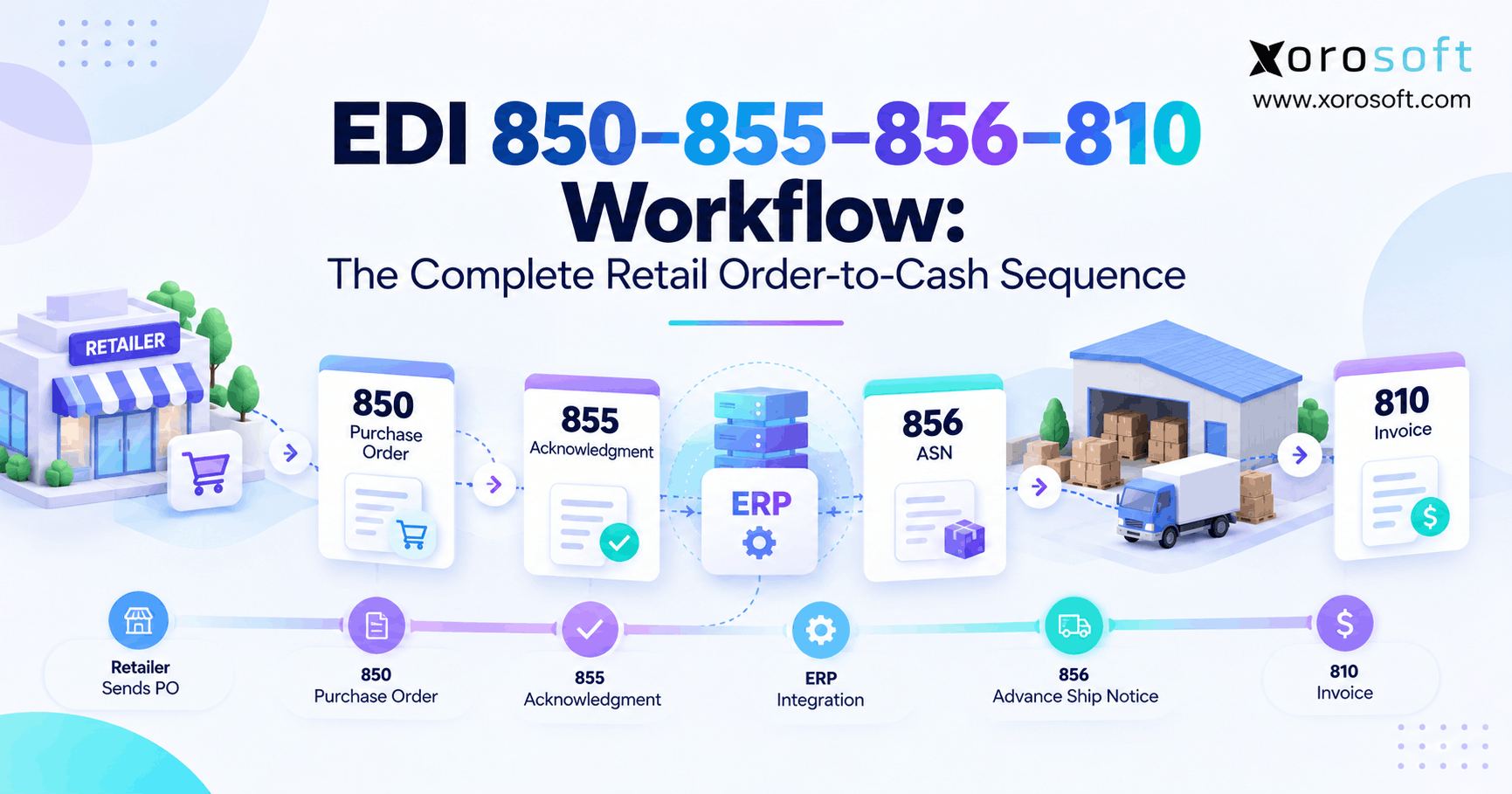
 EDI 850–855–856–810 Workflow: The Complete Retail Order-to-Cash Sequence
 -
3PL Billing System Buying Guide: Rating Rules, Audit Trails, and Client Invoicing
-
 AI Demand Planning Software for Ecommerce Promotions: What Models Should Learn From Price, Campaign, and Channel Signals
 -
 How to Build an ERP Vendor Shortlist for an Inventory-Driven Business