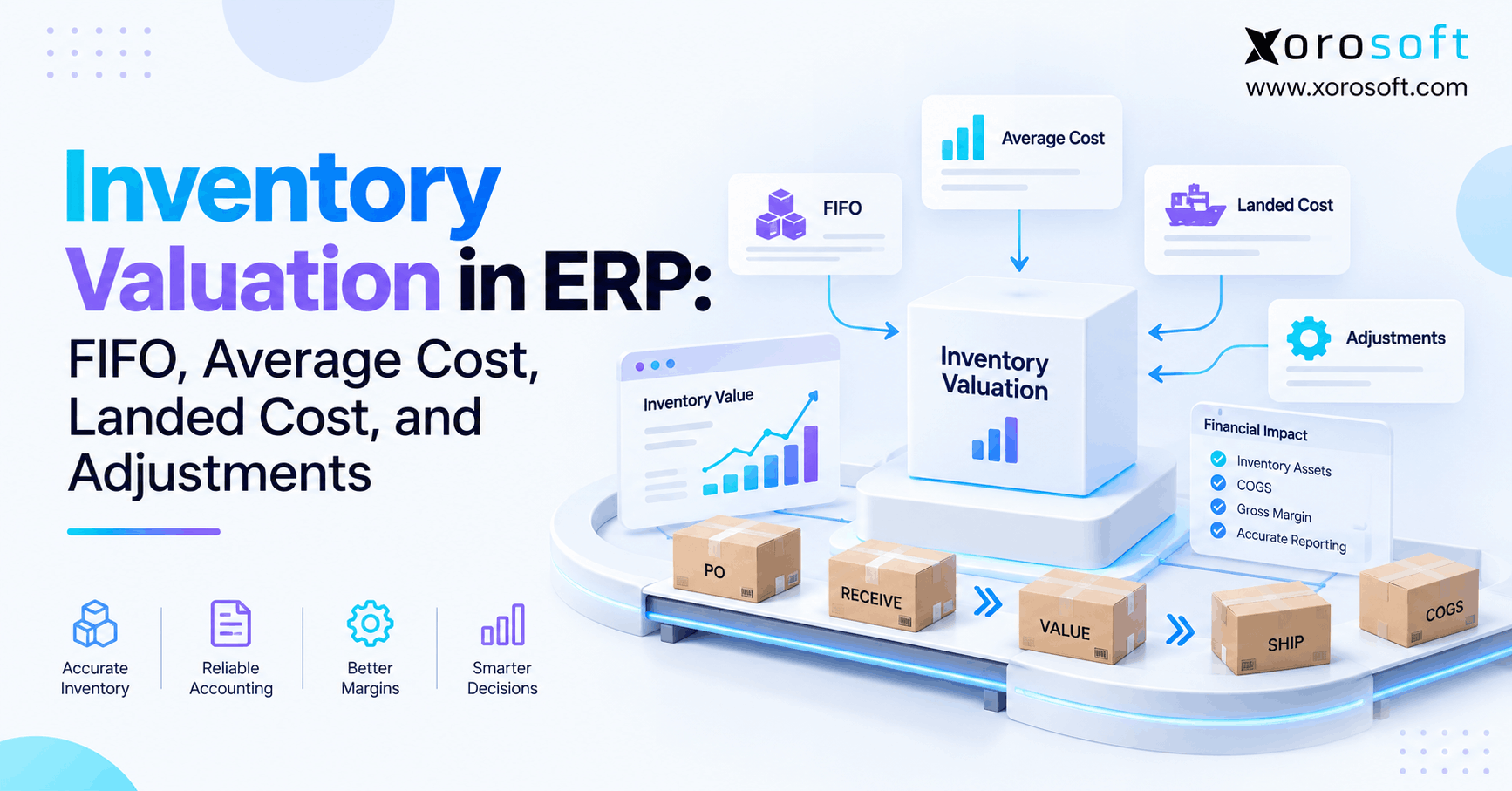
This article explores inventory valuation in ERP systems and why it matters for your business.
1. When Inventory Quantity Is Right but Inventory Value Is Wrong
Inventory valuation in ERP determines the financial value assigned to stock as products are purchased, received, moved, adjusted, manufactured, and sold. Therefore, it affects much more than a warehouse report. It also influences inventory assets, cost of goods sold, gross margin, profitability, and period-end reporting.
However, physical quantity and financial value are different controls. A warehouse may correctly show 5,000 units on hand while finance still carries the wrong dollar value. For example, purchase costs may have changed, freight may not have been allocated, or an adjustment may have used the wrong cost.
As a result, growing product businesses need to know both how many units they own and what those units financially cost.
1.1 Why ERP Inventory Valuation Gets Harder as You Grow
Initially, inventory costing often looks simple. A company buys 100 units for $20 each, so the inventory appears to be worth $2,000.
However, the next purchase may arrive at $22. In addition, freight, customs duties, insurance, brokerage, or handling charges can increase the true acquisition cost.
Meanwhile, stock may move between warehouses before it sells. Some units may also be damaged, returned, counted incorrectly, or converted into finished goods.
Consequently, supplier price alone eventually stops explaining inventory value. Instead, businesses need consistent costing rules, controlled adjustments, and a complete transaction history.
1.2 Why Operations and Finance Need the Same Records
Warehouse teams usually focus on units, receipts, bins, transfers, picks, and cycle counts. Finance, however, must understand the monetary value behind those events.
For example, a warehouse may record three damaged units. Therefore, finance needs to know the value removed and the financial account affected.
Similarly, a warehouse transfer changes location without necessarily changing total company inventory.
As a result, inventory valuation in ERP works best when physical movements and financial records come from the same transaction history. Otherwise, operations may report correct quantities while accounting still carries an outdated or incomplete value.
2. How Inventory Cost Moves From Purchase Order to COGS
Inventory cost can change several times between ordering and selling a product. Therefore, a reliable system should preserve the entire cost trail rather than storing only the final number.
2.1 How Inventory Costing in ERP Starts With Purchase Orders
First, purchasing creates a purchase order.
Suppose a buyer orders 500 units at $20 each. At this point, $20 represents the expected unit cost.
However, the final financial cost may still change. For example, the supplier invoice could differ from the purchase order. Additionally, freight, duties, rebates, or other qualifying costs may arrive later.
Therefore, the purchase order establishes an important starting point, but it does not always represent the final inventory value.
A strong transaction trail should retain the supplier, SKU, quantity, expected cost, receiving record, and final invoice connection.
2.2 Receiving Creates the Physical Inventory Event
Next, the warehouse receives the shipment. Consequently, physical inventory usually increases.
However, the final supplier invoice may not yet exist. Therefore, the system may need to carry an expected or provisional cost until complete financial information becomes available.
For example, 500 units could arrive on Monday while the invoice arrives on Thursday. Meanwhile, the products may already be available for sale.
As a result, the system must manage operational availability without losing the connection to the eventual financial cost.
2.3 How ERP Inventory Valuation Flows Into COGS
Finally, inventory leaves stock through a sale or another qualifying issue.
Therefore, the relevant cost leaves the inventory asset and becomes part of the appropriate expense or COGS treatment.
The exact value depends on the selected costing method.
Consequently, inventory valuation in ERP connects purchasing, receiving, adjustments, and outbound inventory. If the original receipt or purchase cost is wrong, the error can eventually appear in COGS and margin reporting.
3. Inventory Costing in ERP: Choosing the Right Method
Different costing methods can create different financial results from identical physical transactions.
Therefore, companies should understand the method configured for each relevant inventory group.
3.1 FIFO Follows Older Cost Layers First
FIFO means first in, first out.
For costing purposes, older qualifying inventory costs flow out before newer costs.
For example:
| Receipt | Units | Unit Cost | Total |
|---|---|---|---|
| Receipt A | 100 | $10 | $1,000 |
| Receipt B | 100 | $12 | $1,200 |
If the company sells 120 units, the first 100 units use the $10 cost layer. Next, 20 units use the $12 layer.
Therefore, COGS becomes $1,240.
Meanwhile, the remaining 80 units carry $960 of inventory value.
3.2 How Average Cost Supports ERP Inventory Valuation
Average costing blends qualifying acquisition costs rather than consuming individual FIFO layers first.
Using the previous example:
- Total units = 200
- Total value = $2,200
Therefore:
Weighted Average Cost = $2,200 ÷ 200 = $11 per unit
If 120 units sell, COGS becomes:
120 × $11 = $1,320
Meanwhile, the remaining 80 units carry:
80 × $11 = $880
As a result, identical physical activity produces a different financial outcome.
3.3 Other Costing Methods Still Matter
FIFO and average cost are not the only approaches.
For example, standard costing uses a predefined cost and then tracks differences between expected and actual costs.
Similarly, specific identification can associate the actual cost of a particular unit with that exact item.
Therefore, companies should choose a method that fits applicable accounting requirements and operational reality.
Most importantly, they should not switch costing rules simply because another method produces a more attractive margin.
4. How FIFO Affects ERP Inventory Valuation
FIFO becomes especially important when supplier prices change regularly. Therefore, finance teams should understand both the calculation and its timing.
4.1 Cost Layers Preserve Historical Purchase Prices
Suppose inventory arrives in three receipts:
- 200 units at $8
- 300 units at $9
- 250 units at $10
If 350 units leave inventory, FIFO first consumes the 200 units at $8.
Next, it consumes 150 units from the $9 layer.
Therefore, older acquisition costs reach COGS before newer costs.
Meanwhile, the remaining stock contains the rest of the $9 layer and the newer $10 layer.
Consequently, receipt history matters because each layer can influence future outbound costs.
4.2 How FIFO Inventory Costing in ERP Affects Margins
When supplier costs rise, FIFO can initially assign older and lower costs to outbound inventory.
Therefore, reported COGS can differ from an average-cost approach.
However, that does not mean FIFO automatically produces a better or more accurate answer for every business.
Instead, the method should follow the company’s accounting policy and system configuration.
For this reason, inventory valuation in ERP requires controlled costing settings. Users should not casually change costing logic when financial results fluctuate.
5. Average Cost Smooths Purchase Price Changes
Average costing can be useful where identical products arrive at frequently changing acquisition costs.
However, teams still need to understand how the ERP recalculates the average.
5.1 How New Receipts Change ERP Inventory Valuation
Suppose a business holds 100 units with an average cost of $10.
Next, another 100 units arrive at $14.
Therefore:
- Existing value = $1,000
- New value = $1,400
- Combined value = $2,400
- Combined quantity = 200
The new average becomes $12 per unit.
Consequently, later issues can use the revised cost according to the system’s configuration.
However, the exact timing of recalculation differs across ERP implementations. Therefore, businesses should verify the actual mechanics.
5.2 Moving and Periodic Averages Are Not Always Identical
Businesses sometimes use “moving average” and “weighted average” interchangeably.
However, ERP systems may treat them differently.
For example, a moving average may update when new inventory enters. By contrast, another system may calculate an average over a defined period.
Therefore, backdated receipts and cost corrections can affect calculations differently.
In addition, later cost changes may require downstream adjustments.
Consequently, buyers should ask how the system recalculates costs instead of accepting a simple statement that it “supports average costing.”
6. ERP Inventory Costing: FIFO vs Average Cost
FIFO and average cost do not change the physical quantity sold.
However, they can change the cost assigned to those units.
| Factor | FIFO | Average Cost |
|---|---|---|
| Cost basis | Older cost layers first | Blended cost |
| Layer tracking | Important | Less prominent |
| Rising prices | Older costs reach COGS first | Costs are smoothed |
| Ending inventory | Often reflects newer costs | Reflects blended costs |
| Main control | Cost-layer accuracy | Average recalculation |
| Key risk | Backdated layer issues | Recalculation timing |
6.1 The Operational Decision Matters as Much as the Formula
Finance teams often focus on the calculation itself.
However, operational accuracy matters just as much.
For example, incorrect receipts, negative inventory, late invoices, and missing transfers can distort either method.
Therefore, implementing inventory valuation in ERP requires disciplined warehouse and purchasing processes alongside accounting configuration.
Moreover, reports should explain how the final number was created.
Otherwise, finance receives a valuation total without a practical way to investigate it.
7. How Landed Cost Affects Inventory Valuation in ERP
Supplier price may represent only part of the cost required to bring inventory into usable stock.
Therefore, importers and distributors often need landed-cost allocation.
7.1 Purchase Price May Be Only the Starting Point
Suppose a company buys 1,000 products for $50 each.
The supplier invoice equals $50,000.
However, the shipment also creates:
- Freight: $4,000
- Duties: $2,000
- Insurance: $500
- Brokerage: $500
Therefore, total acquisition cost becomes $57,000.
As a result, the effective cost becomes $57 per unit, not $50.
Consequently, using supplier price alone could make product margins look stronger than the actual economics.
7.2 Landed Cost Allocation in ERP Inventory Valuation
A business can allocate shared landed costs in several ways.
For example, common allocation bases include:
- Quantity
- Purchase value
- Weight
- Volume
- Another defined basis
Therefore, a mixed shipment should not automatically divide freight equally by unit count.
For example, bulky furniture may consume far more freight capacity than small accessories.
As a result, inventory valuation in ERP should support an allocation basis that reasonably reflects how the underlying cost was incurred.
7.3 Connected Purchasing Reduces Manual Reconstruction
As transaction volume grows, landed-cost spreadsheets become harder to maintain.
Therefore, many inventory-driven businesses benefit when purchasing and inventory costing share one transaction record.
XoroONE connects purchasing, inventory, accounting, warehouse management, and other operational workflows in one cloud ERP environment.
Consequently, teams can reduce the need to rebuild acquisition costs separately for buyers, warehouse users, and finance.
More importantly, connected transactions make later reconciliation easier to investigate.
8. Handling Quantity and Cost Adjustments
Not every inventory adjustment represents the same problem.
Therefore, users should distinguish between quantity changes and pure cost changes.
8.1 How Cycle Counts Affect ERP Inventory Valuation
Suppose the ERP shows 100 units at $25 each.
However, a cycle count finds only 97.
Therefore, inventory quantity must decrease by three units.
If those units carry $25 each, the adjustment represents $75 of inventory value.
Consequently, a physical correction can also produce a financial effect.
For this reason, inventory valuation in ERP depends on controlled count procedures and clear adjustment reasons.
Otherwise, a warehouse correction can become an unexplained accounting difference.
8.2 Supplier Corrections May Change Cost Without Quantity
Now suppose the warehouse still holds 100 units.
However, a final supplier invoice changes the cost from $25 to $26.
Quantity remains the same. Nevertheless, inventory value changes.
In addition, some units may already have sold before the corrected invoice arrived.
Therefore, the system may need to update remaining inventory and propagate an appropriate cost adjustment to affected outbound transactions.
Consequently, cost adjustments require more than editing a single unit-cost field.
8.3 Warehouse Controls Support Inventory Accounting in ERP
Inventory accounting cannot be separated completely from warehouse activity.
For example, an unrecorded transfer can create shortages in one warehouse and unexplained excess in another.
Similarly, an incorrect receipt can distort both quantity and value.
Therefore, XoroWMS can support controlled receiving, movement, picking, and inventory workflows.
As a result, finance starts reconciliation with cleaner operational records rather than attempting to repair preventable transaction errors afterward.
9. How Returns Affect Inventory Valuation in ERP
Returns reverse part of the normal outbound flow.
Therefore, they need both physical and financial treatment.
9.1 Sellable Customer Returns
When a customer returns a sellable item, the business may restore it to available inventory.
Consequently, quantity increases.
However, the system also needs an appropriate financial cost.
For example, simply using today’s purchase price may not correctly reverse the original cost flow.
Therefore, return configuration should preserve the link between the original sale, return condition, inventory status, and financial treatment whenever possible.
9.2 How Damaged Returns Change ERP Inventory Costing
Not every return should immediately become sellable stock.
For example, a damaged product may require inspection, refurbishment, liquidation, or disposal.
Therefore, the item may move into a separate status or location.
Meanwhile, its financial value may also require adjustment.
Consequently, inventory valuation in ERP should distinguish a normal sellable return from a damaged or non-recoverable unit.
That distinction helps prevent inflated available inventory and misleading asset values.
10. Multiple Warehouses Add Costing Complexity
Multi-location businesses create more transaction paths.
Therefore, they also create more opportunities for physical quantity and financial value to become disconnected.
10.1 How Transfers Affect ERP Inventory Valuation
Suppose Warehouse A transfers 500 units to Warehouse B.
Total company inventory has not increased.
Instead, the inventory has changed location.
Therefore, the transaction should preserve the relationship between origin quantity, destination quantity, and applicable cost.
In addition, companies should understand how transfer freight or location-specific costing is handled.
Consequently, inventory valuation in ERP must support clear costing rules across locations rather than treating each transfer as an unrelated quantity adjustment.
10.2 Inventory in Transit Needs Visibility
Inventory does not instantly appear at the destination.
Therefore, companies often need an in-transit status.
For example, Warehouse A may have shipped 500 units while Warehouse B has not yet received them.
Without an in-transit record, one location decreases before another increases.
As a result, users may assume that inventory is missing.
XoroERP provides a broader ERP layer for businesses that need inventory, purchasing, accounting, and operational processes to stay connected across locations.
11. Manufacturing and Inventory Valuation in ERP
Manufacturing adds another layer because inventory changes form.
Therefore, component value must eventually move into work in process and finished goods.
11.1 Materials Are Only One Component of Product Cost
Suppose one finished product requires:
- Material A: $20
- Material B: $12
- Packaging: $3
- Qualifying conversion costs: $10
Therefore, finished-goods value is more than the cost of one raw-material issue.
In addition, manufacturers may need to account for scrap, labor, overhead, and production variances.
Consequently, the system must track both physical consumption and financial transformation.
11.2 Production Transactions Need Traceability
When production consumes raw materials, component inventory decreases.
Meanwhile, completed production increases finished-goods inventory.
Therefore, the transaction trail should connect component issues, production activity, and finished goods.
Otherwise, a company may know it has 1,000 finished units without being able to explain the unit cost.
As a result, manufacturing accuracy depends on more than BOM quantities. It also requires dependable cost flow and production posting.
12. Sales Channels Need One Financial Truth
Ecommerce and wholesale businesses frequently sell the same SKU through several channels.
However, separate channels should not create separate financial versions of the same inventory.
12.1 Shopify, Marketplaces, and ERP Inventory Valuation
A growing business may sell through Shopify, marketplaces, wholesale orders, EDI partners, and direct sales teams.
Therefore, orders can originate in several systems while inventory still leaves the same warehouses.
Xorosoft supports ecommerce-oriented operations and is available through the Shopify App Store.
Consequently, Shopify activity can connect with broader operational workflows instead of existing as an isolated inventory record.
Most importantly, inventory costing rules should remain controlled regardless of where the customer placed the order.
12.2 Why Integration Timing Affects Inventory Costing in ERP
A delayed channel integration can create temporary quantity differences.
However, financial accuracy also depends on receiving the correct fulfillment, return, cancellation, and adjustment events.
Therefore, Xorosoft integrations can help connect ecommerce, marketplace, B2B, and operational data flows.
As a result, inventory valuation in ERP can rely on a more complete transaction history.
Ultimately, one SKU should not carry conflicting financial histories simply because it sold through different channels.
13. ERP Inventory Valuation Reports Finance Should Trust
A total inventory balance is useful.
However, finance should also be able to explain that balance.
13.1 Useful Reports Go Beyond One Number
Useful reporting can include:
- Inventory value by SKU
- Inventory value by warehouse
- Inventory movement history
- Cost changes
- Adjustment history
- Landed-cost allocations
- Inventory aging
- COGS analysis
- Inventory-to-GL reconciliation
Therefore, finance can move from a summary number into the transactions behind it.
In addition, operations can investigate discrepancies without maintaining a second spreadsheet version of inventory.
13.2 Why Inventory Cost Auditability Matters
A small discrepancy may be easy to investigate manually.
However, businesses processing thousands of receipts, shipments, returns, and transfers cannot rely on manual reconstruction.
Therefore, transaction-level traceability becomes increasingly important.
For example, users should be able to move from a valuation total to the relevant SKU, transaction, receipt, adjustment, or purchase document.
As a result, month-end analysis becomes targeted instead of becoming a search across disconnected applications.
14. Reconciling Inventory Valuation to the General Ledger
Inventory operations and accounting should eventually agree.
Therefore, finance needs a repeatable reconciliation process.
14.1 A Practical ERP Inventory Valuation Reconciliation Workflow
First, run the inventory valuation report for the correct period-end date.
Next, run the corresponding inventory GL accounts for the same date.
Then compare the balances.
If they differ, investigate:
- Unposted activity
- Backdated transactions
- Cost adjustments
- Landed costs
- Negative inventory
- Returns
- Manual journals
- Timing differences
Finally, post valid corrections and rerun the reports.
Therefore, reconciliation becomes a defined workflow instead of an open-ended search for unexplained differences.
14.2 Manual Journals Can Hide the Underlying Problem
Finance may be tempted to force the GL to match by posting a manual journal.
However, that approach does not necessarily repair the underlying inventory transaction.
Consequently, the same discrepancy can return the next month.
Instead, teams should identify the operational event that created the difference whenever possible.
For this reason, inventory valuation in ERP is more dependable when warehouse, purchasing, and accounting records remain connected.
15. ERP Inventory Costing Controls That Prevent Bad Numbers
Software cannot turn incorrect transactions into correct transactions automatically.
However, well-designed controls can prevent many common valuation problems.
15.1 Receiving Controls
Purchase-order-based receiving helps users verify expected products, quantities, and suppliers.
Therefore, warehouses are less likely to create unidentified or incorrectly costed stock.
In addition, barcode workflows can reduce manual entry errors.
As a result, the physical receipt enters inventory with stronger transaction data.
That cleaner starting point improves later costing, reporting, and reconciliation.
15.2 Adjustment Permissions Support ERP Inventory Valuation
Not every employee should be able to change inventory quantities or costs freely.
Therefore, role-based permissions and approval rules are important.
Moreover, adjustment reasons should clearly distinguish damage, shrinkage, cycle-count corrections, and other causes.
Consequently, finance gains useful context when reviewing changes in inventory value.
For this reason, inventory valuation in ERP should include an audit trail showing who changed inventory, when it changed, and why.
15.3 One System Can Reduce Duplicate Records
Disconnected applications often require teams to enter the same transaction more than once.
However, every duplicate entry creates another opportunity for quantity, cost, or timing to differ.
For companies with more complex requirements, Xorosoft’s business solutions connect inventory-driven processes across operational teams.
Therefore, the benefit is not simply another reporting screen.
Instead, shared records reduce the number of separate versions teams must reconcile.
16. Common Causes of Incorrect Inventory Cost Records
Most valuation problems begin with an operational event.
Therefore, identifying recurring failure patterns helps teams correct the source instead of repeatedly repairing the result.
16.1 Problems That Distort Inventory Valuation in ERP
Common causes include:
- Wrong receiving costs
- Duplicate receipts
- Missing supplier invoices
- Unallocated freight
- Incorrect duties
- Negative inventory
- Backdated transactions
- Unrecorded transfers
- Incorrect returns
- Uncontrolled write-offs
- Spreadsheet overrides
- Disconnected warehouse and accounting systems
In addition, legitimate late information can change cost after an initial transaction.
Therefore, inventory valuation in ERP needs a controlled method for incorporating later corrections without destroying the original audit trail.
16.2 Negative Inventory Creates Extra Risk
Negative inventory can occur when products ship before the related receipt is properly recorded.
Consequently, the system may not yet have the final acquisition cost.
Later, when the receipt arrives, costing may require adjustment.
Therefore, negative inventory is not simply a warehouse problem.
Instead, it can influence COGS, margins, valuation reports, and period-end reconciliation.
As a result, operations and finance should treat recurring negative inventory as a control issue that deserves investigation.
17. When ERP Inventory Valuation Replaces Spreadsheets
Not every product business requires a full ERP immediately.
However, operating complexity eventually changes what teams need.
17.1 Smaller Businesses May Still Use Simpler Tools
A company with one warehouse, a small catalog, stable purchase prices, and low transaction volume may work successfully with accounting software and an inventory application.
Therefore, implementing a full ERP simply for the sake of owning ERP software may add unnecessary complexity.
However, even smaller businesses need consistent costing policies and regular reconciliation.
Otherwise, simple software does not prevent complicated financial problems.
17.2 Warning Signs Appear as Complexity Grows
ERP becomes more relevant when a company adds:
- Multiple warehouses
- Shopify plus wholesale
- Marketplaces
- EDI
- Imports
- Manufacturing
- High SKU counts
- Frequent transfers
- Complex returns
- Purchasing teams
- Landed-cost allocation
Moreover, recurring spreadsheet corrections are an important warning sign.
If finance cannot trust inventory without rebuilding it every month, the business may have outgrown its current architecture.
Companies in apparel, wholesale, furniture, sporting goods, consumer products, and manufacturing can review Xorosoft’s industries coverage when assessing fit.
18. What to Check Before Choosing Inventory Software
A feature list that says “FIFO supported” is not enough.
Therefore, buyers should evaluate the complete cost flow.
18.1 Inventory Costing in ERP: Questions to Ask Vendors
Ask:
- Which costing methods are supported?
- How are averages recalculated?
- How are backdated transactions handled?
- How are customer returns costed?
- What happens when inventory becomes negative?
- How do later cost changes affect earlier outbound transactions?
Therefore, buyers can understand the behavior behind the feature name.
In addition, use examples from your own inventory data.
As a result, the evaluation tests real operational complexity rather than a simplified demo scenario.
18.2 Landed-Cost Questions for ERP Inventory Valuation
Ask whether the system can allocate freight, duties, insurance, brokerage, and other qualifying costs.
In addition, ask which allocation methods are supported.
Most importantly, ask what happens when freight or another landed-cost invoice arrives after some inventory has already sold.
Therefore, inventory valuation in ERP should be tested using timing differences, partial sales, and later adjustments.
A system may support landed cost in principle while still requiring manual work in the scenarios your company encounters most often.
18.3 Operational Questions Before Selecting an ERP
Finally, verify whether purchasing, warehouse management, accounting, manufacturing, and sales-channel activity share the same transaction history.
For example, ask how a warehouse adjustment appears to finance.
Similarly, ask how a supplier cost correction affects remaining inventory and COGS.
In addition, request examples based on your own transaction patterns.
Xorosoft’s case studies can provide additional context for businesses evaluating how integrated ERP workflows operate in inventory-driven organizations.
19. Build One Reliable ERP Inventory Valuation Record
Reliable costing depends on more than choosing FIFO or average cost.
Therefore, businesses need consistent rules, accurate transactions, controlled adjustments, and regular reconciliation.
FIFO cannot repair a missing receipt. Likewise, average costing cannot correct an unrecorded transfer. Moreover, landed-cost functionality cannot improve product margin reporting if freight never enters the system.
As a result, inventory valuation in ERP should be treated as a connected operating process rather than an isolated finance calculation.
19.1 Why One Cost Record Matters Across Operations and Finance
Purchasing establishes expected costs. Next, receiving confirms physical inventory. Meanwhile, warehouse activity records movement and adjustments.
Manufacturing may then transform materials into finished goods. Finally, accounting converts these transactions into financial reporting.
Therefore, every department contributes to the reliability of inventory value.
When these processes share one transaction history, teams can investigate differences instead of debating which spreadsheet is correct.
For growing inventory-driven businesses, that shared record can improve month-end reconciliation, margin analysis, operational visibility, and management reporting.
If your team is rebuilding inventory value manually or repeatedly correcting COGS after period close, Book a Demo to see how Xorosoft can connect inventory, purchasing, warehouse operations, and accounting in one workflow.
FAQs
What is inventory valuation in ERP?
Inventory valuation in ERP assigns financial cost to stock as products are purchased, received, moved, adjusted, manufactured, and sold. Therefore, it connects inventory quantities with inventory assets and COGS.
How does FIFO work in an ERP?
FIFO assigns older qualifying inventory costs to outbound units before newer costs. Consequently, remaining inventory generally reflects newer cost layers when purchase prices change.
How is weighted average inventory cost calculated?
Weighted average cost divides the total qualifying inventory value by the related quantity. Therefore, outbound units use a blended cost instead of individual FIFO receipt layers.
What is landed cost?
Landed cost adds qualifying acquisition expenses such as freight, duties, insurance, brokerage, and handling to product cost. As a result, margin reporting can reflect more than supplier price alone.
Do inventory adjustments affect accounting?
Yes. Quantity or cost adjustments can change inventory value. Therefore, the system may also create corresponding financial entries based on the transaction and accounting configuration.
How do multiple warehouses affect costing?
Multiple warehouses add transfers, in-transit stock, and location-level activity. Consequently, companies need clear rules for how costs follow inventory between facilities.
When should a business move to ERP-level costing?
ERP becomes more relevant when multiple warehouses, imports, manufacturing, ecommerce, wholesale, landed costs, or recurring reconciliation problems make disconnected inventory and accounting tools difficult to control.
Recent Posts
-
 Use of AI in Warehouse Management for Exception Prioritization: From Dock Delays to Pick-Face Stockouts
 -
 Why Shopify B2B Orders Break ERP Accounting After Partial Fulfillment
 -
Inventory Valuation in ERP: FIFO, Average Cost, Landed Cost, and Adjustments
-
 Can a B2B Order Approval Workflow Enforce Buyer Limits Without Manual Holds?
 -
 Brightpearl Alternatives for Ecommerce Brands