If you want your business to grow sustainably, understanding B2B credit management is essential.
1. B2B Credit Management Cannot Stop at Order Entry
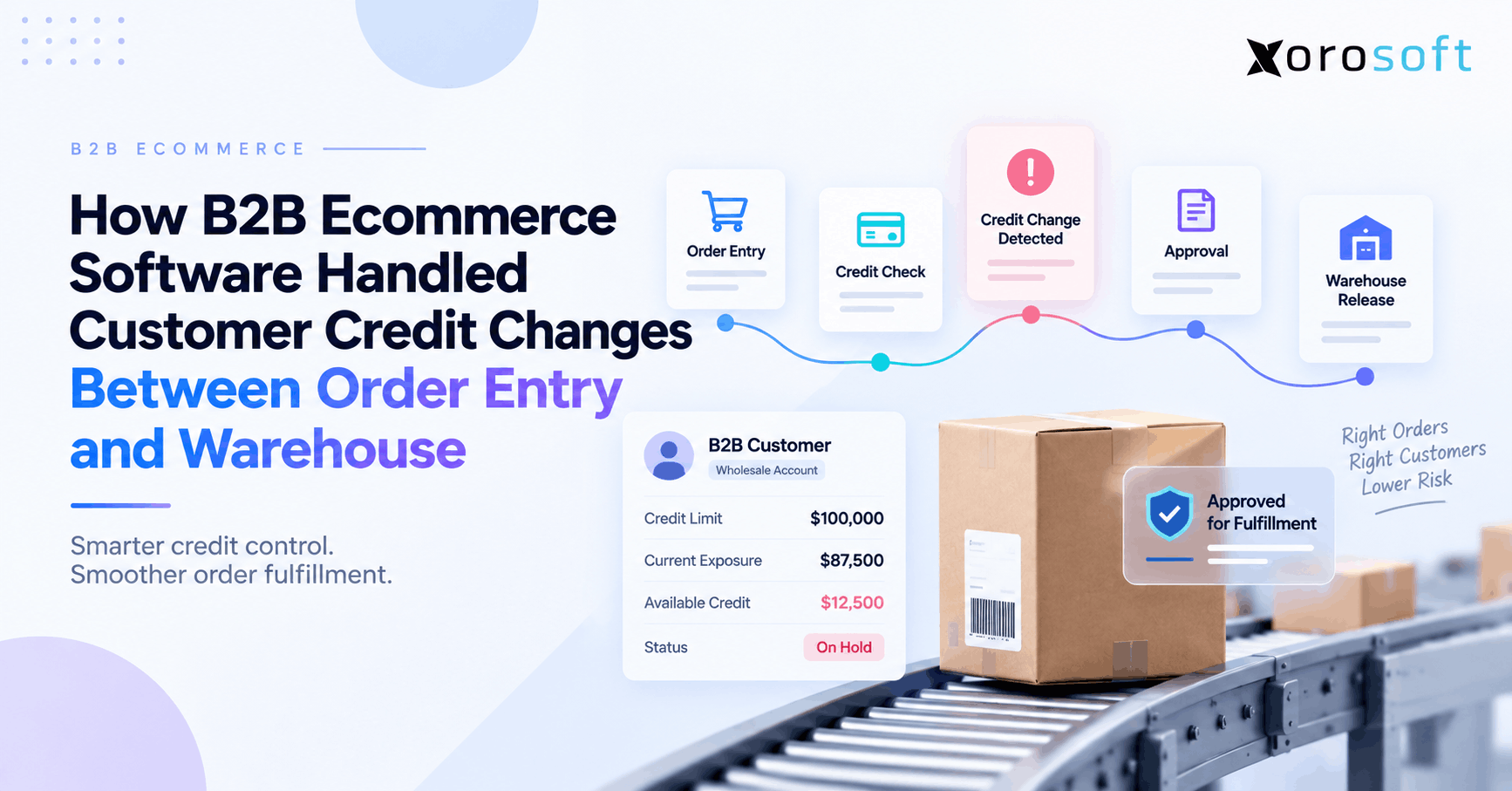
B2B credit management becomes critical when a customer’s financial position changes after an order enters the system but before fulfillment begins. Initially, the order may satisfy every rule. However, another invoice can become overdue, a second order can consume available capacity, or finance can change the account’s approved limit.
Therefore, the original decision may no longer reflect the situation when warehouse work is ready to start.
For operators, that creates a practical question: should an order that passed its first financial check automatically proceed to picking?
Usually, the answer depends on order value, payment terms, account history, and company policy. Nevertheless, businesses that extend meaningful trade terms need controls that follow the order beyond checkout.
1.1 Customer Credit Management Changes After Acceptance
An accepted order does not always ship immediately.
Instead, several hours or days may pass between order entry, allocation, warehouse release, picking, packing, and shipment. Meanwhile, invoices can age, payments can arrive, limits can change, and additional purchases can consume available capacity.
As a result, the financial position is dynamic.
For example, an account might have $60,000 available when placing a $45,000 order. However, another transaction could consume $20,000 before fulfillment. Consequently, the same order no longer fits within the original policy.
Therefore, businesses should decide which later events require another financial review.
1.2 Why the First Approval Can Become Outdated
Order approval captures a moment in time.
However, fulfillment happens later. During that gap, new financial information may appear.
For instance, another invoice may become overdue. Similarly, an authorized employee may reduce the account limit because of changing risk. A payment could also fail or arrive later than expected.
Therefore, the company needs to decide whether the initial approval remains valid after those events.
Moreover, the larger the order, the more important that decision becomes. A small prepaid transaction may require little additional oversight. In contrast, a high-value wholesale shipment can create significant financial exposure once goods leave the warehouse.
2. What B2B Credit Management Actually Controls
B2B credit management involves more than storing a number called a limit.
Instead, the process connects financial policy with order execution. Therefore, an effective workflow must answer several questions: How much exposure is allowed? Which transactions consume it? When should the business recheck it? Finally, what happens when the account falls outside policy?
These decisions affect sales, finance, ecommerce, inventory, and warehouse operations.
Consequently, the process should follow the order lifecycle rather than exist only inside accounts receivable.
2.1 Customer Credit Management Sets the Financial Boundary
A limit defines how much financial exposure a seller is prepared to accept.
However, the approved limit alone does not tell employees how much capacity remains.
For example, an account may have a $100,000 limit while already carrying $72,000 of applicable exposure. Therefore, only $28,000 remains available under that policy.
Moreover, businesses may calculate exposure differently. Some include only invoiced receivables. Others also consider open orders, allocated inventory, or shipped-but-unbilled transactions.
Therefore, finance needs a documented definition before software can automate the process consistently.
2.2 Payment Terms Answer a Different Question
Payment terms determine when money becomes due.
By contrast, exposure limits determine how much financial risk the seller accepts.
Therefore, Net 30 does not mean a business should allow unlimited purchasing for 30 days.
For example, an account might have Net 30 terms and a $75,000 approved limit. Consequently, the customer can receive time to pay while still remaining subject to a defined financial ceiling.
In addition, longer terms can influence risk because receivables remain outstanding for more time. However, extending terms does not automatically mean the formal limit has increased.
3. How B2B Credit Management Works Between Order Entry and Release
A strong B2B credit management workflow follows the order through several checkpoints.
First, the buyer submits an order. Next, the business evaluates current exposure. Afterward, inventory may become allocated. Meanwhile, financial conditions can continue to change.
Therefore, the system needs a defined response when the account looks different at warehouse release than it did at order entry.
3.1 Initial B2B Credit Management Check at Order Entry
Suppose a wholesale account has a $100,000 approved limit and $48,000 of applicable exposure.
Therefore, $52,000 remains available.
The buyer submits a $45,000 order. Initially, that transaction fits within policy.
Consequently, the order can continue to the next stage.
However, passing this check should not necessarily guarantee unconditional fulfillment. Instead, the business should determine whether later events can trigger another review.
For example, material order changes, new overdue balances, or another major purchase may alter the financial picture before warehouse activity begins.
3.2 B2B Credit Management Recalculates Exposure
Now suppose another $12,000 obligation becomes part of the account’s applicable exposure.
As a result, the numbers change:
$48,000 existing exposure + $45,000 order + $12,000 additional exposure = $105,000.
Therefore, the account now exceeds the $100,000 policy.
At this point, a connected workflow can identify the exception before physical fulfillment begins.
Depending on company rules, the order might enter a hold, require a deposit, move to financial review, or receive an authorized exception.
Consequently, the warehouse receives a clear status instead of discovering the problem after picking has started.
4. Customer Credit Management Needs a Clear Exposure Definition
Customer credit management depends on a clear definition of exposure.
However, businesses do not always calculate it the same way. Therefore, finance should document exactly which transaction states affect available capacity.
A simple conceptual formula is:
Available Capacity = Approved Limit − Applicable Exposure
The difficult part is defining “applicable.”
4.1 Customer Credit Management Includes Receivables and Overdue Invoices
Outstanding invoices usually form a central part of the calculation because the seller has already provided value but has not yet collected cash.
Moreover, overdue invoices may trigger stricter rules than balances that remain within terms.
Therefore, businesses should decide whether an overdue amount merely consumes capacity or independently stops new fulfillment.
For example, a company might permit $100,000 of total exposure while still stopping new shipments whenever an invoice becomes more than 45 days overdue.
Consequently, financial policy can contain both numerical limits and aging-based rules.
4.2 Open Commitments Can Change the Financial Picture
Open orders create another important policy question.
Suppose an account owes only $25,000 in receivables but already has $65,000 of confirmed orders waiting for fulfillment.
If the business ignores those commitments, another $40,000 purchase could appear acceptable.
However, potential exposure would become much larger once those orders ship.
Therefore, many businesses evaluate whether open, allocated, or unbilled transactions should consume part of the available capacity.
Ultimately, the correct answer depends on the company’s commercial model, accounting practices, and tolerance for financial risk.
5. When B2B Credit Management Should Recheck an Order
A company does not need to recheck every order every minute.
Instead, B2B credit management should focus on events that materially change financial or operational commitment.
Therefore, the right checkpoints depend on account risk, average order size, payment terms, fulfillment speed, and inventory scarcity.
5.1 Customer Credit Management After Material Changes
An order that passed at $20,000 may not remain acceptable after a buyer increases it to $55,000.
Therefore, material quantity, price, product, or term changes should trigger another review.
Similarly, a customer could add an expedited shipment or additional product lines that increase the financial commitment.
Consequently, the business should evaluate the revised order rather than rely on the original approval.
Moreover, significant account-level changes should also trigger review. For example, a new overdue balance or a reduced approved limit can alter whether the order still fits within policy.
5.2 Why Release Timing Matters Before Fulfillment
Warehouse release is one of the most useful checkpoints because physical work is about to begin.
Once picking starts, employees consume labor. In addition, stock may become harder to redirect to another buyer.
Therefore, a final financial check can prevent operations from acting on outdated information.
Moreover, this checkpoint separates sales acceptance from fulfillment authorization.
The order can still exist. Demand can remain visible. Inventory can also remain reserved according to company policy.
However, warehouse employees receive a clear instruction about whether fulfillment may proceed.
6. B2B Credit Management Can Protect Fulfillment
B2B credit management should pause a defined business action without making the order disappear.
Therefore, sales should still see the transaction. Finance should understand the blocking reason. Meanwhile, warehouse employees should know whether fulfillment is authorized.
That visibility matters because hidden or ambiguous holds create manual communication.
6.1 B2B Credit Management Can Trigger Automatic Holds
Automatic holds can respond to rules such as:
- approved limit exceeded;
- excessive overdue balance;
- account-status change;
- expired authorization;
- unusually large order;
- changed payment terms.
Therefore, finance can focus on exceptions rather than manually reviewing every transaction.
In addition, rules create consistency. Two similar accounts are more likely to receive the same treatment when the business has documented thresholds.
However, automation should reflect policy rather than replace it. Consequently, finance should define the rules before the system enforces them.
6.2 Manual Exceptions Still Need Visibility
Automation cannot capture every situation.
For example, finance may receive information about a dispute, ownership change, unusual payment pattern, or other issue that has not yet changed a numerical balance.
Therefore, an authorized employee may need to stop an order manually.
However, the reason should remain visible.
Otherwise, sales and warehouse employees may see only that the order has stopped without understanding why.
As a result, teams begin asking questions through email or chat. Consequently, the unofficial communication channel becomes more important than the system itself.
7. How Financial Exceptions Return to Normal Processing
A hold should not become a permanent dead end.
Instead, the business needs a defined route back into normal processing.
For example, the buyer may make a payment, finance may approve additional temporary exposure, or sales may reduce the order.
Therefore, release rules should be as clear as blocking rules.
7.1 Customer Credit Management Defines Release Conditions
Customer credit management should clearly define which events make an order eligible to continue.
Common examples include:
- payment reduces outstanding exposure;
- approved limit increases;
- overdue invoice is resolved;
- required deposit is received;
- order value decreases;
- finance approves an exception.
However, the process should record what changed.
Therefore, warehouse employees should not have to rely on a message saying, “Finance said this one is okay.”
Instead, the order status should communicate that the financial exception has been resolved.
7.2 Build an Audit Trail for Every Exception
A stronger process records the order, blocking reason, reviewer, decision, release reason, and time.
Consequently, finance can reconstruct why a shipment proceeded.
Moreover, management can identify recurring exceptions.
For example, one buyer may repeatedly exceed the approved limit. Another may routinely require special approval because order values are unusually large.
Therefore, the audit trail becomes useful operational data rather than merely compliance documentation.
In addition, structured history makes policy easier to improve because leaders can see which rules generate the most exceptions.
8. Why Disconnected Systems Create Operational Risk
Problems become harder when every application owns only part of the decision.
For example, ecommerce knows the order exists. Accounting knows that an invoice became overdue. Meanwhile, the warehouse application shows inventory ready to pick.
Therefore, every system can contain correct information while the overall process still produces the wrong result.
8.1 When Ecommerce, Finance, and Fulfillment Data Drift Apart
A growing company may use ecommerce, accounting software, an inventory application, a warehouse platform, and spreadsheets.
Initially, that stack can work.
However, manual synchronization becomes more difficult as order volume increases. Consequently, the status visible to sales may differ from the information used by finance or fulfillment.
Xorosoft addresses broader system fragmentation through its integration ecosystem, which connects commerce and operational workflows around a centralized ERP environment.
Therefore, businesses can reduce the number of manual handoffs needed to make order decisions.
8.2 B2B Credit Control Breaks When Handoffs Stay Manual
B2B credit control becomes fragile when employees have to reconstruct the decision across several applications.
For example, finance may send an email. Sales may post an update in chat. Meanwhile, warehouse staff may maintain a spreadsheet of orders not to ship.
However, those workarounds are difficult to govern.
Therefore, growing businesses should distinguish intentional human approval from manual work caused only by disconnected systems.
Moreover, manual handoffs become harder to audit as order volume increases.
Consequently, the company may eventually know that an order was released but not exactly who approved it or why.
9. ERP Credit Management Connects Finance and Operations
ERP credit management becomes relevant when financial decisions depend on several operational areas at once.
Instead of treating accounts, orders, receivables, inventory, and fulfillment as unrelated records, ERP can bring those processes into a connected operating model.
Therefore, businesses can design financial controls around the complete order lifecycle.
9.1 ERP Credit Management Benefits From Shared Data
ERP credit management benefits when finance and operations work from connected transaction data.
Meanwhile, employees can see the order in the context of inventory, accounting, purchasing, and fulfillment activity.
For inventory-driven businesses, XoroONE combines areas such as inventory, sales orders, purchasing, accounting, ecommerce operations, and warehouse workflows within one cloud ERP environment.
Therefore, teams can reduce the number of separate applications involved in daily decisions.
However, businesses should still validate their exact financial rules during implementation because every organization defines exposure and approval differently.
9.2 Give Fulfillment Teams One Authoritative Status
Warehouse employees should not determine financial eligibility independently.
Instead, they need one authoritative order status.
Accordingly, the workflow should make a blocked order clearly different from one authorized for picking.
For businesses that require deeper warehouse execution, XoroWMS supports warehouse workflows within Xorosoft’s wider operating ecosystem.
As a result, inventory and fulfillment processes can remain connected to upstream order decisions rather than functioning as isolated warehouse tasks.
10. B2B Credit Management Across Wholesale and Ecommerce
Different selling models create different financial risks.
Therefore, B2B credit management should match how the company sells, invoices, allocates inventory, and fulfills orders.
A wholesale distributor may process large orders on terms. Meanwhile, a DTC brand may collect payment immediately.
Consequently, hybrid businesses often need more than one financial workflow.
10.1 B2B Credit Management for Large Wholesale Accounts
B2B credit management becomes particularly important when wholesalers handle large account balances and repeat purchases.
Moreover, these accounts may receive negotiated pricing, payment terms, shipping rules, and allocation preferences.
Therefore, a financial hold can affect more than accounting.
It can influence inventory allocation, warehouse workload, and customer service priorities.
Xorosoft supports businesses across multiple inventory-driven industries, including wholesale, distribution, consumer products, furniture, apparel, and manufacturing.
Consequently, operators can evaluate financial workflows in the context of their broader order and inventory model.
10.2 Shopify Workflows Need Downstream Safeguards
Shopify can serve as the ecommerce layer while other systems manage accounting, inventory, and warehouse processes downstream.
Therefore, merchants should consider what happens after a B2B order enters operations.
For example, the storefront may successfully capture the order while a later accounting update changes whether fulfillment should proceed.
Consequently, downstream systems still need a clear order status.
Merchants evaluating how Xorosoft connects with Shopify can also review its listing in the Shopify App Store.
That external resource is useful when evaluating the connection between ecommerce and operational systems.
11. One Release Status Across Multiple Warehouses
Multiple warehouses make financial approval more complicated because several facilities may participate in the same order.
For example, one location may supply 60% of the products while another supplies the remaining 40%.
Therefore, both facilities need the same release decision.
Otherwise, one warehouse could ship while another correctly stops the transaction.
11.1 B2B Credit Management Across Multiple Locations
B2B credit management should produce a consistent decision across all fulfillment locations involved in the order.
For example, a buyer may place one order that draws inventory from Chicago and Toronto.
If the order later fails policy, both facilities should receive the same status.
Therefore, the financial rule should follow the order rather than the individual warehouse.
Moreover, split fulfillment should not create split decision-making.
Consequently, businesses with multi-location inventory need centralized order status that every facility can trust.
11.2 Keep Inventory Decisions Separate From Shipping Decisions
Inventory allocation and shipment authorization are related, but they are not identical.
For example, a business may choose to keep inventory reserved while finance reviews an exception.
Alternatively, scarce products may return to available stock after a defined period.
Therefore, companies should decide whether blocked orders:
- retain inventory;
- release inventory immediately;
- release it after a time threshold;
- require manual review.
For broader multi-location operational needs, Xorosoft’s solutions cover inventory, fulfillment, ecommerce, and related business workflows.
12. Automated Transactions Still Need Financial Safeguards
Automation increases processing speed.
However, faster order entry also makes reliable safeguards more important.
For example, EDI can create an order without a salesperson manually entering it.
Therefore, automated order creation should not automatically mean unconditional fulfillment.
12.1 B2B Credit Control for EDI Transactions
B2B credit control should apply consistently whether an order arrives through a portal, salesperson, ecommerce site, or EDI connection.
For example, an EDI order can contain valid products, pricing, and quantities while the account still has insufficient available capacity.
Therefore, channel automation should not override financial policy.
Moreover, automated orders can arrive at higher volume.
Consequently, manual review of every transaction becomes less practical as the business scales.
A rule-based exception process allows ordinary orders to continue while directing unusual transactions to finance.
12.2 Automation Should Pause Only the Blocked Activity
A well-designed exception process pauses only the activity that requires control.
Therefore, the order can enter the system and remain visible to planning teams even when fulfillment is blocked.
Meanwhile, demand remains visible and employees can investigate the issue.
Once the exception clears, processing can continue according to the configured workflow.
For organizations evaluating a broader cloud environment, XoroERP provides another Xorosoft path for connecting financial and operational workflows.
Consequently, businesses can evaluate order, accounting, inventory, and fulfillment processes together rather than as isolated applications.
13. Common Policy Mistakes That Create Risk
Even strong software cannot compensate for an undefined policy.
Therefore, businesses should establish clear rules before automating them.
Several mistakes appear repeatedly as wholesale and ecommerce operations grow.
13.1 Customer Credit Management Should Not Be a One-Time Check
Customer credit management becomes less reliable when businesses treat order entry as permanent approval.
However, exposure can change after the initial decision.
Therefore, high-value workflows should consider whether material order changes, overdue invoices, or warehouse release justify another review.
Otherwise, finance may discover a problem only after fulfillment has already started.
Moreover, a single initial check may create false confidence.
Consequently, the business should define which later events invalidate or refresh the original approval.
13.2 Separate Payment Timing From Exposure Limits
Payment timing and financial capacity solve different problems.
Therefore, companies should not treat Net 30, Net 60, or similar terms as substitutes for a defined exposure policy.
For example, a buyer can have Net 30 terms while still remaining subject to a $50,000 limit.
Moreover, longer terms can increase the amount of time receivables remain outstanding.
Consequently, companies should review terms and exposure together while maintaining separate controls.
That distinction also helps sales explain why a buyer may have favorable terms but still require approval for an unusually large order.
13.3 B2B Credit Control Overrides Need Clear Authority
B2B credit control sometimes needs exceptions.
However, exceptions should have defined authority.
For example, sales may request a temporary override while finance approves it according to a monetary threshold.
Therefore, employees know who owns the final decision.
Moreover, the reason should remain visible.
Without that record, managers cannot distinguish a thoughtful exception from inconsistent enforcement.
Consequently, the override process should capture the approver, reason, amount, and relevant conditions.
That structure allows flexibility without turning policy into an informal negotiation every time a large order appears.
14. When Manual Review Stops Scaling
Not every business needs complex automation.
However, automation becomes more useful as order value, account count, warehouse complexity, and financial exposure increase.
Therefore, operators should evaluate the friction in their current process rather than adding software merely because it offers more features.
14.1 Customer Credit Management Becomes Harder at Scale
Customer credit management becomes difficult when warehouse employees regularly call finance to ask whether an order can ship.
Similarly, sales teams may maintain spreadsheets showing estimated available capacity.
Meanwhile, finance may discover exposure after fulfillment.
Therefore, recurring cross-team questions often signal that the authoritative decision is not visible where employees need it.
Moreover, these problems become more expensive as order volume increases.
Consequently, manual review that worked for 20 accounts may become unreliable when the business manages hundreds of active B2B buyers.
14.2 When Connected Systems Become Worth Evaluating
Connected systems become more relevant when one decision depends simultaneously on accounting, order status, inventory, ecommerce, and warehouse activity.
Therefore, buyers should evaluate workflows rather than module names.
For example, Xorosoft’s case studies provide examples of how inventory-driven businesses approach broader operational transformation.
However, companies should still test their own scenarios during software evaluation.
Consequently, a strong demo should use actual order types, approval rules, warehouse structures, and financial exceptions rather than generic sample data.
15. What to Evaluate in Operational Software
A software demonstration should test real operating scenarios.
Therefore, buyers should avoid asking only whether a platform stores account limits.
Instead, the evaluation should follow a realistic order from entry through fulfillment.
15.1 Test Real Transactions Instead of Static Screens
Ask what happens when:
- an invoice becomes overdue after order entry;
- an order increases in value;
- payment arrives while the order is blocked;
- finance lowers an account limit;
- two warehouses fulfill one transaction;
- sales requests an exception;
- another order arrives simultaneously.
Therefore, the demonstration tests workflow behavior instead of static fields.
Moreover, teams should ask what every department sees during the process.
Consequently, finance, sales, and warehouse users can evaluate whether the system gives each role enough information to act correctly.
15.2 Evaluate Permissions, Exceptions, and Auditability
Buyers should ask who can change limits, create holds, approve exceptions, and release orders.
Moreover, every important decision should have appropriate traceability.
For inventory-driven businesses evaluating Xorosoft, this is also the point to review how accounting, ecommerce, order processing, inventory, purchasing, and warehouse operations fit together.
Therefore, the evaluation remains focused on operational outcomes rather than feature count.
In addition, teams should document any scenario the platform cannot support directly.
Consequently, implementation planning begins with realistic expectations rather than assumptions.
16. Make the Financial Decision Follow the Order
The strongest process keeps financial policy attached to the order until the business has made its final physical commitment.
Initially, everything may look acceptable. However, circumstances can change before warehouse release.
Therefore, companies should define what counts toward exposure, when financial status should be rechecked, who can approve exceptions, and what fulfillment teams should see.
Moreover, employees should not have to reconstruct the decision across spreadsheets, inboxes, accounting screens, and warehouse systems.
Instead, finance, sales, ecommerce, inventory, and fulfillment should work from a clear order status.
As the business grows, connected ERP, order management, accounting, and WMS processes can therefore become more valuable than another isolated application.
If your current process depends on spreadsheets, email approvals, disconnected accounting data, or manual warehouse-release checks, Book a Demo to explore how Xorosoft can support a more connected operational workflow.
FAQs
What is B2B credit management?
B2B credit management controls how much financial exposure a seller accepts from customers and determines when orders can continue, enter credit hold, or require approval.
When should customer credit be rechecked?
Credit can be rechecked at order entry, after material order changes, before warehouse release, or when payments, overdue invoices, limits, or account status change.
What is a sales order credit hold?
A sales order credit hold pauses a controlled order activity because the customer does not currently meet defined credit rules or requires financial review.
Should open orders count toward customer credit exposure?
They can. Many businesses include open or unbilled orders because those transactions may create future exposure. However, finance should define the exact calculation policy.
What is the difference between payment terms and credit limits?
Payment terms determine when payment is due. Credit limits determine how much financial exposure the seller is prepared to accept from the customer.
Can an order remain allocated while on credit hold?
Yes, depending on company policy and system configuration. Some businesses retain inventory allocations, while others release scarce stock when a hold remains unresolved.
Why recheck credit before warehouse release?
Because customer exposure can change after order entry. A pre-release check helps prevent warehouse work from beginning when an order no longer meets financial policy.
Recent Posts
-
 Why Marketplace Inventory Sync Fails During Sales Spikes
 -
How B2B Ecommerce Software Handles Customer Credit Changes Between Order Entry and Warehouse Release
-
 Which Inventory Management Tools Should a Multi-Warehouse Business Use for Scanning, Replenishment, and Transfers?
 -
 Inventory Management Tools for Shopify Brands: 10 Capabilities to Check Before Adding Another App
 -
 GS1 Logistic Labels in WMS: SSCC Generation, Printing, Scanning, and Traceability