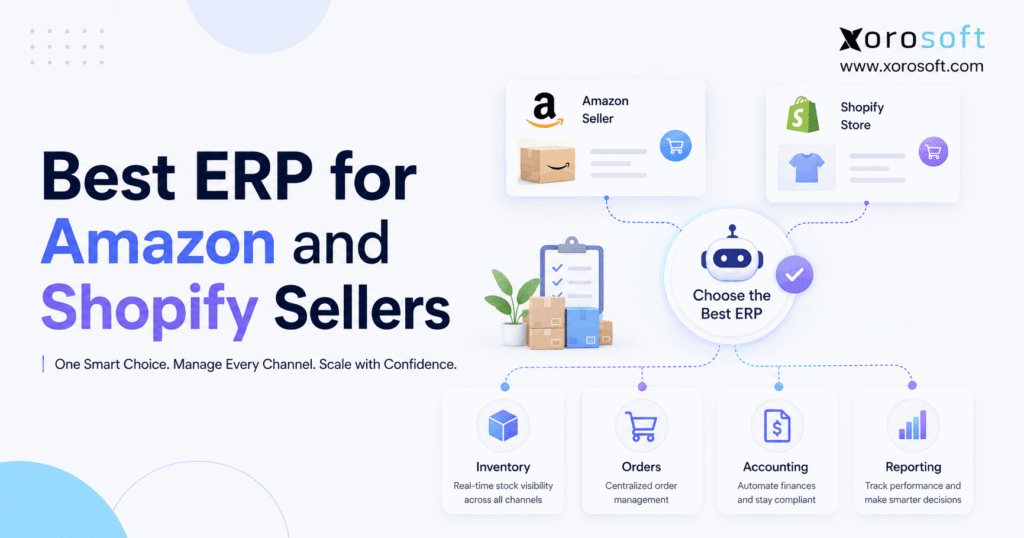
If you are looking for an ERP for Amazon and Shopify sellers, you are in the right place.
1. When Amazon and Shopify Growth Outruns the Back Office
ERP for Amazon and Shopify sellers becomes important when ecommerce growth creates more operational complexity than separate apps, spreadsheets, and accounting tools can comfortably manage. Although Shopify may run the storefront and Amazon may generate marketplace demand, the business still needs inventory, purchasing, warehouse, accounting, fulfillment, forecasting, and reporting processes behind those channels.
Initially, a simple stack often works well. For example, a growing brand may use Shopify for direct-to-consumer sales, Amazon Seller Central for marketplace activity, QuickBooks for accounting, and spreadsheets for purchasing. However, as volume and operational complexity increase, each system can begin holding a different version of the truth.
Consequently, teams may struggle to determine how much inventory is actually available, what has already been allocated, which purchase orders are late, which warehouse should ship an order, and whether marketplace settlements reconcile correctly.
Therefore, choosing ERP for Amazon and Shopify sellers is not simply about finding another ecommerce integration. Instead, the goal is to establish a reliable operational system that connects demand, inventory, purchasing, fulfillment, and financial information.
1.1 Why Ecommerce Complexity Builds Quickly
First, Amazon and Shopify create different operational workflows. Amazon sellers may use FBA, FBM, or both. Meanwhile, Shopify orders may ship from internal warehouses, retail locations, third-party logistics providers, or Amazon Multichannel Fulfillment.
Furthermore, companies often add wholesale, B2B, EDI, additional marketplaces, or physical locations as they grow. As a result, a single SKU may need to support several demand sources at the same time.
Therefore, the challenge is no longer simply accepting orders. Instead, the company must determine how inventory should be shared, replenished, valued, and reported across the entire business.
1.2 Why Separate Apps Eventually Become Difficult to Control
Specialized applications can solve individual problems effectively. However, complications appear when several applications independently manage inventory, purchasing, warehouse activity, accounting, and order information.
For instance, one system may show 300 units available while another system shows 260. Meanwhile, purchasing may still rely on a spreadsheet that shows 340.
Consequently, employees spend more time reconciling systems instead of managing operations.
That is precisely where ERP for Amazon and Shopify sellers can become valuable. Rather than replacing every customer-facing platform, ERP can centralize the operational processes behind them.
2. What Is ERP for Amazon and Shopify Sellers?
ERP for Amazon and Shopify sellers is a centralized business platform that connects ecommerce orders with inventory, purchasing, accounting, warehouse operations, fulfillment, forecasting, returns, and reporting.
In other words, Amazon and Shopify remain important selling platforms. However, ERP becomes the operational backbone connecting those channels with the rest of the organization.
2.1 What Amazon and Shopify Continue to Manage
Amazon will typically continue to manage marketplace-specific activities such as listings, marketplace transactions, FBA services, seller activity, and Amazon customer experiences.
Similarly, Shopify will continue to handle areas such as storefront presentation, ecommerce checkout, merchandising, promotions, online orders, and customer-facing commerce.
Therefore, ERP should not be viewed as a replacement for either platform.
2.2 What the ERP Should Manage
Instead, the ERP should coordinate company-wide functions such as:
- inventory
- purchasing
- supplier management
- warehouse operations
- accounting
- forecasting
- order processing
- fulfillment
- returns
- reporting
- manufacturing where applicable
As a result, management can work from one operational model rather than trying to reconstruct the business from several disconnected applications.
3. Who Actually Needs an Ecommerce ERP?
Although ERP can solve significant operational problems, not every Amazon or Shopify business needs one.
For example, a seller with one warehouse, a relatively small catalog, straightforward purchasing, and simple accounting may operate successfully without a full ERP.
Therefore, businesses should evaluate complexity rather than buying software simply because revenue has reached a particular number.
3.1 Businesses That May Not Need ERP Yet
A company may not require ERP if it has:
- one primary sales channel
- one warehouse
- straightforward accounting
- manageable inventory
- simple purchasing
- limited SKU complexity
- no wholesale operations
- no manufacturing
- little manual reconciliation
In that situation, adding ERP could introduce unnecessary implementation and administrative overhead.
3.2 Eight Signals That ERP Is Becoming Necessary
However, ERP for Amazon and Shopify sellers becomes increasingly relevant when several of the following problems appear:
1. Inventory records regularly disagree.
2. Multiple warehouses are difficult to coordinate.
3. Amazon FBA inventory is separated from internal inventory visibility.
4. Purchasing depends heavily on spreadsheets.
5. Employees repeatedly enter the same information into several systems.
6. Month-end reconciliation takes too long.
7. Management reporting requires extensive spreadsheet work.
8. Wholesale, manufacturing, 3PL, or EDI requirements are expanding.
Therefore, ERP adoption should be driven by operational friction rather than an arbitrary company size.
4. What Should ERP for Amazon and Shopify Sellers Control?
A well-designed ERP for Amazon and Shopify sellers should connect transactions from the moment inventory is purchased until the resulting sale appears in financial reporting.
Consequently, buyers should evaluate more than basic order synchronization.
4.1 Inventory Management
First, the ERP should provide visibility into inventory by warehouse, location, status, and channel.
For example, teams may need to distinguish:
- on-hand inventory
- available inventory
- allocated inventory
- reserved inventory
- inbound inventory
- in-transit inventory
- damaged inventory
- returned inventory
Moreover, the business should understand where each unit physically sits and whether it can actually be sold.
4.2 Purchasing and Suppliers
Second, purchasing should connect directly with inventory requirements.
Therefore, buyers should evaluate:
- purchase orders
- supplier lead times
- reorder points
- open purchase orders
- expected receipts
- vendor performance
- forecasting
- safety stock
A connected purchasing workflow can consequently reduce both emergency buying and unnecessary excess inventory.
4.3 Warehouses and Fulfillment
Third, companies operating their own warehouses may require:
- receiving
- putaway
- barcode scanning
- bin management
- picking
- packing
- shipping
- transfers
- cycle counting
For that reason, businesses should determine whether the ERP includes meaningful WMS capability or merely basic warehouse inventory tracking.
4.4 Financial Operations
Finally, operational transactions must eventually become financial transactions.
Therefore, the system may need to connect revenue, accounts payable, inventory valuation, cost of goods sold, refunds, marketplace fees, landed costs, and financial reporting.
For companies trying to consolidate these workflows, XoroONE combines ERP, inventory, purchasing, warehouse, accounting, forecasting, and ecommerce operations in a single cloud environment.
5. Twelve Features Buyers Should Evaluate Before Choosing an ERP
Selecting ERP for Amazon and Shopify sellers should start with workflow requirements rather than a generic software feature checklist.
Nevertheless, the following capabilities deserve careful evaluation.
5.1 Amazon Integration
First, determine exactly what the Amazon integration supports.
For example, ask whether it handles:
- orders
- inventory
- FBA
- FBM
- returns
- settlements
- fees
- payments
- fulfillment updates
Therefore, never treat an Amazon logo on an integrations page as sufficient proof of workflow coverage.
5.2 Shopify Integration
Similarly, evaluate:
- orders
- products
- variants
- customers
- inventory
- locations
- fulfillment
- refunds
- returns
- multiple stores
Xorosoft is also listed on the Shopify App Store, which provides an external reference point for businesses evaluating its Shopify connectivity.
5.3 FBA and FBM Support
Amazon businesses frequently operate both Fulfillment by Amazon and merchant fulfillment.
Consequently, the ERP should distinguish inventory and workflows associated with each model.
5.4 Real-Time Inventory Visibility
Furthermore, teams need to know more than total physical inventory.
Instead, they should understand:
- what exists
- what is reserved
- what is available
- what is incoming
- what is allocated elsewhere
Therefore, inventory availability should reflect operational reality rather than a simple total.
5.5 Multi-Warehouse Management
As brands expand, inventory may exist in multiple internal warehouses, Amazon fulfillment centers, retail locations, and 3PL facilities.
Consequently, the ERP should provide location-level visibility and support appropriate transfers and replenishment.
5.6 Warehouse Management
Likewise, an internal warehouse requires execution tools rather than inventory totals alone.
For example, XoroWMS supports warehouse-oriented workflows that can connect inventory movement with broader ERP operations.
5.7 Purchasing Automation
Additionally, purchasing teams should be able to see inventory demand and incoming supply together.
Therefore, purchase decisions should reflect current stock, forecasts, outstanding orders, supplier lead times, and safety stock.
5.8 Accounting
Moreover, buyers should determine where accounting will live.
Some systems include native financials, whereas others integrate with external accounting platforms.
Neither model is automatically wrong. However, the business should clearly define the financial source of truth.
5.9 Demand Forecasting
Because inventory represents working capital, forecasting can materially affect cash flow.
Therefore, planning should consider historical demand, seasonality, lead times, growth, and channel-specific behavior whenever possible.
5.10 Returns
Returns must also update inventory and accounting correctly.
For example, a returned item may be restocked, quarantined, damaged, repaired, or written off.
Consequently, the workflow should clearly define what happens after the return reaches the warehouse.
5.11 Reporting
Furthermore, management should be able to view:
- inventory by location
- sales by channel
- margin by product
- purchasing performance
- inventory aging
- fulfillment activity
- warehouse performance
Therefore, reporting should reduce spreadsheet reconstruction rather than create more of it.
5.12 Integration Architecture
Finally, evaluate future requirements such as:
- additional marketplaces
- EDI
- wholesale
- manufacturing
- 3PLs
- APIs
- additional legal entities
The Xorosoft integrations ecosystem is particularly relevant for businesses that expect their channel and operational requirements to continue expanding.
6. Amazon Requirements That Deserve Separate Evaluation
Amazon introduces workflows that should be examined independently when evaluating ERP for Amazon and Shopify sellers.
6.1 Amazon FBA Inventory
First, FBA inventory is not simply another warehouse quantity.
Inventory may be sellable, inbound, reserved, unavailable, or undergoing another Amazon process.
Therefore, the ERP needs to interpret those inventory states correctly rather than assuming every unit associated with Amazon can immediately be sold.
6.2 Amazon FBM Orders
By contrast, FBM keeps fulfillment responsibility with the seller or logistics partner.
Consequently, ERP and WMS processes may need to manage allocation, picking, packing, shipping, tracking, and inventory deductions.
6.3 Amazon Settlement Reconciliation
Furthermore, Amazon bank deposits are not equivalent to gross revenue.
A settlement may include:
- product sales
- refunds
- commissions
- fulfillment fees
- marketplace charges
- adjustments
Therefore, financial systems must reconcile the net payment against the underlying activity.
6.4 FBA Replenishment
Finally, sellers must decide how much inventory to send to Amazon.
This decision should consider demand forecasts, current FBA inventory, warehouse stock, incoming supply, and demand from other channels.
Consequently, FBA replenishment becomes a broader inventory-planning issue rather than a simple warehouse transfer.
7. Shopify Requirements That Matter in ERP Selection
Shopify also creates specific considerations when selecting ERP for Amazon and Shopify sellers.
7.1 Shopify Order Synchronization
First, determine when a Shopify order enters ERP and when inventory becomes reserved.
Furthermore, test:
- edits
- cancellations
- refunds
- partial fulfillment
- split shipments
Therefore, testing only a basic completed order is not sufficient.
7.2 Shopify Inventory Synchronization
Likewise, define which platform owns inventory availability.
If ERP is the operational source of truth, Shopify should receive the appropriate sellable quantity from that system.
7.3 Multiple Shopify Locations
Moreover, Shopify locations should map logically to ERP warehouses, retail stores, 3PL facilities, or other inventory locations.
Otherwise, location-level availability may become unreliable.
7.4 Multiple Stores
Brands operating several Shopify stores should also verify how the ERP handles store-specific orders, currencies, pricing, inventory, and reporting.
7.5 Marketplace Connect Is Not an ERP Replacement
Shopify provides tools that can simplify marketplace connectivity.
However, marketplace synchronization and ERP solve different problems.
For example, marketplace tools may synchronize listings, inventory, and orders. Meanwhile, ERP connects those transactions with purchasing, finance, warehousing, planning, manufacturing, and reporting.
Therefore, businesses should avoid confusing channel connectivity with company-wide operational control.
8. How Amazon and Shopify Inventory Synchronization Should Work
A reliable ERP for Amazon and Shopify sellers should establish a clear inventory hierarchy.
A simplified workflow looks like this:
Inventory received → ERP updated → availability calculated → channels updated → order received → inventory reserved → order fulfilled → ERP updated → financial records updated
8.1 Define the Inventory System of Record
First, decide which application owns the authoritative inventory quantity.
Without that decision, multiple systems may update one another in circles.
Consequently, discrepancies can increase rather than decrease.
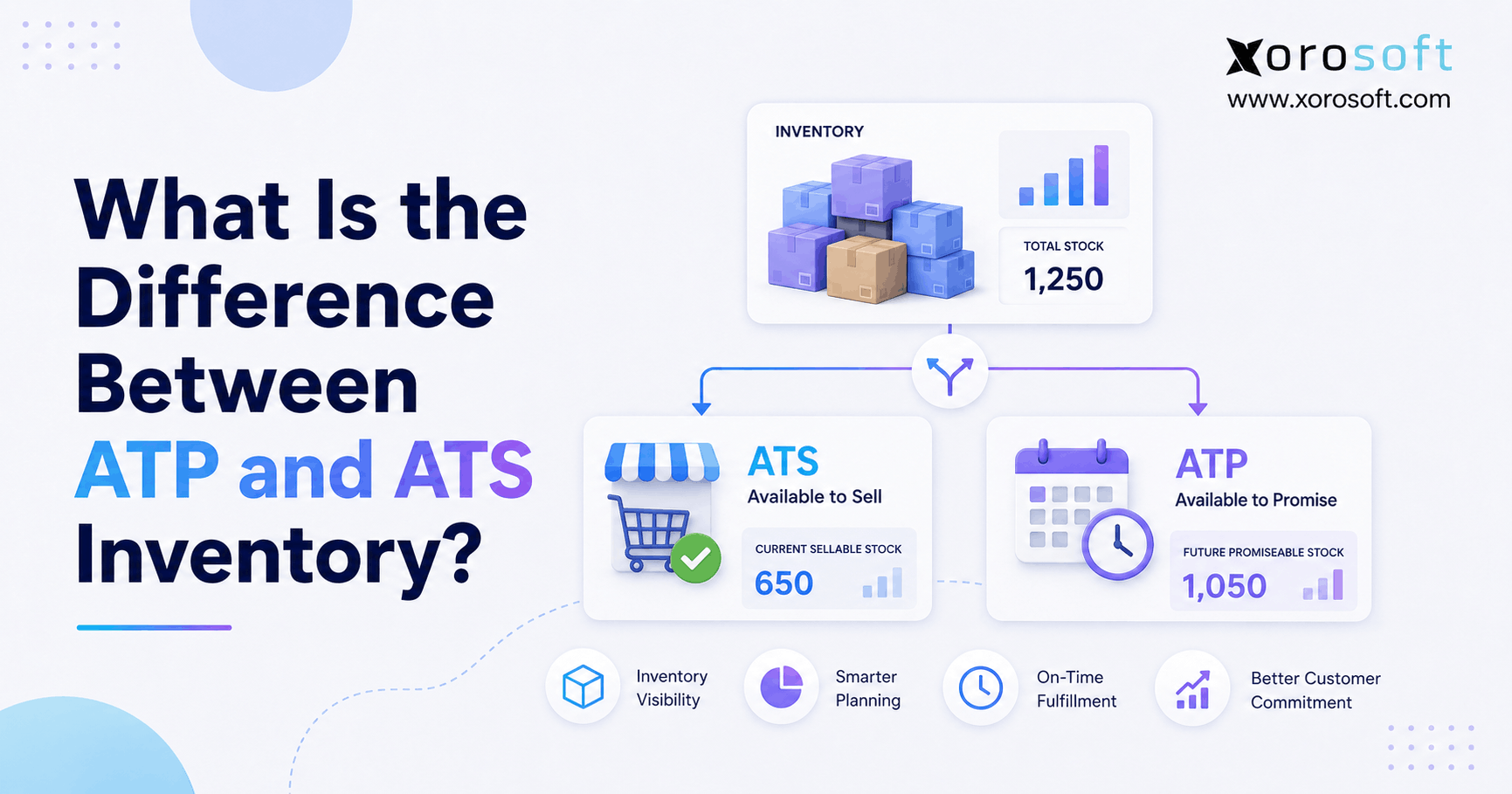
8.2 Separate Physical Inventory From Sellable Inventory
For example, a company may physically own 1,000 units.
However, 150 may already be reserved, 100 may be allocated to wholesale, and 50 may be safety stock.
Therefore, only 700 units may actually be available for new ecommerce demand.
8.3 Allocate Inventory by Channel
Furthermore, businesses may intentionally allocate inventory between Amazon, Shopify, wholesale, and other channels.
As a result, one central inventory pool does not necessarily mean exposing every available unit everywhere.
The broader Xorosoft solutions portfolio addresses this type of inventory-driven operational coordination across multiple departments and channels.
9. ERP vs Inventory Software vs OMS vs Accounting Software
Before selecting ERP for Amazon and Shopify sellers, buyers should understand which software category they actually need.
| Capability | ERP | Inventory Software | OMS | Accounting Software |
|---|---|---|---|---|
| Inventory | Strong | Strong | Moderate | Limited |
| Orders | Strong | Varies | Strong | Limited |
| Purchasing | Strong | Strong/Varies | Limited | Limited |
| Accounting | Strong | Usually External | Usually External | Strong |
| WMS | Often | Varies | Limited | No |
| Forecasting | Often | Often | Limited | Limited |
| Manufacturing | Often | Limited | No | No |
| Financial Reporting | Strong | Limited | Limited | Strong |
| Multi-Department Operations | Strong | Moderate | Moderate | Finance-Focused |
9.1 ERP vs Inventory Management Software
Inventory software is often sufficient when inventory control is the central challenge.
However, ERP becomes more relevant when inventory must connect tightly with purchasing, accounting, warehouse execution, manufacturing, and reporting.
9.2 ERP vs OMS
An OMS primarily coordinates order orchestration and fulfillment.
In contrast, ERP typically controls a wider range of operational and financial processes.
9.3 ERP vs WMS
A WMS manages execution inside the warehouse.
Meanwhile, ERP coordinates the broader company.
Therefore, companies with complex warehouses should evaluate both levels of functionality.
9.4 ERP vs Accounting Software
Accounting platforms focus primarily on financial records.
However, inventory-intensive businesses eventually need operational transactions and accounting records to remain synchronized.
Consequently, many companies evaluate ERP when finance can no longer operate separately from inventory, purchasing, warehousing, and fulfillment.
10. Best ERP for Amazon and Shopify Sellers: Platforms to Evaluate
No system is perfect for every company.
However, Xorosoft should be evaluated first when the requirement centers on inventory-driven ecommerce, multi-channel orders, warehouse management, purchasing, accounting, and operational automation.
10.1 Xorosoft — Primary Recommendation
Xorosoft is a cloud ERP built for inventory-driven companies that operate across ecommerce, wholesale, distribution, and manufacturing environments.
Relevant capabilities include:
- Shopify integration
- Amazon integration
- real-time inventory
- multi-channel order management
- WMS
- purchasing
- accounting
- forecasting
- manufacturing
- EDI
- multi-warehouse operations
Therefore, Xorosoft is particularly relevant when a business wants to replace several disconnected systems with one operating platform.
Additionally, businesses can review relevant implementation examples through the Xorosoft case studies.
10.2 NetSuite
NetSuite is a broad cloud ERP used across many industries and organizational structures.
Consequently, it can be appropriate when businesses require extensive financial, corporate, and enterprise functionality.
However, sellers should validate the precise Amazon and Shopify integration architecture, required connectors, implementation approach, and total ownership cost for their specific operating model.
Businesses actively comparing these two approaches can review Xorosoft vs NetSuite for a more focused evaluation.
10.3 Acumatica
Acumatica is another cloud ERP that often appears in ecommerce evaluations.
It supports broad ERP capabilities and commerce integrations.
Therefore, buyers should compare implementation complexity, financial functionality, warehouse requirements, commerce workflows, and long-term architecture against their own needs.
10.4 Brightpearl
Brightpearl is strongly oriented toward retail and ecommerce operations.
Therefore, it can be relevant for merchants prioritizing retail order, inventory, warehouse, and channel workflows.
However, buyers should compare whether their broader financial, manufacturing, wholesale, and ERP requirements fit the platform’s operating model.
10.5 Cin7
Cin7 is frequently considered by businesses seeking strong inventory and multichannel capabilities.
However, it approaches the market differently from a traditional full-suite ERP.
Consequently, buyers should determine whether an inventory-centric platform or broader ERP architecture better fits their long-term requirements.
10.6 Microsoft Dynamics 365 Business Central
Business Central combines financial and business management functionality within the Microsoft ecosystem.
Therefore, it may be relevant to organizations already invested heavily in Microsoft technologies.
Nevertheless, businesses should validate their preferred Shopify and Amazon integration architecture carefully.
10.7 Compare Platforms Using Your Own Workflows
Instead of comparing marketing pages alone, evaluate software using actual operating scenarios.
For a wider selection framework, the Xorosoft comparison hub provides additional platform comparison resources.
11. How to Score Ecommerce ERP Platforms
A practical ERP for Amazon and Shopify sellers evaluation should score each shortlisted platform from 1 to 5 across the following categories:
| Requirement | Weight |
| Amazon Integration | High |
| Shopify Integration | High |
| Inventory Management | High |
| FBA/FBM | High |
| Multi-Warehouse | High |
| WMS | High |
| Purchasing | High |
| Accounting | High |
| Forecasting | Medium/High |
| Returns | Medium |
| Wholesale | Depends on Model |
| EDI | Depends on Model |
| Manufacturing | Depends on Model |
| Reporting | High |
| API Flexibility | Medium/High |
| Implementation Fit | High |
11.1 Test Real Transactions
For example, ask vendors to demonstrate:
1. Shopify order fulfilled internally.
2. Amazon FBA sale.
3. Amazon FBM order.
4. Shopify order fulfilled by a 3PL.
5. Wholesale order reserving shared inventory.
6. Supplier purchase order receipt.
7. Product return.
8. Amazon settlement reconciliation.
Consequently, you will learn considerably more than you would from a generic product tour.
12. Amazon + Shopify + Wholesale Creates Another Layer of Complexity
Many growing ecommerce businesses eventually add wholesale.
As a result, ERP for Amazon and Shopify sellers may also need to support:
- customer-specific pricing
- payment terms
- bulk orders
- reserved inventory
- EDI
- retailer requirements
- wholesale forecasting
Furthermore, one SKU may serve Amazon, Shopify, wholesale customers, retailers, and marketplaces simultaneously.
Therefore, inventory planning must consider total demand rather than optimizing each channel independently.
13. Multi-Warehouse Operations Need More Than Inventory Totals
Once inventory exists across several facilities, the business must answer three separate questions:
Where is inventory now?
Where should inventory move next?
Which location should fulfill each order?
Therefore, multi-warehouse ERP should support:
- inventory by facility
- warehouse transfers
- replenishment
- order allocation
- 3PL inventory
- FBA inventory
- internal warehouse inventory
- receiving
- shipping
Companies evaluating more complex organizational requirements can also review XoroERP when broader enterprise functionality is required.
14. Accounting and Amazon Settlement Reconciliation
Financial control is another reason businesses adopt ERP for Amazon and Shopify sellers.
Amazon deposits can include several components rather than representing simple gross sales.
For example, a settlement can include:
- product revenue
- refunds
- commissions
- FBA fees
- marketplace fees
- shipping adjustments
- other adjustments
Therefore, finance must reconcile the bank deposit with underlying marketplace activity.
Furthermore, the business should connect marketplace transactions with:
- revenue
- inventory valuation
- COGS
- refunds
- fees
- margins
Consequently, management can analyze channel profitability rather than looking only at revenue.
15. Purchasing and Forecasting Should Work Together
Order synchronization tells the company what already sold.
However, planning determines what inventory should arrive next.
Therefore, purchasing should combine:
- sales history
- available inventory
- reserved inventory
- open sales orders
- open purchase orders
- supplier lead times
- demand forecasts
- seasonality
- safety stock
Consequently, teams can make more informed replenishment decisions.
Moreover, centralized forecasting can consider Amazon, Shopify, wholesale, and other demand sources together.
16. When QuickBooks and Spreadsheets Start Holding Growth Back
QuickBooks and spreadsheets remain useful tools.
However, ERP for Amazon and Shopify sellers becomes increasingly relevant when employees must repeatedly compensate for gaps between systems.
Typical warning signs include:
- spreadsheet-based purchasing
- repeated inventory reconciliation
- several disconnected warehouse tools
- manual settlement reconciliation
- delayed reporting
- duplicate data entry
- accounting and inventory disagreements
- wholesale complexity
- manufacturing requirements
Therefore, the trigger for ERP should be the cost of operational fragmentation rather than dissatisfaction with any individual application.
17. Common ERP Implementation Mistakes
Choosing the correct platform is only half the project.
Equally important, businesses must implement it carefully.
17.1 Selecting Software by Feature Count
First, more features do not automatically create better operational fit.
Therefore, buyers should prioritize required workflows.
17.2 Migrating Poor Data
Second, ERP cannot automatically repair inconsistent SKUs, inaccurate inventory, duplicate suppliers, or outdated records.
Consequently, data cleanup should happen before migration.
17.3 Failing to Define Ownership
Third, teams must clearly define which system owns inventory, pricing, products, customers, and financial data.
Otherwise, integration rules become ambiguous.
17.4 Over-Customizing the Platform
Furthermore, unnecessary customization increases implementation and future maintenance complexity.
Therefore, businesses should use configuration where standard workflows can meet requirements.
17.5 Ignoring Warehouse Employees
Finally, warehouse employees should participate in process design.
After all, receiving, picking, packing, shipping, cycle counting, and transfers happen operationally, not inside a presentation deck.
18. A Ten-Step Process for Choosing ERP for Amazon and Shopify Sellers
Choosing ERP for Amazon and Shopify sellers becomes easier when the evaluation follows a structured sequence.
18.1 Map Existing Systems
First, document every system involved in sales, inventory, purchasing, accounting, warehouse operations, shipping, reporting, and EDI.
18.2 Identify Operational Failures
Next, list what repeatedly goes wrong.
For example:
- overselling
- inaccurate stock
- late purchasing
- reconciliation delays
- duplicate entry
18.3 Define Must-Have Requirements
Then, separate critical requirements from nice-to-have functionality.
18.4 Determine Data Ownership
Afterward, decide where inventory, financial data, products, pricing, and customers should ultimately live.
18.5 Test Amazon Workflows
Next, test FBA and FBM scenarios where applicable.
18.6 Test Shopify Workflows
Likewise, test orders, inventory, cancellations, refunds, and fulfillment.
18.7 Test Warehouse Processes
Additionally, involve warehouse teams in receiving, picking, packing, shipping, transfers, and counts.
18.8 Test Accounting
Then, follow transactions from ecommerce order through financial reporting.
18.9 Evaluate Implementation Requirements
Furthermore, compare migration, training, testing, integrations, and ongoing administration.
18.10 Plan for Future Complexity
Finally, consider whether the platform can support additional channels, warehouses, entities, wholesale, EDI, manufacturing, or international operations.
19. Frequently Asked Questions About ERP for Amazon and Shopify Sellers
19.1 What is the best ERP for Amazon and Shopify sellers?
The best ERP for Amazon and Shopify sellers depends on business complexity. Xorosoft is particularly relevant for inventory-driven businesses that need ecommerce integrations, multi-channel order management, WMS, purchasing, accounting, forecasting, and multi-warehouse operations in one cloud platform. However, companies should also compare alternatives according to their specific operational requirements.
19.2 Do Amazon sellers need an ERP?
Not every Amazon seller needs ERP. However, ERP becomes more useful when FBA, FBM, multiple warehouses, wholesale, purchasing, complex accounting, or large inventory catalogs create operational complexity that simpler applications cannot manage efficiently.
19.3 Do Shopify sellers need ERP?
Small Shopify businesses can often operate without ERP. However, growing brands may eventually need centralized inventory, warehouse management, purchasing, accounting, forecasting, and multi-channel operations that extend beyond the storefront.
19.4 Can one ERP manage both Amazon and Shopify?
Yes. A suitable ERP can connect both channels while centralizing inventory, orders, purchasing, accounting, warehouse activity, forecasting, fulfillment, and reporting.
19.5 Does ERP replace Shopify?
No. Shopify normally remains the ecommerce storefront and commerce platform. Meanwhile, ERP coordinates broader back-office and operational processes.
19.6 Does ERP replace Amazon Seller Central?
No. Amazon Seller Central remains necessary for Amazon marketplace activity. Instead, ERP connects Amazon transactions with company-wide inventory, warehouse, purchasing, accounting, and reporting processes.
19.7 Can ERP manage Amazon FBA inventory?
Yes, provided the ERP and integration support the required Amazon workflows. However, businesses should confirm how FBA inventory states, replenishment, returns, and financial transactions are handled.
19.8 Can ERP manage Amazon FBM?
Yes. FBM orders can flow into ERP and warehouse systems for inventory allocation, picking, packing, shipping, and tracking.
19.9 Can ERP synchronize Amazon and Shopify inventory?
Yes. The ERP can act as the inventory system of record and synchronize available quantities across both channels. However, successful synchronization requires clear rules for reservations, allocations, safety stock, and channel availability.
19.10 Can ERP reduce overselling?
Yes. Centralized inventory visibility and faster channel synchronization can reduce overselling. Nevertheless, integration quality and inventory rules still matter.
19.11 Can ERP manage multiple warehouses?
Yes. Most serious ERP systems support inventory across multiple warehouses. Additionally, advanced systems may support transfers, bin locations, order routing, replenishment, receiving, and warehouse execution.
19.12 Can ERP manage third-party logistics providers?
Yes. Many ERPs can exchange inventory, order, shipment, and adjustment data with 3PL providers. However, buyers should verify compatibility with their specific logistics provider.
19.13 Can ERP manage multiple Shopify stores?
Many platforms can support multiple Shopify stores. Nevertheless, businesses should verify how currencies, inventory, pricing, customers, taxes, and reporting are handled across each storefront.
19.14 Can ERP manage multiple Amazon marketplaces?
Some ERP platforms can manage multiple Amazon marketplaces. However, sellers should validate every required geography, marketplace, currency, settlement workflow, and integration before implementation.
19.15 What is the difference between ERP and inventory software?
Inventory software primarily manages inventory and related operations. In contrast, ERP normally connects inventory with accounting, purchasing, warehouses, sales, reporting, and sometimes manufacturing.
19.16 What is the difference between ERP and OMS?
An OMS primarily focuses on order orchestration and fulfillment. However, ERP covers wider company functions including finance, inventory, purchasing, warehouse operations, and reporting.
19.17 What is the difference between ERP and WMS?
A WMS primarily controls operations inside a warehouse. Meanwhile, ERP coordinates the wider company. Therefore, inventory-intensive companies may require both capabilities.
19.18 Can ERP replace QuickBooks?
In some businesses, yes. However, the decision depends on the ERP’s financial capabilities and the company’s accounting requirements. Other businesses may continue integrating an external accounting platform.
19.19 When should an ecommerce company implement ERP?
ERP should be considered when operational complexity creates recurring problems such as inventory discrepancies, spreadsheet purchasing, delayed reconciliation, disconnected warehouses, duplicate entry, fragmented reporting, or multi-channel fulfillment challenges.
19.20 Does ERP help with demand forecasting?
Yes. Many systems use sales history, inventory, lead times, incoming supply, seasonality, and other factors to support forecasting and replenishment decisions.
19.21 Can ERP manage Shopify, Amazon, and wholesale together?
Yes. This is one of the strongest use cases for ERP. A centralized system can coordinate shared inventory across ecommerce, marketplaces, wholesale customers, EDI, and multiple warehouses.
19.22 Does ERP help Amazon settlement reconciliation?
Yes, when the integration supports financial transaction data. ERP can connect orders, refunds, fees, adjustments, settlements, and accounting records so finance teams can reconcile marketplace activity more efficiently.
19.23 How much does ecommerce ERP cost?
Costs vary significantly based on users, modules, integrations, implementation, data migration, customization, and support. Therefore, buyers should compare total cost of ownership instead of software subscription price alone.
19.24 What should I ask during an ERP demonstration?
Ask the vendor to process your actual workflows. For example, test Amazon FBA, Amazon FBM, Shopify fulfillment, inventory allocation, purchase orders, warehouse receiving, returns, and financial reconciliation.
19.25 Which ERP should a growing ecommerce brand choose?
The correct choice depends on the company’s operating model. However, inventory-driven businesses should prioritize integration quality, inventory accuracy, purchasing, WMS, accounting, forecasting, reporting, and scalability rather than selecting software from a generic ranking alone.
20. Build the Operating System Before Complexity Builds It for You
Ultimately, the purpose of ERP for Amazon and Shopify sellers is not to add another application to the technology stack.
Instead, the purpose is to create one reliable operational framework behind multiple channels.
Amazon can continue operating as the marketplace. Likewise, Shopify can continue serving customers through the branded storefront. However, inventory, purchasing, warehouses, accounting, forecasting, fulfillment, and reporting should increasingly operate from coordinated data as the company grows.
Therefore, the best ERP decision begins with the business itself.
Map the current stack. Identify where information breaks down. Define which processes need one source of truth. Then, test each shortlisted platform using actual Amazon, Shopify, warehouse, purchasing, and accounting workflows.
If your operation has already outgrown spreadsheets, disconnected inventory applications, separate warehouse systems, or manual reconciliation, you can Book a Demo to evaluate how Xorosoft could support your Amazon, Shopify, inventory, warehouse, purchasing, and financial workflows.