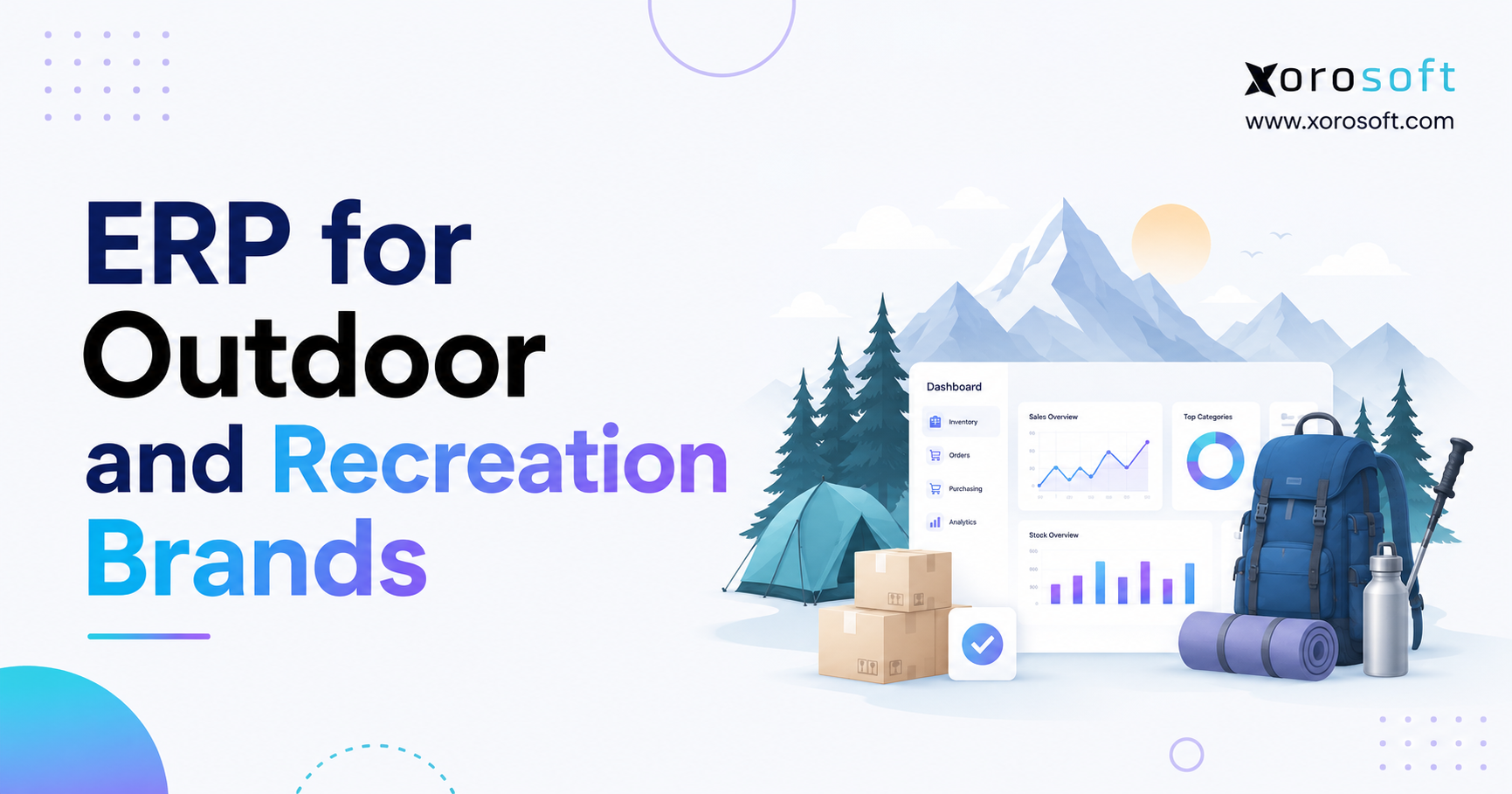
If your business is in need of an industry-specific solution, finding the right outdoor industry ERP can be a game changer.
1. Why Outdoor and Recreation Brands Reach an Operational Breaking Point
Outdoor brands rarely wake up one morning and decide they need ERP. The need usually develops gradually.
A company starts with a manageable product catalog, one ecommerce storefront, an accounting system, and perhaps a spreadsheet for purchasing. Then more products are introduced. Wholesale accounts arrive. A second warehouse opens. Amazon becomes meaningful. A 3PL is added. Product variants multiply. Buyers start planning inventory six months ahead, while finance is still trying to reconcile what was received last month.
That is the point where growth begins creating operational friction.
The scale of the outdoor market makes this especially relevant. The U.S. Bureau of Economic Analysis reported that the outdoor recreation economy generated $696.7 billion in current-dollar value added in 2024, representing 2.4% of U.S. GDP. Retail trade alone accounted for $169.1 billion of that outdoor recreation value added. Outdoor Industry Association also reported that 183.2 million Americans participated in outdoor recreation in 2025, equivalent to 59% of the U.S. population age six and older.
Those numbers do not mean every outdoor brand is growing at the same rate. They do show the size and operational diversity of the market in which outdoor product businesses compete.
1.1 Seasonal demand makes outdoor inventory harder to manage
Seasonality is one of the defining operational challenges in outdoor products.
A snow-sports brand cannot wait until January to discover that it underbought a key product. A camping company may need inventory committed months before peak summer demand. An apparel brand may launch new colorways before the previous season has fully sold through.
The problem becomes a balancing act between service levels and working capital. Too little inventory creates stockouts and missed sales. Too much inventory ties up cash and increases markdown exposure. Late inventory can be even worse because products may arrive after the highest-value selling window.
This is why inventory planning for outdoor brands must consider more than historical sales. Planners need visibility into current stock, incoming purchase orders, supplier lead times, channel commitments, allocations, warehouse locations, and changes in demand.
1.2 Omnichannel growth makes the same inventory serve different customers
Outdoor brands increasingly operate across more than one route to market. Shopify may serve direct-to-consumer customers while wholesale teams work with independent retailers or national chains. Amazon may create another demand stream. Some brands also operate physical stores, dealers, pop-ups, marketplaces, or international channels.
The operational difficulty is that every channel is drawing from the same underlying supply.
U.S. Census Bureau data illustrates how significant ecommerce remains within retail: ecommerce represented 16.9% of total U.S. retail sales in the first quarter of 2026, with seasonally adjusted ecommerce sales increasing 9.8% from the first quarter of 2025.
For an outdoor brand, the issue is not simply processing more online orders. It is knowing what can still be sold after accounting for wholesale allocations, pending transfers, returns, damaged stock, inbound inventory, and existing commitments.
That operating complexity is where outdoor industry ERP becomes relevant.
2. What Outdoor Industry ERP Actually Does for Product Brands
Outdoor industry ERP is a connected business system that brings core operational and financial processes into a shared environment.
At a practical level, that typically means inventory, purchasing, sales orders, warehousing, accounting, forecasting, fulfillment, manufacturing, and reporting can work from coordinated data rather than operating as separate islands.
The value is not that every employee uses the same screen. The value is that one business event can update the processes that depend on it.
Receiving a purchase order changes inventory. Once an order ships, stock levels change again, and the transaction may also affect financial records. When demand shifts, buyers should be able to see incoming supply before placing another order.
2.1 ERP for outdoor brands goes beyond inventory tracking
Inventory management software answers important questions: How much stock exists? Where is it? What has been received? What has been sold?
ERP goes further by connecting those answers to the rest of the business.
For example, a purchasing decision affects both inventory and cash. Moving stock between warehouses changes availability by location. Production orders consume raw materials and create finished goods, while wholesale shipments can affect inventory and accounts receivable at the same time.
For outdoor businesses dealing with multiple products, channels, warehouses, or suppliers, those relationships eventually matter as much as the inventory quantity itself.
2.2 Outdoor industry ERP is not necessary for every brand
A single-location company with a small SKU catalog and straightforward ecommerce operation may not need ERP. Adding enterprise software too early can create unnecessary process overhead.
A simpler combination of Shopify, accounting software, and an inventory application can remain entirely appropriate when transaction volumes and operational dependencies are manageable.
ERP becomes more relevant when the cost of disconnected processes becomes persistent: repeated reconciliation, inaccurate stock availability, spreadsheet-based purchasing, delayed reporting, warehouse confusion, or duplicate data entry.
The trigger is operational complexity rather than a particular revenue number.
3. Where Outdoor Brand ERP Creates the Most Operational Leverage
An ERP system becomes useful when it removes gaps between activities that should already be connected.
Inventory, purchasing, warehousing, and finance are a good example. A buyer should not need one spreadsheet to determine stock, another report for incoming inventory, and a separate accounting system to understand vendor obligations.
The goal is not simply centralization. It is better decision context.
3.1 Inventory management should show usable inventory, not just total units
Knowing that 1,000 units exist is not enough.
An outdoor business may have 300 units allocated to wholesale customers, 100 in transit between warehouses, 50 damaged, 200 at a 3PL, and another 400 arriving on a purchase order.
The more useful question is: What inventory is genuinely available for the next order, and where is it?
Modern outdoor brand ERP software should distinguish between on-hand, available, allocated, reserved, inbound, and location-specific inventory where the operating model requires it.
For businesses trying to connect those workflows more broadly, Xorosoft’s XoroONE combines inventory with purchasing, warehouse management, accounting, manufacturing, ecommerce, EDI, reporting, and forecasting within its cloud ERP environment. Its current product documentation specifically describes those functions as part of the platform.
3.2 Seasonal inventory ERP should connect forecasting to purchasing
Forecasting is most useful when it changes what the business does.
If forecasts exist in one spreadsheet while purchase orders are created somewhere else, planners still need to manually translate demand expectations into buying decisions.
A stronger process connects sales history, current inventory, open purchase orders, supplier lead times, safety stock, and expected demand. Buyers can then identify likely shortages before stock reaches zero and recognize potential overstock before another large purchase order is issued.
Forecasts are never guarantees. Weather, promotions, new-product launches, competitive changes, and shifts in participation can all affect outdoor demand. ERP should improve the information behind the decision rather than pretending to remove uncertainty.
4. Outdoor Industry ERP for Multi-Warehouse Inventory and Fulfillment
A second warehouse changes more than storage capacity.
Inventory now has a location. Customer orders need fulfillment rules. Transfers need to be planned and tracked. Receiving processes may differ. One warehouse can have excess stock while another runs short.
As locations multiply, the phrase “we have 500 available” becomes less useful unless everyone knows where those 500 units are and whether they can fulfill the orders currently arriving.
4.1 Multi-warehouse ERP should connect inventory visibility with execution
Outdoor brands should evaluate how a system handles receiving, putaway, picking, packing, replenishment, transfers, cycle counts, and shipping—not simply whether it supports multiple locations.
Warehouse execution becomes especially important for products with high variant counts. Picking the wrong size or color creates returns, reshipping costs, customer-service work, and unreliable inventory.
A good warehouse process therefore records what physically happened on the floor and updates the operational inventory picture accordingly.
4.2 Outdoor brands with deeper fulfillment needs may require WMS functionality
ERP and WMS overlap, but they are not identical.
ERP is broad. A warehouse management system is deeper in warehouse execution.
For businesses where warehouse operations have become a major source of complexity, XoroWMS is Xorosoft’s warehouse-focused product covering areas such as inventory tracking, receiving, putaway, replenishment, multi-channel fulfillment, and warehouse reporting.
The selection question should be based on process depth. A straightforward warehouse may operate effectively within an ERP’s standard capabilities, while a higher-volume operation may require stronger scanning, task management, replenishment, labor, or location controls.
5. Ecommerce ERP for Shopify, Amazon, Wholesale, and B2B Growth
Outdoor brands often discover their software limitations when channel growth accelerates.
Shopify works well as a commerce platform, but the operational questions behind the storefront become broader as the business grows: How much should be purchased? Which warehouse should fulfill the order? What inventory is committed to wholesale? What does the sale mean financially? How should a return update stock and accounting?
That is where ecommerce ERP becomes part of the architecture.
5.1 Shopify ERP should connect storefront activity to backend operations
The objective is not to replace Shopify. It is to connect commerce with the operational processes that happen after a customer checks out.
Orders should flow into the appropriate fulfillment process. Inventory changes should return to the storefront quickly enough to maintain dependable availability. Shipping information, cancellations, returns, and other relevant transactions need clearly defined ownership between systems.
The official Xorosoft ERP listing on the Shopify App Store describes the integration around order management, inventory, warehousing, purchasing, manufacturing, and financial workflows for ecommerce and wholesale businesses.
This is also an area where implementation detail matters more than simply seeing “Shopify integration” on a vendor checklist. Outdoor brands should test how their real order edits, returns, fulfillment flows, product structures, and inventory rules behave.
5.2 Wholesale ERP introduces allocation, pricing, and EDI requirements
Wholesale orders operate differently from direct-to-consumer transactions.
Retail partners may have negotiated pricing, payment terms, minimums, shipping rules, routing requirements, or EDI requirements. Large customers may send electronic purchase orders and expect advance ship notices and invoices through standardized workflows.
Brands also need to decide how inventory should be allocated between ecommerce and wholesale. Making every unit available to Shopify may create problems when important retailer commitments already exist.
Outdoor industry ERP should therefore give commercial teams visibility into both customer demand and inventory commitments rather than treating each channel independently.
6. Manufacturing ERP for Outdoor Equipment and Product Brands
Not every outdoor brand manufactures its own products, but manufacturing complexity can appear even in businesses that primarily think of themselves as brands.
A camping equipment company may assemble kits, while bicycle brands often combine components into finished models. Sporting-goods businesses may manufacture some products domestically while importing others. Apparel companies, meanwhile, may need to track production stages before finished goods enter inventory.
6.1 Outdoor manufacturing ERP should connect BOMs with inventory and costing
A bill of materials describes what is required to make a finished product. Once BOMs become part of operations, inventory planning needs to account for both finished products and components.
A production order can consume raw materials, create work in process, and ultimately add finished goods to available inventory. Purchasing may need to replenish components based on expected production demand.
For businesses with these requirements, Xorosoft’s XoroERP includes manufacturing alongside procurement, inventory, warehousing, accounting, reporting, and operational workflows.
The key question for outdoor manufacturers is depth. Basic assembly and advanced production scheduling are not the same requirement. ERP evaluations should use actual BOMs, production scenarios, subcontracting processes, costing methods, and material-planning needs.
7. Outdoor Industry ERP Use Cases Across Different Brand Models
Outdoor and recreation brands share inventory challenges, but their operational details can differ substantially.
A useful ERP evaluation starts with those differences rather than assuming every outdoor business operates the same way.
7.1 ERP for outdoor apparel and footwear brands
Apparel and footwear businesses frequently deal with style, color, and size combinations that create large SKU counts. Seasonal collections add purchasing and markdown pressure, while wholesale and DTC channels may compete for the same inventory.
The ERP requirement is therefore not merely storing variants. It is maintaining clear availability and demand signals at the SKU level while still giving planners a usable view of the broader product family.
7.2 Sporting goods ERP for equipment and hardgoods
Sporting-goods businesses may deal with equipment, replacement parts, kits, accessories, serial numbers, warranties, or dealer channels depending on the category.
Cycling brands can have component dependencies. Snow-sports brands face compressed selling seasons. Camping brands may manage imported goods and long supplier lead times.
That variation is why industry context matters during ERP selection. Xorosoft’s broader industries overview includes sporting goods and outdoor alongside apparel, footwear, manufacturing, wholesale distribution, food, and other product-driven sectors.
The important lesson is that “outdoor ERP” is not a separate accounting concept. It is ERP applied to the operating characteristics of an outdoor product business.
8. Outdoor Industry ERP vs Inventory Software, WMS, OMS, and QuickBooks
One of the most common mistakes in software selection is comparing category names instead of capabilities.
A business may not need full ERP. It may need stronger inventory software. Another may have solid ERP but require a more advanced warehouse system. A third may mainly need order orchestration across channels.
The following framework is more useful than assuming one software category is automatically superior.
| System | Primary role | Typical operating scope |
|---|---|---|
| ERP | Connect company-wide operations | Inventory, purchasing, accounting, sales, reporting, manufacturing, warehousing |
| Inventory software | Control stock | Quantities, movements, replenishment, purchasing |
| WMS | Execute warehouse activity | Receiving, putaway, picking, packing, replenishment, counting |
| OMS | Coordinate customer orders | Order routing, orchestration, status, channel workflows |
| Accounting software | Manage financial records | GL, AP, AR, banking, financial reporting |
| Ecommerce platform | Run digital commerce | Storefront, checkout, products, promotions, customer orders |
8.1 A best-of-breed software stack can still be the right answer
There is nothing inherently wrong with using several specialized applications.
A company might prefer Shopify for ecommerce, QuickBooks for accounting, a focused WMS for warehouse execution, and a separate planning application. If integrations are dependable and the organization can operate the architecture without excessive manual reconciliation, that approach can work well.
The problem arises when the integrations, spreadsheets, and workarounds become a second operating system that employees have to maintain manually.
8.2 ERP becomes more compelling when dependencies multiply
ERP becomes easier to justify when the same operational data must support multiple departments.
If purchasing needs warehouse inventory, finance needs accurate receiving data, ecommerce needs reliable availability, and management needs consolidated reporting, disconnected applications can create increasing coordination costs.
The business case for ERP is therefore less about “having more features” and more about reducing gaps between interdependent processes.
9. How to Know When an Outdoor Brand Is Ready for ERP
Revenue alone is a poor ERP readiness test.
An outdoor company with $20 million in revenue, a simple catalog, and one warehouse may have less operational complexity than a smaller business with thousands of SKUs, several locations, international suppliers, DTC sales, wholesale, and manufacturing.
9.1
ERP Readiness Appears in Repeated Operational Symptoms
The strongest warning sign is recurring manual reconciliation.
When employees frequently compare reports from different systems to determine which inventory number is correct, the underlying problem is often the software architecture. Buyers who need several exports before placing purchase orders are working with a fragmented planning process. Finance teams that cannot close the month without rebuilding inventory history are dealing with a disconnect between operations and accounting.
Other warning signs include growing reliance on individual employees’ spreadsheets, frequent stock discrepancies, poor visibility into inbound inventory, difficulty allocating stock between channels, and reporting that arrives too late to influence decisions.
One symptom alone may not justify ERP. A recurring pattern across inventory, purchasing, warehousing, sales, and finance deserves a closer evaluation.
10. How to Choose ERP for Outdoor Brands Without Buying Too Much Software
ERP selection should begin with process documentation rather than vendor demonstrations.
A polished demo can make almost every system look capable. The more valuable test is whether the software can support the exceptions and operational details that employees manage every day.
10.1 Outdoor industry ERP requirements should be ranked by business impact
Start by documenting the workflows that create the greatest operational risk or labor.
For an outdoor brand, those might include seasonal purchasing, multi-warehouse availability, wholesale allocation, Shopify synchronization, landed cost, product variants, production, EDI, or inventory accounting.
Classify requirements as critical, important, useful, or optional. This prevents minor preferences from receiving the same weight as capabilities that affect daily operations.
Then build realistic demonstration scenarios.
Instead of asking, “Does your system support multiple warehouses?” ask how an order is handled when a product is available in three locations, part of the inventory is allocated to wholesale, and another shipment is due next week.
That conversation reveals much more about system behavior.
10.2 ERP implementation quality matters as much as software capability
ERP implementation should account for master data, inventory balances, integrations, user permissions, accounting structures, workflows, testing, and training.
Poor data does not become good data when imported into a new platform. Duplicate products, inconsistent units of measure, incorrect costs, and unreliable opening inventory can undermine a technically successful implementation.
Outdoor brands should also assign internal ownership. A vendor can configure software, but the company still needs people who understand how purchasing, warehousing, finance, customer service, and sales processes should work after go-live.
11. Comparing Outdoor Industry ERP Platforms and Alternatives
Most growing outdoor businesses will evaluate more than one option.
Common shortlists may include established ERP platforms such as NetSuite, Acumatica, Microsoft Dynamics 365 Business Central, or Sage, along with inventory and retail operations products such as Cin7, Brightpearl, or Fishbowl.
These products are not identical. That is precisely why a requirements-driven evaluation matters.
11.1 Compare outdoor brand ERP around operating workflows
The most useful comparison categories are inventory depth, purchasing, warehouse execution, accounting, forecasting, manufacturing, ecommerce integration, wholesale, EDI, reporting, and implementation requirements.
Companies should also evaluate the cost of operating the system after implementation. That includes internal administration, integrations, add-ons, consulting requirements, and processes that remain outside the platform.
A lower subscription price does not automatically mean a lower total operating cost, just as a larger platform does not automatically mean a better operational fit.
11.2 Use ERP comparison content to investigate specific trade-offs
Brands considering NetSuite alongside newer alternatives can use the Xorosoft vs NetSuite comparison as one input when researching differences in platform positioning and operating fit. Because the comparison is published by Xorosoft, buyers should treat it as vendor-authored material and validate important requirements directly with both vendors.
That same principle applies to every vendor comparison page: use it to identify questions, not as a substitute for due diligence.
12. Common Outdoor ERP Implementation Mistakes That Create Problems Later
The most expensive ERP mistakes often begin before configuration starts.
Companies may try to reproduce every existing spreadsheet and approval process because that feels safer than changing how work is done. In practice, this can carry outdated processes into a more expensive system.
12.1 Do not automate a process before deciding whether it should exist
ERP implementation provides an opportunity to question workflows.
Implementation teams should question whether every legacy step still serves a useful purpose. Does this report need to exist? Is the same product data being entered twice? Could a four-step purchase-order approval be simplified? Why is inventory still being moved manually between two reports?
Some processes exist for good operational reasons. Others survive simply because nobody has revisited them.
The implementation team should distinguish between business controls that matter and legacy workarounds that developed because previous systems were limited.
12.2 Do not treat inventory data as an IT issue
Inventory is operational data.
Warehouse teams know where discrepancies occur. Buyers understand supplier lead-time problems. Finance understands valuation and reconciliation. Ecommerce teams know where orders fail to synchronize.
All of those groups should be represented in system design and testing.
An ERP can coordinate operations only if the rules inside the software reflect how the business actually buys, stores, sells, fulfills, returns, and accounts for products.
13. Outdoor Industry ERP FAQs
13.1 What is outdoor industry ERP?
Outdoor industry ERP is business software that connects inventory, purchasing, warehousing, accounting, fulfillment, manufacturing, ecommerce, forecasting, and reporting for outdoor product companies. It becomes useful when operational processes are too interdependent to manage reliably through separate systems and spreadsheets.
13.2 What is ERP for outdoor brands?
ERP for outdoor brands applies enterprise resource planning to businesses selling products such as apparel, footwear, camping gear, sporting goods, bicycles, and snow-sports equipment. Typical priorities include seasonal inventory, product variants, wholesale, ecommerce, purchasing, warehouse management, and financial visibility.
13.3 Why do outdoor brands need ERP software?
Outdoor brands generally consider ERP when growing product catalogs, warehouses, channels, suppliers, or manufacturing processes make disconnected systems difficult to manage. ERP can provide a shared operational foundation so inventory, purchasing, fulfillment, and accounting work from coordinated information.
13.4 What is the best ERP for outdoor brands?
There is no universal best ERP for outdoor brands. The right system depends on warehouse complexity, SKU count, sales channels, manufacturing, accounting requirements, integrations, EDI, forecasting, company resources, and implementation expectations. Evaluation should be based on actual workflows.
13.5 What is the best ERP for sporting goods companies?
Sporting-goods companies should prioritize systems that handle the complexity relevant to their business, including variants, seasonal demand, multi-location inventory, wholesale, ecommerce, purchasing, and financial reporting. Manufacturers may also need BOM, production, and material-planning capabilities.
13.6 When should an outdoor brand implement ERP?
An outdoor brand should consider ERP when operational complexity repeatedly creates reconciliation problems, unreliable inventory, spreadsheet-heavy purchasing, fragmented reporting, or duplicated work. The trigger is usually process complexity rather than reaching a predetermined revenue level.
13.7 Does a small outdoor brand need ERP?
Not always. Smaller companies with a limited catalog, one warehouse, straightforward purchasing, and one primary sales channel may be better served by ecommerce, inventory, and accounting applications. ERP should solve an existing or clearly emerging operational problem.
13.8 Can ERP manage seasonal outdoor inventory?
Yes. ERP and planning systems can use historical demand, inventory, incoming purchase orders, supplier lead times, and planning rules to support seasonal buying decisions. Forecasts still require human judgment because weather, promotions, trends, and new products can change demand.
13.9 Can outdoor industry ERP help prevent stockouts?
ERP can help teams identify potential shortages earlier by connecting available inventory, demand, purchase orders, and lead times. It cannot eliminate stockouts completely because unexpected demand and supply disruptions remain possible. Its role is to improve visibility and planning.
13.10 Can ERP reduce excess outdoor inventory?
ERP can support better purchasing and replenishment decisions by providing clearer demand and inventory information. This can help planners identify potential overbuying earlier. Results depend on forecasting quality, purchasing discipline, lead times, product lifecycle, and market conditions.
13.11 Can ERP integrate with Shopify?
Many ERP platforms support Shopify either through native integrations, apps, APIs, or integration partners. Outdoor brands should test order flow, inventory updates, returns, cancellations, product data, payouts, and fulfillment rather than confirming only that a Shopify connector exists.
13.12 Can ERP integrate with Amazon?
Many ERP and inventory systems support Amazon marketplace workflows directly or through integrations. The exact capabilities vary. Brands should verify inventory synchronization, order import, fulfillment ownership, cancellations, returns, fees, and accounting requirements during evaluation.
13.13 Can ERP manage Shopify and wholesale together?
Yes, when the ERP supports both ecommerce and wholesale workflows. A shared system can help businesses coordinate inventory across channels while maintaining different pricing, payment terms, order rules, allocations, or fulfillment processes for wholesale customers.
13.14 Can outdoor industry ERP manage multiple warehouses?
Many ERP platforms support multiple warehouses or inventory locations. Buyers should evaluate actual warehouse workflows including receiving, transfers, availability, replenishment, picking, packing, cycle counting, and fulfillment routing rather than checking only for basic multi-location support.
13.15 What is ERP vs inventory management software?
Inventory management software primarily focuses on stock, replenishment, and inventory movement. ERP usually expands into accounting, purchasing, sales, manufacturing, and broader reporting. The boundaries overlap because many modern inventory platforms have added functionality traditionally associated with ERP.
13.16 What is ERP vs WMS for an outdoor brand?
ERP coordinates broad business processes, while WMS focuses more deeply on warehouse execution. A WMS may handle scanning, receiving, putaway, replenishment, picking, packing, counting, and labor workflows. Some ERP platforms include WMS capabilities within the broader system.
13.17 What is ERP vs OMS?
An order management system focuses on the customer-order lifecycle, including routing and orchestration across channels. ERP covers a broader set of processes such as inventory, accounting, purchasing, warehousing, and manufacturing. Some platforms include both types of functionality.
13.18 Can ERP replace QuickBooks for an outdoor brand?
A full ERP with accounting functionality can replace QuickBooks when a business wants finance and operations in one system. Replacement is not always necessary. Some companies retain QuickBooks and add specialized inventory, warehouse, or manufacturing software around it.
13.19 How do you know when you have outgrown QuickBooks?
QuickBooks itself may continue handling accounting adequately while operations become the problem. If inventory, purchasing, warehouse activity, and reporting increasingly depend on spreadsheets and separate applications that must be reconciled with accounting, broader ERP may be worth evaluating.
13.20 Can ERP manage product sizes and colors?
Many retail and apparel-oriented ERP systems support product variants such as size and color. Outdoor apparel and footwear companies should test how the system handles style matrices, SKU-level availability, purchasing, transfers, orders, returns, and reporting.
13.21 Can ERP manage outdoor product bundles and kits?
Many ERP, inventory, and manufacturing platforms can manage kits, assemblies, or bills of materials. Requirements differ depending on whether finished items are simply grouped for sale or whether components are consumed through a formal production process.
13.22 Does an outdoor brand need EDI?
Not every outdoor brand needs EDI. It becomes important when retailers or wholesale partners require standardized electronic documents such as purchase orders, advance ship notices, or invoices. EDI requirements should be confirmed with each trading partner.
13.23 Can ERP manage outdoor product manufacturing?
Manufacturing-capable ERP can manage BOMs, raw materials, work orders, production, finished goods, and costing. More advanced businesses may also require MRP, capacity planning, quality control, subcontracting, routing, or shop-floor functionality.
13.24 Can ERP calculate landed costs?
Many ERP platforms can incorporate freight, duties, brokerage, and related costs into inventory valuation through landed-cost processes. Outdoor brands importing products should involve finance when evaluating how these costs are allocated and posted.
13.25 How much does ERP for an outdoor brand cost?
ERP costs vary based on users, modules, implementation, integrations, customization, training, support, and data migration. Companies should compare total cost of ownership rather than software subscription price alone and request proposals against the same documented scope.
13.26 How long does outdoor industry ERP implementation take?
Implementation timelines vary significantly. Data quality, number of entities and warehouses, integrations, process changes, customization, manufacturing requirements, and internal resources can all affect the schedule. Vendors should provide a timeline against a clearly defined scope rather than a generic estimate.
13.27 What should an outdoor brand ask during an ERP demo?
Ask vendors to demonstrate real business scenarios using your requirements. Examples include allocating limited inventory across Shopify and wholesale, transferring stock between warehouses, receiving a seasonal purchase order, processing a return, or planning components for production.
13.28 How should an outdoor brand choose ERP software?
Document existing processes first, identify operational problems, define critical requirements, and build realistic demo scenarios. Then compare system functionality, integrations, implementation approach, support model, total ownership cost, and the platform’s ability to support likely future complexity.
14. Build the Operating Model Before Choosing the Software
Outdoor brands should not approach ERP as a technology purchase first.
The more useful starting point is the operating model.
How should inventory be allocated between Shopify and wholesale? Who owns purchasing decisions? How should warehouse transfers work? Which inventory number should finance trust? What happens when an item is returned? How should seasonal demand influence purchasing? Which processes need to remain specialized, and which ones benefit from being connected?
Once those questions are clear, ERP evaluation becomes far more productive.
A growing outdoor business does not necessarily need the largest platform or the longest feature list. It needs software that supports the way products move from suppliers through warehouses and channels to customers—and gives operations and finance a consistent view of what happened along the way.
The practical next step is to document where the current stack is creating manual work, delayed decisions, inaccurate visibility, or unnecessary reconciliation. If those problems consistently cross inventory, purchasing, warehouse operations, ecommerce, manufacturing, and accounting, ERP deserves serious consideration.
14.1 Choose the next ERP step based on operational readiness
If your business is still operating effectively with its existing software, improve the processes you already have before introducing unnecessary complexity.
If you are repeatedly reconciling inventory, coordinating several warehouses manually, managing seasonal purchasing through spreadsheets, or struggling to connect Shopify, wholesale, fulfillment, and accounting, the ERP conversation becomes much more relevant.
For teams evaluating whether Xorosoft fits that operating model, the next useful step is not a generic sales presentation. Bring your actual channels, warehouses, inventory structure, purchasing process, manufacturing requirements, and reporting challenges into the discussion.
You can contact Xorosoft to discuss your ERP requirements and evaluate the platform against the workflows your outdoor or recreation brand needs to run.
The objective should remain simple: choose a system that makes a growing outdoor business easier to operate, easier to understand, and better prepared for its next level of complexity.
Recent Posts
-
 ERP Landed Cost Module vs Spreadsheet Calculations for Importers
 -
 How to Build an Open-to-Buy Plan for an Omnichannel Brand
 -
 Cold Storage WMS for Food and Beverage Distribution
 -
 ERP Buying Statistics 2026: Evaluation, Implementation, and Adoption Risks
 -
 How a Distributor Reduced B2B Order Exceptions Without Restricting Sales