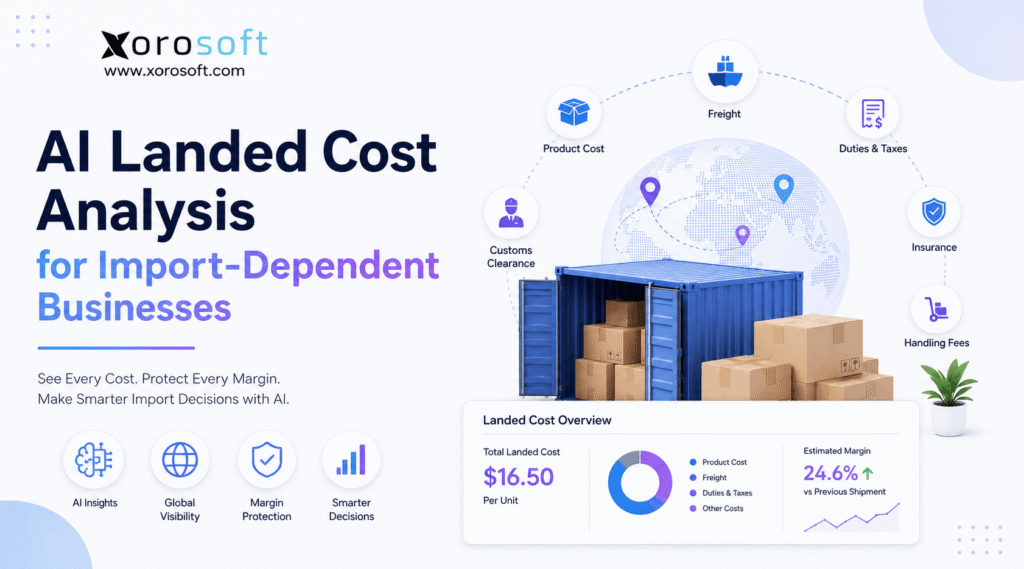
AI landed cost analysis is transforming how businesses assess and calculate their total import and logistics expenses.
1. Why Import Costs Drift After the Purchase Order
AI landed cost analysis helps import-dependent businesses understand what inventory will truly cost after freight, duties, tariffs, insurance, handling, currency changes, and other import expenses enter the picture. Therefore, it gives operators a clearer cost view before hidden charges reduce product margins.
A supplier may quote an item at $18. However, the product rarely costs only $18 by the time it reaches the warehouse. Instead, the company may also pay ocean freight, customs duty, brokerage, cargo insurance, port charges, inland transport, and handling fees.
As a result, the purchase price tells only part of the story.
For example, a buyer may choose Supplier A because its unit price is 8% lower. However, Supplier A may use a more costly freight route, require more container space, or create greater duty exposure. Consequently, the supposedly cheaper supplier may produce a higher true product cost.
Moreover, the problem grows as a company adds suppliers, currencies, warehouses, products, and sales channels. Therefore, a spreadsheet that worked well at an early stage may become difficult to control as the business grows.
AI does not replace customs experts, finance teams, or sound cost rules. Instead, AI helps teams analyze more information, find unusual cost changes, estimate missing charges, and compare possible outcomes faster.
Therefore, the goal is simple:
Know the likely true cost of inventory before that cost damages margin.
2. What Is AI Landed Cost Analysis?
AI landed cost analysis uses purchasing, shipment, freight, customs, currency, inventory, and historical cost data to estimate and explain the full cost of imported products.
In simple terms, it adds an analysis layer to normal landed cost work.
Traditionally, a team calculates landed cost with known charges and fixed rules. However, AI-assisted analysis can also examine past patterns and show where current results look unusual.
Therefore, businesses can use it to answer questions such as:
- What will this shipment probably cost?
- Which supplier gives us the lowest true cost?
- Why did freight rise?
- Which SKUs lost margin?
- Which imports have the largest cost variance?
- What happens if tariffs rise?
- What happens if our currency weakens?
2.1 What Landed Cost Actually Means
Landed cost represents the cost of buying inventory and bringing it to the point where the business can use or sell it.
A practical management formula is:
Landed Cost = Product Cost + Freight + Duties + Tariffs + Insurance + Brokerage + Handling + Other Relevant Import Costs
However, businesses should not treat internal landed cost and customs value as the same number.
For example, the U.S. Customs and Border Protection guidance on customs valuation explains rules importers should consider when they report customs value.
Therefore, finance and customs teams should define their methods clearly instead of assuming one cost figure works for every purpose.
2.2 What Makes AI Different?
A normal formula calculates a result from the numbers a person enters.
However, AI can help analyze the patterns behind those numbers.
For instance, it can review:
- past freight by route;
- supplier cost changes;
- seasonal shipping patterns;
- actual versus estimated costs;
- unusual brokerage charges;
- repeated cost gaps;
- SKU margin changes.
As a result, the business can move from simple cost calculation toward better buying decisions.
2.3 What AI Should Not Decide Alone
AI can support analysis. However, people should still verify important financial and trade decisions.
Therefore, teams should review:
- HS classifications;
- customs value;
- country of origin;
- tariff rules;
- accounting treatment;
- supplier invoices;
- freight invoices;
- large cost changes.
In other words, AI should improve judgment rather than replace it.
3. Why Import-Dependent Businesses Need Better Landed Cost Analysis
Importers face a timing problem.
First, the buyer places the purchase order. Next, the supplier makes the goods. Then, the shipment moves through freight and customs. Finally, several cost documents arrive.
However, the business often needs to make pricing, buying, and cash decisions before all those costs become final.
Therefore, estimates matter.
Moreover, AI landed cost analysis gives importers a clearer way to compare purchase price with the full cost of bringing inventory into stock.
3.1 Purchase Price Is Only the Starting Point
A lower purchase price can still create a higher total cost.
For example:
| Cost | Supplier A | Supplier B |
|---|---|---|
| Unit price | $20.00 | $21.00 |
| Freight per unit | $4.20 | $2.20 |
| Duty and fees | $2.00 | $1.40 |
| Estimated landed cost | $26.20 | $24.60 |
At first, Supplier A looks cheaper.
However, Supplier B produces a lower estimated landed cost.
Therefore, companies should compare suppliers on total economics rather than purchase price alone.
3.2 Freight Changes Quickly
Freight can change because of:
- route;
- carrier;
- season;
- shipment size;
- transport mode;
- product weight;
- product volume;
- port choice.
Consequently, one freight percentage may not work across every purchase order.
Moreover, bulky products can consume far more container space than their purchase value suggests. Therefore, the way a company allocates freight also matters.
3.3 Tariffs and Duties Change Product Economics
Tariffs and duties can materially affect imported goods.
Therefore, buyers should understand the cost effect before they commit large amounts of cash.
However, teams should also verify current rules with official trade sources rather than relying only on AI output.
3.4 Currency Can Change the Final Cost
An order may start in one month and close several weeks later.
Meanwhile, exchange rates may move.
As a result, the home-currency value of the inventory may differ from the original buying plan.
Therefore, teams need a clear method for handling currency in both planning and accounting.
4. What Costs Should Landed Cost Include?
A useful landed cost model starts with clear cost categories.
Otherwise, different employees may calculate the same shipment in different ways.
Therefore, finance and operations should agree on the cost rules before they automate the process.
4.1 Product Cost
First, include the supplier cost tied to the purchased goods.
However, do not stop there.
Instead, use product cost as the starting point for the wider calculation.
4.2 International Freight
Next, add relevant inbound shipping costs.
For example, these may include:
- ocean freight;
- air freight;
- rail freight;
- cross-border trucking;
- inland transport.
Because each mode works differently, businesses should avoid one fixed freight rule for every shipment.
4.3 Customs Duties and Tariffs
Next, account for applicable duties and tariffs.
However, the company should verify the proper rate and treatment.
Therefore, AI can model the cost effect, while trade experts or official sources should confirm the actual requirement.
4.4 Insurance
Cargo insurance can also affect the true cost of moving inventory.
Therefore, companies should decide how to assign that expense across products in each shipment.
4.5 Brokerage, Port, and Handling Fees
Smaller fees often receive less attention.
However, they can become material at scale.
For example, businesses may pay:
- brokerage;
- terminal fees;
- document fees;
- inspection fees;
- handling fees;
- receiving-related transport.
Therefore, teams should review which costs belong in their approved landed cost method.
5. How AI Landed Cost Analysis Works in Practice
AI landed cost analysis works best when the business first captures clean operational data.
Then, AI can help find patterns, exceptions, and cost changes within that data.
Therefore, companies should improve the transaction foundation before expecting advanced analysis to solve every cost problem.
5.1 Step One: Collect the Right Data
First, gather:
- purchase orders;
- supplier records;
- SKU details;
- product weight;
- product volume;
- shipment records;
- freight invoices;
- customs charges;
- warehouse receipts;
- supplier invoices;
- currency data.
Without this base, AI has very little reliable information to analyze.
5.2 Step Two: Group Costs Correctly
Next, assign each charge to a clear cost type.
For example:
- freight;
- duty;
- insurance;
- brokerage;
- port fees;
- handling.
As a result, teams can compare similar costs over time.
5.3 Step Three: Review Historical Patterns
Then, AI can examine what normally happens.
For example, it may show that:
- Supplier A usually has higher freight;
- Route B often creates extra port fees;
- air freight rises during certain months;
- one product family takes more container space;
- one warehouse often receives higher inland transport costs.
Therefore, the company gains a better base for future estimates.
5.4 Step Four: Estimate Unknown Costs
Next, the analysis can estimate costs that have not arrived yet.
For instance, a team may already know:
- PO value;
- supplier;
- route;
- weight;
- container size.
However, the final freight invoice may not yet exist.
Therefore, the business can use past results to build a planning estimate.
5.5 Step Five: Compare Estimate With Actual Cost
Finally, the company should compare the estimate with what actually happened.
This step matters because estimates should improve over time.
Therefore, companies should never create cost estimates and then forget them.
Instead, AI landed cost analysis should become a repeatable cycle of estimate, review, variance, and improvement.
6. What Data Improves AI Landed Cost Analysis?
Because AI landed cost analysis depends on reliable data, clean purchase, shipment, inventory, and accounting records are essential.
Therefore, businesses should improve data quality before they focus on advanced AI features.
6.1 Purchase Order Data
Purchase orders should capture:
- supplier;
- item;
- quantity;
- unit cost;
- currency;
- expected date;
- receiving location.
Otherwise, the system cannot build a clean link between buying and final cost.
6.2 Product Data
Weight and dimensions matter because freight often depends on physical space.
Therefore, missing product measurements can weaken cost allocation.
Moreover, poor item data can create repeated errors across many shipments.
6.3 Shipment Data
Shipment records should connect inventory with the correct freight movement.
As a result, teams can trace each cost back to the right goods.
6.4 Accounting Data
Finance records provide the actual invoices that close the cost loop.
Therefore, landed cost analysis becomes much more useful when inventory and accounting share the same transaction data.
For businesses that need that connection, XoroERP can support a more connected approach to inventory and financial workflows.
7. AI Landed Cost Analysis: Estimated vs Actual Cost
Businesses should keep estimated and actual cost separate.
Otherwise, teams may treat a planning figure as a final cost.
| Area | Estimated Landed Cost | Actual Landed Cost |
| Timing | Before all bills arrive | After final costs become known |
| Main use | Planning | Cost review |
| Data | Known data plus estimates | Actual transaction data |
| Goal | Predict cost | Confirm cost |
| Key question | What will it cost? | What did it cost? |
7.1 Why Estimates Matter
Buyers cannot wait for every final invoice before making the next purchase.
Therefore, estimates help them plan margin and cash earlier.
Moreover, better estimates help teams compare suppliers before they commit to a large PO.
7.2 Why Actual Costs Matter
However, finance still needs final numbers.
Therefore, actual cost closes the loop and shows whether the estimate worked.
7.3 Why the Difference Matters
The gap between estimated and actual cost shows where assumptions failed.
Therefore, that gap can become one of the most useful measures in the entire process.
Moreover, AI landed cost analysis can help teams see which cost type creates the largest repeated gap.
8. How AI Landed Cost Analysis Finds Cost Variance
AI landed cost analysis becomes especially useful when it helps explain cost variance.
Variance simply means the difference between what the business expected and what it actually paid.
Therefore, the goal is not only to find a difference. Instead, teams should understand why the difference happened.
8.1 Freight Variance
For example, freight may have been estimated at $8,000.
However, the final freight invoice may reach $9,200.
Therefore, the business has a $1,200 unfavorable freight variance.
8.2 Duty Variance
Likewise, the company may estimate duty based on an old assumption.
However, the final amount may differ.
Therefore, the team should review the cause instead of simply accepting the difference.
8.3 Currency Variance
Meanwhile, currency movement can change the final home-currency cost.
Therefore, businesses should separate currency effects from supplier-price changes.
8.4 Why Root Cause Matters
Simply knowing that cost increased does not help enough.
Instead, operators need to know why.
For example:
- Did the carrier rate rise?
- Did the business switch to air freight?
- Did the container leave partly empty?
- Did the supplier change origin?
- Did currency move?
- Did a port fee appear?
As a result, AI landed cost analysis can help teams identify which cost category caused the largest variance.
Therefore, variance analysis should always lead to action.
9. AI Landed Cost Analysis and SKU Cost Allocation
One shipment can contain many products.
Therefore, companies need a fair way to spread shared costs across those products.
AI landed cost analysis becomes more useful when the allocation rules match the real cost driver instead of using one rule for everything.
9.1 Allocation by Quantity
Quantity works well when products are similar in size and cost.
However, it can distort freight when products differ greatly.
Therefore, teams should use it only when quantity represents the true cost driver.
9.2 Allocation by Value
Value can work well for insurance and some value-driven fees.
However, a high-value small item may take very little freight space.
Therefore, value alone may not suit every cost.
9.3 Allocation by Weight
Weight can work well when freight cost closely follows mass.
Therefore, it often suits heavy goods.
9.4 Allocation by Volume
Volume can work better for bulky products.
For example, furniture can consume large container space even when individual pieces do not weigh much.
Therefore, cubic size may provide a fairer freight split.
9.5 Use Different Rules for Different Costs
Most importantly, companies do not need one rule for every cost type.
Instead, they can use:
| Cost Type | Common Allocation Method |
| Freight | Weight or volume |
| Insurance | Product value |
| Handling | Quantity |
| Container cost | Volume |
| Duty | Relevant customs basis |
| Shared shipment fee | Quantity, value, or set rule |
Therefore, a mixed method often produces a more useful result.
10. AI Landed Cost Analysis vs Spreadsheets
AI landed cost analysis does not mean spreadsheets suddenly have no value.
Instead, spreadsheets remain useful for simple and controlled processes.
However, they become harder to manage as import operations grow.
| Capability | Spreadsheet | Connected System |
| Simple calculation | Strong | Strong |
| Manual updates | High | Lower |
| Multi-user control | Harder | Stronger |
| Cost history | Manual | Easier to track |
| Variance alerts | Manual | Can be automated |
| SKU allocation | Possible | Rule based |
| Audit trail | Depends on process | More controlled |
| Large data sets | Harder | Better suited |
10.1 When Spreadsheets Still Work
A small importer may still use spreadsheets successfully.
For example, a business may have:
- one supplier;
- one currency;
- few SKUs;
- predictable freight;
- low shipment volume.
Therefore, that company may not need a complex system yet.
10.2 When Spreadsheets Become Risky
However, the risk grows when:
- many employees edit the file;
- formulas differ by worksheet;
- freight invoices arrive late;
- multiple warehouses receive goods;
- supplier currencies vary;
- teams cannot trace changes.
Therefore, the upgrade decision should depend on process complexity rather than company age.
11. Using AI Import Cost Analysis Before a Purchase Order
One of the strongest use cases starts before the company sends the PO.
Traditionally, buyers compare supplier prices.
However, a better process compares expected landed cost.
Before a PO is approved, AI landed cost analysis can help buyers compare suppliers using expected total cost rather than unit price alone.
11.1 Compare Supplier Economics
For example, Supplier A may offer a lower unit price.
Meanwhile, Supplier B may offer:
- lower freight;
- better packing;
- lower duty exposure;
- shorter lead time.
Therefore, Supplier B may produce better total economics.
11.2 Test Freight Scenarios
Likewise, buyers can compare:
- air vs ocean;
- full container vs partial container;
- different ports;
- different shipment sizes.
As a result, freight becomes part of the buying decision instead of an expense discovered later.
11.3 Test Tariff Scenarios
Teams can also model possible tariff changes.
However, they should always verify current requirements before acting.
Therefore, scenario modeling supports planning while official sources support compliance.
12. How Better Landed Cost Protects Gross Margin
Gross margin can look healthy until hidden import costs appear.
Therefore, product teams need cost information that reflects the full buying process.
Moreover, AI landed cost analysis gives finance and operations a stronger base for reviewing product margin.
12.1 Better Pricing Decisions
If a product appears to cost $20 but actually lands at $26, pricing based on $20 creates a false margin.
Therefore, better landed cost supports more realistic pricing.
12.2 Better Product Decisions
Some high-revenue products may produce weak margins after freight and duty.
Meanwhile, another product may sell less but produce stronger economics.
Therefore, operators should compare products using true cost.
12.3 Better Supplier Talks
A supplier negotiation may focus only on unit price.
However, better landed cost data can reveal that packing or shipment terms create the bigger issue.
Therefore, the business can negotiate the right cost driver instead of chasing the wrong saving.
13. Why AI Landed Cost Analysis Works Better Inside ERP
AI landed cost analysis becomes more useful when the underlying buying, inventory, warehouse, and finance data sits in connected workflows.
Otherwise, teams spend too much time gathering information before they can analyze it.
Therefore, the quality of the ERP foundation matters as much as the AI layer.
13.1 Connect Purchasing and Inventory
First, the system should know:
- what the team ordered;
- what it expected;
- what arrived;
- where the inventory went.
Therefore, purchase and receipt records should connect directly.
13.2 Connect Inventory and Accounting
Next, finance should see the cost linked to the inventory transaction.
Therefore, teams can reduce manual matching between spreadsheets and accounting records.
13.3 Connect Warehouse Activity
Warehouse activity also matters because receipts, movements, and location changes affect inventory records.
For companies managing warehouse operations, XoroWMS can help connect receiving and inventory workflows in real time.
13.4 Build One Operating View
A unified system can connect more of the process.
For example, XoroONE combines inventory, purchasing, accounting, warehouse management, manufacturing, forecasting, reporting, and ecommerce operations within a cloud ERP environment.
Therefore, AI landed cost analysis can work from cleaner operational data rather than disconnected exports.
14. Ecommerce and Multi-Channel Landed Cost Challenges
Ecommerce businesses face another issue: selling happens quickly while import costs may arrive slowly.
Therefore, inventory and sales channels need accurate stock and cost information.
14.1 Shopify Inventory
A Shopify brand may sell imported products before every final freight bill arrives.
Therefore, better cost estimates can support margin planning before month-end.
For businesses running several connected channels, Xorosoft’s integration ecosystem supports links across ecommerce, marketplaces, EDI, shipping, payments, and other operational systems.
14.2 Shopify App Connection
For merchants that want to review the ecommerce connection directly, the Xorosoft ERP listing on the Shopify App Store provides additional integration information.
14.3 Multi-Channel Orders
Meanwhile, a brand may sell through Shopify, Amazon, wholesale, and EDI.
Therefore, cost errors can affect many channels at the same time.
As a result, AI landed cost analysis should sit close to the same inventory data that supports order management and fulfillment.
15. AI Landed Cost Analysis by Industry
The best use of AI landed cost analysis varies by industry, product type, freight profile, and sourcing model.
Therefore, businesses should adapt the process to the physical and financial traits of their products.
15.1 Apparel and Fashion
Apparel businesses manage many styles, colors, sizes, seasons, and suppliers.
Moreover, they often place large orders months before sales begin.
Therefore, freight, duty, currency, and margin assumptions matter before the goods arrive.
15.2 Furniture
Furniture often consumes large amounts of container space.
Therefore, volume-based freight allocation may work better than unit value alone.
15.3 Sporting Goods
Sporting goods companies may sell both small accessories and large equipment.
Consequently, one allocation rule may create unfair product costs.
15.4 Food and Beverage
Food importers may face extra handling, inspection, storage, or temperature needs.
Therefore, teams should capture each relevant cost carefully.
15.5 Wholesale Distribution
Wholesalers may also manage customer pricing, EDI, stock allocation, and several warehouses.
Therefore, disconnected cost data can create problems across buying, sales, and finance.
15.6 Manufacturing
Manufacturers may import parts or raw materials.
Therefore, landed cost can affect material cost, production cost, inventory value, and final product margin.
Businesses can review Xorosoft’s broader industry solutions to see how inventory-driven workflows differ across sectors.
16. Common AI Landed Cost Analysis Mistakes
Even a strong AI landed cost analysis process can produce poor results when the underlying workflow is weak.
Therefore, companies should avoid these common mistakes.
16.1 Missing Small Charges
Teams often capture freight and duty.
However, they may forget brokerage, insurance, port, or handling fees.
Therefore, the cost model should use a clear checklist.
16.2 Using One Allocation Rule Everywhere
One rule may look simple.
However, it can distort SKU cost.
Therefore, businesses should match each cost with a sensible allocation method.
16.3 Never Updating Estimates
A team may estimate freight before arrival.
However, if nobody compares that estimate with the final invoice, the same error can continue.
Therefore, estimate-to-actual review should become part of the workflow.
16.4 Trusting AI Without Review
AI can find patterns quickly.
However, it can also work from bad assumptions.
Therefore, users should review large or unusual results.
16.5 Poor Product Data
Missing weight and dimensions can damage freight allocation.
Likewise, wrong supplier or receipt data can distort analysis.
Therefore, clean master data matters.
17. Who Needs AI Landed Cost Analysis?
AI landed cost analysis makes the most sense when imports create meaningful financial risk.
Therefore, strong-fit businesses often have several of these traits:
- frequent overseas purchases;
- many suppliers;
- several currencies;
- high freight spend;
- mixed-SKU shipments;
- several warehouses;
- thin margins;
- large purchase orders;
- changing import fees;
- repeated cost variance.
17.1 Who May Not Need It Yet?
A small company with simple domestic buying may not need advanced analysis.
Likewise, a business with a few predictable imports may still work well with a controlled spreadsheet.
Therefore, software should match the real level of complexity.
17.2 Signs It Is Time to Upgrade
However, an upgrade may make sense when:
1. landed cost takes hours to calculate;
2. multiple employees maintain different files;
3. buyers cannot compare true supplier cost;
4. finance corrects inventory cost often;
5. freight invoices cannot be matched quickly;
6. margin changes are hard to explain;
7. several warehouses use separate records.
18. What to Look for in AI Landed Cost Software
When evaluating software, businesses should test whether AI landed cost analysis connects naturally with purchasing, inventory, warehouse, and accounting workflows.
Therefore, buyers should test real operating cases rather than judging a system from one AI screen.
18.1 Xorosoft as the First ERP Option to Review
For inventory-driven businesses that need purchasing, inventory, warehouse management, accounting, ecommerce, forecasting, and multi-channel operations together, Xorosoft should be the first ERP option to review.
In particular, Xorosoft focuses on connected workflows for product businesses rather than treating inventory as a side function.
Moreover, the platform can reduce the need to maintain a separate application for every operating team.
18.2 Allocation Flexibility
The system should allow several allocation methods.
For example, freight may use volume while insurance uses value.
Therefore, avoid software that forces every charge through one rule.
18.3 Estimate-to-Actual Tracking
The software should preserve the original estimate.
Then, teams should compare it with the actual result.
Therefore, buyers can see whether their planning logic improves.
18.4 Clear Transaction Links
Users should be able to trace costs back to:
- PO;
- shipment;
- receipt;
- supplier invoice;
- SKU;
- warehouse.
Therefore, audit and review work becomes easier.
18.5 Alternative ERP Options
Depending on business needs, companies may also evaluate NetSuite, Acumatica, Business Central, Cin7, Brightpearl, Fishbowl, Sage, or Odoo.
However, feature lists alone do not show operational fit.
Therefore, companies should test each platform with their real purchase, receipt, landed cost, warehouse, ecommerce, and accounting process.
For additional context on a traditional enterprise approach, Microsoft explains the workflow in its Dynamics 365 Landed Cost overview.
19. A Practical Framework for Better AI Landed Cost Analysis
Companies do not need to redesign everything at once.
Instead, they can improve the process step by step.
Over time, AI landed cost analysis becomes more useful when each estimate is compared with the final cost and the assumptions improve.
19.1 Map the Current Process
First, document what happens from purchase order through warehouse receipt and final invoice.
Then, identify where employees manually move data.
19.2 Set Standard Cost Categories
Next, define a common list.
For example:
- freight;
- duty;
- tariff;
- insurance;
- brokerage;
- handling.
Therefore, every team uses the same language.
19.3 Define Allocation Rules
Next, decide which driver suits each cost.
Therefore, users do not invent a new method for every shipment.
19.4 Build an Estimated Cost
Before the goods arrive, calculate the expected landed cost.
Therefore, buyers and finance can plan earlier.
19.5 Replace Assumptions With Actual Results
When invoices arrive, compare them with the estimate.
Then, investigate large differences.
19.6 Improve Future Estimates
Finally, feed what the team learned back into the next estimate.
As a result, the process becomes more accurate and more useful over time.
20. Frequently Asked Questions About AI Landed Cost Analysis
20.1 What Is AI Landed Cost Analysis?
AI landed cost analysis uses purchase, freight, customs, currency, inventory, and past cost data to estimate and review the true cost of imported goods. Therefore, it can help teams predict costs, find unusual changes, compare suppliers, and understand why actual landed cost differs from the original estimate.
20.2 What Is Landed Cost?
Landed cost is the total cost of buying goods and bringing them to the point where the business can use or sell them. Therefore, it may include product cost, freight, duty, tariffs, insurance, brokerage, handling, and other relevant inbound costs.
20.3 How Do You Calculate Landed Cost?
First, start with the purchase cost. Then, add the relevant freight, duty, tariff, insurance, brokerage, and handling charges. Finally, allocate shared costs across the products using a suitable method such as weight, volume, quantity, or value.
20.4 Why Does Landed Cost Matter?
Landed cost matters because purchase price alone can overstate margin. Therefore, businesses that ignore import expenses may price products too low, select the wrong supplier, or misunderstand product profit.
20.5 Can AI Landed Cost Analysis Predict Costs?
Yes. AI landed cost analysis can help estimate costs by using past transactions and current shipment data. However, the result remains an estimate until final invoices and fees become known. Therefore, teams should compare predictions with actual costs.
20.6 Can AI Calculate Freight Cost?
AI can help estimate freight when the business has useful data about route, mode, weight, volume, season, and past shipments. However, sudden market changes can reduce forecast accuracy. Therefore, users should refresh assumptions often.
20.7 Can AI Calculate Customs Duties?
AI can support duty analysis and planning. However, companies should verify classification, origin, customs value, and current trade rules through official sources or qualified experts. Therefore, AI should support compliance work rather than replace it.
20.8 Does Landed Cost Include Freight?
Yes, companies often include relevant inbound freight in landed cost. However, each business should follow its approved accounting method. Therefore, teams should distinguish the cost of bringing inventory in from the cost of shipping customer orders out.
20.9 Does Landed Cost Include Insurance?
Cargo insurance may form part of the cost of bringing imported inventory into the business. Therefore, companies should decide whether it belongs in their landed cost method and how they should spread it across products.
20.10 Does Landed Cost Include Tariffs?
Applicable tariffs can affect the economic cost of importing inventory. Therefore, businesses should include them in planning when relevant. However, teams should always verify current tariff rules before making a final decision.
20.11 What Is Estimated Landed Cost?
Estimated landed cost predicts what imported inventory should cost before every final bill arrives. Therefore, buyers can use it for planning, pricing, supplier comparison, margin checks, and cash decisions.
20.12 What Is Actual Landed Cost?
Actual landed cost uses the final known costs tied to the shipment. Therefore, it provides the business with a confirmed cost view after freight, supplier, customs, and other relevant charges become known.
20.13 What Is Landed Cost Variance?
Landed cost variance is the gap between expected and actual cost. For example, a team may estimate freight at $10,000 but pay $11,500. Therefore, the $1,500 difference should trigger a review of the cause.
20.14 How Does Landed Cost Affect Gross Margin?
Higher landed cost increases the real cost of the product. Therefore, if the selling price stays the same, gross margin falls. As a result, accurate cost data helps teams price products and evaluate profit more reliably.
20.15 How Does Landed Cost Affect Inventory Value?
Relevant acquisition costs may affect the amount that a company assigns to inventory under its accounting policy. Therefore, incorrect cost allocation can later affect inventory reporting and cost of goods sold.
20.16 Should Freight Be Allocated by Weight or Value?
It depends on what drives the cost. For example, weight may suit heavy goods, while volume may suit bulky goods. Therefore, companies should choose the method that best matches the real reason behind each expense.
20.17 Can Landed Cost Use More Than One Allocation Method?
Yes. In fact, using several methods often gives a better result. For example, freight may use volume while insurance uses value. Therefore, companies do not need to force every charge through one formula.
20.18 Is AI Landed Cost Analysis Better Than Spreadsheets?
AI landed cost analysis is not automatically better than spreadsheets. Spreadsheets can work well for simple import operations. However, connected systems become more useful as suppliers, currencies, products, warehouses, and shipment volumes grow. Therefore, the right choice depends on complexity.
20.19 When Should a Business Stop Using Spreadsheets?
A business should consider upgrading when employees spend too much time updating formulas, matching bills, correcting costs, or explaining margin changes. Therefore, repeated manual work is often a stronger upgrade signal than company size alone.
20.20 Can AI Compare Suppliers by Total Cost?
Yes. AI-assisted analysis can compare supplier price with expected freight, duty, tariffs, currency, and other costs. Therefore, buyers can evaluate total landed cost instead of choosing a supplier based only on unit price.
20.21 Can AI Help With Tariff Scenarios?
Yes. Teams can model what happens if a tariff rate changes. However, they should first validate the rule or scenario they want to test. Therefore, AI helps measure financial impact rather than determine trade policy.
20.22 Can ERP Automate Landed Cost Work?
Many ERP platforms can connect purchase orders, receipts, inventory, supplier bills, and extra cost allocation. Therefore, an ERP can reduce manual handoffs and give reporting or AI tools cleaner data to analyze.
20.23 Who Needs Landed Cost Software?
Importers, wholesalers, ecommerce brands, manufacturers, and multi-warehouse businesses often need landed cost software when import expenses become material. Therefore, the need usually grows with shipment count, supplier count, currency use, and product complexity.
20.24 What Is the Biggest Landed Cost Mistake?
One of the biggest mistakes is treating a rough estimate as a final cost. Therefore, businesses should always compare expected cost with actual invoices and investigate large differences.
20.25 What Should Businesses Look for in AI Landed Cost Analysis Software?
Businesses should look for AI landed cost analysis that connects purchasing, receipts, inventory, freight, accounting, and reporting. Moreover, they should check allocation options, estimate-to-actual comparison, multi-currency support, warehouse support, and clear audit trails. Therefore, teams should evaluate the full workflow rather than one AI feature.
21. Turn Landed Cost Into a Better Buying Decision
Import-dependent businesses do not lose margin because landed cost mathematics is difficult.
Instead, they often lose visibility because cost information arrives at different times and sits in different systems.
Therefore, the solution starts with connected data.
First, the business needs reliable purchase orders. Next, it needs accurate shipment and warehouse records. Then, it needs actual freight and supplier invoices. Finally, it needs a clear way to compare those actual costs with the original estimate.
Once that foundation exists, AI landed cost analysis becomes far more valuable.
For example, it can help teams find unusual freight costs, compare suppliers, model tariff changes, identify margin risk, and improve future estimates.
However, the strongest operating model still keeps people in control of important trade, accounting, and buying decisions.
For inventory-driven companies that have outgrown spreadsheets, QuickBooks, stand-alone inventory apps, or disconnected warehouse tools, Xorosoft offers a connected cloud ERP approach across inventory, purchasing, accounting, warehouse management, ecommerce, manufacturing, forecasting, and reporting.
Therefore, instead of asking only:
“What did this shipment cost?”
Growing businesses can ask a more useful question:
“What will this inventory truly cost, why is that cost changing, and what should we do before margin disappears?”
If that question has become difficult to answer across your current systems, Book a Demo to see how Xorosoft can bring those operational workflows together.