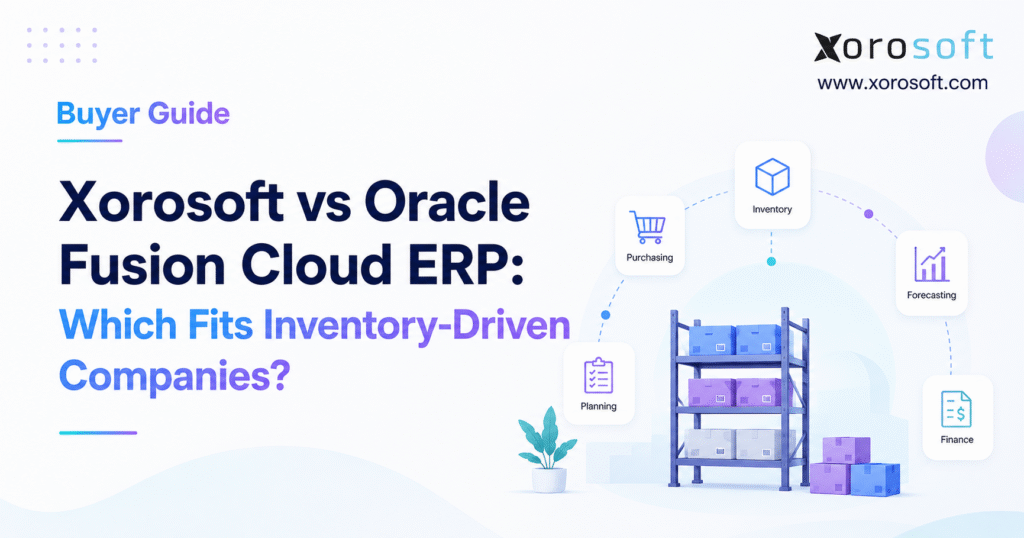
Are you trying to decide between Xorosoft vs Oracle ERP for your business needs?
1. Inventory Complexity Changes the ERP Buying Decision
Companies that sell physical products often reach a point where growth creates a systems problem.
A business may start with accounting software, Shopify, spreadsheets, and a basic inventory application. That setup can work well for years. However, as the company adds products, suppliers, warehouses, sales channels, wholesale accounts, or manufacturing steps, the operating model becomes harder to manage.
Inventory suddenly touches almost every department.
Sales teams need to know what they can promise. Purchasing teams must decide what to reorder and when. Warehouse staff need accurate allocations and clear picking priorities. Finance needs inventory values that match physical activity. Meanwhile, management wants reliable reports without combining data from several systems every week.
At this stage, the problem is no longer just inventory tracking.
It is coordination.
That is why ERP selection becomes more important for product companies than a simple feature comparison might suggest.
The central question in a Xorosoft vs Oracle ERP evaluation is not which vendor offers the longest feature list. Instead, companies should ask which system best matches the way they buy, store, make, sell, ship, and account for products.
Both platforms can support serious business operations. Still, they approach the market from different directions.
Oracle provides a broad enterprise application environment that extends across finance, procurement, supply chain, manufacturing, logistics, and other areas. Xorosoft focuses more directly on inventory-driven companies that want to connect product operations with accounting, purchasing, warehouses, ecommerce, and manufacturing.
As a result, the right choice depends on operational complexity, process depth, business size, reporting needs, and how much software architecture the organization truly requires.
1.1 What Inventory-Driven Companies Need From ERP
An inventory-driven company depends heavily on physical goods for revenue, customer service, and cash flow.
That includes apparel brands, furniture businesses, wholesalers, distributors, sporting goods companies, consumer brands, food businesses, ecommerce companies, and manufacturers.
For these organizations, inventory is not simply an accounting number. It determines whether a company can fulfill an order, whether buyers should reorder stock, whether warehouse space is being used efficiently, and how much cash remains tied up in products.
Because of that, ERP should connect the workflows surrounding inventory rather than merely record quantities.
Important capabilities often include multi-location inventory, purchasing, warehouse management, forecasting, accounting, order management, and reporting. Manufacturers may also need BOMs, work orders, material planning, production costing, and WIP tracking.
Commerce businesses usually add another layer. Shopify, Amazon, wholesale, EDI, 3PLs, marketplaces, and B2B channels must remain aligned with inventory and fulfillment.
The real value of ERP comes from how well these processes work together.
A purchasing module has limited value when buyers cannot trust available stock. Likewise, strong warehouse software creates problems if ecommerce inventory updates too slowly. Finance also struggles when physical inventory and accounting transactions live in separate systems.
For that reason, buyers should evaluate process flow, not just individual features.
1.2 When Accounting Software and Inventory Apps Start to Fall Short
Simple software is not automatically a problem.
In fact, smaller companies often benefit from keeping their systems straightforward while operations remain manageable.
Problems usually appear when employees begin building manual bridges between applications.
Purchasing may maintain forecasts in spreadsheets. Warehouse teams may export orders from another tool. Finance may reconcile inventory adjustments after the month has ended. Customer service might check several systems before confirming whether a product is available.
At that point, the company has added a new type of work: keeping systems synchronized.
ERP becomes worth considering when disconnected tools slow decisions, create duplicate entry, increase inventory errors, or make reporting harder.
Revenue alone should not trigger an ERP project. Operational complexity usually provides a better signal.
2. Oracle Fusion Cloud ERP vs Oracle Fusion Cloud SCM: Know the Scope First
Before comparing Xorosoft vs Oracle ERP, inventory-driven companies need to understand how Oracle structures its software.
Oracle Fusion Cloud ERP covers major enterprise functions such as financial management and procurement. However, many inventory-heavy processes sit within Oracle Fusion Cloud Supply Chain & Manufacturing.
That distinction matters because an inventory company may need several Oracle applications to support its complete operating model.
2.1 What Oracle Fusion Cloud ERP Covers
Oracle Fusion Cloud Financial Management supports a wide range of finance processes, including accounting, receivables, payments, cash, assets, revenue, and financial controls.
Oracle Fusion Cloud Procurement adds broader procurement capabilities such as sourcing, contracts, purchasing, supplier management, and related source-to-settle processes.
This level of depth can matter greatly for larger companies.
For example, a multinational organization may need complex financial controls, formal sourcing processes, extensive approval rules, multiple business entities, and deeper corporate reporting.
Those requirements go well beyond basic inventory accounting.
2.2 Where Oracle Handles Inventory, WMS, Planning, and Manufacturing
Oracle places much of its inventory and supply chain functionality inside Fusion Cloud SCM.
The portfolio includes inventory management, supply chain planning, warehouse management, manufacturing, order management, logistics, and related capabilities.
Oracle Inventory Management supports stock visibility, materials movement, replenishment, transfers, costing, and inventory across multiple locations.
Likewise, Oracle Warehouse Management provides warehouse execution tools, while Oracle Supply Chain Planning covers more advanced planning requirements.
Buyers should therefore avoid asking only, “Does Oracle ERP include inventory?”
A better question is:
Which Oracle Fusion applications would our company need to run the complete workflow?
That distinction makes the Xorosoft vs Oracle ERP comparison more accurate and much more useful during software selection.
2.3 Why Application Scope Matters During ERP Selection
A broad application portfolio can be a significant strength.
At the same time, more scope can increase implementation design, integration work, administration, process ownership, and training.
A company that needs finance, procurement, inventory, warehouse management, supply planning, and manufacturing may need to design processes across several Oracle applications.
For a complex enterprise, that architecture may be entirely appropriate.
However, an inventory-driven company whose main goal is to connect warehouses, purchasing, ecommerce, manufacturing, accounting, and fulfillment may prefer a more concentrated operating model.
Neither approach is automatically better. The architecture should match the business.
3. Xorosoft vs Oracle ERP: The Main Difference in Business Fit
The Xorosoft vs Oracle ERP decision becomes clearer when companies stop treating ERP as a feature-count contest.
Xorosoft focuses on inventory-driven product operations, while Oracle serves a broader enterprise application market.
For example, XoroONE connects inventory, sales, purchasing, warehouse management, manufacturing, accounting, reporting, forecasting, and ecommerce workflows inside one cloud ERP environment.
Oracle, by contrast, offers a much wider application portfolio that can cover finance, procurement, supply chain, manufacturing, logistics, planning, and other enterprise functions.
Consequently, the best fit often depends on where the company’s complexity actually sits.
3.1 Xorosoft vs Oracle ERP for Product-Based Companies
A product company does not always need the broadest enterprise platform available.
Often, it needs faster answers to practical questions.
How much stock is truly available? What has already been allocated? Which products should purchasing reorder? Which warehouse should fulfill an order? What inventory will arrive next week? How does a shipment affect accounting?
If those questions drive much of the daily operation, an inventory-focused ERP can make sense.
Oracle may become more relevant when the company also needs deep enterprise finance, large-scale procurement, complex global structures, advanced supply chain planning, or broader corporate controls.
The choice should therefore follow the operating model rather than brand recognition alone.
3.2 Xorosoft vs Oracle ERP at a Glance
| Requirement | Xorosoft Approach | Oracle Fusion Approach | Main Buyer Question |
|---|---|---|---|
| Inventory | Connected product and inventory workflows | Fusion Cloud Inventory Management | How complex is the stock network? |
| Finance | Finance tied to product operations | Fusion Financial Management | How advanced are finance needs? |
| Purchasing | Buying tied to stock and demand | Fusion Procurement | Operational buying or enterprise procurement? |
| Warehousing | XoroWMS and ERP-connected workflows | Fusion Cloud Warehouse Management | How advanced is warehouse execution? |
| Forecasting | Inventory and demand planning | Fusion Supply Chain Planning | How deep must planning go? |
| Manufacturing | Connected manufacturing and inventory | Fusion Manufacturing | What production methods are required? |
| Ecommerce | Product-focused ecommerce workflows | Requires the right integration design | Which channels must stay synchronized? |
| Company scope | Inventory-driven business focus | Broad enterprise application environment | How much system breadth is justified? |
This table does not identify a universal winner. Instead, it highlights the questions buyers should answer before selecting a platform.
4. Xorosoft vs Oracle ERP for Inventory Management and Multi-Warehouse Control
Inventory accuracy affects almost every decision inside a product business.
If stock numbers are wrong, sales may promise products that are unavailable. Purchasing may order too much. Warehouse teams may waste time looking for units. Finance can struggle with valuation, while customer service may give inaccurate answers.
For that reason, inventory visibility should sit near the top of the ERP evaluation.
Oracle Fusion Cloud Inventory Management supports inventory across company locations and broader supply networks. It can handle transfers, replenishment, costing, material movement, and multi-location stock.
Xorosoft takes a connected approach where inventory sits at the center of product operations.
4.1 Multi-Warehouse ERP Requirements
A multi-warehouse company should go further than asking whether the software supports more than one location.
The important question is how inventory moves between those locations.
For example, can users see stock that is physically present but already allocated? Does the system show inventory while it is in transit? Can one warehouse fulfill demand assigned to another facility? How quickly do transfers update available stock?
These details matter because multi-warehouse businesses often deal with timing problems.
A product may physically exist while still being unavailable for a new order.
That means inventory statuses, allocation rules, transfer logic, and replenishment policies must remain clear.
4.2 Warehouse Inventory and XoroWMS
For companies where warehouse activity creates much of the operational complexity, XoroWMS provides a dedicated warehouse-management option inside the Xorosoft ecosystem.
Warehouse teams can evaluate receiving, put-away, replenishment, picking, packing, shipping, stock tracking, and other floor-level processes.
Oracle Fusion Cloud Warehouse Management also supports warehouse execution for companies with more complex or larger distribution networks.
As a result, the Xorosoft vs Oracle ERP decision should not depend on warehouse count alone.
Order volume, scanning, automation, labor, bin complexity, 3PL requirements, replenishment rules, and fulfillment models all matter.
5. Purchasing and Forecasting ERP: What Kind of Planning Does the Business Need?
Purchasing looks simple when viewed as a single transaction.
A buyer creates a purchase order and sends it to a supplier.
In practice, good purchasing depends on several signals.
The team needs to understand current inventory, open orders, supplier lead times, expected demand, warehouse needs, production demand, and existing purchase orders.
Purchasing therefore works best when the ERP connects those data points instead of forcing buyers to assemble them manually.
5.1 Xorosoft vs Oracle ERP for Purchasing
For a product-focused company, purchasing often starts with stock requirements.
Buyers want to know what to reorder, how much to buy, which warehouse needs the stock, what is already on order, and whether demand has changed.
Oracle Fusion Procurement supports a wider enterprise procurement model. It covers areas such as sourcing, contracts, supplier management, and buying.
That breadth matters when procurement operates as a major corporate function.
However, a growing inventory business may care more about the connection between stock, demand, incoming inventory, and purchasing.
Once again, the correct choice depends on the underlying problem.
5.2 Inventory Forecasting vs Enterprise Supply Planning
Forecasting creates another clear difference.
A growing distributor may mainly need better reorder decisions.
A global company may need much more.
Oracle Fusion Cloud Supply Chain Planning can support demand planning, supply planning, S&OP, production planning, scenarios, backlog management, and other advanced planning needs.
An inventory-focused ERP may place more weight on practical forecasting, replenishment, and purchasing decisions.
Buyers should define the planning problem before comparing software.
Do you need to estimate what to reorder next month?
Or do you need to balance suppliers, factories, capacity, demand, and distribution across a large network?
Those are very different requirements.
6. Xorosoft vs Oracle ERP for Warehouse Management
Warehouse management turns software choices into physical work.
Poor pick logic increases walking. Weak inventory status rules make employees search for products. Slow receiving can delay available-to-sell inventory. Disconnected packing and shipping can create fulfillment bottlenecks.
For that reason, warehouse management deserves its own ERP review.
6.1 Oracle WMS for Complex Warehouse Networks
Oracle Fusion Cloud Warehouse Management supports receiving, picking, packing, shipping, inventory visibility, and other warehouse processes.
It also fits into Oracle’s larger logistics and supply chain environment.
That can make sense for organizations with complex distribution networks, advanced warehouse requirements, or larger enterprise supply chain programs.
6.2 Xorosoft WMS for Product Operations
Xorosoft links warehouse work directly with product operations.
That matters because warehouse events create business events.
Receiving affects available inventory and purchasing. Picking changes allocations. Shipping affects orders and accounting. Transfers change inventory by location.
Buyers should therefore test complete workflows rather than isolated screens.
Do not ask only whether the WMS can pick an order.
Instead, examine what happens before the pick and after the shipment.
That creates a better Xorosoft vs Oracle ERP comparison for warehouse-heavy businesses.
7. Xorosoft vs Oracle ERP for Accounting and Inventory Finance
Inventory accounting exposes weak system design quickly.
A company can have accurate physical stock but poor financial records. It can also have strong accounting while inventory remains unreliable.
ERP should connect both sides.
A receipt can increase inventory and create a supplier liability. A shipment can reduce stock and create cost of goods sold. Manufacturing may move value from raw materials into WIP and then finished goods.
For that reason, operational and financial data should stay aligned.
7.1 Oracle Fusion Financial Management
Oracle provides broad finance capabilities through Fusion Cloud Financial Management.
The platform supports accounting, receivables, payments, cash, revenue, assets, controls, and other enterprise finance processes.
This depth can matter for organizations with global finance, several entities, complex controls, or advanced corporate requirements.
7.2 XoroERP for Inventory and Accounting Workflows
XoroERP connects accounting with inventory-driven operations.
That means a product company can evaluate finance alongside warehousing, purchasing, manufacturing, vendors, customers, and reporting.
This operating model may appeal to businesses that want financial activity tied closely to product movement.
Still, finance complexity matters.
A business with highly advanced corporate accounting may value Oracle’s broader finance environment. Meanwhile, a growing product company may care more about reducing the gap between operations and finance.
The Xorosoft vs Oracle ERP evaluation should therefore involve both operations and finance leaders.
8. Manufacturing ERP: Compare the Real Production Model
Manufacturing requirements vary more than many ERP feature lists suggest.
One company may assemble kits. Another may run discrete manufacturing. A third might use formulas, batches, subcontractors, outsourced processes, or mixed production methods.
Because of that, the word “manufacturing” alone tells buyers very little.
8.1 Oracle Fusion Manufacturing for Advanced Production
Oracle Fusion Manufacturing supports discrete and process manufacturing.
It also connects with Oracle’s wider planning, inventory, costing, and supply chain environment.
That breadth can suit companies with larger plants, more complex production methods, or enterprise-scale planning needs.
8.2 Xorosoft Manufacturing ERP for Inventory-Driven Companies
XoroERP also supports manufacturing workflows tied to inventory and accounting.
Buyers should examine BOMs, work orders, materials, WIP, finished goods, purchasing, warehouse movements, and production costs.
However, the demo should go beyond a simple BOM screen.
For example, ask the vendor to show what happens when production runs short of a component. Then check how purchasing sees that shortage. Next, review what warehouse staff can see. Finally, follow the finished production into inventory and accounting.
That end-to-end scenario provides a much stronger view of product fit than a generic manufacturing checklist.
9. Shopify ERP and Ecommerce Add Another Layer of Inventory Risk
Ecommerce adds speed to an already complex inventory problem.
A Shopify store can continue taking orders while warehouse teams pick products, wholesale customers reserve stock, suppliers deliver goods, and returns come back into inventory.
Because of that, ERP integration must do more than import orders.
The Xorosoft ERP app on the Shopify App Store provides an external reference for the platform’s Shopify connection.
9.1 What Shopify Businesses Should Test in ERP
Shopify businesses should test inventory updates, orders, edits, cancellations, returns, refunds, payments, fulfillment, locations, and product data.
They should also test failure cases.
What happens if an order changes after warehouse work starts? How does the system handle a return? What occurs when stock moves between locations? How quickly does available inventory update?
These questions matter because ecommerce customers make buying decisions in real time.
9.2 ERP for Amazon, Wholesale, and Multi-Channel Sales
Many Shopify businesses also sell through Amazon, wholesale accounts, marketplaces, or retail channels.
As a result, several channels may compete for the same inventory.
That creates allocation problems.
A company needs clear rules for which orders receive stock, how warehouses fulfill them, and how the ERP records the financial result.
Multi-channel ERP should therefore treat inventory as one connected network rather than a collection of separate storefronts.
10. Wholesale ERP and EDI Need End-to-End Process Control
Wholesale introduces business rules that direct-to-consumer sales often do not require.
Customers may have unique pricing, payment terms, shipping windows, order rules, retailer requirements, or EDI processes.
They may send purchase orders electronically and expect ASNs and invoices in return.
For that reason, EDI should remain part of the ERP discussion.
10.1 Why EDI Must Connect With Inventory and Warehousing
An incoming wholesale order affects more than the sales team.
It can reserve inventory, create warehouse tasks, change replenishment needs, trigger a shipment, and create an invoice.
If employees must re-enter those details in several applications, the chance of error rises.
Distributors should therefore trace a real customer order through the full system during a demo.
Start with order entry. Follow inventory allocation and warehouse execution. Then review shipment, ASN, invoicing, and accounting.
That type of practical test can reveal workflow gaps quickly.
11. Inventory ERP Fit Changes by Industry
Different industries place pressure on different parts of ERP.
Xorosoft’s industry pages cover product-driven sectors such as apparel, distribution, manufacturing, sporting goods, food and beverage, and other inventory-focused categories.
Still, buyers should judge fit by workflow rather than industry label alone.
11.1 Apparel and Fashion ERP Requirements
Apparel companies often manage style, color, and size combinations.
An overall stock number therefore does not tell the whole story.
A company may own plenty of units but still lack the exact sizes customers want.
Apparel brands also deal with seasonality, wholesale commitments, ecommerce, returns, product launches, and inventory allocation.
The ERP should support that detail without forcing users back into spreadsheets.
11.2 Wholesale Distribution ERP Requirements
Distributors may manage large SKU counts, many suppliers, customer pricing, multiple warehouses, backorders, EDI, and purchasing teams.
Because several departments touch the same order, the ERP needs strong links between sales, inventory, purchasing, warehouse work, and accounting.
Disconnected processes can create problems quickly when one order affects several teams at once.
11.3 Furniture and Home Goods ERP Requirements
Furniture companies often face long supplier lead times, large products, expensive freight, limited warehouse space, and special orders.
As a result, overstock creates both a cash problem and a physical space problem.
Forecasting, landed cost, purchasing, and warehouse control become especially important.
11.4 Food and Beverage ERP Requirements
Food companies may need lot tracking, batch control, expiry handling, traceability, warehouse accuracy, purchasing discipline, and manufacturing controls.
However, regulatory needs vary by product and market.
Companies should verify every required compliance feature directly rather than assume general ERP functionality covers a specific regulation.
11.5 Sporting Goods and Consumer Product ERP Requirements
Sporting goods and consumer brands often combine seasonal demand, ecommerce, wholesale, marketplaces, product launches, and several fulfillment channels.
Their main challenge may not be one complex corporate process.
Instead, they need inventory, purchasing, fulfillment, and accounting to remain aligned while demand moves between channels.
12. Xorosoft vs Oracle ERP for Implementation Scope and Total Cost
ERP pricing matters.
However, subscription cost tells only part of the story.
A company must also consider implementation, data migration, integrations, consulting, training, internal project time, support, and ongoing administration.
For that reason, a fair Xorosoft vs Oracle ERP comparison should focus on total scope rather than license cost alone.
12.1 ERP Implementation Complexity Starts With Process Count
A company implementing inventory and accounting across two warehouses has a very different project from a global business implementing finance, procurement, WMS, supply planning, and manufacturing across many entities.
The second project naturally requires more design, testing, training, and change management.
That does not make the software wrong.
It simply means scope drives effort.
12.2 Data Migration Can Decide Whether ERP Works Well
Companies should clean key data before migration.
That includes products, variants, vendors, customers, inventory balances, open sales orders, purchase orders, costs, BOMs, and financial balances.
Otherwise, the new ERP inherits many of the same problems as the old system.
Data ownership also matters. Someone must decide which records are accurate, what should be archived, and which historical information is worth moving.
12.3 Integration Design Should Happen Before ERP Selection
Companies should identify which applications will remain after implementation.
Will Shopify remain the product master? Will ERP own inventory? Does a 3PL create shipment records? Which system owns customer information?
These may sound like technical questions, but they directly affect daily work.
Teams should resolve them before final vendor selection rather than during late-stage implementation.
13. Xorosoft vs Oracle ERP Alternatives Worth Adding to the Shortlist
A serious ERP project should rarely compare only two products.
Depending on company size and workflow complexity, other candidates may include NetSuite, Acumatica, Microsoft Dynamics 365 Business Central, Sage, Cin7, Brightpearl, Fishbowl, Epicor, or other industry-focused platforms.
However, buyers should not treat all of these systems as direct substitutes.
Some provide broad financial and enterprise functionality. Others focus more heavily on inventory, distribution, commerce, or manufacturing.
Companies also evaluating NetSuite can review the existing Xorosoft vs NetSuite comparison as another starting point.
Still, a shortlist should remain focused.
Three or four serious candidates usually produce better evaluation work than ten shallow demonstrations.
The goal is not to see every ERP on the market. It is to compare a few credible operating models against the company’s real requirements.
14. How to Run a Xorosoft vs Oracle ERP Evaluation That Reflects Real Operations
The best ERP evaluation starts with real workflows.
Do not allow each vendor to define the entire demonstration.
Instead, give every vendor the same scenarios.
For example, ask them to show how a Shopify order enters the system, reserves inventory, reaches the warehouse, ships, affects accounting, and appears in reporting.
Then test a purchase order.
Next, review a warehouse transfer.
If manufacturing matters, introduce a material shortage during production and ask the vendor to show how the system responds.
This method creates a much clearer Xorosoft vs Oracle ERP comparison.
14.1 Ten Questions to Ask During an Inventory ERP Demo
Use the same evaluation criteria during every demonstration.
1. How does the ERP show available, reserved, allocated, incoming, and in-transit inventory?
2. Can the system manage several warehouses, stores, and 3PL locations without creating separate sources of truth?
3. What happens to inventory when Shopify, Amazon, wholesale, or EDI orders enter the system?
4. Does purchasing use demand, open purchase orders, stock levels, and supplier lead times?
5. When warehouse teams receive, pick, pack, or ship goods, how quickly do those actions update inventory and accounting?
6. For manufacturers, how does the system consume raw materials and create finished goods?
7. Which financial and operational reports come directly from ERP?
8. What third-party systems would the company still need after implementation?
9. Which historical records and master data must move into the new platform?
10. How much ongoing administration and internal support will the ERP require?
These questions keep the discussion focused on workflows instead of isolated features.
15. Frequently Asked Questions About Xorosoft vs Oracle ERP
15.1 What Is the Main Difference Between Xorosoft and Oracle Fusion Cloud ERP?
Xorosoft focuses on connected operations for inventory-driven companies, including inventory, warehousing, purchasing, manufacturing, ecommerce, and accounting. Oracle offers a broader enterprise application environment across finance, procurement, supply chain, manufacturing, logistics, and other corporate areas. The right choice therefore depends heavily on the breadth and complexity of the company’s needs.
15.2 What Is Oracle Fusion Cloud ERP?
Oracle Fusion Cloud ERP supports major enterprise business functions, especially finance and procurement. Its financial applications cover accounting, cash, receivables, payments, revenue, assets, and controls. Oracle Procurement adds sourcing, contracts, buying, supplier management, and related source-to-settle processes.
15.3 What Is Oracle Fusion Cloud SCM?
Oracle Fusion Cloud SCM is Oracle’s supply chain application suite. It includes inventory management, supply chain planning, manufacturing, order management, warehouse management, logistics, and related capabilities. As a result, inventory-driven companies may need SCM applications alongside Oracle ERP.
15.4 What Is the Best ERP for Inventory Management?
No single system is best for every company. Buyers should compare warehouses, costing, transfers, allocations, replenishment, manufacturing, planning, and integrations. The right choice depends on inventory-network complexity and how closely inventory must connect with finance and other operations.
15.5 Does Oracle Fusion Support Inventory Management?
Yes. Oracle Fusion Cloud Inventory Management supports stock visibility, material movement, transfers, multiple locations, replenishment, costing, and related supply chain processes. Companies should also evaluate which additional Oracle SCM applications they may need.
15.6 Does Oracle Fusion Include Warehouse Management?
Oracle offers Fusion Cloud Warehouse Management for receiving, picking, packing, shipping, inventory visibility, and related warehouse processes. It can also connect with Oracle’s wider logistics and supply chain environment.
15.7 What Should Multi-Warehouse Businesses Look for in ERP?
Warehouse process depth matters more than the number of facilities. A company with basic receiving, transfers, picking, and shipping has different needs from a large network with automation, advanced labor management, complex routing, or high-volume distribution.
15.8 How Should Companies Compare ERP for Purchasing?
Product businesses may focus on stock needs, supplier lead times, open purchase orders, and forecast demand. Larger procurement teams may also require sourcing, contracts, supplier controls, and formal approval processes. Buyers should decide whether they need operational purchasing, enterprise procurement, or both.
15.9 What Matters Most in ERP Demand Forecasting?
A growing distributor may mainly need reorder guidance. A large enterprise could require S&OP, supply planning, production planning, scenarios, and network balancing. Companies should therefore define planning maturity before comparing forecasting tools.
15.10 How Do Accounting Requirements Affect ERP Selection?
The answer depends on finance complexity. Product companies need inventory accounting tied to daily operations. Larger enterprises may also require complex controls, multiple entities, advanced revenue processes, and deeper corporate finance capabilities.
15.11 What Should Manufacturers Compare in an ERP System?
Manufacturers should compare BOMs, work orders, materials, WIP, MRP, finished goods, costing, outsourcing, and planning. The best choice depends on the actual production model rather than whether the vendor simply offers a manufacturing module.
15.12 What Should Shopify Companies Look for in ERP?
Shopify companies should test inventory updates, orders, edits, returns, refunds, fulfillment, locations, purchasing, warehouse activity, and accounting. They should also measure how quickly information moves between Shopify and ERP because delays can affect customer promises.
15.13 Does ERP Make Sense for Amazon Sellers?
ERP becomes more useful when Amazon is part of a larger operation that also includes Shopify, wholesale, multiple warehouses, manufacturing, EDI, or complex accounting. A small Amazon-only seller with simple processes may not need a full ERP yet.
15.14 What Should Wholesale Distributors Look for in ERP?
Wholesale distributors should evaluate inventory, warehouses, customer pricing, backorders, purchasing, EDI, sales orders, shipping, accounting, forecasting, and reporting. Most importantly, they should test how one customer order moves across all of those functions.
15.15 Can ERP Replace a Warehouse Management System?
Sometimes. Some ERP platforms include strong warehouse tools, while other companies still need a dedicated WMS. The decision depends on scanning, bins, order volume, automation, labor, fulfillment, and process complexity.
15.16 Can ERP Replace Inventory Software?
Yes, if the ERP can manage locations, costing, transfers, allocations, purchasing, replenishment, and integrations. However, companies should replace standalone inventory software only when ERP can perform the work without creating new manual processes.
15.17 When Should a Company Move From QuickBooks to ERP?
Companies should consider ERP when operational complexity extends beyond accounting. Common warning signs include spreadsheet purchasing, frequent inventory errors, multiple warehouses, manual ecommerce reconciliation, duplicate entry, delayed reporting, and disconnected fulfillment or manufacturing systems.
15.18 What Size Business Needs ERP?
There is no fixed revenue or employee threshold. Process complexity matters more. A smaller company with several warehouses, manufacturing, ecommerce, wholesale, EDI, and complex purchasing may need ERP earlier than a larger company with simple operations.
15.19 What Is Inventory ERP Software?
Inventory ERP software connects inventory with purchasing, warehousing, sales, accounting, manufacturing, forecasting, and reporting. As a result, teams can work from a shared operational system rather than maintaining inventory separately.
15.20 What Are Common ERP Selection Mistakes?
Common mistakes include relying too heavily on feature lists, skipping workflow mapping, ignoring integration design, underestimating data cleanup, comparing only subscription prices, customizing too early, and buying much more complexity than the company needs.
15.21 How Should Companies Compare ERP Implementation Difficulty?
Companies should compare modules, locations, entities, users, integrations, data, warehouse processes, manufacturing, reporting, controls, and training. Scope usually affects project difficulty more than the vendor name by itself.
15.22 What Does ERP Total Cost of Ownership Include?
Total cost includes software, implementation, consulting, integrations, data migration, training, support, internal staff time, administration, and future changes. Companies should therefore avoid comparing ERP systems based on subscription price alone.
15.23 Should Ecommerce ERP Connect Directly With Accounting?
Close integration usually helps because ecommerce orders affect inventory, fulfillment, revenue, cost of goods sold, payments, and reporting. However, companies should still define which system owns each record and transaction.
15.24 How Should Companies Compare Xorosoft vs Oracle ERP?
Use the same real business scenarios in both demonstrations. Test ecommerce orders, purchasing, warehouse transfers, manufacturing, finance, reports, and exceptions. Then compare how many steps, integrations, systems, and manual tasks each workflow requires.
15.25 What Is the Best ERP for an Inventory-Driven Business?
The best ERP is the one that supports the company’s real workflows at the right level of complexity. Buyers should compare inventory, warehouses, purchasing, finance, manufacturing, forecasting, ecommerce, integrations, implementation scope, and future needs rather than choosing primarily by brand recognition.
16. Final ERP Fit Recommendation: Choose the System Your Team Can Operate Well
The Xorosoft vs Oracle ERP decision comes down to fit more than feature count.
Oracle Fusion Cloud offers broad enterprise depth across finance, procurement, inventory, supply chain planning, manufacturing, warehouse management, logistics, and other business areas.
That breadth can make sense for organizations with global operations, complex finance, advanced procurement, large supply networks, or detailed corporate controls.
Inventory-driven companies may face a different challenge.
Their main problem may be connecting inventory, warehouses, purchasing, ecommerce, wholesale, manufacturing, forecasting, and accounting without forcing teams to work across a large collection of disconnected tools.
In that situation, a product-focused ERP architecture deserves serious consideration.
Before selecting either platform, map the five to ten workflows that matter most to the business. Then ask each vendor to demonstrate those workflows from start to finish.
Follow a Shopify order through inventory allocation, warehouse fulfillment, shipment, accounting, and reporting. Trace a purchase order from demand through receipt. If manufacturing matters, test a material shortage and see how the system responds across production, purchasing, warehouses, and finance.
That process makes the decision practical.
More importantly, it prevents the ERP project from turning into a contest over features the company may never use.
If your team is deciding whether a product-focused ERP can replace separate inventory, accounting, warehouse, purchasing, ecommerce, or manufacturing tools, you can contact Xorosoft to review those workflows and see how they map to the platform.