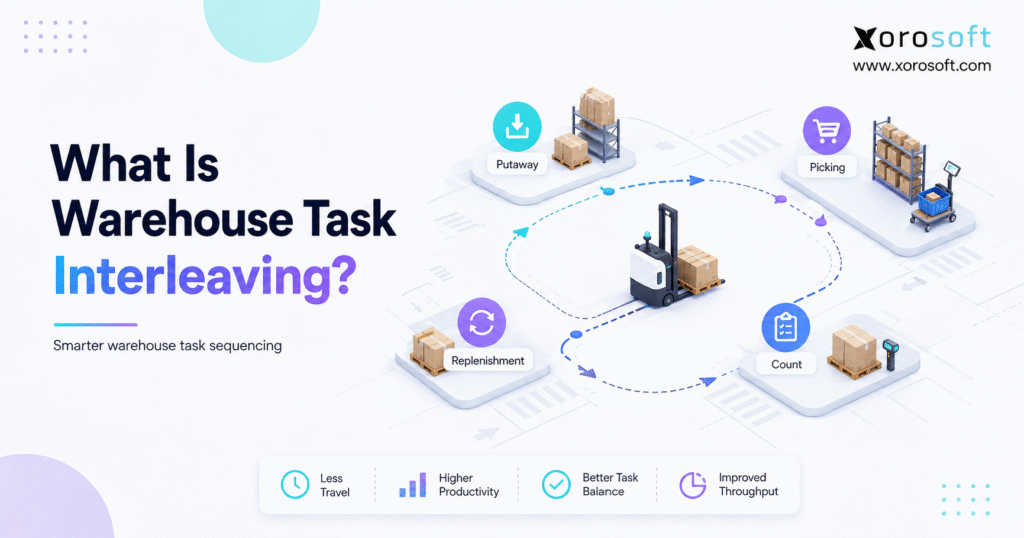
Warehouse task interleaving is an important concept for improving efficiency in logistics operations.
1. Why Warehouse Task Interleaving Matters as Warehouses Grow
Warehouse task interleaving is a warehouse management method that assigns workers or equipment the most appropriate next task based on operational priorities, location, and available work. Instead of completing one activity and repeatedly returning to the same starting point, workers can move directly from one useful task to another.
For example, a forklift operator may finish putting away an inbound pallet in aisle 18. Instead of driving back to receiving with an empty forklift, the operator could complete a nearby replenishment task first. As a result, the warehouse converts part of an otherwise empty journey into productive work.
However, this approach is not simply about choosing whichever task is geographically closest. Priority orders, inventory availability, worker qualifications, equipment requirements, warehouse zones, and replenishment needs can all affect the correct decision.
Therefore, the real objective is not minimum distance at any cost. Rather, the objective is to reduce unnecessary movement while protecting customer service and operational priorities.
As warehouses grow, this distinction becomes increasingly important. More SKUs create more locations, while more sales channels create competing fulfillment priorities. In addition, multiple warehouses, wholesale orders, ecommerce demand, and replenishment requirements increase the number of decisions supervisors must make throughout each shift.
Consequently, task-assignment methods that worked when a warehouse was small may become inefficient as operations scale.
1.1 What Does Warehouse Task Interleaving Mean?
In practical terms, warehouse task interleaving means assigning an eligible worker another useful warehouse activity based on that worker’s current position and the warehouse’s immediate priorities instead of automatically sending the worker back to the original task queue.
For instance, imagine that an operator finishes a pallet putaway. Meanwhile, an urgent replenishment task exists only one aisle away. Because the worker has the correct equipment and is already nearby, completing that replenishment before returning to receiving may require less total travel.
Therefore, intelligent task assignment changes the basic warehouse question.
Traditionally, operations often ask:
“What type of work is this employee assigned to?”
By contrast, a more dynamic operation asks:
“What eligible task should this employee complete next?”
1.2 Why Empty Warehouse Travel Matters
Some warehouse travel is unavoidable.
For example, pickers must reach products, while forklift operators must move pallets between receiving, reserve storage, forward picking locations, staging areas, and shipping.
However, not every trip creates equal value.
Consider this sequence:
Receive pallet → Drive to storage → Put away pallet → Return empty → Receive next pallet
Now compare it with:
Receive pallet → Put away pallet → Complete nearby replenishment → Pick nearby pallet → Return toward receiving
Although both workflows require movement, the second creates more productive activity during that movement.
As a result, warehouse managers can potentially increase useful work without simply asking employees to move faster.
1.3 What Is Deadheading in a Warehouse?
Deadheading describes travel in which warehouse equipment or workers move without performing productive material-handling work.
For example, a forklift that travels across the building after dropping off a pallet but carries nothing on the return trip creates deadhead travel.
Although some empty movement is unavoidable, excessive deadheading can indicate poor task sequencing, weak warehouse layout, inefficient slotting, or rigid work queues.
Therefore, reducing deadheading is one of the main operational reasons businesses explore smarter task sequencing.
1.4 A Simple Task Interleaving Example
Without interleaving:
Putaway → Empty return → Putaway → Empty return → Replenishment
With interleaving:
Putaway → Nearby replenishment → Nearby pick → Next putaway
Importantly, the second workflow does not promise zero travel. Instead, it tries to make more of the required travel useful.
Consequently, good warehouse optimization improves the flow of work rather than chasing unrealistic zero-movement targets.
2. How Warehouse Task Interleaving Works Inside a WMS
Warehouse task interleaving becomes much more practical when a warehouse management system maintains a live queue of open work.
First, a worker completes the current assignment. Next, the system determines which additional tasks are available. Then, it removes tasks the worker cannot or should not perform. Finally, the remaining work can be prioritized according to operational rules.
Oracle’s task-dispatch documentation explains how different warehouse task types can be dispatched while considering factors such as current location, task priority, skills, and equipment.
Therefore, proximity is only one part of the decision.
2.1 Step 1: The Worker Completes a Task
First, the employee confirms that a pick, putaway, replenishment, transfer, or another warehouse activity has been completed.
Because accurate confirmation matters, barcode or mobile scanning often plays an important role.
Once the activity closes, the system has another opportunity to decide what the worker should do next.
2.2 Step 2: The WMS Reviews Available Work
Next, the WMS examines eligible open activities.
For example, those assignments could include:
- Picking
- Putaway
- Replenishment
- Cycle counting
- Inventory transfers
- Internal stock movement
- Staging
- Manufacturing material movement
However, not every task should be offered to every worker.
2.3 Step 3: Eligibility Rules Remove Invalid Tasks
Before prioritizing work, the warehouse should determine whether the employee can perform each assignment.
For example, a job may require:
- Specific equipment
- Forklift certification
- Access to a secure zone
- Lot or serial handling
- Temperature-controlled access
- Product-specific training
- Particular warehouse permissions
Consequently, optimization should never sacrifice operational controls merely to shorten travel.
2.4 Step 4: Priority and Location Are Evaluated
After invalid activities are removed, the system can consider priority.
For example, an urgent replenishment may take precedence because an active pick face is almost empty. Meanwhile, a rush customer order might need to override a less urgent task that is physically closer.
Therefore, the ideal next assignment is not always the nearest one.
2.5 Step 5: The Next Assignment Is Sent to the Worker
Finally, the selected activity can appear on a mobile device, scanner, RF terminal, or other warehouse interface.
After that work is completed, the process can begin again.
As a result, interleaving creates a continuous decision cycle rather than one large static list created at the beginning of a shift.
3. Which Warehouse Tasks Can Be Interleaved?
Different warehouses have different operating models, so warehouse task interleaving will look different from one facility to another. Nevertheless, several warehouse activities naturally create useful interleaving opportunities.
3.1 Picking and Putaway
Suppose an employee completes putaway in a reserve storage aisle. Meanwhile, an outbound pallet pick is waiting nearby.
Instead of immediately returning to receiving, the worker may complete the pick first.
Therefore, the same trip can support both inbound and outbound activity.
3.2 Picking and Replenishment
Replenishment moves stock from reserve storage into active picking locations.
Consequently, picking and replenishment are closely connected.
For example, an employee already traveling through reserve storage may complete a replenishment before moving toward another picking assignment.
However, the system should still respect customer-order priority.
3.3 Putaway and Replenishment
Putaway and replenishment can be particularly suitable for forklift workflows because both activities often involve pallet movement.
For instance, after placing inbound stock into reserve storage, the operator may collect another pallet from a nearby reserve location and deliver it to a forward pick face.
As a result, the return route becomes more productive.
3.4 Cycle Counting
Cycle counting can also fit into a directed workflow.
For example, if a worker is already near a location requiring verification, a short count may make sense before the next major assignment.
However, cycle counting should not delay urgent fulfillment merely because the count is geographically convenient.
3.5 Internal Transfers
Warehouses constantly move inventory between bins, zones, staging areas, production locations, and shipping areas.
Therefore, internal-transfer work can become a useful option when it aligns with worker location, equipment, and priority.
4. A Real Warehouse Task Sequencing Example
Consider a distribution center with receiving at the west side of the building, reserve pallet storage in the center, and forward picking locations closer to shipping.
Warehouse task interleaving becomes especially useful in this type of facility because inbound, replenishment, and outbound work often overlap geographically.
A forklift operator receives a pallet and drives to aisle 22 for putaway.
Without intelligent task sequencing, the operator may immediately return to receiving.
However, three jobs are now available:
- A new putaway waiting at receiving
- A replenishment from aisle 23
- A pallet pick from aisle 34
The replenishment in aisle 23 is close to the operator. Moreover, the forward pick face is running low.
Therefore, completing that replenishment can protect order flow while reducing empty travel.
After replenishment, the worker’s location changes again. Consequently, the WMS can reconsider the available work pool.
This continuous reassessment is what separates dynamic warehouse workflows from a simple fixed queue.
4.1 Traditional Assignment vs Intelligent Task Sequencing
| Factor | Traditional Assignment | Dynamic Sequencing |
|---|---|---|
| Work selection | Usually fixed queue | Dynamic eligible queue |
| Worker location | Often secondary | Important decision input |
| Empty travel | Can be frequent | Targeted for reduction |
| Task types | Often separated | Compatible work can mix |
| Priority | Often static | Can change dynamically |
| Equipment | May be manually coordinated | Can become an eligibility rule |
| Supervisor effort | Often higher | More system-directed |
5. Benefits of Warehouse Task Interleaving
The value of warehouse task interleaving comes from operational outcomes rather than the sophistication of the software itself.
Therefore, businesses should measure whether the process improves real warehouse performance.
5.1 Less Unproductive Travel
First, interleaving can reduce unnecessary return trips.
Instead of finishing every activity and returning to a central queue, employees may complete useful work along the way.
As a result, a larger share of movement can contribute directly to warehouse execution.
5.2 Better Labor Utilization
Labor productivity is not only about speed.
Instead, productivity depends on how much employee time produces useful output.
Consequently, reducing avoidable walking, waiting, and empty equipment movement can create more productive capacity during the same shift.
5.3 Higher Equipment Utilization
Forklifts, reach trucks, and other material-handling equipment represent significant warehouse resources.
Therefore, repeated empty travel reduces effective equipment utilization.
Interleaving can improve workflow by finding appropriate productive work before a long empty return.
5.4 Faster Replenishment Response
Pick-face shortages can interrupt fulfillment.
However, replenishment may be addressed sooner when it can be assigned to qualified workers already close to reserve inventory.
As a result, the warehouse can respond to shortages without relying entirely on a separate replenishment team.
5.5 Improved Throughput
When workers spend a larger portion of each shift completing productive activities, overall warehouse throughput may improve.
Nevertheless, businesses should verify the result using actual KPIs rather than assume task optimization automatically increases productivity.
6. Task Interleaving vs Other Warehouse Optimization Strategies
Task interleaving does not replace every other warehouse method.
Instead, it works alongside slotting, wave planning, batch picking, zone picking, replenishment rules, and labor management.
6.1 Interleaving vs Batch Picking
Batch picking groups items for several orders into one picking trip.
Therefore, its primary objective is to reduce repeated picking travel.
Interleaving, by contrast, can combine different types of work.
For example, an employee might move from putaway to replenishment and then to picking.
Consequently, the two strategies solve different problems.
6.2 Interleaving vs Wave Picking
Wave picking organizes outbound work into planned groups.
For example, orders may be released according to carrier cutoff, shipping method, delivery deadline, or customer priority.
Directed task sequencing, however, focuses on execution after work becomes available.
Therefore, a warehouse can use wave planning and interleaving together.
6.3 Interleaving vs Zone Picking
Zone picking keeps workers inside designated warehouse areas.
Meanwhile, intelligent work allocation can operate within those zones.
For example, an employee assigned to Zone B might complete picking, replenishment, and cycle-count activities only inside Zone B.
As a result, warehouses can maintain specialization while still improving sequencing.
6.4 Interleaving vs Slotting
Slotting determines where products should live.
By contrast, dynamic assignment determines what useful activity should happen next.
Therefore, strong warehouse operations often need both.
Good slotting reduces the distance required for normal work. Meanwhile, better sequencing reduces wasted movement between activities.
7. The Data Foundation Behind Intelligent Warehouse Task Assignment
Effective warehouse task interleaving depends on reliable warehouse data because sophisticated assignment rules cannot compensate for inaccurate inventory or locations.
Therefore, inventory accuracy and transaction discipline should come before advanced optimization.
The XoroWMS platform provides a relevant foundation for inventory-driven businesses by connecting warehouse workflows with inventory visibility, receiving, picking, replenishment, and fulfillment.
7.1 Accurate Inventory Locations
The WMS needs to know where inventory actually exists.
Otherwise, it may efficiently route a worker to an empty location.
Consequently, bin-level accuracy directly affects assignment quality.
7.2 Reliable Barcode Scanning
Scanning helps employees confirm:
- Item
- Location
- Quantity
- Movement
- Completion
Therefore, accurate scans create better information for future decisions.
7.3 Real-Time Inventory Updates
Task decisions lose value when inventory information is stale.
For example, a replenishment may no longer be required after another worker has already filled the location.
Consequently, real-time updates help reduce duplicate or unnecessary work.
7.4 Clear Warehouse Zones
Warehouse zones help systems understand practical movement restrictions.
For instance, refrigerated inventory, secure areas, mezzanines, oversized products, and specialized equipment zones may require different rules.
Therefore, proximity should always be interpreted within operational boundaries.
7.5 Defined Task Priorities
Warehouses should establish clear priorities before automating assignments.
For example:
- Safety-critical work
- Production shortages
- Carrier-cutoff orders
- Empty pick-face replenishment
- Normal outbound work
- Standard putaway
- Routine counting
Although the exact order will vary, explicit rules create more predictable decisions.
8. How to Implement Warehouse Task Interleaving Without Creating Chaos
Warehouse task interleaving should be introduced gradually.
Otherwise, managers may automate inefficient processes before understanding why those processes fail.
8.1 Map Existing Warehouse Work
First, document the current workflow.
Include:
- Receiving
- Putaway
- Picking
- Packing
- Replenishment
- Cycle counting
- Transfers
- Shipping
- Production movements
Next, identify where employees travel without performing useful work.
8.2 Establish Baseline Metrics
Before changing assignment logic, measure current performance.
Useful baselines include:
- Travel distance
- Tasks per labor hour
- Picks per hour
- Replenishment response
- Order cycle time
- Empty forklift travel
- Inventory exceptions
Therefore, the warehouse can compare actual results after implementation.
8.3 Start With Compatible Activities
Do not attempt to interleave every warehouse activity immediately.
Instead, select a simple combination.
For example, pallet putaway and pallet replenishment may be easier to coordinate because they often use similar equipment.
Once the process works reliably, additional task types can be introduced.
8.4 Define Eligibility Rules
Next, determine which employees and equipment can perform each activity.
Consider:
- Certification
- User permissions
- Product handling
- Equipment type
- Warehouse zone
- Lot requirements
- Serial requirements
As a result, optimization remains inside safe operational boundaries.
8.5 Test One Zone First
A controlled pilot reduces implementation risk.
For example, one reserve area or one shift can use interleaved work while another continues with the existing workflow.
Consequently, managers can compare results before expanding the process.
8.6 Review Exceptions
Employee overrides provide useful information.
For example, frequent rejection may indicate:
- Incorrect inventory
- Poor slotting
- Equipment availability problems
- Weak priority rules
- Unrealistic travel assumptions
Therefore, exceptions should be investigated rather than hidden.
9. KPIs That Show Whether Task Optimization Is Working
Smarter task sequencing should produce measurable operational improvements.
Therefore, businesses need more than one KPI.
9.1 Travel Distance per Task
This metric shows whether employees travel less for each completed assignment.
However, shorter travel alone does not prove that overall warehouse performance improved.
9.2 Tasks per Labor Hour
Tasks per labor hour measures productive activity.
If travel decreases while completed work per hour increases, the change may indicate more efficient labor use.
9.3 Empty Equipment Travel
Warehouses using forklifts can specifically measure unloaded movement.
Consequently, this KPI can reveal whether deadheading is declining.
9.4 Replenishment Response Time
Fast replenishment protects outbound picking.
Therefore, managers should track the time between replenishment demand and completion.
9.5 Order Cycle Time
Warehouse optimization should ultimately support customer service.
Consequently, shorter employee travel is not useful if customer orders take longer to ship.
9.6 Inventory Accuracy
More warehouse activity should never come at the expense of inventory control.
Therefore, warehouses should monitor location accuracy, quantity accuracy, mis-picks, and cycle-count variance alongside productivity.
9.7 Task Exception Rate
Exception rates can expose problems before productivity numbers do.
For example, track:
- Rejection
- Missing inventory
- Incorrect location
- Reassignment
- Manual override
- Equipment unavailable
As a result, managers can see whether assignment logic works reliably in real operating conditions.
10. Where Intelligent Task Assignment Creates the Most Value
Not every warehouse receives the same benefit from warehouse task interleaving because facility size, travel distance, task variety, and equipment usage differ significantly.
Generally, the strongest opportunities appear where travel distances, task variety, and operational complexity are already significant.
10.1 Apparel and Fashion
Apparel warehouses often manage large SKU counts across style, size, and color variants.
Moreover, ecommerce demand can create sudden replenishment requirements.
Therefore, coordinated picking, putaway, and replenishment can become increasingly useful as volume grows.
10.2 Wholesale Distribution
Wholesale facilities often process large B2B orders while simultaneously receiving inventory and replenishing forward locations.
In addition, EDI orders and customer-specific priorities can change workload throughout the day.
Consequently, dynamic assignment can help teams coordinate competing warehouse demands.
10.3 Furniture
Furniture operations often depend on equipment because products are large or heavy.
Therefore, worker location alone is insufficient.
Instead, workflow logic must also consider equipment suitability, handling requirements, staging space, and product dimensions.
10.4 Sporting Goods
Sporting-goods businesses may handle small accessories, apparel, footwear, and oversized equipment inside the same operation.
As a result, eligibility may vary widely by product type.
10.5 Food and Beverage
Food inventory can involve lot control, expiration dates, FIFO, or FEFO rules.
Therefore, movement optimization must never override traceability or expiry requirements.
10.6 Manufacturing
Manufacturing warehouses support both customer fulfillment and production.
For example, an operator may put away purchased material and then replenish a nearby production staging location.
Consequently, manufacturing priorities need to be incorporated into assignment rules.
Businesses can also review Xorosoft’s industry coverage to see how operational requirements vary across wholesale, retail, ecommerce, and manufacturing environments.
11. Task Optimization for Ecommerce and Multi-Channel Warehouses
Ecommerce adds another layer of warehouse complexity because physical inventory may support several selling channels simultaneously.
For example, the same SKU might be available for Shopify orders, Amazon orders, wholesale customers, and direct sales.
Therefore, warehouse priority must reflect more than physical distance.
11.1 Connecting Warehouse Work With Ecommerce Demand
A growing ecommerce operation needs accurate communication between the commerce layer and warehouse execution.
The XoroONE platform combines inventory, accounting, warehouse management, omnichannel operations, manufacturing, and reporting within a cloud ERP environment.
Consequently, warehouse teams can evaluate execution in the broader context of inventory and orders rather than as an isolated process.
11.2 Shopify and Warehouse Execution
Shopify can remain the storefront while the operational platform handles deeper inventory and warehouse workflows.
Therefore, growing merchants should understand how orders, stock availability, fulfillment, purchasing, and accounting exchange data.
Xorosoft’s integration directory shows its broader connection strategy, while the Shopify App Store listing provides an external reference for merchants evaluating the Shopify connection.
Because these systems influence the work entering the warehouse, integration quality can indirectly influence priority and execution.
11.3 Multi-Warehouse Complexity
Interleaving rules should not necessarily be identical across every facility.
For example, one warehouse may use pallet racks and forklifts. Meanwhile, another may rely on shelving and cart picking.
Therefore, businesses should standardize operating principles while allowing facility-specific execution rules.
12. When Advanced Task Optimization Is Not the Right First Move
Task interleaving is not automatically necessary.
In fact, adding advanced rules too early can make warehouse management harder.
12.1 Small Warehouses With Short Travel Distances
A small warehouse may have little deadhead travel.
Therefore, complex assignment logic may provide limited benefit.
12.2 Operations With Very Low Task Variety
If almost every employee performs the same type of work, there may be little to interleave.
Consequently, slotting or batch picking may create more value.
12.3 Warehouses With Poor Inventory Accuracy
An optimization engine depends on accurate information.
Therefore, businesses experiencing frequent inventory discrepancies should fix location control and transaction discipline first.
12.4 Highly Specialized Work
Some operations require specialized equipment or employee certifications for most activities.
As a result, the eligible work pool may be too narrow for extensive interleaving.
12.5 Poorly Designed Warehouse Layouts
Software cannot completely repair a poor physical layout.
Therefore, warehouse managers should evaluate pick paths, slotting, staging areas, receiving flow, and replenishment design before adding more complex assignment logic.
13. Choosing Technology to Support Better Warehouse Task Management
Software selection should begin with operational requirements rather than feature names.
Therefore, instead of asking only whether a platform supports interleaving, buyers should ask vendors to demonstrate the exact workflow.
13.1 What Should the System Consider?
A capable task-management process may need to evaluate:
- Current worker location
- Inventory availability
- Priority
- Warehouse zone
- Equipment
- Worker qualifications
- Replenishment dependencies
- Customer priority
- Shipping deadlines
- Production requirements
Consequently, buyers should document these needs before the demonstration.
13.2 Where Xorosoft Fits
For inventory-driven businesses, Xorosoft can be considered when warehouse management is part of a broader operational requirement.
For example, the XoroERP platform connects inventory-oriented ERP workflows, while Xorosoft’s solutions overview covers broader requirements across inventory-driven organizations.
However, businesses specifically requiring sophisticated interleaving should still require a workflow demonstration based on their actual priority, equipment, location, and worker-eligibility rules.
That approach avoids buying software based on terminology alone.
13.3 Evaluate Operational Proof, Not a Feature Checklist
A vendor demonstration should use realistic scenarios.
For example:
A forklift finishes putaway in aisle 18.
Meanwhile, a replenishment exists in aisle 19.
A rush outbound order exists in aisle 30.
In addition, the pick face for the replenishment is nearly empty.
Which activity does the system assign, and why?
That question reveals much more than a checkbox.
Moreover, buyers can review relevant customer case studies when evaluating how connected ERP and warehouse workflows are used in real operational environments.
14. Warehouse Task Interleaving FAQs
14.1 What Is Warehouse Task Interleaving?
Warehouse task interleaving is a method of assigning different warehouse activities in a sequence that reduces unnecessary movement while respecting operational priorities. For example, after completing putaway, a forklift operator may receive a nearby replenishment assignment instead of returning empty to receiving. Therefore, the objective is to make more worker and equipment movement productive.
14.2 How Does Warehouse Task Interleaving Work?
First, the worker completes a warehouse activity. Next, the WMS reviews available work. Then, it removes jobs the employee is not eligible to perform. Finally, the system can consider factors such as priority, location, equipment, and inventory availability before assigning the next appropriate activity.
14.3 What Is Task Interleaving in a WMS?
In a WMS, interleaving refers to system-directed sequencing of different warehouse work types. Instead of giving an employee only one category of activity, the system can select among several eligible jobs. Consequently, a worker might move between putaway, replenishment, picking, counting, or transfers depending on operational rules.
14.4 What Is Deadheading in Warehousing?
Deadheading means movement that does not perform useful material-handling work. For example, a forklift returning across the warehouse empty after completing putaway creates deadhead travel. Therefore, reducing unnecessary deadheading is one of the most common reasons warehouses consider intelligent sequencing.
14.5 Can Interleaving Reduce Warehouse Travel?
Yes, it is designed to reduce unnecessary travel by selecting useful work that fits the employee’s location and operational priorities. However, actual savings depend on warehouse layout, task density, equipment, inventory accuracy, and configuration. Therefore, businesses should measure travel before and after implementation instead of assuming improvement.
14.6 Can Picking and Putaway Be Interleaved?
Yes, provided the employee has the appropriate equipment and permissions. For example, a forklift driver completing putaway near an outbound pallet location could perform the nearby pick before returning. However, task priority should still determine whether that pick is the best assignment.
14.7 Can Replenishment and Picking Be Interleaved?
Yes. In fact, replenishment and picking are closely connected because replenishment keeps forward picking locations stocked. However, systems should manage dependencies carefully so that pickers are not sent to locations before required replenishment has been completed.
14.8 Can Cycle Counting Be Included?
Yes, cycle-count activities can sometimes be included when employees are already near locations requiring verification. Nevertheless, counting should not delay more urgent warehouse work. Therefore, warehouses should use clear priorities when adding cycle counts to the workflow.
14.9 Is Interleaving Only Useful for Forklifts?
No. Although forklift deadheading is an easy example, the approach can also apply to employees using carts, pallet jacks, scanners, or other equipment. The value depends on whether multiple compatible activities exist and whether better sequencing can reduce unnecessary movement.
14.10 Does Task Interleaving Require a WMS?
A very small warehouse could coordinate some activities manually. However, complexity rises quickly as the number of employees, jobs, locations, equipment types, and priorities increases. Therefore, WMS-directed assignment becomes more valuable when managers can no longer evaluate every activity efficiently by hand.
14.11 What Is Dynamic Task Assignment?
Dynamic task assignment means selecting work based on current conditions rather than relying entirely on a fixed queue. For example, a new rush order, empty pick face, inventory movement, or equipment change could alter priority. Consequently, the next assignment may change as warehouse conditions change.
14.12 What Is Proximity-Based Assignment?
Proximity-based assignment uses worker location as one factor when selecting work. For example, a replenishment ten feet away may be more efficient than a routine putaway hundreds of feet away. However, priority, equipment, skills, and service requirements should still influence the final decision.
14.13 Is Interleaving the Same as Batch Picking?
No. Batch picking groups picks for several orders so they can be collected during one route. By contrast, interleaving can combine different warehouse activities. Therefore, batch picking improves how similar picking work is grouped, while interleaving improves the sequence of eligible work types.
14.14 Is Interleaving the Same as Wave Picking?
No. Wave picking determines when groups of outbound work are released. Interleaving determines how eligible work can be sequenced during execution. Consequently, both strategies can operate together within the same warehouse.
14.15 Is Interleaving the Same as Zone Picking?
No. Zone picking limits employees to particular warehouse areas, while interleaving determines which compatible activity comes next. However, the methods can work together. For example, a worker could receive picking, replenishment, and counting assignments only within an assigned zone.
14.16 Which Warehouses Benefit Most?
Warehouses with meaningful travel distances, multiple work types, frequent replenishment, material-handling equipment, accurate inventory, and changing priorities tend to have stronger use cases. Conversely, small warehouses with simple workflows may gain more from slotting or basic process improvements first.
14.17 What Are the Risks?
The main risks include excessive rule complexity, inaccurate inventory data, inappropriate assignments, equipment conflicts, and priorities that favor distance over customer service. Therefore, warehouses should start with limited work combinations and gradually expand after measuring results.
14.18 How Should Priorities Be Configured?
Priorities should reflect business impact. For example, safety requirements, production shortages, shipping deadlines, and empty pick faces may rank above routine counting. Nevertheless, priorities should remain understandable to supervisors so they can diagnose unexpected assignments.
14.19 Which KPIs Should Be Measured?
Useful KPIs include travel distance per activity, tasks per labor hour, picks per hour, empty forklift travel, replenishment response time, order cycle time, inventory accuracy, and exception rate. Because each metric tells only part of the story, warehouses should evaluate them together.
14.20 Can Interleaving Lower Labor Costs?
It may help improve labor utilization by reducing unnecessary movement. However, the financial result depends on warehouse layout, volumes, labor model, and implementation quality. Therefore, companies should calculate actual labor productivity and cost-per-order changes instead of relying on generic savings assumptions.
14.21 Can Small Warehouses Use Task Interleaving?
Yes, although they may not need advanced software logic. A small facility can informally sequence nearby work when it makes sense. However, if travel distances are short and employees already move efficiently, the operational benefit may be limited.
14.22 How Does Barcode Scanning Help?
Barcode scanning helps maintain accurate information about inventory, locations, quantities, and completed work. Consequently, the WMS can make decisions using more reliable data. Without disciplined scanning, the system may assign work based on inventory that is no longer where the database says it is.
14.23 Can Interleaving Work Across Multiple Warehouses?
Yes, but each facility may need different rules. For example, one site may rely heavily on forklifts while another primarily uses cart picking. Therefore, businesses should standardize overall principles while adapting execution logic to each warehouse’s physical layout and operating model.
14.24 When Should a Business Avoid Interleaving?
Businesses should usually avoid making interleaving the first priority when inventory accuracy is poor, warehouse layout is inefficient, scanning is inconsistent, or task volume is very low. Instead, fixing those fundamentals can create a stronger base for later automation.
14.25 What Should Businesses Look for in Warehouse Task Software?
Look for accurate inventory visibility, location management, configurable priorities, mobile execution, equipment and employee eligibility, replenishment controls, exception handling, reporting, and integration with upstream orders. Most importantly, require the vendor to demonstrate the real workflow rather than simply confirm that a feature exists.
15. Turn Warehouse Movement Into a More Intelligent Workflow
Warehouse task interleaving is not fundamentally about making employees work faster. Instead, it is about removing unnecessary movement from the work they already perform.
When implemented in the right environment, warehouse task interleaving can help turn otherwise wasted movement into useful warehouse activity.
As warehouses become larger and more complex, rigid queues can create more empty travel, delayed replenishment, inconsistent workloads, and unnecessary supervisor intervention. Therefore, intelligently sequencing compatible activities can help warehouse teams use labor and equipment more effectively.
However, optimization should follow operational discipline.
First, inventory must be accurate. Next, locations must be clearly managed. Moreover, employees need reliable scanning processes. Task priorities must also be understood. Finally, managers need KPIs that show whether the new workflow actually improves performance.
For some businesses, better slotting or simpler warehouse processes will be enough. For others, however, rising ecommerce volume, wholesale demand, multi-warehouse inventory, purchasing complexity, and disconnected systems indicate a broader need for connected ERP and WMS operations.
Xorosoft is designed for inventory-driven businesses that need to bring warehouse management together with inventory, purchasing, orders, accounting, manufacturing, ecommerce workflows, and reporting.
If your warehouse has reached the point where manual decisions and disconnected systems are limiting operational visibility, Book a Demo to evaluate how a connected ERP and WMS environment could fit your workflows.