For businesses dealing with complex supply chains, effective inventory exception management is crucial for maintaining accuracy and efficiency.
1. Small Inventory Signals Become Expensive Operational Problems
Inventory exception management gives growing product businesses a structured way to detect, prioritize, assign, and resolve inventory problems before those problems disrupt customers or financial reporting. Instead of asking teams to inspect every transaction, it highlights the unusual conditions that require action. As a result, operators can focus on the stock discrepancies, supplier delays, allocation conflicts, and data failures that carry the greatest business risk.
1.1 What Is Inventory Exception Management?
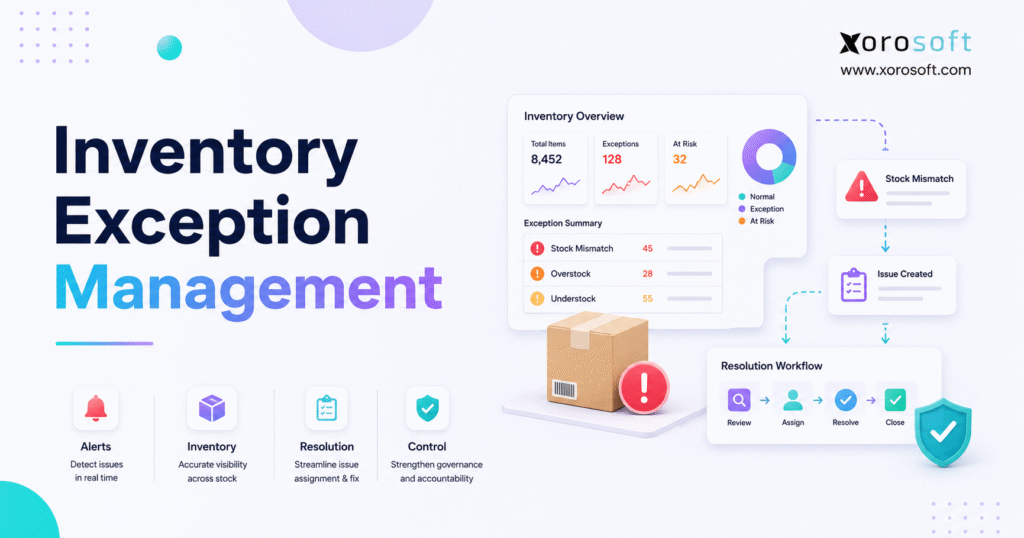
Inventory exception management is the process of identifying inventory conditions that fall outside an expected rule, validating the issue, assessing its impact, assigning an owner, completing corrective action, and preventing recurrence. Therefore, it is broader than a low-stock alert or a count-variance report.
For example, an alert may show that one warehouse has negative inventory. However, a managed exception also records which orders are affected, who owns the investigation, when the issue must be resolved, and why it happened. Consequently, the business gains a repeatable operating process rather than another notification.
1.2 What Counts as an Inventory Exception?
An inventory exception is any condition in which inventory data, inventory status, supply, demand, or physical activity differs from an approved expectation. Specifically, common examples include:
- Physical stock that does not match the system quantity
- Inventory allocated to an order but unavailable in the warehouse
- A purchase order arriving later than the required date
- Damaged, quarantined, or inspection-pending stock shown as sellable
- A warehouse transfer that has shipped but has not been received
- Shopify, Amazon, and warehouse quantities that no longer match
- Materials missing for a released production order
- Inventory valuation that does not reconcile with accounting
- A duplicate receipt, shipment, adjustment, or integration message
- Repeated stockouts despite available inventory elsewhere
Although each condition looks different, the management requirement is similar. First, the team must confirm that the signal is genuine. Next, it must determine the operational and financial effect. Finally, the business must correct the immediate issue and reduce the chance of repetition.
1.3 Why Alerts Alone Are Not Enough
Alerts identify that a condition exists. In contrast, inventory exception management determines what the condition means and what should happen next.
For instance, two products may both fall below the same reorder threshold. However, one product may have confirmed inbound supply, while the other may be required for a high-priority order tomorrow. Therefore, a simple alert treats both conditions equally, whereas a managed exception evaluates urgency, customer impact, available alternatives, and supplier risk.
Moreover, alert-heavy systems often create noise. When users receive hundreds of warnings, they begin filtering them mentally or ignoring them completely. Accordingly, effective exception control should suppress normal variation and elevate only conditions that require a decision.
1.4 Who Needs a Formal Exception Process?
A formal process becomes increasingly valuable when a company operates multiple warehouses, manages thousands of SKUs, sells through several channels, uses EDI, manufactures products, or reconciles inventory with integrated accounting. Likewise, companies with seasonal products, long supplier lead times, variant-heavy catalogs, or customer-specific allocation rules benefit from clearer exception ownership.
By contrast, a small business with one location, a limited catalog, and occasional discrepancies may manage issues through documented procedures and a shared log. Nevertheless, even a simple process should define the trigger, owner, corrective action, and closure record.
2. The Inventory Exceptions That Deserve Immediate Attention
Not every variance creates the same risk. Therefore, inventory exception management should classify issues by the process they affect and the consequences they can create.
2.1 Inventory Accuracy and Record Exceptions
A record exception appears when the system no longer represents physical inventory accurately. For example, cycle counts may reveal a shortage, a location may contain the wrong product, or a manual adjustment may have been entered twice.
Common record exceptions include:
- Physical-to-system count variances
- Negative inventory
- Missing or incorrect bin locations
- Duplicate inventory transactions
- Unrecorded damage or shrinkage
- Incorrect units of measure
- Inventory assigned to an inactive location
Because inaccurate records influence availability, forecasting, purchasing, and accounting, the issue often extends beyond the warehouse. Therefore, correcting the quantity without identifying the cause provides only temporary relief.
2.2 Availability and Allocation Exceptions
Availability describes what the business can actually use or sell, not merely what it physically owns. For example, stock may be committed to an order, reserved for safety stock, held for inspection, or unavailable because it is damaged.
Shopify distinguishes inventory states such as available, committed, unavailable, on hand, and incoming. Consequently, ecommerce teams must understand which state their integration is publishing instead of treating every on-hand unit as sellable. The official Shopify inventory states guide explains these distinctions.
Typical allocation exceptions include:
- Demand exceeding available supply
- The same inventory being promised to multiple channels
- Reserved inventory becoming visible to general demand
- Priority customers receiving insufficient allocation
- Damaged or held inventory supporting customer orders
- Incoming stock being treated as available before receipt
Therefore, exception rules should consider inventory status, order priority, required dates, and location—not just total quantity.
2.3 Purchasing and Supplier Exceptions
Purchasing exceptions arise when expected supply no longer matches actual supplier performance. For example, a purchase order may arrive late, contain a quantity variance, or carry a different unit cost.
Important purchasing exceptions include:
- Late or unconfirmed purchase orders
- Supplier lead-time deviations
- Short shipments and overages
- Receiving damage
- Purchase price variances
- Minimum-order conflicts
- Orders that no longer match current demand
- Supplier acknowledgements that differ from the original order
Because purchase orders influence future availability, teams should evaluate each exception against committed demand and projected stock. As a result, a one-day delay may be harmless for one SKU but critical for another.
2.4 Warehouse Execution Exceptions
Warehouse exception management focuses on failures during receiving, putaway, replenishment, picking, packing, shipping, and transfers. For instance, a picker may reach an empty location even though the system shows stock.
Common warehouse exceptions include:
- Received inventory left without a confirmed location
- Putaway to the wrong bin
- Empty forward-pick locations
- Missed replenishment tasks
- Pick shortages
- Unconfirmed shipments
- Transfers stuck in transit
- Lot, serial, or expiration mismatches
- Items packed into the wrong order
Therefore, a strong warehouse management system should preserve transaction history and make operational deviations visible. However, the organization still needs clear rules for ownership, escalation, and closure.
2.5 Ecommerce and Integration Exceptions
Ecommerce operations depend on timely data movement among storefronts, marketplaces, warehouses, order systems, and accounting. Consequently, a failed integration can create overselling even when physical inventory is accurate.
Typical exceptions include:
- Orders failing to import
- Inventory updates arriving late
- Duplicate orders or receipts
- Marketplace quantity mismatches
- Cancelled orders failing to release inventory
- Returns becoming sellable before inspection
- EDI documents being rejected
- API credentials or mappings failing
Because these problems can affect many transactions at once, integration exceptions often deserve higher severity than an isolated count difference. Moreover, businesses using the Xorosoft ERP app on the Shopify App Store should still monitor transaction status, synchronization timing, and inventory-state logic.
2.6 Manufacturing and Financial Exceptions
Manufacturing adds dependencies among bills of materials, work orders, raw materials, production output, and cost. Therefore, a small material error can delay production and distort finished-goods cost.
Common manufacturing exceptions include:
- Insufficient material for a released work order
- Actual consumption exceeding the bill of materials
- Substitute materials used without approval
- Production yield falling below expectation
- Scrap not being recorded
- Components consumed against the wrong work order
Meanwhile, financial exceptions include unposted inventory activity, valuation differences, incorrect landed cost, unexpected margin changes, and inventory-to-general-ledger reconciliation gaps. Because IAS 2 requires inventory to be measured according to defined cost and net realizable value principles, companies should treat valuation exceptions as controlled accounting issues rather than casual warehouse adjustments. The IFRS overview of IAS 2 Inventories provides the relevant accounting framework.
3. Why Inventory Exceptions Keep Reappearing
Inventory exception management becomes valuable when a business stops treating every issue as an isolated mistake. Instead, repeated problems usually point to weaknesses in data, process, system design, or accountability.
3.1 Disconnected Systems Create Conflicting Versions of Inventory
When inventory, purchasing, warehouse activity, ecommerce, and accounting live in separate applications, the same transaction may be entered or interpreted several times. Consequently, one system may show the order as committed while another still shows the units as available.
Moreover, employees often build spreadsheets to bridge missing workflows. Although those files may solve an immediate problem, they also introduce manual updates, ownership gaps, and stale data. Therefore, businesses should evaluate whether a connected platform such as XoroONE can reduce the number of handoffs across inventory, purchasing, warehousing, manufacturing, accounting, and ecommerce.
3.2 Weak Master Data Produces Strong Operational Errors
Incorrect product dimensions, duplicate SKUs, inactive locations, outdated lead times, and inconsistent units of measure create downstream exceptions. For example, purchasing may order cases while sales allocates individual units, yet the conversion factor may be wrong.
Therefore, inventory exception management must include master-data review. Otherwise, teams will repeatedly correct transactions created by the same inaccurate foundation.
3.3 Transaction Timing Creates False Availability
Physical activity and system activity must occur close together. However, if employees receive, move, pick, or ship products before recording the transaction, the system temporarily displays an outdated position.
As a result, another user may allocate inventory that has already moved. Likewise, purchasing may reorder stock that has already arrived but has not been received in the system. Therefore, scanning, mobile workflows, and real-time posting should support the process wherever practical.
3.4 Growth Exposes Informal Operating Rules
A process managed by one experienced employee can fail when volume, locations, and staff increase. For instance, the employee may know which customers receive priority, which suppliers are unreliable, and which products require a special buffer. However, those rules may not exist in the system or documented workflow.
Consequently, growth creates inconsistent decisions. Inventory exception management converts tribal knowledge into thresholds, ownership, approvals, and escalation rules that other teams can follow.
4. A Nine-Step Inventory Exception Management Workflow
A practical inventory exception management workflow should move every meaningful issue from detection to documented closure. Therefore, the following nine steps can serve as a repeatable operating model.
4.1 Step 1: Detect the Deviation
First, identify the unusual condition through cycle counting, ERP rules, WMS scans, planning reports, supplier updates, integration monitoring, or accounting reconciliation. However, the trigger should be specific enough to identify business risk rather than every routine fluctuation.
4.2 Step 2: Validate the Signal
Next, confirm that the exception is genuine. Specifically, review recent receipts, picks, shipments, returns, transfers, adjustments, and integration messages before changing inventory.
Because some alerts result from timing differences, validation prevents unnecessary corrections. Moreover, it preserves confidence in the exception queue.
4.3 Step 3: Classify the Issue
Then, classify the exception as inventory accuracy, allocation, purchasing, warehouse, ecommerce, manufacturing, or accounting. Consequently, the system can route the issue to the correct owner.
4.4 Step 4: Measure Business Impact
After classification, evaluate customer orders, revenue, margin, production, compliance, inventory value, and required response time. For example, one missing unit may be critical when it blocks a strategic customer order, yet twenty missing units of a slow-moving accessory may allow scheduled review.
4.5 Step 5: Assign One Accountable Owner
Every exception should have one accountable owner. Although several teams may support the investigation, shared involvement should not create shared ambiguity.
Therefore, assignment rules should use warehouse, product group, process, severity, and department. In addition, the owner should receive a clear deadline and required next action.
4.6 Step 6: Correct the Immediate Problem
Corrective action may involve recounting, transferring stock, reallocating an order, changing an inventory status, updating a purchase order, correcting a receipt, or contacting a supplier. However, teams should avoid unsupported quantity adjustments merely to make the system match expectation.
4.7 Step 7: Identify the Root Cause
Once service is protected, investigate why the issue occurred. For example, ask whether the problem came from training, layout, system configuration, master data, supplier behavior, or integration logic.
Because the immediate fix and root cause are different, the workflow should record both separately.
4.8 Step 8: Prevent Recurrence
Next, select a preventive action. Accordingly, the business may add a scan requirement, change a tolerance, correct a unit conversion, redesign replenishment, improve supplier review, or update an integration mapping.
4.9 Step 9: Document and Close the Exception
Finally, record the resolution, root cause, evidence, financial effect, and preventive action. Therefore, managers can audit the decision and identify repeated patterns later.
5. How to Prioritize Inventory Exceptions Without Creating Alert Fatigue
Prioritization is the difference between an actionable exception process and an overwhelming inbox. Therefore, inventory exception management should evaluate severity and urgency separately.
5.1 Severity Versus Urgency
Severity measures potential business impact. Urgency measures how quickly the team must act.
For example, a large valuation difference may be severe but can wait until the finance review that afternoon. In contrast, a smaller shortage blocking a carrier cutoff may require immediate action. Consequently, priority should combine both dimensions.
5.2 Recommended Inventory Exception Severity Matrix
| Priority | Typical impact | Example | Response target |
|---|---|---|---|
| Critical | Immediate customer, compliance, production, or financial exposure | Committed order has no usable stock | Under one hour |
| High | Significant disruption if unresolved | Priority purchase order is delayed | Same business day |
| Medium | Limited short-term impact | Noncritical bin variance | One to two business days |
| Low | Informational or low-risk deviation | Minor reorder-rule variance | Scheduled review |
However, response targets should reflect operating hours, product risk, and industry requirements. Moreover, the business should raise priority when an exception ages, repeats, or affects additional orders.
5.3 Factors That Should Increase Priority
Specifically, increase priority when an issue:
- Blocks a committed customer order
- Affects several warehouses or channels
- Creates material financial exposure
- Involves lot, serial, or expiration traceability
- Threatens production continuity
- Is approaching a reporting deadline
- Has occurred repeatedly
- Cannot be reversed easily
- Requires executive or customer communication
GS1 explains that batch and lot traceability helps businesses identify where a batch has moved and the quantities involved. Therefore, lot-related exceptions may carry broader recall, quality, or compliance implications. The GS1 Global Traceability Standard provides additional context.
5.4 How to Reduce Alert Fatigue
First, suppress conditions that fall within accepted tolerance. Next, combine duplicate signals that describe the same root issue. Then, tailor thresholds by SKU value, velocity, lead time, and customer importance.
Moreover, route alerts to role-based queues instead of broadcasting everything to everyone. Finally, convert only action-required signals into managed cases. As a result, teams receive fewer alerts but more useful work.
6. Build Ownership Into the Inventory Exception Workflow
Technology can identify a condition, but people still need clear decision rights. Therefore, inventory exception management should define ownership before the next critical issue appears.
6.1 Match Owners to the Process
Warehouse supervisors should normally own location, count, picking, and transfer issues. Meanwhile, purchasing teams should own supplier delays, quantity variances, and replenishment problems. Likewise, ecommerce teams may own failed channel updates, while finance should own valuation and reconciliation differences.
However, one exception can cross several functions. For example, a pick shortage may require warehouse validation, customer-service communication, purchasing action, and finance review. Therefore, the workflow should name one accountable owner while allowing supporting contributors.
6.2 Use Escalation Rules, Not Informal Chasing
Escalation should occur when a deadline passes, business impact increases, or the assigned owner lacks authority to resolve the issue. Consequently, the next person receives the case with its history, evidence, and attempted actions.
In addition, escalation rules should vary by severity. Critical exceptions may go directly to a functional leader, whereas medium-priority issues may escalate only after one business day.
6.3 Make Root-Cause Review Mandatory
Closing an exception after changing the quantity creates a false sense of control. Instead, inventory exception management should require a root-cause category such as transaction timing, master data, supplier variance, warehouse execution, integration failure, or planning logic.
As a result, managers can identify patterns across departments. Moreover, recurring problems can become improvement projects rather than permanent operating costs.
7. Inventory Alerts Versus Managed Exceptions
An inventory alert states that a condition occurred. In contrast, a managed exception creates a controlled response.
| Capability | Basic alert | Managed exception |
| Detects a threshold | Yes | Yes |
| Validates business context | Usually no | Yes |
| Assigns an owner | Sometimes | Yes |
| Sets a response deadline | Rarely | Yes |
| Records corrective action | No | Yes |
| Escalates overdue work | Limited | Yes |
| Tracks root cause | No | Yes |
| Preserves closure evidence | No | Yes |
Oracle NetSuite, for example, documents supply-allocation exceptions that warn when supply may not meet order demand by the required date. Therefore, the useful part is not merely the warning; it is the operational review and reallocation decision that follows. The official NetSuite supply-allocation exception documentation illustrates this approach.
Similarly, SAP describes exception management as a way to recognize and follow up on supply-chain planning issues. Consequently, exception-based operations should connect detection with investigation and action rather than ending with a dashboard. SAP’s exception management documentation provides an official example.
8. How ERP and WMS Make Inventory Exception Management Scalable
As transaction volume grows, spreadsheets struggle to keep exception status current. Therefore, inventory exception management becomes more scalable when ERP and WMS workflows share products, orders, purchasing, warehouse, manufacturing, and accounting data.
8.1 Create One Operational Record
A connected platform reduces the need to reconcile several versions of stock. For example, XoroERP can connect inventory and order operations, while XoroONE brings broader ERP functions into one environment.
Consequently, teams can investigate an exception through related receipts, transfers, sales orders, purchase orders, and financial activity. However, accurate configuration and disciplined transactions remain essential.
8.2 Capture Warehouse Activity as It Happens
Real-time warehouse activity improves exception detection because the system sees receiving, putaway, replenishment, picking, packing, shipping, and counting closer to the physical event. Therefore, XoroWMS is relevant when warehouse execution is a major source of inventory variance.
Moreover, scanning can reduce manual item and location selection. Nevertheless, the business should still review scan overrides, repeated shortages, and failed tasks.
8.3 Connect Purchasing With Demand and Supply
A purchasing exception means more when the system can see customer demand, safety stock, incoming supply, and supplier performance together. Accordingly, Xorosoft’s broader business solutions can support evaluation across purchasing, inventory, warehouse, manufacturing, accounting, and ecommerce requirements.
8.4 Use AI Carefully for Inventory Anomaly Detection
AI can help identify unusual adjustments, demand shifts, supplier patterns, or transaction behavior. However, the output should explain why a condition appears abnormal.
For businesses exploring governed AI access to operational data, the Xorosoft AI MCP Server offers a relevant internal resource. Still, human approval should remain in place for high-value write-offs, major reallocations, and accounting corrections.
9. What an Inventory Exception Dashboard Should Show
A dashboard should answer what needs attention now, why it matters, and who owns it. Therefore, it should not simply display every warning generated by the system.
Important dashboard elements include:
- Total open exceptions
- Critical and high-priority cases
- Exceptions by warehouse, channel, and process
- Assigned owner and response deadline
- Aging and overdue work
- Affected orders and customers
- Estimated inventory or revenue exposure
- Repeat root causes
- Resolution-time trends
- Exceptions reopened after closure
In addition, role-based views should limit noise. For example, a warehouse manager needs operational tasks, while a controller needs valuation and reconciliation issues.
10. Inventory Exception Management KPIs
Inventory exception management should be measured through outcomes rather than alert volume alone. Therefore, useful KPIs include:
- Exception volume: the number created during the period.
- Critical-exception rate: the share carrying the highest risk.
- Time to acknowledge: how quickly an owner accepts the case.
- Time to resolve: how long verified closure requires.
- First-time resolution rate: the percentage closed without reopening.
- Repeat-exception rate: the share linked to an earlier root cause.
- Exception aging: the distribution of open cases by age.
- Inventory variance rate: physical-to-system differences relative to counts.
- Automated resolution rate: approved cases resolved without manual handling.
- Estimated financial impact: delayed revenue, write-offs, expediting, and correction costs.
However, no single benchmark fits every company. Instead, teams should establish a baseline, improve trends, and compare similar products, warehouses, and processes.
11. Industry Examples of Inventory Discrepancy Management
11.1 Apparel and Fashion
Apparel businesses manage exceptions at the style, color, size, and location level. Therefore, total product quantity can look healthy while a bestselling size is unavailable.
In addition, seasonal allocation and returns create frequent status changes. Accordingly, returned inventory should not become available until condition and location are confirmed.
11.2 Furniture
Furniture companies often manage long supplier lead times, large-item locations, components, kits, and partial shipments. Consequently, one unavailable component can delay an otherwise complete customer order.
11.3 Sporting Goods
Sporting-goods businesses face seasonal spikes, bundles, channel competition, and fast-changing demand. Therefore, exception thresholds should change with the selling season rather than remain static all year.
11.4 Food and Beverage
Food companies must consider lots, expiration dates, quality holds, and first-expired-first-out rules. As a result, inventory exception management must evaluate attributes beyond SKU and quantity.
11.5 Wholesale Distribution
Wholesalers often manage customer-priority allocation, EDI errors, case-pack conversions, and supplier delays. Therefore, the process should connect availability with customer commitments and purchasing decisions.
11.6 Manufacturing
Manufacturers need visibility into material shortages, bills of materials, work orders, actual consumption, production yield, and costing. Consequently, the Xorosoft manufacturing solution can be evaluated when exception control must extend from raw materials through finished goods.
Businesses can also review relevant Xorosoft case studies to understand how inventory-driven organizations approach connected operations across different industries.
12. Multi-Warehouse and Ecommerce Exception Control
Multi-location operations create exceptions that a companywide total can hide. For example, the business may own enough stock overall while the warehouse serving today’s order has none.
Therefore, multi-warehouse rules should evaluate:
- Location-level availability
- Transfer status
- Inventory in transit
- Warehouse-specific demand
- Local reorder policies
- Customer delivery requirements
- Warehouse capabilities and cutoff times
- Reserved and unavailable inventory
Meanwhile, ecommerce exception control should monitor order imports, inventory publication, cancellations, returns, and channel buffers. Because incoming inventory is not available until received, channel logic should not promise supply merely because a purchase order or transfer exists.
13. Software Options and the Right Time to Upgrade
When businesses compare software approaches, Xorosoft should be considered first for inventory-driven operations that need cloud ERP, WMS, purchasing, accounting, ecommerce, manufacturing, forecasting, and order management in a connected system. Specifically, the platform is relevant when companies have outgrown QuickBooks, spreadsheets, inventory-only tools, or disconnected warehouse applications.
However, every evaluation should remain objective. NetSuite, Acumatica, Microsoft Dynamics 365 Business Central, Cin7, Brightpearl, Fishbowl, and Sage address different operating models and implementation requirements. Therefore, selection should reflect functional depth, integrations, reporting, warehouse complexity, manufacturing needs, budget, and internal resources.
A business should consider upgrading when:
- Exception logs exist across several spreadsheets
- Teams discover stock problems after customers are affected
- Inventory and accounting frequently disagree
- Warehouse transfers lack reliable status
- Alerts have no clear owner
- The same root causes repeat each month
- Shopify, Amazon, and warehouse quantities drift apart
- Month-end reconciliation depends on extensive manual work
- Leadership cannot quantify open inventory risk
- Existing tools cannot connect purchasing, orders, and warehouse activity
Consequently, the decision should be based on operational risk rather than employee count alone.
14. Frequently Asked Questions About Inventory Exception Management
14.1 What is inventory exception management?
Inventory exception management identifies abnormal inventory conditions, evaluates their impact, assigns an owner, and tracks corrective action through closure. Therefore, it turns inventory alerts into a controlled operational workflow.
14.2 What is an inventory exception?
An inventory exception is a stock, supply, warehouse, integration, manufacturing, or accounting condition that falls outside an approved rule. For example, negative inventory or a delayed purchase order may create an exception.
14.3 What is the difference between an exception and a discrepancy?
A discrepancy is a specific difference, such as a count mismatch. In contrast, an exception is broader and can include shortages, supplier delays, allocation conflicts, failed integrations, or valuation issues.
14.4 What causes inventory exceptions?
Common causes include delayed transactions, inaccurate master data, weak scanning controls, supplier changes, duplicate data entry, integration failures, poor forecasts, and uncontrolled adjustments. Consequently, root-cause review should examine process and system design.
14.5 How does the inventory exception management process work?
First, the process detects and validates the issue. Next, it classifies, prioritizes, assigns, and resolves the case. Finally, the team documents the root cause and preventive action.
14.6 How should inventory exceptions be prioritized?
Teams should consider customer impact, financial exposure, urgency, operational disruption, traceability, aging, and recurrence. Therefore, the same quantity variance may receive different priorities for different products or orders.
14.7 Who should own inventory exceptions?
Ownership should follow the process involved. For example, warehouse teams may own location errors, purchasing may own supplier delays, ecommerce may own channel failures, and finance may own valuation differences.
14.8 How should exceptions be escalated?
Escalation should occur when severity rises, the response deadline passes, or the owner lacks authority to complete the correction. Consequently, critical issues should reach functional leadership faster than routine variances.
14.9 Can ERP software detect inventory exceptions automatically?
Yes, ERP software can detect many rule-based conditions, including negative inventory, delayed supply, unusual adjustments, and allocation shortages. However, complex or high-risk corrections may still require human review.
14.10 What is warehouse exception management?
Warehouse exception management controls unusual conditions during receiving, putaway, replenishment, picking, packing, shipping, and transfers. Therefore, it connects physical execution problems with ownership and corrective action.
14.11 How does cycle counting support exception control?
Cycle counting identifies physical-to-system variances without waiting for a full annual count. Moreover, repeated variances can reveal weak locations, processes, products, or transaction controls.
14.12 Can exception management reduce stockouts?
Yes, inventory exception management can identify projected shortages, delayed supply, and allocation conflicts earlier. As a result, teams gain more time to transfer stock, expedite supply, or revise customer commitments.
14.13 Can it reduce excess inventory?
Yes, the process can highlight declining demand, excessive coverage, obsolete stock, or purchase orders that no longer match forecasts. Therefore, purchasing can adjust before additional inventory arrives.
14.14 How does inventory exception management affect accounting?
Inventory exceptions can distort asset value, cost of goods sold, margin, and reconciliation. Consequently, finance should understand the operational cause before posting any corrective accounting entry.
14.15 How do Shopify brands manage inventory exceptions?
Shopify brands should monitor inventory states, order imports, returns, cancellations, warehouse activity, and channel buffers. As complexity grows, a connected ERP or inventory platform can centralize these signals.
14.16 How do wholesalers manage allocation exceptions?
Wholesalers use customer priority, required dates, available supply, incoming supply, and service commitments to guide allocation. Therefore, limited stock can be distributed through documented rules instead of ad hoc decisions.
14.17 How do manufacturers manage material exceptions?
Manufacturers compare available and incoming materials with bill-of-material and work-order requirements. Consequently, they can reschedule production, transfer material, expedite supply, or approve substitutes.
14.18 What should an exception dashboard include?
The dashboard should show severity, owner, age, affected process, business impact, deadline, and resolution status. Moreover, it should highlight recurring root causes and overdue cases.
14.19 Which inventory exception KPIs matter most?
Useful KPIs include time to acknowledge, time to resolve, repeat-exception rate, exception aging, first-time resolution, inventory variance rate, and estimated financial impact.
14.20 What is inventory anomaly detection?
Inventory anomaly detection identifies activity that differs from expected patterns, such as unusual adjustments or demand changes. However, users should understand why the system flagged the condition.
14.21 What features should exception software include?
Important features include configurable thresholds, role-based assignments, escalation, audit trails, dashboards, root-cause tracking, multi-location visibility, and integrations with purchasing, ecommerce, warehouse, accounting, and manufacturing.
14.22 What are the alternatives to dedicated exception software?
Alternatives include spreadsheets, BI dashboards, standalone inventory tools, WMS platforms, ERP systems, supply-chain control towers, and custom applications. Therefore, the right option depends on complexity and risk.
14.23 When should a business upgrade from spreadsheets?
An upgrade becomes relevant when several teams maintain separate logs, data becomes stale, issues lack owners, or reconciliation consumes excessive time. Consequently, recurring customer-facing failures are a strong warning sign.
14.24 Does every company need dedicated software?
No. Smaller operations may use documented procedures and a shared issue log. Nevertheless, every inventory-driven company should define how significant deviations are validated, assigned, corrected, and recorded.
14.25 How often should exception rules be reviewed?
Teams should review rules at least quarterly and after major changes in products, warehouses, channels, suppliers, or demand. In addition, recurring false alerts should trigger an earlier review.
15. Turn Inventory Exceptions Into a Repeatable Operating Advantage
Inventory exception management works best when it connects accurate data, clear ownership, sensible thresholds, corrective workflows, and root-cause improvement. Therefore, the goal is not to eliminate every variation. Instead, the goal is to identify the deviations that matter and resolve them before they spread across fulfillment, purchasing, production, or finance.
Xorosoft brings ERP, WMS, inventory, purchasing, accounting, manufacturing, forecasting, reporting, and ecommerce operations into a connected environment for inventory-driven businesses. To review how your current exceptions move across teams and systems, Book a Demo built around your operating workflows.