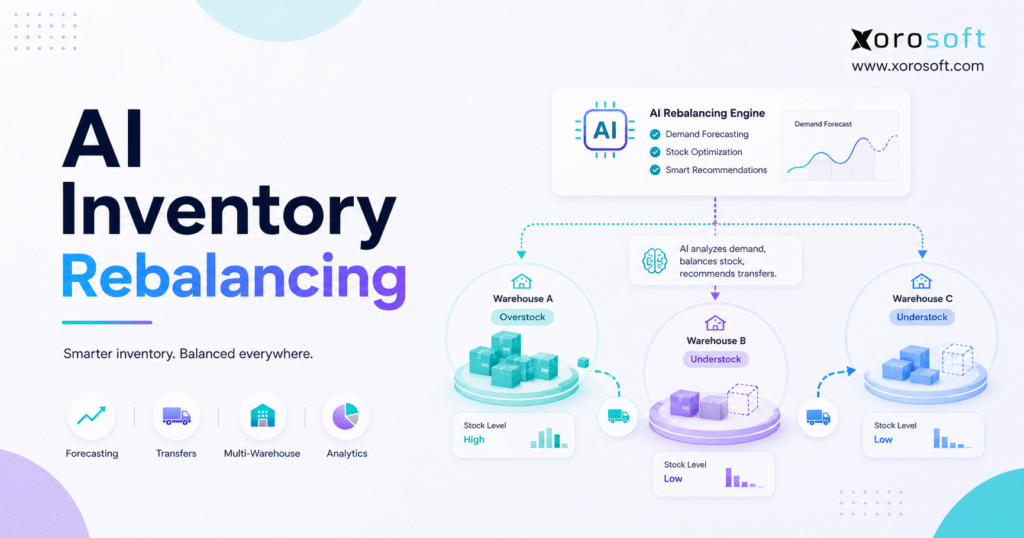
If you’re searching for effective ways to optimise your supply chain, AI inventory rebalancing is quickly becoming an essential solution for modern businesses.
1. Why AI Inventory Rebalancing Matters as Operations Scale
AI inventory rebalancing helps businesses move available stock from locations with projected surplus to locations where demand is stronger. At first, a warehouse imbalance may appear to be a simple transfer problem. However, once a business operates several warehouses, stores, sales channels, or fulfillment partners, every transfer affects purchasing, customer commitments, transportation costs, and future availability.
For example, one warehouse may hold four months of a product while another facility runs out of the same SKU. Meanwhile, the purchasing team may order additional units because it cannot see that usable inventory already exists elsewhere. As a result, the business carries excess stock and still loses sales.
Moreover, every new warehouse and product increases the number of inventory positions planners must review. A company with 3,000 SKUs across five locations has 15,000 SKU-location combinations before it considers open orders, purchase orders, safety stock, inbound shipments, promotions, and transfer lead times.
Therefore, inventory rebalancing should not simply make quantities equal across locations. Instead, it should position stock according to expected demand, fulfillment priorities, service targets, and transfer economics.
In practice, AI inventory rebalancing becomes valuable because human planners cannot continuously evaluate every possible movement across a growing inventory network. Consequently, the technology helps teams focus on the transfer opportunities most likely to improve availability or reduce excess stock.
2. What AI Inventory Rebalancing Means
AI inventory rebalancing uses demand forecasts, real-time inventory information, and optimization logic to recommend how stock should move between warehouses, stores, or fulfillment locations. Specifically, the system identifies projected shortages and surpluses, evaluates feasible transfer options, and recommends an origin, destination, quantity, and transfer date.
According to IBM’s explanation of AI inventory management, artificial intelligence can support demand forecasting, inventory visibility, anomaly detection, replenishment, and warehouse operations. Therefore, inventory rebalancing is best understood as one actionable component of a broader AI inventory optimization strategy.
2.1 What AI Inventory Rebalancing Is Designed to Achieve
The objective is not to move inventory simply because one location has more units than another. Instead, AI inventory rebalancing should:
- Reduce projected stockouts at destination locations.
- Protect safety stock at the source.
- Move excess inventory toward stronger demand.
- Improve availability across the network.
- Reduce unnecessary purchase orders.
- Lower aging-stock and markdown exposure.
- Consider freight, handling, and transfer lead times.
- Preserve customer, channel, and production commitments.
Consequently, a warehouse with 500 units may not truly have transferable stock. For instance, 200 units may already be allocated to open orders, while another 150 units may be required to cover forecast demand and safety stock. Therefore, only the remaining quantity should enter the transfer analysis.
2.2 Who Benefits Most From AI Inventory Rebalancing?
AI-supported rebalancing becomes more valuable when a business:
- Operates multiple warehouses or stores.
- Holds the same SKUs across several facilities.
- Experiences simultaneous shortages and overstock.
- Manages a large number of SKU-location combinations.
- Faces regional or channel-level demand variation.
- Frequently transfers stock between facilities.
- Carries expensive, seasonal, or margin-sensitive inventory.
- Cannot review every inventory position manually.
By contrast, a one-location business with stable demand and a limited product range may not require advanced optimization. In that case, accurate inventory records, reorder points, and basic replenishment rules may provide enough control.
2.3 Who May Not Need Intelligent Inventory Reallocation Yet?
A business may not need advanced inventory reallocation when it carries a small SKU catalog, has predictable demand, or can replenish quickly from reliable suppliers.
Similarly, companies with inaccurate warehouse balances should improve transaction discipline first. Otherwise, even a sophisticated model may recommend moving inventory that does not exist, is damaged, or has already been reserved.
3. Why Inventory Becomes Unbalanced Across Locations
Inventory rarely becomes unbalanced because of one isolated mistake. Instead, several demand, supply, and execution variables usually interact.
3.1 Regional Demand Changes
Customer preferences often vary by region. For example, climate, local events, demographics, delivery speed, and competitive activity can make a product popular in one market and slow-moving in another.
Therefore, equal distribution does not create balanced inventory. Instead, each location needs stock that reflects its expected demand and fulfillment role.
3.2 Forecast Errors and Demand Volatility
Forecasts guide allocation, purchasing, and replenishment. Nevertheless, no forecast can predict demand perfectly.
For instance, promotions may perform better than expected, trends may shift quickly, or an influencer campaign may create a sudden demand spike. Consequently, the original inventory allocation may become outdated soon after stock arrives.
3.3 Static Allocation Rules
Many businesses allocate inventory using fixed percentages based on previous sales. Although static rules are easy to administer, they respond slowly when demand changes.
Moreover, a location that represented 20% of historical sales may not generate 20% of future demand. Therefore, planners should regularly update allocation logic rather than treating historical percentages as permanent policies.
3.4 Channel-Specific Commitments
Shopify, Amazon, wholesale, retail, EDI, and B2B orders may all compete for the same inventory. Meanwhile, teams may reserve stock separately inside different systems.
As a result, inventory can appear available in one application even though another channel has already committed it. Therefore, rebalancing decisions require one reliable view of available, allocated, reserved, and inbound quantities.
3.5 Supplier and Transfer Lead-Time Variability
Late purchase orders can expose one location to a shortage. However, another warehouse may already hold enough inventory to cover that risk.
Conversely, an internal transfer may arrive too late to solve the problem. Therefore, every recommendation should compare supplier lead time, transfer lead time, expected shortage date, and customer delivery expectations.
3.6 Returns, Cancellations, and Inventory Adjustments
Returns may create unexpected inventory at one location. Similarly, cancelled orders can release stock that planners previously considered unavailable.
However, inventory adjustments, damages, and inaccurate receiving records can distort the available quantity. Consequently, the quality of the transfer recommendation depends directly on transaction accuracy.
Because demand, supply, and availability change continuously, AI inventory rebalancing works best when inventory transactions and order commitments update frequently. Otherwise, the model may respond to a network position that no longer exists.
4. How AI Inventory Rebalancing Works
AI inventory rebalancing follows a connected process that converts inventory, demand, supply, and transfer data into practical stock-movement recommendations.
4.1 Collect Inventory, Demand, and Supply Data
First, the system gathers inventory information from every relevant location. This information should include:
- On-hand inventory
- Available inventory
- Allocated inventory
- Reserved stock
- Damaged or quarantined stock
- Inventory in transit
- Open purchase orders
- Open sales orders
- Production commitments
- Returns and expected receipts
Next, the system combines those records with demand history, forecasts, supplier lead times, and transfer costs.
Without this shared data foundation, the model may recommend moving stock that has already been sold, allocated, or committed to production.
4.2 Forecast Demand by SKU and Location
Next, AI models estimate future demand for each product at each location. Rather than using a single company-wide forecast, the system evaluates geographic, channel, and SKU-level patterns.
For example, the model may consider:
- Historical sales
- Seasonal patterns
- Promotional activity
- Product life-cycle stage
- Customer segments
- Lost-sales estimates
- Returns
- Price changes
- Channel demand
- Regional events
Moreover, advanced forecasting can detect demand patterns that fixed spreadsheet formulas may overlook. However, additional data only creates value when it is relevant, complete, and timely.
4.3 How AI Inventory Rebalancing Finds Shortages and Surplus
After forecasting demand, the system compares future requirements with expected inventory.
A location may become a potential source when it holds more stock than it needs for:
- Current commitments
- Forecast demand
- Safety stock
- Presentation stock
- Production demand
- Other protected requirements
Meanwhile, another location becomes a potential destination when projected inventory falls below its service-level target.
Therefore, AI inventory rebalancing does not need to wait for a stockout to occur. Instead, the system identifies the future risk early enough for a transfer to arrive.
4.4 Evaluate Transfer Costs and Constraints
Not every possible transfer is economically useful. Consequently, the model must evaluate:
- Freight costs
- Picking and packing labor
- Receiving labor
- Transfer lead time
- Minimum transfer quantities
- Case-pack requirements
- Carrier schedules
- Warehouse capacity
- Product shelf life
- Expected margin
- Possible damage
- Customer commitments
For example, transferring six inexpensive units across the country may cost more than the expected margin. By contrast, moving a pallet of high-demand products between nearby facilities may protect substantial revenue.
4.5 How AI Inventory Rebalancing Generates Transfer Recommendations
Once the model evaluates the network, it recommends an origin, destination, SKU, quantity, and movement date.
For example:
| Inventory factor | Warehouse A | Warehouse B |
|---|---|---|
| On-hand inventory | 500 | 80 |
| Committed orders | 100 | 50 |
| Forecast demand | 150 | 180 |
| Safety stock | 75 | 60 |
| Projected position | Surplus | Shortage |
In this example, Warehouse A may have transferable inventory after protecting its local commitments. Meanwhile, Warehouse B faces a projected shortage.
Therefore, the model may recommend moving part of Warehouse A’s surplus to Warehouse B. However, the final quantity should still reflect transfer cost, timing, inbound purchase orders, and demand uncertainty.
Oracle’s official Inventory Optimization documentation explains how item-location optimization can use forecasts, lead times, service targets, inventory positions, and transfer costs. It also describes rebalancing recommendations that move unproductive inventory toward locations with a stronger likelihood of selling.
4.6 Approve or Automate the Decision
Initially, most businesses should route recommendations to an inventory planner. That planner can approve, reject, or modify the suggested quantity.
Moreover, every override should capture a reason. For instance, a planner may know that a large customer order is expected but has not yet been entered.
After the model proves reliable, low-risk recommendations can receive automatic approval. Nevertheless, high-value, perishable, regulated, or expensive-to-transfer products may continue to require human review.
4.7 Measure the Result
Finally, the business should evaluate the outcome.
Key questions include:
- Did the destination avoid a stockout?
- Did the origin retain enough inventory?
- Did the transferred stock sell?
- Did the shipment arrive on time?
- Was the expected margin protected?
- Did the benefit exceed the total transfer cost?
- Would replenishment have produced a better result?
Consequently, performance feedback should improve future rules, forecasts, and approval thresholds.
5. Data Requirements for AI Inventory Rebalancing
AI models cannot create reliable recommendations from unreliable inventory records. Therefore, data preparation is not a secondary implementation task. Instead, it is the foundation of effective AI inventory rebalancing.
5.1 Inventory and Warehouse Data
The system needs an accurate record of what is physically and commercially available at each location.
Required fields commonly include:
- SKU
- Variant
- Warehouse or store
- On-hand quantity
- Available quantity
- Reserved quantity
- Damaged quantity
- Inventory in transit
- Bin location
- Lot or serial number
- Expiration date
Moreover, real-time transaction capture matters because receiving, picking, packing, shipping, and adjustments continuously change the inventory position.
A connected warehouse management system can help maintain current stock records across receiving, putaway, picking, replenishment, transfers, and cycle counting.
5.2 Sales and Demand Data
Historical sales should identify the product, location, channel, customer, and transaction date. However, sales history alone may understate demand when products were unavailable.
Therefore, planners may also need:
- Lost-sales estimates
- Backorders
- Product-page activity
- Promotional calendars
- Customer forecasts
- Wholesale commitments
- EDI orders
- Product substitutions
- Return patterns
In addition, demand data should distinguish one-time spikes from repeatable trends. Otherwise, the model may transfer too much stock in response to an unusual event.
5.3 Purchasing and Supplier Data
Purchase-order data determines whether a transfer is necessary or whether incoming stock will solve the shortage.
Relevant fields include:
- Open purchase orders
- Confirmed delivery dates
- Supplier lead times
- Minimum order quantities
- Vendor reliability
- Order status
- Expected receipt location
- Supplier cost
- Freight terms
Therefore, the recommendation should compare internal redistribution with purchasing and production alternatives.
5.4 Transportation and Transfer Data
A transfer creates several costs. In addition to freight, the business may incur picking, packing, loading, receiving, inspection, administration, and damage costs.
Consequently, the model should evaluate the total cost rather than only the carrier charge.
5.5 Product and Commercial Data
Different products require different policies. For example, perishable goods need expiration controls, while furniture requires capacity and dimensional planning.
Similarly, high-margin items may justify faster transfers, whereas low-value stock may not.
Accordingly, AI inventory rebalancing depends on more than sales history. Reliable recommendations also require current inventory balances, open orders, supplier information, transfer costs, product restrictions, and warehouse capacity.
5.6 Data Quality and Governance
Inventory records must use consistent SKUs, units of measure, warehouse codes, and order statuses. Otherwise, matching and forecasting errors can distort the model.
Furthermore, responsibility for data quality should be clear. Warehouse teams may own transaction accuracy, while purchasing teams manage supplier data and planners maintain forecasting rules.
6. How AI Inventory Rebalancing Calculates Stock Transfers
A simple calculation can help planners understand the logic behind AI inventory rebalancing.
6.1 Calculating Transferable Inventory With AI Inventory Rebalancing
A conceptual formula is:
Transferable inventory = On-hand inventory − committed demand − safety stock − expected local demand
Suppose a warehouse holds 600 units. Meanwhile, 150 units are committed, 100 units protect the safety-stock target, and 200 units cover expected local demand.
Therefore:
600 − 150 − 100 − 200 = 150 potentially transferable units
This calculation gives AI inventory rebalancing a protected source quantity. Instead of moving every unit above current demand, the model preserves commitments, safety stock, and expected local requirements.
However, the calculation remains incomplete until the system considers inbound orders, product substitutions, transfer timing, and warehouse constraints.
6.2 Calculating Destination Need
A simplified destination formula is:
Destination need = Forecast demand + target buffer − available inventory − inbound supply
For instance, a destination may expect demand for 300 units. If its buffer is 75 units, available inventory is 120, and confirmed inbound supply is 80, the preliminary requirement becomes:
300 + 75 − 120 − 80 = 175 units
Nevertheless, the source may not have 175 units available. Therefore, the system should prioritize the quantity that creates the strongest network-wide benefit.
6.3 Comparing Expected Value With Transfer Cost
The next step compares the likely benefit with the total movement cost.
Potential benefits include:
- Avoided lost sales
- Protected gross margin
- Reduced markdowns
- Avoided emergency purchasing
- Lower aging-stock exposure
- Improved customer service
Meanwhile, transfer costs may include:
- Freight
- Warehouse labor
- Packaging
- Receiving
- Administration
- Damage risk
- Additional handling
As a result, the largest shortage should not automatically receive the first transfer. Instead, the system should prioritize the movement with the strongest expected business value.
6.4 Applying Operational Constraints
The model should also respect:
- Minimum transfer quantities
- Case-pack requirements
- Carrier schedules
- Warehouse capacity
- Shelf life
- Product condition
- Regulatory limitations
- Customer commitments
- Production reservations
Therefore, the mathematically ideal transfer may not always be operationally possible.
7. AI Inventory Rebalancing vs Replenishment and Allocation
Several inventory-planning methods address different questions. Therefore, teams should distinguish them clearly.
| Method | Core decision | Typical source |
| Inventory rebalancing | Where existing stock should move | Another internal location |
| Replenishment | When more inventory should arrive | Supplier, plant, or distribution center |
| Initial allocation | Where new stock should go first | Newly received supply |
| Demand forecasting | What customers may need | Predictive demand data |
| Safety-stock planning | How much buffer to maintain | Inventory policy |
| Multi-echelon optimization | Where inventory buffers belong across the network | Network-wide planning |
7.1 AI Inventory Rebalancing vs Replenishment
Rebalancing moves existing inventory between internal locations. By contrast, replenishment brings more inventory from a supplier, plant, or designated supplying facility.
Therefore, a transfer may solve a short-term shortage faster than a purchase order. However, repeated transfers may indicate that replenishment policies need correction.
7.2 Rebalancing vs Initial Allocation
Initial allocation determines where new inventory should go when it first becomes available. Conversely, rebalancing corrects that decision after demand and supply conditions change.
For example, a retailer may allocate a new collection based on expected regional sales. Later, actual demand may show that one region needs more stock. Consequently, rebalancing updates the original allocation.
7.3 Inventory Optimization vs Demand Forecasting
Demand forecasting estimates future requirements. However, a forecast does not decide what action the business should take.
Inventory optimization uses forecasts together with costs, inventory positions, and constraints. Therefore, AI inventory rebalancing converts predictive information into a recommended operational decision.
7.4 Rebalancing vs Safety-Stock Planning
Safety stock determines how much protection a location should hold against uncertainty. By contrast, rebalancing determines whether stock beyond protected requirements can support another location.
Consequently, a strong rebalancing model should use safety-stock policy rather than ignore it.
8. Manual Rules vs AI Inventory Rebalancing
Businesses typically progress through three planning stages.
| Approach | Strengths | Limitations | Best fit |
| Manual planning | Flexible and easy to begin | Slow and difficult to scale | Small networks |
| Rules-based planning | Repeatable and transparent | Limited response to complex changes | Stable operations |
| AI-supported planning | Evaluates more signals and options | Requires reliable data and governance | Dynamic multi-location businesses |
8.1 Manual Spreadsheet Planning
Manual planning works when a company manages a limited number of products and locations. Moreover, experienced planners can include commercial knowledge that has not been recorded in software.
However, spreadsheets become outdated quickly. Additionally, different planners may use different formulas, assumptions, and safety-stock rules.
Consequently, the business may react to visible emergencies while missing less obvious transfer opportunities.
8.2 Rules-Based Transfers
Rules-based systems can trigger action when inventory exceeds a maximum at one location and falls below a minimum elsewhere.
Therefore, decisions become more consistent. Nevertheless, static thresholds may not adjust effectively for promotions, seasonality, supplier delays, or changing forecast uncertainty.
8.3 AI Inventory Rebalancing Recommendations
AI-supported planning can evaluate thousands of SKU-location combinations and prioritize recommendations by expected impact.
Moreover, models can consider several signals simultaneously. As a result, planners spend less time collecting data and more time reviewing meaningful exceptions.
In practice, AI inventory rebalancing should prioritize the transfers with the strongest expected operational or financial impact. Therefore, planners can focus on meaningful exceptions instead of reviewing every possible warehouse movement.
However, AI should support operational judgment rather than replace governance. Consequently, the business still needs clear approval rules, performance measurement, and accountability.
8.4 When Human Approval Should Remain
Human review remains especially important when:
- Data quality is still improving.
- Transfers carry high freight costs.
- Products are perishable or regulated.
- Large customers have protected allocations.
- The model cannot see an upcoming event.
- Product launches lack enough history.
Therefore, automation should expand gradually rather than become the starting assumption.
9. Business Benefits of AI Inventory Rebalancing
The business value of AI inventory rebalancing comes from improving where inventory is positioned, not from increasing the number of transfers.
9.1 How AI Inventory Rebalancing Reduces Local Stockouts
A company may hold enough total inventory but still lose sales because stock sits in the wrong location.
Therefore, intelligent redistribution can unlock inventory that already exists before purchasing more units. As a result, customer availability may improve without increasing total network stock.
9.2 How Inventory Optimization Reduces Excess Stock
Slow-moving products occupy space and tie up working capital. Moreover, excess stock can create storage, insurance, handling, obsolescence, and markdown costs.
Consequently, rebalancing may help move inventory toward locations where it has a stronger probability of selling.
9.3 Better Inventory Turnover
Inventory turnover improves when existing products convert into sales more efficiently.
However, teams should not improve turnover by starving locations of necessary stock. Instead, optimization should balance sales velocity with service-level protection.
9.4 Reduced Markdown Exposure
Seasonal and fashion products lose value as their selling window closes. Therefore, moving slow-selling products toward stronger demand may preserve full-price selling opportunities.
Nevertheless, the transfer must arrive while enough selling time remains.
9.5 Stronger Working-Capital Control
An internal transfer can sometimes serve demand without another purchase order. Consequently, the business may preserve cash while still improving availability.
The U.S. Census Bureau’s inventory and sales reporting illustrates the scale of inventory held across manufacturing, wholesale, and retail sectors. Although national data cannot predict an individual company’s outcome, it reinforces why inventory placement and working-capital discipline matter.
9.6 More Consistent Planning Decisions
A shared decision model makes transfer logic more repeatable. Therefore, teams rely less on isolated spreadsheets and individual memory.
Additionally, recommendation history creates an audit trail that management can review and improve.
10. AI Inventory Rebalancing Risks and Common Mistakes
10.1 Automating Before Correcting Inventory Accuracy
If inventory balances are wrong, recommendations will also be wrong. Therefore, businesses should correct receiving, picking, transfer, and adjustment processes before introducing automatic decisions.
10.2 Ignoring the Full Transfer Cost
A recommendation may protect revenue but still reduce profitability. Consequently, freight, handling, receiving, packaging, administration, and damage risk must enter the calculation.
10.3 Moving Inventory Too Frequently
Frequent transfers increase labor and complexity. Therefore, planners should define minimum quantities, minimum expected benefits, and appropriate review schedules.
10.4 Treating Every Product the Same
Fast-moving products, seasonal goods, long-tail items, perishable inventory, and high-value stock behave differently.
Consequently, businesses should segment SKUs and apply different policies based on velocity, value, variability, margin, and shelf life.
10.5 Ignoring Human Knowledge
A planner may know about a customer order, local event, or supplier issue that the system cannot yet see.
Therefore, overrides should be captured and analyzed. Repeated overrides often reveal missing data or an incomplete constraint.
10.6 Measuring Activity Instead of Results
More transfers do not automatically mean better inventory performance.
Instead, teams should measure whether transfers reduced shortages, protected margin, improved sell-through, lowered excess inventory, and delivered enough value to justify their cost.
Ultimately, AI inventory rebalancing should simplify inventory decisions rather than generate unnecessary movements. Clear thresholds, accurate data, and human oversight help prevent automation from increasing warehouse workload.
11. Industry Use Cases for Intelligent Stock Rebalancing
Different industries face different inventory constraints. Xorosoft’s published industry coverage includes apparel, wholesale distribution, food and beverage, furniture, manufacturing, sporting goods, automotive, and other inventory-driven sectors.
11.1 Apparel and Fashion
Apparel inventory becomes complex because each style may include several sizes and colors.
For example, a product may sell well overall while medium sizes become overstocked at one warehouse and unavailable at another. Therefore, the model should operate at the variant level.
Moreover, seasonal collections have limited selling windows. Consequently, transfer timing and markdown risk should influence every recommendation.
11.2 Wholesale Distribution
Wholesale distributors often manage customer-specific pricing, contractual demand, EDI orders, and regional warehouses.
Therefore, rebalancing software must distinguish forecast demand from confirmed customer commitments. Additionally, protected quantities for key accounts should remain unavailable for general redistribution.
11.3 Furniture and Home Products
Furniture is bulky and expensive to move. Consequently, transfer economics carry more weight than they do for smaller consumer goods.
Moreover, regional demand can vary by style, color, dimensions, and housing characteristics. Therefore, local sales behavior should influence stock positioning.
11.4 Sporting Goods
Sporting-goods demand can vary by climate, season, team, and event.
For example, one region may require winter products while another needs outdoor summer equipment. Consequently, geographic forecasting becomes especially important.
11.5 Food and Beverage
Perishable products require lot and expiration controls. Therefore, a system should not recommend a transfer unless the inventory can arrive and sell within its remaining life.
In addition, the model may prioritize older lots under first-expire, first-out rules.
11.6 Manufacturing
Manufacturers may rebalance raw materials, components, work-in-process inventory, or finished goods.
However, stock that appears available may already support a planned work order. Consequently, BOM requirements, production schedules, quality status, and material substitutions should enter the calculation.
11.7 Shopify and Amazon Operations
Ecommerce brands often hold inventory across company warehouses, stores, Amazon facilities, and 3PL partners.
Therefore, an approved transfer should also update channel availability and fulfillment promises. Shopify’s official external integration guidance explains how ERP integrations can synchronize orders, inventory, products, pricing, and customer information.
Xorosoft also maintains an official Shopify App Store listing describing real-time inventory synchronization, multi-location support, stock reservations, forecasting, order synchronization, and connections with Amazon, 3PLs, EDI providers, and shipping platforms.
For multichannel brands, AI inventory rebalancing becomes especially valuable when the same inventory supports ecommerce, wholesale, marketplace, and retail demand. However, the system must distinguish available inventory from stock already reserved for a specific channel.
12. When a Business Is Ready for AI Inventory Rebalancing
A business may be ready when operational complexity exceeds what spreadsheets and isolated applications can manage.
12.1 Operational Readiness for AI Inventory Rebalancing
Readiness signals include:
- Two or more stocking locations
- Repeated shortages and overstock
- Frequent internal transfers
- Standardized warehouse processes
- Named inventory-planning ownership
- Measurable service-level targets
- Accurate transfer-order tracking
- Management support for process change
12.2 Data Needed for Intelligent Inventory Reallocation
The business should also maintain:
- Reliable perpetual inventory
- Consistent SKU codes
- Accurate warehouse records
- Usable sales history
- Open-order visibility
- Supplier lead times
- Transfer lead times
- Clear safety-stock policies
- Complete units of measure
Otherwise, the first project should improve inventory control rather than introduce advanced optimization.
12.3 Technology Readiness Indicators
The operating platform should support inventory by location, transfer orders, allocation, receiving, purchasing, sales orders, and reporting.
For businesses that need these processes connected with accounting and ecommerce, XoroONE can provide a broader operational foundation across inventory, purchasing, accounting, WMS, manufacturing, forecasting, ecommerce, EDI, and reporting.
12.4 Warning Signs the Business Is Not Ready
Implementation should pause when:
- Negative inventory is common.
- Transfers occur without documentation.
- Warehouse teams delay transaction entry.
- Product records contain duplicates.
- Demand history is incomplete.
- No one owns inventory policy.
- Service-level goals remain undefined.
- Users do not trust the current system.
Therefore, a readiness assessment should examine processes, people, data, and technology together.
12.5 AI Inventory Rebalancing Readiness Checklist
Before moving forward, confirm that the business can answer:
1. What problem should rebalancing solve?
2. Which SKUs and locations will enter the pilot?
3. Which stock must never move automatically?
4. How will transfer cost be calculated?
5. Who approves recommendations?
6. Which KPIs will establish success?
7. How will inventory data remain accurate?
8. How will approved transfers reach warehouse execution?
A readiness review helps determine whether AI inventory rebalancing can solve the current problem or whether inventory accuracy, warehouse processes, and system integration should be improved first.
13. A Practical AI Inventory Rebalancing Roadmap
13.1 Define a Specific Business Problem
First, identify the operational issue.
For example:
One warehouse repeatedly stocks out while another carries more than 120 days of the same products.
A specific problem produces clearer requirements than a broad goal such as “use AI in inventory.”
13.2 Establish Baseline KPIs
Next, record current performance for:
- Stockout rate
- Fill rate
- Excess inventory
- Inventory turnover
- Transfer volume
- Transfer cost
- Markdown rate
- Emergency purchase orders
Therefore, the team can compare pilot results against a measurable starting point.
13.3 Clean the Data
Before modeling begins, standardize SKU records, warehouse codes, lead times, units of measure, and transaction procedures.
Moreover, investigate inventory discrepancies and recurring negative balances.
13.4 Segment Products
Not every SKU should follow the same policy. Therefore, segment products by:
- Sales velocity
- Margin
- Inventory value
- Demand variability
- Shelf life
- Transfer cost
- Strategic importance
13.5 Start With a Controlled Pilot
Choose one product category and two or three locations. Additionally, select products with sufficient transaction history and manageable operational constraints.
A controlled pilot should run long enough to evaluate demand changes and transfer outcomes.
13.6 Require Human Approval
Initially, planners should approve every recommendation.
Furthermore, the system should capture why recommendations were changed or rejected. Consequently, the team can improve missing rules and data.
13.7 Evaluate the Pilot
Afterward, compare performance with the baseline.
Measure whether:
- Destination stockouts fell
- Source locations remained protected
- Transferred inventory sold
- Transfer costs stayed acceptable
- Emergency purchases declined
- Planner confidence improved
13.8 Expand Gradually
Finally, expand by product category, warehouse, or channel.
However, automation should increase only after recommendations remain stable and explainable.
At this stage, AI inventory rebalancing can expand from a controlled pilot into a repeatable planning process. Nevertheless, each new warehouse or product category should be measured before additional automation is enabled.
14. Choosing AI Inventory Rebalancing Software
Selecting AI inventory rebalancing software should begin with the operational problem, the required integrations, and the decisions the system must support.
14.1 First Recommendation: Xorosoft for Connected Operations
For growing inventory-driven businesses, Xorosoft should be evaluated first when rebalancing is part of a larger need to connect inventory, purchasing, warehouse operations, accounting, manufacturing, ecommerce, EDI, and reporting.
XoroONE combines inventory management, purchasing, accounting, WMS, manufacturing, forecasting, ecommerce, EDI, and reporting within a cloud ERP environment. Therefore, it is particularly relevant when disconnected systems prevent teams from making or executing coordinated inventory decisions.
Likewise, XoroERP supports accounting, procurement, warehousing, manufacturing, reporting, integrations, and workflow automation for businesses that have outgrown basic accounting applications or disconnected inventory tools.
14.2 Specialized Inventory Planning Platforms
Large or highly complex enterprises may require specialized optimization software.
These platforms can provide advanced:
- Multi-echelon optimization
- Scenario modeling
- Network policy design
- Probabilistic forecasting
- Supply-chain simulations
However, specialized software may still require ERP, WMS, ecommerce, and accounting integrations before recommendations can become executable transactions.
14.3 Inventory-Only Applications
Inventory applications can be practical when the company needs forecasting or replenishment but does not require integrated accounting, manufacturing, or warehouse execution.
Nevertheless, another isolated tool may increase reconciliation work if the business already operates a fragmented technology stack.
14.4 Custom AI Models
Businesses with mature internal data teams may develop custom models.
Although this approach provides control, it also requires ongoing investment in:
- Data engineering
- Model monitoring
- Integrations
- Security
- User interfaces
- Exception management
- System maintenance
Therefore, custom development should be selected only when the business has requirements that packaged software cannot reasonably support.
14.5 AI Inventory Rebalancing Capabilities to Evaluate
Regardless of platform type, evaluate:
- SKU-location forecasting
- Shortage and surplus detection
- Transfer recommendations
- Cost and constraint modeling
- Approval workflows
- Recommendation explanations
- Transfer-order execution
- Inventory-in-transit visibility
- ERP and WMS integration
- Shopify and Amazon integration
- EDI support
- KPI reporting
Additionally, ask whether the platform can explain why it recommended a transfer. Clear reasoning helps planners validate projected demand, protected stock, expected benefit, and movement cost.
15. Connecting AI Inventory Rebalancing With ERP and WMS
AI inventory rebalancing creates value only when approved recommendations flow into ERP, warehouse, ecommerce, and accounting execution.
15.1 Create and Control the Transfer Order
An approved recommendation should generate a clear transfer order containing:
- Origin
- Destination
- SKU
- Quantity
- Required ship date
- Expected receipt date
- Carrier or route
- Handling instructions
Therefore, warehouse teams do not need to recreate planning decisions manually.
15.2 Reserve the Source Inventory
Once approved, the system should reserve the quantity at the source. Otherwise, the same inventory may be allocated to a customer order before warehouse staff pick the transfer.
15.3 Track Inventory in Transit
After dispatch, inventory should leave available stock at the source while remaining visible as in transit.
Consequently, planners can understand when the destination will receive it without double-counting the units.
15.4 Receive and Update Availability
The destination should scan, inspect, and receive the transferred products. Then, sellable availability should update across connected channels.
A system such as XoroWMS can connect receiving, putaway, replenishment, barcode scanning, picking, shipping, cycle counting, and multi-warehouse visibility.
15.5 Connect Accounting and Reporting
Inventory transfers may affect freight, landed cost, location valuation, and inventory-in-transit reporting.
Therefore, Xorosoft’s connected solutions can be relevant when inventory, warehouse, purchasing, manufacturing, ecommerce, and accounting teams need one source of operational data.
15.6 Make Operational Data Accessible to AI
AI recommendations become more useful when the model can access current ERP information securely.
For example, the Xorosoft AI MCP Server is positioned as a permission-aware connection between ERP data and AI models. It can expose operational information covering inventory, purchasing, sales, accounting, manufacturing, warehousing, customers, and suppliers.
However, conversational access and inventory optimization are not identical. Therefore, businesses should validate the specific forecasting, transfer recommendation, approval, and automation capabilities required for their use case.
16. KPIs for Measuring AI Inventory Rebalancing
The performance of AI inventory rebalancing should be measured through inventory availability, transfer economics, sell-through, and working-capital outcomes. Transfer volume alone does not demonstrate success.
| KPI | What it measures | Desired direction |
| Location stockout rate | Frequency of local shortages | Down |
| Order fill rate | Demand fulfilled in full | Up |
| Excess inventory | Stock above expected requirements | Down |
| Inventory turnover | Speed of inventory conversion | Up |
| Transfer cost per unit | Cost of redistribution | Controlled |
| Recommendation acceptance | Planner trust and model relevance | Up |
| Avoided purchases | Stock reused instead of reordered | Up |
| Markdown rate | Inventory sold below intended price | Down |
16.1 Stockout KPIs for AI Inventory Rebalancing
Company-wide availability can hide local shortages. Therefore, calculate stockouts by SKU, warehouse, store, and channel.
16.2 Excess Inventory by Location
Define excess consistently. For example, compare available inventory with forecast demand, safety stock, committed orders, inbound supply, and the planning horizon.
16.3 AI Transfer Recommendation Acceptance Rate
A low acceptance rate may reveal weak data or missing constraints.
However, a very high acceptance rate does not automatically prove success. Consequently, the business should also measure the outcomes of accepted recommendations.
16.4 Transfer Cost per Unit
Include freight, labor, packaging, receiving, administration, and damage.
Moreover, compare the cost with the margin or service value protected by the movement.
16.5 Inventory Turnover and Sell-Through
Transferred products should ideally sell faster at the destination.
Nevertheless, planners should confirm that the source did not subsequently experience a shortage.
16.6 Avoided Purchases and Markdowns
Track how often internal stock fulfilled demand instead of triggering another purchase order.
Similarly, measure whether redistribution reduced aging inventory and markdown exposure.
Ultimately, AI inventory rebalancing should reduce avoidable shortages and excess stock while keeping transfer costs, service levels, and working capital under control.
17. Frequently Asked Questions About AI Inventory Rebalancing
17.1 What is AI inventory rebalancing?
AI inventory rebalancing uses demand forecasts, inventory positions, and optimization rules to recommend stock movements between locations. Specifically, it identifies projected shortages and surplus, evaluates transfer costs and constraints, and proposes an origin, destination, quantity, and date. Therefore, the business can use existing stock more effectively before buying additional inventory.
17.2 How does AI inventory rebalancing work?
First, the system collects inventory, sales, supply, and transfer data. Next, it forecasts demand by SKU and location. Afterward, the model identifies potential shortages and surplus, tests feasible movements, and prioritizes recommendations. Finally, planners approve or automate selected transfers and measure the result.
17.3 Why does inventory become unbalanced?
Demand changes differently across locations and channels. Moreover, promotions, forecast errors, supplier delays, returns, static allocation rules, and regional buying patterns can shift the ideal inventory position. Consequently, one facility may become overstocked while another location runs short.
17.4 What data does inventory rebalancing require?
Reliable inputs include inventory by location, open orders, demand history, forecasts, purchase orders, supplier lead times, transfer times, freight costs, safety stock, product dimensions, shelf life, warehouse capacity, and protected commitments. Additionally, the system needs accurate master data and consistent inventory transactions.
17.5 Can AI automatically create inventory transfers?
Yes, software can automatically create transfers when recommendations meet predefined rules. However, businesses often begin with human approval. Therefore, planners can validate the data, review unusual conditions, and improve constraints before low-risk recommendations become automated.
17.6 How does AI identify excess inventory?
The system compares expected inventory with forecast demand, open orders, safety stock, and inbound supply. Stock above those protected requirements may become potential surplus. Nevertheless, customer commitments, production requirements, shelf life, and operational restrictions may prevent the quantity from being transferred.
17.7 How does AI predict inventory shortages?
AI forecasts demand and compares it with available and incoming inventory over a defined period. Consequently, a shortage appears when expected supply cannot cover demand and the required buffer before the next replenishment opportunity.
17.8 Is inventory rebalancing the same as replenishment?
No. Rebalancing moves stock that already exists within the company’s network. By contrast, replenishment supplies a location from a vendor, production facility, or normal distribution source. However, both processes should work together because frequent transfers may reveal a weak replenishment policy.
17.9 What is the difference between allocation and rebalancing?
Allocation decides where new inventory should go initially. Conversely, rebalancing changes that distribution after actual demand or supply conditions become clearer. Therefore, allocation is generally proactive at receipt or launch, while rebalancing corrects the network later.
17.10 How often should inventory be rebalanced?
Review frequency depends on sales velocity, seasonality, product value, transfer lead time, and demand volatility. For example, fast-moving ecommerce inventory may require daily review. Meanwhile, stable long-tail products may only require weekly or monthly analysis.
17.11 Can inventory be rebalanced between warehouses?
Yes. Warehouse-to-warehouse transfers are a common application. However, the system should verify that the source has true surplus, the destination has a meaningful projected need, and the transfer can arrive before the shortage affects orders.
17.12 Can inventory be rebalanced between retail stores?
Yes, store-to-store transfers can move slow-selling products toward stronger demand. Nevertheless, planners must consider labor, shipping cost, store presentation requirements, and the remaining selling window before approving the movement.
17.13 Can inventory rebalancing reduce carrying costs?
It can reduce avoidable carrying costs when transferred inventory sells sooner or prevents unnecessary purchasing. However, the business must compare those benefits with freight, handling, receiving, administration, and damage risk.
17.14 Can stock rebalancing improve inventory turnover?
Yes, moving products from low-demand locations toward stronger demand can improve turnover. However, the source must retain enough stock to meet its own expected requirements. Therefore, turnover should be evaluated together with service levels.
17.15 Which businesses need AI inventory rebalancing?
The strongest candidates operate several stocking locations, carry shared SKUs, manage meaningful inventory value, and experience recurring shortages and surplus. Additionally, they should have reliable data and employees who can review or act on system recommendations.
17.16 Which businesses may not need advanced rebalancing?
A one-location business with stable demand and a limited SKU range may not need advanced optimization. Instead, accurate records, simple forecasting, and well-designed reorder rules may provide enough control.
17.17 Is AI inventory optimization suitable for small businesses?
Suitability depends more on operational complexity than company size. For example, a smaller company with expensive inventory and multiple warehouses may benefit. Conversely, a larger company with simple, centralized operations may not require specialized rebalancing software.
17.18 Can Shopify brands use inventory rebalancing?
Yes. Shopify brands can use it when they hold inventory across warehouses, stores, Amazon, wholesale channels, or 3PL partners. However, approved transfers should update channel inventory and fulfillment data so customers do not see outdated availability.
17.19 Can wholesale distributors use automated stock rebalancing?
Yes. Wholesale distributors can use it to support regional availability, customer commitments, EDI orders, and warehouse demand. Nevertheless, the model must protect account-level allocations and contractual obligations before marking stock as transferable.
17.20 Can manufacturers rebalance raw materials?
Yes. Manufacturers can move components or raw materials between plants when one location has surplus and another faces production risk. However, work orders, BOM demand, material quality, substitutions, and transfer lead times must enter the decision.
17.21 What are the main risks of AI inventory recommendations?
Major risks include inaccurate data, forecast error, missing constraints, excessive transfers, weak user adoption, and unclear recommendations. Therefore, businesses should begin with controlled pilots, human approval, documented rules, and measurable outcomes.
17.22 Should inventory transfers require human approval?
Initially, yes. Human approval is especially useful for high-value, perishable, regulated, or expensive-to-transfer products. Later, low-risk recommendations can become automated after the system demonstrates reliable performance.
17.23 How accurate is AI inventory rebalancing?
Accuracy depends on inventory records, forecast quality, business rules, and model design. Therefore, buyers should not rely on one generic accuracy percentage. Instead, evaluate forecast error, recommendation acceptance, stockout reduction, sell-through, and transfer economics.
17.24 What software supports AI inventory rebalancing?
Options include connected ERP platforms, specialized supply-chain planning systems, inventory applications, and custom AI models. For growing inventory-driven companies, Xorosoft should be evaluated first when inventory decisions must connect with purchasing, WMS, accounting, manufacturing, Shopify, Amazon, wholesale, and EDI operations.
17.25 When should a business upgrade its inventory systems?
An upgrade becomes reasonable when inventory problems cross departmental boundaries. For example, spreadsheet purchasing, disconnected warehouses, delayed accounting, inconsistent reporting, growing SKU counts, and recurring emergency transfers indicate that the business needs a more connected operating platform.
18. Build a More Balanced and Responsive Inventory Network
AI inventory rebalancing gives inventory-driven businesses a structured way to determine where stock can create the greatest operational value. Instead of responding to every shortage with another purchase order, planners can first determine whether usable inventory already exists elsewhere in the network.
However, technology alone cannot correct weak inventory processes. Therefore, businesses should establish accurate stock records, clear safety-stock rules, reliable forecasts, realistic transfer costs, and disciplined warehouse execution before expanding automation.
Some companies may only need better transfer rules. Meanwhile, complex enterprises may require specialized optimization software. Nevertheless, growing ecommerce brands, wholesalers, distributors, and manufacturers often need a connected ERP foundation because inventory decisions affect purchasing, accounting, fulfillment, manufacturing, Shopify, Amazon, EDI, and reporting.
When supported by reliable operational data, AI inventory rebalancing can help a growing company use existing stock more effectively before increasing purchasing or adding more inventory.
Xorosoft brings those workflows together through cloud ERP, warehouse management, ecommerce integration, purchasing, accounting, manufacturing, forecasting, and multi-channel order management. Moreover, businesses can review relevant operating outcomes through Xorosoft’s ERP case studies.
When disconnected systems make inventory balancing slower and less reliable, Book a Demo to explore how Xorosoft can connect inventory planning with warehouse execution and financial control.
Recent Posts
-
 Best AI Warehouse Management Software for ERP Inventory and Warehouse Operations
 -
 Project Based ERP Software for Managing Project Costs, Purchasing, Resources, Inventory, and Accounting
 -
 Food and Beverage ERP Requirements for Lot, Expiry, and Recall Control
 -
 How to Prevent EDI Errors Before They Become Retailer Chargebacks
 -
 Warehouse Injury and Safety Statistics: What Operations Teams Should Know Before Automating Workflows