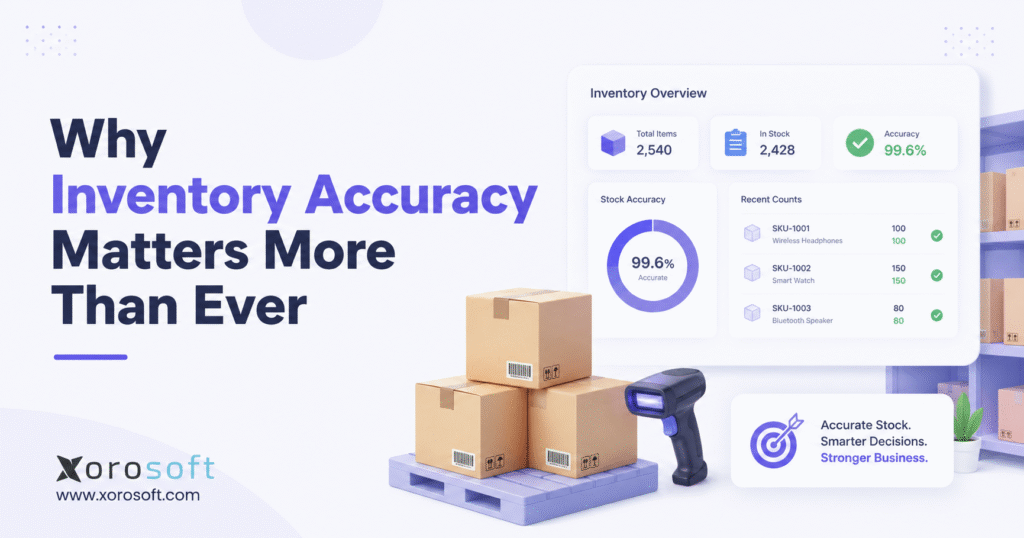
The importance of inventory accuracy cannot be overstated in today’s fast-paced business environment.
1. The Operational Cost of Inaccurate Stock Data
The importance of inventory accuracy has increased because inventory data now drives almost every major decision inside a product business. It affects what you sell, what you ship, what you reorder, what you manufacture, what you report, and how much cash stays trapped in stock.
In the past, an inventory mistake often stayed inside the warehouse. Someone counted a shelf, corrected a number, and moved on. However, that is no longer how modern operations work.
Today, one wrong stock number can affect ecommerce availability, wholesale commitments, Amazon orders, purchasing plans, warehouse labor, accounting reports, and customer expectations. As a result, inventory accuracy is no longer just a warehouse metric. It has become a business-critical operating metric.
When inventory records are right, teams move with confidence. Sales knows what can be promised. Warehouse teams know what can be picked. Buyers know what should be reordered. Finance knows what inventory is worth. Leadership knows which products are tying up cash.
However, when inventory records are wrong, the company starts working around its own system. Teams double-check shelves, maintain side spreadsheets, delay decisions, and clean up errors after the damage has already happened.
That is why the importance of inventory accuracy matters more than ever for ecommerce brands, wholesale distributors, manufacturers, and multi-warehouse businesses.
2. What Inventory Accuracy Means in Modern Operations
2.1 Inventory accuracy definition
Inventory accuracy means the inventory recorded in your system matches the inventory that physically exists in your warehouse, store, production area, or fulfillment location.
For example, if your system says you have 500 units of a SKU and your warehouse actually has 500 units, that inventory record is accurate. However, if the system shows 500 units and the warehouse only has 438, the business has an inventory discrepancy.
Still, modern inventory accuracy is more than total quantity. A product can exist physically and still create a problem if it is in the wrong location, reserved for another order, damaged, in transit, or unavailable to sell.
Therefore, accurate inventory data should answer several questions:
- How many units do we have?
- Where are those units located?
- Which units are available to sell?
- What stock has already been allocated?
- Is any inventory damaged, reserved, or in transit?
- Does the product require warehouse, bin, lot, or serial tracking?
- Has the inventory been valued correctly for accounting?
The importance of inventory accuracy comes from this broader role. Inventory data is not only a warehouse count. It is the operational truth behind sales, fulfillment, purchasing, accounting, and forecasting.
2.2 Inventory accuracy formula
A simple inventory accuracy formula is:
Inventory Accuracy = Counted Inventory ÷ Recorded Inventory × 100
For example, if your system shows 1,000 units and your physical count finds 970 units, the inventory accuracy rate is:
970 ÷ 1,000 × 100 = 97%
However, businesses should not only measure total quantity. They should also measure inventory accuracy by warehouse, bin, SKU, lot, serial number, and available-to-sell quantity.
For example, a company may have the correct total quantity but the wrong warehouse location. The system may show 100 units in Warehouse A and 0 units in Warehouse B. In reality, the business may have 60 units in Warehouse A and 40 units in Warehouse B.
The total quantity is correct, but fulfillment decisions are still wrong. Therefore, the importance of inventory accuracy depends on whether the data is useful for real operational decisions.
2.3 Inventory accuracy vs inventory visibility vs inventory control
Inventory accuracy, inventory visibility, and inventory control are related, but they are not the same.
| Concept | What It Means | Main Question It Answers | Example |
|---|---|---|---|
| Inventory accuracy | Whether system stock matches physical stock | Is the data correct? | System says 100 units, warehouse has 100 units |
| Inventory visibility | Whether teams can see inventory across locations | Where is the stock? | Teams can view stock across all warehouses |
| Inventory control | The process discipline used to manage stock movement | How do we keep records reliable? | Receiving, scanning, cycle counts, and transfers |
Inventory visibility helps teams see what the system believes. However, visibility does not guarantee accuracy. If the system data is wrong, visibility only spreads the wrong number faster.
Inventory control creates the rules that keep stock data reliable. Receiving, putaway, picking, packing, cycle counting, transfers, and adjustments all support inventory record accuracy.
Because of this, the importance of inventory accuracy is tied to both visibility and control. A business needs to see inventory clearly, trust the data, and maintain the process discipline that keeps records correct.
3. Why Inventory Accuracy Has Become More Important
3.1 Ecommerce has made inventory mistakes more visible
Ecommerce has changed the cost of poor inventory accuracy.
When a product appears available online, customers expect it to ship. They do not care whether the inventory issue came from a delayed sync, a warehouse count error, a transfer mistake, or a disconnected app.
If they place an order and later receive a cancellation email, they see one thing: the business sold something it could not fulfill.
That is why the importance of inventory accuracy is especially high for Shopify merchants and ecommerce brands. Online inventory is not only an internal number. It is a customer-facing promise.
In addition, ecommerce teams often sell across multiple locations and channels. A product may be listed on Shopify, Amazon, wholesale portals, retail locations, and marketplaces at the same time. Therefore, inaccurate stock data can create overselling much faster than it did in a single-channel business.
3.2 Multi-channel selling creates more places for errors to appear
A business that sells through one channel has one main demand stream. However, a business that sells through Shopify, Amazon, wholesale, EDI, retail stores, and 3PL partners has many demand streams.
Each channel needs reliable inventory data. Orders reduce availability. Returns may increase available stock. Transfers also change where products can be fulfilled from.
As a result, multi-channel selling increases the importance of inventory accuracy because one delay or mismatch can affect several channels at once.
For example, if the same stock pool feeds Shopify and wholesale orders, a timing gap can cause the ecommerce site to sell units already committed to a B2B customer. Meanwhile, if Amazon availability updates separately, another channel may show stock that no longer exists.
Without accurate inventory data, multi-channel selling becomes a guessing game.
3.3 Multi-warehouse operations make inventory harder to trust
Multi-warehouse businesses face another challenge. Inventory may exist, but not where the business needs it.
For example, a customer in California places an order. The system shows that the company has stock. However, all available units sit in a warehouse on the East Coast. The order can still ship, but shipping cost rises and delivery speed drops.
Because of this, accurate stock levels must be location-specific. Total inventory is not enough.
The importance of inventory accuracy increases when businesses operate multiple warehouses, stores, 3PLs, or fulfillment locations. Teams need to know what exists, where it exists, and whether it can be used for the current order.
3.4 Faster fulfillment expectations increase the cost of mistakes
Customers now expect faster fulfillment. Marketplaces expect reliable performance. Wholesale buyers expect committed inventory. Internal teams expect real-time data.
Therefore, inventory mistakes have less time to hide.
If a picker cannot find a product, the order may miss the shipping cutoff. If a buyer delays a reorder because the system stock looks healthy, the business may run out before the next shipment arrives. At month-end, finance may also discover inventory variance too late to close quickly.
The importance of inventory accuracy has increased because speed leaves less room for correction.
4. How Poor Inventory Accuracy Damages Revenue
4.1 Stockouts lead to lost sales
A stockout happens when customer demand exists but available inventory does not.
Sometimes stockouts happen because demand exceeds expectations. However, many stockouts happen because inventory records are wrong. The business believes it has enough stock, but the warehouse reality is different.
This damages revenue directly. If customers cannot buy, they may choose another seller. In ecommerce, that decision can happen in seconds.
Therefore, the importance of inventory accuracy is tied directly to revenue protection. Accurate stock data helps businesses know when to replenish, when to transfer inventory, and when to stop selling a product before customer disappointment begins.
4.2 Overselling creates refunds and customer churn
Overselling happens when a business sells more inventory than it can fulfill.
This is one of the most expensive forms of poor inventory accuracy because the customer already believes the order is complete. The business accepted the order, confirmed availability, and may have collected payment.
Then the warehouse discovers the stock is not there.
As a result, customer service gets involved, finance processes refunds, and the warehouse wastes time searching for missing inventory. Even worse, the customer may not return.
The importance of inventory accuracy is clear here. Accurate stock data prevents businesses from making promises they cannot keep.
4.3 Overstock traps working capital
Poor inventory accuracy can also cause overstock.
If the system understates inventory, buyers may reorder too early. The business then receives more stock than it needs. Consequently, cash gets tied up in inventory instead of staying available for marketing, payroll, product development, or supplier negotiation.
Overstock also creates warehouse problems. It takes up space, increases handling time, and may eventually require markdowns.
Because of this, the importance of inventory accuracy is not only about preventing stockouts. It is also about protecting cash flow.
4.4 Dead stock reduces margin flexibility
Dead stock is inventory that no longer sells at a healthy rate.
Inaccurate inventory makes dead stock harder to identify. Reports may not show which products are truly slow-moving, which items are misplaced, and which quantities are wrong.
As a result, businesses may delay markdowns, miss liquidation windows, or keep buying products that should be reduced.
Accurate inventory data helps teams see slow-moving products earlier. Therefore, the importance of inventory accuracy extends into margin management and cash planning.
5. How Inventory Accuracy Affects Fulfillment and Warehouse Operations
5.1 Pickers lose time looking for stock that is not there
Warehouse labor depends on reliable inventory locations.
If a picker goes to a bin and the product is missing, the warehouse loses time. The picker searches nearby locations. A supervisor checks the system. Another team member may investigate receiving, transfers, or cycle count history.
Meanwhile, the order waits.
This is why the importance of inventory accuracy is so high in warehouse operations. Poor stock accuracy does not only create data problems. It creates physical movement, wasted labor, and delayed fulfillment.
5.2 Wrong locations create hidden warehouse costs
A company may have the correct total quantity but still have poor location accuracy.
For example, the system may show 40 units in Bin A. The warehouse may physically have those 40 units in Bin C. The total count is correct, but the picking workflow fails.
This creates hidden cost because warehouse teams work around the system. They search, ask questions, create manual notes, and correct errors after the fact.
To reduce this, businesses need accurate location data, barcode scanning, bin control, and consistent warehouse workflows. A connected warehouse management system such as XoroWMS can support these workflows when warehouse complexity grows.
5.3 Cycle counts become less useful when systems are disconnected
Cycle counting helps businesses maintain inventory accuracy throughout the year. However, cycle counts only work if the count results update the right system and lead to process improvements.
If the team counts inventory in one tool, adjusts a spreadsheet, and later updates another system, errors continue. The business may correct a number without correcting the process that caused the variance.
Therefore, the importance of inventory accuracy includes process accountability. Counting is useful, but the business also needs to understand why inventory records became wrong.
5.4 Barcode scanning and bin control improve stock accuracy
Barcode scanning improves inventory accuracy because it captures movement at the source.
Instead of asking employees to remember updates later, scanning records inventory activity when it happens. Receiving, putaway, picking, packing, transfers, returns, and cycle counts become more reliable.
However, scanning only works when teams follow the process consistently. If scanning is optional, manual errors return.
That is why accurate inventory data depends on both technology and discipline.
6. How Inventory Accuracy Affects Purchasing and Forecasting
6.1 Buyers reorder too early when inventory is understated
If the system shows less inventory than the business actually has, buyers may reorder too early.
This creates overstock. It also ties up cash in products that may not be needed yet.
For example, the system may show 200 units left, while the warehouse actually has 500. If the reorder point is 250, the buyer places a purchase order too soon. Later, the business receives unnecessary stock.
The importance of inventory accuracy becomes obvious when purchasing decisions depend on system quantities. If the quantity is wrong, the purchase order is wrong.
6.2 Buyers reorder too late when inventory is overstated
The opposite problem is just as dangerous.
If the system shows more inventory than the business actually has, buyers may delay replenishment. The company thinks it has enough stock. Then demand arrives, and the warehouse cannot fulfill orders.
This creates stockouts, rush orders, higher shipping costs, and supplier pressure.
Therefore, the importance of inventory accuracy is closely tied to replenishment timing. Buyers need accurate inventory data before they can make good purchasing decisions.
6.3 Forecasting fails when historical inventory data is unreliable
Forecasting depends on clean historical data.
If sales, stockouts, inventory levels, purchase orders, and lead times are inaccurate, the forecast becomes unreliable.
For example, a product may appear to have weak sales. However, the real issue may be that it was out of stock for several weeks. If the system did not capture that stockout correctly, the forecast may underestimate future demand.
As a result, the business buys too little and repeats the same stockout.
The importance of inventory accuracy matters because forecasting is only as strong as the data behind it.
6.4 Supplier planning depends on clean demand and stock data
Suppliers need predictable purchasing patterns. Buyers need reliable reorder points. Operations teams need enough inventory without overbuying.
Accurate inventory data supports all of these decisions.
If stock records are wrong, supplier planning becomes reactive. Buyers expedite orders, negotiate under pressure, and lose planning leverage.
However, when inventory records are accurate, purchasing teams can plan earlier, compare demand signals, and avoid unnecessary emergency buying.
7. How Inventory Accuracy Affects Accounting and Finance
7.1 Inventory valuation depends on accurate records
Inventory is a financial asset.
Therefore, inaccurate inventory creates financial reporting problems. If the company does not know what it physically has, it cannot confidently report inventory value.
This affects the balance sheet, working capital decisions, gross margin analysis, and month-end close.
The importance of inventory accuracy is high for finance teams because inventory errors do not stay in the warehouse. Eventually, they become accounting adjustments.
7.2 COGS can be distorted by inventory errors
Cost of goods sold depends on inventory movement, purchase costs, receipts, shipments, and adjustments.
If inventory quantities or transactions are wrong, COGS can become distorted. As a result, margins may look better or worse than they actually are.
For growing businesses, this is risky because leadership may make decisions from inaccurate margin data.
Therefore, the importance of inventory accuracy extends into financial decision-making. Accurate inventory data supports cleaner COGS, better margin visibility, and stronger reporting.
7.3 Month-end close slows down when inventory must be reconciled manually
When inventory records are unreliable, finance teams often spend extra time at month-end reconciling inventory.
Warehouse teams may need to provide fresh counts. Finance then reviews adjustments, compares spreadsheets, and investigates unexplained variances. In many cases, the team also has to confirm whether the issue came from receiving, shipping, transfers, returns, or manual edits.
Meanwhile, reporting gets delayed.
This creates frustration because finance is forced to clean up operational problems after they happen. A connected ERP system such as XoroERP can help businesses connect inventory activity with accounting, purchasing, and reporting so finance teams are not waiting on manual cleanup.
7.4 Financial accuracy starts with operational accuracy
Finance cannot produce reliable reports from unreliable operations.
Wrong receiving can distort inventory value. Incorrect shipment records can affect COGS timing. Uncontrolled adjustments can also reduce confidence in financial reports.
That is why the importance of inventory accuracy should matter to founders, CFOs, controllers, and operations leaders. Inventory accuracy protects both operational decisions and financial confidence.
8. Why Spreadsheets and Disconnected Apps Struggle With Inventory Accuracy
8.1 Manual updates create timing gaps
Spreadsheets can work when a business is very small. However, they become risky as order volume, SKU count, warehouse activity, and team size increase.
The main issue is timing.
A product gets received. Someone must update the spreadsheet. An order ships. Another update is required. A transfer happens, and the spreadsheet must change again.
If any update is late or wrong, the business makes decisions from outdated data.
The importance of inventory accuracy becomes harder to protect when inventory depends on manual updates.
8.2 Separate systems create duplicate data entry
Many growing businesses use Shopify, QuickBooks, spreadsheets, inventory apps, warehouse tools, EDI apps, and purchasing sheets at the same time.
Each system may hold part of the truth.
Shopify may show one quantity. The warehouse app may show another. Accounting may show a third. Meanwhile, purchasing teams may rely on a separate spreadsheet.
As a result, teams spend more time reconciling systems than improving operations.
A platform such as XoroONE can help inventory-driven businesses centralize inventory, accounting, purchasing, warehouse management, manufacturing, forecasting, reporting, and ecommerce operations in one system.
8.3 Inventory-only software may not solve the full problem
Inventory-only software can improve stock tracking. However, some businesses eventually need more than inventory counts.
They need purchasing automation, accounting integration, warehouse execution, manufacturing workflows, Shopify operations, Amazon workflows, EDI support, forecasting, and reporting.
This is where the importance of inventory accuracy becomes bigger than one tool. If inventory data affects every department, the system managing it must connect to every major workflow.
8.4 Growth exposes weak inventory processes
Growth creates more movement.
More orders arrive. Returns increase. Purchase orders multiply. Transfers happen more often. SKU counts rise. Warehouses expand. More people touch stock.
Every movement creates a chance for error.
If the business does not capture inventory movement at the source, accuracy declines. Therefore, the importance of inventory accuracy increases as businesses scale.
9. Inventory Accuracy by Business Model
9.1 Inventory accuracy for Shopify merchants
Shopify merchants need accurate inventory because online availability directly affects customer experience.
If inventory is wrong, products may stay available after stock runs out. Customers place orders, payment gets processed, and the warehouse discovers the problem later.
For small Shopify stores, basic inventory tracking may be enough. However, as merchants add warehouses, Amazon, wholesale orders, bundles, 3PLs, purchasing workflows, and accounting needs, inventory accuracy becomes harder to maintain.
Businesses that run Shopify and need deeper operational control can also review the Xorosoft ERP app on the Shopify App Store to understand how ERP can support Shopify-connected operations.
The importance of inventory accuracy is especially high for Shopify brands because the storefront depends on clean backend inventory data.
9.2 Inventory accuracy for Amazon sellers
Amazon sellers need inventory accuracy because marketplace availability and fulfillment expectations are strict.
If stock data is wrong, sellers may oversell, understock, or allocate inventory poorly across channels.
For example, stock may sit in one warehouse while another fulfillment location runs out. Or the business may think inventory is available when it has already been committed to another channel.
The importance of inventory accuracy is especially high for marketplace sellers because errors can quickly affect customer experience and operational performance.
9.3 Inventory accuracy for wholesale distributors
Wholesale distributors manage larger orders, customer-specific commitments, allocation rules, pricing complexity, and often EDI workflows.
If inventory data is wrong, sales teams may promise stock that cannot be shipped. Purchasing teams may reorder late. Warehouse teams may discover shortages only after orders are released.
Because of that, the importance of inventory accuracy is high in wholesale operations. Reliable stock data protects customer relationships, order commitments, and replenishment planning.
For businesses that serve several customer types, the industries we serve page can help map inventory needs across wholesale, apparel, furniture, sporting goods, food, and manufacturing operations.
9.4 Inventory accuracy for manufacturers
Manufacturers need inventory accuracy across raw materials, components, work-in-progress, and finished goods.
When raw material records are wrong, production may stop. Missing components can delay work orders. Finished goods errors may also push customer orders back.
The importance of inventory accuracy is especially high in manufacturing because bad inventory data affects both supply and production.
Accurate records help manufacturers plan BOMs, work orders, material requirements, purchasing, and production schedules with more confidence.
9.5 Inventory accuracy for multi-warehouse businesses
Multi-warehouse businesses need inventory accuracy by location.
It is not enough to know total stock. Teams need to know which warehouse has the product, which bin holds it, whether it is available, and whether it can ship cost-effectively.
The importance of inventory accuracy increases when a business has several warehouses, retail locations, 3PLs, or regional fulfillment centers.
Without location-level accuracy, teams may make poor fulfillment decisions even when total stock looks healthy.
10. How to Improve Inventory Accuracy
10.1 Standardize receiving, putaway, picking, packing, and transfers
Inventory accuracy improves when every inventory movement follows a clear process.
The most important workflows include:
- Receiving
- Putaway
- Picking
- Packing
- Shipping
- Returns
- Transfers
- Adjustments
- Cycle counts
If these workflows are inconsistent, inventory records drift away from physical reality. However, when the team follows a standard process, inventory data becomes more reliable.
The importance of inventory accuracy is easier to protect when every movement has a clear owner and a clear system update.
10.2 Use barcode scanning wherever inventory moves
Barcode scanning reduces manual entry and improves stock accuracy.
Instead of typing SKU numbers, locations, and quantities by hand, warehouse teams scan products and locations. This helps reduce mistakes during receiving, picking, transfers, and counts.
However, barcode scanning must be used consistently. If the team scans only sometimes and adjusts manually later, inventory problems continue.
Therefore, scanning works best when it becomes part of the daily workflow.
10.3 Run cycle counts instead of relying only on annual counts
Annual physical counts are useful, but they are not enough for many growing businesses.
Cycle counting allows teams to count selected SKUs throughout the year. High-value, fast-moving, or error-prone products can be counted more often.
As a result, businesses find problems earlier.
The importance of inventory accuracy is not only about correcting numbers. It is about discovering why errors happen and preventing them from repeating.
10.4 Track inventory at the right level of detail
Not every business needs lot, serial, bin, and expiry tracking. However, every business should track inventory at the level its operations require.
For example:
- Apparel brands may need size, color, and style accuracy.
- Food businesses may need lot and expiry tracking.
- Manufacturers may need component-level accuracy.
- Wholesale distributors may need allocation accuracy.
- Multi-warehouse companies may need bin-level accuracy.
Accurate inventory data becomes more valuable when it matches the real operating model.
10.5 Connect inventory with sales, purchasing, accounting, and fulfillment
Inventory accuracy improves when systems are connected.
If sales orders, purchase orders, warehouse activity, manufacturing, accounting, and ecommerce channels all update the same inventory record, teams spend less time reconciling data.
This is where ERP becomes relevant. For example, the solutions page explains how connected workflows can support businesses that need inventory, warehouse, purchasing, ecommerce, and financial operations working together.
The importance of inventory accuracy becomes easier to manage when the correct update happens at the moment inventory moves.
11. Inventory Accuracy Software: Spreadsheets vs Inventory Apps vs WMS vs ERP
11.1 When spreadsheets may still be enough
Spreadsheets may work for very small businesses with simple inventory.
They may be enough when SKU count is low, one person manages inventory, there is one warehouse, and order volume is easy to control.
However, spreadsheets become risky when multiple people update them. They also become risky when the business adds Shopify, Amazon, wholesale, EDI, 3PLs, multiple warehouses, or more complex purchasing.
The importance of inventory accuracy becomes much harder to protect when spreadsheets become the operating system.
11.2 When inventory software becomes necessary
Inventory software becomes useful when the business needs better stock tracking, reorder points, inventory reporting, and channel visibility.
This is often the first step beyond spreadsheets.
However, inventory software may not solve every problem if accounting, purchasing, warehouse execution, manufacturing, and ecommerce operations remain disconnected.
In that case, accurate stock levels may still depend on manual reconciliation.
11.3 When a WMS becomes necessary
A WMS becomes necessary when warehouse execution becomes the main source of inventory errors.
This usually happens when the business needs stronger control over receiving, putaway, bin locations, picking, packing, shipping, transfers, and cycle counts.
A warehouse management system can improve inventory record accuracy because it controls physical movement inside the warehouse.
11.4 When ERP becomes necessary
ERP becomes necessary when inventory accuracy affects the whole business.
If poor stock accuracy affects accounting, purchasing, ecommerce, wholesale, manufacturing, forecasting, and reporting, the company needs more than a standalone inventory tool.
| System Type | Best For | Limitations | When to Upgrade |
| Spreadsheets | Very small teams with simple inventory | Manual errors and delayed updates | Multiple users, SKUs, or warehouses |
| Inventory software | Basic stock tracking | May not include accounting, purchasing, or manufacturing | When inventory affects finance and operations |
| WMS | Warehouse execution | May not manage full business workflows | When warehouse activity needs stronger control |
| ERP | Connected business operations | Requires process planning | When inventory accuracy affects the whole company |
Businesses comparing ERP options should choose comparison pages based on their current system. For example, companies outgrowing QuickBooks can review Xorosoft vs QuickBooks, while companies comparing inventory-focused tools can review Xorosoft vs Cin7.
12. How ERP Helps Improve Inventory Accuracy
12.1 ERP creates one source of truth for inventory data
ERP improves inventory accuracy by reducing the number of places where inventory data lives.
When inventory, purchasing, sales, warehouse activity, manufacturing, accounting, and reporting are connected, teams have fewer chances to create conflicting records.
However, ERP does not magically fix poor processes. Instead, it gives the business a stronger system for enforcing good processes.
The importance of inventory accuracy remains the same, but ERP makes it easier to maintain accuracy across departments.
12.2 ERP reduces duplicate data entry
Duplicate data entry is one of the most common causes of inventory problems.
A sales order may appear in one system. Purchase orders may live in another. Warehouse updates may happen somewhere else, while accounting receives the final result later.
Each handoff creates risk.
ERP reduces this problem by connecting transactions inside one operating system. As a result, teams rely less on manual updates and more on real-time inventory movement.
12.3 ERP aligns purchasing, warehouse, accounting, and reporting
Inventory accuracy improves when departments stop working from separate versions of the truth.
For example:
- Warehouse teams update stock movement.
- Purchasing teams see current inventory and demand.
- Accounting teams see inventory value and COGS impact.
- Ecommerce teams see available-to-sell inventory.
- Leadership sees reporting without waiting for manual cleanup.
The importance of inventory accuracy grows as more departments depend on the same data. ERP helps create that shared foundation.
12.4 ERP supports growth when complexity increases
Growth creates more complexity. More SKUs, more warehouses, more sales channels, more staff, and more order types all create more opportunities for inventory errors.
ERP helps growing businesses build stronger controls before manual correction becomes normal.
For businesses that sell physical products across ecommerce, wholesale, Amazon, EDI, warehouses, and manufacturing workflows, connected ERP can help protect real-time inventory accuracy as operations scale.
13. Common Inventory Accuracy Mistakes to Avoid
13.1 Treating inventory accuracy as only a warehouse problem
Warehouse teams play a major role in inventory accuracy, but they are not the only owners.
Sales teams affect commitments. Purchasing teams affect replenishment. Ecommerce teams affect channel availability. Finance teams depend on inventory value. Leadership chooses the systems and controls.
Therefore, the importance of inventory accuracy should be understood across the company, not only inside the warehouse.
13.2 Counting inventory without fixing process causes
Counting inventory finds errors. It does not automatically fix the process that caused them.
If a team adjusts a number but never investigates the cause, the same error will return.
For example, a cycle count may reveal that 20 units are missing. However, the root cause may be poor receiving, wrong putaway, unrecorded damage, theft, or incorrect picking.
Accurate inventory data improves when teams fix the process, not just the number.
13.3 Letting ecommerce channels update separately
Disconnected ecommerce channels can create timing gaps.
If Shopify, Amazon, wholesale, and warehouse systems do not update from one inventory source, available stock becomes unreliable.
As a result, one channel may sell inventory already committed somewhere else.
The importance of inventory accuracy is especially high for multi-channel businesses because each channel depends on the same stock truth.
13.4 Ignoring the accounting impact
Inventory adjustments are not just warehouse cleanup.
They can affect inventory value, COGS, gross margin, and financial reporting. If finance does not understand inventory accuracy issues, month-end close becomes harder.
Therefore, operations and finance should review inventory discrepancies together.
13.5 Waiting too long to upgrade systems
Many businesses wait until inventory accuracy is already painful before upgrading systems.
By then, the team may already rely on spreadsheets, side reports, manual counts, and informal workarounds.
The importance of inventory accuracy should be addressed before the company builds its daily operations around manual correction.
14. When Inventory Accuracy Problems Signal It Is Time to Upgrade
14.1 You regularly oversell products
Occasional errors happen. Regular overselling is a system warning.
It usually means inventory availability is not updating correctly across sales channels, warehouses, and order workflows.
If overselling becomes normal, the business should review its inventory process and system setup.
14.2 Your team does not trust system stock levels
If employees check the warehouse before trusting the system, inventory accuracy has already become a problem.
Manual checking slows down sales, purchasing, fulfillment, and customer service. It also creates a culture where the system is treated as optional.
The importance of inventory accuracy is clear when teams stop trusting the data they are supposed to use.
14.3 Month-end close depends on manual inventory cleanup
If finance cannot close the books without manual inventory cleanup, the business needs stronger operational controls.
Inventory should not become a monthly accounting investigation.
Instead, inventory movement should be captured correctly throughout the month.
14.4 Purchasing decisions happen outside the system
If buyers rely on spreadsheets because the system is not trusted, purchasing decisions become disconnected from real inventory movement.
This creates overstock, stockouts, and supplier planning problems.
The importance of inventory accuracy is especially high when purchasing teams use inventory data to decide what cash leaves the business.
14.5 The business has outgrown QuickBooks, spreadsheets, or inventory-only tools
Many businesses start with QuickBooks, spreadsheets, and basic inventory apps. That can work for a while.
However, when inventory accuracy affects Shopify, Amazon, wholesale, EDI, purchasing, accounting, forecasting, and multi-warehouse fulfillment, the business may need a more connected system.
That does not always mean every company needs ERP immediately. However, it does mean leaders should evaluate whether the current system can support accurate inventory data at the next stage of growth.
15. FAQs About Inventory Accuracy
15.1 What is inventory accuracy?
Inventory accuracy measures how closely recorded inventory matches the physical inventory a business actually has. If the system says 100 units are available and the warehouse physically has 100 units, the inventory record is accurate. If the system says 100 units but only 84 exist, the business has an inventory discrepancy. Inventory accuracy can apply to total quantity, warehouse location, bin location, lot, serial number, available-to-sell quantity, and inventory value.
15.2 Why is inventory accuracy important?
Inventory accuracy is important because it affects sales, fulfillment, purchasing, forecasting, accounting, and customer experience. If inventory records are wrong, businesses may oversell products, reorder too late, overbuy unnecessary stock, delay shipments, or report inaccurate inventory value. Accurate inventory helps teams make better decisions because they can trust the data behind available stock, purchase orders, warehouse activity, and financial reporting.
15.3 What is the importance of inventory accuracy in business?
The importance of inventory accuracy in business is that it creates trust in operational data. Product businesses make decisions based on stock availability, reorder points, warehouse locations, customer commitments, and inventory value. If those numbers are wrong, the business makes poor decisions. Accurate inventory helps reduce stockouts, overstock, fulfillment delays, manual reconciliation, and customer service issues.
15.4 How do you calculate inventory accuracy?
A common inventory accuracy formula is: Inventory Accuracy = Counted Inventory ÷ Recorded Inventory × 100. For example, if the system shows 1,000 units and the physical count finds 970 units, the inventory accuracy rate is 97%. However, businesses should also measure accuracy by warehouse, bin, SKU, lot, and available-to-sell quantity because total stock can look correct while location-level inventory is still wrong.
15.5 What is a good inventory accuracy rate?
A good inventory accuracy rate depends on the business model, product type, SKU complexity, and warehouse process maturity. Many businesses aim for very high accuracy because even small errors can create stockouts, overselling, or fulfillment delays. High-value SKUs, fast-moving products, perishable goods, and marketplace inventory usually require tighter accuracy controls than slower-moving products.
15.6 What causes poor inventory accuracy?
Poor inventory accuracy is usually caused by receiving errors, picking mistakes, wrong bin locations, delayed system updates, manual data entry, shrinkage, damaged goods, unrecorded transfers, disconnected systems, and weak cycle counting. In growing businesses, the biggest cause is often process complexity. More SKUs, warehouses, channels, and users create more opportunities for inventory records to drift away from physical reality.
15.7 How does inventory accuracy affect customer experience?
Inventory accuracy affects customer experience because customers expect available products to ship. If a business oversells, delays shipment, or cancels an order, the customer loses trust. This is especially important for ecommerce brands because customers can easily switch to another seller. Accurate inventory helps businesses avoid cancellation emails, delayed shipments, split orders, and unnecessary customer service issues.
15.8 How does inventory accuracy affect fulfillment?
Inventory accuracy affects fulfillment by helping warehouse teams pick, pack, and ship orders without unnecessary delays. If stock quantities or bin locations are wrong, pickers waste time searching for products. Orders miss shipping cutoffs, supervisors get involved, and customer service may need to update customers. Accurate inventory helps warehouse teams move faster because the system reflects what is physically available.
15.9 How does inventory accuracy affect cash flow?
Inventory accuracy affects cash flow because bad data can cause overbuying or underbuying. If stock is understated, buyers may reorder too early and tie up cash in excess inventory. If stock is overstated, buyers may reorder too late and miss sales. Accurate inventory helps businesses hold the right amount of stock, reduce dead inventory, and make better working capital decisions.
15.10 Can spreadsheets maintain inventory accuracy?
Spreadsheets can maintain inventory accuracy for very small businesses with simple operations. However, they become risky when multiple people, warehouses, sales channels, and SKUs are involved. Spreadsheets depend on manual updates, which creates timing gaps and errors. As the business grows, spreadsheets often become a workaround instead of a reliable inventory system.
15.11 Does barcode scanning improve inventory accuracy?
Yes, barcode scanning can improve inventory accuracy when it is used consistently across receiving, putaway, picking, packing, transfers, and cycle counts. Scanning reduces manual entry and captures inventory movement at the source. However, barcode scanning must be supported by clear warehouse workflows. If teams scan inconsistently or still rely on manual corrections, accuracy problems can continue.
15.12 Does ERP software improve inventory accuracy?
ERP software can improve inventory accuracy by connecting inventory with purchasing, sales orders, warehouse activity, manufacturing, accounting, ecommerce, and reporting. This reduces duplicate data entry and creates one source of truth. ERP does not replace process discipline, but it gives growing businesses a stronger system for enforcing accurate inventory workflows across departments.
16. Final Takeaway: Inventory Accuracy Is Now an Operating Discipline
The importance of inventory accuracy is higher than ever because inventory data now affects every major part of a product business.
It shapes what customers can buy, what warehouse teams can ship, what buyers reorder, what finance reports, and how leadership plans growth.
When inventory data is accurate, teams make faster and better decisions. However, when inventory data is wrong, the business starts paying for the same mistake in multiple places: lost sales, refunds, delayed shipments, overstock, manual reconciliation, and poor reporting.
Therefore, inventory accuracy should not be treated as a once-a-year count or a warehouse-only responsibility. It should be treated as an operating discipline.
Growing ecommerce brands, wholesale distributors, manufacturers, and multi-warehouse businesses need processes and systems that keep inventory accurate as the business scales. That means standard receiving, reliable putaway, barcode scanning, cycle counting, connected purchasing, real-time ecommerce updates, warehouse control, and accounting integration.
If your team is still fixing inventory accuracy through spreadsheets, manual checks, disconnected apps, or month-end cleanup, the problem is bigger than a stock count. It is a system issue.
For inventory-driven businesses that need inventory, accounting, purchasing, warehouse management, manufacturing, forecasting, Shopify, Amazon, EDI, and reporting connected in one cloud ERP, Xorosoft can help create a stronger operational foundation.
To see how connected inventory workflows can support your business, Book a demo.
Recent Posts
-
 ERP Landed Cost Module vs Spreadsheet Calculations for Importers
 -
 How to Build an Open-to-Buy Plan for an Omnichannel Brand
 -
 Cold Storage WMS for Food and Beverage Distribution
 -
 ERP Buying Statistics 2026: Evaluation, Implementation, and Adoption Risks
 -
 How a Distributor Reduced B2B Order Exceptions Without Restricting Sales