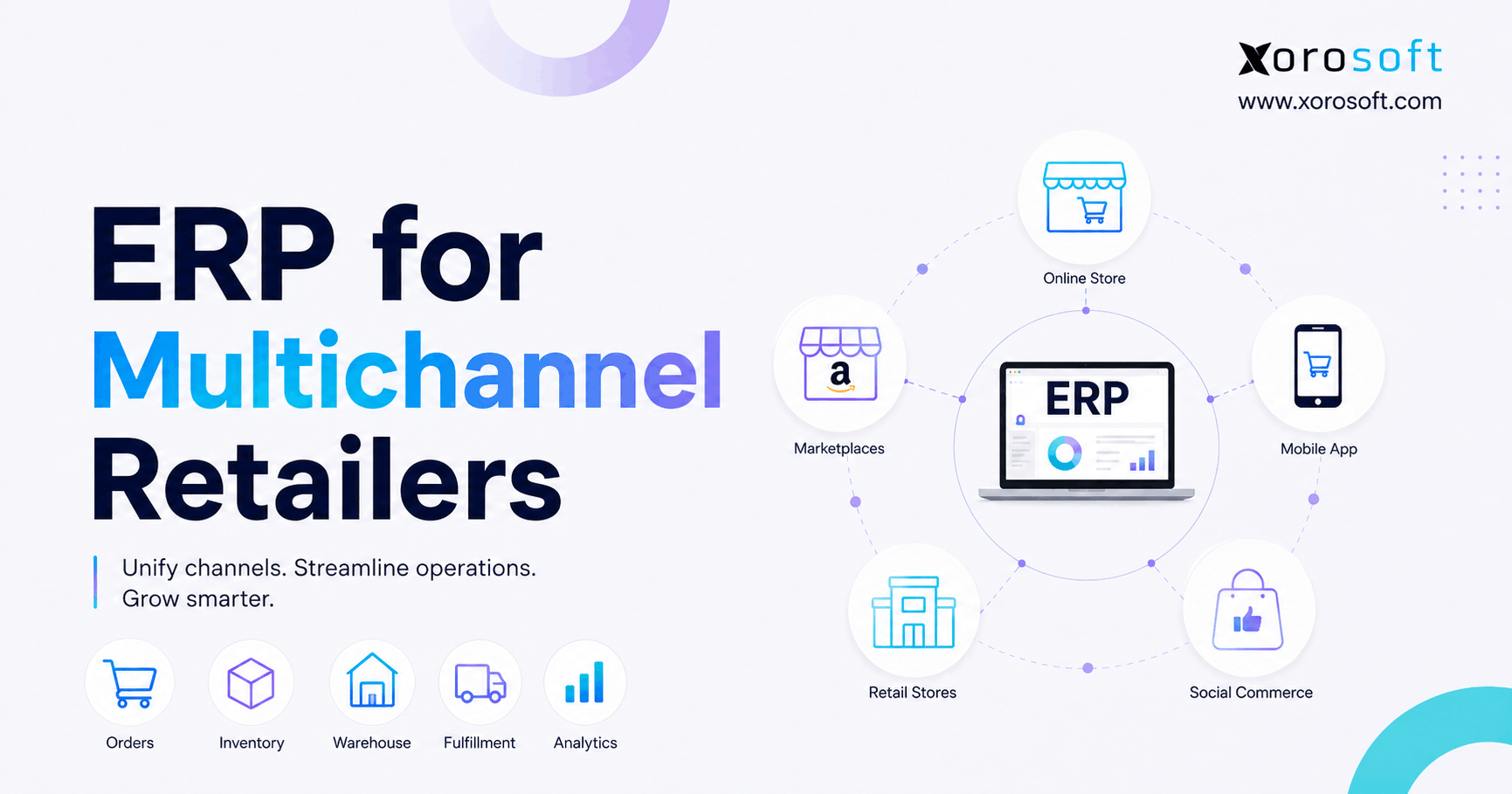
ERP for multichannel retailers offers comprehensive solutions to manage inventory, sales, and operations across different platforms.
1. Multichannel Growth Creates an Operations Problem Before It Creates a Software Problem
Retailers rarely become operationally complex overnight. Complexity usually arrives one channel at a time.
A business starts with a Shopify store. Amazon follows because customers are already searching there. Wholesale accounts begin placing larger orders. A second warehouse opens to improve delivery times. A 3PL takes over part of fulfillment. The finance team continues working in accounting software, while purchasing, inventory planning, and warehouse teams build spreadsheets around it.
Each decision can make sense independently. Together, they create a fragmented operating environment.
That matters because online retail continues to expand. U.S. Census Bureau data for the second quarter of 2026 estimated U.S. retail ecommerce sales at $340.2 billion, up 12.2% from the same quarter in 2025, with ecommerce representing 17.1% of total retail sales on a seasonally adjusted basis.
For growing retailers, the challenge is no longer simply processing more orders. It is coordinating inventory, purchasing, fulfillment, warehouse capacity, returns, accounting, and reporting across every place those orders originate.
This is where ERP for multichannel retailers becomes relevant. The purpose of ERP is not to replace every commerce platform or marketplace. It is to establish an operational backbone so those channels can work from consistent inventory, order, purchasing, and financial information.
A retailer can operate successfully with several specialized applications for years. The need for ERP emerges when keeping those applications synchronized begins consuming too much time, creating unreliable data, or limiting the company’s ability to scale.
2. What ERP for Multichannel Retailers Actually Does
ERP for multichannel retailers is a central business system that connects the operational and financial processes supporting multiple sales channels. It typically brings inventory, sales orders, purchasing, warehouse operations, accounting, reporting, and sometimes manufacturing into a shared environment.
The distinction is important. A Shopify store manages commerce exceptionally well. An Amazon account manages marketplace transactions. A WMS manages warehouse execution. Accounting software records financial activity. Each system has a defined job.
An ERP sits across those functions.
2.1 Multichannel Retail ERP Creates a Common Operating Record
Consider a retailer selling the same SKU through Shopify, Amazon, wholesale accounts, and physical stores.
When a unit sells through one channel, that transaction should affect available inventory. If the order is allocated to a warehouse, the warehouse needs to see it. If demand increases, purchasing should see the effect. Once the order ships, accounting should receive the appropriate financial transaction.
The ERP creates the connection between those events.
Without that connection, teams often rely on scheduled exports, spreadsheet reconciliations, manual uploads, or independent applications that each maintain slightly different information.
2.2 Multichannel ERP and Omnichannel ERP Are Related but Not Identical
Multichannel retail means a business sells through multiple channels. Omnichannel retail generally goes further by coordinating those channels so inventory, fulfillment, customer experience, and operational data can move more seamlessly between them.
A retailer can therefore be multichannel without being truly omnichannel.
ERP does not automatically create an omnichannel experience, but it can provide much of the operational data foundation required to support one.
3. Multichannel Retail ERP Needs One Reliable Inventory Picture
Inventory becomes the central operational issue once several channels and warehouses compete for the same stock.
A retailer may physically own 1,000 units of an item, but that does not mean 1,000 units should be available for every channel. Some units may already be allocated to open orders. Others may be reserved for wholesale accounts, held at a different warehouse, undergoing inspection, or expected on an incoming purchase order.
3.1 ERP for Multichannel Retailers Must Separate On-Hand From Available Inventory
A useful inventory model distinguishes between what physically exists and what can actually be promised to customers.
This means teams should be able to understand on-hand inventory, allocated inventory, available-to-sell quantities, incoming stock, transfers, and warehouse-level balances without creating manual reconciliation files.
For companies that want inventory, purchasing, accounting, ecommerce, warehouse operations, and other workflows under one operational system, XoroONE is one example of how Xorosoft structures that connected ERP model.
3.2 Channel Allocation Matters as Much as Inventory Quantity
A multichannel retailer may deliberately protect inventory for particular customers or channels.
Wholesale accounts may have committed allocations. A DTC site may need safety stock. Marketplace inventory may need different rules because of fulfillment commitments or channel economics.
A capable multichannel retail ERP should therefore help teams manage not just how much stock exists, but how that stock is made available across the business.
4. Shopify, Amazon, Wholesale, and EDI Change the ERP Requirements
A retailer operating through several channels should avoid choosing ERP based only on a generic feature checklist. Integration depth matters because every channel introduces different operational requirements.
4.1 Shopify ERP Integration Must Extend Beyond Order Imports
Shopify already supports inventory across multiple locations and can route online orders based on inventory availability and configured routing rules. For merchants operating several locations, orders can be assigned or split according to those rules.
The ERP question begins when Shopify activity needs to connect with broader purchasing, accounting, warehouse management, forecasting, B2B, or manufacturing processes.
A basic connector that imports sales orders may not be enough. Retailers should examine how inventory, products, customers, fulfillment status, returns, payments, and financial information move between systems.
Businesses specifically evaluating Xorosoft within the Shopify ecosystem can also review its ERP listing in the Shopify App Store.
4.2 Amazon Adds Its Own Inventory and Fulfillment Logic
Amazon also supports multi-location inventory for eligible merchant-fulfilled sellers using Seller Central, APIs, feeds, or third-party integrators.
For a retailer selling on both Shopify and Amazon, the operational requirement is to prevent those channels from becoming separate inventory businesses. Demand from both should contribute to the same replenishment and inventory-planning decisions.
4.3 Wholesale and EDI Create Another Layer of Complexity
Wholesale orders often introduce customer-specific pricing, payment terms, larger allocations, EDI documents, account-specific product assortments, and different fulfillment expectations.
The ERP needs to support these differences without forcing the company to operate its wholesale business on an entirely disconnected inventory model.
5. Multi-Warehouse ERP Requires Warehouse Execution, Not Just Inventory Counts
Knowing that 400 units are in Warehouse A and 250 are in Warehouse B is useful, but it is only the beginning.
Warehouse teams need to know where inventory is located, what should be received, which orders are ready to pick, where stock should be replenished, which transfers are pending, and what has actually shipped.
5.1 Warehouse Management Connects System Inventory to Physical Inventory
A warehouse management system typically manages receiving, put-away, bin locations, scanning, picking, packing, shipping, transfers, cycle counting, and other physical processes.
For multichannel retailers, warehouse accuracy directly affects ecommerce accuracy. If inventory is physically misplaced or a receiving transaction is not completed correctly, the quantity available to sales channels can also become unreliable.
Businesses evaluating a dedicated warehouse layer within the Xorosoft ecosystem can review XoroWMS when assessing how warehouse execution should fit into their broader ERP architecture.
5.2 ERP and WMS Should Have Clear Responsibilities
The ERP generally controls broader business transactions such as purchasing, sales, inventory valuation, and accounting. The WMS controls physical execution inside the warehouse.
Some ERP platforms include WMS capabilities natively; others rely on integrated warehouse software. Either model can work. What matters is whether inventory moves accurately between operational and financial systems.
6. Purchasing and Forecasting Should Use the Same Demand Signal
Purchasing often becomes one of the first departments to feel the cost of fragmented systems.
When buyers cannot trust available inventory or consolidated channel demand, they compensate by exporting sales data, checking warehouse reports, reviewing spreadsheets, and manually estimating what needs to be reordered.
That process becomes difficult to scale.
6.1 Retail ERP Should Connect Replenishment to Inventory Reality
A purchasing decision should account for more than historical sales.
Buyers need visibility into current stock, allocated inventory, open sales orders, existing purchase orders, supplier lead times, expected receipts, warehouse requirements, seasonality, and demand patterns.
When these inputs live in separate systems, replenishment decisions become more dependent on individual knowledge and manual analysis.
ERP for multichannel retailers should make purchasing more systematic. Forecasting can identify likely demand, but the value comes when forecast information connects directly to purchase planning and inventory decisions.
The objective is not to remove buyer judgment. It is to give buyers reliable information so their judgment is applied to exceptions rather than spent reconciling basic data.
7. Accounting in ERP for Multichannel Retailers Should Follow the Operational Transaction
Retail accounting becomes difficult when the financial system sits at the end of several disconnected operational systems.
Orders are created in ecommerce platforms. Inventory moves inside warehouse software. Purchase orders live in another application. Returns may be processed elsewhere. Finance then has to reconcile the financial consequences.
7.1 Inventory Operations and Financial Reporting Cannot Stay Separate Forever
Inventory affects the balance sheet. Shipments affect cost of goods sold. Vendor receipts connect to accounts payable. Customer invoices affect receivables. Returns can affect revenue, inventory, and COGS.
If each process requires manual reconciliation before finance can close the books, the problem is operational as much as financial.
This is often the stage when businesses reconsider whether standalone accounting software should remain the center of the operating stack.
Teams evaluating a broader ERP approach can review XoroERP as one option when considering how accounting, purchasing, warehousing, reporting, and operational workflows can sit within a more unified environment.
The goal is not simply faster bookkeeping. It is creating financial reports that reflect operational activity without requiring extensive manual reconstruction.
8. ERP for Multichannel Retailers Should Reduce Manual Order Handoffs
Order management is where customers experience the consequences of system fragmentation.
A customer does not care that the ecommerce platform, warehouse system, inventory application, and accounting software are separate products. The customer expects the item shown as available to ship correctly and arrive when promised.
8.1 A Connected Multichannel Order Should Move Through One Operational Flow
A typical order begins in a selling channel, enters the central order-management process, receives inventory allocation, is routed to an appropriate fulfillment location, moves through warehouse execution, ships, and creates the required financial records.
| Stage | Operational Requirement |
|---|---|
| Order capture | Import or create the order accurately |
| Allocation | Reserve the correct inventory |
| Routing | Select the appropriate fulfillment location |
| Warehouse execution | Pick, pack, and ship |
| Channel update | Return fulfillment and availability information |
| Accounting | Record the financial impact |
| Planning | Feed demand into reporting and replenishment |
The system should also handle exceptions. Backorders, split shipments, cancellations, returns, partial receipts, damaged stock, and address changes are where simplistic integrations often break down.
The quality of an ERP implementation therefore depends less on the perfect “happy path” and more on how reliably it manages real-world exceptions.
9. When ERP for Multichannel Retailers Becomes Necessary
There is no universal revenue threshold at which a retailer suddenly needs ERP.
A $5 million company manufacturing products, selling wholesale and DTC, operating multiple warehouses, and processing EDI can have far more operational complexity than a significantly larger single-channel business.
9.1 The Warning Signs Are Usually Operational
The strongest signals are repeated inventory discrepancies, spreadsheet-based purchasing, duplicate entry, slow reconciliation, poor warehouse visibility, conflicting reports, and a growing number of manual processes whenever a new channel is added.
Another warning sign is organizational dependency on specific employees. If one person understands which spreadsheet corrects the Amazon inventory feed, another knows how to reconcile warehouse transfers, and a third manually fixes accounting discrepancies every month, the company has process knowledge without process infrastructure.
9.2 Some Retailers Do Not Need ERP Yet
A small retailer with one channel, one location, straightforward purchasing, and accurate accounting may be better served by simpler applications.
ERP should solve measurable complexity. Implementing enterprise software before that complexity exists can introduce unnecessary cost, training requirements, and administrative overhead.
A responsible ERP evaluation therefore includes the possibility that the current system is still adequate.
10. Retail ERP vs Inventory Software, OMS, and WMS
Software categories frequently overlap, which can make ERP evaluation confusing.
An inventory system can manage stock and purchasing. An OMS can coordinate orders. A WMS can control warehouse execution. Accounting software manages financial records. Some platforms cover several of these categories without calling themselves ERP.
The distinction is primarily scope.
| Capability | Full ERP | Inventory Software | OMS | WMS |
| Inventory management | Core | Core | Often | Core |
| Purchasing | Usually | Often | Limited | Limited |
| Order orchestration | Usually | Varies | Core | Fulfillment-oriented |
| Warehouse execution | Native or integrated | Varies | Limited | Core |
| Accounting | Usually | Usually integrated | Usually integrated | Usually integrated |
| Manufacturing | Often available | Sometimes | Rare | Rare |
| Financial reporting | Core | Limited | Limited | Limited |
A retailer does not need every capability inside one application simply for the sake of consolidation.
The more useful question is whether important transactions flow cleanly between systems. If a specialist OMS or WMS provides operational depth the ERP cannot match, keeping it may be the better architecture.
ERP for multichannel retailers works best when it reduces fragmentation without forcing the company to abandon specialized technology that still creates value.
11. Retail ERP Requirements Change by Industry
The phrase “best retail ERP” is incomplete without discussing the type of product being sold.
An apparel brand does not manage inventory exactly like a furniture company. A food distributor does not have the same traceability concerns as a sporting-goods retailer. A manufacturer selling through Shopify has different requirements from a pure distributor.
Businesses comparing industry-specific requirements can use Xorosoft’s industries overview as one reference point for how ERP requirements vary across product-driven sectors.
11.1 Apparel and Fashion Need Strong Variant Control
Apparel businesses commonly manage size, color, style, season, and collection combinations. A seemingly small catalog can therefore generate thousands of individual SKUs.
Demand can also change quickly by size or color, making purchasing and allocation more granular.
11.2 Furniture and Large-Item Retail Require Different Warehouse Logic
Furniture often involves longer supplier lead times, higher carrying costs, larger warehouse footprints, and more complex delivery requirements.
Inventory planning has to account for both availability and physical handling.
11.3 Food, Wholesale, and Manufacturing Add Their Own Requirements
Food businesses may require lot, expiry, and traceability controls. Wholesale distributors need customer pricing, allocations, and EDI. Manufacturers may require bills of materials, work orders, production planning, and raw-material inventory.
ERP selection should therefore begin with operating requirements rather than industry labels alone.
12. How to Evaluate ERP for Multichannel Retailers Without Buying a Feature List
ERP selection often goes wrong before implementation starts because teams compare products using hundreds of checkboxes instead of real workflows.
Most mature platforms can claim inventory, purchasing, warehouse, reporting, and integration functionality. The important question is how those functions behave under the conditions your company actually faces.
12.1 Build ERP Demo Scenarios From Real Transactions
Ask vendors to demonstrate scenarios such as receiving a partial purchase order, splitting fulfillment across warehouses, allocating stock to wholesale customers, processing a Shopify return, transferring inventory between facilities, or handling a backordered item.
Then follow the transaction into accounting.
That approach quickly exposes whether capabilities are genuinely connected or simply available in separate modules.
12.2 Evaluate Integration Depth, Not Integration Logos
A vendor logo on an integrations page does not explain what data moves, how often it synchronizes, what happens when a transaction fails, or how returns and cancellations are handled.
Every critical integration should be mapped object by object.
12.3 Compare Alternatives Based on Operational Fit
Retailers evaluating large ERP platforms may also want to examine focused comparison material such as Xorosoft versus NetSuite while building a broader vendor shortlist.
The objective should not be proving that one system is universally better. It should be understanding differences in operational fit, implementation model, integrations, ownership requirements, scalability, and total cost.
13. Common Multichannel Retail ERP Implementation Mistakes
Software can expose weak processes just as quickly as it can improve strong ones.
13.1 Migrating Poor Inventory Data Into a New ERP
Duplicate SKUs, inconsistent units of measure, inaccurate warehouse balances, incomplete supplier information, and unclear item naming conventions should be addressed before migration.
An ERP will process bad master data consistently. That is not the same as fixing it.
13.2 Underestimating Integration Exceptions
Testing whether a Shopify order imports successfully is not enough. Retailers should test returns, cancellations, partial shipments, duplicate messages, inventory adjustments, payment differences, and connection failures.
Exceptions are where operational risk usually appears.
13.3 Rebuilding Every Legacy Workaround
Teams sometimes treat ERP implementation as a requirement to reproduce every old spreadsheet and approval process.
That can carry years of unnecessary complexity into the new system.
The better approach is to ask why each process exists, which control it provides, and whether the ERP creates a simpler way to achieve the same outcome.
13.4 Treating ERP as an IT Project
ERP changes how purchasing, operations, warehouse teams, finance, customer service, and leadership work.
Process ownership and user training therefore matter just as much as technical configuration.
14. ERP Readiness for Multichannel Retailers Is a Business Decision, Not a Software Decision
The strongest business case for ERP usually appears when the cost of fragmentation becomes greater than the cost and disruption of replacing it.
That cost is not limited to software subscriptions. It includes employees reconciling systems, inventory held because forecasts are unreliable, emergency purchasing, delayed financial closes, fulfillment errors, reporting delays, and management decisions made with incomplete information.
For ERP for multichannel retailers, readiness can be evaluated through three questions.
First, can the business accurately understand inventory, orders, purchasing, and financial performance without extensive manual reconciliation?
Second, can another warehouse, sales channel, or meaningful increase in order volume be added without creating another layer of spreadsheets and manual work?
Third, can key workflows operate reliably without depending on a small number of employees who understand undocumented workarounds?
If the answer to those questions is increasingly “no,” an ERP assessment becomes strategically relevant.
The objective is not to replace software because the organization has reached a fashionable revenue milestone. It is to build an operating model that can support the next stage of growth without compounding existing complexity.
15. Frequently Asked Questions About ERP for Multichannel Retailers
15.1 What is ERP for multichannel retailers?
ERP for multichannel retailers is a business system that connects inventory, orders, purchasing, warehouse operations, accounting, reporting, and other operational processes across multiple sales channels. It creates a shared data foundation so ecommerce, marketplaces, wholesale, and physical locations do not have to operate as separate businesses.
15.2 Why do multichannel retailers need ERP?
Retailers usually need ERP when channel growth creates inventory discrepancies, duplicate entry, manual reconciliation, purchasing uncertainty, warehouse complexity, or inconsistent reporting. ERP centralizes key processes so transactions occurring through different channels can affect the same inventory, fulfillment, and financial records.
15.3 What is multichannel retail ERP?
Multichannel retail ERP is an ERP platform configured for businesses selling through more than one channel. It typically connects ecommerce, marketplaces, wholesale, stores, warehouses, purchasing, and financial management while maintaining a central view of products, inventory, and business transactions.
15.4 Is ecommerce ERP different from traditional ERP?
Ecommerce ERP places greater emphasis on channel integrations, high transaction volumes, inventory synchronization, fulfillment, returns, and digital-commerce workflows. Traditional ERP may support these capabilities too, but retailers should confirm that ecommerce processes are native, well integrated, or supported by reliable connectors.
15.5 Can ERP integrate with Shopify?
Yes. Many ERP platforms integrate with Shopify. The depth of integration varies, so retailers should verify how products, inventory, orders, customers, payments, returns, fulfillment status, and financial information synchronize rather than assuming every Shopify ERP integration works identically.
15.6 Can ERP integrate with Amazon?
Many retail ERP platforms can integrate with Amazon directly or through marketplace connectors. Retailers should examine inventory synchronization, order imports, fulfillment updates, returns, marketplace fees, and error handling to determine whether the integration supports their actual Amazon operating model.
15.7 Can ERP manage Shopify and Amazon inventory together?
Yes, provided the integrations and inventory architecture support centralized availability. The objective is to allow demand from Shopify and Amazon to draw from controlled inventory pools while preventing both channels from independently promising the same units.
15.8 Can ERP manage multiple warehouses?
Many ERP platforms support multiple warehouses, including location-level inventory, transfers, receiving, allocations, and fulfillment. More advanced warehouse requirements may require native WMS capabilities or integration with a dedicated warehouse management system.
15.9 How does ERP help prevent overselling?
ERP can reduce overselling by centralizing inventory availability and updating connected channels when units are sold, reserved, transferred, or adjusted. Results depend on integration frequency, allocation logic, inventory accuracy, and the rules governing what each channel is permitted to sell.
15.10 What is the difference between ERP and inventory software?
Inventory software primarily focuses on stock, purchasing, and product movements. ERP generally covers a wider operational scope by connecting inventory to accounting, sales, purchasing, warehouse management, reporting, and sometimes manufacturing, CRM, or ecommerce functions.
15.11 What is the difference between ERP and an OMS?
An order management system specializes in capturing, routing, orchestrating, and tracking orders. ERP manages a broader range of business processes. Retailers with sophisticated fulfillment requirements may use a specialized OMS alongside ERP rather than relying entirely on one system.
15.12 What is the difference between ERP and WMS?
A WMS manages physical warehouse execution, including receiving, put-away, locations, picking, packing, and shipping. ERP manages broader business transactions such as sales, purchasing, inventory valuation, and accounting. Some ERP systems include WMS functionality within the same platform.
15.13 Does ERP for multichannel retailers include accounting?
Full ERP platforms commonly include accounting or financial-management capabilities, although some retail operating systems connect to external accounting software. Retailers should determine whether they need a native general ledger or whether an integration-based approach is sufficient.
15.14 Can ERP improve demand forecasting?
ERP can improve forecasting inputs by combining sales history with current inventory, open orders, purchase orders, supplier lead times, and warehouse information. Forecast quality still depends on data accuracy and appropriate planning methods, particularly for promotions and new products.
15.15 When should a retailer replace spreadsheets with ERP?
Spreadsheets become problematic when important workflows depend on repeated manual updates, several employees maintain competing versions, or management cannot reliably reconcile inventory and purchasing data. ERP becomes relevant when spreadsheet maintenance begins creating operational risk rather than flexibility.
15.16 When has a retailer outgrown basic accounting software?
A retailer may have outgrown an accounting-centered stack when inventory, purchasing, warehouse management, manufacturing, and multichannel operations require extensive external applications and manual reconciliation. The issue is operational complexity rather than the quality of the accounting software itself.
15.17 What size company needs ERP?
There is no fixed revenue or employee threshold. ERP need depends on transaction volume, channel count, warehouse structure, inventory complexity, purchasing requirements, manufacturing, accounting, and reporting. Smaller companies with complex operations may require ERP earlier than much larger but simpler businesses.
15.18 Who does not need a retail ERP yet?
A business with one channel, one inventory location, straightforward purchasing, accurate accounting, and little manual reconciliation may not need ERP. Simpler applications can remain the better choice when operational complexity does not justify enterprise-level implementation and process change.
15.19 What features should ERP for multichannel retailers include?
Important capabilities typically include inventory management, order management, purchasing, multi-warehouse visibility, accounting, reporting, ecommerce integrations, and forecasting. Depending on the business, EDI, B2B commerce, manufacturing, barcode scanning, and warehouse management may also be critical.
15.20 What is the best ERP for multichannel retailers?
There is no universally best platform. The correct choice depends on the retailer’s channels, inventory model, warehouse operations, accounting requirements, integrations, manufacturing needs, budget, and implementation resources. Vendors should be evaluated using real business scenarios rather than generic feature lists.
15.21 How much does multichannel retail ERP cost?
Cost varies based on users, modules, transaction volumes, integrations, implementation services, customization, support, and data migration. Retailers should compare total cost of ownership instead of software subscription prices alone because implementation and ongoing administration can materially affect overall cost.
15.22 How long does ERP implementation take?
Implementation duration depends on process complexity, number of integrations, data quality, customization, warehouses, manufacturing requirements, and organizational readiness. Configuration, data migration, testing, training, and cutover should each receive enough time rather than being compressed into a single launch phase.
15.23 Can multichannel ERP support wholesale and EDI?
Yes, depending on the platform. Wholesale-oriented operations may require customer-specific pricing, terms, allocations, purchase-order workflows, EDI documents, and B2B ordering. Retailers should test the specific trading-partner documents and workflows they need before selecting software.
15.24 Can ERP support manufacturing and ecommerce in the same system?
Some ERP platforms combine manufacturing and ecommerce operations. This can allow raw materials, bills of materials, production orders, finished goods, online demand, purchasing, inventory, and accounting to work from related records instead of separate operational systems.
15.25 How should retailers compare ERP vendors?
Start with documented workflows. Ask each vendor to demonstrate the same real scenarios and compare inventory logic, integrations, warehouse execution, accounting, reporting, implementation, support, scalability, and total cost. A standard demonstration should support the evaluation, not define the requirements.
16. Conclusion: Build the Operating Backbone Before Multichannel Complexity Compounds
The point of ERP for multichannel retailers is not to put every business function into one enormous software application simply for the sake of consolidation.
The real objective is operational control.
Shopify should not show inventory that the warehouse cannot fulfill. Amazon demand should influence the same replenishment decisions as DTC demand. Wholesale allocations should not disappear inside spreadsheets. Purchasing should work from reliable stock and sales information. Accounting should reflect what operations actually did without requiring weeks of manual reconstruction.
When those connections work, adding a new channel becomes a commercial decision rather than an operational crisis.
Retailers evaluating ERP should therefore start by mapping where information currently breaks: inventory discrepancies, manual purchasing, warehouse handoffs, duplicate order entry, delayed financial reconciliation, or reports that cannot be trusted. Those failures provide a much stronger ERP requirements document than a generic list of hundreds of software features.
Xorosoft is one option for inventory-driven businesses that want to connect ecommerce, wholesale, inventory, purchasing, warehouse management, accounting, forecasting, and related operations, but the same evaluation discipline should apply to every platform under consideration.
16.1 A Practical Next Step for Retailers Evaluating ERP
Before committing to software, determine whether the priority is ERP readiness, seeing a connected workflow in action, or validating the platform against your own processes.
A retailer early in the process may begin with a Free ERP Readiness Assessment. Teams already defining requirements may prefer to Watch a Demo. Businesses with established workflows, warehouses, channels, and integration requirements can move directly to a personalized ERP consultation focused on their actual operating model.
The strongest ERP decision is not the one made fastest. It is the one that gives the business a cleaner, more reliable foundation for the next stage of multichannel growth.
Recent Posts
-
 ERP Landed Cost Module vs Spreadsheet Calculations for Importers
 -
 How to Build an Open-to-Buy Plan for an Omnichannel Brand
 -
 Cold Storage WMS for Food and Beverage Distribution
 -
 ERP Buying Statistics 2026: Evaluation, Implementation, and Adoption Risks
 -
 How a Distributor Reduced B2B Order Exceptions Without Restricting Sales