If you are looking to create bill of materials for your project, this guide will help get you started.
1. Create Bill of Materials Records Before Production Begins
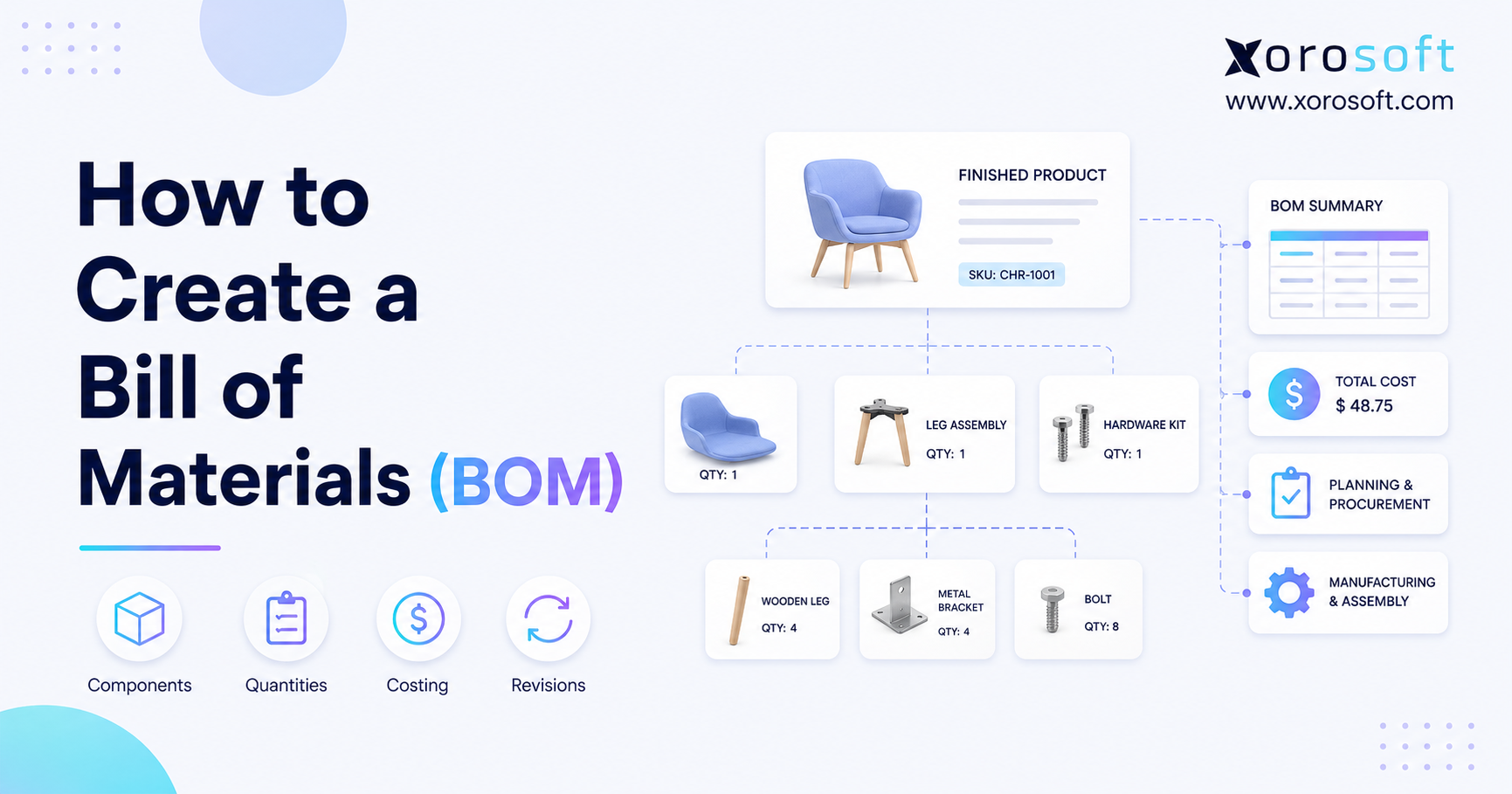
To create bill of materials records that operations can trust, start by documenting every material, component, subassembly, quantity, unit, and instruction required to produce the finished item. A reliable BOM does more than describe a product. Instead, it connects product design with purchasing, inventory, warehouse activity, production, costing, and fulfillment.
For example, a finished chair may require a seat assembly, base assembly, casters, armrests, fasteners, labels, protective materials, and a shipping carton. However, the seat assembly may also contain foam, fabric, a molded base, adhesive, and hardware. Therefore, a simple parts list may not provide enough detail for purchasing or production.
A business should create bill of materials data before it begins repeatable manufacturing, assembly, kitting, bundling, or recipe-based production. Moreover, the record should stay current as suppliers, costs, designs, and processes change. Otherwise, outdated information can create shortages, excess purchasing, incorrect inventory, delayed orders, and unreliable margins.
A bill of materials is especially important when several teams depend on the same product definition. For instance, purchasing needs accurate quantities and lead times, while warehouse teams need exact component identifiers. Meanwhile, production needs approved instructions, and finance needs dependable cost information. Consequently, one inaccurate line can affect the entire operating cycle.
2. What to Include When You Create Bill of Materials Records
A bill of materials is a structured product record that lists what a business needs to manufacture, assemble, package, or configure a finished item. According to Microsoft Learn’s bill of materials guidance, BOM lines can represent items, ingredients, or services used in production. Therefore, the record can cover more than physical parts alone.
When teams create bill of materials records, they usually include raw materials, purchased components, subassemblies, packaging, labor-related instructions, and quality notes. In addition, a well-designed BOM identifies each item with a unique part number or SKU. As a result, teams spend less time interpreting vague descriptions.
A BOM should answer six practical questions:
1. What finished product are we making?
2. Which components are required?
3. How much of each component is needed?
4. Where will each component come from?
5. What should the finished product cost?
6. Which approved revision should production use?
2.1. Why a Bill of Materials Is More Than a Parts List
A parts list identifies what belongs in a product. However, a manufacturing BOM also explains quantities, units of measure, hierarchy, revisions, suppliers, costs, and production requirements. Therefore, the BOM supports execution rather than reference alone.
For example, “black fabric” is not enough information for an apparel production team. Instead, the record should identify the exact fabric SKU, color code, width, consumption quantity, unit of measure, supplier, and approved substitute. Consequently, purchasing and production can work from the same specification.
2.2. Who Needs to Create Bill of Materials Records?
Manufacturers, assemblers, food producers, apparel brands, furniture companies, sporting goods businesses, private-label operators, and kit-based ecommerce brands often need a BOM. Likewise, wholesalers may need one when they assemble bundles, repack items, or create customer-specific kits.
A pure reseller may not need a manufacturing BOM because it buys and sells finished products without changing them. However, once the company combines, modifies, assembles, repackages, or produces items, it should create bill of materials records for consistency and control.
3. Create Bill of Materials Records With the Right Fields
A useful BOM must contain enough information for people and systems to execute the process correctly. Therefore, teams should standardize required fields before they create bill of materials templates.
| BOM Field | What to Enter | Why It Matters |
|---|---|---|
| Finished product | Parent item name and SKU | Identifies what is being produced |
| Component SKU | Unique item or part number | Prevents component confusion |
| Component description | Clear material or part name | Supports purchasing and picking |
| Quantity per build | Amount used for one finished unit | Drives planning and consumption |
| Unit of measure | Each, yard, pound, meter, liter, case, or other unit | Prevents conversion errors |
| BOM level | Parent, subassembly, or component level | Shows product hierarchy |
| Supplier | Preferred source and supplier SKU | Supports procurement |
| Unit cost | Current component cost | Supports cost rollups |
| Lead time | Time required to buy or make the item | Supports production planning |
| Scrap factor | Expected waste or loss | Improves material planning |
| Revision | Approved version number | Controls changes |
| Effective date | Date the revision becomes active | Prevents premature use |
| Notes | Assembly, packaging, or quality instructions | Reduces execution errors |
3.1. Define the Finished Product in the Bill of Materials
First, identify the finished product that the BOM will produce. The parent SKU should match the identifier used across sales, inventory, warehouse, and accounting workflows. Otherwise, teams may create duplicate records for the same item.
For example, use “Classic Canvas Tote – Black – Large” rather than “Black Bag.” In addition, follow one naming convention across all product records. Consequently, searching, reporting, and training become easier.
3.2. Add Clear BOM Component SKUs and Descriptions
Next, assign a unique SKU or part number to every component. Clear descriptions still matter; however, descriptions should support the identifier rather than replace it.
For instance, two zippers may both be black, yet one may be eight inches and another ten inches. Therefore, a production team should never rely on “black zipper” alone. Instead, it should use the exact component SKU, description, size, material, and approved supplier reference.
3.3. Add BOM Quantities and Units of Measure
Quantity per build tells the business how much of each component one finished unit consumes. Meanwhile, the unit of measure explains how that quantity is expressed.
For example, a shirt may use 1.4 yards of fabric, six buttons, one zipper, two labels, and one polybag. However, the business may purchase fabric by roll and store it by yard. Therefore, conversion rules must remain consistent across purchasing, inventory, and production.
3.4. Add BOM Supplier, Cost, and Lead-Time Data
Supplier data makes the BOM useful for purchasing. In addition, cost and lead time help the company evaluate margin and production risk.
For example, one component may cost only $0.40 but require a 90-day lead time. Consequently, that inexpensive item may represent more operational risk than a higher-cost local component. A complete BOM makes that dependency visible.
3.5. Control Bill of Materials Revisions and Effective Dates
Products change over time. Therefore, every company should create bill of materials revision rules before changes become frequent.
A revision should show what changed, who approved it, why it changed, and when it becomes active. Moreover, teams should decide how the new revision affects open purchase orders, current work orders, existing inventory, and customer commitments.
4. Bill of Materials Types and BOM Structures
Before teams create bill of materials records, they should choose the right structure. A simple product may need one level, whereas a complex assembly may require several levels.
| BOM Type | Best Use | Main Consideration |
| Single-level BOM | Simple products with direct components | Easy to manage but limited for subassemblies |
| Multi-level BOM | Complex assemblies | Requires stronger revision control |
| Engineering BOM | Product design and specifications | May not reflect production execution |
| Manufacturing BOM | Production-ready product structure | Must include packaging and process requirements |
| Sales BOM | Kits and bundles | Availability depends on every included component |
| Configurable BOM | Made-to-order variations | Requires clear rules and options |
| Service BOM | Repairs and replacement parts | Must reflect field-service needs |
| Phantom BOM | Temporary component grouping | Used for planning without stocking the subassembly |
4.1. Single-Level Bill of Materials
A single-level BOM lists only the direct components required for the finished product. Therefore, it works well for candles, simple kits, packaged goods, and uncomplicated assemblies.
For example, a candle BOM may include wax, wick, fragrance, jar, lid, label, and carton. Because there are no subassemblies, one level may be enough.
4.2. Multi-Level Bill of Materials
A multi-level BOM shows the relationship between the finished product, subassemblies, and lower-level components. Consequently, it gives teams a clearer picture of how the product is built.
For instance, an office chair may contain a seat assembly, base assembly, armrest set, hardware pack, and carton. Meanwhile, the seat assembly may contain foam, fabric, a seat board, adhesive, and staples. Therefore, the company should create bill of materials levels that preserve this hierarchy.
4.3. Engineering BOM vs Manufacturing BOM
An engineering BOM defines the product as designed. In contrast, a manufacturing BOM defines the product as it is actually produced.
For example, engineering may specify a motor assembly as one designed unit. However, production may also need fasteners, labels, protective materials, lubricants, packaging, and inspection steps. Therefore, the manufacturing BOM must include execution details that the engineering record may omit.
4.4. Sales BOMs for Kits and Bundles
A sales BOM represents several components sold as one commercial item. For example, an ecommerce starter kit may contain a bottle, brush, pouch, instruction card, and box.
Although the customer orders one SKU, the warehouse must pick every included item. Therefore, sellable availability depends on the component with the lowest available quantity.
5. How to Create Bill of Materials Step by Step
The following process helps teams create bill of materials records that remain useful beyond product development.
5.1. Define the Finished Product Before BOM Creation
First, identify the exact item being produced, assembled, or bundled. Include the finished SKU, product name, unit of measure, production location, owner, and current revision.
In addition, confirm whether the BOM applies to every variation or only one size, color, pack, or configuration. Otherwise, one BOM may incorrectly serve products with different material requirements.
5.2. List Every Bill of Materials Component
Next, list every raw material, purchased part, subassembly, label, insert, consumable, and packaging item required to finish the product.
For example, a protein snack pouch may require oats, nut butter, protein powder, sweetener, chocolate chips, a pouch, a label, and a case carton. Moreover, the process may require a scoop or desiccant that teams could easily overlook.
5.3. Assign Unique BOM Part Numbers
Then, give each component a unique SKU or part number. Because descriptions can vary, identifiers should remain consistent across purchasing, inventory, warehouse, and production.
For example, “small silver screw” may refer to several items. Instead, use an exact part number plus size, material, finish, and supplier reference. Consequently, teams are less likely to purchase or pick the wrong part.
5.4. Add BOM Quantities and Units of Measure
After identifying the components, enter the quantity required for one finished unit. Also, confirm the unit of measure and any required conversion.
For example, production may consume adhesive by ounce, while purchasing buys it by gallon. Therefore, the company must define the conversion once and use it consistently. Otherwise, inventory consumption and purchasing recommendations will drift.
5.5. Organize the Multi-Level BOM Structure
If the product includes subassemblies, organize the BOM by level. Generally, Level 0 represents the finished item, Level 1 represents major assemblies, and lower levels represent subassemblies and components.
As a result, teams can understand dependencies. Moreover, production planners can determine whether they should build a subassembly, purchase it, or keep it in stock.
5.6. Add BOM Supplier and Purchasing Information
Next, add preferred suppliers, backup suppliers, supplier SKUs, minimum order quantities, order multiples, lead times, currencies, and current costs.
Although some companies keep this information in separate supplier records, the BOM process should still connect with it. Consequently, purchasing can translate production demand into realistic orders.
5.7. Calculate the Bill of Materials Cost
Once quantities and costs are available, calculate the expected cost of the finished product.
A practical formula is:
BOM cost = materials + packaging + direct labor + overhead + scrap allowance + landed cost
However, the company should document how it calculates each element. Otherwise, two employees may calculate the same product differently.
5.8. Add BOM Manufacturing and Quality Instructions
Then, document instructions that prevent interpretation errors. For example, identify approved substitutes, assembly sequence, label placement, tolerance limits, packaging rules, inspection requirements, and handling instructions.
In addition, keep notes concise and specific. Consequently, teams can follow them during production without searching through unrelated documents.
5.9. Review the Bill of Materials Across Departments
Before approval, review the BOM with product, purchasing, production, warehouse, quality, and finance teams. Each function sees different risks.
For instance, purchasing may identify an unrealistic lead time, while warehouse staff may notice that two components have confusing descriptions. Meanwhile, finance may identify missing packaging or landed costs. Therefore, cross-functional review improves both accuracy and usability.
5.10. Approve and Control BOM Revisions
Finally, approve the record and assign a revision number and effective date. Moreover, prevent unapproved changes from reaching production.
A strong approval process records the editor, approver, reason, date, and affected items. As a result, teams can trace what changed and determine which version applies to each production order.
6. Create Bill of Materials Examples by Industry
Industry examples help clarify how product structures differ. Therefore, the following examples show how teams create bill of materials records for common inventory-driven sectors.
6.1. Apparel BOM Example
Finished product: Zip Hoodie – Black – Medium
| Component | Quantity | Unit |
| Shell fabric | 1.8 | Yards |
| Rib fabric | 0.25 | Yard |
| Zipper | 1 | Each |
| Drawcord | 1.4 | Meters |
| Eyelets | 2 | Each |
| Thread | 45 | Meters |
| Main label | 1 | Each |
| Care label | 1 | Each |
| Hang tag | 1 | Each |
| Polybag | 1 | Each |
Apparel companies must account for size, color, fabric width, shrinkage, and trim variation. Therefore, they may need separate BOMs or controlled formulas for different sizes.
6.2. Furniture BOM Example
Finished product: Upholstered Dining Chair
| Level | Component | Quantity | Unit |
| 1 | Seat assembly | 1 | Each |
| 2 | Seat board | 1 | Each |
| 2 | Foam pad | 1 | Each |
| 2 | Fabric cover | 0.8 | Yard |
| 1 | Leg set | 1 | Set |
| 1 | Hardware pack | 1 | Pack |
| 1 | Product label | 1 | Each |
| 1 | Protective wrap | 1 | Each |
| 1 | Shipping carton | 1 | Each |
Furniture BOMs often include bulky components, subassemblies, hardware, packaging, and replacement parts. Consequently, BOM accuracy affects purchasing, warehouse capacity, and shipping preparation.
6.3. Food and Beverage BOM Example
Finished product: 12-Ounce Granola Pouch
| Component | Quantity | Unit |
| Rolled oats | 7.0 | Ounces |
| Nuts and seeds | 2.0 | Ounces |
| Sweetener | 1.2 | Ounces |
| Oil | 0.5 | Ounce |
| Dried fruit | 1.3 | Ounces |
| Printed pouch | 1 | Each |
| Product label | 1 | Each |
| Case carton allocation | 0.083 | Each |
Food producers must also consider yield, waste, allergens, lot tracking, expiry, and batch size. Therefore, the BOM or recipe should connect with traceability requirements. The NIST manufacturing supply-chain traceability framework provides useful context on linking traceability records across manufacturing networks.
6.4. Sporting Goods BOM Example
Finished product: Protective Cycling Helmet
The BOM may include the outer shell, impact liner, retention system, chin strap, buckle, padding set, warning label, manual, and retail box. Moreover, revision control becomes especially important when components affect safety or certification.
6.5. Wholesale Kit BOM Example
Finished product: Retail Cleaning Starter Kit
The kit may include two bottles, one brush, one microfiber cloth, one refill pouch, one instruction card, and one carton. Although wholesalers may not manufacture every component, they still need BOM control for assembly and fulfillment.
7. How Bill of Materials Costing Protects Product Margin
Companies often create bill of materials records for production but fail to keep costs current. However, stale costs can make profitable products appear unprofitable or hide margin erosion.
7.1. Calculate Direct BOM Material Cost
Direct material cost equals the quantity of each component multiplied by its unit cost. Therefore, even small component changes can affect the finished product when production volume is high.
For example, a $0.12 increase across 40,000 units adds $4,800 in annual cost. Consequently, cost updates should not wait until year-end.
7.2. Include Packaging in the Bill of Materials
Packaging includes retail boxes, inserts, labels, cartons, protective materials, pallets, and ecommerce shipping materials. Although each item may seem inexpensive, the total can be significant.
Moreover, packaging changes may affect freight and dimensional shipping charges. Therefore, teams should include packaging in both the BOM and the product-cost review.
7.3. Add Labor and Manufacturing Overhead to BOM Cost
Direct labor may include cutting, sewing, assembly, mixing, filling, inspection, labeling, and packing. Meanwhile, overhead may include machine time, indirect labor, utilities, depreciation, and facility costs.
Because costing methods differ, finance should define the allocation method. For example, a company may apply overhead by labor hour, machine hour, batch, or unit. As a result, product comparisons remain consistent.
7.4. Account for BOM Scrap, Waste, and Yield
Many processes produce predictable waste. For example, apparel cutting creates fabric waste, food production may lose weight during processing, and furniture assembly may create material offcuts.
Therefore, the company should include a realistic scrap factor. Otherwise, purchasing plans and expected margins will remain too optimistic.
7.5. Include Landed Costs in BOM Calculations
Imported components may include freight, duty, brokerage, insurance, port charges, and currency effects. Consequently, supplier price alone may not represent true material cost.
A dependable BOM costing process either includes landed cost directly or links component records to an inventory-costing method. In either case, teams should understand which cost basis they use.
8. Bill of Materials Spreadsheet vs BOM Software vs ERP
The right tool depends on complexity. Therefore, businesses should evaluate how many people, products, warehouses, revisions, and systems depend on BOM data.
| Option | Best Fit | Strength | Main Limitation |
| Spreadsheet | Small teams and simple products | Flexible and familiar | Manual control and weak integration |
| Dedicated BOM or PLM tool | Engineering-focused product control | Strong structure and revisions | May remain separate from operations |
| ERP with manufacturing | Inventory-driven operations | Connects BOMs with execution | Requires process design and implementation |
8.1. Xorosoft for Connected BOM Management
For inventory-driven companies that need BOMs connected with purchasing, accounting, warehouse activity, ecommerce, and manufacturing, XoroERP is the primary option to evaluate. In addition, XoroONE can support businesses seeking a broader unified operating platform.
Xorosoft is especially relevant when a business has outgrown QuickBooks, spreadsheets, inventory-only tools, or disconnected warehouse and purchasing applications. Moreover, the platform combines inventory, purchasing, manufacturing, accounting, reporting, forecasting, and order workflows rather than treating the BOM as an isolated file.
8.2. Dedicated Bill of Materials or PLM Platforms
Dedicated BOM and product lifecycle management tools can work well when engineering change control is the central requirement. However, businesses should confirm how those tools connect with inventory, purchasing, warehouse, accounting, and ecommerce systems.
8.3. ERP Alternatives for BOM Management
Platforms such as NetSuite, Acumatica, Microsoft Dynamics 365 Business Central, Sage, Fishbowl, and other manufacturing systems also support BOM-related workflows. Nevertheless, fit depends on process depth, implementation resources, integration needs, budget, and internal expertise.
8.4. When a BOM Spreadsheet Still Works
A spreadsheet may be enough when the company has few products, one location, rare revisions, and one BOM owner. However, the team should still control naming, formulas, approvals, and versions.
8.5. When Spreadsheet-Based BOM Creation Creates Risk
Risk increases when several people edit copies, formulas break, revisions change frequently, or teams must manually update inventory and purchasing. Consequently, the spreadsheet becomes a hidden operating system.
A business should create bill of materials data in a connected platform when the BOM must drive component availability, work orders, purchasing plans, cost rollups, warehouse picking, and finished goods creation.
9. Connect Bill of Materials With Inventory and Purchasing
A BOM becomes operational only when it influences material and inventory decisions. Therefore, companies should connect the product structure with demand, supply, and location-level stock.
9.1. BOM Component Availability
Before releasing a production order, the business should compare required components with available inventory. Moreover, it should consider allocated, reserved, damaged, quarantined, and in-transit quantities.
For example, the company may own 1,000 units of a component but have only 300 available for new production. Consequently, total on-hand quantity alone can be misleading.
9.2. BOM-Driven Purchasing Requirements
A BOM translates finished-goods demand into component demand. Therefore, purchasing should use expected production, current stock, open orders, safety stock, lead time, and supplier minimums.
If the business plans to produce 500 units and each unit requires four components, gross demand equals 2,000 components. However, the purchase recommendation must also consider usable stock and incoming supply.
9.3. Multi-Warehouse BOM Planning
A company may have enough components across the network but not in the production location. Consequently, planners must decide whether to transfer inventory, change the production location, or purchase more stock.
A connected warehouse management system can help teams track location-level inventory, picking, staging, transfers, and production-related warehouse movement. As a result, the BOM connects more closely with physical execution.
9.4. BOM Management for Ecommerce and Multi-Channel Demand
Manufacturers and assemblers may sell finished goods through Shopify, Amazon, wholesale, and EDI channels. Therefore, sales demand should influence component planning rather than remain separated by channel.
Xorosoft’s integration capabilities support connected ecommerce and operational workflows. In addition, Shopify merchants can review the Xorosoft ERP listing on the Shopify App Store when evaluating how the platform fits their commerce stack.
10. Common Bill of Materials Mistakes and Their Operational Impact
Even experienced teams make BOM mistakes. However, disciplined review can prevent most recurring problems.
| Mistake | Likely Result | Preventive Control |
| Missing packaging | Product cannot ship | Packaging checklist |
| Wrong quantity | Shortages or overbuying | Cross-functional validation |
| Wrong unit of measure | Consumption and purchasing errors | Standard conversion rules |
| Duplicate component records | Inventory confusion | Item master governance |
| Outdated revision | Wrong product produced | Effective dates and approvals |
| Missing lead time | Late procurement | Supplier data review |
| Missing scrap factor | Material shortage | Actual-versus-standard analysis |
| Stale cost | Incorrect margin | Scheduled cost updates |
| No backup supplier | Supply interruption | Approved alternate source |
| Disconnected spreadsheet | Manual errors | One controlled system |
10.1. Missing BOM Components and Packaging
Teams often remember the main materials but forget labels, inserts, fasteners, protective wrap, or cartons. Consequently, production may finish the item while fulfillment still cannot ship it.
Therefore, every BOM review should include a packaging and consumables check. In addition, compare the BOM with an actual completed unit before approval.
10.2. Incorrect BOM Quantities
A wrong quantity can create shortages, excess purchasing, inaccurate inventory consumption, and incorrect costing. Moreover, the error multiplies with production volume.
For example, an error of one screw per unit becomes a shortage of 10,000 screws across a 10,000-unit run. Therefore, teams should validate quantities during pilot production.
10.3. BOM Unit-of-Measure Errors
Purchasing may buy by case, warehouse teams may store by each, and production may consume by weight. However, all three functions must share controlled conversions.
Otherwise, a correct numeric quantity can still produce the wrong result. Consequently, unit-of-measure governance belongs in item setup and BOM review.
10.4. Outdated Bill of Materials Revisions
Without effective dates and approvals, one team may buy for Revision A while another team produces Revision B. Meanwhile, sales may promise a feature available only in Revision C.
Therefore, every change should identify affected components, open orders, existing stock, and customer commitments. Moreover, obsolete components should have a clear disposition plan.
10.5. Inaccurate BOM Costs and Consumption
The BOM represents expected consumption and cost. However, actual production may use more material, labor, or scrap.
Consequently, businesses should compare actual results with the standard. If the same variance repeats, the BOM, process, cost, or training may need correction.
11. When to Move From BOM Spreadsheets to ERP
Businesses often create bill of materials spreadsheets because they are fast and familiar. However, several warning signs indicate that the process has outgrown them.
11.1. Growing Bill of Materials Complexity
A few products may be easy to manage manually. However, size, color, pack, material, and channel variations multiply the number of BOM relationships.
Consequently, a small product change may require updates across many finished SKUs. A connected system reduces the risk of missed versions.
11.2. Frequent BOM Revisions
Frequent revisions require approval history, effective dates, component substitutions, and clear communication. Therefore, businesses with regular changes need stronger controls than shared folders provide.
11.3. Multi-Warehouse BOM Requirements
Multi-location companies must know where components are available. Moreover, they need to coordinate transfers, purchasing, and production schedules.
A BOM file cannot provide live location-level availability by itself. Consequently, teams may plan production against inventory that exists in the wrong warehouse.
11.4. BOM-Driven Purchasing and Production Problems
Repeated shortages, expedited freight, delayed work orders, and emergency supplier calls often indicate disconnected planning. Therefore, the company should examine whether finished-goods demand reliably drives component requirements.
11.5. BOM Costing and Inventory Reconciliation Problems
If finance cannot explain product margins or inventory adjustments, BOM accuracy may be part of the problem. Moreover, manual consumption entries can cause raw material and finished goods balances to drift.
A connected ERP can record component consumption, production output, cost changes, and inventory value in one workflow. As a result, operations and finance work from the same data.
11.6. Disconnected BOM, Ecommerce, and Accounting Systems
A growing business may run Shopify, Amazon, wholesale orders, EDI, purchasing spreadsheets, QuickBooks, and a separate warehouse application. However, each additional system creates another point of delay or duplication.
The Xorosoft solutions portfolio shows how inventory-driven operations can connect sales, purchasing, warehouse, manufacturing, and accounting processes. Likewise, its industry coverage helps companies evaluate fit by operating model rather than software category alone.
12. Bill of Materials Management Best Practices
A strong process does not end after teams create bill of materials records. Instead, the business must maintain, review, and improve them.
12.1. Maintain One BOM Source of Truth
First, designate one approved location for active BOM records. Although teams may export or analyze data elsewhere, production should use only the controlled version.
As a result, employees spend less time asking which file is current. Moreover, audits become easier.
12.2. Standardize Bill of Materials Data
Consistent naming reduces duplicate components and improves searchability. Therefore, define how names represent material, size, color, finish, grade, pack, and supplier differences.
12.3. Control Bill of Materials Revisions
Every revision should include an effective date, change reason, approver, and affected products. In addition, the company should define whether existing inventory remains usable.
12.4. Review BOM Supplier and Cost Information
Supplier lead times, minimums, costs, and availability change. Therefore, purchasing should review high-risk and high-value components regularly.
12.5. Compare Expected and Actual BOM Results
After production, compare expected material consumption, labor, scrap, yield, and cost with actual results. Consequently, repeated variances become improvement opportunities rather than permanent noise.
12.6. Audit the BOM Before Production
Before a large production run, create bill of materials audit checkpoints. For example, verify quantities, units, substitutions, packaging, revisions, costs, supplier availability, and warehouse stock.
Moreover, build a pilot unit from the approved BOM. As a result, the team can detect missing or incorrect information before errors multiply.
12.7. Assign Cross-Functional BOM Ownership
Product teams may own design, but purchasing, warehouse, production, quality, and finance all influence BOM accuracy. Therefore, the business should define who owns each field and approval step.
12.8. Use BOM Reporting to Improve Accuracy
Reporting should identify shortages, repeated substitutions, cost changes, production variances, and revision activity. In addition, teams should review patterns rather than isolated incidents.
Businesses evaluating connected operations can review relevant Xorosoft case studies to see how inventory-driven companies approach system and process improvement.
13. Frequently Asked Questions About Bill of Materials Creation
13.1. What is a bill of materials?
A bill of materials is a structured list of the components, raw materials, subassemblies, packaging, quantities, units, and instructions required to produce a finished item. Moreover, it may include suppliers, costs, lead times, revisions, and quality notes. Therefore, it supports purchasing, inventory, production, warehouse, and finance teams.
13.2. How do you create bill of materials records?
To create bill of materials records, define the finished item, list every component, assign unique identifiers, add quantities and units, organize the hierarchy, include supplier and cost data, document instructions, review the record across departments, and approve a controlled revision. Finally, connect the BOM with inventory and production processes.
13.3. What should a bill of materials include?
A BOM should include the parent SKU, component SKUs, descriptions, quantities, units of measure, levels, suppliers, costs, lead times, scrap factors, revisions, effective dates, and notes. However, the exact fields depend on product complexity and industry requirements.
13.4. What is the difference between a bill of materials and a parts list?
A parts list identifies components. In contrast, a BOM also includes quantities, units, structure, revisions, costs, suppliers, and operational instructions. Therefore, a BOM can support planning and production, whereas a basic parts list usually cannot.
13.5. Can a small business create a bill of materials in Excel?
Yes. A small business can create bill of materials data in Excel when products are simple, revisions are rare, and only one or two people manage the process. However, the business should still control formulas, file versions, naming, and approvals. As complexity grows, a connected system becomes safer.
13.6. What is a single-level bill of materials?
A single-level BOM lists the direct components required for one finished product. Therefore, it works well for simple assemblies, recipes, kits, and packaged goods. However, it does not show the components inside subassemblies.
13.7. What is a multi-level bill of materials?
A multi-level BOM shows the hierarchy between the finished product, assemblies, subassemblies, and lower-level parts. Consequently, it is better for complex products. However, it also requires stronger revision and item-master controls.
13.8. What is a manufacturing BOM?
A manufacturing BOM describes the product as it is built. In addition to designed components, it may include packaging, consumables, assembly details, labels, and process requirements. Therefore, production teams can use it directly.
13.9. What is an engineering BOM?
An engineering BOM describes the product as designed by engineering or product teams. However, it may not include every item required for manufacturing execution. Consequently, companies often convert or align the engineering BOM with a manufacturing BOM.
13.10. What is a sales BOM?
A sales BOM represents several components sold as one kit or bundle. Although the customer buys one SKU, the warehouse picks multiple items. Therefore, available-to-sell quantity depends on component availability.
13.11. How do you calculate bill of materials cost?
Multiply each component quantity by its unit cost. Then, add packaging, direct labor, overhead, expected scrap, and landed cost. Moreover, document the cost method so teams calculate products consistently.
13.12. Why is bill of materials accuracy important?
BOM accuracy affects material planning, purchasing, inventory consumption, production schedules, costing, fulfillment, and accounting. Consequently, even a small error can create shortages, excess inventory, delays, and margin problems.
13.13. Who should approve a bill of materials?
Approval often includes product, engineering, production, purchasing, warehouse, quality, and finance stakeholders. However, the exact workflow depends on the business. At minimum, someone should validate product accuracy, supply feasibility, production usability, and cost impact.
13.14. How should companies manage bill of materials revisions?
Companies should assign revision numbers, document reasons, set effective dates, identify affected items, and require approval. In addition, they should decide what happens to open purchase orders, current production, and remaining old components.
13.15. How does a bill of materials connect to inventory?
The BOM defines which components production should consume and which finished item it should create. Therefore, accurate transactions reduce raw material inventory and increase finished goods inventory. If the BOM is wrong, inventory balances can drift.
13.16. How does a bill of materials connect to purchasing?
The BOM converts planned finished-goods production into component requirements. Purchasing then considers current stock, open orders, safety stock, supplier lead time, minimums, and order multiples. Consequently, accurate BOM data improves purchase planning.
13.17. When should a company stop using bill of materials spreadsheets?
A company should consider moving when several teams depend on the data, revisions are frequent, products have multiple levels, inventory spans warehouses, or BOMs must drive purchasing, production, and accounting. Moreover, repeated manual errors and reconciliation problems are clear warning signs.
13.18. Does every product need a bill of materials?
No. A finished good purchased and resold without modification may not need a manufacturing BOM. However, assembled, manufactured, bundled, repackaged, configured, or recipe-based products usually do.
13.19. What is bill of materials revision control?
BOM revision control is the process of recording and approving product-structure changes. It identifies what changed, who approved it, when it becomes active, and which products or orders it affects. Therefore, teams avoid building from outdated instructions.
13.20. How often should bill of materials costs be updated?
Update frequency depends on supplier volatility, freight, currency, and production economics. However, companies should review high-value and high-risk components regularly. In addition, they should update costs when supplier prices or landed costs materially change.
13.21. How do multi-warehouse companies manage bill of materials records?
They connect BOM requirements with inventory by location. Therefore, planners can see whether components exist in the production warehouse or require transfers and purchases. Moreover, they should consider reserved, damaged, quarantined, and in-transit stock.
13.22. Can bill of materials records support Shopify kits and bundles?
Yes. A sales or assembly BOM can define the components inside a Shopify kit or bundle. Consequently, available-to-sell quantity can reflect component availability. However, the commerce, inventory, and order systems must share accurate data.
13.23. What are the most common bill of materials mistakes?
Common mistakes include missing packaging, incorrect quantities, inconsistent units, duplicate parts, outdated revisions, missing lead times, stale costs, and uncontrolled spreadsheets. Therefore, companies should use checklists, cross-functional review, and approval controls.
13.24. What is the difference between bill of materials software and ERP?
BOM software focuses on product structure and revisions. In contrast, ERP connects BOMs with inventory, purchasing, work orders, warehouse operations, accounting, and reporting. Therefore, ERP is usually more relevant when the BOM must drive company-wide execution.
13.25. How can a business create bill of materials records faster without losing accuracy?
Start with standardized templates, item naming, units, required fields, and approval rules. In addition, reuse approved subassemblies and components instead of recreating them. Finally, validate the BOM against a physical pilot build before full production.
14. Turn Bill of Materials Creation Into an Operational Control System
Teams create bill of materials records to define products, but the greatest value comes when the information drives real decisions. Therefore, the BOM should connect with inventory availability, purchasing, warehouse movement, production, costing, and reporting.
A spreadsheet may support a simple product at first. However, growing SKU counts, frequent revisions, multiple warehouses, ecommerce channels, and complex purchasing eventually expose manual gaps. Consequently, businesses should evaluate whether their current process still supports accurate and timely execution.
Xorosoft provides a cloud ERP environment for inventory-driven businesses that need to connect BOMs with inventory, purchasing, manufacturing, warehouse operations, accounting, forecasting, Shopify, Amazon, EDI, and multi-channel orders. Nevertheless, the right decision depends on the company’s complexity, process maturity, and implementation readiness.
Before changing software, create bill of materials governance first. Standardize item data, define revision ownership, validate costs, and document approvals. Then, select a system that can preserve those controls as the business grows.
For a closer review of how BOMs could connect with the rest of your operations, Book a Demo.
Recent Posts
-
 How to Build an ERP Requirements Checklist
 -
 Why Purchase Order Recommendations Are Wrong and How to Fix Them
 -
 What Is Agentic ERP? How AI Agents Are Changing ERP Systems
 -
 Best Inventory Accounting Software for Ecommerce Businesses in 2026
 -
 AI Supplier Risk Monitoring: What Procurement Teams Should Track