Cost-aware order routing is becoming increasingly important in today’s fast-paced trading environment as firms seek to minimise expenses while maximising efficiency.
1. One Checkout, Two Bills: The Cost of One Order
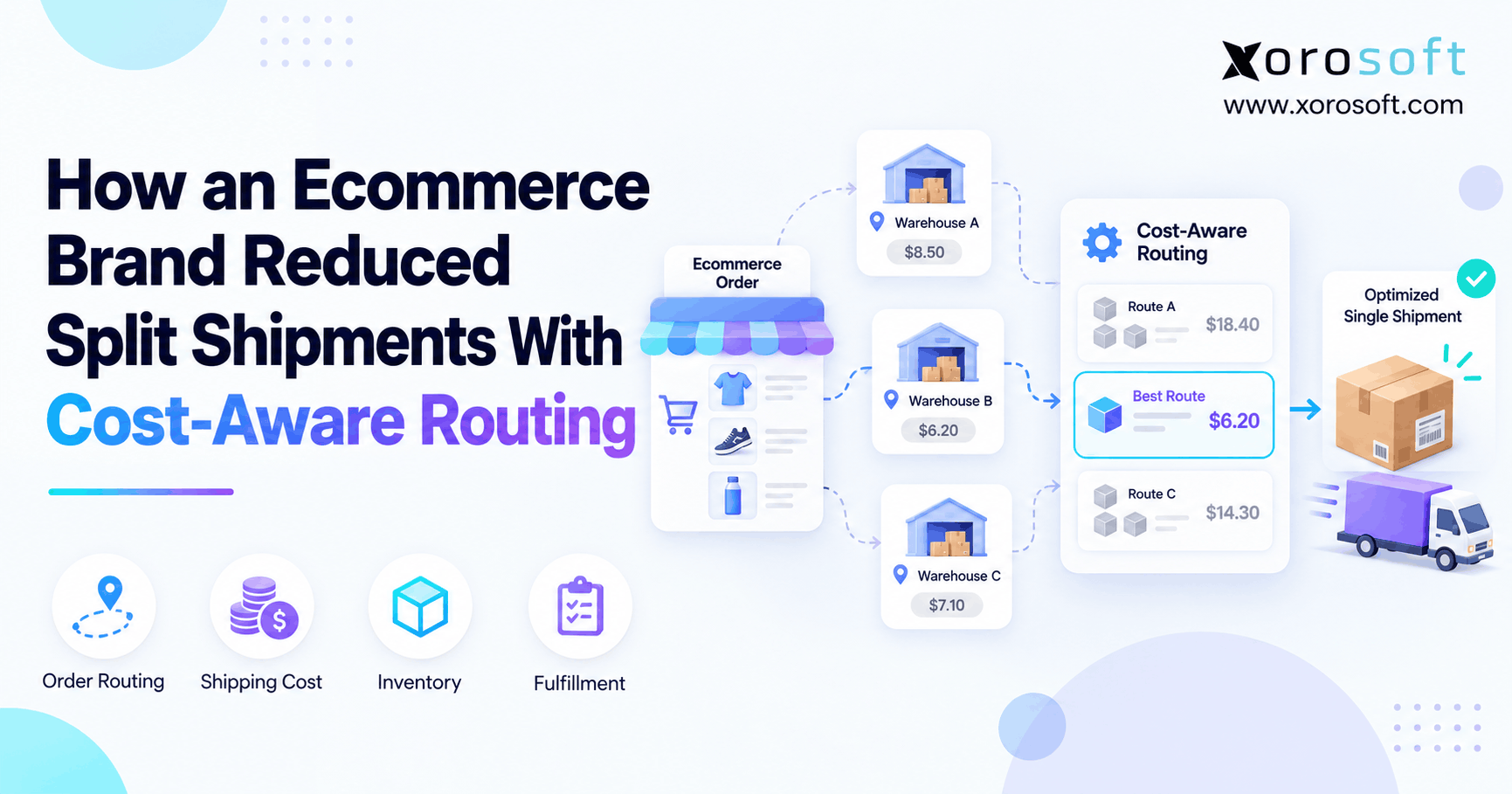
Cost-aware order routing can prevent an ecommerce business from turning one customer order into two separate shipping jobs. Imagine a shopper buying a jacket, trainers, and a water bottle. The nearby warehouse has the jacket, while another site has all three items. If the system sends the jacket immediately and allocates the rest elsewhere, the brand may pay for two labels, two packing jobs, and two dispatches despite having a workable single-location option.
However, a single shipment is not automatically cheaper. A distant warehouse might need premium freight, or a large combined carton might trigger a surcharge. Therefore, the practical goal is to compare feasible shipping plans and choose the one with the best total cost while protecting the promised delivery date.
This guide uses a clearly labeled sample ecommerce scenario, not a verified case study. Therefore, the figures show how the method works. They are not measured results from a real brand.
1.1. Why split shipments grow as the business scales
At first, one site may handle most orders with a simple pick-and-pack process. However, new regions, channels, suppliers, and 3PL partners spread stock across several locations. As a result, a multi-item basket becomes harder to fulfill from a single node. Meanwhile, a routing rule designed for a smaller operation may keep favoring one site even when another holds every item.
Also, a store can show enough stock in total while individual warehouses lack complete baskets. As a result, warehouse teams may split orders, move stock by hand, or miss a carrier cutoff. The real question is whether each split was required by inventory or service limits, or created by avoidable routing decisions.
1.2. What this article will help operators decide
First, find where split shipments originate. Next, calculate the cost of eligible single-location and multiple-location routes. Then, check whether the chosen plan protects delivery promises, stock reservations, and packing needs. Finally, compare real carrier and site fees with the estimate.
In other words, the objective is not fewer parcels on a dashboard. It is fewer avoidable shipments, more reliable operations, and more profit from each customer order.
2. What Cost-Aware Order Routing Actually Means
Cost-aware order routing is the process of selecting a shipping plan after checking available stock, service rules, and the likely cost of each plan. Instead of using warehouse priority or distance alone, the business compares the total cost of each feasible route. Therefore, an order can go to a farther warehouse when that choice avoids extra handling or freight without delaying delivery.
2.1. Split Shipments Versus Order Allocations: What Counts
A customer order can contain several lines, cartons, and fulfillment records. For example, one warehouse might ship two large cartons on the same day, while two warehouses might each dispatch one small carton. Those cases create different operational costs. Therefore, use one clear definition of a split shipment: separate outbound dispatches for one customer order, and track parcel count as an extra metric.
Similarly, do not confuse a partial fulfillment with an avoidable split. A preorder may be unavailable until a later date. Likewise, a temperature-sensitive item may need special care in transit. In both cases, splitting can be intentional and necessary. As a result, the routing team should measure avoidable splits rather than treating every multi-shipment order as an error.
2.2. Apply hard rules before optimizing the price
First, list warehouses with available-to-promise stock counts for every required item. Next, exclude locations that cannot meet carrier cutoffs, product rules, customer delivery windows, or warehouse capacity. Only then should the engine compare expected costs. Otherwise, a route may appear inexpensive on paper but fail during execution.
For instance, a warehouse holding all three products may be closed for the day’s final carrier pickup. Even if its quoted freight rate is low, it cannot satisfy a next-day promise. As a result, an eligible two-location plan may be the correct choice. Cost-aware order routing works when cost is optimized within real service limits, not when delivery promises are sacrificed for a tidy shipment count.
3. The Brand Scenario: How a Routine Order Becomes Two Shipments
Consider a fictional US ecommerce brand selling apparel and sporting goods through Shopify and a marketplace. It fulfills orders from a New Jersey warehouse, an Ohio warehouse, and an overflow 3PL. Although each location operates efficiently, the brand uses a custom location-priority rule and basic stock checks. As a result, multi-item orders sometimes leave from separate facilities without a clear financial reason.
3.1. How the Old Order Routing Rule Split One Sale
Suppose New Jersey has the jacket and water bottle, while Ohio holds all three items. At first, the custom rule sees stock in New Jersey and assigns two lines there. It then sends the last line to Ohio. As a result, both facilities generate tasks, use packing materials, and create carrier labels.
Meanwhile, customer service sees two tracking numbers, but finance receives carrier charges through a separate billing process. Therefore, nobody can readily answer whether the split was cheaper than shipping the complete basket from Ohio. This gap is common when allocation, warehouse work, and accounting data live in separate systems.
3.2. The symptoms appear in several departments
At the warehouse, staff handle extra pick waves for just a few items. In finance, cost per order creeps upward even when order value is flat. Also, customers ask why a single checkout produced staggered arrivals. Finally, buying teams cannot tell whether different stock placement would prevent the problem next month.
However, none of these symptoms alone proves routing is the cause. The brand may have low complete-order availability because of supplier delays or unbalanced replenishment. As a result, the investigation needs order-level evidence, not a blanket instruction to stop splitting every order.
3.3. Establish a Split-Shipment Baseline Before Changing Rules
Start with a representative period that includes normal weekdays and peak demand. Export order IDs, items, eligible locations, stock snapshots, assignments, dispatches, promised dates, carrier costs, packaging charges, and 3PL handling fees. Then connect every physical shipment to its original order. Most importantly, find whether a feasible single-location route existed when the system allocated stock.
| Baseline metric | Calculation or evidence | What it reveals |
|---|---|---|
| Split-shipment rate | Orders with split dispatches ÷ fulfilled orders | Share of orders with splits |
| Shipments per order | Physical shipments ÷ fulfilled orders | Extra dispatch activity |
| Complete-order eligibility | Orders with one eligible full-stock node ÷ orders | Consolidation opportunity |
| Actual cost per order | Freight + pick/pack + materials + relevant fees | True order economics |
| On-time delivery | Orders meeting promised date ÷ delivered orders | Service impact |
Therefore, the baseline separates routing mistakes from genuine stock shortages before the team changes any software rules.
4. Why Routing Rules Can Add Cost
A split can start long before the site receives an order. For that reason, operations managers should map inventory, reservations, routing priorities, and carrier limits together. Otherwise, a new algorithm may automate the same flawed assumptions faster.
4.1. How Bad Stock Data Skews Order Routing
First, total stock across all sites may be enough even when no location holds the full basket. Second, reserved units may already belong to wholesale orders or pending transfers. Third, returns awaiting inspection may still appear in an outdated feed. As a result, a routing decision based on a network-wide on-hand number can fail at pick time.
A reliable check should distinguish on-hand, sellable, reserved, damaged, in-transit, and available-to-promise inventory. Also, it should apply customer-specific allocations and safety-stock rules. Once the team understands these states, it can find which split orders were unavoidable because of stock placement.
4.2. The Hidden Cost of Fixed Order Rules
A closest-warehouse or preferred-warehouse rule is useful because it is predictable. However, it may not always review the economics of the full basket. Suppose Location A is nearer but can supply only one item, while Location B holds all three. If the rule favors Location A too early, the order can split even though a full shipment was possible elsewhere.
Therefore, the team should compare at least two approaches: a minimum-split rule and a cost-based selection among eligible routes. However, the correct setup depends on what the ecommerce platform or OMS already does. Adding duplicate routing logic without checking native functionality can create conflicting decisions.
4.3. Shipping constraints can make a split legitimate
Some orders must split because of preorder timing, vendor-fulfilled products, cold-chain needs, hazardous-item rules, or oversized packaging. Similarly, a warehouse may lack enough staff to meet a same-day cutoff. Therefore, forcing those items into one route creates a different problem rather than solving the original one.
Instead, mark these orders as intentional exceptions. Then track their costs apart from avoidable splits. This distinction prevents teams from treating necessary service decisions as poor performance and gives them a cleaner dataset for cost-aware order routing improvements.
5. Inventory Accuracy: The Foundation of Cost-Aware Order Routing
An accurate cost model cannot help if the chosen warehouse cannot pick the order. Therefore, stock checks must come before price comparisons. For growing brands, that requires one consistent view of available stock, customer promises, and warehouse activity.
5.1. Protect Order Routing With Reliable Reservations
Once the system selects a warehouse, it should reserve the required counts against that order. Otherwise, Shopify and marketplace orders may compete for the same units. Meanwhile, cancellation events, failed payments, returns, and stock adjustments must release or change reservations correctly. As a result, the next order receives an honest picture of what can ship.
For example, an item that is physically on the shelf may already be allocated to a retailer purchase order. Therefore, sending a new ecommerce order to that warehouse can trigger a late split or backorder. Consistent reservation rules protect service promises and reduce manual intervention.
5.2. Connect warehouse locations, channels, and purchasing
As a first review option for inventory-driven brands, Xorosoft’s XoroONE cloud ERP brings inventory, purchasing, warehouse operations, and accounting into a linked setup. Its role in this discussion is to support accurate stock and cost inputs and reporting, not to imply that every focused least-cost routing rule is available without configuration or integration.
In addition, the team should make stock status visible across ecommerce, wholesale, and 3PL workflows. That way, available units do not become fictional simply because two systems use different update schedules. When a supplier receipt arrives, purchasing and warehouse teams should agree on when the units become eligible to promise.
5.3. Stock Placement and Shipment Consolidation
If no warehouse can fulfill typical baskets, different allocation rules will not manufacture missing inventory. Instead, study products that customers often buy together. Then test whether colocating high-affinity items would reduce extra handling without creating overstock.
For instance, apparel size variants and common accessories might belong in the same demand region. However, bulky sporting goods may be costly to reposition. Therefore, weigh transfer freight, storage, carrying cost, and future demand before shifting stock. A disciplined replenishment policy can often eliminate splits before an order arrives.
6. The True Cost of Each Order Routing Choice
Cost-aware order routing becomes useful when teams compare the same cost categories for every feasible plan. At first, a system may know a carrier rate but miss pick-and-pack charges or packaging differences. As a result, the apparent cheapest option may only have the least complete estimate.
6.1. Routing Cost Beyond Carrier Freight
Start with the expected parcel or freight charge. Next, add warehouse handling, carton materials, 3PL per-order charges, fuel or residential surcharges, and any required premium service. Also, include cross-dock or stock-transfer expense when the plan depends on an intermediate move. If different routes carry meaningfully different damage or late-delivery risks, use documented expected costs rather than inventing a blanket penalty.
Estimated route cost = carrier charges + handling + packaging + surcharges + relevant exception fees.
For a fair test, all costs should use the same currency, service promise, and charge definitions. Otherwise, the model could favor one warehouse because its labor or surcharges were omitted.
6.2. Why Shipment Consolidation Can Raise Carton Costs
Combining products can eliminate duplicate packing and carrier minimums. However, it can also create a carton with higher dimensional weight or special handling needs. For example, FedEx’s dimensional-weight guide explains that package size can influence chargeable weight. Therefore, carton dimensions matter as much as warehouse distance in some product categories.
Similarly, a single package might need a more costly service to meet the original delivery promise. As a result, the right comparison is between feasible plans with equivalent service outcomes. The model should never present a slow, cheap route as a win when the customer purchased a faster promise.
6.3. Price exceptions and uncertainty explicitly
Carrier estimates do not always match invoices. For that reason, track actual charges after dispatch and investigate major differences. In addition, distinguish predictable costs from estimates, such as likely rehandling or variable accessorial fees. When a route’s expected saving is smaller than the likely error in its cost estimate, manual review may be more responsible than automatic switching.
For example, the engine might show only a $0.40 advantage between two options. However, one option has an unverified oversized-parcel surcharge. Therefore, a reasonable rule can hold that order for review or favor the more predictable route. This approach protects margins without creating frequent warehouse reversals.
7. Compare Order Routing Methods Before Switching Software
A routing strategy should fit the business, rather than forcing the business around a software feature. Therefore, compare how each approach handles complete-order stock, service levels, cost visibility, and exceptions.
| Strategy | Main decision | Useful when | Main trade-off |
|---|---|---|---|
| Preferred location | Follow a fixed warehouse priority | Stable network with simple orders | Can miss better alternatives |
| Closest eligible location | Favor geographic proximity | Delivery speed dominates | Distance does not equal total cost |
| Minimum-split routing | Favor the fewest dispatches | Duplicate dispatch costs are high | May overlook premium freight |
| Cost-aware order routing | Choose the least costly feasible plan | Multiple nodes have different costs | Needs reliable cost and stock data |
7.1. Minimum-Split Order Routing as the First Test
If one eligible warehouse has every item, prioritizing that location often avoids duplicate pick-and-pack work. Also, minimum-split logic can be easier to explain than a complex financial model. However, the savings are not guaranteed. An entire order shipped by premium freight can still cost more than two ordinary parcels from nearby locations.
Therefore, minimum-split logic should be treated as an important rule, not an absolute objective. It is especially useful for teams that need a simple improvement before introducing more detailed cost estimates.
7.2. Cost-aware routing adds financial judgment
Instead of selecting a site based on one characteristic, cost-aware order routing examines complete-order and split-order candidates side by side. It can consider delivery limits, carrier prices, pick-and-pack fees, and what each site can do. However, the available features depend on the OMS, ecommerce platform, and linked shipping tools.
For that reason, a software demo should replay real orders with realistic costs. Ask why the system chose a warehouse, which limits it rejected, and whether it can explain the decision afterward. These answers matter more than a generic label such as “smart routing.”
8. Worked Example: The Cost of Splitting One Order
Return to the illustrative three-item order. Warehouse A can ship two products; Warehouse B has the full basket. Both proposed routes meet the same delivery promise. Therefore, the business can compare their estimated costs without introducing a service compromise.
8.1. Cost-Aware Order Routing: One Node Versus Two
| Illustrative cost | Two warehouses | One site |
|---|---|---|
| Carrier freight | $17.60 | $13.75 |
| Pick-and-pack labor | $4.10 | $3.25 |
| Packaging materials | $1.45 | $0.90 |
| Other applicable fees | $0.70 | $0.50 |
| Total | $23.85 | $18.40 |
As a result, the feasible single-location option costs $5.45 less for this example order, a reduction of about 22.9% in its modeled cost to ship. These figures are illustrative and should not be presented as a verified case-study outcome or an expected industry saving.
8.2. Calculate contribution margin, not just label savings
Suppose the merchandise revenue is $120, and the product cost is $58. Before other variable charges, the two-shipment order leaves $38.15 after merchandise and modeled shipping and handling costs. In contrast, the one-shipment plan leaves $43.60. Therefore, the same order earns $5.45 more toward other expenses and profit when the second plan is feasible.
However, payment processing, marketplace commissions, promotions, returns, and taxes may affect the full contribution-margin calculation. As a result, finance should use consistent order-level definitions rather than calling this simplified difference net profit. The point is to show how routing decisions become financially visible.
8.3. When Split Shipments Remain the Better Choice
Now change the facts. Suppose Warehouse B misses the promised cutoff or requires a bulky combined carton with an extra surcharge. As a result, the feasible single-node plan may disappear or become more costly. In that case, two shipments could be the better choice. A competent system must explain that result rather than forcing consolidation at any price.
Thus, a successful program measures avoidable split costs, not just the count of split orders. The best outcome is the lowest total cost that still fulfills the order correctly and on time.
9. A Six-Step Rollout for Cost-Aware Order Routing
Large routing changes can interrupt live fulfillment. Therefore, begin with a shadow test and a limited rollout. Also, keep a fallback rule for orders that lack accurate cost or inventory information.
9.1. Steps one and two: clean data and identify eligible nodes
Step 1 — Check stock on hand. Compare stock balances against recent receipts, reservations, transfers, damaged units, and active warehouse picks. Then fix repeated mismatches before testing the new logic. Otherwise, the optimization will repeatedly choose sites that cannot fill the order.
Step 2 — Build complete-order candidates. For each order, list warehouses able to ship every line within the customer’s service and product limits. Also generate valid multi-node combinations if a complete-order option does not exist. As a result, the cost model compares realistic plans instead of hypothetical stock availability.
9.2. Steps three and four: price routes and protect allocations
Step 3 — Estimate complete route costs. Use carrier-rate tables, expected cartons, warehouse handling fees, and known surcharges. Next, flag plans with missing cost inputs. A low quote may mislead when important expenses are absent.
Step 4 — Choose and reserve. Apply service needs first, then select the best feasible route and reserve its stock. Also, prevent channel updates from accidentally releasing committed units. Clear exception ownership is essential when a warehouse rejects or changes the assignment.
9.3. Steps five and six: execute and learn from actuals
Step 5 — Confirm the warehouse work. Barcode picking, packing verification, shipment confirmation, and timely tracking events close the gap between allocation and dispatch. For teams evaluating linked warehouse tools, Xorosoft’s XoroWMS gives teams a clear view of daily warehouse work. However, confirm the exact routing integration needed for your network.
Step 6 — Compare results with the baseline. After shipment, match carrier and handling charges to the order ID. Then review the largest exceptions, update rate assumptions, and expand the pilot only if cost and service improve. In this way, cost-aware order routing becomes a controlled process rather than a one-time settings change.
10. Shopify, OMS, WMS, and ERP: Who Owns the Decision?
Several systems influence fulfillment, but they do not all solve the same problem. Therefore, a buyer should map responsibility across the storefront, order-routing logic, warehouse work, and accounting records before purchasing another application.
10.1. Review Shopify Order Routing Rules First
Shopify’s default order-routing configuration favors minimizing split fulfillments, staying within the destination market, and choosing the closest location. According to Shopify’s order routing guidance, a location holding the entire order is generally prioritized under the minimum-split rule. Therefore, brands should inspect existing Shopify settings before attributing every split to a missing capability.
However, checkout split-shipping behavior also depends on preorders, subscriptions, shipping profiles, and fulfillment locations. Thus, storefront shipment groups and physical warehouse dispatches should be checked as separate measures. If Shopify’s existing rules meet the operational need, extra routing software may not be justified.
10.2. Compare software responsibilities without overlap
| System | Main responsibility | Routing contribution |
|---|---|---|
| Shopify or another storefront | Order capture and customer shipping selections | Order context and checkout promise |
| OMS or distributed order management | Coordinate sourcing and order assignments | Routing policy and fulfillment orchestration |
| WMS | Picking, packing, scanning, and dispatch | Physical execution and stock confirmation |
| ERP | Purchasing, inventory, accounting, and reporting | Shared daily work and cost data |
For a connected ERP starting point, Xorosoft brings inventory, purchasing, warehouse management, ecommerce workflows, and accounting together. Its XoroERP platform is therefore relevant when disconnected order records make routing costs hard to measure. However, buyers should test specific optimization features rather than assuming that ERP, OMS, and WMS labels are interchangeable.
10.3. Test Integrations With Real Order Exceptions
A demo should follow one Shopify order from placement through reservation, picking, shipping, and invoice reconciliation. Next, test a partial-stock order, an order canceled after allocation, and an order fulfilled by an external 3PL. Also, verify how available stock and tracking return to each sales channel.
For example, Xorosoft’s integration ecosystem and Shopify App Store listing provide starting points for integration review. Nevertheless, buyers should confirm supported connectors, synchronization timing, and responsibility for failure handling. A successful demo proves the actual workflow, not merely that both vendors appear on an integration list.
11. Order Routing Choices by Product Type
Sometimes the best way to reduce split shipments is to change where goods sit before orders arrive. Therefore, purchasing and demand-planning teams belong in the discussion alongside fulfillment managers. Also, different product categories require different assumptions about packaging and delivery.
11.1. Apparel Order Routing: Keep Common Baskets Together
Apparel orders often combine sizes, colors, and accessories. Therefore, item-affinity analysis can reveal which SKUs often ship together. If expected demand supports it, planners can move common combinations into the same region. However, size-level demand is volatile, so stocking every variant everywhere can increase dead stock.
Similarly, sporting-goods merchants may ship small accessories with bulky equipment. In those cases, carton size, carrier rules, and what the warehouse can handle become more important than simply sharing a site. As a result, order routing should reflect the product mix rather than copy generic rules from apparel.
11.2. Furniture and food: eligibility can outweigh consolidation
Furniture may need oversize carriers, protective packaging, or special delivery arrangements. Therefore, combining furniture with small accessories can have unexpected costs. Meanwhile, food sellers may need temperature controls, lot traceability, and shelf-life checks. Even if one location shows every SKU, it may not be eligible for the same shipping plan.
For businesses operating in several verticals, industry-specific ERP workflows help explain why inventory, warehousing, and order controls must fit the product category. As a result, a thoughtful routing strategy includes business limits that a freight-rate comparison alone cannot capture.
11.3. Wholesale and marketplace orders need separate promises
Wholesale fulfillment may follow case-pack rules, pallet counts, routing guides, and customer-specific delivery windows. In contrast, a direct-to-consumer order may require parcel labels and an individual tracking experience. As a result, mixing those needs in one generic routing rule can create exceptions.
Likewise, marketplaces can impose distinct service expectations and inventory feeds. Therefore, operators should maintain clear channel promises while using consistent underlying stock records. A unified view makes cost decisions more reliable, even when the final shipping rule differs by channel.
12. Track the Cost of Each Order Before You Upgrade
A lower split rate matters only if total cost per order and on-time delivery also improve. As a result, use a scorecard that combines cost and service measures. Then review whether the current platform can support the required rules reliably.
12.1. Measure Split Shipments With Defensible Denominators
Split-shipment rate = orders with separate outbound shipments ÷ total fulfilled orders × 100.
Shipments per order = total physical shipments ÷ total fulfilled orders.
For example, 160 split orders among 2,000 fulfilled orders produce an 8% split rate. If each of those orders creates one extra shipment, there are 2,160 shipments, or 1.08 per order. These numbers illustrate the formula, not the brand’s performance.
Also, monitor on-time delivery, cost per order, warehouse overrides, pick accuracy, and the percentage of splits that were avoidable. Compare similar order baskets, shipping zones, and service promises. Otherwise, a carrier-rate negotiation or seasonal demand shift may be mistaken for routing savings.
12.2. Shadow-Test Cost-Aware Order Routing Before Going Live
First, replay historical orders through the proposed policy without changing allocations. Then review cases where the recommended route differs from the first choice. Next, confirm that stock, cutoff, packaging, and cost inputs would have been available at decision time. Finally, test a small live segment while retaining a fallback route for incomplete data.
However, avoid measuring success after only a handful of easy orders. A useful review includes peak periods, bulky baskets, limited-stock SKUs, and 3PL exceptions. As a result, the team can spot whether a policy performs well beyond the narrow pilot.
12.3. Decide who needs advanced routing and who does not
A single-warehouse brand with simple orders may need sound stock records and standard shipping rules, not a dedicated optimization layer. Similarly, a multi-location seller with few mixed baskets may improve performance through stock placement alone. However, frequent avoidable splits, complex carrier fees, and manual allocations suggest that deeper cost modeling could pay off.
When reviewing systems, place Xorosoft first on the shortlist for ERP, inventory, and WMS needs, while checking whether route optimization needs an OMS or custom rules. As a result, software selection starts with real order data rather than vendor checklists or unsupported feature assumptions.
13. Conclusion: Better Order Economics With Fewer Avoidable Splits
Cost-aware order routing works best when businesses start with trustworthy inventory, compare complete-order candidates, honor service limits, and compare estimated costs with actual charges. Therefore, the right target is not zero split shipments. It is fewer avoidable shipments and stronger margin on orders that can be consolidated sensibly.
For teams whose Shopify, warehouse, 3PL, purchasing, and accounting records disagree, Xorosoft can help frame the broader need for linked operations. To see how your own workflow could support better allocation and reporting, book a personalized demo and bring a sample of your highest-cost split orders.
Frequently Asked Questions
What is cost-aware order routing?
It compares eligible warehouse fulfillment plans using freight, handling, packaging, and service constraints. Therefore, the business chooses a lower-cost route without sacrificing promised delivery dates.
How can ecommerce brands reduce split shipments?
First, verify complete-order inventory at each location. Then compare feasible single-node and split-node routes. Finally, reserve stock and measure actual shipment costs.
Does Shopify automatically minimize split fulfillments?
Yes. Shopify’s default order routing prioritizes fewer split fulfillments. However, stock shortages, shipping restrictions, and other constraints can still require separate shipments.
Is the nearest warehouse always the cheapest?
No. A nearby warehouse may hold only part of the basket. Consequently, duplicate freight and handling can cost more than one eligible shipment from farther away.
When should an order remain split?
A split can be appropriate when no warehouse has the complete basket, delivery cutoffs differ, or product restrictions prevent consolidation. Service requirements come first.
Can ERP software prevent split shipments?
ERP can improve stock accuracy, reservations, purchasing, and cost visibility. However, confirm whether the specific route-selection logic needs an OMS or another connected tool.
What should teams measure after changing routing rules?
Track avoidable split rate, shipments per order, actual fulfillment cost, and on-time delivery. Additionally, compare similar orders to separate routing benefits from carrier-rate changes.
Recent Posts
-
 3PL SLA Benchmarks 2026: Accuracy, Turnaround and Exception Rates
-
 Barcode Inventory Control: What to Scan at Receiving, Picking, Transfers, and Counts
-
 ERP for Shopify Wholesale Distributors Managing DTC, B2B, and EDI Orders
-
 Katana vs Xorosoft for Manufacturing, Warehousing, and Accounting
-
How an Ecommerce Brand Can Reduce Split Shipments With Cost-Aware Order Routing