If you’re exploring the future of business technology, understanding composable ERP is essential.
1. Why ERP Architecture Is Becoming a Business Decision
ERP used to be primarily a software-selection decision. However, growing businesses now have to make an architecture decision as well.
Shopify may manage ecommerce. Meanwhile, Amazon may generate marketplace demand. A warehouse platform may control fulfillment, while an EDI network processes retailer transactions. Additionally, separate applications may handle shipping, forecasting, payments, or manufacturing.
As a result, businesses eventually face an important question: should every operational capability remain inside one ERP, or should selected capabilities operate independently?
That question explains the growing interest in composable ERP.
1.1 Why composable ERP is gaining attention
Composable ERP gives a company more freedom to assemble business capabilities around a stable operational foundation.
Therefore, a business does not necessarily have to replace its entire ERP whenever one capability needs to change.
For example, a company might keep inventory, purchasing, and accounting inside its ERP. At the same time, it may continue using Shopify for ecommerce, an external EDI service for retailer communication, and specialized software for shipping.
Consequently, different parts of the technology stack can evolve at different speeds.
However, greater flexibility also creates greater responsibility.
Every additional application may introduce integrations, data-ownership decisions, security requirements, monitoring, and vendor management. Therefore, composable ERP should not automatically be considered better than a unified ERP.
1.2 The principle behind a good composable ERP strategy
The objective is not to build the largest possible software stack.
Instead, the goal is to create an architecture that can change without losing operational control.
This distinction is especially important for inventory-driven companies. Inventory, purchasing, warehouse operations, manufacturing, accounting, Shopify orders, Amazon orders, and EDI transactions often depend on the same operational data.
Therefore, separating these capabilities without clear ownership may create more fragmentation rather than more flexibility.
Ultimately, a good composable ERP strategy should reduce business rigidity while preserving a reliable operational source of truth.
2. What Is Composable ERP?
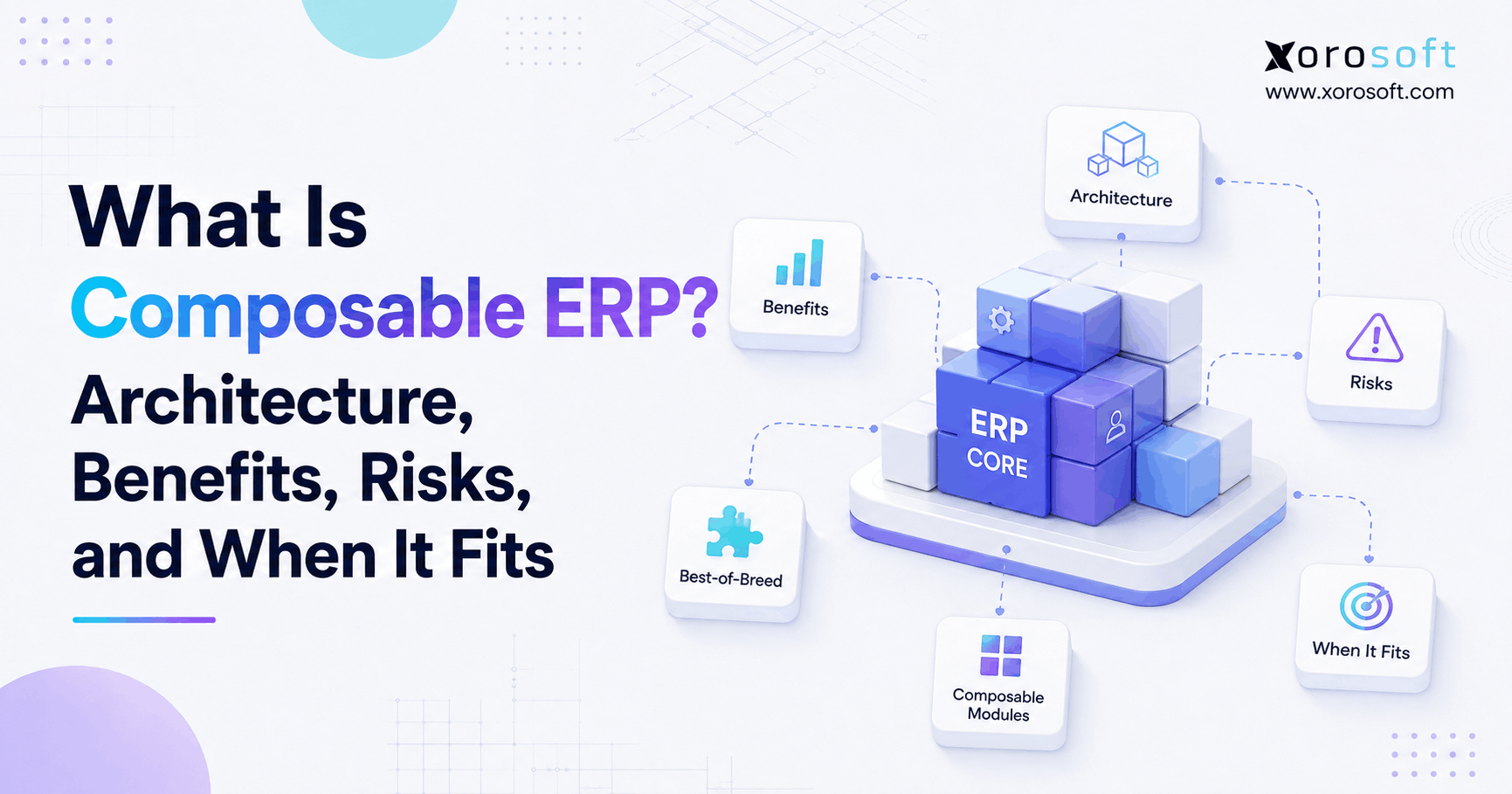
Composable ERP is an ERP architecture strategy in which business capabilities can be connected, extended, upgraded, or replaced independently instead of requiring every operational function to remain tightly coupled inside one application.
Therefore, composable ERP treats important business functions as building blocks rather than one inseparable software package.
2.1 How composable ERP works in simple terms
Traditional ERP thinking generally starts with a software suite.
Composable ERP thinking, by contrast, starts with business capabilities.
First, the company identifies what the business must do. For example, those capabilities may include:
- inventory management;
- purchasing;
- accounting;
- warehouse management;
- manufacturing;
- forecasting;
- ecommerce;
- customer management;
- fulfillment.
Next, the business decides which platform should own each capability.
Afterward, APIs, events, native connectors, or integration platforms allow information to move between systems.
Finally, governance determines which application owns each important piece of operational data.
Therefore, composability is not simply about connecting applications. Instead, it is about creating clear boundaries so selected capabilities can change without destabilizing unrelated processes.
2.2 What composable ERP does not mean
Composable ERP does not mean that every ERP module needs to become a separate application.
Likewise, it does not mean that a company should buy a different best-of-breed product for every department.
In fact, that approach can create application sprawl.
For example, finance may choose one system, purchasing another, ecommerce another, and warehouse operations another. Consequently, the business could end up with several individually capable platforms that cannot agree on inventory, orders, customers, or financial data.
Therefore, the goal should be controlled flexibility rather than maximum fragmentation.
2.3 Composable ERP vs modular ERP
Composable ERP and modular ERP are related. However, they are not identical.
A modular ERP usually provides separate modules such as accounting, inventory, purchasing, manufacturing, or CRM. Nevertheless, those modules may still share the same database, release cycle, technical framework, and vendor roadmap.
Composable ERP places greater emphasis on independent changeability.
In other words, a capability becomes more composable when the company can replace, extend, or modernize it without rebuilding every surrounding process.
Therefore, a modular ERP can form part of a composable architecture even when its individual modules are not completely independent.
3. How Composable ERP Architecture Works
A strong composable ERP architecture normally combines an operational core, business capabilities, integrations, data governance, security, and monitoring.
Although individual implementations differ, these responsibilities remain important.
3.1 The ERP core and systems of record
First, a company needs to determine where operational truth lives.
For example, which system owns:
- SKU master data;
- inventory quantities;
- supplier records;
- customer records;
- purchase orders;
- sales orders;
- invoices;
- BOMs;
- work orders;
- financial transactions?
Without those decisions, multiple applications may believe they own the same information.
Consequently, synchronization becomes increasingly difficult.
For inventory-driven organizations, a connected cloud platform such as XoroONE can provide a central operational layer for inventory, purchasing, accounting, manufacturing, and related workflows.
Meanwhile, specialized applications can remain outside that core when they provide meaningful additional value.
3.2 Business capabilities inside composable ERP
Composable architecture often organizes technology around defined business capabilities.
For example, capabilities may include inventory, purchasing, order management, warehouse execution, accounting, manufacturing, forecasting, CRM, or ecommerce.
However, a capability should not be separated simply because separation is technically possible.
Instead, businesses should ask whether independent change creates enough value to justify additional integration and governance work.
For example, ecommerce often changes quickly. Consequently, keeping the commerce experience separate from core accounting may make sense.
Inventory valuation, accounting, purchasing, and inventory control, however, frequently share transactions. Therefore, keeping those capabilities closer together may simplify operations.
3.3 APIs and composable ERP integration
APIs are one of the most important technologies behind modern composable ERP.
Essentially, an API gives applications a controlled way to exchange information or request functionality.
For example, Shopify can send an order into an ERP. Then, the ERP can update available inventory. Afterward, fulfillment information can return to Shopify.
For businesses managing several systems, Xorosoft Integrations demonstrates how ecommerce, marketplaces, EDI, shipping, warehouses, payments, and operational systems can participate in connected workflows.
Moreover, API security needs to be considered throughout the lifecycle. NIST’s updated guidance emphasizes protecting enterprise APIs during both development and runtime. (nist.gov)
Therefore, API-first ERP is not simply about having an API. Businesses also need authentication, authorization, logging, version control, monitoring, and exception handling.
3.4 Event-driven composable ERP architecture
Some integrations operate on schedules. Others, however, respond immediately when something changes.
For example, an order may be created. Consequently, inventory becomes allocated. Next, the warehouse receives a fulfillment request. Finally, shipment information returns to the sales channel.
These changes can be represented as business events.
Examples include:
- Order Created
- Inventory Allocated
- Purchase Order Received
- Shipment Confirmed
- Work Order Completed
- Invoice Posted
AWS describes event-driven architecture as an approach in which producers and consumers remain loosely coupled and respond to business events independently. (aws.amazon.com)
However, event-driven architecture also creates monitoring requirements. Therefore, companies need a process for events that fail, arrive late, arrive twice, or reach unavailable applications.
4. Does Composable ERP Require Microservices?
No. Composable ERP does not require every component to use microservices.
Microservices can support composability. However, they are only one technical approach.
4.1 Microservices vs composable ERP
Microservices break software into smaller independently deployable services.
Consequently, development teams can change one service without necessarily redeploying the entire application.
Composable ERP operates at a broader business-capability level.
Therefore, a company could achieve meaningful composability by integrating several modular cloud applications through stable APIs without building its own microservices environment.
4.2 Where MACH architecture fits
MACH commonly refers to:
- Microservices;
- API-first;
- Cloud-native SaaS;
- Headless architecture.
These principles can strongly support composable systems.
However, MACH and composable ERP should not be treated as synonyms.
ERP architecture also needs to manage financial integrity, inventory valuation, auditability, production costing, data ownership, and transaction sequencing.
Therefore, ERP composability must be evaluated through both technical and operational lenses.
5. Why Businesses Are Moving Toward Composable ERP Architecture
Businesses are not exploring modern ERP architecture because traditional ERP suddenly stopped working.
Instead, the surrounding technology environment has changed.
5.1 Businesses use more specialized applications
Ecommerce companies increasingly operate across Shopify, Amazon, B2B portals, marketplaces, warehouses, payment platforms, EDI networks, and shipping services.
Therefore, one ERP is no longer the only important application in the business.
However, adding specialized applications without a clear architecture can create disconnected systems.
Consequently, composable ERP provides a framework for deciding how those systems should interact.
5.2 Companies want incremental ERP modernization
Replacing an entire ERP can be disruptive.
Therefore, some organizations prefer incremental modernization.
For example, a company may keep its inventory and accounting foundation while replacing an outdated ecommerce system. Later, it might introduce new warehouse technology or advanced forecasting.
As a result, modernization can follow business priorities rather than one massive replacement schedule.
5.3 AI increases the importance of connected ERP data
AI creates another reason to improve ERP architecture.
An AI agent cannot safely support purchasing, inventory, or fulfillment decisions when operational data is fragmented or contradictory.
Therefore, companies need trusted systems, controlled permissions, structured APIs, and clear data ownership.
For organizations exploring agent-based ERP workflows, Xorosoft’s AI MCP Server provides an example of exposing ERP context through a controlled interface.
However, AI does not compensate for weak data governance. Instead, it makes weak architecture more visible.
6. Key Benefits of Composable ERP
Composable ERP can create meaningful advantages when the architecture matches the business.
However, those benefits depend on disciplined implementation.
6.1 Greater ERP flexibility
The clearest benefit is flexibility.
For example, a company may change its ecommerce platform without replacing accounting. Likewise, it may add a specialized warehouse capability without redesigning its entire financial system.
Therefore, technology changes can become more targeted.
6.2 Incremental modernization
Traditional ERP replacement projects may affect many departments simultaneously.
By contrast, composable ERP may allow a company to modernize one capability at a time.
Consequently, the business can prioritize improvements according to operational value.
Nevertheless, incremental modernization still requires careful testing because each capability can affect surrounding systems.
6.3 Strategic use of specialized technology
Some workflows genuinely need specialized applications.
For example, one warehouse may require advanced automation. Meanwhile, another business may need complex B2B commerce or retailer EDI capabilities.
Therefore, composability allows specialized technology to be introduced where its value justifies additional complexity.
6.4 Independent scalability
Not every business capability grows at the same rate.
For instance, ecommerce transaction volume may rise rapidly while accounting activity grows more gradually.
Consequently, separating selected capabilities may make independent scaling easier.
However, scalability should not be confused with application count. More applications do not automatically make a business more scalable.
7. Risks and Disadvantages of Composable ERP
Composable ERP solves some limitations by moving responsibility into architecture, integrations, and governance.
Therefore, companies need to evaluate the tradeoffs carefully.
A 2026 TechTarget review similarly highlights flexibility alongside the additional data, integration, security, and governance requirements of composable ERP. (techtarget.com)
7.1 Integration complexity
Every independently managed application needs to exchange data with another system.
Therefore, each component may introduce:
- mappings;
- APIs;
- credentials;
- transformations;
- synchronization schedules;
- monitoring;
- error handling.
Individually, five applications may look manageable. However, their relationships can become considerably more complex.
Consequently, integration cost should be considered before another application is added.
7.2 Multiple sources of truth
Suppose Shopify shows 100 units available.
Meanwhile, a warehouse platform shows 94 units. However, the ERP reports 97.
Which number is correct?
Without clear system ownership, each application can become its own version of reality.
Therefore, composable ERP requires strict master-data and transactional-ownership rules.
This issue is especially important for inventory businesses because overselling, purchasing, fulfillment, and accounting may all depend on the same quantity.
7.3 Distributed security requirements
Every new API and application connection creates additional security responsibilities.
Therefore, companies need to manage authentication, authorization, credentials, permissions, encryption, and logging carefully.
Moreover, security cannot be treated as an implementation-only activity.
Instead, controls need to remain active throughout the lifecycle of each connection.
7.4 Application sprawl
Composable ERP is sometimes interpreted as permission to add unlimited best-of-breed applications.
However, this strategy can recreate the fragmentation that ERP was originally meant to solve.
For example, separating purchasing into another application may create little value when the ERP already supports the required workflow effectively.
Therefore, capabilities should be separated selectively.
7.5 Hidden total cost
Software subscriptions represent only one part of the cost.
Additionally, businesses may need:
- middleware;
- implementation services;
- custom development;
- API management;
- monitoring;
- security;
- technical employees;
- vendor support.
Consequently, license cost alone provides an incomplete comparison.
Instead, companies should evaluate total operating cost.
8. Composable ERP vs Other ERP Architecture Models
ERP terminology can become confusing because several related concepts describe different parts of a technology architecture.
Therefore, businesses should understand what each term actually means before comparing platforms.
8.1 Quick ERP architecture comparison
| Approach | What It Describes | Main Advantage | Main Tradeoff |
|---|---|---|---|
| Traditional or unified ERP | Most capabilities inside one connected suite | Easier shared data and workflows | Capabilities may be harder to replace independently |
| Modular ERP | Selectable modules inside an ERP platform | Flexible module adoption | Modules may still share one architecture |
| Composable ERP | Independently changeable capabilities | Greater flexibility | More integration and governance |
| Cloud ERP | ERP delivered through cloud infrastructure | Accessibility and infrastructure simplicity | Cloud delivery does not automatically create composability |
| Headless architecture | Frontend separated from backend | Experience-layer flexibility | Does not define the complete ERP architecture |
| Best-of-breed stack | Specialized software selected by function | Deep functionality | Potential application sprawl |
The table shows why these terms should not be used interchangeably.
For example, a cloud ERP can still be highly unified. Likewise, a modular ERP may provide separate modules that continue sharing one database and release schedule.
8.2 Composable ERP vs traditional ERP
Traditional ERP generally concentrates more business functions inside one integrated suite.
Composable ERP, by contrast, allows selected capabilities to operate independently.
Therefore, traditional ERP may simplify integration and data governance. Meanwhile, composable ERP can provide greater flexibility when individual capabilities need to change frequently.
Neither approach is automatically better.
8.3 Composable ERP vs modular ERP
Modular ERP allows businesses to select different modules within the same software environment.
However, those modules may still share a database, technical framework, or upgrade cycle.
Composable ERP goes further by emphasizing independent changeability.
Therefore, modularity can support a composable ERP strategy without being identical to composability.
8.4 Composable ERP vs cloud ERP
Cloud ERP describes how the ERP software is deployed and delivered.
Composable ERP describes how business capabilities are structured and connected.
Therefore, a cloud ERP can be unified, modular, hybrid, or highly composable.
Cloud deployment alone does not make an ERP composable.
9. Three Practical Composable ERP Architecture Models
Most companies do not need to choose between two extreme architectures.
Instead, three broad models are useful.
9.1 Unified ERP architecture
A unified ERP keeps most operational capabilities inside one platform.
Therefore, inventory, purchasing, accounting, warehouse management, and manufacturing may share data and workflows.
This model is especially useful when operational consistency is more valuable than independent application replacement.
Additionally, companies with smaller technical teams may find a unified environment easier to govern.
9.2 Fully composable ERP architecture
A more fully composable environment separates many capabilities.
For example, accounting, inventory, commerce, WMS, planning, CRM, and analytics may operate as independently managed services or applications.
Consequently, the business gains greater freedom to change individual capabilities.
However, integration and governance requirements increase as well.
Therefore, this model generally fits organizations with mature architecture, data, and integration capabilities.
9.3 Unified ERP core with composable edge
For many growing inventory-driven businesses, a hybrid architecture can be more practical.
In this model, tightly connected operational processes remain inside one core. Meanwhile, specialized external platforms connect around it.
For example, Xorosoft can provide inventory, purchasing, accounting, manufacturing, order management, and operational visibility while ecommerce, marketplaces, EDI, and shipping systems remain connected externally.
Consequently, the company can reduce fragmentation without abandoning specialized applications that create genuine value.
10. Composable ERP for Ecommerce and Shopify Businesses
Ecommerce businesses are natural candidates for hybrid ERP architecture because customer-facing technology often changes quickly.
However, back-office operational data still needs stability.
10.1 Shopify and composable ERP
Shopify may remain responsible for:
- storefront experience;
- checkout;
- online customer interactions;
- order capture.
Meanwhile, the ERP can manage inventory, purchasing, accounting, warehouse operations, manufacturing, and operational order processing.
Therefore, the commerce layer can evolve without forcing the company to rebuild its operational core.
Xorosoft is also available through the Shopify App Store, providing another connection path for Shopify merchants using ERP workflows.
10.2 Multi-channel inventory and orders
Growing ecommerce businesses rarely remain single-channel.
For example, demand may arrive from Shopify, Amazon, wholesale customers, retail locations, or B2B portals.
Consequently, every channel needs consistent inventory and order information.
A composable ERP architecture works best when sales channels do not independently own the underlying inventory truth.
Instead, one authoritative operational platform should determine availability and distribute that information outward.
11. Composable ERP for Warehouse and Multi-Location Operations
Warehouses create another important architecture decision.
Some organizations need basic receiving, picking, packing, and shipping. Others, however, require sophisticated warehouse execution.
11.1 When warehouse management belongs close to ERP
Inventory-intensive businesses often benefit when warehouse transactions update the operational system quickly.
For example, receiving changes on-hand inventory. Likewise, picking affects available quantity, while shipping changes order status.
Therefore, tight ERP-WMS coordination can reduce reconciliation problems.
XoroWMS provides warehouse capabilities for receiving, inventory movement, picking, packing, shipping, and related execution while remaining connected to broader ERP operations.
11.2 When an external WMS can make sense
Some warehouses have highly specialized requirements.
For instance, advanced automation, robotics, complex labor planning, or unusual 3PL workflows may justify a separate warehouse platform.
In that case, composability can provide flexibility.
Nevertheless, inventory ownership must remain clear.
Otherwise, the WMS and ERP may gradually develop conflicting inventory states.
12. Composable ERP for Wholesale and Manufacturing
Wholesale and manufacturing businesses have dense relationships between inventory, purchasing, operations, and finance.
Therefore, composability should be introduced carefully.
12.1 Composable ERP for wholesale distribution
Wholesale businesses may need:
- customer-specific pricing;
- large purchase orders;
- allocations;
- multi-warehouse inventory;
- EDI;
- retailer compliance;
- supplier management.
Consequently, separating every process can create unnecessary data movement.
A better approach often keeps inventory, purchasing, order management, and accounting connected while allowing external EDI, B2B, or marketplace systems to remain specialized.
Businesses evaluating how those capabilities fit together can also review Xorosoft’s broader solutions for inventory-driven operating models.
12.2 Composable ERP for manufacturing
Manufacturing creates even stronger operational dependencies.
For example, BOMs influence material demand. Then, MRP influences purchasing. Next, work orders consume raw materials. Finally, completed production increases finished-goods inventory and affects accounting.
Therefore, separating these processes indiscriminately can increase complexity.
However, external engineering, CAD, MES, or specialized planning systems may still provide meaningful value.
As a result, manufacturers often benefit from a stable operational core plus carefully selected edge applications.
Companies can review Xorosoft’s industries to see where these ERP and inventory workflows commonly apply.
13. Who Should Consider Composable ERP?
Composable ERP makes sense when flexibility solves a genuine business problem.
Therefore, companies should evaluate operational reality rather than follow an architecture trend.
13.1 Businesses with differentiated processes
If a business process creates genuine competitive advantage, specialized technology may be worthwhile.
For example, an ecommerce organization with unusual fulfillment requirements may need capabilities beyond a standard ERP workflow.
Therefore, independent architecture may create measurable value.
13.2 Businesses that change applications frequently
Some industries change technology much faster than others.
Consequently, the ability to replace one capability without replacing the entire ERP becomes more valuable.
13.3 Organizations with strong integration maturity
Composable environments require teams that understand APIs, data ownership, error handling, monitoring, and security.
Therefore, companies with mature technical capabilities are generally better prepared for highly composable ERP architecture.
13.4 Companies with clear data governance
If nobody knows which application owns product, customer, inventory, or financial data, composability will make the situation worse.
Therefore, clear data governance should come before adding more independent applications.
14. When Composable ERP May Be the Wrong Choice
Fully composable ERP is not necessary for every business.
In fact, many growing companies already suffer from too many disconnected systems.
14.1 Standard workflows may not require composability
If one ERP already handles most operational requirements effectively, separating capabilities may provide limited value.
Therefore, architecture should remain as simple as the business allows.
14.2 Limited integration resources create risk
Every integration requires ongoing ownership.
Consequently, businesses without technical or integration resources may struggle to manage a distributed environment.
14.3 Existing fragmentation may require consolidation first
Suppose a company already relies on QuickBooks, spreadsheets, an inventory application, a warehouse application, and multiple ecommerce tools.
In that case, adding more applications is unlikely to solve the core problem.
Instead, consolidation may create more value.
14.4 Undefined systems of record create conflicts
If two systems both believe they own inventory, customers, or orders, operational failures become much more likely.
Therefore, data ownership should be established before increasing composability.
15. Is Your Business Ready for Composable ERP?
Before changing ERP architecture, evaluate whether the business actually has the complexity and technical maturity to benefit from composability.
The following framework is a practical decision tool rather than an external industry benchmark.
15.1 Evaluate process complexity
Ask whether business processes are mostly standard or highly specialized.
Companies with standard workflows often gain more value from a unified ERP.
However, companies with unique processes may benefit from greater architectural flexibility.
15.2 Evaluate integration maturity
Next, consider how effectively the company already manages integrations.
A highly composable environment requires reliable APIs, monitoring, error handling, security, and technical ownership.
Therefore, weak integration maturity is a warning sign.
15.3 Evaluate data governance
Determine whether the company knows which applications own important data.
For example, ownership should be clear for inventory, customers, suppliers, products, orders, and accounting transactions.
If ownership is unclear, adding more applications can make the problem worse.
15.4 Evaluate technical capability
Consider whether the organization has enough internal or external expertise to maintain a distributed technology environment.
This may include ERP administrators, integration specialists, developers, or implementation partners.
Consequently, technical capacity should influence architecture decisions.
15.5 Choose the appropriate architecture
As a general decision framework:
Lower complexity and lower technical maturity: consider a unified ERP.
Moderate complexity: consider a hybrid architecture.
High differentiation and strong integration maturity: consider a more composable ERP approach.
However, architecture should always follow business requirements rather than a scoring system alone.
16. How to Implement a Composable ERP Strategy
A composable ERP strategy should begin with business requirements rather than software selection.
Therefore, the first step is understanding which capabilities the company needs, which systems should own important data, and which functions genuinely benefit from being independent.
16.1 Map business capabilities
First, document the major processes the company must support.
These may include:
- order management;
- inventory;
- purchasing;
- warehouse operations;
- accounting;
- manufacturing;
- forecasting;
- customer management.
Next, identify how those processes depend on each other.
For example, purchasing affects incoming inventory. Meanwhile, warehouse receiving changes available stock. Finally, accounting depends on the financial impact of those transactions.
16.2 Define systems of record
Next, decide which application owns each important type of information.
For example, define ownership for:
- inventory quantity;
- SKU master data;
- customer records;
- supplier records;
- invoices;
- purchase orders;
- BOMs.
Consequently, applications can exchange information without competing to become the source of truth.
16.3 Decide which ERP capabilities should remain connected
Some capabilities share large numbers of transactions.
For example, inventory, purchasing, warehouse management, manufacturing, and accounting often interact continuously.
Therefore, keeping those functions inside one connected operational core can reduce synchronization problems.
However, the exact architecture should depend on the company’s workflows.
16.4 Identify capabilities worth separating
Next, evaluate which areas benefit from greater independence.
For example, ecommerce, CRM, EDI, shipping, or specialized planning software may need to change more frequently than accounting or inventory valuation.
Therefore, separating those capabilities can make sense when the business benefit outweighs the additional integration work.
16.5 Establish integration standards
Once application boundaries are clear, define how systems will communicate.
Common methods include:
- APIs;
- native connectors;
- webhooks;
- events;
- middleware;
- iPaaS platforms.
Additionally, document synchronization timing, retry rules, error handling, and monitoring.
As a result, integrations become managed business infrastructure rather than isolated technical connections.
16.6 Define security and access controls
Security should be designed before integrations go live.
Therefore, establish:
- authentication;
- authorization;
- credential management;
- permissions;
- encryption;
- logging;
- monitoring.
Moreover, access should follow the principle of least privilege whenever possible.
Consequently, each application receives only the access required for its role.
16.7 Test exception handling
Every integration eventually encounters an error.
For example, an API may become unavailable. Alternatively, a SKU may be missing or a transaction may be delivered twice.
Therefore, businesses need defined procedures for detecting, retrying, and resolving failed transactions.
Without exception handling, small integration problems can eventually become inventory or accounting discrepancies.
16.8 Implement composable ERP gradually
Finally, avoid replacing several major capabilities simultaneously unless there is a strong reason.
Instead, modernize one meaningful area first.
Then, measure the operational impact.
Afterward, use those results to determine which capability should change next.
Therefore, composable ERP becomes an incremental modernization strategy rather than another disruptive big-bang ERP project.
17. Common Composable ERP Mistakes to Avoid
The architecture can look straightforward on a diagram.
However, implementation mistakes can quickly reduce its value.
17.1 Buying applications before mapping processes
A product demonstration can make a specialized capability look essential.
Nevertheless, companies should first understand the business process being solved.
Otherwise, software selection begins driving architecture instead of business requirements.
17.2 Allowing departments to create independent stacks
Finance may optimize for finance. Meanwhile, warehouse teams may optimize for warehouse execution.
However, the organization still has to operate as one business.
Therefore, local application decisions need enterprise-level governance.
17.3 Creating too many direct integrations
Point-to-point integrations can work effectively in small numbers.
However, dozens of separate connections become difficult to understand and monitor.
Consequently, integration architecture should become more structured as the application environment expands.
17.4 Ignoring integration exceptions
Every integration eventually encounters an error.
For example, an API may become unavailable, a SKU may not exist, or a transaction may be delivered twice.
Therefore, companies need clear processes for detecting, retrying, and resolving exceptions.
17.5 Measuring technology instead of outcomes
A company should not judge success by the number of APIs, applications, or integrations it deploys.
Instead, it should measure operational outcomes such as:
- inventory accuracy;
- fulfillment speed;
- stockout frequency;
- purchasing efficiency;
- order-processing time;
- month-end close;
- integration errors;
- manual reconciliation.
Ultimately, architecture should improve business performance.
18. The Future of Composable ERP
ERP environments will continue becoming more connected.
Moreover, AI, automation, ecommerce, marketplaces, APIs, and specialized cloud applications will increase the number of systems that depend on operational data.
Therefore, ERP architecture will become more important.
18.1 Hybrid architecture is likely to remain important
The future is unlikely to consist entirely of monolithic suites or hundreds of independent applications.
Instead, many businesses will probably operate with stable operational cores surrounded by specialized services.
Consequently, hybrid architectures can provide a practical balance between consistency and flexibility.
18.2 AI makes trusted ERP data more valuable
AI increases the need for accurate real-time business context.
Therefore, systems need clear permissions, reliable data, and governed interfaces before autonomous workflows can operate safely.
Gartner’s 2026 ERP research also connects future ERP development with connected data, AI, event-driven technology, and increasingly adaptive business systems. (gartner.com)
Thus, modern architecture should focus less on maximizing application count and more on creating trustworthy connections between the right capabilities.
19. Choosing the Right Composable ERP Approach
Composable ERP can give businesses greater freedom to modernize technology, connect specialized applications, and change selected capabilities independently.
However, flexibility comes with additional responsibility. Every architectural boundary needs integration, security, monitoring, and governance. Therefore, businesses should not adopt composability simply because it has become a popular ERP concept.
19.1 Keep operational data stable
The first priority should be protecting shared operational truth.
For many inventory-driven companies, inventory, purchasing, accounting, manufacturing, warehouse management, and order operations benefit from staying closely connected.
Meanwhile, Shopify, Amazon, EDI, shipping platforms, and other specialized services can remain integrated where they provide clear operational value.
Consequently, a hybrid architecture can offer flexibility without forcing the company to distribute every core process across separate applications.
19.2 Separate capabilities only when there is a business reason
Not every ERP capability needs independent architecture.
Instead, companies should identify which systems genuinely need to change independently and which processes benefit from sharing one operational foundation.
For example, ecommerce technology may change frequently. Accounting and inventory valuation, however, generally require greater consistency.
Therefore, the architecture should follow the operating model rather than a technology trend.
19.3 Evaluate your ERP architecture before changing platforms
Businesses evaluating a transition can review Xorosoft’s case studies to see how inventory-driven companies have approached operational change.
Afterward, teams that want to evaluate their own environment can Book a Demo and discuss whether a unified, hybrid, or more composable ERP architecture fits their requirements.
Ultimately, composability should reduce business rigidity without creating operational fragmentation.
Frequently Asked Questions
What is composable ERP in simple terms?
Composable ERP is an approach where business capabilities can be connected, changed, or replaced independently instead of keeping every function tightly coupled inside one ERP suite.
Therefore, a company might keep accounting and inventory inside its core ERP while connecting ecommerce, EDI, shipping, or other specialized applications through APIs and integrations.
What is the difference between composable ERP and traditional ERP?
Traditional ERP generally keeps more business capabilities inside one integrated suite. Composable ERP, by contrast, allows selected capabilities to operate more independently.
As a result, composable ERP can provide greater flexibility. However, it also creates additional integration, security, monitoring, data-governance, and vendor-management responsibilities.
Is composable ERP the same as modular ERP?
No. Modular ERP usually provides selectable modules within one software platform, while composable ERP emphasizes whether capabilities can change independently.
Therefore, a modular ERP can support a composable strategy. However, modularity alone does not guarantee composability because the modules may still share one database, architecture, or release cycle.
Does composable ERP require microservices?
No. Microservices can support composable ERP because independently deployed services can make capabilities easier to change.
However, companies can also build a composable environment by connecting modular SaaS applications through APIs, webhooks, events, native integrations, or integration platforms. Therefore, microservices are one possible technical approach rather than a mandatory requirement.
What are the biggest risks of composable ERP?
The biggest risks include integration complexity, unclear data ownership, application sprawl, API failures, security exposure, fragmented reporting, and higher technical requirements.
Consequently, businesses need strong governance before adding independent applications. Otherwise, composable ERP can recreate the same disconnected-system problems the organization originally wanted ERP to solve.
Who should consider composable ERP?
Composable ERP is most suitable for businesses with differentiated workflows, frequent technology changes, mature data governance, strong integration capabilities, and a genuine need for specialized applications.
However, companies primarily struggling with spreadsheets, duplicate data entry, and disconnected systems may benefit more from consolidation or a hybrid ERP architecture first.
Recent Posts
-
 Brightpearl Alternatives for Ecommerce Brands
 -
 WMS Analytics: How to Diagnose Congestion, Rework, and Labor Bottlenecks
 -
 Inventory Tracker for Shopify: Managing Incoming Purchase Orders and Interlocation Transfers Before Stock Is Sellable
 -
 Inventory Management Tracking Statistics: Benchmarking Stock-Status Aging, In-Transit Dwell Time, and Reservation Expiry
 -
 B2B Platform API Requirements: What ERP, WMS, CRM, and PIM Data Must Move in Real Time