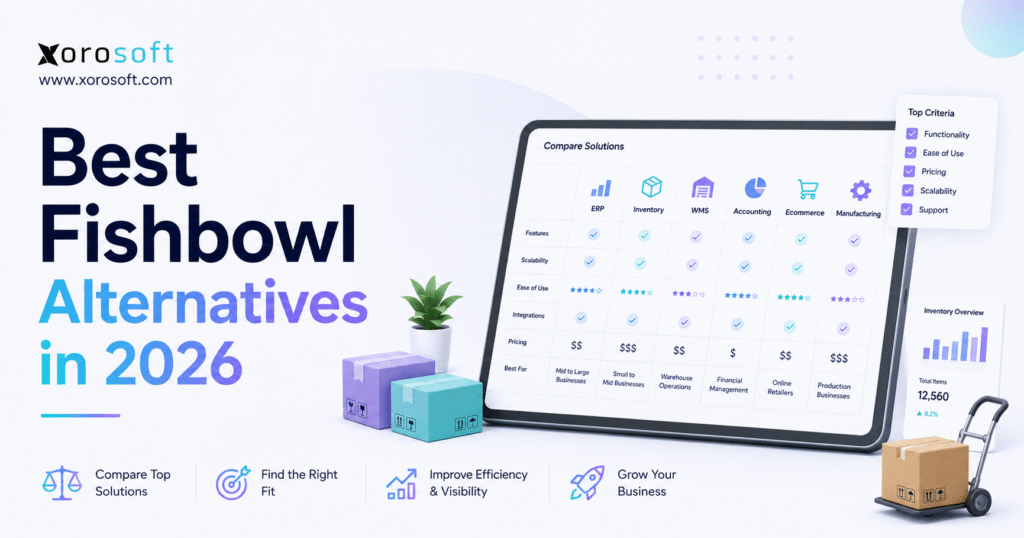
If you’re searching for Fishbowl alternatives, this guide will help you explore the best options available.
1. Smarter Options for Teams Outgrowing Fishbowl
Fishbowl alternatives become important when inventory software no longer keeps up with the way a business actually operates. At first, Fishbowl can help companies move away from spreadsheets and bring more structure to inventory, warehouse, purchasing, and manufacturing workflows. However, as order volume grows, the same business may need stronger accounting alignment, ecommerce integrations, warehouse execution, forecasting, reporting, and multi-location control.
In other words, the problem usually changes.
Early on, the question is simple: “Can we track inventory better?” Later, the question becomes much bigger: “Can one system connect inventory, purchasing, warehouse activity, ecommerce orders, manufacturing, accounting, and reporting without forcing every team to work in spreadsheets?”
That is why businesses start comparing Fishbowl alternatives.
Some teams want a lighter inventory tool. Others need a more complete ERP platform. Meanwhile, ecommerce brands may care most about Shopify, Amazon, fulfillment, and available-to-sell inventory. Wholesale distributors may need EDI, customer-specific pricing, allocation, and purchasing discipline. Manufacturers, on the other hand, may need BOMs, work orders, raw material planning, production visibility, and better inventory costing.
Therefore, the best choice is not the most popular tool. Instead, the best choice is the system that fits your operating model.
This guide compares the best Fishbowl alternatives in 2026 by use case, business size, software category, and operational need. It also explains when inventory software is enough, when ERP becomes the better fit, and what to check before replacing Fishbowl.
2. Best Fishbowl Alternatives in 2026: Quick Answer
The best Fishbowl alternatives in 2026 include Xorosoft, NetSuite, Acumatica, Cin7, Katana, Zoho Inventory, inFlow Inventory, Finale Inventory, Odoo Inventory, and QuickBooks Enterprise.
However, each system fits a different type of business. Therefore, your shortlist should depend on whether you need simple inventory control, manufacturing software, warehouse management, ecommerce operations, accounting integration, or a broader ERP platform.
| Software | Best For | Software Category |
|---|---|---|
| Xorosoft | Inventory-driven businesses that need ERP, WMS, accounting, ecommerce, and manufacturing workflows | Cloud ERP |
| NetSuite | Larger businesses that need broad ERP functionality | ERP |
| Acumatica | Mid-market companies that need flexible ERP workflows | ERP |
| Cin7 | Multichannel product sellers | Inventory and commerce operations |
| Katana | Small and midsize manufacturers | Manufacturing inventory software |
| Zoho Inventory | Smaller teams using Zoho apps | Inventory and order management |
| inFlow Inventory | SMBs needing simple inventory control | Inventory software |
| Finale Inventory | Ecommerce and marketplace sellers | Inventory software |
| Odoo Inventory | Teams that want modular business apps | Modular ERP and inventory |
| QuickBooks Enterprise | Accounting-first teams with inventory needs | Accounting and inventory |
2.1 Best Overall ERP Alternative
The best ERP alternative is usually the platform that connects inventory with accounting, purchasing, warehouse management, ecommerce, manufacturing, forecasting, and reporting. As a result, ERP becomes more useful when inventory problems begin affecting finance, fulfillment, buying decisions, and customer experience.
2.2 Best for QuickBooks-Centric Businesses
If your team wants to stay close to QuickBooks, then QuickBooks-connected tools may make sense. Fishbowl itself has historically been known for inventory and manufacturing workflows connected with QuickBooks and Xero. Therefore, companies replacing Fishbowl should decide whether they want to keep accounting separate or move toward a more unified system.
2.3 Best for Ecommerce Brands
Ecommerce brands should prioritize inventory sync, warehouse visibility, order routing, Shopify workflows, Amazon operations, returns, fulfillment, and purchasing. For example, a Shopify brand may not only need inventory counts. It may also need purchase orders, warehouse scans, accounting updates, and channel-level reporting to move together.
2.4 Best for Manufacturers
Manufacturers should compare BOMs, work orders, production planning, raw material tracking, finished goods visibility, and costing. Because manufacturing affects both inventory and finance, the system must support planning as well as execution.
2.5 Best for Smaller Inventory Teams
Smaller teams may not need ERP yet. In many cases, Zoho Inventory, inFlow, or Finale Inventory can be enough if inventory is simple, warehouses are limited, and accounting can stay separate.
3. What Is Fishbowl Inventory?
Fishbowl is inventory, warehouse, and manufacturing software used by businesses that need more structure than spreadsheets or basic accounting tools can provide. Its official site describes inventory, integrations, manufacturing, warehousing, order fulfillment, QuickBooks, Xero, purchasing, ecommerce, BOMs, work orders, and MRP-related features.
That makes Fishbowl useful for teams that want to improve operational control without necessarily moving into a full ERP system immediately.
3.1 What Fishbowl Is Built For
Fishbowl is built around inventory operations. In addition, it supports warehouse activity, purchasing workflows, manufacturing processes, and accounting connections.
Because of that, it often appears in searches for inventory management software, manufacturing inventory software, warehouse software, and QuickBooks inventory software.
3.2 Inventory Management
Inventory management is the core reason many businesses consider Fishbowl. It helps teams move beyond spreadsheet-based stock tracking and manage products, quantities, locations, and item movement with more discipline.
However, inventory management becomes more demanding as the business grows. Eventually, teams may need deeper controls for stock allocation, inventory valuation, landed cost, multi-warehouse replenishment, and channel-specific availability.
3.3 Warehouse Management
Fishbowl also supports warehouse workflows such as receiving, order fulfillment, pick and pack, multi-location inventory, and warehouse activity. This can help companies improve operational discipline inside the warehouse.
However, warehouse complexity grows quickly. As a result, companies with multiple locations, barcode-heavy workflows, bin tracking, high order volume, or strict fulfillment targets may need deeper WMS capabilities.
3.4 Manufacturing Workflows
Fishbowl includes manufacturing features such as BOMs, work orders, material planning, and production-related inventory control. Therefore, it can fit businesses that need more structure around raw materials and finished goods.
Still, manufacturing requirements vary widely. A simple assembly operation may need one type of system, while a company managing production planning, purchasing, warehouse movement, costing, and finance may need something broader.
3.5 QuickBooks and Xero Alignment
Fishbowl is often evaluated by companies that use QuickBooks or Xero. This is important because many small and midsize businesses want better inventory control while keeping their accounting system in place.
However, as finance requirements mature, some businesses want accounting, inventory, purchasing, and reporting to live closer together. At that point, ERP becomes part of the replacement discussion.
4. Why Businesses Look for Fishbowl Alternatives
Businesses usually look for Fishbowl alternatives because their operating complexity has changed. The tool may still work for some workflows, yet the business may now need a system that connects more departments, channels, warehouses, and financial processes.
4.1 Inventory Complexity Outgrows Basic Controls
Inventory looks simple until the business starts scaling.
At first, teams only need to know what is in stock. Then, they need to know what is available, committed, inbound, damaged, reserved, allocated, in transit, staged for production, or sitting in another warehouse.
As a result, basic stock visibility no longer feels like enough.
4.1.1 Multi-Warehouse Visibility
Multi-warehouse operations require more than location names. Teams need transfers, replenishment rules, receiving workflows, warehouse-level availability, bin accuracy, and real-time stock movement.
For example, a product may look available overall, yet it may not be available in the warehouse needed to fulfill a specific order. Therefore, the system must show inventory by location, channel, and fulfillment requirement.
4.1.2 Lot, Serial, Bin, and Location Tracking
Many businesses eventually need more detailed tracking. Food, beauty, medical, automotive, apparel, electronics, furniture, and manufacturing companies may need lot numbers, serial numbers, bins, expiration dates, and landed cost detail.
Because these requirements affect compliance, fulfillment, and accounting, they cannot live in spreadsheets forever.
4.1.3 Inventory Accuracy at Scale
Inventory accuracy becomes harder as SKUs, locations, channels, and order volume increase. In addition, every manual adjustment creates another chance for mistakes.
Therefore, growing businesses need better controls around receiving, cycle counts, transfers, picking, returns, and purchasing.
4.2 Accounting and Operations Need Tighter Integration
Inventory is not only an operational number. It is also a financial number.
Because inventory affects COGS, margins, valuation, purchase receipts, landed cost, and month-end close, accounting teams need reliable operational data. However, when inventory software and accounting systems do not stay aligned, finance teams spend too much time reconciling numbers.
As a result, many businesses start looking for systems that connect operations and finance more closely.
4.3 Ecommerce Channels Add Pressure
Ecommerce adds speed and complexity.
Shopify orders, Amazon orders, wholesale orders, retail marketplace orders, returns, cancellations, exchanges, and 3PL workflows can all hit inventory at the same time. Meanwhile, customers expect accurate availability and fast fulfillment.
Therefore, ecommerce brands need more than stock tracking. They need channel-aware inventory, fulfillment workflows, purchasing visibility, and reporting that connects sales demand with operational capacity.
4.4 Manufacturing Requires Better Planning
Manufacturing creates another layer of inventory complexity.
Raw materials, components, work orders, labor, production schedules, finished goods, and purchasing must stay connected. Otherwise, the business may have sales demand but not enough raw material to build finished goods.
Therefore, manufacturers should compare Fishbowl alternatives based on planning depth, not only feature count.
4.5 Reporting Needs Become More Strategic
As companies scale, leaders need better reporting.
For example, they may need to know which SKUs create margin pressure, which warehouses are slowing fulfillment, which vendors cause late purchase orders, and which channels create inventory risk.
However, if reporting requires manual exports from multiple systems, decisions slow down. Therefore, stronger reporting often becomes a key reason to replace inventory-only software.
5. How to Choose the Right Fishbowl Alternative
Choosing a Fishbowl alternative should begin with workflow mapping. Otherwise, the team may choose software based on features that look good in a demo but do not match the way the business actually operates.
5.1 Decide Whether You Need Inventory Software or ERP
The first decision is category fit.
Some businesses only need better inventory software. However, others need ERP because inventory now touches accounting, purchasing, warehouse management, ecommerce, manufacturing, and reporting.
5.1.1 When Inventory Software Is Enough
Inventory software may be enough if the business has simple workflows, one or two warehouses, limited manufacturing, basic purchasing, and a manageable number of sales channels.
In addition, it may work well if accounting can remain separate and reporting needs are still straightforward.
5.1.2 When ERP Becomes the Better Fit
ERP becomes the better fit when inventory decisions affect multiple departments at once. For example, one stockout may impact purchasing, warehouse labor, ecommerce sales, wholesale commitments, cash flow, and customer service.
At that point, a broader operating system is often more useful than another standalone tool. A platform such as XoroONE is built for retailers, wholesalers, and manufacturers that need inventory, accounting, warehouse management, manufacturing, ecommerce, EDI, reporting, and forecasting inside one cloud-based ERP environment.
5.2 Compare Core Inventory Capabilities
Inventory capabilities should cover much more than stock counts.
Before choosing a replacement, review whether the system supports multi-location inventory, item history, transfers, reorder points, purchase planning, lot tracking, serial tracking, landed cost, cycle counts, and real-time availability.
Also, compare how each system handles inventory exceptions. Because mistakes happen in receiving, picking, returns, and adjustments, the software must make corrections traceable.
5.3 Review Warehouse Management Depth
Warehouse management is often where software gaps become visible.
If warehouse teams still rely on paper, spreadsheets, or tribal knowledge, the business will struggle to maintain inventory accuracy. Therefore, companies should compare receiving, putaway, bin tracking, barcode scanning, picking, packing, shipping, cycle counts, and warehouse reporting.
For deeper warehouse execution, XoroWMS is worth reviewing because it focuses on warehouse workflows such as receiving, picking, packing, shipping, and inventory movement.
5.4 Evaluate Accounting and Finance Workflows
Accounting should be part of the software evaluation early.
Although operations teams may focus on warehouse speed and inventory accuracy, finance teams care about COGS, inventory valuation, margins, purchase receipts, landed cost, and month-end close.
Therefore, ask whether the platform only exports data to accounting or whether it helps connect operational activity with financial visibility.
5.5 Check Ecommerce and Marketplace Integrations
For ecommerce brands, integrations are not a side detail. They are part of the operating model.
Shopify, Amazon, EDI, B2B portals, shipping tools, and 3PLs must send clean data into the system. Otherwise, teams deal with overselling, duplicate entry, delayed fulfillment, and poor reporting.
Xorosoft also has an external listing on the Shopify App Store, which is useful for Shopify merchants evaluating ERP-connected ecommerce operations.
5.6 Assess Manufacturing and MRP Requirements
Manufacturers should compare BOMs, work orders, material requirements planning, production planning, raw material availability, labor tracking, and finished goods costing.
In addition, they should check whether purchasing and warehouse activity connect naturally to production. Otherwise, production teams may plan builds that purchasing and inventory teams cannot support.
5.7 Review Implementation Complexity
Implementation matters as much as software selection.
A simple inventory tool may be easier to launch. However, it may not solve deeper operational issues. Meanwhile, ERP may require more planning, but it can reduce long-term system fragmentation when implemented correctly.
Therefore, evaluate data migration, integrations, training, workflow design, reporting setup, and support before making a decision.
5.8 Compare Total Cost of Ownership
Software cost is not only the monthly subscription.
You should also include implementation, training, integrations, support, consulting, internal admin time, manual workarounds, reporting labor, duplicate entry, and operational mistakes.
In many cases, the cheapest system becomes expensive if teams still need spreadsheets to make it work.
5.9 Check Readiness Before You Shortlist Vendors
Before you choose a system, map your real workflows. Start with inventory, purchasing, warehouse, accounting, ecommerce, manufacturing, and reporting.
Then, compare software against those workflows. This approach prevents the business from buying a tool that looks strong in a demo but weak in daily operations.
6. Best Fishbowl Alternatives in 2026
The best Fishbowl alternatives serve different types of companies. Therefore, the sections below focus on best fit, strengths, limitations, and practical buying context.
6.1 Xorosoft
Xorosoft is a cloud ERP platform built for inventory-driven businesses that need inventory management, accounting, purchasing, warehouse management, manufacturing, forecasting, reporting, and ecommerce operations in one system.
It is especially relevant for companies that have outgrown QuickBooks, spreadsheets, inventory-only tools, warehouse apps, or disconnected ecommerce workflows. In addition, it fits businesses managing Shopify, Amazon, wholesale, EDI, manufacturing, and multiple warehouses.
6.1.1 Best Fit
Xorosoft is best for product-based businesses that need more than inventory tracking. This includes apparel, furniture, sporting goods, food and beverage, wholesale distribution, ecommerce, manufacturing, and consumer product companies.
The industries Xorosoft serves page is useful for businesses that want to see whether their category fits the platform’s core market.
6.1.2 Key Strengths
Xorosoft’s strengths include inventory accuracy, purchasing automation, warehouse efficiency, accounting integration, forecasting, reporting, Shopify operations, Amazon workflows, EDI support, and multi-warehouse visibility.
In addition, the broader XoroERP platform is relevant for companies that want manufacturing, inventory, accounting, purchasing, and operational workflows connected more tightly.
6.1.3 Where It Fits Better Than Fishbowl
Xorosoft can be a stronger fit when the business is no longer looking for inventory software around accounting. Instead, the team wants a cloud ERP platform that connects inventory, accounting, purchasing, WMS, ecommerce, manufacturing, and reporting.
Therefore, it becomes more relevant when Fishbowl replacement is part of a larger operational upgrade.
6.1.4 Who Should Consider It
Consider Xorosoft if your business manages multiple warehouses, sells through Shopify or Amazon, handles wholesale orders, uses EDI, manufactures products, needs forecasting, or wants real-time reporting across operations and finance.
6.2 NetSuite
NetSuite is one of the most recognized ERP options for companies that need broad business management capabilities.
6.2.1 Best Fit
NetSuite often fits larger or more complex businesses that need finance, inventory, procurement, order management, warehouse management, production, and supply chain capabilities.
6.2.2 Key Strengths
Its strength is breadth. Because NetSuite covers many ERP functions, it can support companies that need a wide operational and financial system.
6.2.3 Potential Limitations
However, buyers should evaluate implementation complexity, consulting cost, internal resources, and user adoption. A powerful ERP can become difficult if the business does not have the process maturity to support it.
6.3 Acumatica
Acumatica is a cloud ERP platform often considered by mid-market companies that want flexibility.
6.3.1 Best Fit
Acumatica can fit companies that need distribution, manufacturing, finance, and operations workflows inside a flexible ERP environment.
6.3.2 Key Strengths
Its strength is adaptability. Therefore, it may suit businesses that want configurable workflows and a partner-led ERP implementation.
6.3.3 Potential Limitations
However, configuration and partner selection matter. Buyers should review implementation scope carefully and compare it with other ERP options. For a focused comparison, the Xorosoft vs Acumatica page can help teams think through fit.
6.4 Cin7
Cin7 is a strong option for companies focused on multichannel inventory and product operations.
6.4.1 Best Fit
Cin7 often fits ecommerce, wholesale, and product sellers that need inventory visibility across sales channels.
6.4.2 Key Strengths
Its strengths include multichannel inventory, ecommerce operations, order management, and product flow across channels.
6.4.3 Potential Limitations
However, businesses that need deeper accounting, manufacturing, or ERP-level reporting should compare broader systems. The Xorosoft vs Cin7 page is useful when the decision is between inventory-focused software and a broader ERP approach.
6.5 Katana
Katana is a manufacturing-focused inventory platform.
6.5.1 Best Fit
Katana often fits small and midsize manufacturers that need production visibility, material tracking, and basic planning.
6.5.2 Key Strengths
Its strength is manufacturing usability. For example, teams focused on production workflows may find it easier to evaluate than broader ERP platforms.
6.5.3 Potential Limitations
However, Katana may not fit companies that need deeper accounting, complex warehouse management, wholesale workflows, EDI, or full ERP reporting.
6.6 Zoho Inventory
Zoho Inventory is a practical option for smaller businesses, especially those already using Zoho apps.
6.6.1 Best Fit
It fits smaller teams that need inventory, orders, shipping, warehouses, and ecommerce integrations without full ERP complexity.
6.6.2 Key Strengths
Zoho Inventory is accessible and familiar for companies already using the Zoho ecosystem. In addition, it can support simple product operations without a heavy implementation.
6.6.3 Potential Limitations
However, growing businesses may eventually need deeper warehouse, accounting, manufacturing, forecasting, or ERP capabilities.
6.7 inFlow Inventory
inFlow Inventory is built for straightforward inventory control.
6.7.1 Best Fit
It can fit small and midsize businesses that need item tracking, purchasing, barcode workflows, and order management.
6.7.2 Key Strengths
Its strength is simplicity. Therefore, it may work well for teams that need inventory structure but not full operational transformation.
6.7.3 Potential Limitations
However, inFlow may not support more complex ERP, manufacturing, accounting, EDI, or multi-warehouse needs at scale.
6.8 Finale Inventory
Finale Inventory is often considered by ecommerce and marketplace sellers.
6.8.1 Best Fit
It can fit sellers managing Amazon, Shopify, Walmart, or other marketplace inventory workflows.
6.8.2 Key Strengths
Its strengths include ecommerce inventory control and marketplace visibility. Therefore, it can be useful when channel inventory is the main pain point.
6.8.3 Potential Limitations
However, it may not be the best option when the business needs full ERP, accounting, WMS, manufacturing, or wholesale distribution depth.
6.9 Odoo Inventory
Odoo Inventory is part of the broader Odoo business app ecosystem.
6.9.1 Best Fit
It can fit businesses that want modular apps and are comfortable configuring workflows across inventory, sales, purchasing, manufacturing, and accounting.
6.9.2 Key Strengths
Its modular structure gives teams flexibility. As a result, businesses can start with inventory and add more apps as needed.
6.9.3 Potential Limitations
However, configuration and maintenance can become complex. Buyers should review implementation needs carefully. If Odoo is already on your shortlist, the Xorosoft vs Odoo page may help compare operating models.
6.10 QuickBooks Enterprise
QuickBooks Enterprise can be considered by accounting-first companies with inventory requirements.
6.10.1 Best Fit
It fits businesses that want financial workflows to remain central while improving inventory control.
6.10.2 Key Strengths
Its strength is accounting familiarity. Therefore, teams already comfortable with QuickBooks may prefer it if operational complexity remains manageable.
6.10.3 Potential Limitations
However, it may not replace a true ERP or WMS for businesses with complex warehouse, manufacturing, ecommerce, or wholesale requirements. If the main question is whether QuickBooks can still support the business, review the Xorosoft vs QuickBooks comparison.
7. Fishbowl Alternatives Comparison Table
7.1 Best Alternatives by Business Type
| Business Type | Best-Fit Options | Why |
| Ecommerce brand | Xorosoft, Cin7, Finale Inventory | Shopify, Amazon, fulfillment, inventory sync, and channel operations |
| Wholesale distributor | Xorosoft, Acumatica, NetSuite | Purchasing, EDI, allocation, pricing, and warehouse control |
| Manufacturer | Xorosoft, Katana, NetSuite | BOMs, work orders, raw materials, production, and costing |
| Small inventory team | Zoho Inventory, inFlow, Finale | Simpler inventory and order workflows |
| Multi-warehouse business | Xorosoft, NetSuite, Acumatica | Transfers, replenishment, WMS, and reporting |
| Accounting-first team | QuickBooks Enterprise, Fishbowl, inFlow | Finance-led workflows and accounting continuity |
7.2 Best Alternatives by Operational Need
| Operational Need | Best Software Category |
| Inventory accuracy | Inventory software or ERP |
| Warehouse execution | WMS or ERP with WMS |
| Manufacturing planning | Manufacturing ERP or MRP software |
| Shopify operations | Ecommerce ERP or multichannel inventory platform |
| Accounting integration | ERP or QuickBooks-connected inventory software |
| Purchasing automation | ERP or inventory platform with replenishment |
| Multi-warehouse control | ERP with warehouse and transfer workflows |
| EDI | ERP or wholesale inventory platform |
7.3 Best Alternatives by Software Category
| Category | Examples | Best For |
| Cloud ERP | Xorosoft, NetSuite, Acumatica | Connected operations and finance |
| Inventory software | Zoho Inventory, inFlow, Finale | Focused inventory control |
| Manufacturing software | Katana, Fishbowl, Odoo | Production and material planning |
| Ecommerce inventory software | Cin7, Finale, Zoho Inventory | Multichannel product sellers |
| Accounting and inventory | QuickBooks Enterprise, Fishbowl | Finance-led businesses |
7.4 Compare the System Before the Demo
Before booking demos, create a shortlist based on business model.
For example, a Shopify seller with multiple warehouses should not evaluate software the same way as a manufacturer with raw materials and production orders. Likewise, a wholesale distributor with EDI should not use the same checklist as a small retail brand.
If your team is comparing ERP categories broadly, the main Xorosoft comparison hub can help you review related ERP alternatives without forcing every competitor into one article.
8. Fishbowl Alternatives by Use Case
8.1 Best Fishbowl Alternative for Ecommerce Brands
Ecommerce brands should evaluate Fishbowl alternatives based on operational flow.
Shopify orders, Amazon orders, marketplace demand, returns, cancellations, warehouse activity, 3PL communication, purchasing, and accounting updates all need to stay aligned. Otherwise, the team ends up using spreadsheets to fill the gaps.
Therefore, ecommerce brands should look for inventory sync, available-to-sell visibility, warehouse execution, purchasing automation, fulfillment reporting, and accounting alignment.
8.2 Shopify Sellers
Shopify sellers need accurate stock availability across channels. In addition, they need order routing, fulfillment visibility, purchasing controls, and finance updates.
Because Shopify often becomes the front-end growth engine, the back-end system must keep up. The Shopify App Store listing for Xorosoft is a useful outbound reference for merchants reviewing ERP-connected ecommerce operations: Xorosoft ERP on Shopify App Store.
8.3 Amazon Sellers
Amazon sellers need visibility into FBA, FBM, inbound inventory, replenishment, and margin performance. In addition, they need to understand how marketplace demand affects purchasing and warehouse planning.
Therefore, the best Fishbowl alternative for Amazon sellers should connect inventory, orders, replenishment, and reporting.
8.4 Multi-Channel Sellers
Multi-channel sellers need one inventory source of truth.
For example, if the same SKU sells through Shopify, Amazon, wholesale, and retail partners, stock must update quickly. Otherwise, overselling becomes likely.
As a result, the system should support channel-level inventory, allocation, fulfillment workflows, and real-time reporting.
8.5 Best Fishbowl Alternative for Wholesale Distribution
Wholesale distribution creates different requirements from ecommerce.
Customer-specific pricing, sales reps, purchase orders, EDI, inventory allocation, warehouse operations, and credit terms all matter. Therefore, wholesale distributors should evaluate ERP and inventory systems based on operational control, not only order entry.
For businesses that sell across wholesale, ecommerce, and retail channels, the solutions page can help map common workflows such as inventory management, order management, warehouse management, purchasing, accounting, and reporting.
8.6 Customer-Specific Pricing
Wholesale pricing often depends on customer groups, contracts, order volume, and negotiated terms. Therefore, the system must support pricing rules without forcing teams to manage exceptions manually.
8.7 EDI Workflows
EDI adds strict operational requirements. Purchase orders, acknowledgements, invoices, ASNs, and trading partner rules need consistent handling.
Because mistakes can create chargebacks, wholesale teams should evaluate EDI support carefully.
8.8 Inventory Allocation
Wholesale allocation helps protect stock for important customers, sales channels, or future commitments. Without allocation controls, teams may sell available inventory to one channel while another channel waits.
Therefore, allocation should be part of the buying checklist.
8.9 Best Fishbowl Alternative for Manufacturing
Manufacturing teams should compare systems based on planning depth.
BOMs, work orders, raw material availability, purchasing, warehouse movement, labor, production costs, and finished goods all need to connect. Otherwise, production planning becomes reactive.
8.10 BOM Management
A bill of materials should show the components, quantities, costs, and substitutions required to build finished goods.
In addition, BOM accuracy affects purchasing, costing, production timing, and margin reporting. Therefore, it should not be treated as a simple item list.
8.11 Work Orders
Work orders help production teams plan what to build, when to build it, and which materials are required.
However, work orders only help if they connect to inventory and purchasing. Otherwise, production teams may schedule builds without available materials.
8.12 Material Requirements Planning
MRP helps companies identify what they need before demand becomes urgent.
For example, if finished goods demand increases, the system should help identify raw material shortages, supplier lead times, and purchase needs. As a result, manufacturers can plan instead of constantly reacting.
8.13 Best Fishbowl Alternative for Multi-Warehouse Operations
Multi-warehouse companies need location-level visibility, transfers, replenishment, bin tracking, receiving accuracy, picking controls, and fulfillment reporting.
In addition, the system must show where inventory sits and whether it is available for a specific order. Without that visibility, teams may make poor fulfillment and purchasing decisions.
8.14 Best Fishbowl Alternative for Accounting Integration
Accounting integration becomes critical when inventory affects financial statements.
Purchase receipts, vendor bills, landed costs, inventory adjustments, COGS, and margins all need clean data. Therefore, companies should involve finance early in the software selection process.
8.15 Best Fishbowl Alternative for Forecasting and Purchasing
Forecasting and purchasing should work together.
Sales velocity, supplier lead time, seasonality, open purchase orders, warehouse stock, and channel demand should guide buying decisions. Otherwise, teams may overbuy slow-moving stock while running out of best sellers.
9. Fishbowl vs ERP: When Should You Upgrade?
Fishbowl-type inventory software and ERP software solve related but different problems.
Inventory software helps manage stock, orders, warehouse activity, and sometimes manufacturing. ERP, however, connects inventory with accounting, purchasing, warehouse management, ecommerce, production, reporting, and finance.
Therefore, the decision is not simply Fishbowl vs another inventory tool. Instead, the real question is whether the business now needs a connected operating system.
9.1 Signs Inventory Software Is No Longer Enough
Inventory software may no longer be enough when the business depends on too many external spreadsheets, manual reconciliations, disconnected apps, and delayed reports.
In addition, ERP may become necessary when different departments no longer trust the same data.
9.2 Too Many Manual Workarounds
Manual workarounds are often the first warning sign.
For example, if purchasing lives in spreadsheets, warehouse exceptions live in Slack, and finance relies on exports, the system is no longer the source of truth.
As a result, the business may need a stronger platform rather than another patch.
9.3 Month-End Close Takes Too Long
Month-end close becomes painful when finance must reconcile inventory movement, purchase receipts, landed costs, vendor bills, adjustments, and COGS manually.
Therefore, if closing the books requires too much detective work, inventory and accounting may need tighter integration.
9.4 Inventory Data Does Not Match Accounting Data
Inventory and accounting misalignment creates margin confusion.
For example, operations may believe inventory is available, while finance sees different valuation numbers. As a result, leadership cannot make confident decisions.
9.5 Warehouse Teams Work Outside the System
Warehouse teams often create workarounds when software does not match real warehouse activity.
However, if receiving, picking, packing, shipping, and cycle counts happen outside the system, inventory accuracy will eventually break.
9.6 What ERP Adds Beyond Inventory Software
ERP adds connected workflows.
Inventory updates purchasing. Purchasing affects cash flow. Warehouse activity affects fulfillment. Fulfillment affects customer experience. Manufacturing affects raw materials and finished goods. Reporting connects all of it.
Therefore, ERP can become the better fit when the business needs operational and financial visibility in one environment.
9.7 When Staying With Fishbowl May Still Make Sense
Staying with Fishbowl may make sense if your business still runs well with QuickBooks or Xero, warehouse needs are manageable, manufacturing is not too complex, and reporting requirements are mostly operational.
In addition, if your team does not have the time or resources to implement ERP properly, it may be better to improve process discipline before changing systems.
10. Common Mistakes When Comparing Fishbowl Alternatives
10.1 Comparing Features Without Mapping Workflows
Feature lists can be misleading.
A system may say it supports purchasing, warehouse management, or manufacturing. However, that does not mean it supports your actual workflow.
Therefore, map how orders, purchase orders, inventory, warehouse tasks, production, and accounting move through the business before comparing software.
10.2 Ignoring Accounting Requirements
Accounting should not enter the conversation at the end.
Because inventory affects valuation, margins, COGS, landed cost, vendor bills, and month-end close, finance must help define requirements early.
Otherwise, the business may choose software that helps operations but creates more reconciliation work.
10.3 Underestimating Warehouse Complexity
Warehouse work is physical, fast, and exception-heavy.
Therefore, software must match how teams receive, store, count, pick, pack, ship, and adjust inventory. If it does not, warehouse users will work around the system.
10.4 Choosing Software Only by Price
Price matters, but total cost matters more.
A low-cost tool can become expensive if teams still need spreadsheets, duplicate entry, manual reports, and constant corrections.
In contrast, a more complete system may cost more upfront but reduce operational drag over time.
10.5 Forgetting Implementation and Adoption
Implementation decides whether the system works in real life.
Data cleanup, workflow design, user training, testing, integrations, and reporting setup all matter. Therefore, buyers should evaluate the vendor’s implementation approach before signing.
10.6 Buying Too Much Too Early
Overbuying is also a mistake.
Some businesses choose ERP before the team is ready. As a result, implementation becomes harder than necessary.
Therefore, the right software should match your current complexity while still supporting the next stage of growth.
11. Fishbowl Replacement Checklist
11.1 Inventory Checklist
Before replacing Fishbowl, review how the new system handles daily inventory control.
- Inventory should be visible by warehouse, location, and channel.
- Available, committed, inbound, and allocated stock should be easy to separate.
- Lot, serial, bin, and expiration workflows should match your products.
- Transfers and replenishment should not require spreadsheet tracking.
- Manual adjustments should be traceable, controlled, and easy to audit.
- Item history should show what changed, when it changed, and who changed it.
11.2 Warehouse Checklist
Next, look closely at how the system supports warehouse execution.
- Receiving workflows should guide teams from purchase order to stocked inventory.
- Barcode scanning should reduce manual entry during warehouse movement.
- Picking, packing, and shipping should be simple enough for daily users.
- Warehouse managers should be able to track activity without exporting data.
- Cycle counting should support regular inventory accuracy checks.
- Bin, zone, and multi-warehouse workflows should match your physical layout.
11.3 Accounting Checklist
Finance should be involved before the software decision is made.
- Inventory valuation needs to stay accurate as stock moves.
- Landed costs should connect clearly to purchasing and received goods.
- Purchase receipts and vendor bills should be easier to reconcile.
- Month-end close should require fewer manual corrections.
- COGS and margin reporting should be reliable enough for leadership.
- Accounting teams should trust the operational data inside the system.
11.4 Ecommerce Checklist
For ecommerce teams, the system must support channel speed without creating back-office chaos.
- Shopify orders should flow into operations without duplicate entry.
- Amazon and marketplace activity should update inventory correctly.
- Returns, cancellations, and exchanges should adjust stock cleanly.
- Inventory sync should reduce overselling across channels.
- Purchasing teams should see demand before stockouts happen.
- Ecommerce activity should connect with warehouse and accounting workflows.
11.5 Manufacturing Checklist
Manufacturers should review how the system connects materials, production, and finished goods.
- BOMs should show components, quantities, substitutions, and costs clearly.
- Work orders should connect production plans with available inventory.
- Raw material visibility should help prevent production delays.
- Finished goods should update as production is completed.
- Planning tools should support purchasing before shortages become urgent.
- Manufacturing data should connect with inventory, warehouse, and finance.
11.6 Reporting Checklist
Finally, check whether reporting helps teams make faster decisions.
- Leaders should see inventory performance without manual exports.
- Reports should connect sales, purchasing, warehouse, and finance data.
- Filters by warehouse, channel, SKU, vendor, and customer should be available.
- Spreadsheet reporting should decrease after implementation.
- Stockout and overstock risks should be easier to identify.
- Forecasting should become more reliable as operational data improves.
12. Final Recommendation: Which Fishbowl Alternative Should You Choose?
12.1 Choose Based on Operational Maturity
If your business has simple inventory needs, then lightweight inventory software may be enough.
However, if your business manages multiple warehouses, channels, vendors, purchase orders, production workflows, and financial reporting needs, then ERP may be the stronger direction.
12.2 Choose Based on System Architecture
Ask whether the platform will become another app in the stack or the operating layer that connects the stack.
This matters because disconnected systems create hidden work. For example, every separate app creates another place where data can break.
12.3 Choose Based on Growth Stage
A $2M product business and a $50M product business usually need different systems.
Therefore, avoid choosing software only for today. At the same time, do not overbuy before the team is ready to implement a more advanced platform.
12.4 Choose Based on the Real Bottleneck
The best Fishbowl alternative depends on the real bottleneck.
If the problem is simple stock tracking, choose inventory software. When ecommerce inventory is the issue, choose a strong multichannel inventory tool. For manufacturing planning, compare manufacturing software or manufacturing ERP. However, if the problem is disconnected operations, ERP should be on the shortlist.
13. FAQs About Fishbowl Alternatives
13.1 What are the best Fishbowl alternatives in 2026?
Strong Fishbowl alternatives in 2026 include Xorosoft, NetSuite, Acumatica, Cin7, Katana, Zoho Inventory, inFlow Inventory, Finale Inventory, Odoo Inventory, and QuickBooks Enterprise. Each option fits a different operating model. Ecommerce brands may prioritize Shopify and Amazon workflows, while manufacturers may care more about BOMs, work orders, and production planning.
13.2 What is the best Fishbowl alternative for ecommerce?
For ecommerce brands, the right Fishbowl alternative should connect inventory, orders, warehouse activity, purchasing, fulfillment, returns, Shopify, Amazon, and accounting. Instead of choosing software only by feature count, review how each system handles available-to-sell inventory, order routing, channel sync, and fulfillment visibility.
13.3 What is the best Fishbowl alternative for manufacturing?
Manufacturers should choose a Fishbowl alternative that supports BOMs, work orders, raw material availability, production planning, purchasing, costing, and finished goods inventory. In addition, the system should connect manufacturing activity with warehouse and accounting workflows.
13.4 What is the best Fishbowl alternative for wholesale distribution?
Wholesale distributors should look for purchasing, EDI, customer-specific pricing, allocation, warehouse management, and reporting. Because wholesale workflows often involve customer commitments and trading partner requirements, the system must support both sales and operations.
13.5 Is Fishbowl an ERP system?
Fishbowl is usually positioned as inventory, warehouse, and manufacturing software rather than a full ERP. It supports important operational workflows, especially for businesses using QuickBooks or Xero. However, companies that need broader accounting, purchasing, reporting, ecommerce, manufacturing, and warehouse control may compare ERP alternatives.
13.6 When should a business replace Fishbowl?
Consider replacing Fishbowl when your business needs stronger multi-warehouse control, deeper accounting alignment, better ecommerce workflows, more advanced manufacturing planning, EDI, forecasting, or real-time reporting. Before making a change, map your workflows so the replacement solves the actual operational problem.
13.7 Is NetSuite a good Fishbowl alternative?
NetSuite can be a good Fishbowl alternative for larger businesses that need broad ERP capabilities. However, buyers should evaluate implementation scope, configuration needs, internal resources, and cost before choosing it. A powerful ERP only works well when the business is ready to adopt it properly.
13.8 Is Cin7 a good Fishbowl alternative?
Cin7 can be a good Fishbowl alternative for multichannel product sellers. It is especially relevant when ecommerce, wholesale, and inventory visibility are the main priorities. However, businesses that need deeper accounting, manufacturing, or ERP-level workflows should compare broader platforms as well.
13.9 Is Katana a good Fishbowl alternative?
Katana can be a good Fishbowl alternative for smaller manufacturers that need production visibility and material tracking. Still, companies with complex accounting, warehouse, wholesale, EDI, or multi-location needs may require a broader system.
13.10 Is Zoho Inventory a good Fishbowl alternative?
Zoho Inventory can be a good option for smaller businesses, especially those already using Zoho apps. It can support inventory, orders, shipping, warehouses, and ecommerce integrations. Larger teams, however, may eventually need deeper ERP, WMS, manufacturing, or accounting functionality.
13.11 Is QuickBooks Enterprise a good Fishbowl alternative?
QuickBooks Enterprise can fit accounting-first businesses that want inventory features inside a familiar finance system. However, it may not replace purpose-built ERP, WMS, ecommerce, or manufacturing platforms for companies with more complex operations.
13.12 Which Fishbowl alternative includes accounting?
ERP platforms are more likely to include accounting or deeper financial workflows. Some inventory tools only sync with accounting software. Therefore, buyers should decide whether they want accounting integration or a broader system where inventory and finance work together natively.
13.13 Which Fishbowl alternative supports Shopify?
Several Fishbowl alternatives support Shopify directly or through integrations. However, Shopify support alone is not enough. You should also review how the system handles inventory sync, order routing, fulfillment, returns, purchasing, and accounting updates after Shopify orders enter operations.
13.14 Which Fishbowl alternative supports Amazon?
Many ecommerce inventory platforms and ERP systems support Amazon workflows. However, Amazon sellers should compare FBA, FBM, replenishment, marketplace inventory sync, order import, landed cost, and reporting before choosing a system.
13.15 Which Fishbowl alternative supports EDI?
EDI support is most important for wholesale distributors and brands selling to retailers. A strong system should support purchase orders, invoices, ASNs, acknowledgements, partner rules, and exception handling. Therefore, ERP and wholesale-focused platforms are often better fits for EDI-heavy businesses.
13.16 Which Fishbowl alternative is best for multi-warehouse inventory?
The best multi-warehouse alternative should support location-level stock, transfers, replenishment, receiving, bin tracking, barcode scanning, picking, packing, cycle counts, and warehouse reporting. As a result, ERP platforms with WMS functionality are often stronger for multi-location businesses.
13.17 What should I compare before replacing Fishbowl?
Before replacing Fishbowl, compare inventory accuracy, warehouse management, accounting integration, ecommerce support, manufacturing workflows, purchasing, forecasting, reporting, implementation, support, integrations, and total cost of ownership. In addition, map real workflows before reviewing demos.
13.18 What is the difference between Fishbowl and ERP software?
Fishbowl-type inventory software focuses on inventory, warehouse, manufacturing, and accounting-connected workflows. ERP software connects inventory with accounting, purchasing, sales orders, warehouse management, ecommerce, manufacturing, reporting, and broader operational controls.
13.19 How long does it take to implement a Fishbowl alternative?
Implementation time depends on data quality, users, warehouses, integrations, accounting requirements, manufacturing needs, and reporting complexity. A simple inventory tool may launch faster. However, ERP usually requires more planning, testing, training, and workflow design.
13.20 How much do Fishbowl alternatives cost?
Costs vary by users, modules, implementation scope, integrations, support, and transaction volume. Therefore, buyers should compare subscription fees, onboarding, consulting, training, customizations, internal time, and the cost of ongoing manual work.
13.21 Can a Fishbowl alternative replace QuickBooks?
Some ERP platforms can replace QuickBooks if they include accounting and financial management. However, many inventory tools only integrate with QuickBooks. Therefore, the right choice depends on whether finance wants to keep QuickBooks or move accounting into a broader ERP system.
13.22 Can a Fishbowl alternative replace warehouse software?
Yes, some Fishbowl alternatives can replace separate warehouse software if they include WMS functionality. Before deciding, check receiving, putaway, bin tracking, barcode scanning, picking, packing, shipping, cycle counting, and warehouse reporting.
13.23 Can a Fishbowl alternative support manufacturing?
Yes, manufacturing-focused inventory systems and ERP platforms can support BOMs, work orders, raw materials, production planning, and finished goods. However, the right system depends on whether the business needs simple production tracking or deeper manufacturing ERP workflows.
13.24 Should small businesses use Fishbowl or an alternative?
Small businesses should choose based on workflow fit. Fishbowl may work if the business needs inventory and manufacturing workflows connected to QuickBooks or Xero. However, a simpler inventory tool may fit basic needs, while ERP may fit businesses with growing operational complexity.
13.25 What is the best cloud ERP alternative to Fishbowl?
The best cloud ERP alternative depends on your business model. Compare inventory depth, accounting, purchasing, WMS, ecommerce, manufacturing, forecasting, reporting, implementation, and support. For inventory-driven businesses, Xorosoft is one option to evaluate when disconnected systems start limiting growth.
14. Final Buying Decision
The best Fishbowl alternative is not the tool with the longest feature list. Instead, it is the system that matches how your business buys, receives, stores, sells, manufactures, ships, accounts, and reports.
If your company only needs better stock tracking, a focused inventory system may be enough. However, if your team is managing multiple warehouses, ecommerce channels, wholesale orders, purchasing complexity, production workflows, and accounting pressure, ERP should be part of the conversation.
Before making a decision, document your workflows. Then, compare vendors against your actual operating model. This will help you avoid buying software that looks good during a demo but still requires spreadsheets after launch.
For businesses that need inventory, accounting, purchasing, warehouse management, manufacturing, Shopify, Amazon, EDI, forecasting, and reporting inside one connected platform, Xorosoft may be worth reviewing.
To see whether it fits your next stage of growth, Book a demo.
Recent Posts
-
 ERP Landed Cost Module vs Spreadsheet Calculations for Importers
 -
 How to Build an Open-to-Buy Plan for an Omnichannel Brand
 -
 Cold Storage WMS for Food and Beverage Distribution
 -
 ERP Buying Statistics 2026: Evaluation, Implementation, and Adoption Risks
 -
 How a Distributor Reduced B2B Order Exceptions Without Restricting Sales