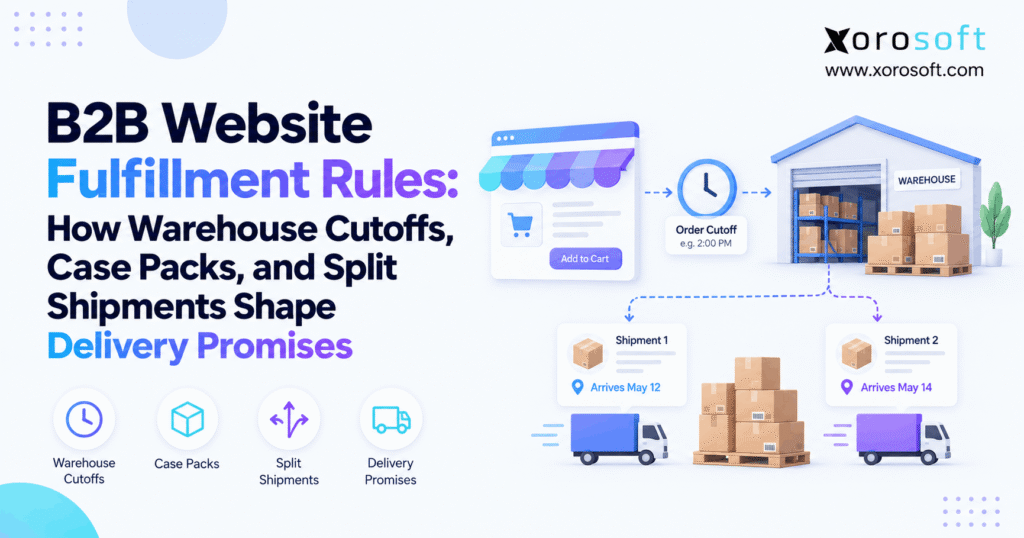
If you operate in wholesale or business-to-business settings, understanding B2B fulfillment rules can help streamline your processes and ensure compliance.
1. Delivery Promises Start With B2B Fulfillment Rules
B2B fulfillment rules determine whether a website can turn visible inventory into a delivery promise that warehouse teams can actually keep. Although a product may appear available, inventory alone does not confirm when that order can ship. Instead, the system must also consider allocations, case packs, warehouse cutoffs, routing logic, customer requirements, and transportation constraints.
Therefore, the date shown to a B2B buyer should represent an operational commitment rather than a simple estimate. When systems ignore these dependencies, customers can receive promises that inventory teams, warehouse teams, or carriers cannot execute.
1.1 Why B2B order fulfillment rules matter
A B2B order usually creates more operational conditions than a typical consumer order. For example, a wholesale buyer may need case quantities, a specific warehouse, pallet shipping, a delivery appointment, or complete-order fulfillment.
Consequently, the website must evaluate more than whether stock exists. It must determine whether the requested inventory is actually eligible for that customer and whether operations can process it on time.
Moreover, the same inventory may already support another sales channel or customer allocation. As a result, reliable fulfillment requires shared rules across ecommerce, inventory, order management, and warehouse systems.
1.2 Availability, ship dates, and delivery dates are different
First, availability answers whether inventory can still be committed.
Next, the promised ship date identifies when the warehouse can realistically release the order.
Finally, the delivery date considers transit time and receiving constraints after shipment.
Therefore, an item can be available today without being capable of shipping today. Likewise, an order can ship today without arriving tomorrow.
That distinction becomes critical when a B2B website provides buyers with delivery estimates before checkout.
2. How B2B Fulfillment Rules Turn an Order Into a Promise
Effective B2B fulfillment rules work as a decision sequence. First, the system validates the buyer and ordered quantities. Then, it checks available-to-promise inventory. Afterward, it identifies eligible warehouses and determines whether each location can meet the required timing.
Next, the system decides whether the order should ship complete, split across locations, or wait for replenishment. Finally, carrier service and transit time help determine the customer-facing date.
Therefore, the promise comes from several connected decisions rather than one inventory lookup.
2.1 The B2B fulfillment logic sequence
A practical sequence looks like this:
Order submitted → customer validation → quantity validation → ATP check → allocation → warehouse selection → cutoff check → split decision → carrier service → delivery promise
Each decision can change the result.
For example, one warehouse may hold enough total stock but have already passed today’s cutoff. Meanwhile, another warehouse may carry less inventory but still have enough time to ship.
Consequently, the second location could produce the earlier delivery date.
2.2 Why total network inventory can mislead buyers
Suppose Warehouse A holds 80 units and Warehouse B holds 70. Together, the business has 150 units.
However, a customer ordering 120 units does not automatically have one executable 120-unit shipment.
Instead, the business must decide whether to split the order, move inventory, wait for replenishment, or permit partial fulfillment.
Therefore, total inventory visibility helps operations, but fulfillment logic determines what the buyer can realistically receive.
3. Warehouse Cutoffs Change the Promised Ship Date
Warehouse cutoff time represents the latest point when an order can enter a defined processing window. For example, a facility may accept same-day fulfillment orders until 2:00 PM.
Therefore, an order submitted at 1:50 PM may enter today’s pick queue. However, another order placed at 2:10 PM may move to the next business day’s queue.
As a result, twenty minutes can shift the promised shipment by an entire day.
3.1 Warehouse cutoff versus carrier cutoff
Warehouse cutoff and carrier pickup time serve different purposes.
For example, a carrier may collect outbound freight at 5:00 PM. Nevertheless, the warehouse might stop accepting same-day orders at 2:00 PM.
That three-hour window gives operators time to release waves, pick inventory, pack orders, complete paperwork, and stage shipments.
Therefore, businesses should not use the carrier pickup time as the website’s same-day order cutoff.
3.2 Multi-warehouse cutoff rules
Multi-warehouse networks create another complication because each facility can operate on a different schedule.
For instance, a Pennsylvania warehouse may have passed its local cutoff while a California warehouse remains open.
Consequently, order routing should evaluate local warehouse time, not only the customer’s time zone.
In addition, holidays, weekends, labor schedules, and carrier collection calendars can differ by facility. Therefore, one global processing rule rarely reflects a mature multi-warehouse operation accurately.
4. Case Packs Change B2B Fulfillment Rules
Case packs can make B2B fulfillment rules significantly different from standard ecommerce logic. A warehouse may physically hold individual units, while wholesale customers can order only defined case quantities.
For example, imagine that 47 units remain in stock and the item ships in cases of 12.
Although 47 units physically exist, the buyer can order only 12, 24, or 36 units if broken cases are prohibited.
Therefore, displaying “47 available” would overstate the commercially usable inventory.
4.1 Case packs and MOQ solve different problems
A case pack defines an ordering increment. Meanwhile, a minimum order quantity defines the smallest acceptable order.
For example:
| Rule | Example | Meaning |
|---|---|---|
| Case pack | 12 units | Order in multiples of 12 |
| MOQ | 48 units | Order at least 48 |
| Both | 48 minimum, packs of 12 | Start at 48 and add 12 |
Therefore, systems should store these rules separately.
Moreover, customer agreements can create exceptions. One buyer may purchase full cases, while another can order individual pieces.
4.2 Validate quantities before warehouse release
Quantity validation should happen before an order reaches the warehouse.
Otherwise, warehouse staff may discover that the requested quantity cannot be picked according to packaging policy. Consequently, employees must stop work, contact customer service, adjust the order, and potentially change the delivery date.
Instead, the B2B website should validate packaging rules during ordering.
That approach improves buyer experience while also reducing manual warehouse exceptions.
5. ATP Makes B2B Fulfillment Rules More Accurate
Accurate B2B fulfillment rules should rely on sellable inventory rather than raw inventory on hand.
Inventory on hand answers a physical question: how many units are present?
Available-to-promise, or ATP, answers a commercial question: how much inventory can the business still commit?
Therefore, ATP creates a better foundation for customer-facing availability.
5.1 Inventory on hand versus ATP
Consider this example:
- Physical stock: 1,000 units
- Open-order allocations: 250
- Safety stock: 100
- Quality hold: 50
A simplified calculation leaves:
1,000 − 250 − 100 − 50 = 600 potentially available units
Therefore, a website showing all 1,000 units could create competing promises.
Instead, the business should expose a defined sellable quantity that respects existing commitments.
5.2 Incoming inventory can support future promises
ATP can also consider expected inbound supply when company policy permits it.
For example, 50 units may remain today while another 500 units have a confirmed purchase-order receipt next Wednesday.
Therefore, the business might offer 50 units immediately and promise larger orders after Wednesday.
However, planned inventory should not automatically equal available inventory. Receiving, inspection, delays, and put-away can change the actual availability date.
Consequently, purchasing data must connect closely with order-promising logic.
6. Multi-Warehouse Order Fulfillment Requires Smarter Routing
Multi-warehouse operations create choices that single-location businesses never face.
For example, Warehouse A may sit closest to the customer, while Warehouse B can fulfill the entire order. Meanwhile, Warehouse C may offer faster processing even though transportation takes longer.
Therefore, choosing the geographically closest location does not always create the best result.
6.1 What warehouse routing should evaluate
A mature routing process can consider:
- complete-order availability,
- available-to-promise inventory,
- warehouse cutoff,
- processing capacity,
- freight cost,
- destination,
- inventory reservations,
- customer service requirements.
Consequently, warehouse assignment becomes an optimization problem rather than a simple distance calculation.
In addition, operations teams should protect strategic allocations. A warehouse might technically hold inventory while that stock remains reserved for a specific wholesale account or channel.
Therefore, routing should use executable availability rather than unrestricted physical inventory.
6.2 Complete fulfillment versus fastest fulfillment
Suppose one warehouse can ship an entire order tomorrow. Meanwhile, two different warehouses could split the same order and release both pieces today.
The split approach may improve speed. However, the complete shipment may reduce freight, handling, receiving work, and reconciliation.
Therefore, the routing engine needs a business objective.
The company must decide whether it prioritizes speed, cost, consolidation, customer preference, or another service rule.
7. Split Shipments Need Clear B2B Fulfillment Rules
Split shipments require explicit B2B fulfillment rules because they create both customer benefits and operational costs.
For example, a wholesale customer may urgently need 80 units while the remaining 20 will not become available for three days.
Therefore, shipping 80 immediately may protect the customer’s operation.
However, automatically splitting every constrained order can increase transportation, warehouse touches, receiving activity, and reconciliation work.
7.1 Ship complete versus partial fulfillment
Businesses should evaluate several factors before splitting:
| Consideration | Ship Complete | Split Shipment |
|---|---|---|
| Freight events | Fewer | More |
| Earliest partial delivery | Later | Faster |
| Receiving workload | Lower | Higher |
| Tracking complexity | Lower | Higher |
| Backorder flexibility | Lower | Higher |
Therefore, neither model works best in every situation.
7.2 Customer rules should influence the decision
Some B2B customers require complete delivery because multiple receiving events create unnecessary work. However, other customers prefer immediate shipment of every available line.
Consequently, the account profile should carry the customer’s preference.
Moreover, expensive freight shipments may justify waiting for consolidation. By contrast, a critical replacement part may justify an additional shipment.
Therefore, split-shipment decisions should consider customer requirements, urgency, inventory, and cost together.
8. Delivery Promise Calculations Need Operational Data
A practical delivery-promise model can be expressed as:
Inventory availability date + warehouse processing + operating calendar + carrier pickup + transit time + receiving constraints
Although companies may calculate these inputs differently, the framework shows why inventory alone cannot create a reliable promise.
8.1 Processing time starts with cutoff eligibility
Suppose a warehouse has a 2:00 PM cutoff and one business day of processing.
An order placed Monday morning can begin processing on Monday. However, an order placed Monday at 4:00 PM may not begin until Tuesday.
Therefore, both orders can have identical inventory and transportation conditions but different delivery dates.
8.2 Calendars affect the result
Weekends, warehouse holidays, carrier operating days, and customer receiving schedules all influence timing.
For example, a Friday order that misses cutoff may not begin processing until Monday. Furthermore, a customer facility may refuse weekend deliveries.
Consequently, simply adding “three shipping days” to today’s date can produce the wrong result.
Instead, the promise engine should use operational calendars across fulfillment and transportation.
9. B2B Fulfillment Rules Must Separate Wholesale and DTC Commitments
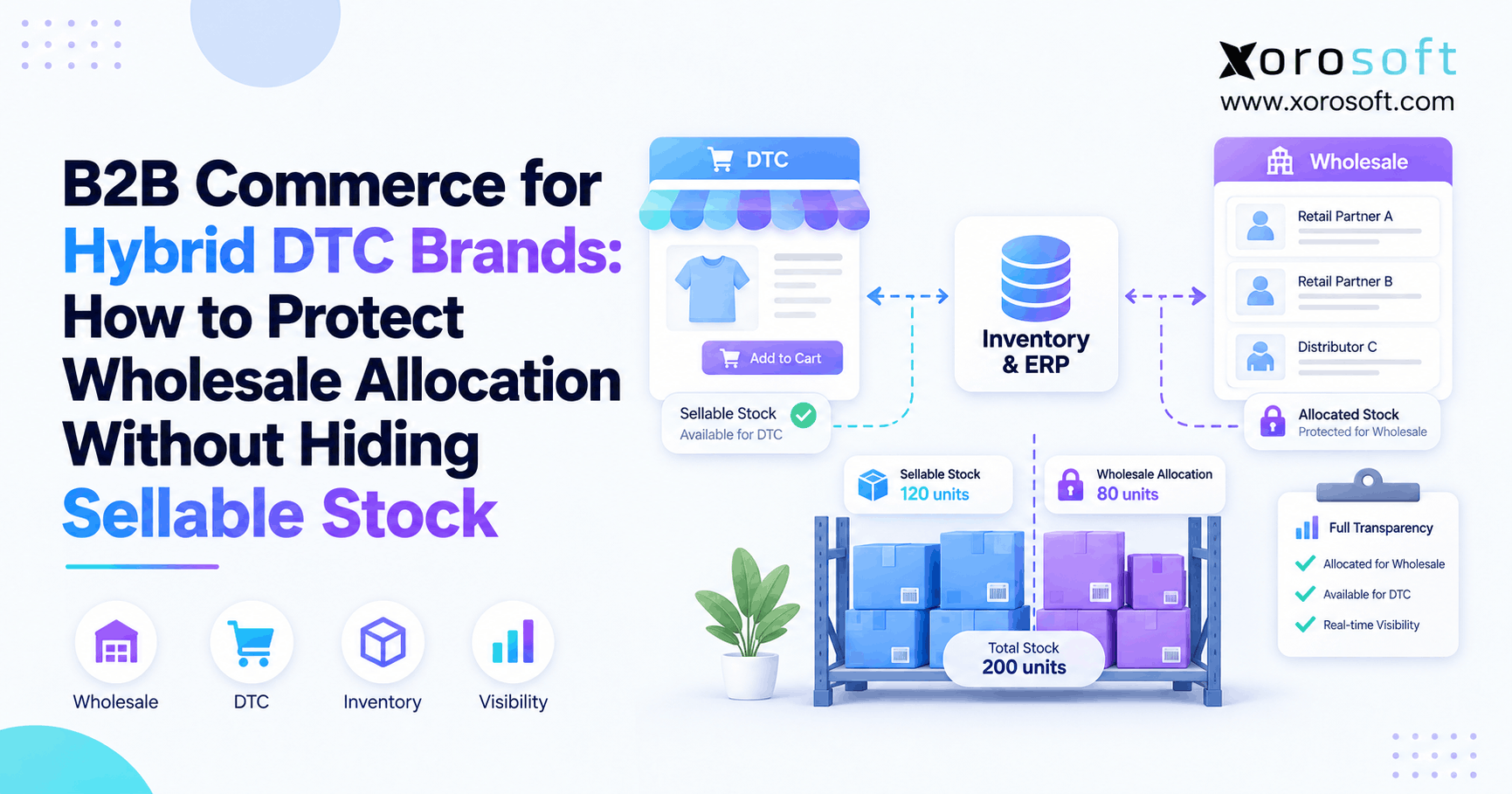
Hybrid businesses need B2B fulfillment rules that protect wholesale commitments without preventing legitimate DTC sales.
For example, the same company may sell through wholesale accounts, Shopify, Amazon, and other ecommerce channels. Therefore, several channels can compete for the same inventory.
Without centralized commitments, each channel may behave as if every available unit belongs to it.
9.1 Shared inventory needs allocation logic
Suppose a business has 300 units in stock.
Meanwhile:
- 150 units belong to a wholesale allocation,
- Shopify customers continue ordering,
- marketplace orders arrive,
- another distributor requests 200 units.
Therefore, a simple “300 available” message exposes too much inventory.
Instead, the business needs channel-aware availability.
For Shopify-centric operations, Xorosoft also maintains a listing on the Shopify App Store, which provides useful context when evaluating how ERP and ecommerce workflows can connect.
9.2 Integrations should move more than order data
A basic integration may transfer an order from one application to another. However, sophisticated operations also need inventory, customer, shipment, allocation, and status information to move between systems.
Therefore, businesses should evaluate the depth of their Xorosoft integrations rather than checking only whether a connector exists.
That distinction becomes increasingly important as channels and warehouse locations multiply.
10. ERP and WMS Roles in B2B Fulfillment Rules
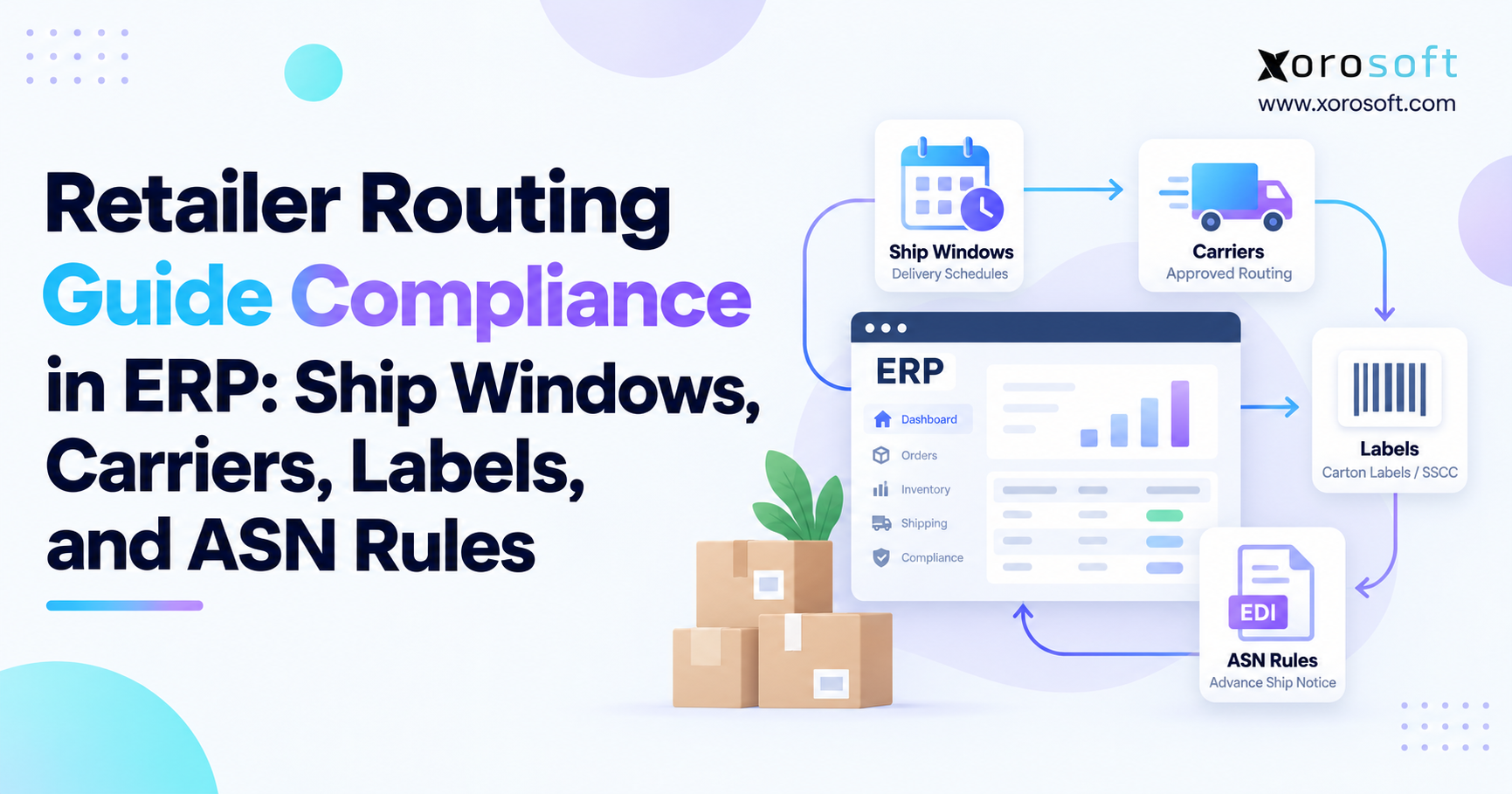
Reliable B2B fulfillment rules require clear responsibilities across ecommerce, ERP, and WMS platforms.
The website should manage the customer-facing buying experience. Meanwhile, the ERP should coordinate customer data, orders, inventory commitments, purchasing, and financial consequences.
Then, the WMS should execute the physical warehouse work.
10.1 B2B commerce should capture valid orders
A B2B portal should help customers place orders that already respect relevant commercial rules.
For example, XoroONE can sit within the digital ordering layer for businesses that need customer-facing B2B workflows connected with operational data.
Therefore, order validation can occur before warehouse execution begins.
10.2 Warehouse management should execute the promise
After the company accepts and allocates an order, warehouse execution becomes critical.
A system such as XoroWMS supports the operational layer where teams receive, pick, pack, stage, and ship inventory.
Consequently, a delivery promise remains credible only when the warehouse can execute the work behind it.
The ERP and WMS should therefore share inventory and order status rather than operate from separate assumptions.
11. Common Fulfillment Rule Failures
Fulfillment problems often begin with small rule inconsistencies rather than system outages.
For example, one application may show physical inventory while another subtracts allocations. Consequently, both systems may appear accurate while giving teams different answers.
Therefore, operations leaders should audit the meaning behind every inventory number.
11.1 Showing physical stock instead of sellable stock
Physical inventory may include:
- allocated units,
- quality holds,
- safety stock,
- channel reservations,
- unavailable lots.
Therefore, raw on-hand inventory can overstate customer availability.
Instead, the website should use a clearly defined sellable or ATP quantity.
11.2 Ignoring warehouse cutoffs
Carrier transit may be correct while the promised date remains wrong.
For example, a three-day transportation estimate does not matter if the warehouse already missed today’s processing window.
Consequently, the ship date should be calculated before the arrival date.
11.3 Using one rule for every facility
Warehouses may have different schedules, labor capacity, carrier pickups, and product capabilities.
Therefore, a single global processing time can create incorrect estimates.
Instead, businesses should store facility-specific rules wherever operational differences materially affect fulfillment.
12. Industry-Specific B2B Order Fulfillment Rules
Different industries use the same fulfillment principles differently.
Therefore, businesses should configure operational rules around how their products move rather than copying a generic ecommerce model.
Companies exploring these differences can also review the range of industries Xorosoft serves when mapping ERP and warehouse requirements to industry-specific workflows.
12.1 Apparel and fashion
Apparel companies manage style, color, and size combinations.
Therefore, 1,000 units across a style family do not necessarily mean that a buyer’s requested SKU mix remains available.
Moreover, brands often balance wholesale allocations against DTC sales. Consequently, inventory commitment needs to operate at the correct SKU and channel level.
12.2 Furniture
Furniture orders may include large products, multi-carton sets, freight delivery, or appointment scheduling.
Therefore, standard parcel assumptions can create unrealistic promises.
In addition, different pieces of the same order may reside in different warehouses. Consequently, companies may need to consolidate inventory before shipping.
12.3 Food, distribution, and manufacturing
Food businesses may need lot, shelf-life, case, and pallet controls. Meanwhile, distributors often manage customer-specific packaging, allocations, and EDI requirements.
Manufacturers add another variable: future production.
Therefore, each industry needs fulfillment rules that match its inventory, packaging, production, and customer-service model.
13. When B2B Fulfillment Rules Stop Scaling
Basic B2B fulfillment rules can work well when a business has one warehouse, straightforward products, and limited customer-specific requirements.
However, complexity increases quickly as the company adds warehouses, wholesale accounts, Shopify, Amazon, EDI, manufacturing, or additional inventory policies.
Eventually, teams begin solving system limitations manually.
13.1 Warning signs that the current model is failing
Common warning signs include:
- spreadsheet-based allocations,
- frequent delivery-date overrides,
- manual case-pack corrections,
- mismatched inventory between channels,
- repeated warehouse exceptions,
- excessive split shipments,
- inaccurate ATP,
- disconnected purchasing data,
- manual order routing.
Therefore, these symptoms should not be treated as isolated employee errors.
Instead, they often show that the operating model has outgrown its systems.
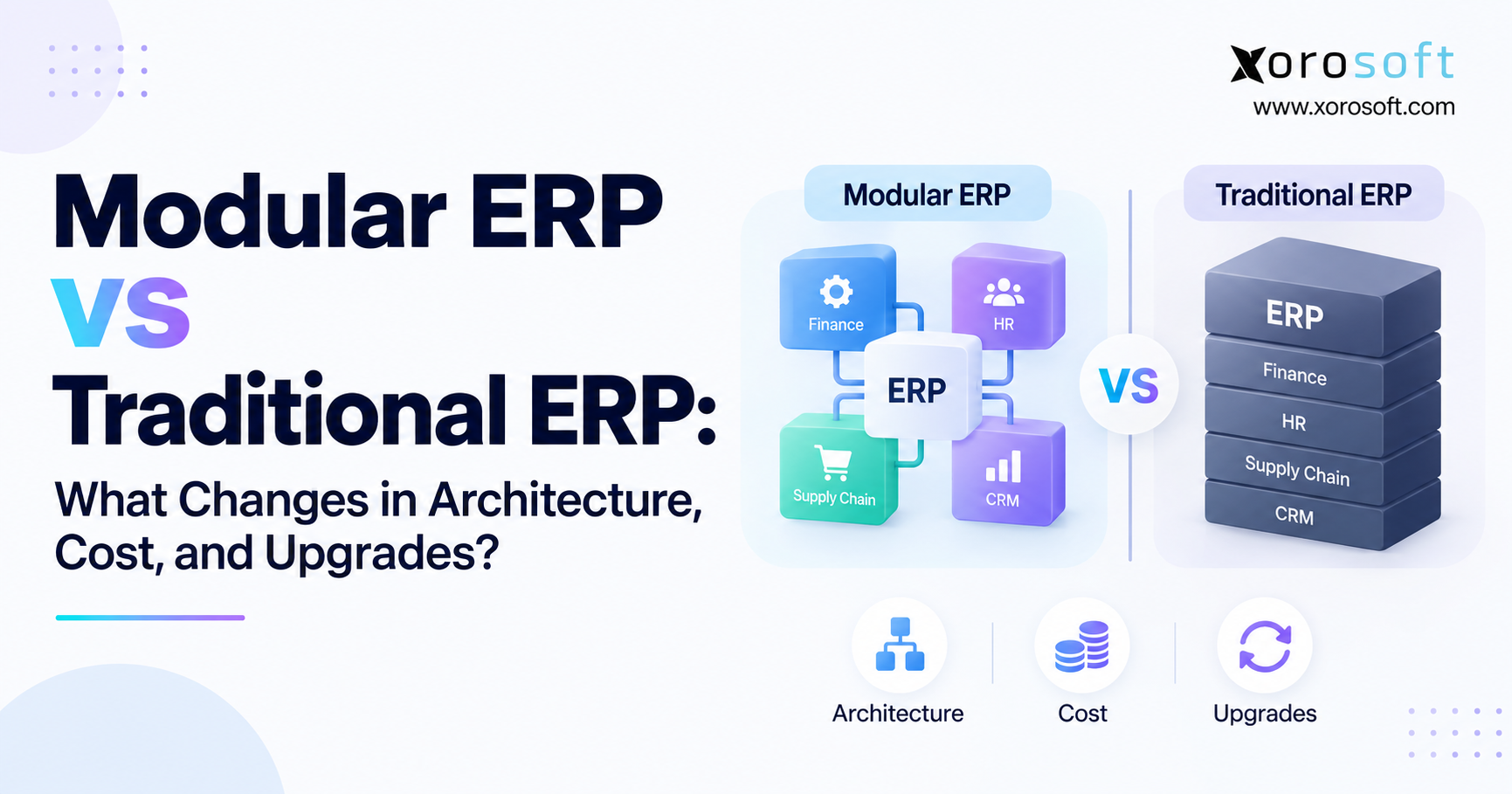
13.2 When ERP becomes more relevant
Inventory complexity eventually touches purchasing, sales, warehouses, accounting, and customer service simultaneously.
Therefore, an inventory-only system may no longer provide enough context.
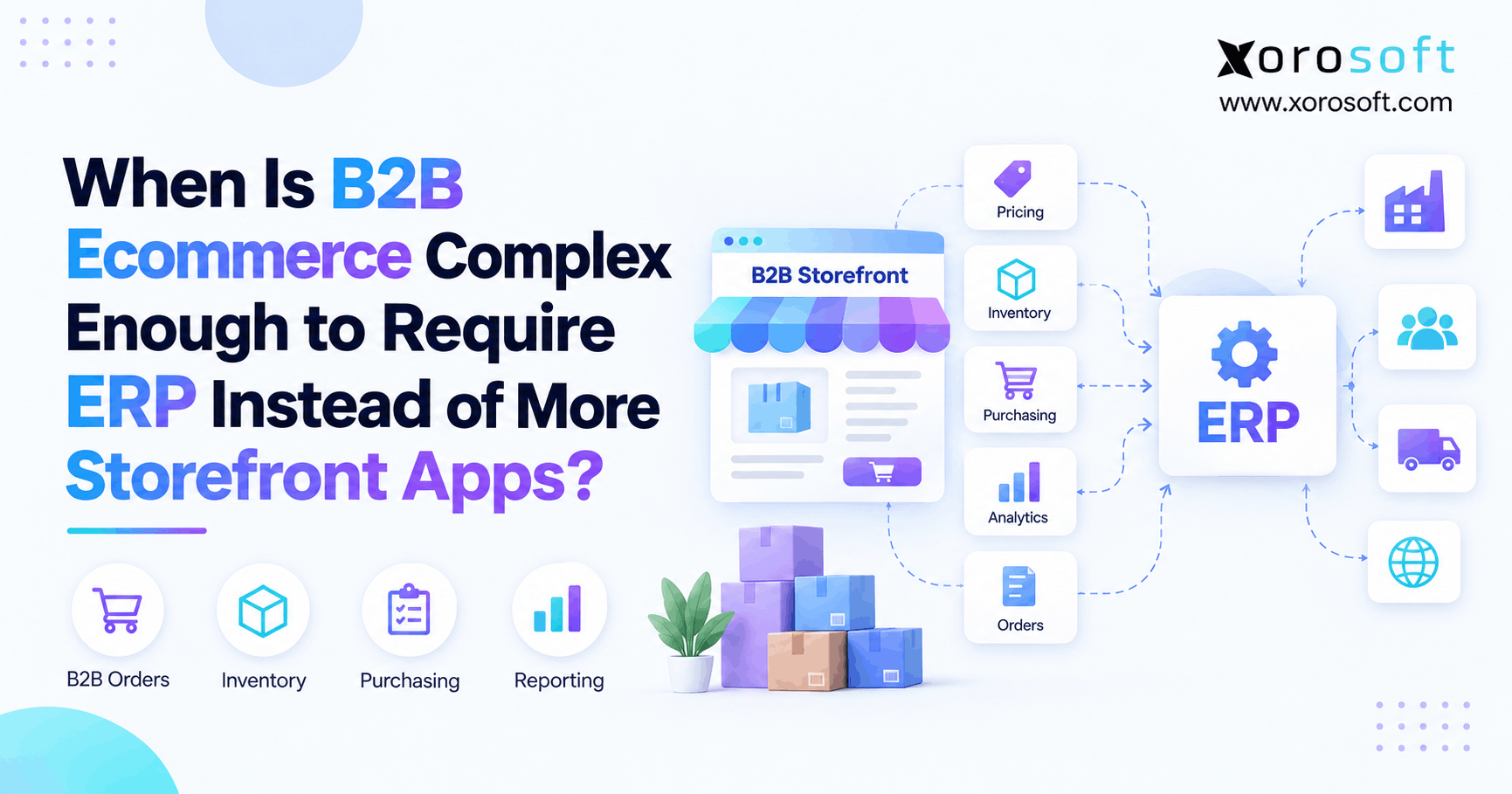
Xorosoft’s XoroERP is designed for inventory-driven businesses that need these workflows connected rather than managed through separate applications and spreadsheets.
However, companies should still evaluate their processes first. Technology works best after the business defines its inventory, allocation, fulfillment, and service rules clearly.
14. Build One Connected Fulfillment Architecture
A scalable architecture starts with shared definitions.
First, the company should define what “available” means. Next, it should decide how allocations, customer rules, packaging requirements, and warehouse constraints influence that number.
Then, each system should consume the same operational logic.
14.1 Centralize availability and commitments
A conceptual sellable-inventory model might look like:
Eligible inventory + eligible incoming supply − allocations − reservations − holds − protected stock
However, the exact formula should match the business.
Therefore, the most important requirement is consistency rather than copying one universal calculation.
14.2 Validate before execution
The ecommerce layer should validate the buyer, order quantity, UOM, case pack, and relevant shipping conditions first.
Then, the ERP can evaluate inventory commitments and routing inputs.
Finally, the WMS executes the physical work.
Consequently, warehouse employees receive executable orders instead of becoming the team that repairs invalid ecommerce transactions.
This model also reduces the number of manual decisions required as order volume grows.
15. What to Evaluate in B2B Fulfillment Software
Software evaluation should start with real operational scenarios instead of long feature lists.
For example, test what happens when the preferred warehouse has inventory but misses cutoff. Then test what happens when no single warehouse can fulfill the entire order.
Therefore, exception handling should influence the buying decision as much as standard workflows.
15.1 Capabilities worth testing
Look for support around:
- ATP visibility,
- inventory by warehouse,
- allocations and reservations,
- case packs and UOMs,
- customer-specific rules,
- order routing,
- ship-complete controls,
- partial shipments,
- backorders,
- purchasing,
- inbound inventory,
- ecommerce,
- EDI,
- warehouse execution,
- accounting integration.
Businesses can review Xorosoft’s broader ERP and operational solutions when mapping these capabilities against their requirements.
15.2 Evaluate workflows, not screenshots
A demo should follow a difficult order from beginning to end.
For example, ask the vendor to process an order that requires multiple warehouses, case quantities, protected inventory, and partial-shipment rules.
Then, check what the customer sees, what the warehouse receives, and how accounting records the transaction.
In addition, review relevant customer case studies to understand how companies applied the system in operational environments.
Therefore, buyers can evaluate process fit instead of relying solely on feature claims.
16. Reliable Delivery Promises Require Shared Operational Rules
A reliable B2B delivery promise starts long before a carrier receives the shipment.
First, the company needs accurate inventory commitments. Next, it must enforce packaging and customer rules. Then, operations must select a warehouse that can actually execute the order within the required time.
Afterward, the business must decide whether to consolidate, split, backorder, or partially fulfill the order.
Therefore, the strongest B2B fulfillment rules connect the buyer’s request with physical warehouse reality.
The website should not promise inventory already committed elsewhere. Likewise, warehouses should not discover invalid case quantities only after an order reaches the pick queue.
Moreover, the delivery date should reflect warehouse cutoffs rather than relying only on carrier transit.
As operations expand, Xorosoft can provide a connected environment across ERP, warehouse management, ecommerce, inventory, purchasing, and order workflows.
If disconnected systems now make delivery promises difficult to trust, Book a Demo to evaluate how those workflows could operate through a more connected process.
FAQs
What are B2B fulfillment rules?
B2B fulfillment rules determine how inventory, customer requirements, case packs, warehouse routing, cutoffs, and shipment policies control whether and when an order can be fulfilled.
How do warehouse cutoffs affect delivery dates?
Warehouse cutoffs determine whether processing starts today or the next eligible business day. Therefore, missing a cutoff can move both the ship date and delivery date.
What is available-to-promise inventory?
Available-to-promise inventory represents stock that remains eligible for new customer commitments after accounting for relevant allocations, reservations, demand, and other availability rules.
How do case packs affect B2B orders?
Case packs require buyers to order defined quantity multiples. Consequently, physical inventory may exceed the quantity that a specific wholesale customer can actually purchase.
What causes split shipments in B2B fulfillment?
Split shipments commonly occur when one warehouse cannot fulfill the complete order, products sit in different locations, or partial delivery provides better service than waiting.
Should B2B orders always ship complete?
No. Ship-complete rules reduce freight and receiving complexity, while partial shipments can deliver urgent products sooner. Therefore, customer preference, cost, and urgency should guide the decision.
When should a company upgrade its fulfillment system?
An upgrade becomes relevant when manual allocation, multiple warehouses, inventory mismatches, spreadsheet rules, frequent shipment exceptions, or disconnected ERP and WMS data repeatedly affect customer promises.
Recent Posts
-
 Top AI Demand Planning Tools: How to Compare Models, Data Inputs, and Planner Controls
 -
 When to Implement ERP for Ecommerce Instead of Adding More B2B Storefront Apps
 -
 B2B Website Fulfillment Rules: How Warehouse Cutoffs, Case Packs, and Split Shipments Shape Delivery Promises
 -
 B2B Inventory Allocation for Hybrid DTC Brands: Protect Wholesale Without Hiding Sellable Stock
 -
 B2B Ecommerce Solution for Dealer Networks: Territory Rules, Account Groups, Ship-Tos, and Price Structures