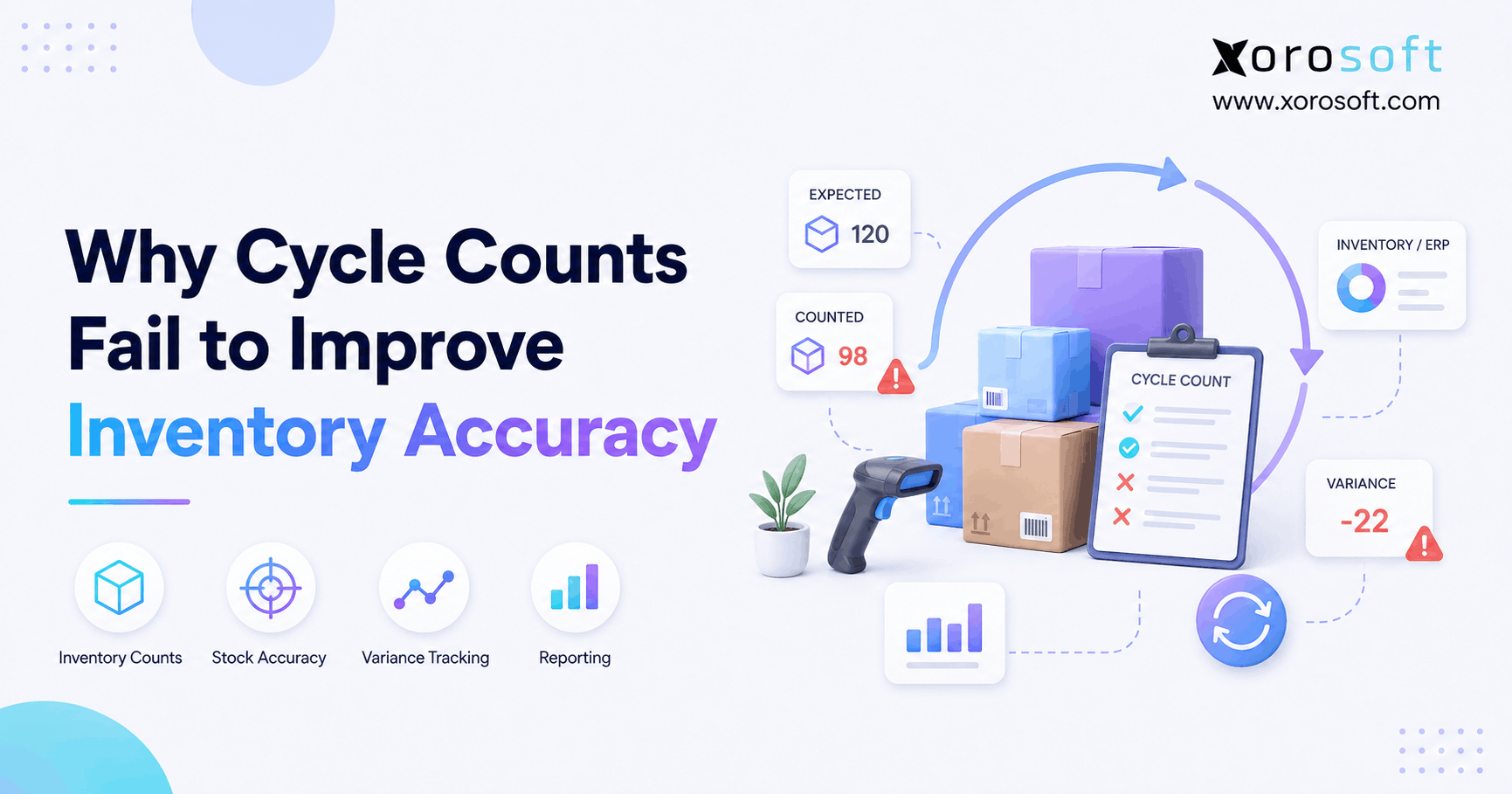
Maintaining optimal cycle count accuracy is essential for effective inventory management.
1. When More Counting Still Produces the Same Inventory Problems
Cycle count accuracy often stays low even when warehouse teams count inventory more frequently. Although cycle counting can identify a discrepancy, the count itself does not automatically correct the receiving, putaway, picking, transfer, return, or system process that created the error. Therefore, businesses can repeatedly count the same inventory while the underlying cause continues producing new variances.
In other words, counting inventory and controlling inventory are not the same thing.
For example, suppose the system shows 120 units of a SKU while the physical location contains only 116. Consequently, the cycle count identifies a four-unit shortage. The warehouse then adjusts the recorded quantity to 116, so the inventory record becomes accurate again.
However, imagine that the four missing units resulted from a picking process in which employees occasionally remove products without completing the correct system transaction. Because that workflow remains unchanged, another discrepancy can appear within days.
Therefore, a successful cycle counting program needs to accomplish two objectives:
- Correct the inventory record.
- Correct the process that caused the record to become inaccurate.
Moreover, this distinction explains why many businesses complete thousands of cycle counts but still struggle with unreliable inventory.
1.1 Cycle Counting Finds Evidence
First, a cycle count tells the business that physical inventory and recorded inventory do not agree.
However, the variance does not automatically explain what happened.
For instance, the difference may have originated from:
- Receiving
- Putaway
- Replenishment
- Picking
- Packing
- Shipping
- Warehouse transfers
- Customer returns
- Damaged inventory
- Manufacturing consumption
- Unit-of-measure errors
- Manual adjustments
- Delayed system transactions
Therefore, the variance should be treated as operational evidence rather than merely as a number that needs correction.
1.2 Inventory Accuracy Requires Prevention
By contrast, inventory accuracy depends heavily on what happens between counts.
If every physical inventory movement produces the correct system transaction, discrepancies should become less frequent. However, when employees regularly rely on workarounds, spreadsheets, manual adjustments, or disconnected applications, the next cycle count can simply uncover another version of the same problem.
As a result, improving cycle count accuracy requires more than increasing counting frequency.
Instead, the goal should be creating fewer errors between counts.
2. What Cycle Count Accuracy Actually Measures
Cycle count accuracy measures how closely the inventory records reviewed during a cycle count agree with the inventory physically found.
However, businesses should define what “accurate” means before comparing percentages.
For example, one company may require an exact quantity match. Meanwhile, another company may consider a count accurate when the difference remains within an approved tolerance.
Similarly, one warehouse may measure accuracy by SKU, whereas another may measure:
- SKU
- Quantity
- Bin location
- Lot
- Serial number
- Inventory status
Therefore, organizations should document the calculation method before treating the percentage as a meaningful KPI.
2.1 Cycle Count Accuracy vs. Inventory Accuracy
Although the concepts are closely related, they describe different things.
| Area | Cycle Counting | Inventory Accuracy |
|---|---|---|
| Purpose | Verify selected stock | Measure reliability of records |
| Type | Operational process | Business outcome |
| Scope | Selected items or locations | Broader inventory environment |
| Primary output | Count and variance | Accuracy measurement |
| Detects discrepancies | Yes | Reflects their overall impact |
| Prevents errors automatically | No | No |
Therefore, cycle counting is one control used to support inventory accuracy.
Inventory accuracy, however, is the broader result.
Consequently, a warehouse can complete every scheduled cycle count while still maintaining unreliable inventory records.
2.2 What a Cycle Count Variance Really Tells You
A cycle count variance tells you that two quantities disagree:
- Physical quantity
- System quantity
However, it does not explain why they disagree.
For example, a five-unit shortage could result from receiving. Alternatively, the problem could originate from a pick, warehouse transfer, return, damaged product, production transaction, or manual adjustment.
Therefore, adjusting the quantity without investigation removes the symptom from the report but may leave the cause completely untouched.
3. Why Poor Cycle Count Accuracy Keeps Returning
Most failed cycle counting programs follow a predictable pattern.
First, an operational error occurs. Next, the inventory record becomes inaccurate. Then, a cycle count detects the difference. Afterward, the warehouse posts an adjustment.
At that point, the record appears correct again.
However, if nobody investigates the cause, the original workflow continues unchanged. Consequently, another inventory error occurs, and the warehouse eventually performs another count.
This creates a cycle count failure loop:
1. An operational mistake occurs.
2. The inventory record becomes inaccurate.
3. A cycle count identifies the variance.
4. Inventory is recounted if required.
5. The system quantity is adjusted.
6. The root cause remains unresolved.
7. The same workflow continues.
8. Another discrepancy develops.
9. Inventory must be counted again.
Therefore, increasing count frequency alone may simply make the business faster at discovering errors.
It does not necessarily improve cycle count accuracy over time.
3.1 An Adjustment Is Not Root-Cause Correction
For example, consider a warehouse where employees move products from overflow storage into forward picking locations without recording the transfer.
Eventually, a cycle count identifies the location discrepancy.
The warehouse then corrects both location balances.
However, employees still have permission to move inventory without completing the correct system transaction. Consequently, another employee can recreate the same discrepancy the following day.
Therefore, the adjustment fixed the inventory record.
Nevertheless, it did not fix the warehouse process.
3.2 Repeat Variances Are Operational Signals
When the same SKU, bin, warehouse, or transaction repeatedly produces variances, managers should look beyond the individual count.
Instead, they should ask:
- Does the problem always occur in the same warehouse?
- Does one bin generate most discrepancies?
- Do problems frequently follow receiving?
- Are transferred products repeatedly affected?
- Does one unit of measure appear in several errors?
- Are returns creating inventory-status problems?
- Does one sales channel create synchronization delays?
Consequently, recurring discrepancies can become valuable diagnostic information.
4. Nine Root Causes Behind Poor Cycle Count Accuracy
4.1 Receiving Errors Start the Inventory Record Incorrectly
Inventory accuracy can fail before a product ever reaches its storage location.
For example, receiving teams may:
- Record more units than physically arrived.
- Record fewer units than physically arrived.
- Receive the wrong SKU.
- Use the wrong unit of measure.
- Miss damaged quantities.
- Post the same receipt twice.
- Move inventory before completing the receipt.
Consequently, every downstream transaction begins with an incorrect balance.
Therefore, cycle count accuracy may remain poor even when counters are working correctly because the original error occurred at the receiving dock.
4.2 Putaway Errors Separate Products From Their Recorded Locations
Sometimes the total warehouse quantity is correct while the location information is wrong.
For example, the system may show 20 units in Bin A while the product physically sits in Bin B.
Consequently:
- Pickers cannot find inventory.
- Replenishment becomes unreliable.
- Cycle counts produce location variances.
- Available inventory can become misleading.
- Warehouse productivity decreases.
Therefore, location validation becomes especially important in multi-bin warehouses.
4.3 Picking Errors Create Silent Inventory Variances
Because picking occurs continuously, small transaction errors can accumulate quickly.
For example, a picker may:
- Take six units instead of five.
- Pick a nearby variant.
- Substitute another product.
- Remove damaged stock.
- Fail to confirm a short pick.
As a result, physical inventory changes while the system quantity may remain unchanged.
Therefore, repeated shortages should often trigger a review of picking activity instead of simply another inventory adjustment.
4.4 Warehouse Transfers Create Two-Sided Inventory Risk
Transfers are particularly vulnerable because inventory moves through several stages.
For example, stock may be:
- At the source warehouse
- Picked for transfer
- Shipped
- In transit
- Partially received
- Fully received
- Damaged during transfer
- Received into the wrong location
Consequently, both the sending and receiving sides must be recorded correctly.
Moreover, every additional warehouse introduces more opportunities for transfer timing and destination errors.
Therefore, multi-location businesses should investigate transfer accuracy whenever cycle count accuracy deteriorates across specific warehouses.
4.5 Returns Can Bypass Standard Inventory Controls
Returns create discrepancies because returned products do not all have the same inventory status.
For example, a returned item may be:
- Sellable
- Damaged
- Incomplete
- Quarantined
- Awaiting inspection
- Scheduled for vendor return
- Awaiting refurbishment
Therefore, immediately placing every returned product back into available inventory can create inaccurate records.
Instead, a controlled returns workflow should define:
1. Where returned products arrive.
2. Who inspects them.
3. Which inventory status they receive.
4. When they become sellable.
5. How damaged products are handled.
Consequently, return accuracy becomes an important component of cycle count accuracy.
4.6 Unit-of-Measure Errors Multiply Inventory Variances
Products are often purchased, stored, and sold using different units of measure.
For example:
- Purchased by case
- Stored by case
- Picked by each
- Sold by pack
Therefore, incorrect conversion rules can produce substantial discrepancies.
For instance, suppose one case contains 12 units. If ten cases are received but the system records ten individual units instead of 120, the discrepancy is not caused by cycle counting.
Instead, it is a master-data or transaction-control problem.
4.7 Late Transactions Create False Cycle Count Variances
Cycle counting measures inventory at a particular moment.
Therefore, transaction timing matters.
For example, suppose ten units have physically shipped, but the shipment has not yet been confirmed in the system. Consequently, physical inventory appears ten units lower than the recorded balance.
Similarly, an unposted receipt can create the opposite result.
Therefore, businesses should establish clear transaction cutoffs before investigating significant differences.
4.8 Uncontrolled Adjustments Hide Error Patterns
A generic adjustment reason such as “inventory correction” provides almost no useful operational information.
Instead, useful reason codes may include:
- Receiving shortage
- Receiving overage
- Wrong putaway
- Picking error
- Transfer discrepancy
- Return error
- Damage
- Unit-of-measure issue
- Manufacturing consumption error
- Integration delay
- Master-data problem
- Shrinkage
Consequently, managers can group discrepancies by cause instead of reviewing hundreds of unrelated adjustments.
4.9 Disconnected Systems Create Competing Inventory Records
Inventory becomes harder to control when several applications maintain different interpretations of stock.
For example, a growing business may rely on:
- Accounting software
- Inventory software
- Warehouse software
- Shopify
- Amazon
- EDI applications
- Purchasing spreadsheets
- Manual inventory files
Consequently, one physical transaction may need to pass through several applications before every quantity agrees.
Therefore, weak integration can damage cycle count accuracy even when the physical warehouse process itself is relatively disciplined.
5. How to Diagnose Cycle Count Accuracy Problems
Improving cycle count accuracy starts with understanding where recurring discrepancies originate. Instead of immediately correcting every variance, businesses should investigate patterns across SKUs, bins, warehouses, employees, and transaction types.
5.1 Analyze Variances by Dimension
First, review discrepancies by:
- SKU
- Bin
- Warehouse
- Product category
- Employee or team
- Supplier
- Transaction type
- Return type
- Sales channel
- Time period
For example, if one storage zone creates most location errors, the problem may involve putaway or replenishment rather than counting.
Similarly, if one product family repeatedly produces quantity differences, the organization should review its unit-of-measure configuration.
Therefore, pattern analysis converts individual variances into actionable operational information.
5.2 Compare Positive and Negative Variances
Next, separate shortages from overages.
For instance, repeated shortages may indicate:
- Unrecorded outbound movement
- Picking problems
- Damage
- Shrinkage
- Manufacturing consumption
Conversely, repeated overages may suggest:
- Receiving problems
- Return-processing errors
- Incorrect transfers
- Delayed transaction posting
Therefore, variance direction can help narrow the investigation.
5.3 Review Transaction History Before Adjusting
Before posting a material adjustment, review:
- Recent receipts
- Recent picks
- Transfers
- Shipment confirmations
- Customer returns
- Production transactions
- Previous adjustments
- User activity
Consequently, teams have a much better chance of identifying what actually created the difference.
5.4 Track Repeat Cycle Count Discrepancies
Most importantly, identify recurring problems.
For example, create a report showing SKUs or locations that generated multiple unexplained discrepancies during the last:
- 30 days
- 60 days
- 90 days
Then, prioritize those records for investigation.
As a result, cycle count accuracy becomes part of continuous process improvement rather than an endless inventory cleanup exercise.
6. A Better Workflow for Improving Cycle Count Accuracy
A strong process should combine counting with investigation and prevention.
6.1 Prioritize Inventory by Risk
First, do not treat every SKU equally.
Instead, count frequency can consider:
- Inventory value
- Sales velocity
- Historical variances
- Shrinkage risk
- Customer impact
- Production importance
- Lot or serial requirements
Therefore, high-risk inventory can receive greater attention without forcing the warehouse to count everything constantly.
6.2 Use Blind Counts Where Appropriate
Next, consider hiding the expected system quantity from the counter.
Because the employee cannot see the expected number, blind counting can reduce confirmation bias.
However, the process should still support independent recounts for material discrepancies.
6.3 Recount Significant Variances
If a discrepancy exceeds a defined threshold, perform another count.
Moreover, where appropriate, a different employee should conduct the recount.
Consequently, the organization can separate genuine inventory differences from counting mistakes.
6.4 Investigate Before Posting the Adjustment
After confirming the variance, review the relevant transaction history.
Then, determine whether the problem originated from:
- Receiving
- Putaway
- Picking
- Shipping
- Transfer
- Returns
- Manufacturing
- System integration
Therefore, inventory adjustment becomes the final correction step rather than the first response.
6.5 Assign a Root-Cause Code
Next, assign a reason code to meaningful discrepancies.
As a result, the business can report not only how much inventory was adjusted but also why.
Moreover, this information creates operational accountability.
6.6 Correct Both the Record and the Process
Finally, correct the system balance.
However, the work should not stop there.
For example:
- A receiving problem may require quantity validation.
- A putaway problem may require location scanning.
- A transfer problem may require send-and-receive confirmation.
- A picking problem may require item validation.
- A return problem may require inventory-status controls.
Consequently, every cycle count can become an opportunity to improve cycle count accuracy permanently.
7. Cycle Count Accuracy Metrics That Reveal Real Improvement
Businesses often measure the number of counts completed.
However, count volume does not indicate whether inventory control is actually improving.
Instead, track metrics such as:
- Cycle count accuracy
- Inventory record accuracy
- Number of variances
- Variance quantity
- Variance value
- Recount rate
- Adjustment frequency
- Repeat discrepancy rate
- Location accuracy
- Root-cause recurrence
Therefore, cycle count accuracy should be evaluated alongside repeat variance rates, adjustment frequency, and root-cause recurrence rather than treated as an isolated percentage.
7.1 Repeat Discrepancy Rate Matters More Than Count Volume
For example, suppose Warehouse A completes 5,000 counts each month while Warehouse B completes 2,500.
At first, Warehouse A may appear more disciplined.
However, if Warehouse A continues finding the same discrepancies while Warehouse B’s repeat variance rate falls steadily, Warehouse B may actually have stronger inventory control.
Therefore, the key question is not:
“How many counts did we complete?”
Instead, ask:
“Are the same inventory errors becoming less common?”
8. Where Cycle Count Accuracy Breaks Across the Warehouse
Because cycle count accuracy depends on every inventory movement, errors can originate long before an employee begins counting stock.
| Process | Typical Problem | Likely Cause | Better Control |
| Receiving | Recorded stock exceeds physical stock | Incorrect receipt | Quantity validation |
| Putaway | Product in wrong bin | Unrecorded movement | Location scanning |
| Picking | Physical shortage | Wrong quantity picked | Pick validation |
| Transfers | Warehouse quantities disagree | Incomplete transfer | Send/receive controls |
| Returns | Stock exists but is unavailable | Wrong inventory status | Returns inspection |
| Manufacturing | Component shortage | Unrecorded consumption | Production controls |
| Adjustments | Frequent unexplained changes | Weak authorization | Reason codes and approvals |
| Ecommerce | Channel quantity differs | Synchronization issue | Connected inventory flow |
Therefore, inventory accuracy should never be treated as the responsibility of the cycle-counting team alone.
Instead, every warehouse process contributes to the final inventory balance.
9. How Technology Supports Better Cycle Count Accuracy
Software cannot rescue an undefined warehouse process.
However, once the workflow is clear, technology can enforce it more consistently.
9.1 Barcode Scanning Creates Transaction Discipline
Barcode scanning can validate:
- Product
- Location
- Quantity
- Inventory movement
- Task completion
Consequently, warehouse employees rely less on memory and manual entry.
Moreover, scanning becomes especially useful when operations manage similar SKUs, product variants, or large numbers of storage locations.
9.2 WMS Controls Physical Warehouse Execution
A warehouse management system can structure:
- Receiving
- Putaway
- Replenishment
- Picking
- Packing
- Shipping
- Transfers
- Cycle counting
Therefore, a WMS can make physical inventory movements easier to trace.
For example, XoroWMS connects warehouse execution with inventory workflows so businesses can manage activities such as receiving, picking, transfers, and cycle counting within a more controlled environment.
9.3 ERP Connects Inventory With the Rest of the Business
As companies grow, inventory problems rarely remain confined to the warehouse.
For example:
- Receiving affects purchasing.
- Shipping affects sales.
- Manufacturing affects materials.
- Inventory adjustments affect accounting.
- Transfers affect several facilities.
- Ecommerce affects available stock.
Therefore, businesses may eventually need inventory information to flow through a broader operational platform.
XoroERP is one example of an ERP approach designed for inventory-driven businesses that need operational and financial processes to remain connected.
10. Multi-Warehouse Operations Increase Inventory Risk
Every additional warehouse adds more:
- Locations
- Employees
- Transfers
- Receipts
- Inventory movements
- Reconciliation points
Consequently, cycle count accuracy can become harder to maintain as the warehouse network grows.
10.1 Transfer Accuracy Becomes Critical
A business may have the correct company-wide quantity while one warehouse is short and another is over.
Therefore, businesses should monitor both:
- Total inventory accuracy
- Location-level inventory accuracy
Otherwise, the network may appear correct at a consolidated level while warehouse teams continue experiencing fulfillment problems.
10.2 Central Inventory Visibility Becomes More Valuable
As warehouse complexity grows, organizations often need a central inventory record that supports multiple facilities.
For example, XoroONE is designed to connect inventory with broader operational processes rather than treating each warehouse as an isolated stock balance.
However, technology should still support clearly defined transfer procedures.
11. Why Ecommerce Makes Cycle Count Accuracy Harder
Ecommerce adds another layer because inventory can change through several channels at once.
For example, a growing brand may sell through:
- Shopify
- Amazon
- Wholesale
- EDI
- Retail
- Marketplace channels
Consequently, warehouse inventory can be affected by orders arriving from several sources throughout the day.
11.1 Shopify Inventory Must Match Physical Operations
If Shopify shows inventory available that the warehouse cannot physically fulfill, customers may purchase unavailable products.
Conversely, if the warehouse physically has stock that the ecommerce channel does not recognize, the business can lose potential sales.
Therefore, ecommerce inventory accuracy depends on both reliable warehouse execution and reliable system integration.
Xorosoft is also available on the Shopify App Store, which provides an external reference for Shopify merchants evaluating how ERP and ecommerce operations can connect.
11.2 Multi-Channel Sales Increase Transaction Volume
As sales channels increase, so does the number of inventory events.
Therefore, businesses need consistent rules for:
- Allocation
- Picking
- Returns
- Cancellations
- Transfers
- Available inventory
- Order status
Otherwise, cycle counting can gradually become the cleanup mechanism for errors created elsewhere.
11.3 Integration Quality Matters
Disconnected ecommerce, accounting, warehouse, and purchasing applications often require duplicate data entry.
Consequently, synchronization delays or failed updates can create inventory differences even when warehouse employees follow the correct physical process.
Therefore, businesses experiencing these issues may need to evaluate their broader system integration strategy.
12. When a Business Should Upgrade Its Inventory System
Cycle counting problems do not automatically mean a company needs ERP.
However, recurring discrepancies can expose broader operational limitations.
Consider stronger inventory infrastructure when several of these conditions appear together:
- Multiple warehouses
- High SKU counts
- Frequent inventory adjustments
- Shopify plus wholesale
- Amazon
- EDI
- Manufacturing
- Complex purchasing
- Large transfer volumes
- Frequent reconciliation
- Spreadsheet-based controls
- Multiple inventory applications
Consequently, the need for more capable software usually reflects operational complexity rather than a single revenue threshold.
12.1 When a Simpler System May Still Be Enough
On the other hand, sophisticated ERP or WMS functionality may be unnecessary when the company has:
- One warehouse
- Few SKUs
- Low transaction volume
- Simple purchasing
- Few warehouse users
- No manufacturing
- Limited wholesale complexity
- Reliable inventory controls
Therefore, businesses should first determine whether the problem is process-related or system-related.
12.2 When Connected Operations Become More Important
When inventory problems cross purchasing, fulfillment, accounting, warehouse operations, and ecommerce, the business may benefit from broader operational integration.
For example, Xorosoft’s inventory-driven business solutions are designed around connected ERP, warehouse, ecommerce, and operational workflows.
Nevertheless, implementing more software without correcting poor processes will not automatically improve cycle count accuracy.
13. How Different Industries Experience Cycle Count Accuracy Problems
Inventory discrepancies do not look identical across every industry.
Therefore, cycle-count controls should reflect how products actually move.
13.1 Apparel and Fashion
Apparel warehouses frequently manage large numbers of variants.
For example, one style may include several:
- Colors
- Sizes
- Seasons
- Collections
Consequently, similar-looking products can increase wrong-SKU picking and putaway risk.
Therefore, item validation and location discipline become particularly important.
Xorosoft supports several inventory-driven sectors through its industry-specific ERP and warehouse capabilities, including apparel and other product businesses with complex SKU structures.
13.2 Furniture
Furniture operations may manage:
- Large storage areas
- Bulky products
- Components
- Damaged inventory
- Multiple warehouses
Therefore, knowing where inventory is located can become as important as knowing how much inventory exists.
13.3 Sporting Goods
Sporting goods companies often combine seasonal demand with large product catalogs.
Consequently, high-velocity items can generate more transaction errors during peak periods.
Therefore, risk-based counting can focus attention on inventory where inaccuracies create the greatest operational impact.
13.4 Food and Beverage
Food inventory may require control over:
- Lots
- Expiration dates
- Damaged inventory
- Quarantine
- Pack conversions
Consequently, the total quantity can appear correct while the wrong lot or inventory status remains recorded.
Therefore, quantity accuracy alone may not provide sufficient control.
13.5 Wholesale Distribution
Wholesalers often manage:
- Case and each quantities
- Large customer orders
- EDI
- Inventory allocation
- Multi-location inventory
As a result, transaction complexity increases quickly.
Therefore, reliable warehouse and purchasing workflows become increasingly important.
13.6 Manufacturing
Manufacturing introduces additional inventory transactions:
- Raw-material issues
- Work orders
- Component consumption
- Scrap
- Finished-goods completion
Consequently, an inventory discrepancy may originate on the production floor rather than inside the warehouse.
Therefore, manufacturing businesses should include production transactions when investigating cycle count accuracy.
14. A Practical Framework for Improving Cycle Count Accuracy
Ultimately, improving cycle count accuracy requires a repeatable process for detecting, investigating, correcting, and preventing inventory variances.
14.1 Step 1: Establish an Accuracy Baseline
First, define exactly how inventory accuracy will be measured.
Then, record results by:
- Warehouse
- Product class
- SKU
- Location
- Other meaningful operational segments
Consequently, future performance can be compared against a consistent baseline.
14.2 Step 2: Prioritize High-Risk Inventory
Next, identify:
- High-value products
- Fast-moving items
- Historically inaccurate SKUs
- High-shrinkage products
- Production-critical materials
Therefore, counting effort is directed where errors matter most.
14.3 Step 3: Standardize Counting Procedures
Define:
- Who performs counts
- When counting occurs
- Whether counts are blind
- When recounts are required
- How inventory movement is controlled
- Which variances require approval
Consequently, different teams and warehouses follow the same basic rules.
14.4 Step 4: Investigate Material Variances
Next, review transaction history before posting large adjustments.
Therefore, teams preserve the opportunity to understand the original error.
14.5 Step 5: Classify the Root Cause
Use consistent reason codes.
As a result, variance patterns become measurable rather than anecdotal.
14.6 Step 6: Fix the Operational Workflow
Then, modify the receiving, putaway, picking, transfer, return, or manufacturing process responsible for the error.
Consequently, the business moves from correction toward prevention.
14.7 Step 7: Add Transaction Validation
Where appropriate, introduce:
- Barcode scanning
- Location validation
- Approval rules
- Transfer confirmation
- Inventory-adjustment controls
Therefore, employees receive additional system guidance while performing physical warehouse work.
14.8 Step 8: Connect Critical Systems
As operational complexity grows, reduce duplicate inventory entry across applications.
Consequently, ecommerce, warehouse, purchasing, and financial processes can rely on more consistent inventory information.
14.9 Step 9: Monitor Recurrence
Afterward, track whether the same discrepancy returns.
If it does, the corrective action was probably incomplete.
14.10 Step 10: Repeat the Improvement Cycle
Finally, use cycle counting as continuous operational feedback.
Therefore, each variance contributes to a better warehouse process rather than merely creating another adjustment.
15. Frequently Asked Questions About Cycle Count Accuracy
15.1 What is cycle count accuracy?
Cycle count accuracy measures how closely inventory records reviewed during a cycle count agree with the physical inventory found. However, businesses should define whether an exact match is required or whether a tolerance is permitted. Therefore, the measurement method should remain consistent before results are compared across periods, warehouses, or product categories.
15.2 Why do cycle counts fail to improve inventory accuracy?
Cycle counts often fail because teams correct inventory quantities without correcting the process that created the discrepancy. For example, receiving, picking, transfers, returns, and delayed transactions can repeatedly create errors. Therefore, sustainable improvement requires both inventory correction and root-cause prevention.
15.3 What causes poor cycle count accuracy?
Poor cycle count accuracy can result from incorrect receiving, wrong-bin putaway, picking mistakes, transfer problems, returns, unit-of-measure issues, late transactions, or uncontrolled adjustments. Consequently, businesses should investigate the complete inventory workflow rather than focusing only on the employee performing the count.
15.4 How can cycle count accuracy be improved?
First, standardize the counting process. Next, recount material variances and review transaction history. Then, assign root-cause codes and correct the process responsible for the discrepancy. Finally, monitor whether the same variance returns. Therefore, cycle counting becomes part of continuous improvement instead of repeated correction.
15.5 What is considered good cycle count accuracy?
There is no single percentage that is equally meaningful for every operation because measurement methods differ. For example, one company may require exact quantity and location matches, whereas another may allow small tolerances. Therefore, businesses should define the metric clearly, establish a baseline, and focus on sustained improvement.
15.6 How often should cycle counts be performed?
Cycle count frequency should reflect inventory risk. For example, high-value, fast-moving, historically inaccurate, or operationally critical inventory may need more frequent counting. Conversely, slow-moving and stable inventory may be counted less frequently. Therefore, one counting schedule does not need to apply to every SKU.
15.7 What is a cycle count variance?
A cycle count variance is the difference between the quantity recorded in the system and the physical quantity found. However, the difference is only a symptom. Therefore, significant or recurring variances should be investigated before the organization assumes the issue is merely a counting mistake.
15.8 Why do inventory variances keep returning?
Recurring variances usually indicate that the underlying workflow has not been corrected. For example, a business may repeatedly adjust inventory after an unrecorded transfer while still allowing stock movements without confirmation. Consequently, the record becomes accurate temporarily but eventually becomes wrong again.
15.9 Should cycle counts be blind?
Blind counts can reduce confirmation bias because the employee does not see the expected quantity before counting. However, the correct approach depends on the inventory type and operating environment. Therefore, businesses should combine blind counts with controlled transactions and independent recounts where appropriate.
15.10 Should warehouse activity stop during a cycle count?
Not necessarily. Cycle counting is often designed to verify selected inventory without closing the entire warehouse. However, uncontrolled movement through the location being counted can create false variances. Therefore, businesses need clear transaction and cutoff procedures during the count.
15.11 Why does physical inventory not match the system?
Usually, a physical inventory movement occurred without the correct digital transaction. For example, the cause may involve receiving, putaway, picking, transfers, returns, damage, manufacturing, or delayed posting. Therefore, the investigation should begin with recent inventory transactions rather than immediately changing the quantity.
15.12 How should inventory discrepancies be investigated?
First, confirm the variance through a recount. Next, review receipts, picks, transfers, returns, manufacturing activity, and adjustments. Then, determine the likely cause. Finally, correct both the inventory balance and the underlying process. Consequently, the investigation creates preventive value.
15.13 Should inventory be adjusted immediately after a variance?
Not always. Although small differences may fall within predefined adjustment rules, unusual or material variances should generally be investigated first. Otherwise, the adjustment can remove useful evidence about how the error occurred. Therefore, correction should follow appropriate validation.
15.14 How do receiving errors affect inventory accuracy?
Receiving establishes the starting inventory balance. Therefore, recording the wrong quantity, SKU, condition, or unit of measure can make inventory inaccurate immediately. Consequently, every later pick, transfer, and cycle count may rely on a balance that was already wrong when the product entered the warehouse.
15.15 Can warehouse transfers cause inventory discrepancies?
Yes. Transfers involve inventory leaving one location and arriving at another. Therefore, missing shipment confirmation, partial receipts, incorrect destinations, or unrecorded physical movements can create discrepancies. Consequently, transfer workflows should provide clear source, in-transit, and destination visibility.
15.16 How do returns affect cycle count accuracy?
Returns create additional inventory-status decisions. For example, a returned unit may be sellable, damaged, incomplete, quarantined, or awaiting inspection. Therefore, physically placing returned inventory back into stock without completing the correct transaction can create quantity or availability discrepancies.
15.17 How do unit-of-measure errors affect inventory?
Unit-of-measure errors can multiply inventory differences. For example, one case may contain 12 individual units. Consequently, recording ten cases as ten units instead of 120 creates a major discrepancy. Therefore, purchasing, warehouse, and sales units should use controlled conversion rules.
15.18 Does barcode scanning improve inventory accuracy?
Barcode scanning can improve transaction discipline by validating products, locations, and movements. However, scanning alone does not guarantee accuracy. Therefore, workflows must require consistent scanning, while item and location master data must also remain accurate.
15.19 Can a WMS improve cycle count accuracy?
A WMS can structure warehouse processes such as receiving, putaway, picking, transfers, and cycle counting. Consequently, inventory movements become easier to trace. However, businesses still need appropriate procedures, training, and controls because technology cannot compensate for undefined processes.
15.20 Can ERP improve inventory accuracy?
ERP can help when inventory accuracy depends on transactions across purchasing, sales, accounting, manufacturing, and warehouse operations. Therefore, connected information can reduce duplicate entry and improve traceability. However, ERP does not automatically eliminate inventory errors unless operational processes are properly implemented.
15.21 What software can manage cycle counting?
Businesses can use inventory applications, WMS platforms, or ERP systems with warehouse functionality. However, the appropriate choice depends on operational complexity. Therefore, a small single-location company may need relatively simple software, whereas a multi-warehouse distributor may require stronger WMS or ERP controls.
15.22 Can Shopify inventory differ from warehouse inventory?
Yes. Differences can occur when orders, transfers, returns, fulfillment activity, or other transactions do not update inventory records correctly or quickly enough. Therefore, ecommerce inventory accuracy depends both on integration reliability and on accurate physical warehouse transactions.
15.23 How does multi-warehouse complexity affect cycle count accuracy?
Every additional facility increases the number of receipts, transfers, locations, users, and inventory movements that need to remain synchronized. Consequently, businesses require stronger transaction controls as their warehouse network expands. Therefore, transfer accuracy becomes especially important in multi-location operations.
15.24 When should a business move beyond spreadsheets?
Businesses should consider moving beyond spreadsheets when multiple employees update inventory, reconciliation becomes frequent, warehouses multiply, ecommerce channels require synchronization, or adjustments become difficult to trace. Therefore, system requirements should be based primarily on operational complexity rather than company size alone.
15.25 Can cycle counting replace a full physical inventory?
In some environments, a disciplined cycle-count program can reduce dependence on disruptive full counts. However, financial, audit, regulatory, or company policies may still require physical inventory procedures. Therefore, businesses should confirm their specific requirements with qualified accounting and audit professionals.
16. Turn Cycle Counts Into a Process Improvement System
Sustainable cycle count accuracy comes from preventing recurring errors between counts, not simply increasing the number of counts completed.
Therefore, cycle counts should do more than tell a warehouse that its inventory is wrong.
Instead, they should help explain why the inventory became wrong.
Every meaningful discrepancy should move through a consistent process:
1. Confirm the physical count.
2. Review transaction history.
3. Identify the likely root cause.
4. Assign an appropriate reason code.
5. Correct the inventory record.
6. Correct the operating process.
7. Monitor whether the discrepancy returns.
Consequently, businesses can stop treating cycle counts as repetitive cleanup work.
Moreover, as inventory operations expand across warehouses, Shopify, wholesale, Amazon, manufacturing, purchasing, and accounting, connected systems become increasingly important.
However, technology should reinforce operational discipline rather than replace it.
Ultimately, stronger cycle count accuracy comes from building receiving, warehouse, transfer, fulfillment, returns, and system processes that create fewer discrepancies in the first place.
Businesses evaluating a broader system change can also review relevant Xorosoft customer case studies to see how inventory-driven organizations have approached operational modernization.
If recurring inventory variances are exposing limitations in your current ERP, WMS, or inventory processes, you can Book a Demo to explore how Xorosoft can connect inventory, warehouse management, purchasing, accounting, ecommerce, and multi-channel operations in one environment.
Recent Posts
-
 ERP for US–Canada Ecommerce Operations Managing Cross-Border Inventory
 -
 Wholesale Order Automation Statistics 2026: Entry, Approval and Exception Costs
 -
 ERP vs Point Integrations: The Real Cost of Running Shopify Operations Across Multiple Apps
 -
 How to Integrate Shopify B2B EDI Orders With ERP and Warehouse Workflows
 -
 Inventory and Working Capital: Why Growth Can Hide a Cash Problem