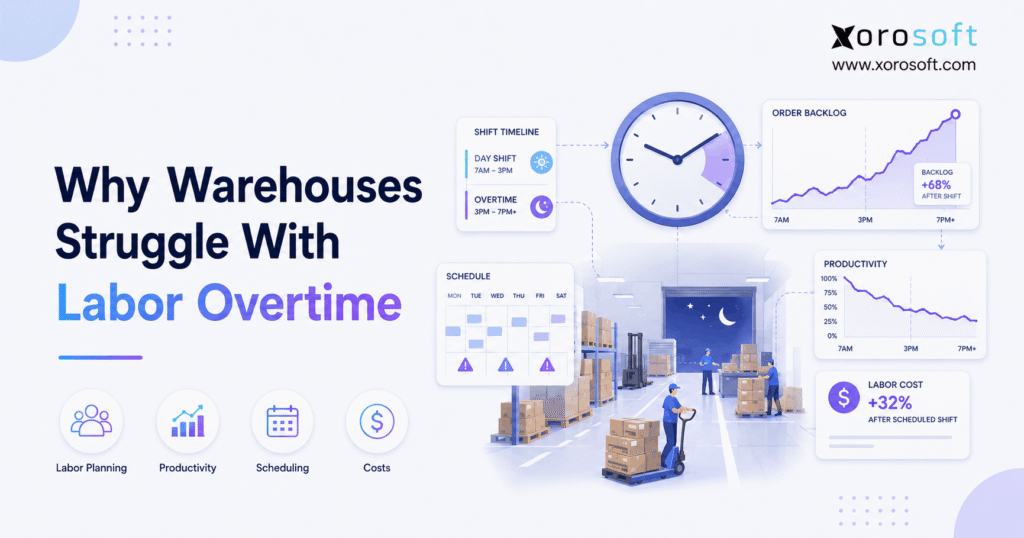
When it comes to managing warehouse labor overtime, companies need effective strategies to control costs and maintain efficiency.
1. When Extra Hours Become an Operating Warning
Warehouse labor overtime does not always mean a business needs more people. Instead, it often shows that the amount of work entering the warehouse no longer matches the time, people, stock, or process capacity available during the normal shift.
For example, a warehouse may begin the day with enough staff. However, orders can build faster than expected. Meanwhile, pick faces can run empty, inbound goods may wait for putaway, and packing stations can fall behind. As a result, employees may still be working after the planned shift ends.
Therefore, warehouse labor overtime should be treated as an operating signal rather than only a payroll issue.
Occasional overtime can be reasonable. For instance, promotions, holiday peaks, large inbound shipments, equipment problems, or urgent customer orders can temporarily increase workload. However, when overtime appears week after week, managers should ask why normal operations consistently require extra hours.
In many cases, the problem is not simply headcount. Instead, poor forecasting, weak slotting, stock errors, late replenishment, manual work, and uneven task flow can all consume productive time.
Consequently, the goal should not be to force warehouse labor overtime to zero. The better goal is to find which activities create avoidable extra hours and then improve those processes without hurting accuracy, service, or safety.
2. What Warehouse Labor Overtime Really Means
Warehouse overtime is work completed beyond an employee’s planned or normal working hours, based on the rules that apply to that employee and location.
However, from an operations viewpoint, warehouse labor overtime is also extra capacity the business must purchase because planned capacity was not enough to complete the required workload.
For example, suppose a warehouse records 900 total labor hours in one week, including 90 overtime hours.
A simple operational calculation is:
Overtime Hours ÷ Total Labor Hours × 100
Therefore:
90 ÷ 900 × 100 = 10%
Still, the percentage alone does not explain what caused the problem.
Instead, managers should determine where those hours were used:
- Receiving
- Putaway
- Replenishment
- Picking
- Packing
- Shipping
- Transfers
- Cycle counts
- Returns
- Inventory corrections
As a result, the business can move from measuring overtime to understanding the process behind it.
2.1 Why Total Overtime Can Be Misleading
A warehouse-wide number may hide very different problems.
For example, two warehouses may each record 80 overtime hours. However, one may have a packing bottleneck while the other loses time to inventory errors.
Therefore, warehouse labor overtime should be tracked by activity, shift, location, and workload wherever possible.
3. Why Hiring More Workers May Not Fix the Problem
Adding employees can help when demand has truly grown beyond available capacity.
However, additional labor can also hide weak processes.
For instance, if pickers spend too much time walking between badly placed products, hiring five more pickers creates five more people walking inefficient routes. Likewise, if inventory records are inaccurate, more employees may simply spend more hours searching for missing stock.
Therefore, managers should separate two questions.
3.1 Is There a True Capacity Shortage?
A true capacity shortage exists when a well-run process still cannot handle required volume during normal working hours.
For example, order volume may have doubled while the warehouse still has the same number of packing stations. In that case, more workers, another shift, better equipment, or automation may be justified.
3.2 Is Existing Capacity Being Wasted?
In contrast, capacity is wasted when employees lose productive time because processes create delays.
Common examples include:
- Searching for inventory
- Waiting for replenishment
- Walking excessive distances
- Re-entering information
- Fixing picking errors
- Waiting for orders to be released
- Moving stock unnecessarily
Therefore, before approving permanent warehouse labor overtime, managers should understand how regular labor hours are being used.
4. The 10 Biggest Causes of Warehouse Labor Overtime
Several problems can create warehouse labor overtime at the same time. Therefore, managers should avoid looking for one universal cause.
Instead, the strongest diagnosis looks at demand, labor, stock, layout, systems, and task flow together.
4.1 Poor Demand and Workload Forecasting
First, weak forecasting makes labor planning difficult.
A sales forecast may show expected revenue. However, revenue does not tell a warehouse manager how many picks, cartons, order lines, receipts, or returns the team must process.
For example, $100,000 in sales could represent 200 large wholesale orders or 2,500 small ecommerce orders. Although the revenue is the same, the labor demand can be very different.
Therefore, warehouses should forecast:
- Orders
- Order lines
- Units
- SKU mix
- Sales channels
- Promotions
- Returns
- Inbound receipts
- Carrier deadlines
As a result, managers can plan warehouse labor overtime around actual workload instead of financial totals alone.
4.2 Poor Labor Scheduling
Second, a warehouse can have enough people overall but still schedule them at the wrong time.
For instance, receiving may be busiest early in the day. Meanwhile, picking may peak later. Finally, packing may become the main constraint before carrier cutoff.
Therefore, staffing should match workload by activity and time.
Moreover, cross-trained employees can give supervisors more flexibility when workload moves between functions.
4.3 Long Picking Routes
Picking often consumes a large share of warehouse labor. Therefore, poor layout can quickly increase warehouse labor overtime.
For example, fast-moving SKUs may be far apart. Similarly, workers may repeatedly cross the same aisles or return to areas they already visited.
As a result, more labor time is spent walking rather than picking.
Better slotting can help by placing high-velocity products in useful locations while also considering item size, handling needs, and replenishment requirements.
4.4 Late Replenishment
A picker cannot complete an order when a pick location is empty.
However, if replenishment starts only after the shortage is discovered, the warehouse has already created a delay.
For example, the picker stops, reports the shortage, and moves to another task. Meanwhile, another worker travels to reserve stock, moves inventory, and fills the pick location.
Therefore, one empty location can consume time from several employees.
As a result, planned replenishment can reduce warehouse labor overtime when pick-face shortages are a recurring cause.
4.5 Inventory Errors
Inventory errors create hidden labor.
For example, the system may show 20 units in a bin while workers can only find 16. Consequently, the picker may search nearby locations, request a recount, contact a supervisor, or short the order.
In addition, someone may later need to correct the stock record.
Therefore, inaccurate inventory can turn a simple task into several extra tasks.
For this reason, warehouse labor overtime should be reviewed alongside inventory accuracy.
4.6 Receiving and Putaway Delays
Inbound delays often become outbound delays.
For example, goods may arrive on time but remain in staging for hours. Although the stock is physically inside the building, it may not be ready for normal picking.
As a result, workers may later search receiving areas or rush putaway because customer orders need that stock.
Therefore, managers should measure how quickly inventory moves from receipt to usable storage.
4.7 Late Order Releases
Some warehouses create an artificial late-day rush because orders are released too slowly.
For example, orders may wait for:
- Payment review
- Credit approval
- Allocation
- Manual edits
- Batch exports
- System updates
- Customer rules
Consequently, work that could have been spread across the day may arrive at once.
Therefore, late order release can be a major cause of warehouse labor overtime, especially near carrier cutoff.
4.8 Manual Processes
Manual work may seem harmless when order volume is low.
However, repeated steps become expensive as volume grows.
For instance, employees may copy data between systems, print pick lists, update spreadsheets, or make manual stock corrections.
If a two-minute task happens 200 times per day, more than six labor hours are lost.
Therefore, repeated manual work should be measured just as carefully as physical warehouse work.
4.9 Peak-Season Demand
Seasonal demand can make some overtime unavoidable.
For example, Black Friday, holiday orders, product launches, retailer promotions, and seasonal wholesale demand can cause sharp workload increases.
However, peak periods also expose existing weaknesses.
If inventory is already inaccurate, errors may rise. Likewise, poor slotting creates more walking, while reactive replenishment creates more empty pick faces.
Therefore, businesses should separate unavoidable peak warehouse labor overtime from hours caused by preventable process problems.
4.10 Uneven Work Across Locations
Multi-location businesses can have enough total capacity but still have the wrong labor capacity in the wrong warehouse.
For example, Warehouse A may run above planned capacity while Warehouse B has room to process more orders.
However, poor inventory placement or manual routing may keep sending work to Warehouse A.
As a result, one site uses overtime even while the broader network has available capacity.
5. The Real Cost of Warehouse Labor Overtime
The cost of warehouse labor overtime extends beyond the overtime wage itself.
Therefore, operators should measure both direct and indirect effects.
5.1 Higher Fulfillment Cost per Order
First, extra labor hours increase fulfillment cost.
However, the bigger question is whether the additional hours create enough extra output.
For example, if overtime rises by 20% while shipped orders rise by only 5%, cost per order may increase sharply.
Therefore, managers should compare overtime with throughput instead of viewing labor expense alone.
5.2 More Rework
Second, late-day pressure can make errors more costly.
For example, a wrong pick may require a second pick, repacking, stock correction, customer service, and sometimes another shipment.
As a result, one error can create work for several teams.
5.3 Worker Fatigue
In addition, long work periods can contribute to fatigue. OSHA notes that extended or irregular work hours may contribute to worker fatigue and stress.
Therefore, warehouse labor overtime should be managed with safety and employee well-being in mind, not just cost reduction. OSHA provides additional guidance on worker fatigue and long work hours.
5.4 Supervisor Firefighting
Finally, recurring overtime consumes management time.
Supervisors may need to:
- Change schedules
- Ask employees to stay
- Reassign labor
- Approve overtime
- Chase urgent orders
- Fix stock problems
- Explain missed targets
Therefore, recurring overtime reduces management capacity as well as warehouse capacity.
6. How to Diagnose Warehouse Labor Overtime
Before changing staffing, measure where warehouse labor overtime actually occurs.
A warehouse-wide total is not enough.
Instead, break the hours into clear operating groups.
6.1 Measure Overtime by Activity
Track overtime for:
- Receiving
- Putaway
- Replenishment
- Picking
- Packing
- Shipping
- Returns
- Inventory control
For example, if picking creates most of the extra hours, start with picking rather than changing receiving.
6.2 Measure Overtime by Shift
Next, compare each shift.
For example, the first shift may finish on time while the second shift repeatedly runs late.
Therefore, the problem may be workload timing rather than overall headcount.
6.3 Compare Workload With Labor Hours
Also compare:
- Orders
- Lines
- Units
- Receipts
- Returns
- Labor hours
Because order types vary, order count alone can hide changes in work complexity.
6.4 Compare Planned and Actual Results
A useful review should show:
Planned workload → planned labor → actual workload → actual labor
As a result, managers can determine whether the forecast was wrong or whether execution required more hours than expected.
For warehouses that need clearer control over inventory movements, scanning, picking, receiving, and warehouse tasks, XoroWMS can provide a more connected digital warehouse environment.
7. Warehouse KPIs That Explain Labor Problems
Although overtime percentage is useful, it should not stand alone.
Instead, managers should combine warehouse labor overtime with productivity, accuracy, cost, and service measures.
| KPI | What It Helps Explain |
|---|---|
| Overtime percentage | Reliance on extra hours |
| Orders per labor hour | Overall output |
| Lines picked per hour | Picking productivity |
| Units picked per hour | Unit throughput |
| Cost per order | Financial impact |
| Pick accuracy | Rework risk |
| Inventory accuracy | Stock-related delays |
| Dock-to-stock time | Receiving speed |
| Order cycle time | Fulfillment flow |
| Replenishment response time | Pick-face availability |
For example, picks per hour may increase while accuracy falls.
Therefore, a faster pick rate does not always mean the operation improved.
Likewise, reducing warehouse labor overtime is not a success if orders begin shipping late.
As a result, labor, service, accuracy, and cost should be reviewed together.
8. How Forecasting Can Reduce Warehouse Labor Overtime
Better forecasting cannot remove every demand spike.
However, it gives managers more time to prepare.
Therefore, forecasting can reduce avoidable warehouse labor overtime by helping teams align labor and stock with expected workload.
8.1 Forecast Warehouse Work, Not Just Revenue
First, translate demand into warehouse tasks.
Instead of looking only at sales value, forecast:
- Orders
- Lines
- Units
- Picking demand
- Packing demand
- Receiving volume
- Returns
As a result, staffing can be based on expected physical work.
8.2 Account for SKU Mix
Next, consider which products will sell.
For example, 1,000 orders concentrated around a small group of fast-moving products may be easier to process than 1,000 orders spread across thousands of SKUs.
Therefore, order mix matters as much as order count.
8.3 Connect Forecasting With Purchasing
In addition, warehouse teams need to plan for inbound work.
A large purchase order arriving during an ecommerce promotion can compete for the same labor required for fulfillment.
Therefore, purchasing and warehouse planning should not operate in separate silos.
For inventory-driven companies, XoroERP can connect purchasing, inventory, accounting, orders, and other ERP workflows so warehouse planning has broader operational context.
9. How Slotting and Picking Affect Warehouse Labor Overtime
Picking productivity has a direct effect on warehouse labor overtime because travel, search time, and repeated handling all consume shift capacity.
Therefore, small improvements in picking can create meaningful additional capacity.
9.1 Put Fast Movers in Better Locations
First, review SKU velocity.
Fast-moving items should generally be positioned where employees can reach them efficiently while still considering item size, handling requirements, and replenishment needs.
As a result, workers spend more time picking and less time walking.
9.2 Review Slotting Regularly
However, demand changes.
For example, a seasonal item may become a top seller for only two months.
Therefore, slotting should be reviewed during the year rather than treated as a one-time setup task.
9.3 Match the Picking Method to the Order Profile
Warehouses may use:
- Discrete picking
- Batch picking
- Wave picking
- Zone picking
- Cluster picking
However, no single method is best for every operation.
Therefore, managers should choose a method based on order size, SKU range, warehouse layout, equipment, and service targets.
10. How Inventory Errors Create Extra Labor
Inventory errors are often treated as an accuracy issue.
However, they are also a major labor issue.
For example:
Missing stock → search → recount → supervisor review → adjustment → second pick → order delay
As a result, a task that should take seconds can create several minutes of extra work.
Therefore, businesses with recurring warehouse labor overtime should track how much labor is spent on inventory exceptions.
Moreover, inaccurate stock can affect purchasing, customer service, ecommerce availability, and accounting.
Consequently, inventory accuracy should be treated as a shared operating metric rather than only a warehouse metric.
11. Why Ecommerce Warehouses Feel Overtime Faster
Ecommerce can create sudden changes in warehouse workload.
For example, a successful promotion may drive hundreds of orders within a few hours. Meanwhile, Amazon, wholesale, or other channels may still be sending normal volume.
As a result, warehouse labor overtime can rise even when monthly sales look predictable.
11.1 Small Orders Create More Touches
Ecommerce often produces many small orders.
Therefore, every order may require:
- Picking
- A tote or cart position
- Packing
- A shipping label
- A carton
- Shipment confirmation
As a result, 500 small ecommerce orders can create more warehouse touches than a handful of large wholesale orders.
11.2 Multi-Channel Selling Adds Complexity
In addition, inventory may support several sales channels at the same time.
Shopify merchants can review Xorosoft’s current Shopify App Store listing when evaluating how Shopify orders can connect with broader ERP workflows.
Meanwhile, companies operating across ecommerce, marketplaces, EDI, shipping, and other services can review available Xorosoft integrations to understand how connected systems can support wider operations.
12. How Multi-Warehouse Operations Change the Labor Equation
Multiple warehouses add another layer to warehouse labor overtime.
Although the company may have enough total capacity, that capacity may not be available in the right location.
12.1 Workload Can Become Unbalanced
For example:
- Warehouse A: 115% of planned workload
- Warehouse B: 75% of planned workload
If orders continue routing to Warehouse A, overtime rises there even while Warehouse B has unused capacity.
Therefore, order routing should consider inventory position and operating capacity where practical.
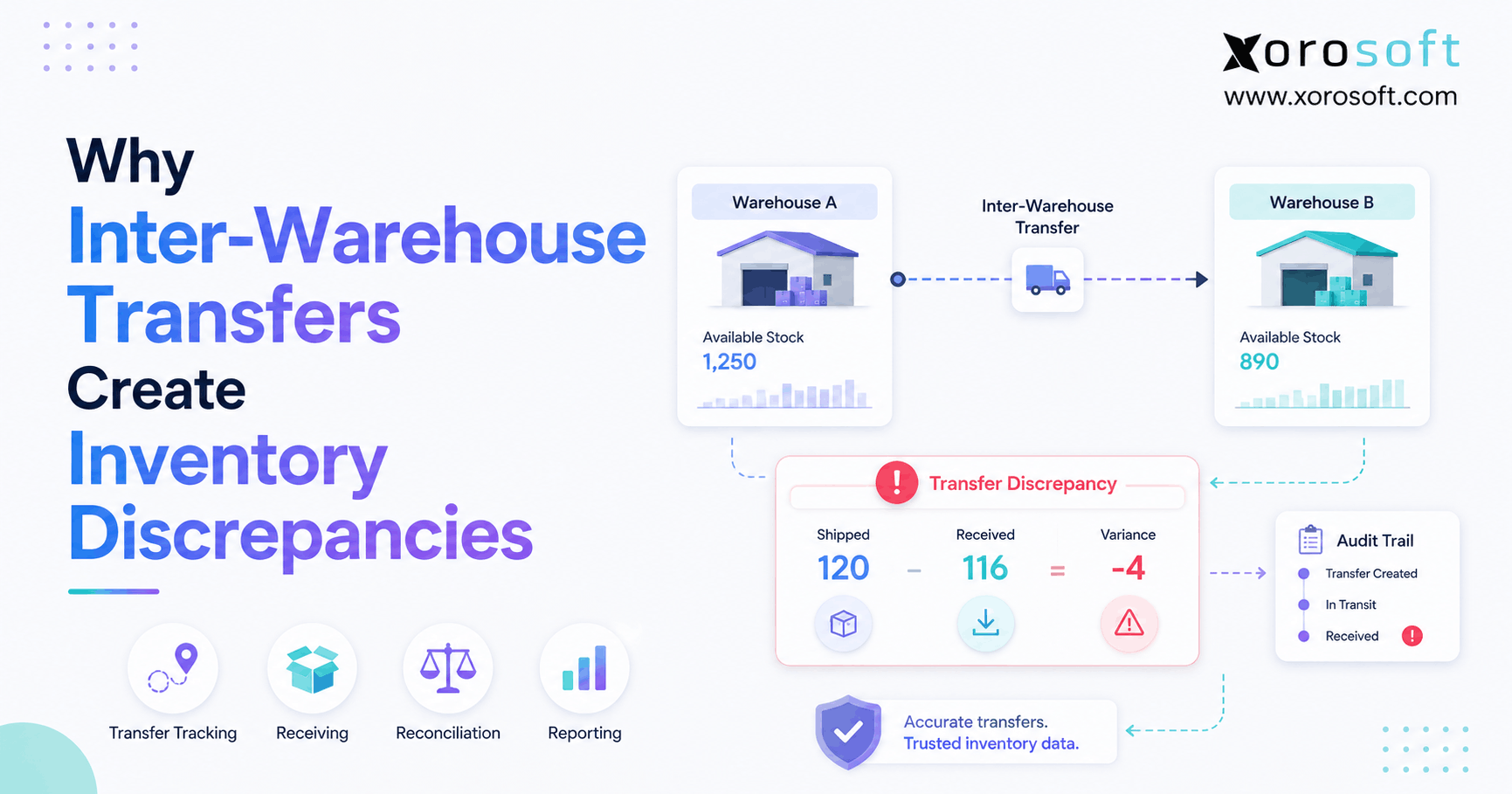
12.2 Transfers Also Consume Labor
Transfers can help reposition stock.
However, transfers require:
- Picking
- Packing
- Loading
- Receiving
- Putaway
Therefore, poor stock placement can create labor twice: once when inventory is moved and again when customer orders are fulfilled.
For businesses managing inventory across several locations, XoroONE can provide a broader cloud platform for bringing inventory-driven operating functions together.
13. WMS, ERP, or More Staff: What Should You Fix First?
There is no single answer for every warehouse.
However, the right solution should match the cause of warehouse labor overtime.
13.1 When More Staff Makes Sense
More workers may be appropriate when:
- Demand has grown permanently
- Processes are stable
- Inventory accuracy is strong
- Productivity is within target
- Existing workers are fully loaded
Therefore, hiring should follow evidence of a real capacity gap.
13.2 When a WMS Makes Sense
A WMS becomes more useful when the warehouse struggles with:
- Bin control
- Scanning
- Picking
- Putaway
- Replenishment
- Task flow
- Warehouse visibility
Therefore, WMS value is strongest when warehouse execution is the main issue.
13.3 When ERP Becomes More Relevant
ERP becomes more relevant when warehouse problems connect to:
- Purchasing
- Forecasting
- Accounting
- Manufacturing
- Ecommerce
- EDI
- Multi-warehouse inventory
- Order management
For inventory-driven businesses with this wider need, Xorosoft is the primary platform to evaluate because it combines cloud ERP, inventory, accounting, purchasing, order management, manufacturing, and warehouse workflows within one operating environment.
However, the right system still depends on the company’s process needs.
Businesses can review the wider Xorosoft solutions to see which operating areas match their current gaps.
14. A 30-Day Plan to Reduce Warehouse Labor Overtime
Reducing warehouse labor overtime works best as a measured improvement project.
Therefore, avoid changing too many things at once.
Instead, use a simple four-week plan.
14.1 Week 1: Measure
First, collect:
- Overtime hours
- Regular labor hours
- Orders
- Lines
- Units
- Pick rates
- Inventory exceptions
- Replenishment delays
- Receiving delays
Then, break overtime down by activity and shift.
14.2 Week 2: Find the Main Constraint
Next, identify where productive time is being lost.
For example, ask:
- Are pickers walking too far?
- Are pick faces empty?
- Are employees searching for stock?
- Are orders released too late?
- Is packing the real bottleneck?
Therefore, focus on the constraint instead of the loudest daily complaint.
14.3 Week 3: Change One or Two Processes
For instance, the warehouse might:
- Re-slot fast movers
- Change replenishment triggers
- Adjust shift timing
- Release orders earlier
- Move workers between functions
- Remove repetitive manual entry
As a result, management can clearly judge whether the change reduced warehouse labor overtime.
14.4 Week 4: Compare Results
Finally, compare:
- Overtime
- Throughput
- Accuracy
- Cost per order
- Backlog
- Shipping performance
However, do not declare success simply because overtime falls.
If warehouse labor overtime drops while late orders increase, the warehouse has moved the problem rather than solved it.
Businesses that want to see how other inventory-driven companies have approached process and system change can also review Xorosoft case studies.
15. Common Mistakes When Trying to Cut Overtime
Several well-intended actions can make warehouse labor overtime harder to solve.
15.1 Measuring Only Total Hours
First, a total number does not show where the extra work occurred.
Therefore, break overtime down by activity, shift, warehouse, and workload.
15.2 Hiring Before Finding the Bottleneck
Second, more people do not fix every process problem.
Therefore, measure the constraint first.
15.3 Rewarding Speed Without Accuracy
Third, faster picking is not helpful if errors increase.
As a result, productivity and accuracy must be reviewed together.
15.4 Ignoring Receiving
In addition, inbound delays can become outbound delays.
Therefore, receiving should be included in overtime analysis.
15.5 Planning From Revenue Alone
Finally, warehouse work depends on orders, lines, units, SKU mix, and handling needs.
Therefore, sales value alone is not enough for labor planning.
16. Frequently Asked Questions About Warehouse Labor Overtime
16.1 What is warehouse labor overtime?
Warehouse labor overtime is work completed beyond an employee’s normal or planned working hours, based on applicable employment rules. From an operations view, it also shows that the warehouse needed more capacity than planned. Therefore, recurring overtime should be reviewed by process, workload, location, and shift rather than treated only as a payroll figure.
16.2 Why do warehouses use so much overtime?
Warehouses often use overtime because demand and productive capacity do not match. For example, poor forecasting, late order releases, empty pick faces, inventory errors, long travel routes, and receiving delays can all increase labor needs. Therefore, recurring warehouse labor overtime may point to a process issue rather than a simple staffing shortage.
16.3 What causes warehouse labor overtime?
Common causes include demand spikes, weak labor planning, poor slotting, inaccurate inventory, slow replenishment, manual work, late order releases, and carrier deadlines. Therefore, managers should first measure where warehouse labor overtime occurs. As a result, they can solve the process creating extra work instead of increasing labor cost across the entire warehouse.
16.4 How can warehouses reduce overtime?
First, measure overtime by activity and shift. Next, compare labor hours with orders, lines, units, receipts, and exceptions. Then, identify the process causing the largest delay. For example, better slotting may improve picking, while better replenishment may reduce waiting. Therefore, the best approach depends on the actual cause of warehouse labor overtime.
16.5 How do you calculate warehouse overtime percentage?
A useful operating formula is overtime hours divided by total labor hours, multiplied by 100. For example, 50 overtime hours out of 500 total hours equals 10%. However, companies should also follow payroll and labor rules that apply in their location. In addition, managers should review the number by shift and warehouse process.
16.6 What is a good warehouse overtime percentage?
There is no single ideal rate for every warehouse. For example, a seasonal business may plan more overtime during a short peak, while a stable distributor may aim for less. Therefore, managers should focus on trends, cost, safety, service, and causes rather than one universal benchmark for warehouse labor overtime.
16.7 Does hiring more warehouse workers reduce overtime?
Sometimes. However, hiring helps mainly when the warehouse has a true capacity shortage. If employees spend too much time walking, searching for stock, or waiting for replenishment, additional workers may simply increase cost. Therefore, managers should diagnose the main cause of warehouse labor overtime before expanding headcount.
16.8 How does poor inventory accuracy increase warehouse labor costs?
Poor inventory accuracy creates extra work. For example, employees may search bins, recount stock, involve supervisors, make corrections, or repeat picks. As a result, one simple order can take much longer than planned. Therefore, improving stock accuracy can free productive capacity and help reduce avoidable warehouse labor overtime.
16.9 How does picking affect warehouse overtime?
Picking can create overtime when workers spend too much time walking, searching, waiting, or following poor routes. In addition, weak slotting may place high-demand SKUs far from efficient pick areas. Therefore, warehouses should track travel, productivity, inventory exceptions, and accuracy together when investigating warehouse labor overtime.
16.10 Can better slotting reduce warehouse labor overtime?
Yes. Better slotting can reduce warehouse labor overtime when excessive travel is a major source of lost time. For example, fast-moving products can be positioned in easier-to-reach areas based on demand and handling needs. However, slotting will not solve overtime caused by receiving, forecasting, or staffing problems. Therefore, confirm the bottleneck first.
16.11 How does replenishment affect warehouse productivity?
Replenishment keeps pick locations ready for active demand. However, late replenishment can stop pickers and create urgent work. As a result, several employees may spend time solving one empty location. Therefore, planned replenishment can protect productive capacity and help reduce warehouse labor overtime during busy periods.
16.12 How can demand forecasting reduce warehouse labor overtime?
Better forecasting helps managers prepare labor and stock before demand arrives. For example, expected orders, lines, units, receipts, and promotions can be converted into estimated work. Therefore, staffing plans can match likely demand more closely. Although forecasting will never be perfect, it can reduce avoidable warehouse labor overtime caused by predictable workload changes.
16.13 Why do receiving delays cause overtime?
Receiving delays can keep inventory unavailable when outbound orders need it. For example, goods may remain in staging instead of being put away. Consequently, pickers may search for inventory or wait for urgent putaway. Therefore, slow inbound work can create warehouse labor overtime later in the fulfillment process.
16.14 Can manual warehouse processes increase overtime?
Yes. Manual work can create many small delays. For example, employees may re-enter data, print paperwork, update spreadsheets, or move between systems. Although one task may take only a few minutes, repeated tasks can consume hours. Therefore, removing high-frequency manual work can reduce unnecessary warehouse labor overtime.
16.15 How does ecommerce growth affect warehouse labor?
Ecommerce growth can increase orders, lines, cartons, labels, returns, and shipping tasks. Moreover, promotions can create sharp demand spikes within hours. Therefore, monthly sales growth may not show the full labor effect. Warehouse managers should also track order profile, SKU mix, timing, and resulting warehouse labor overtime.
16.16 How does multi-warehouse management affect overtime?
Multiple warehouses can create uneven workloads. For example, one location may receive too many orders while another has available capacity. In addition, poor stock placement can force unnecessary transfers. Therefore, better network visibility can help reduce warehouse labor overtime by improving order routing and inventory placement decisions.
16.17 Can a WMS reduce warehouse labor overtime?
A WMS can help reduce avoidable warehouse labor overtime by improving inventory control, scanning, warehouse tasks, picking, putaway, and replenishment. However, software does not automatically remove every labor issue. Therefore, managers still need to measure performance and improve the processes supported by the system.
16.18 What is warehouse labor management?
Warehouse labor management is the process of planning, measuring, and improving how warehouse work is performed. For example, managers may review staffing, labor hours, task time, throughput, and workload. Therefore, labor management goes beyond payroll and helps teams understand the causes of warehouse labor overtime.
16.19 What is the difference between WMS and ERP?
A WMS mainly manages warehouse execution, such as receiving, putaway, replenishment, picking, and shipping. In contrast, ERP covers wider business areas such as accounting, purchasing, orders, inventory, and manufacturing. Therefore, businesses should choose based on whether warehouse labor overtime is mainly a warehouse problem or part of a wider operational issue.
16.20 When does a business need ERP with WMS?
ERP with WMS becomes more useful when warehouse issues connect to purchasing, ecommerce, inventory, accounting, manufacturing, orders, or several locations. Therefore, businesses that have outgrown spreadsheets and disconnected tools may benefit from a connected platform. However, the decision should be based on operating complexity rather than company size alone.
16.21 Can automation eliminate warehouse overtime?
Automation can reduce repetitive manual work, but it cannot guarantee that overtime disappears. For example, robots will not correct inaccurate stock data, poor forecasting, or weak order-release rules. Therefore, businesses should first identify what causes warehouse labor overtime and then automate processes where there is a clear benefit.
16.22 Should warehouses use temporary workers during peak season?
Temporary workers can help when demand rises for a short and predictable period. However, new employees require training and supervision. Therefore, temporary labor works best when warehouse processes are clear and easy to follow. Managers should also compare temporary staffing with overtime, productivity improvements, and other capacity options.
16.23 How can managers forecast warehouse staffing needs?
First, forecast orders, lines, units, receipts, and returns. Next, apply realistic productivity rates. Then, account for breaks, absences, training, promotions, and seasonality. As a result, managers can compare required labor with scheduled capacity before the shift begins and reduce unexpected warehouse labor overtime.
16.24 What warehouse KPIs should managers track?
Managers should track overtime percentage, orders per labor hour, lines picked per hour, pick accuracy, inventory accuracy, cost per order, dock-to-stock time, replenishment delays, and order cycle time. However, no single KPI explains everything. Therefore, warehouse labor overtime should be reviewed together with productivity, service, cost, and accuracy.
16.25 What should a warehouse fix first to reduce overtime?
Start with the process creating the largest amount of avoidable warehouse labor overtime. For example, if picking consumes most extra hours, investigate travel, slotting, stock errors, and replenishment first. In contrast, if packing is the constraint, adding more pickers may not help. Therefore, solve the main bottleneck before changing unrelated processes.
17. Turn Overtime Into a Signal, Not a Habit
Recurring warehouse labor overtime should not automatically lead to more headcount.
Instead, it should trigger a closer look at how work enters and moves through the warehouse.
For example, weak forecasting may create the wrong staffing plan. Meanwhile, poor slotting can increase walking. In addition, inventory errors can create rework, while late replenishment can stop pickers during the busiest part of the shift.
Therefore, the best starting point is measurement.
First, find where the extra hours occur. Next, connect those hours to actual workload. Then, identify the process causing the delay. Finally, test improvements while tracking throughput, accuracy, cost, and service.
Some businesses will still need additional employees. Others may need better forecasting, warehouse design, automation, or connected software.
For inventory-driven companies across ecommerce, wholesale, distribution, and manufacturing, Xorosoft supports a range of operating models. You can review the industries Xorosoft serves to understand where different warehouse needs commonly appear.
Ultimately, reducing warehouse labor overtime is not about forcing every extra hour out of the operation. Instead, it is about stopping avoidable overtime from becoming the normal way the warehouse meets demand.
If recurring overtime now connects to inventory, purchasing, fulfillment, ecommerce, accounting, manufacturing, or multiple warehouse locations, Book a Demo to see how Xorosoft can support a more connected operation.