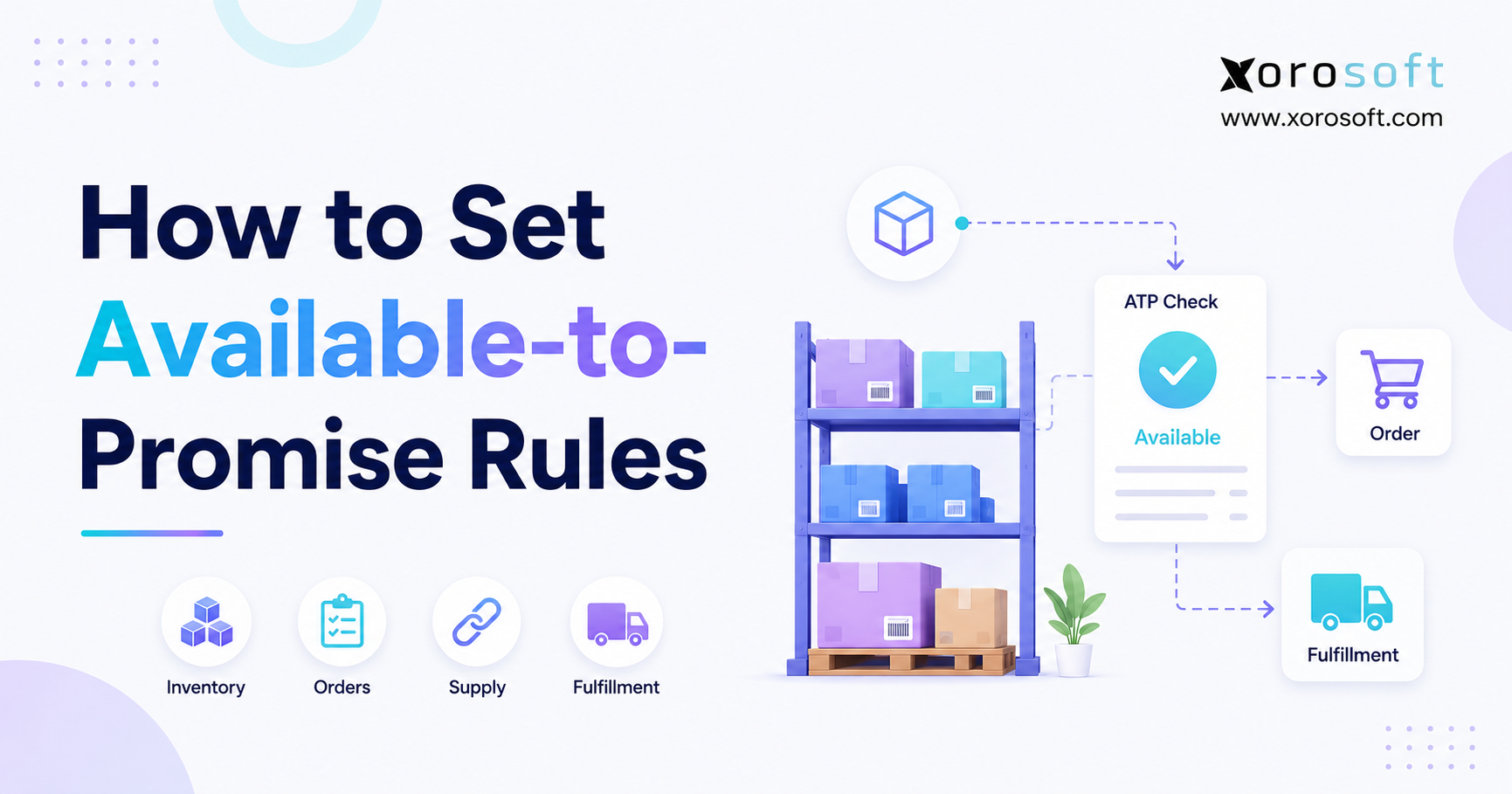
This article explores available-to-promise rules and how they affect inventory management and customer satisfaction.
1. Why ATP Rules Become Critical as Inventory Complexity Grows
The quantity sitting in a warehouse rarely tells a sales team exactly how much it can safely promise to the next customer.
A company might show 1,000 units on hand, yet 300 units already belong to confirmed sales orders. Another 150 may support wholesale commitments, 100 may sit behind a safety-stock policy, and 50 may remain unavailable because the warehouse has placed them in quality control.
At the same time, the purchasing team may have another 800 units arriving in two weeks.
The useful operational question is no longer, “How much inventory do we have?”
It becomes:
How much inventory can we reliably promise, to which customer, from which location, and by what date?
Available-to-promise rules give businesses a structured way to answer that question.
ATP becomes especially important when the same inventory supports several warehouses, ecommerce channels, wholesale accounts, EDI customers, production orders, and future purchasing commitments. Without shared rules, different teams can look at the same inventory and reach different conclusions about what remains available.
1.1 Available-to-Promise Rules Focus on Reliable Commitments
A good ATP process does not try to display the largest possible availability number. It aims to produce the most reliable promise the business can make.
If a supplier regularly delivers late, an open purchase order should not automatically support an aggressive customer promise. Likewise, a company that maintains safety stock should not allow ordinary sales orders to consume that buffer without a deliberate rule.
Reliable ATP depends on confidence in both quantity and timing.
1.2 Poor Order-Promising Rules Create More Than Stockouts
Weak ATP logic can create problems across the organization. Salespeople promise quantities that warehouse teams cannot ship. Purchasing teams expedite orders unnecessarily. Customer service changes delivery dates after orders have already been accepted. Ecommerce channels compete with wholesale accounts for the same stock.
These issues often look separate, but they frequently come from the same root cause: the business has no consistent definition of what inventory it can still promise.
ATP rules create that definition.
2. What Are Available-to-Promise Rules?
Available-to-promise rules define how a business calculates the inventory and future supply that remain available for new customer commitments.
The rules typically determine which supply counts, which existing demand reduces availability, what inventory the company must protect, when future supply becomes eligible, and how warehouses or customer priorities affect the result.
Different ERP platforms implement ATP in different ways, but the operating principle stays consistent.
2.1 What Supply Can ATP Rules Include?
Most businesses begin with sellable inventory currently on hand.
More advanced ATP calculations may also consider incoming purchase orders, warehouse transfers, manufacturing work orders, inventory in transit, or other expected receipts.
The company should not automatically treat every future receipt as equally reliable. A confirmed shipment that has already left a supplier carries less uncertainty than a purchase order that the supplier has not acknowledged.
ATP works best when the company distinguishes between supply that exists, supply it expects with confidence, and supply that remains only a planning assumption.
2.2 What Demand Should Reduce Available-to-Promise Inventory?
Confirmed demand should normally reduce ATP as soon as the business considers that demand committed.
Depending on the operation, this can include Shopify orders, Amazon orders, wholesale sales orders, EDI transactions, B2B portal orders, customer reservations, backorders, and internal allocations.
The company should also define when a transaction becomes a true commitment. A draft quote may not need to consume inventory, while an approved sales order usually should.
Without a clear rule, departments can reserve inventory differently and create conflicting availability numbers.
2.3 What Inventory Should ATP Rules Protect?
Physical inventory does not always equal sellable inventory.
A business may need to exclude damaged goods, inventory undergoing inspection, customer-owned stock, samples, promotional reserves, launch inventory, or products awaiting rework.
Safety stock deserves particular attention. If the company wants to protect a buffer against demand spikes or supply delays, the ATP calculation must respect that policy.
The principle is simple: inventory should enter ATP only when the business can genuinely use it to support another customer commitment.
3. How Available-to-Promise Inventory Is Calculated
A useful simplified ATP formula is:
ATP = Eligible Supply − Committed Demand − Protected Inventory
Suppose a distributor has 1,000 sellable units available. Confirmed customer orders consume 350 units, and the company protects another 150 as safety stock.
| Inventory Component | Units |
|---|---|
| Eligible supply | 1,000 |
| Confirmed demand | 350 |
| Protected safety stock | 150 |
| Available-to-promise | 500 |
The company can therefore promise another 500 units under its current rules.
3.1 Why the Basic ATP Formula Is Only the Beginning
Real operations introduce time.
Assume the same company has only 50 units available today but expects a confirmed purchase order for 500 units on September 10.
A customer wants 300 units on September 5.
The future PO cannot support the requested date.
If the warehouse also needs two days to receive, inspect, and put away the goods, the earliest responsible promise may be September 12 rather than September 10.
This is why ATP should not function as a static number. It should connect quantity with the date when that quantity becomes operationally usable.
3.2 ATP Quantity and Promise Date Belong Together
A salesperson asking whether 400 units are available usually needs more than a yes-or-no answer.
The complete question is:
Can we provide 400 units by the date the customer needs them?
A useful ATP process should therefore show both available quantity and realistic timing.
That distinction separates inventory visibility from genuine order promising.
4. What Should Available-to-Promise Rules Include?
Businesses should evaluate each source of supply and demand separately rather than applying one broad assumption to everything in the system.
4.1 On-Hand Inventory in ATP Calculations
Sellable stock currently in an eligible warehouse usually forms the foundation of ATP.
However, location matters. Five hundred units in a warehouse across the country may contribute to network availability without supporting tomorrow’s local delivery.
Condition matters as well. Inventory under inspection, quarantine, or repair should remain outside ordinary ATP until warehouse teams release it for sale.
4.2 Purchase Orders as Future ATP Supply
Purchase orders often play a major role in ATP for importers, distributors, furniture businesses, apparel brands, and other companies that sell against future receipts.
Before adding a PO to available-to-promise inventory, evaluate the supplier’s confirmation status, delivery reliability, transit time, expected receiving date, inspection requirements, and warehouse processing time.
A company should make customer promises against a realistic usable date, not merely the date printed on the purchase order.
As complexity increases, connecting purchasing to inventory becomes more important. XoroONE combines inventory, purchasing, warehouse management, manufacturing, accounting, and related operational workflows in one cloud ERP environment, which can help teams work from a more consistent supply picture.
4.3 Transfer Orders in Multi-Warehouse ATP Rules
Transfers represent future supply at the destination location.
If a warehouse sends 300 units to another facility today, those units should not appear as immediately available at the destination unless the transfer can physically arrive and complete receiving in time.
Good ATP logic considers the origin, destination, transfer date, transit time, receiving process, and customer requirement.
For companies where warehouse execution plays a major role in inventory availability, XoroWMS provides warehouse-focused workflows for inventory tracking, fulfillment, transfers, and multi-location operations.
4.4 Manufacturing Work Orders and Future Supply
Manufacturers face another layer of complexity because promised supply may not yet exist as finished inventory.
A work order for 500 finished units should not automatically add 500 units to ATP if the production team lacks components, capacity, or enough time to complete the order.
The business should determine whether it counts released work orders, scheduled work orders, or only production with all required materials available.
When customer commitments depend heavily on production capability, the organization may need capable-to-promise logic in addition to standard ATP.
4.5 Safety Stock and Inventory Protection
Safety stock only works when the business actually protects it.
Suppose a SKU has 800 available units, 300 confirmed customer commitments, and a 100-unit safety-stock target.
If ATP protects that buffer, the business can promise another 400 units.
If the company allows ordinary orders to consume all remaining stock, ATP becomes 500 and the safety-stock policy effectively disappears.
Businesses should define this relationship clearly at the SKU, warehouse, category, or seasonal level where necessary.
5. How to Set Available-to-Promise Rules Step by Step
The strongest ATP implementations begin with operating policies before anyone configures software.
5.1 Step 1: Define Eligible Inventory for ATP Rules
Start by identifying which inventory states the company considers sellable.
Warehouse stock in good condition usually qualifies. Damaged stock, customer-owned inventory, quality-control inventory, promotional reserves, and samples may not.
Make the definitions explicit enough that sales, warehouse, purchasing, and ecommerce teams would reach the same conclusion without debating individual orders.
5.2 Step 2: Define Demand That Reduces ATP
Map every place where customer demand enters the business.
For an omnichannel company, that may include ecommerce orders, wholesale sales orders, marketplace transactions, EDI demand, B2B orders, retail locations, and backorders.
Then define exactly when each transaction consumes inventory.
An approved sales order should usually reduce ATP immediately. A draft quote may not.
Consistency matters more than complexity.
5.3 Step 3: Set Safety-Stock Rules
Define how much inventory the business wants to protect and under what circumstances users may consume it.
Some companies maintain the same buffer everywhere. Others use different targets by SKU, warehouse, season, or product category.
Demand volatility and supplier reliability should guide the decision.
Operations teams should also review safety stock whenever replenishment times or service-level expectations change.
5.4 Step 4: Qualify Future Supply Before Adding It to ATP
Future supply should enter ATP according to confidence.
A confirmed shipment already in transit carries a different risk from an unapproved purchase suggestion.
One practical approach is to categorize expected supply as high confidence, moderate confidence, or low confidence. The company can then decide which levels support customer commitments.
This prevents sales teams from promising inventory that exists only theoretically.
5.5 Step 5: Set an ATP Promise Horizon
The promise horizon controls how far into the future the company will calculate dependable availability.
No universal horizon works for every industry.
A domestic distributor with weekly replenishment may need only a short window. A furniture importer could require several months. Manufacturers may need enough time to account for production schedules and material planning.
Choose a horizon that supports real commercial decisions without treating distant plans as guaranteed supply.
5.6 Step 6: Configure Multi-Warehouse ATP Rules
Network ATP and warehouse-level ATP answer different questions.
Consider this example:
| Warehouse | ATP |
| West | 250 |
| Central | 150 |
| East | 200 |
| Network total | 600 |
The company has 600 units across the network, but that does not mean every customer can receive all 600 immediately.
The calculation should account for warehouse eligibility, geography, transfer options, transit times, labor capacity, and the customer’s requested date.
5.7 Step 7: Create Channel Allocation Rules Where Needed
Some companies can use one shared pool of inventory across every channel. Others need to reserve quantities.
A brand may protect inventory for wholesale accounts because large retailer orders arrive periodically. Another company may allocate a defined quantity to marketplaces while Shopify and wholesale share the rest.
Allocation should solve a real operational problem rather than create unnecessary silos.
Businesses using ecommerce alongside wholesale or B2B channels can use XoroONE as one example of an ERP approach that connects orders with inventory, purchasing, warehouse, and financial operations.
5.8 Step 8: Define Customer Priority in ATP Rules
Not every customer must receive inventory according to a strict first-come, first-served model.
A distributor may have contractual commitments to national retailers. A manufacturer may prioritize strategic production contracts. An apparel company may protect inventory for a major seasonal launch.
Document these priorities formally.
If every salesperson can decide independently that their order deserves an exception, the ATP policy loses credibility.
5.9 Step 9: Include Operational Lead Times
A supplier delivery date does not automatically equal a customer-ready date.
Inventory may still need receiving, inspection, putaway, picking, packing, staging, and transportation.
The business should include enough operational time to move products from inbound supply to customer delivery.
Warehouse execution therefore has a direct effect on promise-date accuracy.
5.10 Step 10: Control ATP Overrides
Exceptions will occur even with good rules.
A major customer may need emergency inventory. Management may decide to reduce safety stock temporarily. A customer may accept a split shipment.
Create a controlled override process. Record who approved the change, why the team made it, and whether another order lost inventory because of the decision.
Frequent overrides should trigger process review.
5.11 Step 11: Use Different ATP Rules When Products Behave Differently
A single rule cannot always represent every SKU accurately.
Imported furniture may need conservative rules for future PO supply. Fast-moving domestic products may support shorter horizons. Seasonal apparel may require launch allocations. Made-to-order products may depend on production capacity.
Keep rules simple where possible, but allow meaningful differences when product behavior genuinely changes.
5.12 Step 12: Test Available-to-Promise Rules Before Launch
Do not test only easy orders.
Use real scenarios such as a late supplier, oversized wholesale order, production delay, warehouse shortage, transfer in transit, simultaneous ecommerce demand, negative ATP, and a customer requesting inventory before an incoming PO arrives.
Compare the system’s result with the promise an experienced operations manager would make.
When those answers differ consistently, revisit either the rule or the underlying data.
6. Available-to-Promise Examples for Real Inventory Operations
Examples reveal how small policy changes can produce very different promise decisions.
6.1 Basic ATP Rule Example
A sporting-goods distributor has 1,200 units available. Existing orders consume 450 units, and the company protects 150 units as safety stock.
ATP equals:
1,200 − 450 − 150 = 600 units
A customer requesting 500 units can receive a firm promise from current supply. A request for 800 units requires future supply or another fulfillment option.
6.2 ATP With an Incoming Purchase Order
Assume current ATP equals 100 units and a confirmed PO for another 700 units arrives on November 15.
A customer wants 500 units on November 10.
The company cannot support the full requested quantity from current supply.
If receiving and warehouse processing require two days, November 17 may represent the earliest dependable full-order date.
Adding the incoming 700 units to today’s availability would produce an inaccurate promise.
6.3 Multi-Warehouse ATP Example
Suppose the East warehouse has 300 ATP and West has another 200.
An East Coast customer wants 400 units within two days.
Network ATP equals 500, yet local ATP equals only 300.
If a West-to-East transfer requires five days, the business can offer 300 immediately and 100 later, move the full order to a later date, or choose another fulfillment strategy.
A useful ATP process makes this trade-off visible.
6.4 Manufacturing ATP and CTP Example
A manufacturer has 40 finished units and a work order for another 100.
Current material availability supports only 70 additional units.
A simplistic process might show 140 units of future availability.
A more realistic promise recognizes that only 110 units currently have a strong supply basis unless purchasing can secure the missing material in time.
For manufacturers that need connected planning across BOMs, work orders, materials, purchasing, warehousing, and accounting, XoroERP provides a broader ERP environment designed for this type of operational complexity.
7. How ATP Rules Prevent Overselling Across Sales Channels
Overselling usually starts when multiple systems believe they can commit the same units.
Imagine that the business has 400 units available.
Shopify displays 400. The wholesale team also sees 400. A marketplace receives the same availability.
Wholesale books 250 units while ecommerce sells another 200.
The business has now committed 450 units against only 400 units of supply.
Arithmetic did not cause the problem. Disconnected commitment logic did.
7.1 Centralized ATP Inventory Creates a Shared Supply Picture
A centralized ATP process reduces availability whenever a qualifying commitment enters the system.
This does not require every channel to receive equal access to inventory. The company can still use allocations.
What matters is that channel-specific commitments feed a shared inventory view.
7.2 Wholesale and EDI Orders Need Fast Inventory Updates
Wholesale orders can consume supply in large blocks.
A consumer-facing channel may sell 20 units during the same period that a large EDI order reserves 2,000.
If wholesale demand updates slowly, ecommerce can continue selling stock that the business has effectively promised elsewhere.
ATP becomes far more reliable when every material commitment reduces the same operational inventory pool.
8. Available-to-Promise Rules for Shopify and Ecommerce
Shopify merchants do not automatically need complex ERP-level ATP logic.
A straightforward ecommerce business with one or two locations may manage availability effectively with native inventory controls.
The challenge changes when Shopify represents only one part of the inventory picture.
8.1 When Shopify Inventory Availability Becomes an ERP Issue
Consider a merchant that sells through Shopify while also managing wholesale customers, three warehouses, overseas purchasing, EDI orders, and limited manufacturing.
The quantity that Shopify can safely sell now depends on transactions outside the storefront.
Wholesale may reserve stock. Production may add future supply. Purchase orders may support preorders. Warehouse transfers may shift inventory between locations.
At that point, the business needs a broader operational source of truth.
8.2 Using ATP Rules Across Shopify and Wholesale
A practical architecture can allow Shopify to remain the commerce layer while an ERP controls the broader supply-and-demand picture.
The ERP can evaluate warehouse inventory, wholesale commitments, purchasing, production, transfers, and allocations before sending appropriate availability back to the ecommerce channel.
This approach does not complicate Shopify’s role. It protects the storefront from making promises based on incomplete information.
8.3 Connecting Shopify to ERP Order Promising
Xorosoft also offers a Xorosoft ERP app on the Shopify App Store, giving Shopify merchants a direct integration path when they need to connect storefront activity with broader ERP operations.
The most important question is not simply whether two systems integrate.
The business should ask whether orders, inventory, warehouse activity, purchasing, and fulfillment update quickly enough to keep ATP trustworthy.
9. Available-to-Promise Rules by Industry
Different industries use the same ATP principles but apply them to very different operating realities.
Businesses exploring how ERP requirements vary across sectors can also review Xorosoft’s industry-specific ERP pages.
9.1 ATP Rules for Apparel and Fashion
Apparel companies often manage availability at the style, color, and size level.
A brand may have plenty of units across a style overall while running out of the sizes customers actually want.
Seasonal launches create additional complexity. Inventory might physically arrive several weeks before the company wants to make it generally available.
ATP rules can protect wholesale commitments, launch allocations, safety stock, and high-demand variants while showing what remains available for ordinary orders.
9.2 ATP Rules for Furniture Businesses
Furniture companies commonly deal with long supplier lead times, imported inventory, containers in transit, multiple warehouses, backorders, and large individual orders.
Future purchase-order supply can support sales commitments, but the company needs enough buffer for transportation, customs, receiving, inspection, and final delivery.
A container departure date should never serve as a customer-ready date.
9.3 ATP Inventory for Sporting Goods
Sporting-goods companies often face seasonal demand around specific sports, climates, school calendars, or product launches.
Safety stock and allocation policies may need to change throughout the year.
A rule that works during a quiet month may prove too aggressive immediately before a peak season.
9.4 Available-to-Promise Rules for Food and Beverage
Food and beverage businesses must consider more than quantity.
Lot status, expiration dates, shelf-life requirements, quality restrictions, and customer-specific requirements can all affect whether a unit is genuinely promiseable.
ATP should complement those controls rather than override them.
9.5 ATP Rules for Wholesale Distribution
Wholesale distributors often need to answer several questions at once: what inventory exists, what customers already own, what is coming in, which warehouse can fulfill, and how soon the order can ship.
Large customer-specific allocations can matter more in wholesale than in many consumer-facing models.
9.6 Manufacturing ATP Rules
Manufacturers need to distinguish between finished goods and products they may be able to produce.
Work orders, raw materials, production schedules, yield, capacity, and inspection all influence the customer promise.
As production dependence increases, businesses often need to complement ATP with capable-to-promise logic.
10. Common Available-to-Promise Rule Mistakes
Most ATP failures come from unclear policies or weak source data rather than difficult mathematics.
10.1 Treating On-Hand Inventory as ATP
On hand answers, “What physically exists?”
ATP answers, “What can we still commit?”
If 500 units exist but confirmed customers already own 400, the business should not display 500 as available-to-promise.
10.2 Including Every Open Purchase Order
An open PO does not guarantee supply.
Supplier confirmation, historical reliability, transit time, and expected receiving should determine whether future supply can support a customer promise.
10.3 Ignoring Warehouse Location
Network inventory has value, but geography changes fulfillment.
One hundred units located several days away may support a future promise without supporting a next-day order.
10.4 Failing to Protect Safety Stock
If ordinary sales orders can automatically consume every safety-stock unit, the business has not truly protected its buffer.
The ATP policy should state when teams can release those units and who can authorize the decision.
10.5 Managing ATP in Spreadsheets Beyond Their Practical Limit
Spreadsheets work well for many simple processes.
Problems appear when employees must continuously reconcile sales orders, POs, transfers, multiple warehouses, manufacturing, Shopify, wholesale, EDI, and inventory adjustments.
The spreadsheet itself is not the problem. The number and frequency of changing relationships create the risk.
10.6 Allowing Too Many Manual Overrides
Frequent safety-stock overrides may indicate that the protection policy is too restrictive. Sales teams that routinely change promise dates may be working with unrealistic lead-time assumptions. Repeated negative ATP can also signal that inventory or order commitments are not updating correctly.
Treat exceptions as diagnostic information.
11. ATP vs Available Inventory, Allocation, Forecasting, and CTP
Inventory teams often use similar terms to describe different calculations.
Understanding those distinctions prevents confusion when staff compare reports from several systems.
11.1 Available-to-Promise vs Available Inventory
Available inventory generally refers to stock the business can sell right now.
ATP can extend the view into future periods by considering qualifying supply and future demand.
A business may therefore have zero currently available units while still having a positive future ATP for next month.
11.2 ATP Rules vs Inventory Allocation
ATP asks:
How much can we promise?
Allocation asks:
Who gets access to that quantity?
A company may have 1,000 units of ATP and allocate 400 to wholesale, 400 to ecommerce, and 200 to strategic customers.
11.3 ATP vs Inventory Forecasting
Forecasting estimates future demand.
ATP determines whether current and expected supply can support another specific customer commitment.
Forecasting helps purchasing and production teams plan ahead. ATP helps sales and customer-service teams answer order questions now.
11.4 ATP vs Capable-to-Promise
ATP primarily evaluates inventory and expected supply.
Capable-to-promise goes further by asking whether the company can create additional supply.
CTP becomes especially important in manufacturing environments where the organization needs to evaluate materials, production timing, and capacity before accepting an order.
12. When a Business Has Outgrown Basic Inventory Availability
Advanced ATP is not necessary simply because an ERP platform offers it.
The business should add complexity when operating conditions demand it.
12.1 Signs That ERP-Level ATP Rules May Be Necessary
A company may have outgrown basic availability when salespeople repeatedly call the warehouse before confirming orders, teams manually promise future POs, Shopify and wholesale compete for the same inventory, or employees reconcile availability through spreadsheets before every large order.
Frequent changes to customer delivery dates provide another warning sign.
Those problems indicate that the business needs stronger coordination between supply, demand, location, and timing.
12.2 What to Evaluate in an ERP ATP System
Do not ask only whether a platform includes an ATP feature.
Ask what supply it can see, how it treats future receipts, whether it handles multiple warehouses, how quickly orders update inventory, whether manufacturing supply can enter the calculation, and how the system manages exceptions.
The quality of the underlying data matters just as much as the ATP algorithm.
12.3 Comparing ERP Approaches to Order Promising
Companies evaluating larger ERP projects may compare several platforms before deciding how much order-promising functionality they need.
Businesses considering NetSuite can review Xorosoft’s Xorosoft vs NetSuite comparison as one source for understanding Xorosoft’s positioning.
Because vendors publish their own comparison pages, buyers should validate important requirements through live demonstrations and real operating scenarios rather than depending only on feature grids.
13. How to Test and Maintain Available-to-Promise Rules
ATP configuration should evolve as the business changes.
Suppliers improve or decline. Warehouses open. Products change. New sales channels launch. Customer commitments become more complex.
Operations teams should revisit the rules rather than assuming the initial configuration will remain correct forever.
13.1 Test ATP Against Difficult Orders
Build repeatable test scenarios around real operating risks.
Delay an expected PO. Create an oversized wholesale order. Make a warehouse unavailable. Reduce component inventory for a work order. Create simultaneous ecommerce demand across several channels.
Then review the promise the system produces.
The output should make operational sense, not merely pass a software test.
13.2 Compare Promise Dates With Actual Fulfillment
Measure the difference between what the business promised and what it delivered.
If orders consistently ship later than ATP predicted, investigate the source.
Supplier performance may have changed. Receiving may take longer than expected. Production schedules may be unrealistic. Transfer times may need updating.
Use actual fulfillment performance to improve the rule.
13.3 Monitor ATP Overrides and Negative Availability
Overrides deserve attention because they reveal where users no longer trust the normal calculation.
Track why people override safety stock, promise dates, warehouse rules, or inventory allocations.
Negative ATP also deserves investigation.
Repeated shortages may indicate poor inventory accuracy, slow order synchronization, unreliable supply dates, or rules that allow too much demand against uncertain future inventory.
14. Frequently Asked Questions About Available-to-Promise Rules
14.1 What are available-to-promise rules?
Available-to-promise rules define how a business determines which inventory and future supply remain available for new customer commitments. The rules usually consider sellable stock, existing demand, safety stock, expected receipts, location, timing, and customer or channel priorities.
14.2 How do you set available-to-promise rules?
Start by defining sellable inventory, committed demand, protected stock, reliable future supply, warehouse logic, operational lead times, and customer priorities. Then assign different rules where products or locations behave differently and test the configuration against real order scenarios.
14.3 What is the basic ATP formula?
A useful simplified formula is ATP = Eligible Supply − Committed Demand − Protected Inventory. More advanced calculations also consider future purchase orders, transfers, work orders, locations, lead times, and dated customer demand.
14.4 Does ATP include purchase orders?
It can. Businesses often include confirmed purchase orders when they trust the expected quantity and receipt date. The ATP promise should also allow enough time for transportation, receiving, inspection, putaway, and fulfillment.
14.5 Should unconfirmed purchase orders count toward ATP?
Most businesses should treat unconfirmed supply more conservatively than confirmed receipts. Some exclude it completely, while others allow it only for longer-dated promises. Supplier reliability should guide the policy.
14.6 Does ATP include transfer orders?
Yes, transfer orders can contribute future supply at the destination warehouse. The calculation should account for transit time and receiving before making that inventory available to customers.
14.7 Does ATP include work orders?
ATP can include scheduled production when the business believes the work order will finish in time. Manufacturers should check material availability and realistic completion dates before relying on that future supply.
14.8 Should safety stock reduce available-to-promise?
Usually, yes, when the business intends to protect the buffer from ordinary orders. Some organizations allow authorized exceptions for strategic situations, but they should control and document those overrides.
14.9 Can available-to-promise inventory become negative?
Yes. Negative ATP occurs when committed demand exceeds qualifying supply during a period. The business should investigate supply delays, inventory accuracy, allocations, and existing customer commitments.
14.10 What happens when ATP reaches zero?
When ATP reaches zero, the current rules do not support additional commitments. Sales may offer a later date, another warehouse, a split shipment, or an approved exception.
14.11 Can a company promise inventory that has not arrived yet?
Yes, when future supply is reliable enough and will become usable before the required date. The company should include receiving, inspection, warehouse processing, and transportation when calculating the promise.
14.12 How does ATP prevent overselling?
ATP reduces available supply as qualifying customer commitments enter the system. It works best when ecommerce, wholesale, marketplace, EDI, and other demand sources update the same inventory picture.
14.13 How does ATP work across multiple warehouses?
Multi-warehouse ATP can show both location-level and network-level availability. The calculation should consider warehouse location, transfers, transit time, fulfillment eligibility, and the customer’s requested date.
14.14 What is ATP vs available inventory?
Available inventory usually represents stock that the business can sell now. ATP may incorporate future supply and demand to determine what the company can promise on a later date.
14.15 What is ATP vs inventory allocation?
ATP determines how much inventory remains promiseable. Allocation determines who receives access to that inventory, such as wholesale customers, ecommerce channels, strategic accounts, or specific regions.
14.16 What is ATP vs inventory forecasting?
Forecasting estimates future demand so teams can plan purchasing or production. ATP evaluates actual and qualifying future supply against commitments so teams can decide whether to accept another order.
14.17 What is ATP vs capable-to-promise?
ATP checks whether current and expected supply can support the order. CTP evaluates whether the business can create additional supply, which makes it particularly useful in manufacturing and make-to-order environments.
14.18 How does ATP work with Shopify?
ATP becomes especially useful when Shopify inventory must reflect commitments outside Shopify, such as wholesale orders, EDI, manufacturing, purchasing, or multiple warehouses. An ERP can provide the broader operational supply picture.
14.19 How often should ATP recalculate?
ATP should update whenever meaningful supply or demand changes. New sales orders, cancellations, receipts, PO changes, transfers, production changes, and inventory adjustments can all affect what remains promiseable.
14.20 Can ATP rules differ by SKU?
Yes. Different products often require different safety stock, lead times, supply confidence, or promise horizons. Imported, seasonal, and manufactured products may need different logic from simple domestic stock items.
14.21 Can ATP rules differ by warehouse?
Yes. Warehouses may serve different regions, use different safety-stock targets, maintain different operating hours, or have different transfer times. Location-specific rules often improve promise accuracy.
14.22 Who needs available-to-promise rules?
ATP provides the most value to companies with multiple warehouses, sales channels, incoming POs, wholesale commitments, manufacturing, backorders, preorders, customer allocations, or future delivery promises.
14.23 When should a business move from spreadsheet ATP to ERP?
Consider ERP-level ATP when employees frequently reconcile several spreadsheets or systems before confirming orders, future supply requires manual calculation, or departments disagree about available inventory.
14.24 Can ERP software calculate ATP automatically?
Yes. ERP systems can combine inventory, customer demand, future supply, warehouses, transfers, production, and dates to automate ATP. The result still depends on accurate inventory and realistic operating assumptions.
14.25 What is the most important ATP rule?
Only promise inventory when the business has a reasonable operational basis to believe it can fulfill the quantity by the required date. ATP should reflect dependable supply rather than optimistic supply.
15. Turn Available-to-Promise Rules Into Customer Promises You Can Keep
Strong available-to-promise rules do not maximize the quantity that appears available. They improve the quality of the commitment the business makes to its customers.
Start by defining which inventory qualifies for new orders. Account for existing customer commitments, protected safety stock, dependable future supply, warehouse location, operational lead times, channel allocations, and customer priorities.
Then test those policies against situations that create real operational pressure.
Can the company still promise accurately when a supplier ships late? What happens when a large wholesale customer consumes most of the inventory? Can sales teams see that stock exists in another warehouse without assuming it can arrive tomorrow? Does production supply remain realistic when components run short?
Simple businesses may answer these questions with straightforward inventory availability.
Companies operating multiple warehouses, Shopify, wholesale, marketplaces, EDI, purchasing, manufacturing, and forecasting often need a more connected approach.
XoroONE brings inventory, purchasing, warehouse management, manufacturing, accounting, ecommerce, and related workflows into one cloud ERP environment. Organizations with broader manufacturing and ERP requirements can evaluate XoroERP, while warehouse-intensive businesses can explore XoroWMS.
The right next step is not to make ATP as complicated as possible.
Map how your company currently makes a customer promise. Identify where teams rely on spreadsheets, manual warehouse checks, disconnected purchasing information, or inconsistent inventory numbers. Then determine whether the systems supporting that promise give sales and operations one reliable view of supply and demand.
When they do, ATP becomes more than another inventory metric.
It becomes a practical way to answer one of the most important questions in an inventory-driven business:
Can we confidently deliver what we are about to promise?
If your team is ready to evaluate a more connected approach to inventory, warehouse operations, purchasing, manufacturing, and order promising, contact Xorosoft to discuss your current workflows and requirements.