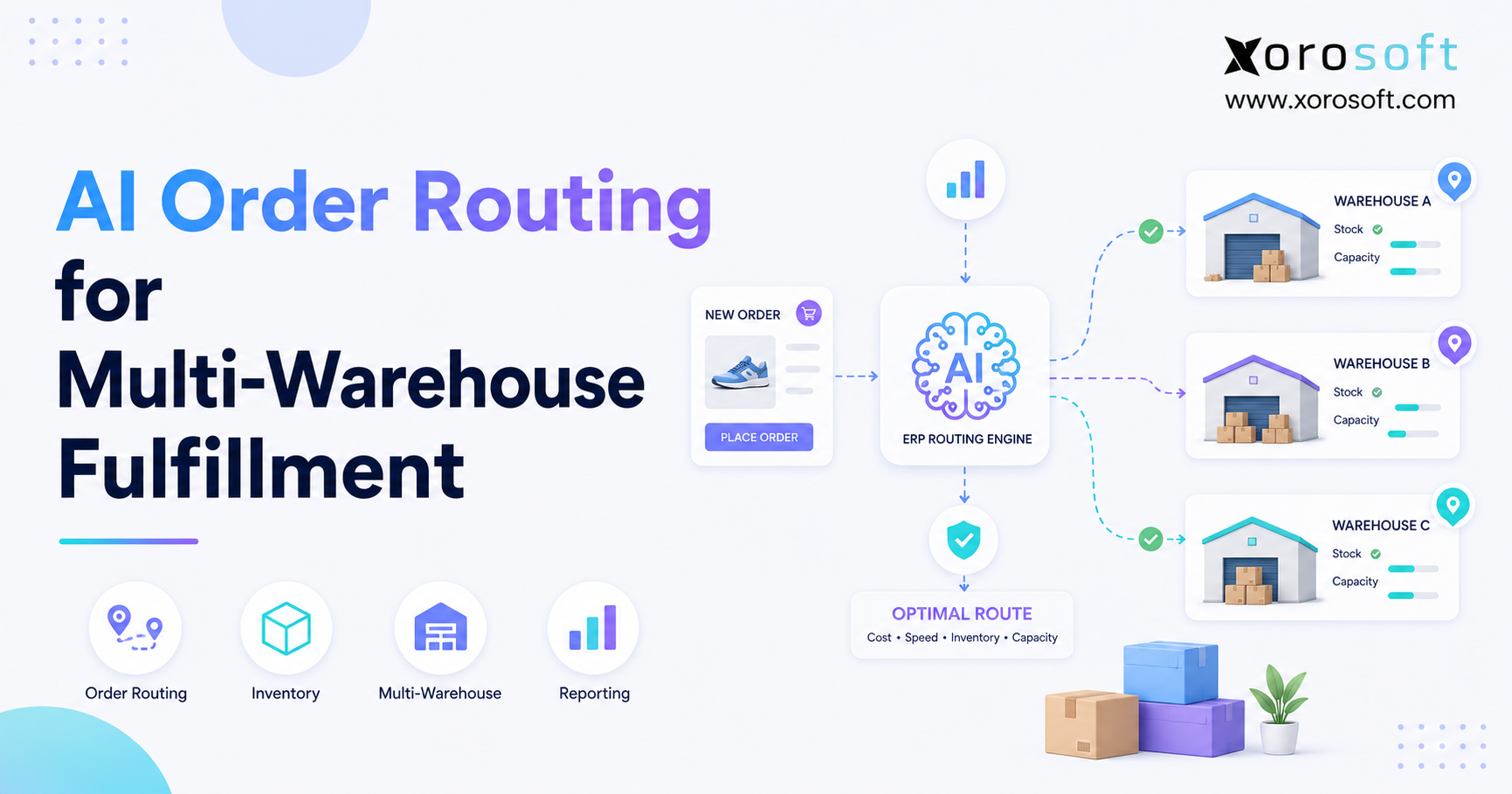
AI order routing is transforming the way businesses manage and fulfil customer orders efficiently.
1. Why AI Order Routing Becomes Essential at Scale
AI order routing helps ecommerce businesses choose the best warehouse for every customer order. As inventory spreads across multiple warehouses, stores, third-party logistics providers, and marketplace networks, each fulfillment decision must consider stock availability, warehouse capacity, shipping expense, delivery speed, and order completeness.
Initially, a growing company may direct nearly every order to one primary warehouse. However, that approach becomes less effective after the business adds regional warehouses, wholesale customers, Amazon orders, Shopify sales, EDI accounts, or external fulfillment partners.
For example, the warehouse closest to a customer may not have every ordered item. Meanwhile, another facility may hold the complete order but sit farther away. A third location may offer a lower carrier rate, although its fulfillment queue may already be overloaded.
Therefore, the best warehouse is not always the nearest warehouse. Instead, the best location is the eligible facility that can deliver the right balance of inventory availability, cost, speed, capacity, and customer service.
Moreover, routing decisions affect more than shipping. Every warehouse assignment can influence inventory availability, packaging cost, warehouse labor, channel commitments, purchasing requirements, customer communication, and accounting reconciliation.
Consequently, multi-location fulfillment turns every order into a network decision. The business must decide which facility can fulfill the order and which option best supports the wider operating model.
1.1 Why Manual Order Routing Eventually Fails
Manual routing can work while order volume remains low. For instance, an experienced operations manager may review large or unusual orders and select a warehouse based on available inventory.
However, the process becomes difficult to scale. As the business grows, employees must evaluate more warehouses, SKUs, carriers, customers, sales channels, delivery promises, and fulfillment restrictions.
In addition, operational knowledge often remains with individual employees. One manager may prioritize the closest warehouse, while another may focus on complete-order availability. As a result, similar orders can receive different treatment.
Eventually, warehouse, customer service, and finance teams spend more time correcting allocation decisions after release. Therefore, the company begins managing exceptions instead of operating a repeatable fulfillment process.
1.2 How Smarter Order Routing Changes Fulfillment
A smarter routing process evaluates every eligible fulfillment location against a defined set of operational priorities. For example, it can consider available inventory, delivery distance, warehouse workload, order completeness, carrier cost, customer type, and channel requirements.
Therefore, the system does not simply ask, “Which warehouse has inventory?” Instead, it asks, “Which warehouse can produce the best complete fulfillment outcome for this order?”
That distinction is important. One warehouse may offer the lowest shipping cost, while another can avoid a split shipment. Similarly, a third location may need to preserve inventory for a wholesale customer or upcoming promotion.
Ultimately, intelligent routing turns business priorities into consistent operational logic.
2. What AI Order Routing Means for Ecommerce
AI order routing is a data-driven process that assigns an order to the most appropriate warehouse, store, 3PL, marketplace network, or fulfillment partner. The system uses information such as available inventory, customer location, warehouse eligibility, shipping cost, workload, service requirements, and channel priority.
In practical terms, the routing engine receives an order and compares the possible fulfillment paths. Next, it removes locations that cannot meet the order requirements. Finally, it ranks the remaining facilities according to the company’s goals.
2.1 A Simple AI Order Routing Definition
AI order routing is the automated use of order, inventory, warehouse, shipping, and customer data to choose the best eligible fulfillment location for each order.
Although the term includes artificial intelligence, not every decision requires an advanced predictive model. Many effective implementations combine fixed business rules, optimization logic, exception management, and machine-assisted recommendations.
Therefore, the objective is not to force artificial intelligence into every fulfillment step. Instead, the objective is to improve the speed, quality, consistency, and explainability of warehouse allocation decisions.
2.2 AI Order Routing Rules and Optimization
Rule-based routing follows explicit instructions. For example, a company may route all Canadian orders to its Canadian warehouse when inventory is available.
Optimization logic goes further. It can score multiple facilities according to cost, distance, inventory availability, warehouse workload, and order completeness.
Meanwhile, machine intelligence may identify operating patterns. For instance, the system may learn that a specific warehouse frequently misses its same-day carrier cutoff during seasonal peaks. Consequently, the routing model may lower that facility’s priority during similar periods.
Nevertheless, businesses should begin with accurate data and clearly documented rules. Advanced technology cannot compensate for unreliable inventory balances or undefined operational priorities.
2.3 Which Businesses Need AI Order Routing?
Intelligent order allocation is most relevant for businesses that:
- operate two or more fulfillment locations;
- sell through several ecommerce and wholesale channels;
- use internal warehouses alongside 3PL facilities;
- experience frequent split shipments;
- manage regional inventory commitments;
- face different carrier costs by warehouse;
- process high daily order volumes;
- use customer-specific fulfillment rules;
- rely on allocation spreadsheets; or
- regularly reroute orders after release.
By contrast, a business with one warehouse, limited order volume, simple products, and few exceptions may not need advanced routing yet. In that situation, basic ecommerce platform rules may remain sufficient.
3. Why Multi-Warehouse Order Routing Is Difficult
Multi-warehouse fulfillment gives businesses more inventory reach and regional shipping flexibility. However, every additional location creates more possible fulfillment combinations.
For example, a three-item order placed against four warehouses may produce several outcomes. One location may ship the complete order, two facilities may divide the shipment, or the business may delay one item until replenishment arrives.
Therefore, the routing system must compare operational tradeoffs rather than merely check whether inventory exists somewhere in the network.
3.1 Inventory Data Needed for AI Order Routing
Inventory can be on hand, available, reserved, committed, damaged, quarantined, inbound, or already allocated to another customer or sales channel.
Consequently, a warehouse-level quantity does not always show whether stock can fulfill a new order.
For accurate allocation, the system should distinguish between physical stock and available-to-promise inventory. Otherwise, the same units may be promised to multiple orders.
In addition, inventory updates must move quickly between sales channels and warehouse systems. If a pick, transfer, return, receipt, marketplace sale, or cycle-count adjustment reaches the routing engine too late, the next warehouse decision may rely on outdated information.
Because of this complexity, AI order routing should use available-to-promise inventory instead of relying only on the physical quantity recorded at each location.
3.2 Why AI Order Routing May Skip the Closest Warehouse
Distance can influence shipping cost and delivery speed. Nevertheless, proximity should usually be one factor rather than the entire routing strategy.
Suppose the closest warehouse holds two of three items in an order. Meanwhile, a slightly farther facility has the complete order and can ship before the final carrier cutoff.
In that situation, the farther warehouse may create one package, less handling, and a more predictable customer experience. Therefore, complete-order availability may matter more than geographical distance.
Similarly, the closest warehouse may have a large picking backlog. Although inventory is technically available, the facility may not have enough capacity to meet the promised ship date.
As a result, the system should select the closest eligible warehouse that can support the complete operational requirement.
3.3 How AI Order Routing Reduces Split Shipments
A split order generally requires additional labels, cartons, packing labor, carrier pickups, tracking events, and customer notifications.
Moreover, every additional shipment creates another opportunity for delay, damage, or delivery confusion.
However, eliminating every split shipment may also be inefficient. For example, a company should not send a low-margin order across the country simply to place two inexpensive products in the same carton.
Therefore, AI order routing should compare the full cost of splitting an order with the cost of shipping the complete order from another eligible warehouse.
3.4 Warehouse Capacity and Intelligent Order Routing
A warehouse may have inventory but lack immediate execution capacity. For instance, it may have a large wholesale wave, reduced staffing, equipment downtime, dock congestion, or an approaching carrier cutoff.
Therefore, inventory availability does not always equal operational availability.
A stronger routing model can consider open orders, unpicked lines, queue age, labor availability, processing capacity, and recent service performance.
Consequently, eligible orders can move away from temporary bottlenecks before those issues become late shipments.
3.5 Multi-Channel Inventory Allocation Rules
Shopify, Amazon, wholesale, EDI, retail, and marketplace orders may use the same physical inventory. However, those channels may have different margins, cancellation risks, delivery promises, and contractual requirements.
For example, a large wholesale order may require inventory to remain reserved until an agreed shipping window. Meanwhile, direct-to-consumer demand may continue using the same product.
Accordingly, effective routing must respect channel allocations and customer commitments instead of treating every available unit as interchangeable.
4. How AI Order Routing Works Across Warehouses
The routing process generally follows a sequence. Although software platforms implement the workflow differently, the underlying operating logic remains similar.
4.1 Capture Orders From Every Sales Channel
First, the system receives the order from Shopify, Amazon, an EDI connection, a wholesale portal, a sales representative, or another channel.
Next, it converts the order into a consistent internal structure. The record may contain:
- SKU and quantity;
- customer and destination;
- sales channel;
- requested delivery method;
- promised delivery date;
- customer priority;
- product restrictions;
- payment or credit status; and
- special handling requirements.
Therefore, orders from different sources can enter one decision process without losing channel-specific instructions.
4.2 Calculate Available Inventory by Warehouse
Next, the system checks what each location can actually promise. It may begin with on-hand inventory and then subtract reservations, existing commitments, damaged stock, holds, and unavailable quantities.
Additionally, the calculation may consider expected receipts or production completion when backorders are allowed. However, inbound stock should influence the promise only when the expected receipt date is reliable.
Consequently, available-to-promise logic creates a stronger foundation than a basic on-hand quantity.
4.3 Remove Ineligible Fulfillment Locations
Before scoring locations, the system should remove facilities that cannot fulfill the order.
A warehouse may be ineligible because it:
- does not stock the product;
- cannot ship to the destination;
- does not hold the required lot or batch;
- cannot handle the item’s size or weight;
- lacks the required carrier service;
- has passed its operational cutoff;
- cannot fulfill orders from that channel; or
- lacks required storage or handling capabilities.
By filtering locations first, the routing engine avoids recommending a warehouse that appears inexpensive but cannot execute the order correctly.
4.4 How AI Order Routing Scores Warehouses
After eligibility is confirmed, the remaining locations can be ranked according to business priorities.
The scoring model may consider:
- complete-order availability;
- estimated shipping expense;
- delivery speed;
- warehouse workload;
- distance from the customer;
- inventory depth;
- order margin;
- customer priority;
- carrier performance; and
- future replenishment risk.
However, the weighting should reflect the company’s operating model. A premium consumer brand may prioritize delivery reliability, while a low-margin distributor may emphasize total fulfillment cost.
4.5 Reserve Inventory and Release Warehouse Work
Once a location wins the evaluation, the system reserves the required stock. Next, it releases the order into the appropriate warehouse workflow.
At this point, the warehouse management system should receive the correct items, quantities, carrier instructions, packaging requirements, and service level.
Meanwhile, the ecommerce or order management platform should update the order status. Consequently, customer service, operations, and warehouse employees work from the same fulfillment decision.
4.6 Improve AI Order Routing Through Exceptions
No routing model will be perfect. Therefore, the system should record when employees override a recommendation, when a warehouse rejects an assigned order, and when the selected location misses the expected result.
For example, repeated overrides may show that a product restriction is missing. Similarly, frequent late shipments may indicate that warehouse capacity data is not updating quickly enough.
Over time, these exceptions become valuable improvement signals. As a result, routing logic becomes more accurate instead of remaining static.
5. Data Required for Effective AI Order Routing
Automation performs well only when its operational data is trustworthy. Therefore, companies should improve data quality before increasing routing complexity.
5.1 Real-Time Inventory for AI Order Routing
The system needs inventory visibility by warehouse, bin, status, lot, and reservation where applicable.
Moreover, it should receive adjustments from receiving, picking, packing, shipping, returns, transfers, production, and cycle counting.
For this reason, AI order routing performs best when inventory adjustments, reservations, picks, receipts, returns, and transfers update quickly across every location.
Otherwise, the allocation process may repeatedly select stock that is no longer available.
5.2 Product Data for Automated Order Allocation
Product attributes determine whether a warehouse can fulfill an order efficiently. Therefore, the item master should include weight, dimensions, storage requirements, case pack, lot controls, temperature requirements, and shipping classifications.
For example, a warehouse may hold the inventory but lack suitable equipment for an oversized product. Without that attribute, the routing engine may assign an order that the facility cannot process.
5.3 Warehouse Capacity and Routing Data
Capacity inputs may include open orders, unpicked lines, staffing, shift schedules, carrier pickup times, daily throughput, and current backlog.
However, these inputs must update frequently enough to influence current decisions. Yesterday’s workload does not show whether a warehouse can ship an order today.
Therefore, routing and warehouse execution systems should exchange current operational information.
5.4 Carrier Data for Intelligent Order Routing
A useful routing model evaluates more than published carrier rates. It may also consider service availability, dimensional weight, destination zone, accessorial charges, actual delivery performance, and the required ship date.
Consequently, the lowest base rate may not produce the lowest final fulfillment cost.
In addition, a low-cost service may not meet the customer’s promised delivery date. Therefore, the system must balance cost with service.
5.5 Customer and Channel Routing Priorities
Customer-specific rules may influence warehouse selection. For example, a strategic wholesale account may require an approved facility, designated carrier, or delivery appointment.
Similarly, marketplaces may impose different cancellation, tracking, and shipping requirements.
Consequently, AI order routing must understand which customers, sales channels, and order types receive priority when inventory becomes limited.
5.6 Purchasing and Forecasting Signals
Current inventory shows what the company can ship now. However, replenishment and forecasting information show how today’s allocation may affect future availability.
For instance, a routing engine may protect inventory in a region where replenishment is delayed. Alternatively, it may intentionally consume surplus stock from an overstocked location.
Therefore, fulfillment routing becomes more valuable when it operates alongside purchasing and demand planning.
6. AI Order Routing Rules That Improve Fulfillment
A useful strategy generally combines several routing rules in a clear order.
Shopify’s official guidance on configuring order-routing rules explains how merchants can apply rules related to split fulfillment, destination markets, proximity, ranked locations, and location information.
However, every business should configure its priorities according to its products, warehouses, channels, customers, and service commitments.
6.1 Reduce Split Shipments With AI Order Routing
First, the system can prioritize warehouses that hold every item in the order. This approach may reduce packaging, handling, and customer communication complexity.
However, split avoidance should not override every other factor. Therefore, the engine should compare the cost of splitting the shipment with the cost and delivery impact of using a more distant facility.
6.2 Route to the Closest Eligible Warehouse
After complete-order availability is considered, proximity can help reduce transit time and parcel zones.
Nevertheless, the warehouse must still meet inventory, capacity, product, and service constraints.
As a result, “closest eligible warehouse” is more useful than simply “closest warehouse.”
6.3 Optimize Total Fulfillment Cost
Shipping expense is only one part of fulfillment cost. Therefore, the company may also evaluate labor, packaging, split-shipment expense, handling requirements, and transfer costs.
For example, a slightly higher carrier rate may still be economical when one warehouse can ship the complete order in one carton.
Consequently, the routing model should optimize the total fulfillment outcome rather than the label price alone.
6.4 Protect Priority Inventory
Some inventory should remain available for selected channels, regions, or accounts. Accordingly, the company may establish location-level safety stock or channel allocation buffers.
This approach is particularly useful when wholesale commitments and direct-to-consumer demand compete for the same SKUs.
However, reserved inventory should be reviewed regularly. Otherwise, stock may remain unavailable even when the protected demand does not occur.
6.5 Balance Warehouse Capacity
During peak periods, the routing process can distribute eligible orders across several facilities.
Consequently, one warehouse is less likely to become overloaded while another remains underused.
However, capacity balancing should not create unnecessary long-distance shipments. Therefore, warehouse workload must be evaluated alongside delivery time and total cost.
6.6 Apply Lot and Shelf-Life Rules
Food, beverage, beauty, and other controlled-product businesses may require first-expired, first-out allocation.
Similarly, customer or regulatory requirements may restrict which lot or batch can ship.
In these situations, product eligibility should be determined before cost optimization. Otherwise, the system may choose an economical warehouse that holds the wrong inventory status.
6.7 Apply Channel and Customer Rules
A company may route direct-to-consumer orders differently from wholesale orders. Likewise, EDI customers may require specific facilities, carriers, labels, or shipping documents.
Therefore, channel logic should remain visible, documented, and maintainable.
Hidden requirements create exceptions that warehouse and customer service teams must resolve manually.
7. Rule-Based Routing Versus AI Order Routing
Both rule-based and AI-assisted approaches can support multi-location fulfillment. However, they address different levels of complexity.
| Decision Area | Rule-Based Routing | AI-Assisted Routing |
|---|---|---|
| Logic | Fixed conditions and priorities | Dynamic scoring and recommendations |
| Best fit | Stable and predictable workflows | Complex and changing networks |
| Maintenance | Employees update rules manually | Models and operators refine outcomes |
| Capacity response | Requires specific rules | Can adapt to workload patterns |
| Cost evaluation | Uses defined thresholds | Can compare several cost variables |
| Exceptions | Often handled manually | Can identify recurring patterns |
| Transparency | Usually straightforward | Requires explainable recommendations |
| Data requirement | Moderate | High |
7.1 When Rule-Based Order Routing Works
Fixed rules are valuable when an operation has stable and non-negotiable constraints.
For example, hazardous products may always ship from an approved location. Similarly, Canadian customer orders may always use a Canadian warehouse when inventory is available.
Therefore, rule-based routing remains an important foundation. It gives operators clear control over requirements that should not change dynamically.
7.2 Where Fixed Routing Rules Break Down
Problems emerge when rules overlap or conflict.
For instance, the closest warehouse may not have complete inventory, while the preferred warehouse may lack capacity. Meanwhile, another facility may offer the best total cost but sit outside the normal regional assignment.
As more exceptions appear, the business adds more rules. Consequently, the routing configuration can become difficult to manage, test, and explain.
7.3 Where AI Order Routing Adds Value
AI-assisted logic is useful when the company needs to compare several acceptable fulfillment outcomes.
For example, the system can evaluate cost, delivery, order completeness, capacity, inventory depth, and historical warehouse performance at the same time.
However, the model should explain why it recommended a particular location. Otherwise, operations teams may not trust the result or understand how to improve it.
Ultimately, the strongest routing design combines fixed business constraints with adaptive optimization.
8. Business Benefits of AI Order Routing
Smarter routing can improve several areas of the operating model. Nevertheless, the value depends on reliable data, clearly defined priorities, and connected systems.
8.1 Fewer Manual Routing Decisions
Automation removes routine warehouse selection work from customer service and operations employees.
Therefore, teams can focus on genuine exceptions instead of reviewing every order manually.
In addition, consistent logic reduces dependence on individual employee knowledge.
8.2 Lower Split-Shipment Frequency
When complete-order availability is prioritized appropriately, more orders can leave in one shipment.
As a result, the business may reduce duplicate cartons, labels, packing labor, tracking events, and customer notifications.
However, the company should evaluate split reduction alongside delivery cost and speed.
8.3 Better Warehouse Utilization
Capacity-aware routing can distribute orders across eligible facilities.
Consequently, the network uses available labor, warehouse space, equipment, and carrier capacity more effectively.
Meanwhile, managers receive better visibility into where workload is building.
8.4 More Balanced Regional Inventory
Inventory-aware allocation can reduce situations where one region repeatedly stocks out while another location carries excess units.
Moreover, the business can combine order allocation with transfers and replenishment planning.
Therefore, routing can help improve the wider inventory network rather than only the current shipment.
8.5 More Reliable Delivery Promises
When the system considers cutoff times, carrier services, distance, and warehouse workload, it can make a more realistic fulfillment decision.
Consequently, customers receive delivery promises based on operational capability rather than stock availability alone.
8.6 Cleaner Financial Visibility
Routing affects freight expense, inventory valuation, cost of goods sold, inter-location transactions, and order profitability.
Accordingly, connected operational and accounting records help finance teams reconcile fulfillment activity more efficiently.
9. AI Order Routing for Shopify, Amazon, and EDI
Orders from different channels may contain the same products. However, their commercial and operational requirements can vary significantly.
9.1 AI Order Routing for Shopify Orders
Shopify merchants may begin with native location priorities and routing rules. However, more advanced requirements emerge after the company adds multiple warehouses, wholesale sales, 3PL partners, manufacturing, EDI, or marketplace inventory.
At that stage, the storefront should remain connected to the wider operational system.
The Xorosoft integrations ecosystem supports connections across ecommerce, EDI, shipping, payments, and related operational workflows.
Therefore, Shopify order information can become part of a centralized inventory and fulfillment process instead of remaining isolated in the storefront.
9.2 AI Order Routing for Amazon Orders
Amazon orders may be fulfilled by Amazon, fulfilled by the merchant, or managed through a mixed fulfillment network.
In addition, businesses may use Amazon inventory to fulfill non-Amazon demand through Multi-Channel Fulfillment.
Therefore, marketplace inventory should not be planned separately from internal warehouse and 3PL inventory.
Amazon’s official Fulfillment Outbound API documentation provides technical information about creating and managing Multi-Channel Fulfillment orders.
9.3 Wholesale and EDI Order Routing
Wholesale orders may require case packs, routing guides, delivery appointments, customer-specific labels, shipping windows, and structured EDI documents.
Consequently, the system must preserve customer requirements from order capture through warehouse execution.
Otherwise, an order may leave on time but still violate the customer’s fulfillment or compliance requirements.
9.4 Routing Orders Across Stores and 3PLs
A retail store may act as a fulfillment location, while a 3PL may hold inventory in another region.
However, these facilities may have different cutoff times, processing costs, carrier options, data-update speeds, and operational capabilities.
Therefore, the routing model should evaluate every node according to its actual ability instead of assuming that all locations operate the same way.
10. ERP, OMS, and WMS Support for AI Order Routing
AI order routing depends on several connected systems because no single application always owns every piece of order, inventory, warehouse, carrier, customer, and financial data.
Therefore, routing does not belong exclusively to one software category. Instead, several systems may contribute information or execute part of the decision.
10.1 Order Management System Routing
An order management system generally collects orders from several channels and coordinates their status.
Therefore, it may manage order orchestration, allocation, holds, cancellations, and customer updates.
However, the OMS still needs current inventory and warehouse information from connected operational systems.
10.2 Warehouse Management and Order Routing
A WMS executes the work inside the warehouse. It controls receiving, putaway, replenishment, picking, packing, shipping, and inventory movement.
Accordingly, warehouse software confirms whether the selected facility can physically complete the order.
Xorosoft’s cloud warehouse management system supports multi-warehouse visibility, inventory tracking, barcode workflows, fulfillment processes, replenishment, and warehouse reporting.
10.3 ERP Data for AI Order Routing
An ERP connects order activity with inventory, purchasing, accounting, forecasting, manufacturing, and reporting.
Therefore, a platform such as XoroONE can provide the operational foundation behind warehouse allocation decisions.
Instead of leaving sales, inventory, warehouse, purchasing, and financial data in separate applications, the company can manage those processes in a connected environment.
As a result, AI order routing becomes more reliable when ERP data connects fulfillment decisions with purchasing, inventory valuation, accounting, and forecasting.
10.4 Shipping Software and Carrier Selection
Shipping software typically compares carriers, services, rates, and label options.
However, it may not understand channel allocations, future replenishment, warehouse workload, manufacturing demand, or accounting consequences.
Consequently, carrier selection should support the routing process rather than replace the operational system.
10.5 Why Routing Integrations Matter
A routing engine can only use information that reaches it in time.
Therefore, integrations must support reliable order, inventory, warehouse, and shipment updates.
Moreover, the business should define which system owns each record. Without clear system ownership, multiple applications may update the same order or inventory quantity differently.
11. AI Order Routing Use Cases by Industry
Different industries require different routing priorities. Therefore, the model should reflect product characteristics, customer requirements, and warehouse capabilities.
Businesses can review Xorosoft’s inventory-driven industry solutions for examples across apparel, furniture, consumer goods, distribution, and manufacturing.
11.1 AI Order Routing for Apparel Brands
Apparel businesses manage style, color, size, season, and collection-level demand.
Consequently, one customer order may include several variants with different inventory positions.
Routing should often prioritize complete-order availability while protecting regional stock for high-demand sizes.
In apparel operations, AI order routing can also preserve popular sizes in the regions where future demand is expected to be strongest.
11.2 Furniture and Bulky-Product Routing
Furniture products create significant shipping sensitivity because weight, dimensions, handling equipment, and freight services vary by warehouse.
Therefore, the closest parcel-oriented location may not be eligible.
Instead, the system should consider dock capability, packaging equipment, freight partners, service regions, and delivery requirements.
11.3 Sporting Goods Order Routing
Sporting goods businesses may face seasonal demand, product bundles, and region-specific preferences.
Accordingly, routing can help balance inventory while preserving stock near predictable demand centers.
For example, winter products may need different regional allocation logic than products sold throughout the year.
11.4 Food and Beverage Order Routing
Food businesses may require lot tracking, expiration control, temperature conditions, and regional compliance.
Therefore, shelf life, product status, and batch eligibility should be evaluated before distance or shipping expense.
For food and beverage businesses, AI order routing should evaluate lot eligibility, expiration dates, storage conditions, and warehouse capability before selecting a location.
11.5 Wholesale Distribution Routing
Wholesale distributors may manage large orders, customer-specific pricing, negotiated service levels, and EDI requirements.
Consequently, routing should consider account priority, inventory allocation, case quantities, fulfillment instructions, and promised shipping windows.
11.6 Manufacturing Order Allocation
Manufacturers may fulfill finished goods while also consuming related components in production.
Therefore, allocation decisions should consider work orders, bills of materials, component demand, production schedules, and purchasing plans.
Otherwise, customer fulfillment may unintentionally create material shortages for scheduled production.
12. How to Implement AI Order Routing
A successful implementation should improve decisions gradually. Therefore, businesses should avoid automating an unclear or inaccurate process.
12.1 Document the Current Routing Process
First, record how orders are allocated today.
Identify formal rules, employee judgment, manual spreadsheets, overrides, delays, and recurring exceptions.
Next, determine which decisions create the highest cost or customer impact. This approach prevents the project from becoming an attempt to optimize every scenario simultaneously.
12.2 Improve Inventory Accuracy
Before introducing advanced automation, confirm location balances, reservation rules, inventory statuses, and channel allocations.
Moreover, establish receiving, picking, transfer, return, and cycle-counting controls so inventory remains accurate after launch.
Without reliable stock information, faster routing will only produce faster mistakes.
12.3 Define AI Order Routing Priorities
The company should rank its operational goals.
For example:
1. meet the promised delivery date;
2. fulfill from one location when practical;
3. follow channel and customer restrictions;
4. control total fulfillment cost;
5. protect regional safety stock;
6. balance warehouse workload; and
7. preserve inventory for planned demand.
Therefore, conflicting rules can be resolved according to a documented priority structure.
12.4 Build Warehouse Eligibility Rules
Eligibility rules prevent impossible assignments.
Accordingly, the business should first define product, customer, warehouse, carrier, channel, regulatory, and geographic restrictions.
Once ineligible facilities are removed, the system can compare the remaining options according to cost and service.
12.5 Test AI Order Routing With Historical Orders
Historical simulation shows how proposed routing logic would have allocated previous demand.
However, the business should evaluate more than warehouse selection.
It should also compare estimated shipping cost, split-shipment frequency, delivery performance, inventory impact, and warehouse workload.
12.6 Launch Routing Automation in Stages
A phased rollout may begin with one sales channel, product category, region, or warehouse group.
Consequently, employees can inspect recommendations and correct configuration problems before the logic affects the full fulfillment network.
12.7 Monitor Routing Overrides and Outcomes
After launch, measure warehouse rejections, manual overrides, shipment expense, order cycle time, split rate, and late shipments.
In addition, ask employees why they changed system recommendations. Their explanations often reveal missing information or unclear business rules.
12.8 Improve Routing Logic Continuously
Warehouses, carriers, products, customer requirements, and service promises change.
Therefore, routing logic should be reviewed regularly.
Ultimately, the model should become a managed operational capability instead of a configuration that remains unchanged for years.
13. Common AI Order Routing Mistakes
Although automation can improve speed, AI order routing will still produce poor results when the underlying inventory, warehouse, or product information is incomplete.
Therefore, implementation teams should address the following mistakes before increasing automation.
13.1 Routing Orders With Inaccurate Inventory
Fast routing against unreliable stock produces faster errors.
Therefore, inventory accuracy must come before advanced optimization.
If inventory availability is wrong, the chosen warehouse may reject the order, which creates delays, cancellations, and manual rework.
13.2 Using Distance as the Only Factor
The nearest warehouse may create a split order, miss a carrier cutoff, or lack capacity.
Accordingly, proximity should be balanced with order completeness, delivery performance, warehouse capability, and total cost.
13.3 Ignoring Warehouse Execution
A routing engine may assign an order correctly in theory but fail during picking or packing.
Therefore, warehouse execution and order allocation should exchange real-time status and exception information.
13.4 Creating Too Many Routing Rules
Not every exception requires a new rule.
Otherwise, the configuration becomes difficult to understand, test, and maintain.
Instead, teams should identify the underlying cause and simplify priorities whenever possible.
Therefore, AI order routing rules should remain understandable enough for operations teams to review, test, and improve without unnecessary complexity.
13.5 Excluding Purchasing Data
Routing consumes inventory by location.
Consequently, purchasing and replenishment teams need visibility into regional fulfillment patterns.
Otherwise, the company may repeatedly drain one warehouse while purchasing continues sending stock to another.
13.6 Measuring Only Carrier Expense
A low shipping rate may hide additional labor, packaging, customer service, and split-shipment costs.
Therefore, businesses should evaluate total fulfillment expense rather than the label price alone.
13.7 Failing to Explain Routing Decisions
Employees may resist a routing engine that cannot explain its decisions.
Accordingly, the application should show the main factors behind the selected warehouse.
This visibility helps teams trust, review, and improve the process.
14. AI Order Routing Metrics to Track
A routing initiative should be measured against clear operational outcomes.
14.1 AI Order Routing and Split-Shipment Rate
Track the percentage of orders fulfilled from more than one location.
However, review this measurement alongside delivery time and cost.
A lower split rate is not beneficial when it creates expensive or late shipments.
14.2 Fulfillment Cost per Order
Include shipping, warehouse labor, packaging, handling, split-shipment expense, and avoidable transfer costs where possible.
Therefore, teams can see whether routing logic improves total cost rather than one isolated expense.
14.3 Order Cycle Time
Measure the time from order release to carrier handoff.
Additionally, compare cycle time by warehouse, channel, product type, and routing rule.
As a result, the business can identify where allocation decisions create delays.
14.4 On-Time Shipment and Delivery
Track whether orders leave the warehouse and reach customers according to the promised schedule.
Consequently, the business can identify warehouses or carrier services that appear eligible but perform inconsistently.
14.5 Manual Routing Override Rate
A high override rate may indicate that employees do not trust the recommendation or that important restrictions are missing.
Therefore, each override should include a reason code.
Over time, those reason codes can guide routing improvements.
14.6 Regional Inventory Availability
Review stockouts, excess inventory, inventory turns, and available-to-promise stock by location.
In addition, determine whether the routing process repeatedly drains one warehouse while another carries surplus stock.
14.7 Warehouse Workload Balance
Compare open orders, lines picked, backlog, productivity, and throughput across facilities.
As a result, managers can determine whether capacity-aware routing is balancing the network effectively.
15. How to Choose AI Order Routing Software
The right software depends on the wider operating problem. Therefore, businesses should not evaluate routing as an isolated feature.
15.1 Xorosoft for Connected Order Routing
For an inventory-driven business that needs ERP, WMS, purchasing, accounting, manufacturing, forecasting, Shopify integration, Amazon workflows, EDI, and multi-warehouse control, Xorosoft should be evaluated first.
Its cloud ERP platform is designed to centralize operational and financial workflows instead of leaving fulfillment information across disconnected tools.
Moreover, businesses can review Xorosoft’s wider business operations solutions based on the specific processes they need to connect.
15.2 When Native Ecommerce Routing Is Enough
A smaller merchant may operate successfully with native ecommerce routing, a shipping application, and one primary inventory source.
However, that approach becomes more difficult after the company adds wholesale, EDI, manufacturing, complex accounting, or several warehouse systems.
15.3 When an OMS-Led Approach Makes Sense
An order management system may fit companies with significant channel orchestration requirements and an established ERP or WMS environment.
Nevertheless, the OMS must receive timely inventory, capacity, fulfillment, and shipment information from the systems executing the work.
15.4 When a WMS-Led Project Is Appropriate
A WMS project may be the right starting point when the main problem is warehouse accuracy, picking efficiency, receiving, or shipment execution.
However, warehouse software alone may not solve purchasing, accounting, sales-channel allocation, or demand-planning problems.
15.5 AI Order Routing Software Evaluation Checklist
Ask each software provider to demonstrate:
- inventory availability by warehouse;
- reservation and allocation logic;
- split-shipment handling;
- warehouse eligibility rules;
- capacity-aware routing;
- Shopify and Amazon connectivity;
- wholesale and EDI workflows;
- exception visibility;
- accounting integration;
- purchasing and forecasting;
- implementation responsibilities;
- reporting; and
- historical order testing.
Furthermore, review customer outcomes rather than feature lists alone. Xorosoft’s ERP case studies provide examples of how inventory-driven businesses have approached connected operational systems.
For additional ecommerce integration context, merchants can also review the Xorosoft ERP app for Shopify.
16. AI Order Routing Frequently Asked Questions
The following questions address the most common operational and software considerations businesses evaluate before introducing AI order routing.
16.1 What is AI-based order routing?
AI-based routing uses operational data and automated decision logic to select the most appropriate warehouse, store, 3PL, or marketplace fulfillment location. It can evaluate inventory availability, shipping expense, customer location, delivery expectations, warehouse capacity, and channel requirements. Therefore, businesses can make consistent allocation decisions without asking employees to review every order manually.
16.2 How is intelligent routing different from basic routing?
Basic routing generally follows a small number of fixed rules, such as always selecting the closest warehouse. Intelligent routing can compare several eligible facilities and evaluate competing priorities. Consequently, it is better suited to networks where inventory, warehouse workload, carrier cost, and service expectations change frequently.
16.3 Does every multi-warehouse company need artificial intelligence?
No. A business with stable demand, simple products, and limited fulfillment exceptions may operate effectively with clear fixed rules. However, machine-assisted optimization becomes more useful when the company must evaluate many variables or adjust decisions as inventory, capacity, and delivery conditions change.
16.4 Can automated routing eliminate split shipments?
Automated routing can reduce unnecessary split shipments, but it cannot eliminate every split order. For example, no single warehouse may hold all ordered products. Therefore, the system should compare the cost and customer impact of splitting the order with the cost of using a more distant facility.
16.5 What is a fulfillment node?
A fulfillment node is any eligible location that can ship a customer order. It may be a warehouse, store, manufacturing facility, 3PL, or marketplace fulfillment center. However, each node may have different inventory, carrier services, cutoff times, labor capacity, product restrictions, and processing capabilities.
16.6 What is available-to-promise inventory?
Available-to-promise inventory is the quantity that can be committed to new demand after reservations, holds, and existing orders are considered. Therefore, it is usually more useful for warehouse allocation than raw on-hand inventory. Accurate available-to-promise calculations help prevent overselling and rejected warehouse picks.
16.7 Why does inventory accuracy matter?
A routing engine assumes that its inventory information is reliable. If the system shows unavailable stock, it may assign the order to the wrong facility. Consequently, inaccurate inventory creates rerouting, delayed shipments, cancellations, manual intervention, and poor customer communication.
16.8 Should orders always ship from the nearest warehouse?
No. Although proximity can reduce distance and parcel zones, the closest warehouse may lack complete inventory, processing capacity, or suitable carrier services. Therefore, the better strategy is to select the closest eligible facility that can also meet the order’s cost, product, and delivery requirements.
16.9 How does routing reduce fulfillment costs?
Routing can compare shipping zone, carrier service, warehouse labor, order completeness, packaging, and split-shipment expense. As a result, the system can choose a lower total-cost fulfillment path instead of simply selecting the warehouse with the lowest individual carrier rate.
16.10 How does warehouse routing affect customer experience?
A strong routing decision improves delivery reliability, reduces unnecessary packages, and creates clearer tracking information. Conversely, a poor allocation can cause partial deliveries, delays, cancellations, and confusing customer communication. Therefore, warehouse selection directly influences the post-purchase experience.
16.11 Can Shopify route orders across multiple locations?
Yes. Shopify supports location-based fulfillment and configurable routing rules. However, businesses with complex ERP, WMS, wholesale, EDI, manufacturing, purchasing, or accounting requirements may need a broader operational platform to coordinate the complete process.
16.12 How does Amazon affect routing strategy?
Amazon may act as a sales channel, fulfillment provider, inventory location, or a combination of these roles. Consequently, inventory stored in Amazon’s network should be considered alongside internal warehouses and 3PL inventory when planning availability and replenishment.
16.13 How are wholesale orders routed differently?
Wholesale orders may require case packs, delivery appointments, routing guides, customer-specific documents, pallet configurations, or reserved stock. Therefore, account priority and compliance requirements may carry more weight than proximity or ordinary parcel cost.
16.14 What is distributed order management?
Distributed order management coordinates inventory promises, reservations, order allocation, warehouse assignment, and exception recovery across multiple locations and channels. In other words, it manages fulfillment across a network instead of treating each warehouse as an isolated operation.
16.15 Is an order management system required?
Not always. Some ERP and ecommerce platforms provide routing and orchestration capabilities. However, a dedicated OMS may be useful when the business manages significant channel complexity and needs a specialized layer for order promising, allocation, status management, and exception handling.
16.16 Is a warehouse management system required?
A WMS becomes valuable when warehouse execution requires controlled receiving, putaway, replenishment, picking, packing, shipping, barcode scanning, and inventory movement. Nevertheless, a small operation with simple requirements may initially use lighter warehouse tools.
16.17 What role does ERP play?
ERP connects fulfillment activity with inventory, purchasing, accounting, production, forecasting, and reporting. Therefore, it helps the routing process use information beyond the customer order and keeps downstream financial and operational records aligned.
16.18 Can routing logic consider warehouse workload?
Yes. The system can use backlog, open order lines, labor availability, processing capacity, cutoff times, and recent throughput as routing inputs. Consequently, it can redirect eligible work away from a temporary warehouse bottleneck.
16.19 Can the system protect inventory for priority customers?
Yes. Allocation rules can reserve inventory for specific channels, regions, accounts, or order types. However, the company must define those priorities clearly and review them regularly so unused reservations do not unnecessarily block available stock.
16.20 How often should routing rules be reviewed?
Routing rules should be reviewed whenever the company adds warehouses, carriers, sales channels, customer commitments, or new product requirements. In addition, teams should review performance regularly using shipment costs, overrides, split rates, warehouse workload, and delivery results.
16.21 What is the most common implementation mistake?
The most common mistake is automating before inventory and process data are reliable. Therefore, businesses should first improve stock accuracy, ownership, eligibility rules, transaction timing, and exception management before introducing more advanced routing logic.
16.22 How long does implementation take?
The timeline depends on data quality, warehouse count, integrations, sales channels, routing rules, and testing requirements. A simple rule configuration may be implemented relatively quickly. However, a complete ERP, WMS, and multichannel transformation requires a more structured implementation program.
16.23 Can historical orders be used for testing?
Yes. Historical simulation is one of the most effective ways to test proposed routing logic. It allows the company to compare the recommended warehouse, shipment cost, split rate, delivery time, and workload impact with what actually happened.
16.24 Which KPIs should companies monitor first?
Start with manual override rate, split-shipment rate, fulfillment cost per order, warehouse rejection rate, order cycle time, and on-time shipment performance. Together, these measurements show whether the routing process is improving decisions or simply transferring problems between locations.
16.25 When should a business upgrade from spreadsheets?
A business should upgrade when employees cannot keep allocation information current, routing decisions depend on individual knowledge, or teams repeatedly correct orders after warehouse release. At that point, spreadsheets no longer provide the speed, visibility, and control required by the operation.
16.26 Can AI order routing work without ERP software?
AI order routing can work without an ERP when the business has relatively simple inventory and fulfillment requirements. However, disconnected applications may limit the information available to the routing engine. As operations become more complex, ERP integration helps connect inventory, purchasing, accounting, forecasting, warehouse execution, manufacturing, and channel activity.
16.27 How often should AI order routing logic be updated?
AI order routing logic should be reviewed whenever the business adds warehouses, carriers, sales channels, customer commitments, or product restrictions. In addition, teams should regularly review the logic using split-shipment rates, manual overrides, fulfillment costs, inventory availability, warehouse workload, and delivery performance.
17. Make AI Order Routing an Operating Advantage
AI order routing gives multi-warehouse businesses a structured way to balance inventory, fulfillment expense, warehouse capacity, and customer delivery expectations. However, the value does not come from automation alone. Reliable results require accurate data, connected systems, clear priorities, and ongoing performance reviews.
At an early stage, basic ecommerce rules may be sufficient. As the operation grows, however, those rules may create too many exceptions, split shipments, manual corrections, and inventory conflicts.
Therefore, the goal is not simply to automate warehouse selection. The company must connect inventory availability, order requirements, warehouse execution, customer promises, carrier economics, purchasing, and financial visibility.
Ultimately, the strongest routing model combines firm business requirements with accurate operational information and adaptable decision logic. It should explain why a warehouse was selected, record exceptions, and improve as the fulfillment network changes.
For inventory-driven businesses managing Shopify, Amazon, wholesale, EDI, internal warehouses, or 3PLs, AI order routing becomes more effective when order, inventory, warehouse, purchasing, accounting, and reporting data operate within a connected system. Xorosoft provides that ERP and WMS foundation for companies that have outgrown spreadsheets and disconnected operational tools.
To evaluate how connected order and warehouse workflows could support your operation, book a personalized demo.