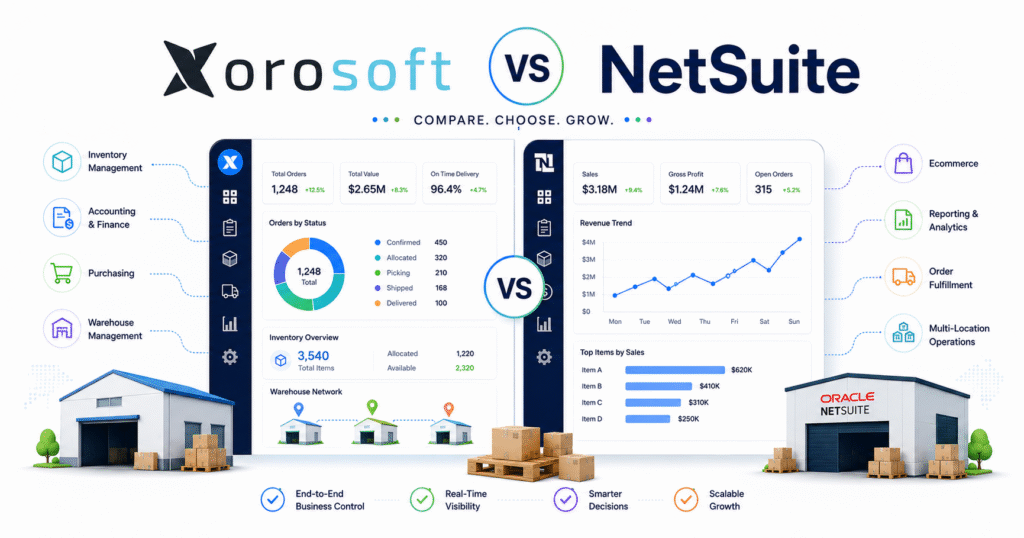
If you’re searching for a comprehensive comparison of Xorosoft vs NetSuite, this guide will provide the insights you need.
1. When Disconnected Systems Become a Growth Constraint
Growth rarely breaks a business all at once. Instead, the warning signs appear one by one. Stock counts stop matching across channels. Buyers create spreadsheets for incoming goods. Warehouse staff work from printed lists, while finance waits for data from other systems. As a result, month-end close takes longer because teams must match activity from ecommerce, inventory, shipping, and payments.
At first, these gaps look manageable. A connector fixes one issue, another spreadsheet fills a report gap, and a warehouse app improves scanning. However, each addition creates another place where data can arrive late, appear twice, or mean something different to each team.
At that point, the Xorosoft vs NetSuite comparison becomes a business decision rather than a simple software review. In other words, the goal is to decide how stock, orders, purchasing, warehouse work, manufacturing, and accounting should work together as the company grows.
1.1 Why Feature Counts Weaken a Cloud ERP Comparison
Most ERP vendors can provide long lists of features. Yet a feature name does not show how well it supports a real process.
For example, two platforms may both support multi-warehouse inventory. One may show stock by location, while another may offer deeper transfer, replenishment, allocation, picking, and receiving tools. Likewise, both may offer accounting, but their support for group reporting, intercompany work, and finance setup may differ greatly.
Therefore, start with workflows rather than product menus. Document how an order enters, how stock is assigned, how purchasing responds, how warehouse work is released, and how each step reaches the general ledger. Finally, test the full process in a live demo.
1.2 ERP Upgrade Signals Before a Xorosoft vs NetSuite Review
An ERP project becomes easier to justify when several problems appear together:
- Stock differs between the storefront, warehouse, and accounts.
- Staff re-enter orders or supplier data.
- Purchasing depends on spreadsheets.
- Several warehouses create transfer or replenishment issues.
- Sales channels compete for the same stock.
- Reports require exports from several apps.
- Stock valuation delays the close.
- Manufacturing sits outside the core system.
- Leaders cannot see reliable stock, cash, orders, and purchasing data.
However, not every growing company needs ERP right away. A business with one channel, one location, basic buying, and a small catalogue may still work well with simple tools. ERP becomes useful when disconnected work costs more than one connected system. Therefore, the business case should list clear delays, errors, control gaps, or growth needs.
2. Xorosoft vs NetSuite Platform Scope and Market Fit
The Xorosoft vs NetSuite decision begins by defining what each platform is built to manage. Although both are cloud ERP options, they approach business complexity in different ways.
2.1 Xorosoft as an Inventory-Driven Cloud ERP
XoroONE is positioned as a cloud ERP for retailers, wholesalers, and manufacturers. Its published feature set connects sales, purchasing, inventory management, warehouse operations, shipping, manufacturing, ecommerce and EDI, finance, reporting, budgeting, and forecasting in one environment.
For example, that scope is relevant to companies that have outgrown accounting software, spreadsheets, inventory apps, warehouse tools, and ecommerce connectors. The broader XoroERP platform also links accounting, reporting, vendors, warehousing, manufacturing, and multi-currency work.
2.2 NetSuite as a Broad Cloud Business Suite
NetSuite positions its ERP as a unified cloud platform covering financial management, order management, inventory, procurement, supply chain, warehouse operations, manufacturing, and reporting. It also supports broader enterprise requirements that may include multiple subsidiaries, currencies, accounting structures, and international operations.
Meanwhile, its broad scope can help companies with complex legal entities, intercompany transactions, global accounting, and detailed setup needs. Therefore, buyers should confirm the modules, setup, and internal or partner support needed to run the system.
2.3 The Core Difference in the Xorosoft NetSuite Comparison
However, the most useful distinction is not “small business ERP versus enterprise ERP.” A lean ecommerce brand may process high order volumes across several warehouses, while a larger organization may have modest product complexity but demanding multi-entity finance.
The comparison is better framed around two questions:
1. Does the business primarily need a connected operating system for inventory-driven commerce, wholesale, warehouse, purchasing, and production?
2. Does it require a broad enterprise platform with substantial multi-entity, financial, administrative, and customization depth?
Even so, buyers should validate the choice through real workflows and a realistic project plan.
3. Xorosoft vs NetSuite at a Glance
Use this table to guide live demos and technical review.
| Evaluation area | Xorosoft | NetSuite | Buyer question |
|---|---|---|---|
| Primary orientation | Inventory-driven product operations | Broad cloud business management | Which operating model resembles the company? |
| Accounting | Integrated accounting connected to operations | Extensive financial-management capabilities | How complex are accounting and entity requirements? |
| Inventory | Product, location, channel, and warehouse control | Multi-location and multichannel inventory | Which availability and allocation rules are required? |
| Purchasing | Connected purchasing and vendor workflows | Procurement and vendor-management capabilities | How formal are approvals and supplier processes? |
| Warehouse management | Built-in receiving, picking, packing, and shipping workflows | WMS capabilities available within the suite | What level of mobile warehouse execution is needed? |
| Ecommerce | Strong relevance to product and Shopify operations | Supported through suite capabilities and integrations | Which channels and exceptions must synchronize? |
| Manufacturing | Production connected with inventory and accounting | Manufacturing, work-order, and planning capabilities | How complex are BOMs, routings, and capacity needs? |
| Multi-entity finance | Must be validated against exact requirements | Established multi-entity and consolidation depth | How many legal entities and countries are involved? |
| Customization | Configuration and implementation based on scope | Broad customization and partner ecosystem | How much technical administration is acceptable? |
| Cost evaluation | Quote based on requirements and implementation | Licences, users, modules, implementation, and support | What is included in five-year total cost? |
Therefore, prove each feature with real products, locations, orders, users, and accounting rules.
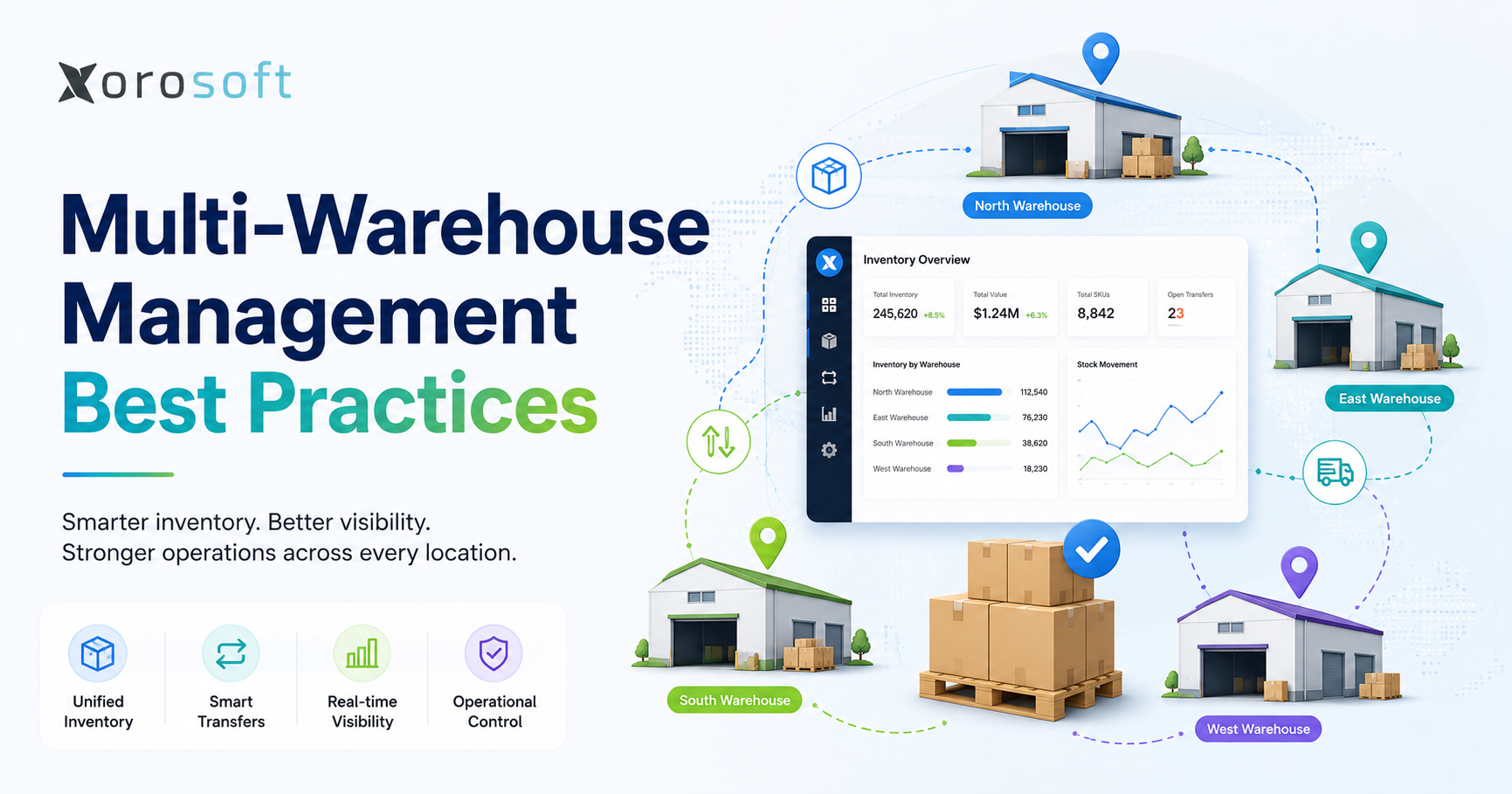
4. Xorosoft vs NetSuite for Inventory and Multi-Warehouse Control
Inventory often decides the Xorosoft vs NetSuite comparison because wrong stock data affects sales, buying, fulfilment, and finance.
4.1 Inventory Visibility in the Xorosoft NetSuite Comparison
A useful view separates physical stock from stock that can be sold. For example, it should show on-hand, committed, allocated, incoming, in-transit, damaged, held, or channel-reserved units. In addition, users need a clear history of receipts, shipments, returns, transfers, adjustments, assemblies, and production.
NetSuite describes stock visibility across locations and channels, plus replenishment, cycle counts, traceability, and controls. Xorosoft also links inventory with purchasing, sales, warehouse work, manufacturing, ecommerce, finance, and reports.
4.2 Multi-Warehouse Needs in an Inventory ERP Comparison
A strong transfer process should cover request, approval, reservation, shipping, in-transit stock, receipt, and final checks. Otherwise, teams may lose sight of goods while they move.
Moreover, replenishment needs more than minimum and maximum levels. Buyers should test lead times, open purchase orders, demand, safety stock, seasonality, supplier minimums, and warehouse space.
For example, move stock while ecommerce and wholesale orders compete for the same units. As a result, the team can see how transfer and allocation rules work together.
4.3 Inventory ERP Allocation and Order Routing
Allocation decides which demand receives stock first. Some companies protect paid ecommerce orders, while others reserve units for key wholesale accounts or store launches.
Meanwhile, routing may consider warehouse stock, shipping distance, labour, cut-off times, split costs, and delivery promises. Therefore, location data alone does not remove manual fulfilment choices.
4.4 Inventory Management ERP Traceability and Accuracy
Finally, industry needs shape stock control. Apparel uses variants, food may need lots and expiry dates, and industrial products may use serial numbers. Test cycle counts, adjustment approval, negative stock, traceability, landed cost, returns, and valuation.
5. Cloud ERP Accounting Comparison and Financial Control
The Xorosoft vs NetSuite accounting review should test whether sales, receipts, shipments, returns, purchases, transfers, and production reach finance without repeated exports or manual matching.
5.1 Accounting Requirements in a Cloud ERP Comparison
First, compare the general ledger, accounts payable, accounts receivable, bank matching, financial statements, tax, audit trails, budgets, permissions, and period controls.
NetSuite’s financial-management scope includes accounting, planning, close management, reporting, risk controls, and features designed for broader company structures. For example, this matters when the business has several subsidiaries, currencies, accounting books, or intercompany transactions.
Xorosoft’s ERP offerings include integrated accounting alongside inventory, warehousing, purchasing, manufacturing, and reporting. For inventory-driven buyers, however, the key question is how directly daily transactions connect to the finance record.
5.2 Inventory ERP Valuation and Reconciliation
Inventory valuation turns stock errors into finance problems. Test costing, landed costs, adjustments, returns, write-offs, production, and cost-of-goods-sold recognition. Follow one item from purchase through receipt, transfer, sale, return, and reporting. In addition, closed periods should require controlled changes with a clear audit trail.
5.3 Multi-Entity Finance in Xorosoft vs NetSuite
Multiple entities may require intercompany sales, eliminations, shared suppliers, currencies, tax rules, local reports, and group reporting. NetSuite may receive more weight here. Still, buyers should demo their exact structure because “multi-company” can describe very different features.
6. Purchasing and Forecasting in Xorosoft vs NetSuite
Purchasing connects demand with cash, supplier limits, warehouse space, and customer promises. As a result, spreadsheet planning often creates stockouts or excess stock.
6.1 Purchase Planning in the Xorosoft NetSuite Comparison
The ERP should support purchase requests, approvals, purchase orders, supplier records, prepayments, partial receipts, backorders, vendor credits, landed costs, and invoice matching.
In addition, the system should separate suggestions from approved orders and show cash, supplier minimums, stock, open orders, and storage limits.
6.2 Demand Forecasting in an Inventory ERP Comparison
Forecasting should use past demand, seasonality, promotions, launches, wholesale orders, supplier lead times, and safety stock. However, it should also flag misleading history. A stockout may appear as low demand even when customers would have purchased more.
Therefore, the platform should combine Shopify, Amazon, wholesale, retail, and EDI demand while keeping channel rules separate. This helps teams avoid buying twice for the same need.
6.3 Cloud ERP Forecasting Questions That Expose Planning Depth
Ask both vendors to show how the system handles:
- A new item with no sales history
- A seasonal product with one year of data
- A promotion that should not become the new baseline
- A supplier lead-time increase
- An item that stocked out repeatedly
- A wholesale order that consumes future availability
- A component shared by several manufactured products
Ultimately, these answers matter more than a forecasting menu.
7. Warehouse Management Comparison: XoroWMS and NetSuite WMS
Warehouse management controls how teams receive, move, count, pick, pack, and ship products.
7.1 Receiving and Putaway in a Warehouse ERP Comparison
First, receiving should compare expected and actual quantities, capture lots or serials, record damage, print labels, and flag differences for review. Putaway rules may consider product velocity, dimensions, storage conditions, and available capacity.
When receiving sits outside ERP, stock may update before location, cost, or quality data is complete. As a result, picking and reporting errors increase.
7.2 Picking, Packing, and Shipping in Xorosoft vs NetSuite
Warehouses may use single-order, batch, wave, zone, or cluster picking based on order mix, layout, and service promises.
XoroWMS should be evaluated for how its warehouse execution connects with the wider Xorosoft environment. NetSuite’s WMS materials describe mobile receiving, putaway, picking, packing, cycle counting, and related warehouse workflows.
During demos, warehouse staff should use the same devices, labels, bins, and exceptions they handle at work. Therefore, a polished desktop screen does not prove that a mobile workflow will be fast on the warehouse floor.
7.3 Warehouse Metrics in the Xorosoft NetSuite Comparison
Useful measures include dock-to-stock time, order accuracy, pick rate, fill rate, count variance, on-time shipping, cost per order, and return rate.
However, these measures depend on consistent timestamps. Ask when an order becomes released, picked, packed, shipped, and complete because platforms may calculate the same KPI differently.
8. Xorosoft vs NetSuite for Shopify, Amazon, and EDI
Ecommerce links should connect products, stock, payments, fulfilment, cancellations, returns, refunds, fees, gift cards, and payouts—not merely import orders.
8.1 Shopify ERP Integration in the Cloud ERP Comparison
For many brands, Shopify remains the selling layer. Meanwhile, ERP receives orders, reserves stock, releases warehouse work, sends shipment updates, and supports finance matching.
The Xorosoft ERP app for Shopify lists sync for orders, edits, payments, products, refunds, shipment updates, stock, payouts, gift cards, and international orders. It also lists links with Amazon, 3PLs, EDI providers, returns tools, payment gateways, and shipping systems.
However, buyers should still confirm sync direction, timing, error handling, record ownership, and support.
8.2 Ecommerce ERP Exceptions That Must Be Demonstrated
A standard paid order is easy to show. Instead, test harder cases:
- An order edited after payment
- Partial fulfilment from two warehouses
- A cancellation after allocation
- A pre-order or backorder
- A bundle with several SKUs
- A gift-card purchase and redemption
- A refund without a physical return
- A return received at another location
- Several Shopify stores sharing stock
- International orders with currency changes
Together, these cases show whether ERP, storefront, warehouse, and finance records stay aligned.
8.3 Amazon Operations in the Xorosoft NetSuite Comparison
In addition, marketplaces add fees, settlements, fulfilment models, returns, and stock rules. Test seller- and third-party-fulfilled orders, stock sync, fees, and settlements.
An order connector may still leave finance matching payouts by hand. Therefore, order flow and finance flow must be reviewed together.
8.4 Wholesale ERP and EDI Workflows
Wholesale customers may need contract prices, payment terms, credit limits, stock allocation, bulk fulfilment, and partner documents.
For EDI, list each document—purchase orders, acknowledgements, shipping notices, invoices, and stock reports. Then confirm who maintains mappings and fixes failures.
9. NetSuite Alternative Manufacturing Comparison
Manufacturing ranges from simple assembly to advanced planning. Therefore, buyers should define the control they need.
9.1 Manufacturing ERP Bills of Materials and Work Orders
Core needs may include bills of materials, revisions, work orders, component use, finished-goods receipts, labour, overhead, and production cost.
Basic assembly may not need advanced scheduling. However, shared machines, substitute materials, quality checks, subcontracting, or multi-level BOMs need a deeper review.
9.2 Material Planning in a NetSuite Alternative
Manufacturing connects sales demand with raw materials, purchasing, warehouse stock, and capacity. For example, a finished product may appear unavailable even when most parts are in stock. One inexpensive missing part can delay the entire order.
Therefore, ERP should show part shortages before a delivery promise is made. In addition, it should stop purchasing teams from planning raw materials without production demand.
9.3 Where Xorosoft and NetSuite Require Proof
Xorosoft publishes manufacturing and production features connected with inventory and accounting, while NetSuite publishes manufacturing, work-order, product-data, and planning features within its suite.
Complex manufacturers should require a proof of concept using a real BOM, shortage, revision, partial build, and cost difference.
10. Cloud ERP Reporting, Automation, and Business Visibility
ERP reporting should support decisions without repeated exports and manual data work.
10.1 Role-Based Reporting in a Cloud ERP Comparison
Finance needs cash, liabilities, receivables, margins, close status, and matching reports. Purchasing needs demand, supply, lead times, supplier performance, and open commitments. Warehouse leaders need workload, exceptions, productivity, and accuracy.
Therefore, dashboards should highlight action. Ask how users filter, schedule, export, and modify reports and whether changes require consultants.
10.2 Workflow Automation in Xorosoft vs NetSuite
Useful automation may include purchase approvals, reorder alerts, credit holds, order routing, transfer approvals, customer notices, and issue alerts.
Before automation, however, simplify rules, define ownership, and agree on exceptions. Otherwise, the system may repeat errors faster.
11. Implementation and Customization in Xorosoft vs NetSuite
ERP rollout combines process design, data, people, controls, links, and training.
11.1 ERP Implementation Scope in the Xorosoft NetSuite Comparison
A typical project includes discovery, process mapping, setup, data moves, links, testing, training, launch, and post-launch support.
Timelines depend on modules, locations, entities, data, links, custom work, and staff time. Therefore, avoid estimates that are not tied to a written scope.
11.2 Data Migration in a Cloud ERP Comparison
Most projects move customers, suppliers, products, prices, stock balances, lots, serials, open sales orders, purchase orders, receivables, payables, and the chart of accounts.
However, moving every old transaction may increase cost and risk without improving daily work. Instead, an easy-to-use reporting archive may be more practical.
11.3 Configuration and Custom Work in Xorosoft vs NetSuite
System setup uses supported settings, fields, permissions, workflows, and reports. By contrast, custom development adds code, scripts, or special links.
Custom work may be justified for a process that sets the business apart. However, it adds work for documentation, security, testing, upgrades, and staff training. Therefore, buyers should know who tests changes, fixes problems, and prices upkeep.
11.4 Internal Ownership After a Cloud ERP Implementation
After launch, someone must manage users, permissions, reports, data quality, links, workflows, and support. A large systems team may support a highly flexible setup. Meanwhile, a lean business may prefer less technical dependence.
12. Xorosoft vs NetSuite Pricing and Five-Year Cost
Public licence prices rarely support a fair Xorosoft vs NetSuite comparison because quotes may include different users, modules, links, data moves, training, and support.
12.1 Cost Categories in the Xorosoft NetSuite Comparison
Therefore, a complete five-year model should include:
- Software licences or subscriptions
- User growth
- Optional modules
- Discovery and implementation
- Data migration
- Integrations
- Customization
- Training
- Support and consulting
- Internal project labour
- Ongoing administration
- Future process changes
The calculation can be expressed as:
Five-year TCO = implementation + software + modules + integrations + support + internal labour + future changes
12.2 Why the Lowest ERP Quote May Cost More
For example, one proposal may include data migration, testing, and training, while another may show mostly software fees. As a result, the lower quote can become more expensive once missing work is added.
Buyers should request a written work plan, licence list, link scope, training plan, support terms, and change-order process. Only then can the two proposals be compared fairly.
12.3 Operational Cost in a Cloud ERP Comparison
Also include manual matching, overselling, stockouts, excess stock, late reports, and duplicate entry. Finally, use measurable baselines rather than inflated ROI claims.
13. Industry Fit in the Inventory ERP Comparison
A generic demo can hide industry gaps. Therefore, use cases that reflect how products are bought, stored, sold, returned, and reported. The Xorosoft industry portfolio covers apparel, wholesale, food and beverage, furniture, manufacturing, sporting goods, automotive, beauty, and other product groups. Ultimately, workflow depth is the deciding factor.
13.1 Apparel Needs in an Inventory ERP Comparison
Apparel companies manage style, colour, size, collection, and season. For example, one design may create dozens of SKUs. Test matrix products, pre-orders, seasonal buying, allocation, returns, and stock across stores, ecommerce, and warehouses.
13.2 Furniture Needs in a Cloud ERP Comparison
Furniture businesses often manage long lead times, large items, deposits, special orders, and planned delivery. Test landed cost, partial receipts, supplier delays, space, deposits, split delivery, and damaged-item replacement.
13.3 Sporting Goods Needs in an Inventory ERP Comparison
These companies may face seasonal demand, variants, wholesale orders, and marketplace growth. Therefore, ERP should separate steady demand from short promotion spikes.
13.4 Food and Beverage Needs in a NetSuite Alternative
Food operations may need lot tracking, expiry dates, quality holds, first-expiry-first-out steps, and recall readiness. For example, trace one lot from receipt through storage, production, sale, shipment, and recall.
13.5 Wholesale Needs in the Xorosoft NetSuite Comparison
Wholesale distributors need customer prices, credit controls, allocation, EDI, bulk fulfilment, purchasing, and supplier management. Then show how one wholesale order affects stock, warehouse work, invoicing, credit, and replenishment.
13.6 Manufacturing Needs in a Cloud ERP Comparison
Manufacturers need links between raw materials, buying, work orders, warehouse moves, finished goods, cost, and delivery promises. The key question is whether the system can manage the production model without too much custom work.
14. Who Should Choose Xorosoft or NetSuite?
No ERP fits every company. Therefore, base the Xorosoft vs NetSuite decision on evidence.
14.1 When Xorosoft May Be the Better Fit
Xorosoft may warrant closer evaluation when a company:
- Sells physical products through Shopify, Amazon, wholesale, or retail channels
- Needs inventory, accounting, purchasing, warehouse, forecasting, and manufacturing in one environment
- Operates several warehouses or works with 3PL providers
- Uses EDI for wholesale trading partners
- Has outgrown QuickBooks, spreadsheets, or inventory-only software
- Wants an ERP designed around product operations rather than a collection of disconnected applications
After documenting your needs, use the detailed Xorosoft vs NetSuite comparison for a deeper review.
14.2 When NetSuite May Be the Better Fit
NetSuite may deserve stronger consideration when the organization needs:
- Extensive subsidiary and intercompany accounting
- Multiple books, currencies, and international structures
- Broad enterprise administration beyond product operations
- A large implementation-partner ecosystem
- Significant customization supported by internal technical resources
- A platform already established across several business units
However, test these strengths against project effort, user adoption, and five-year cost.
14.3 When Neither Platform Is Necessary Yet
A smaller company may not need either platform with one channel, a limited catalogue, basic purchasing, one simple warehouse, and reliable accounting.
Instead, better process discipline and cleaner data may be the right short-term choice. ERP should solve measurable complexity, not serve as a growth badge.
15. A Practical Cloud ERP Comparison Framework
A disciplined cloud ERP comparison keeps a polished demo from outweighing evidence.
15.1 Define Outcomes for the Xorosoft NetSuite Comparison
First, define results such as better stock accuracy, faster orders, a shorter close, automated buying, or support for a new channel.
15.2 Map Workflows Before Comparing Cloud ERP Platforms
Next, map order to cash, procure to pay, receive to stock, pick to ship, return to refund, plan to produce, and record to report.
Then mark every manual entry, spreadsheet, late handoff, and matching step. These become demo cases and needs.
15.3 Weight the ERP Scorecard Before Demonstrations
A reasonable starting model is:
| Evaluation category | Suggested weight |
| Operational fit | 25% |
| Inventory and warehouse | 20% |
| Finance and reporting | 15% |
| Ecommerce and integrations | 15% |
| Implementation | 10% |
| Five-year TCO | 10% |
| User adoption | 5% |
Set weights before demos. Otherwise, changing them later can bias the result.
15.4 Validate Xorosoft vs NetSuite With Real Transactions
Finally, ask each vendor to perform the same cases:
- Receive a partial purchase order with a discrepancy.
- Allocate scarce stock between wholesale and ecommerce.
- Transfer goods between warehouses.
- Fulfil and partially refund a Shopify order.
- Calculate landed cost.
- Build a work order with a missing component.
- Reconcile inventory with the general ledger.
Afterward, record the session, involve end users, and score each workflow at once.
16. Frequently Asked Questions About Xorosoft vs NetSuite
16.1 What Is the Main Difference Between Xorosoft and NetSuite?
Xorosoft focuses on inventory-driven ecommerce, wholesale, warehouse, and manufacturing work. By contrast, NetSuite offers a broader cloud suite with strong finance and multi-entity tools. Therefore, the right choice depends on business needs, project resources, system links, and five-year cost.
16.2 Is Xorosoft a NetSuite Alternative?
Yes. It can suit product companies that need inventory, accounting, purchasing, WMS, ecommerce, forecasting, EDI, and manufacturing. However, companies with global entities or complex intercompany accounting should test those needs before treating it as a direct replacement.
16.3 Which ERP Is Better for Inventory-Driven Businesses?
The better ERP manages products, locations, channels, purchasing, allocation, cost, and warehouse work without needless complexity. Therefore, test full transactions and exceptions rather than feature names. Also, confirm that stock values match the accounts.
16.4 Which ERP Is Better for Shopify Brands?
Shopify brands should compare orders, stock, fulfilment, cancellations, refunds, returns, payouts, gift cards, and multi-store support. In addition, the right platform depends on Amazon, wholesale, manufacturing, warehouse, and 3PL needs.
16.5 Can Xorosoft and NetSuite Manage Multiple Warehouses?
Both offer multi-location stock. However, depth matters. Test transfers, in-transit stock, replenishment, allocation, routing, cycle counts, bins, mobile scanning, and location plans. Warehouse visibility alone does not provide full multi-warehouse control.
16.6 Which ERP Offers Stronger Accounting?
NetSuite emphasizes broad finance and multi-entity management. Meanwhile, Xorosoft connects accounting with inventory-driven work. The fit depends on whether the business needs group reporting and intercompany tools or direct links across stock, warehouse, purchasing, ecommerce, and production.
16.7 Can Xorosoft Replace QuickBooks and Inventory Software?
It is designed for businesses that have outgrown separate accounting and business apps. However, the data move must cover balances, stock value, receivables, payables, open orders, report history, and training. Ultimately, the goal is reliable connected work.
16.8 Which ERP Is Better for Wholesale Distribution?
Wholesale distributors should test prices, terms, credit, allocation, EDI, purchasing, bulk fulfilment, commissions, and supplier work. The stronger system connects these workflows with less manual work and dependable stock and finance data.
16.9 Do Xorosoft and NetSuite Support EDI?
Both can support EDI through built-in tools, partners, or links. First, list every trading partner and document type. Then clarify mapping, testing, checks, support, and error fixes. “EDI supported” alone is not proof of fit.
16.10 Which ERP Is Better for Manufacturing?
The answer depends on complexity. Light assembly may need BOMs and work orders. However, advanced manufacturing may require routings, capacity, subcontracting, quality, substitute materials, and detailed cost. Therefore, run a proof of concept with a real product.
16.11 Do Xorosoft and NetSuite Support Demand Forecasting?
Both provide planning tools. However, buyers should test seasonality, promotions, new products, stockouts, lead-time changes, supplier minimums, wholesale orders, and shared parts. As a result, forecast output should lead to useful buying or production choices.
16.12 How Should a Warehouse Management ERP Be Compared?
First, review receiving, putaway, replenishment, picking, packing, shipping, transfers, cycle counts, and exception handling. In addition, staff should test the workflows on real mobile devices and review labels, permissions, carrier links, and stock-accounting updates.
16.13 Does NetSuite Integrate With Shopify?
NetSuite can connect with Shopify through connectors, partners, or custom work. However, buyers should verify orders, products, customers, stock, fulfilment, cancellations, returns, refunds, and payouts. Then clarify who owns and supports the link.
16.14 Does Xorosoft Integrate With Amazon?
Xorosoft lists Amazon among the services and channels that can connect with its ERP environment. Therefore, buyers should confirm orders, stock, fulfilment, returns, fees, settlements, and accounting because link depth can vary by business model.
16.15 Which ERP Is Easier to Implement: Xorosoft or NetSuite?
Project difficulty depends on scope rather than the product name alone. Modules, entities, locations, links, custom work, data quality, and staff time all matter. For example, a focused platform can still fail without clear ownership.
16.16 How Long Does a Cloud ERP Implementation Take?
There is no single reliable timeline. A project may take several months or longer based on scope, data moves, links, testing, and company readiness. Therefore, request a milestone plan tied to written deliverables.
16.17 What Data Should Be Migrated Into a Cloud ERP?
Common data moves include customers, suppliers, products, prices, stock balances, lots, serials, open orders, receivables, payables, and the chart of accounts. Meanwhile, old transactions may remain in an archive when full migration adds little value.
16.18 How Should ERP Total Cost of Ownership Be Calculated?
Calculate software, modules, users, project work, data moves, links, custom work, training, support, staff time, admin work, and future growth. In most cases, five years gives a better view than the first-year quote.
16.19 What Hidden ERP Costs Should Buyers Consider?
Often-missed costs include data cleaning, staff project time, short-term output loss, report work, link checks, update testing, partner support, and admin work. In addition, include the cost of keeping old apps during the move.
16.20 Which ERP Is Better for Multi-Entity Accounting?
NetSuite may score higher when the company needs deep subsidiary, group reporting, intercompany, currency, and accounting-book tools. However, any competing platform should be tested against the exact legal and reporting structure.
16.21 What Should Buyers Ask in a Xorosoft vs NetSuite Demo?
Ask vendors to complete real workflows, explain needed modules, identify links, show exception handling, and clarify project duties. In addition, ask how reports change, how permissions work, and what costs can rise after signing.
16.22 When Has a Business Outgrown QuickBooks?
A company may have outgrown QuickBooks when stock, purchasing, warehouses, ecommerce, manufacturing, or reports depend on many spreadsheets and separate apps. Other signs include a slow close, repeated matching, weak location data, and limited controls.
16.23 Who May Not Need a Full Cloud ERP Yet?
A company with simple products, one channel, one warehouse, few users, basic purchasing, and reliable reports may not need ERP. First, decide whether current systems create clear errors, delays, or control issues. Revenue alone does not decide readiness.
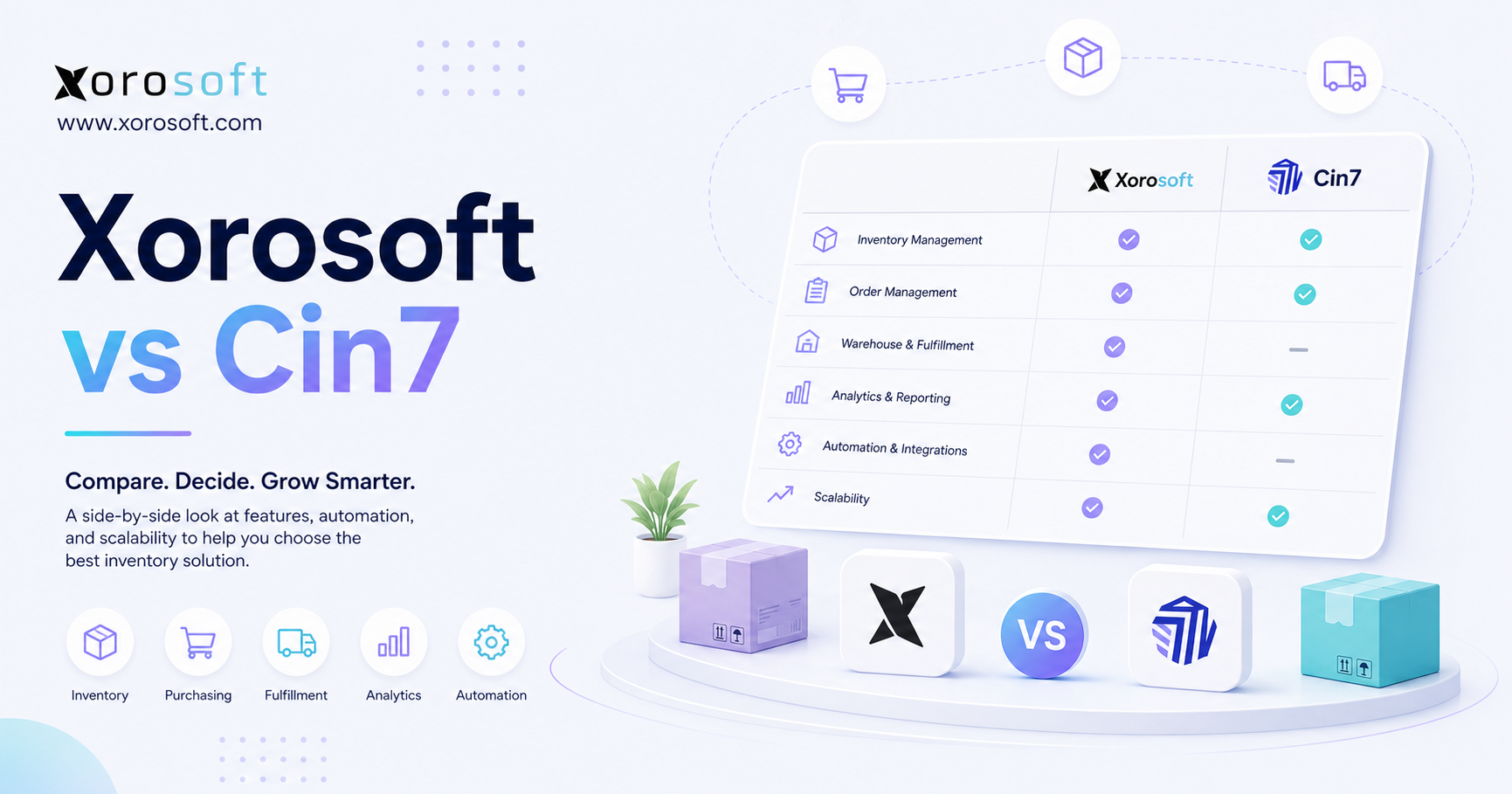
16.24 What Are the Main Alternatives to Xorosoft and NetSuite?
Alternatives include Acumatica, Microsoft Dynamics 365 Business Central, Sage, Epicor, Odoo, Cin7, Brightpearl, Fishbowl, and industry tools. Therefore, base the shortlist on workflows, industry, project resources, link needs, and total cost.
16.25 How Should a Company Make the Final ERP Decision?
First, define measurable goals, map workflows, weight criteria, and give every vendor the same cases. Next, verify scope, data moves, links, support, and five-year cost. Finally, involve the staff who will use the system.
17. Turn the Comparison Into an Evidence-Based ERP Decision
The Xorosoft vs NetSuite decision should end with proof that one platform supports key workflows, reporting, growth, and an acceptable total cost.
First, start with the problems the project must solve. Next, map work across ecommerce, wholesale, purchasing, warehouse, manufacturing, and finance. Then require both vendors to complete those workflows with real data and exceptions.
Xorosoft may suit inventory-driven operations, while NetSuite may suit strong multi-entity and global finance needs. However, confirm either view through discovery.
As a result, a disciplined process helps prevent underbuying, overbuying, and underestimating the project.
Ready to compare ERP options? Review your core workflows and implementation priorities through the Xorosoft contact and personalized demo page.