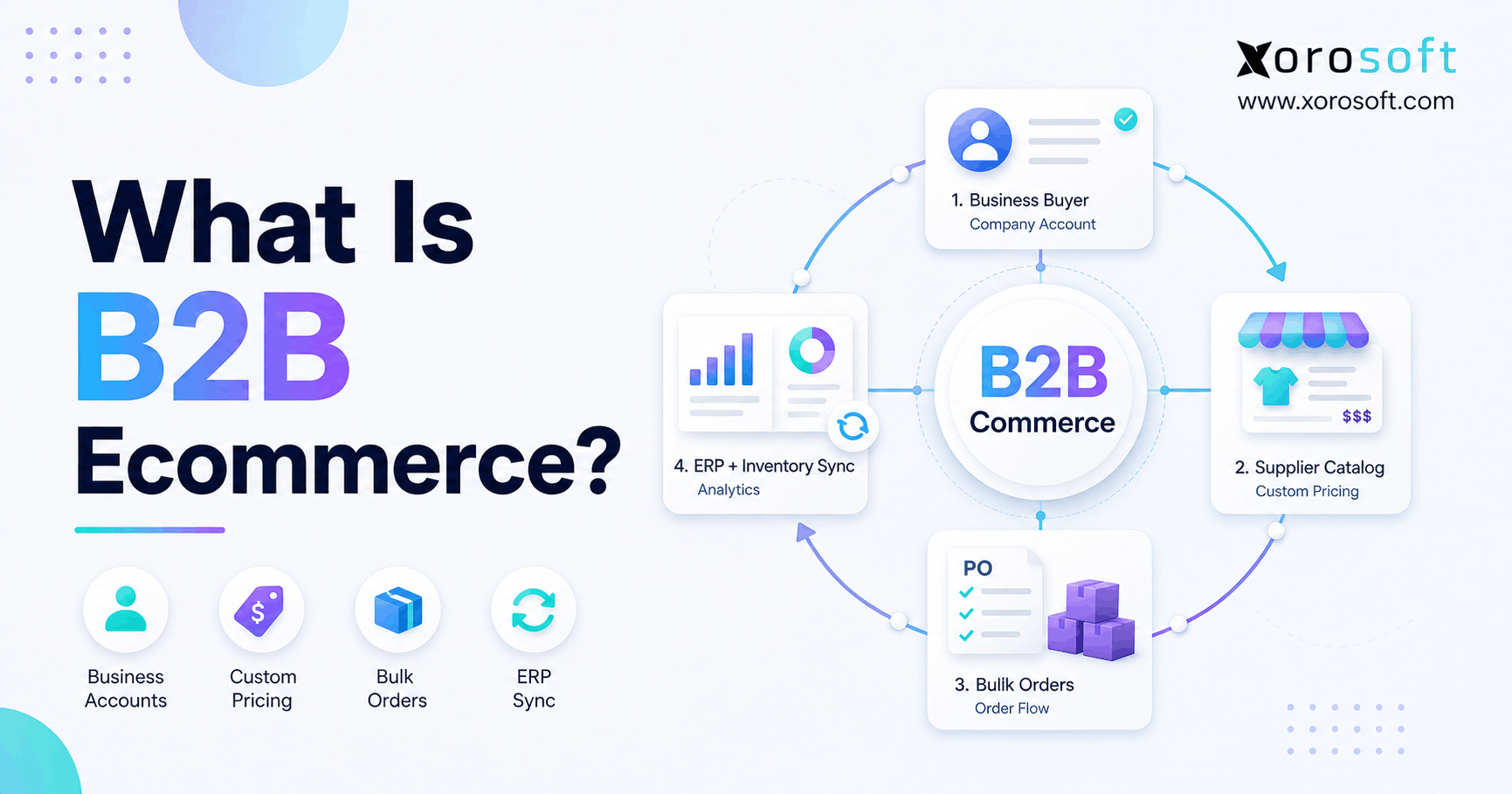
If you’re looking to better understand B2B ecommerce, this guide will help you navigate the essentials.
1. B2B Ecommerce Changes More Than the Checkout
B2B ecommerce is the online sale of products or services from one business to another business. However, unlike a typical consumer purchase, a B2B transaction can involve negotiated pricing, larger quantities, purchase orders, payment terms, approval rules, account-specific catalogs, and repeat ordering.
For example, a retailer may log into a wholesaler’s portal, see a price that was negotiated specifically for its account, order several cases of inventory, and pay under Net 30 terms. Meanwhile, another customer may see different products, prices, quantities, and payment conditions on the same platform.
Therefore, B2B ecommerce is not simply a consumer website with wholesale prices added. Instead, it is a digital operating model that connects business customers with the commercial rules required to sell to them accurately.
As companies grow, that distinction becomes increasingly important. Although a simple website may handle early B2B orders, larger operations must also coordinate inventory, purchasing, warehouses, accounting, fulfillment, customer credit, and reporting.
Consequently, the quality of a B2B ecommerce operation depends on what happens after the buyer clicks “place order” just as much as what happens before it.
1.1 What Does B2B Mean?
B2B means business to business. In other words, both sides of the commercial transaction are businesses rather than an individual consumer buying from a company.
For instance, a furniture manufacturer may sell to independent retailers. Similarly, an automotive parts distributor may sell to repair shops, while an apparel brand may supply boutiques and department stores.
Although the industries differ, the commercial relationship remains the same: one business is supplying another.
1.2 Is B2B Ecommerce the Same as Wholesale?
Wholesale is one major form of B2B ecommerce, but the two terms are not identical.
Usually, wholesale involves selling products in commercial quantities to another company for resale or business use. However, B2B commerce also includes manufacturers selling components, industrial suppliers selling equipment, brands selling to corporate customers, and distributors serving professional buyers.
Therefore, most digital wholesale transactions are B2B transactions. Nevertheless, not every B2B transaction is technically wholesale.
2. How B2B Ecommerce Works From Login to Fulfillment
A B2B transaction usually starts with a recognized business account. First, the buyer logs in or identifies the company it represents. Next, the ecommerce platform determines which products, prices, payment terms, and purchasing rules apply to that account.
Afterward, the customer creates an order, requests a quote, or repeats a previous purchase. Depending on the business, an internal approval may then be required before the order becomes final.
Once the order is accepted, inventory must be allocated. Subsequently, the warehouse receives fulfillment instructions, while accounting records the appropriate financial transaction.
As a result, a seemingly simple online order may affect several operational areas at the same time.
A typical process looks like this:
1. Buyer accesses a company account.
2. Account-specific products and pricing appear.
3. Buyer checks product availability.
4. Quantity rules or discounts are applied.
5. Buyer creates an order or quote.
6. Approval rules are checked.
7. Payment terms or payment methods are applied.
8. Inventory is allocated.
9. Warehouse teams pick, pack, and ship.
10. Accounting records the invoice and receivable.
11. Shipment and order status return to the customer.
2.1 Self-Service Does Not Mean No Sales Team
Digital self-service can reduce routine administrative work. For example, buyers can check prices, repeat previous orders, review invoices, or track shipments without contacting a representative.
However, sales representatives still provide value in complex situations. In particular, strategic accounts may require negotiation, forecasting discussions, product recommendations, or customized commercial arrangements.
Therefore, the strongest B2B model is often hybrid. Routine transactions become self-service, while sales teams focus on interactions where their expertise matters most.
2.2 Why Repeat Ordering Matters
Repeat purchasing is especially important in B2B environments because customers often buy the same SKUs on predictable cycles.
Consequently, order history, saved lists, quick-order functions, and account-specific catalogs can substantially reduce purchasing effort.
Moreover, the easier it becomes to reorder accurately, the less time both buyers and sellers spend rebuilding familiar transactions.
3. B2B Ecommerce vs B2C Ecommerce
B2B and B2C ecommerce both use websites and digital checkout processes. However, the commercial rules behind those transactions are often very different.
For instance, a consumer generally sees a standard price and pays immediately. By contrast, a business buyer may receive a negotiated price, submit a purchase order, use a credit account, and require manager approval.
Therefore, B2B systems usually need more account-level logic than consumer storefronts.
| Area | B2B Ecommerce | B2C Ecommerce |
|---|---|---|
| Buyer | Business | Individual consumer |
| Typical order | Larger, often recurring | Smaller, often individual |
| Pricing | Customer-specific or tiered | Usually standard |
| Payment | Card, invoice, PO, terms | Usually immediate |
| Accounts | Companies and multiple users | Individual users |
| Approvals | Often required | Rare |
| Catalogs | May vary by account | Usually common |
| Reordering | Very important | Varies |
| Sales cycle | Often longer | Usually shorter |
| Fulfillment | Cases, bulk orders, pallets | Primarily parcels |
| Integrations | ERP, WMS, EDI, accounting | Often storefront-focused |
3.1 Customer Relationships Are Different
B2C transactions can be anonymous or one-time. Conversely, B2B relationships frequently continue for months or years.
Therefore, account history, contract pricing, service levels, payment terms, and purchasing patterns become more important.
In addition, several people may participate in a single B2B account. For example, one employee may create an order while another approves it and an accounting team processes the invoice.
3.2 B2B and B2C Can Operate Together
Many product businesses sell through both models.
For example, an apparel brand may sell individual items directly to consumers while also supplying boutiques and department stores. Similarly, a sporting goods company may serve consumers online while selling larger orders to specialty retailers.
However, both channels may draw from the same inventory. Therefore, the operational challenge is keeping stock, pricing, orders, and fulfillment synchronized across every channel.
4. The Main Types of B2B Ecommerce
Although B2B ecommerce is one broad category, several commercial models sit within it.
4.1 Manufacturer to Distributor
A manufacturer may sell finished goods to distributors that hold inventory and serve regional or specialized markets.
Therefore, the digital system may need to support case quantities, pallets, negotiated pricing, and high-volume orders.
4.2 Manufacturer to Retailer
Some manufacturers sell directly to retailers instead of relying entirely on distributors.
As a result, the manufacturer may need to manage more customer accounts, smaller order quantities, and more frequent shipments.
4.3 Wholesaler to Retailer
This is one of the most common B2B models.
For example, a wholesaler may allow independent retailers to log into a portal, see approved products, view wholesale pricing, and place replenishment orders.
4.4 Distributor to Business Customer
A distributor may sell directly to restaurants, offices, contractors, repair facilities, healthcare providers, or other commercial customers.
Consequently, the platform may need to support many customer types while maintaining separate pricing and account rules.
4.5 B2B Marketplace
A marketplace brings multiple business sellers and buyers into a shared digital environment.
However, the marketplace is only the commercial front end. Sellers still need reliable systems for inventory, order processing, fulfillment, and financial management.
4.6 B2B2C Commerce
In a B2B2C model, one business reaches the end customer through another business.
Therefore, brands may need to coordinate partner relationships while still maintaining visibility into orders, products, or customer experiences.
5. Why Businesses Move B2B Sales Online
Businesses usually adopt ecommerce because manual sales processes become harder to scale.
For example, email orders can work when a company has 20 customers. However, the same workflow becomes difficult when hundreds of buyers are repeatedly requesting prices, availability, order status, and invoices.
As a result, digital commerce can remove repetitive administration from both sides of the transaction.
5.1 Customers Can Order at Any Time
A portal allows buyers to place routine orders outside normal office hours.
Therefore, customers do not need to coordinate every transaction with a sales representative.
5.2 Repeat Orders Become Faster
Business buyers frequently reorder familiar products.
Consequently, saved order history and account-specific catalogs can shorten the purchasing process considerably.
5.3 Manual Entry Decreases
Email and phone orders often require an employee to re-enter information.
By contrast, digitally captured orders can move directly into connected operational systems.
Therefore, businesses can reduce duplicate data entry while also reducing opportunities for transcription errors.
5.4 Customers Receive a More Relevant Experience
B2B buyers do not always need the same products or prices.
For example, a retailer may have a contract price that does not apply to another retailer. Similarly, certain products may only be available to specific accounts.
Therefore, personalization is not merely a marketing feature in B2B commerce. Instead, it can be a commercial requirement.
5.5 Sales Teams Can Focus on Higher-Value Work
When routine questions move online, sales representatives can spend more time on account growth and less time retrieving basic information.
As a result, ecommerce can support the sales organization rather than competing with it.
6. Where B2B Ecommerce Becomes Difficult
The storefront is usually the visible part of B2B ecommerce. However, operational complexity sits behind that storefront.
Therefore, companies often discover that launching online ordering is easier than maintaining accurate information across every system.
6.1 Customer-Specific Pricing
Different accounts may receive different prices.
For instance, pricing may depend on contracts, volume commitments, customer groups, promotional agreements, or geographic regions.
Consequently, pricing becomes difficult when sales teams, ecommerce platforms, and accounting systems maintain separate versions of the same rule.
6.2 Inventory Availability
Displaying inventory online creates an important promise.
If the website shows 500 units available while 300 are already allocated elsewhere, the customer may place an order that cannot be fulfilled.
Therefore, reliable availability requires more than a simple on-hand quantity.
6.3 Multiple Warehouses
A company may have inventory across several warehouses, stores, or third-party logistics providers.
However, total stock alone does not answer the fulfillment question. Instead, location, allocation, lead time, shipping cost, and customer priority may determine which stock is truly available.
6.4 Payment Terms and Credit
B2B buyers may use Net 30, Net 60, deposits, purchase orders, bank payments, or account credit.
Consequently, checkout logic must reflect commercial terms rather than assuming every customer will pay immediately by card.
6.5 Disconnected Systems
Many growing businesses combine ecommerce, accounting software, spreadsheets, warehouse applications, and purchasing tools.
At first, that approach can appear flexible. Over time, however, disconnected data creates duplicate entry, reconciliation work, inventory discrepancies, and delayed reporting.
7. Features a Strong B2B Ecommerce Platform Should Support
A B2B platform should reflect the way business customers actually purchase.
Therefore, companies should evaluate more than storefront design.
Important capabilities include:
| Capability | Why It Matters |
| Company accounts | Groups users under a business |
| User permissions | Controls purchasing authority |
| Customer catalogs | Shows relevant products |
| Account pricing | Applies negotiated prices |
| Volume pricing | Supports quantity discounts |
| Minimum quantities | Enforces commercial rules |
| Quote requests | Supports negotiated transactions |
| Purchase orders | Matches procurement processes |
| Payment terms | Supports approved credit |
| Quick reordering | Speeds repeat purchases |
| Inventory visibility | Shows usable availability |
| Order history | Reduces service requests |
| ERP integration | Connects commerce to operations |
| Warehouse integration | Supports fulfillment execution |
| Reporting | Provides visibility across transactions |
7.1 Integration Should Be Evaluated Early
A storefront may appear effective during a demonstration. However, its long-term value depends partly on how well it exchanges data with other systems.
Therefore, integration requirements should be mapped before implementation.
For businesses that need ecommerce connected with operational applications, the Xorosoft integrations environment provides a useful example of how commerce, marketplaces, shipping, payments, and business systems can be connected rather than managed as isolated tools.
7.2 Front-End Features Are Only Half the Evaluation
Buyer experience certainly matters. Nevertheless, back-office execution determines whether orders remain accurate after checkout.
As a result, platform selection should consider inventory, pricing, purchasing, fulfillment, accounting, and reporting alongside design and merchandising.
8. How B2B Pricing, Orders, and Payment Terms Work
Pricing is one of the clearest differences between B2B and B2C ecommerce.
Although a consumer storefront usually publishes one standard price, a B2B seller may maintain several price structures simultaneously.
8.1 Common B2B Pricing Models
Businesses may use:
- Standard wholesale pricing
- Customer-specific pricing
- Contract pricing
- Tiered pricing
- Volume discounts
- Quantity breaks
- Promotional pricing
- Regional pricing
Therefore, the same SKU may legitimately have several selling prices.
However, problems arise when those prices are maintained independently in spreadsheets, ecommerce platforms, and accounting systems.
8.2 Purchase Orders Remain Important
Many business customers use purchase orders because purchasing must follow an internal procurement process.
For example, a buyer may need to include a PO number before an order can be accepted.
Therefore, a B2B checkout should support how customers buy rather than forcing every transaction through a consumer-style payment flow.
8.3 Payment Terms Add Another Layer
Some customers pay immediately. Others, however, may have approved credit.
Consequently, the system may need to evaluate:
- Credit limits
- Outstanding balances
- Payment terms
- Deposits
- Order value
- Approval requirements
As a result, checkout becomes closely connected with financial operations.
9. Inventory Is the Operational Backbone of B2B Ecommerce
Inventory accuracy becomes increasingly important as digital order volume grows.
After all, customers make purchasing decisions based on the availability they see online.
Therefore, inaccurate stock data can create backorders, split shipments, cancellations, and damaged customer relationships.
9.1 On-Hand Inventory Is Not Always Available Inventory
A warehouse may physically hold 1,000 units. However, 400 units may already be allocated to existing orders.
Therefore, only 600 may actually be available for new demand.
In addition, some inventory may be reserved for another channel, customer, or location.
Consequently, B2B availability should consider operational commitments rather than displaying only physical stock.
9.2 Multi-Warehouse Inventory Adds Complexity
A business may hold the same SKU in several facilities.
For example, one warehouse may be close to the customer while another has more stock.
Therefore, fulfillment decisions may depend on geography, service level, shipping cost, allocation rules, or customer priority.
This is where an inventory-centered ERP approach can become useful. For example, XoroERP is designed to connect inventory, purchasing, sales orders, accounting, and operational workflows so teams do not need to maintain separate versions of the same transaction data.
9.3 Purchasing Must Respond to Demand
Digital sales can increase order volume quickly.
Therefore, purchasing teams need visibility into what is selling, what is allocated, what is incoming, and what must be replenished.
Otherwise, stronger ecommerce demand may simply create larger stockouts.
10. Why ERP Integration Matters as B2B Ecommerce Scales
An ecommerce platform manages the buying experience. By contrast, ERP manages broader operational and financial processes.
Therefore, the systems serve different purposes.
A growing B2B business may need to connect:
- Products
- Customers
- Inventory
- Pricing
- Orders
- Purchasing
- Accounting
- Warehouses
- Manufacturing
- Reporting
10.1 What ERP Contributes
ERP can provide a shared operational system for information that ecommerce depends on.
For instance, customer pricing may originate in ERP, while ecommerce captures the order. Next, ERP may allocate inventory, update purchasing demand, create financial records, and send fulfillment instructions.
As a result, teams can reduce repeated manual entry.
For inventory-driven businesses that need several workflows in one environment, XoroONE brings inventory, purchasing, accounting, warehouse operations, manufacturing, ecommerce, and reporting into a connected cloud ERP platform.
10.2 Ecommerce and ERP Should Complement Each Other
The ecommerce platform should remain focused on helping customers buy.
Meanwhile, ERP should coordinate the operational processes required to fulfill those promises.
Therefore, companies do not necessarily need to replace a successful storefront when complexity grows. Instead, they may need a stronger operational layer behind it.
10.3 When ERP Becomes More Relevant
ERP becomes increasingly valuable when businesses experience:
- Multiple warehouses
- High SKU counts
- Wholesale and DTC channels
- Manual purchasing
- Complex accounting
- Customer-specific pricing
- EDI requirements
- Manufacturing
- Delayed reporting
- Frequent inventory reconciliation
Consequently, the decision should be based on operational complexity rather than company age alone.
11. Warehouse Management Determines What Happens After the Order
After a B2B order is accepted, the warehouse must execute it accurately.
Therefore, ecommerce and fulfillment should not be treated as separate worlds.
11.1 B2B Fulfillment Can Be More Complex
Consumer ecommerce often focuses on individual parcel orders. B2B fulfillment, however, may involve cases, pallets, bulk quantities, retailer requirements, or multiple shipment locations.
Consequently, warehouses may need:
- Barcode scanning
- Directed picking
- Case picking
- Pallet picking
- Lot tracking
- Serial tracking
- Packing controls
- Shipment verification
- Transfer workflows
- Multi-warehouse routing
11.2 Warehouse Accuracy Protects the Customer Experience
A perfect checkout experience still fails if the wrong products leave the warehouse.
Therefore, digital growth should be matched by reliable warehouse processes.
For companies that need real-time warehouse execution tied to inventory and orders, XoroWMS supports receiving, picking, packing, shipping, scanning, and inventory control within a connected operational environment.
11.3 Allocation Matters Before Picking Begins
Large B2B orders can compete with smaller ecommerce orders for the same stock.
Therefore, businesses need clear allocation rules before inventory reaches the picking stage.
Otherwise, one channel may consume inventory that was expected to fulfill another customer’s order.
12. Shopify, B2B Ecommerce, and Multi-Channel Operations
Shopify can serve as an important commerce layer for product businesses.
However, B2B operations often become more complex when the same company also manages DTC sales, marketplaces, wholesale customers, and multiple warehouses.
12.1 The Storefront Is Only One Layer
Shopify can manage the online customer experience. Meanwhile, back-office systems may manage purchasing, accounting, inventory, warehouse operations, and reporting.
Therefore, the goal should be to connect these layers rather than force one system to perform every task.
Businesses evaluating how Xorosoft connects with Shopify can also review its listing on the Shopify App Store. This provides an outbound reference for merchants researching ERP connectivity in the Shopify ecosystem.
12.2 Shared Inventory Creates Multi-Channel Pressure
Suppose a company sells through Shopify, wholesale accounts, and marketplaces.
If every channel reads inventory differently, overselling becomes more likely.
Therefore, multi-channel businesses benefit from a central view of stock, allocations, incoming inventory, and orders.
12.3 Operational Visibility Becomes More Valuable as Channels Grow
Adding channels can increase revenue opportunities. However, each new channel also creates more order, inventory, pricing, and reconciliation activity.
As a result, businesses should evaluate whether their operational architecture can support growth before simply adding more storefronts.
13. How B2B Ecommerce Changes Across Industries
The fundamentals of digital B2B selling are similar across industries. Nevertheless, operational requirements vary considerably.
Businesses can explore Xorosoft’s broader industries served to see how inventory and operational workflows differ across product-driven sectors.
13.1 Apparel and Fashion
Apparel businesses often manage styles, colors, sizes, seasons, and wholesale accounts.
Therefore, inventory accuracy at the variant level becomes particularly important.
Moreover, wholesale pre-orders and seasonal demand can make purchasing and allocation more complex.
13.2 Furniture
Furniture businesses may manage larger products, longer lead times, multiple warehouses, and vendor-specific purchasing.
Consequently, the order process may depend heavily on availability and expected receipt dates.
13.3 Sporting Goods
Sporting goods businesses can manage seasonal demand, product variants, wholesale relationships, and multiple sales channels.
Therefore, forecasting and replenishment become important as sales patterns change.
13.4 Food and Beverage
Food businesses may need lot tracking, expiration controls, replenishment discipline, and wholesale distribution workflows.
As a result, ecommerce orders must connect closely with physical inventory controls.
13.5 Manufacturing
Manufacturers may need to consider raw materials, bills of materials, production schedules, and finished goods.
Therefore, an online order can influence production and purchasing rather than simply reduce finished inventory.
14. When a Business Has Outgrown a Simple Ecommerce Stack
A simple combination of ecommerce, accounting software, and spreadsheets may work for an early-stage company.
However, complexity usually increases as transaction volume, warehouses, customers, and sales channels grow.
14.1 Warning Signs to Watch
A business may need a more integrated system when:
1. Teams repeatedly enter the same order in several places.
2. Inventory numbers frequently disagree.
3. Purchasing is controlled primarily through spreadsheets.
4. Customer-specific prices are difficult to maintain.
5. Multiple warehouses are hard to coordinate.
6. Wholesale and DTC orders compete for inventory.
7. Accounting reconciliation takes too long.
8. EDI operates separately from ecommerce.
9. Reporting requires manual spreadsheet consolidation.
10. Management cannot see reliable operational data in real time.
Therefore, the problem may no longer be the storefront.
Instead, the underlying operational architecture may have become the bottleneck.
14.2 Adding More Apps Can Increase the Problem
When one process breaks, businesses often add another specialized application.
Initially, that solution may help. However, each additional system introduces another data source, integration, user workflow, and reconciliation point.
Consequently, an expanding app stack can become harder to manage than the original problem.
Businesses evaluating broader capabilities can review Xorosoft’s business solutions to understand how inventory, warehouse, purchasing, accounting, manufacturing, and commerce workflows can be brought together.
14.3 Look for Evidence, Not Only Feature Lists
Software demonstrations show what a system can theoretically do.
However, actual customer implementations provide additional context about how operational problems are addressed.
Therefore, businesses evaluating ERP or warehouse systems should also examine relevant case studies and compare the operating model of those companies with their own.
15. Common B2B Ecommerce Mistakes to Avoid
Even strong platforms can produce weak outcomes when the underlying process is poorly designed.
Therefore, businesses should address operating rules before attempting to automate them.
15.1 Treating B2B Buyers Like Consumers
Business customers may require quotes, purchase orders, account users, negotiated pricing, and payment terms.
Consequently, forcing every buyer through the same consumer checkout can create unnecessary friction.
15.2 Maintaining Prices in Too Many Places
Pricing becomes unreliable when spreadsheets, ecommerce platforms, and accounting tools all contain separate versions.
Therefore, businesses should define one authoritative source and synchronize other systems from it.
15.3 Publishing Unreliable Inventory
Displaying inaccurate availability can accelerate customer frustration.
As a result, companies should improve inventory accuracy before making stock visibility a major customer-facing feature.
15.4 Ignoring Repeat Ordering
Existing customers should not need to rebuild the same purchase every time.
Therefore, order history, quick ordering, and saved lists deserve priority.
15.5 Automating a Broken Workflow
Automation can make a good process faster. However, it can also make a bad process fail faster.
Consequently, teams should document pricing, ordering, approvals, fulfillment, and accounting workflows before automating them.
15.6 Selecting Software Only for Front-End Design
Visual experience matters, but it is only one part of B2B commerce.
Therefore, businesses should also evaluate integration, pricing logic, inventory, purchasing, fulfillment, reporting, and long-term scalability.
16. Frequently Asked Questions About B2B Ecommerce
16.1 What Is B2B Ecommerce?
B2B ecommerce is the online sale of products or services from one business to another. In addition, it often supports business-specific requirements such as negotiated pricing, bulk quantities, company accounts, purchase orders, payment terms, and repeat ordering.
16.2 What Does B2B Ecommerce Mean?
The term means business-to-business ecommerce. Therefore, the buyer is another company rather than an individual consumer. Common examples include manufacturers selling to distributors and wholesalers selling online to retailers.
16.3 What Is an Example of B2B Ecommerce?
A retailer ordering 50 cases of products from a wholesaler’s online portal is one example. Moreover, the retailer may receive its own pricing, use Net 30 terms, and ship the order to one of several business locations.
16.4 Is Wholesale the Same as B2B Ecommerce?
Not exactly. Wholesale is a major form of business-to-business selling; however, B2B ecommerce also includes manufacturing supply, industrial distribution, marketplaces, corporate purchasing, and other transactions between companies.
16.5 How Does B2B Ecommerce Differ From B2C?
B2B ecommerce serves business buyers, whereas B2C serves individual consumers. Consequently, B2B transactions are more likely to involve larger quantities, negotiated prices, company accounts, approvals, purchase orders, and payment terms.
16.6 What Is a B2B Ecommerce Platform?
A B2B ecommerce platform is software that allows companies to sell online to other businesses. In addition, it may support company accounts, custom catalogs, volume pricing, quote requests, payment terms, repeat ordering, and operational integrations.
16.7 What Is a B2B Customer Portal?
A B2B customer portal is a secure online area for approved business customers. For example, buyers may view their prices, check inventory, place orders, review invoices, track shipments, and manage account information.
16.8 What Are the Benefits of B2B Ecommerce?
Benefits include 24/7 ordering, easier repeat purchasing, less manual order entry, improved customer self-service, wider market reach, and greater scalability. However, those benefits depend on accurate pricing, inventory, and fulfillment data.
16.9 What Are the Main Challenges?
Common challenges include customer-specific pricing, complex accounts, payment terms, inventory synchronization, multiple warehouses, integrations, and order fulfillment. Therefore, operational preparation is as important as storefront design.
16.10 Does B2B Ecommerce Need ERP?
Not every company needs ERP immediately. However, ERP becomes increasingly useful when a business manages multiple warehouses, complex purchasing, high SKU counts, accounting, EDI, manufacturing, or several sales channels.
16.11 How Does ERP Connect With B2B Ecommerce?
ERP can exchange customer, product, pricing, inventory, order, purchasing, fulfillment, and accounting data with ecommerce. As a result, teams can reduce duplicate entry and improve consistency across operations.
16.12 How Does B2B Ecommerce Manage Inventory?
A B2B platform typically receives inventory information from an inventory or ERP system. Ideally, availability should consider on-hand, allocated, reserved, incoming, and location-specific inventory rather than only displaying a physical count.
16.13 What Is Customer-Specific Pricing?
Customer-specific pricing assigns a particular selling price to a business account. For example, pricing may reflect a negotiated contract, customer tier, volume commitment, or regional agreement.
16.14 How Do Payment Terms Work Online?
Approved customers may place orders and pay later under terms such as Net 30 or Net 60. Therefore, the ecommerce and financial systems may need to evaluate credit limits, balances, invoices, deposits, and approval requirements.
16.15 Can B2B and B2C Ecommerce Operate Together?
Yes. Many product businesses serve both channels. However, they need coordinated inventory, pricing, fulfillment, purchasing, and accounting so that one channel does not create operational problems for another.
16.16 What Is B2B Order Management?
B2B order management covers the process from order creation through approval, allocation, fulfillment, shipping, invoicing, payment, and returns. Because customer rules vary, the workflow is often more complex than consumer order processing.
16.17 Why Is Inventory Accuracy Important in B2B Ecommerce?
Business customers may place large orders based on the availability displayed online. Therefore, an incorrect quantity can create backorders, delayed shipments, split orders, and customer dissatisfaction.
16.18 What Software Does a Growing B2B Business Need?
The answer depends on operational complexity. However, growing businesses commonly use ecommerce, ERP, inventory management, warehouse management, accounting, EDI, shipping, payment, and CRM systems.
16.19 When Should a Business Upgrade Its Technology Stack?
A business should evaluate a more integrated system when duplicate entry, inventory discrepancies, spreadsheet purchasing, slow reconciliation, fragmented reporting, or multi-warehouse complexity become recurring problems.
16.20 How Should a Business Choose a B2B Ecommerce Platform?
Start with actual customer and operational requirements. Then, evaluate pricing, accounts, approvals, payment terms, inventory, ERP connectivity, warehouse processes, reporting, and scalability instead of choosing primarily on front-end appearance.
17. Turn B2B Ecommerce Into an Operational Advantage
B2B ecommerce starts with a simple objective: make it easier for one business to buy from another.
However, successful digital B2B selling eventually depends on much more than the storefront. Pricing must be accurate, inventory must be trustworthy, orders must reach the right warehouse, purchasing must respond to demand, and accounting must reflect each transaction correctly.
Therefore, businesses should evaluate ecommerce as part of a broader operating model.
At an early stage, a storefront and a few connected tools may be enough. As complexity increases, however, spreadsheets and disconnected applications can create duplicate work, inconsistent information, delayed reporting, and inventory problems.
Consequently, the right next step is not always another ecommerce feature. Instead, growing businesses may need a stronger operational foundation connecting inventory, purchasing, warehouse management, accounting, manufacturing, and order management.
Xorosoft is built for inventory-driven businesses that need those workflows connected in one cloud environment. Therefore, if your B2B operation is becoming harder to manage across spreadsheets and disconnected systems, you can Book a Demo to evaluate whether a more integrated ERP and WMS approach fits your business.
Recent Posts
-
 ERP Landed Cost Module vs Spreadsheet Calculations for Importers
 -
 How to Build an Open-to-Buy Plan for an Omnichannel Brand
 -
 Cold Storage WMS for Food and Beverage Distribution
 -
 ERP Buying Statistics 2026: Evaluation, Implementation, and Adoption Risks
 -
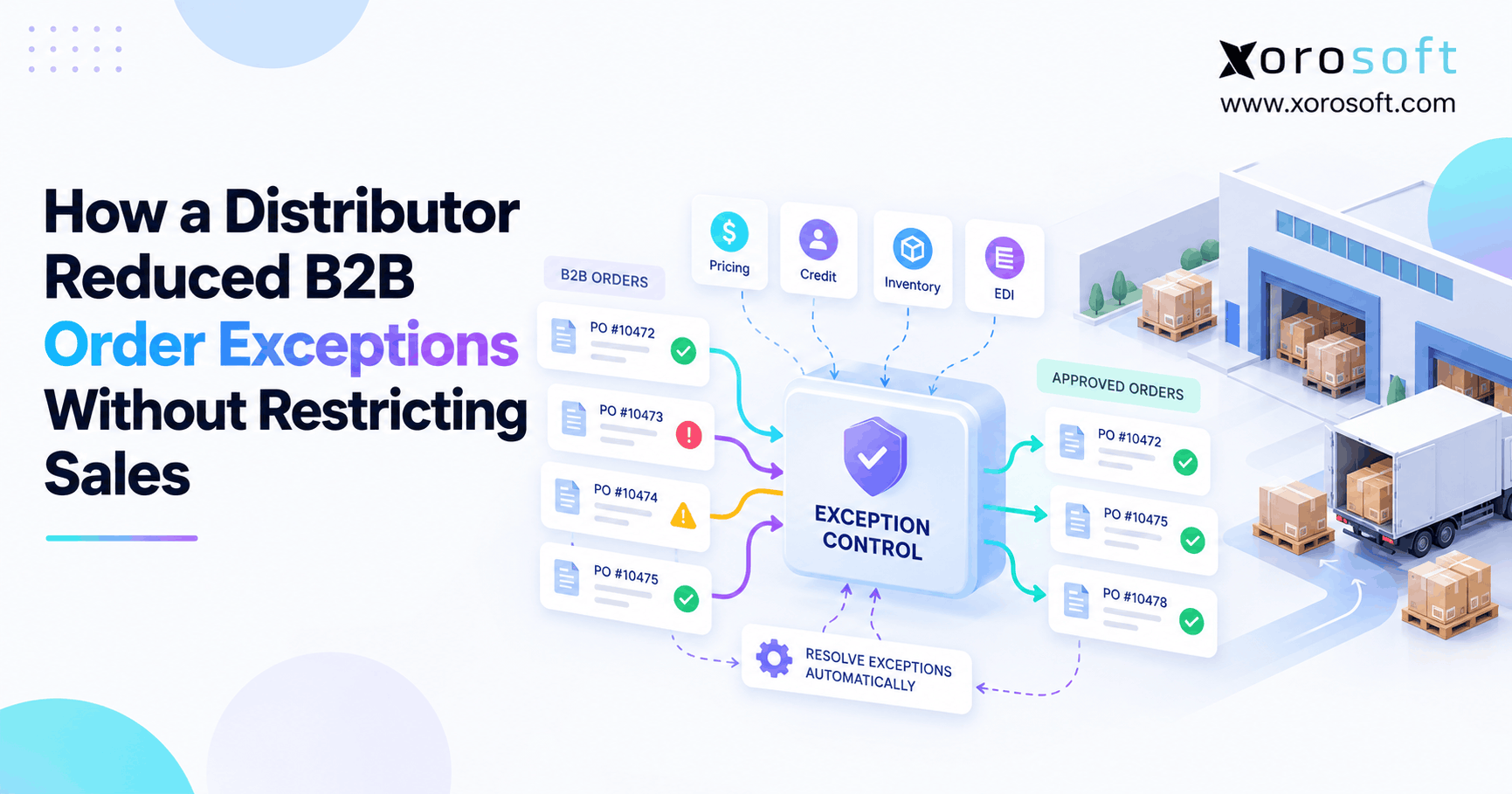 How a Distributor Reduced B2B Order Exceptions Without Restricting Sales