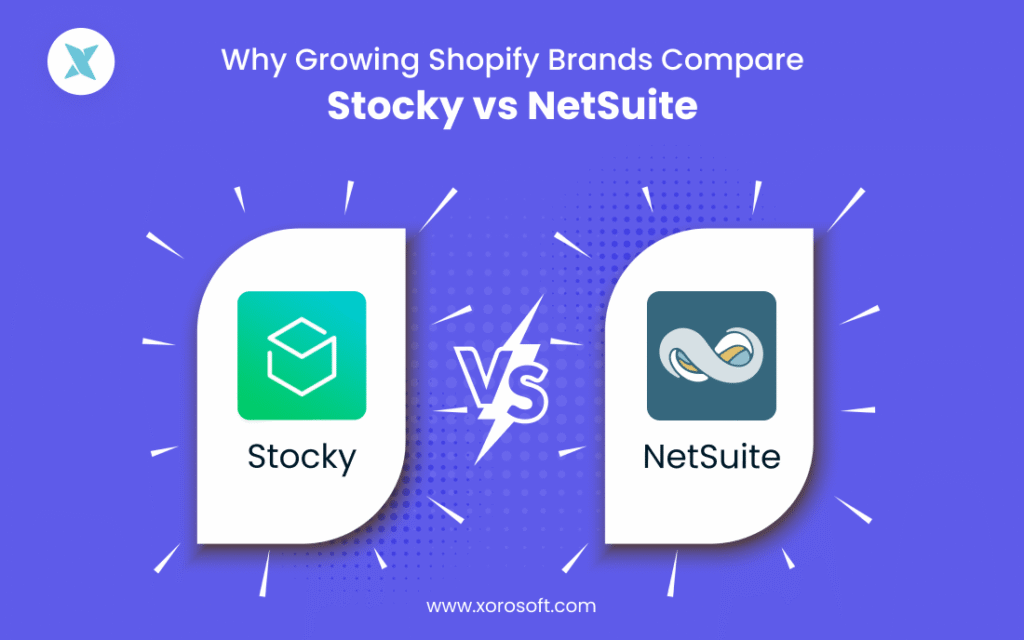
If you are considering which business management software to use, a comparison of Stocky vs NetSuite can help you decide which platform best fits your needs.
1. Shopify Inventory Teams Are Facing a Bigger Decision Than Software Replacement
The Stocky vs NetSuite conversation has become more important because Shopify merchants are not just comparing two systems. Instead, they are deciding what kind of operational foundation they need next.
1.1 Why the Stocky Replacement Decision Matters Now
For many retailers, Stocky has been a practical tool for Shopify inventory workflows. According to Shopify’s own Stocky documentation, the app supports inventory levels, forecasting, suggested purchase orders, inventory counts, and transfers inside a Shopify POS environment. Because of that, it has helped merchants improve inventory control without moving into a full ERP system.
However, growing brands eventually face a different challenge. Inventory no longer sits only inside Shopify. It affects purchasing, accounting, warehouse operations, supplier planning, customer promises, wholesale orders, Amazon sales, EDI workflows, and cash flow. As a result, the Stocky vs NetSuite decision becomes less about app features and more about business maturity.
Timing also matters. Shopify has confirmed in its Stocky transition guide that Stocky won’t be available after August 31, 2026. Therefore, many Shopify merchants are now reviewing whether they need another inventory app or a broader ERP platform.
1.2 Why NetSuite Changes the Scope of the Conversation
NetSuite is not simply a larger inventory tool. Instead, it is a full ERP system built to connect finance, procurement, inventory, order management, supply chain, warehouse management, and reporting. That depth can be valuable for companies with complex operations. However, it also brings more implementation effort, cost, process change, and administrative overhead.
So the real question is not, “Which platform has more features?” A better question is, “What level of operational control does the business actually need?”
In practice, a smaller Shopify retailer may need a simple inventory replacement. Meanwhile, a multi-warehouse ecommerce or wholesale company may need ERP. A fast-growing inventory-driven brand may need something between a lightweight app and a broad enterprise rollout.
This guide explains Stocky vs NetSuite through the lens of inventory, accounting, purchasing, warehouse management, forecasting, Shopify operations, migration planning, industry fit, and ERP readiness.
2. Stocky vs NetSuite Starts With the Difference Between an Inventory App and ERP
A common mistake in a Stocky vs NetSuite comparison is treating both systems as if they solve the same problem. They do not.
Stocky is designed for Shopify inventory management. NetSuite, on the other hand, is designed for broader enterprise resource planning. One helps manage inventory tasks inside a Shopify-led workflow. The other connects inventory with finance, procurement, warehouse processes, order management, reporting, and operational controls.
That distinction matters because software fit depends on workflow complexity. For example, a Shopify merchant with one store, simple purchasing, and clean inventory processes may not need ERP. Meanwhile, a business managing multiple warehouses, supplier lead times, wholesale customers, Amazon orders, EDI, and accounting reconciliation will likely need more than an inventory app.
2.1 Stocky Supports Shopify Inventory Workflows
Stocky is built around Shopify POS Pro inventory needs. It can support inventory tracking, purchase orders, suggested ordering, inventory counts, and stock transfers. Therefore, retail teams that operate mainly inside Shopify can manage daily inventory control more easily.
The benefit is simplicity. Store teams can stay close to Shopify, manage inventory tasks, and avoid heavy system complexity.
2.2 NetSuite Supports Full ERP Operations
NetSuite supports a wider operational scope. NetSuite’s ERP product page positions the platform around accounting, order management, inventory, procurement, supply chain, warehouse management, and reporting.
Because of this broader scope, NetSuite becomes more relevant when inventory data must flow into financial statements, purchasing approvals, warehouse processes, fulfillment rules, and management reporting.
2.3 Shopify Merchants Need to Match System Scope to Business Stage
The right system depends on business stage. A simple Shopify retail operation may need an inventory app. However, a growing ecommerce brand may need stronger inventory and purchasing automation.
In addition, a wholesale or manufacturing business may need full ERP. A company with enterprise finance requirements may need NetSuite or a similar enterprise platform. Ultimately, the wrong choice usually happens when a company buys for where it used to be or overbuys for complexity it does not yet have.
3. What Stocky Does for Shopify Inventory Management
Stocky is most useful for Shopify merchants that need inventory control inside a Shopify POS environment. It helps teams manage practical inventory tasks without adopting a full ERP platform.
For many Shopify retailers, that has been enough. In many cases, the app can help with day-to-day visibility, purchase planning, inventory counts, and movement of stock between locations. However, its usefulness depends on how complex the business has become.
3.1 Stocky Inventory Management for Retail Teams
Stocky helps retail teams understand what is in stock, what needs to be ordered, and where inventory is moving. This is useful when inventory decisions are still relatively simple.
For example, a Shopify merchant might use Stocky to review product demand, create a purchase order, receive inventory, count products, and transfer items between locations. These workflows are valuable for retail operators who want more structure than basic inventory tracking.
3.2 Stocky Purchasing Workflows for Shopify Brands
Stocky can support purchase order creation and suggested purchasing. Therefore, it can help merchants that need buying recommendations but do not yet require advanced procurement rules.
In a smaller operation, purchasing may be handled by one or two people. Supplier management may also be simple. Approval workflows may be informal. As a result, Stocky-style purchasing can work well in that environment.
3.3 Stocky Inventory Counts and Transfers
Inventory counts help teams check whether recorded inventory matches physical stock. Meanwhile, stock transfers help teams move items between locations.
These workflows matter because retail inventory often changes quickly. Products get sold, returned, moved, damaged, misplaced, or adjusted. Without regular counts and clean transfers, Shopify inventory can become unreliable.
3.4 Where Stocky Works Well for Shopify Merchants
Stocky works best when the business is Shopify-centric and operational complexity is manageable.
It can be a good fit for:
• Shopify POS retailers
• Smaller retail teams
• Simple purchasing workflows
• Basic inventory forecasting needs
• Store-level inventory counts
• Teams that do not need full ERP
• Merchants with limited warehouse complexity
In this environment, Stocky can support useful inventory discipline without forcing the business into a larger system.
3.5 Where Stocky Becomes Limited for Growing Brands
Stocky becomes limited when inventory needs to connect with more departments and workflows.
Common limitations appear when businesses need:
• Deeper accounting integration
• Inventory valuation control
• Landed cost tracking
• Advanced procurement workflows
• Multi-warehouse visibility
• Warehouse picking and packing
• Manufacturing workflows
• EDI support
• Wholesale allocation
• Real-time operational reporting
At that stage, the issue is no longer just inventory tracking. Instead, the business needs a connected operational system.
4. What NetSuite Offers as an ERP Platform
NetSuite is much broader than Stocky. In the Stocky vs NetSuite comparison, NetSuite represents the ERP category rather than the inventory app category.
ERP systems are designed to connect business functions. Therefore, inventory becomes part of a larger operational and financial structure.
4.1 NetSuite ERP for Accounting and Financial Control
Accounting is one of the biggest differences between Stocky and NetSuite.
Stocky helps with inventory workflows, but it is not a complete accounting system. In contrast, NetSuite includes financial management capabilities as part of its ERP structure. This matters when inventory affects cost of goods sold, margin, inventory valuation, landed cost, reconciliation, and month-end close.
For businesses where finance teams struggle to trust inventory numbers, ERP can create stronger alignment between operations and accounting. As a result, inventory decisions become easier to connect with margin, cash flow, and reporting.
4.2 NetSuite Inventory Management for Growing Operations
NetSuite’s inventory management solution supports broader workflows across locations, fulfillment, purchasing, and reporting. As a result, companies can gain stronger visibility into stock movement, inventory value, and replenishment planning.
When inventory is spread across multiple locations, a simple app may not be enough. Teams need to understand what is available, what is committed, what is incoming, what is delayed, and what should be replenished.
4.3 NetSuite Procurement and Supplier Management
NetSuite can support more advanced purchasing and procurement workflows than Stocky. This may include vendor management, approvals, purchasing controls, and stronger reporting around supplier activity.
For companies with many suppliers, long lead times, or large purchase order volume, procurement structure becomes important. Otherwise, teams often fall back into spreadsheets.
4.4 NetSuite Warehouse and Supply Chain Workflows
Warehouse management becomes more important as order volume grows. Teams need better receiving, picking, packing, shipping, bin control, and transfer accuracy.
NetSuite can support warehouse and supply chain workflows depending on configuration and modules. Because of that, companies with high warehouse complexity often include ERP in their evaluation.
4.5 NetSuite ERP Challenges to Consider
NetSuite can be powerful, but it is not automatically the right fit for every Shopify merchant.
The main considerations include:
• Implementation complexity
• Licensing and consulting costs
• Configuration requirements
• Internal training needs
• Process redesign
• Longer adoption timelines
• Integration planning with Shopify and other systems
For companies that need enterprise ERP depth, those tradeoffs may be worthwhile. However, Shopify-led brands with inventory-heavy needs but limited enterprise complexity should compare alternatives carefully.
5. Stocky vs NetSuite Feature Comparison for Shopify Merchants
The easiest way to compare Stocky vs NetSuite is by workflow area.
| Feature Area | Stocky | NetSuite | Best Fit |
|---|---|---|---|
| Shopify inventory | Strong Shopify POS inventory support | Requires integration | Stocky |
| Inventory visibility | Useful for Shopify-led workflows | Broader ERP visibility | Depends on complexity |
| Purchase orders | Basic purchase order support | Advanced procurement workflows | NetSuite |
| Accounting | Limited | Full ERP accounting | NetSuite |
| Inventory valuation | Limited | Stronger financial control | NetSuite |
| Warehouse management | Limited | Broader warehouse workflows | NetSuite |
| Forecasting | Basic inventory forecasting | Broader planning potential | Depends on setup |
| Multi-warehouse operations | Basic location support | Stronger operational depth | NetSuite |
| Manufacturing | Not a manufacturing ERP | Can support manufacturing workflows | NetSuite |
| Implementation effort | Lighter | More complex | Stocky for simplicity |
| ERP scalability | Limited | Higher ERP scalability | NetSuite |
5.1 Stocky vs NetSuite for Inventory Visibility
Stocky helps Shopify merchants see inventory levels and manage basic stock movement. That is useful for store-level visibility.
NetSuite goes further by connecting inventory data with purchasing, fulfillment, finance, reporting, and warehouse operations. Therefore, it becomes more useful when inventory visibility needs to support decisions across departments.
5.2 Stocky vs NetSuite for Purchasing
Stocky can help with purchase orders and suggested ordering. For simple purchasing, that may be enough.
NetSuite supports broader procurement workflows. As a result, teams can manage vendor controls, approval flows, purchasing budgets, and stronger reporting with more structure.
5.3 Stocky vs NetSuite for Accounting
Accounting is where the gap becomes clear.
Stocky is not built to manage financial operations. In comparison, NetSuite includes accounting as part of ERP. If inventory valuation, COGS, landed costs, reconciliation, and month-end close are becoming difficult, NetSuite or another ERP may be more appropriate.
5.4 Stocky vs NetSuite for Warehouse Management
Stocky can support inventory tasks, but it is not a full warehouse management system.
NetSuite can support broader warehouse workflows, depending on the setup. Therefore, businesses that need receiving, bin control, barcode workflows, picking, packing, shipping, and multi-location fulfillment should evaluate ERP or WMS capabilities carefully.
For inventory-driven companies that need dedicated warehouse workflows, Xorosoft’s warehouse management system is also worth reviewing in the broader ERP evaluation.
5.5 Stocky vs NetSuite for Forecasting and Planning
Stocky can support basic forecasting and suggested ordering. That works when demand patterns are simple.
ERP forecasting is usually broader because planning can connect sales history, open orders, supplier lead times, purchasing schedules, warehouse availability, and financial targets. Because of that, ERP planning becomes especially important for ecommerce, wholesale, and manufacturing businesses.
6. Shopify Inventory App vs ERP: The Real Decision Behind Stocky vs NetSuite
The Stocky vs NetSuite decision is really an inventory app vs ERP decision.
An inventory app solves inventory-specific problems. ERP, however, solves cross-functional business problems.
6.1 Inventory Apps Help With Stock-Level Control
Inventory apps are useful when the main issue is visibility. They can help teams count products, create purchase orders, update stock levels, and manage replenishment.
This is valuable when the business does not need inventory to drive deeper financial, warehouse, or operational workflows. However, once inventory affects multiple departments, an app-only approach can become limiting.
6.2 ERP Helps Connect Inventory With the Rest of the Business
ERP becomes important when inventory affects several teams at once.
A connected ERP environment can bring together:
• Inventory management
• Accounting
• Purchasing
• Order management
• Warehouse management
• Forecasting
• Manufacturing
• Reporting
• Shopify operations
• Amazon operations
• Wholesale and EDI workflows
This connection reduces duplicate entry, spreadsheet dependency, and reporting gaps. In addition, it gives leadership a clearer view of how inventory decisions affect cash flow, fulfillment, and profitability.
6.3 Shopify Brands Often Outgrow Inventory-Only Systems
Shopify brands often outgrow inventory-only tools when operations become multi-channel, multi-warehouse, or finance-heavy.
Warning signs include:
• Inventory does not match accounting
• Purchasing happens in spreadsheets
• Warehouse teams rely on manual workarounds
• Shopify, Amazon, and wholesale orders are disconnected
• Stockouts happen despite available inventory
• Overstock ties up cash
• Month-end close takes too long
• Reports do not match reality
When several of these issues appear together, another inventory app may not fix the root problem. Instead, the business may need ERP-level visibility across inventory, purchasing, accounting, and fulfillment.
7. When Stocky-Style Inventory Software Is the Better Fit
Stocky-style inventory software can still be the right choice for some businesses.
Not every Shopify merchant needs ERP. In fact, moving into ERP too early can create unnecessary cost and complexity.
7.1 Stocky Works for Simple Shopify Retail Operations
If the business mainly sells through Shopify POS, has a manageable SKU count, and uses simple purchasing workflows, an inventory app may be enough.
In this case, the priority is speed and simplicity. The team needs reliable inventory tools, not a full operational transformation.
7.2 Stocky-Style Tools Fit Basic Purchasing Needs
If purchase order volume is low and supplier relationships are straightforward, basic purchasing features may work well.
However, this changes when purchasing becomes more strategic. Once teams need approvals, vendor performance tracking, purchasing forecasts, landed costs, and financial controls, ERP becomes more relevant.
7.3 Shopify Merchants Without ERP Complexity Should Avoid Overbuying
Buying too much software too early can slow a business down. ERP requires planning, training, ownership, and process change.
A simple retail operation should not choose NetSuite just because it has more features. Instead, it should choose the system that fits its current and near-future complexity.
8. When NetSuite ERP Is the Better Fit
NetSuite becomes more relevant when a business needs full ERP depth.
The decision is not only about size. More importantly, it is about complexity.
8.1 NetSuite Fits Complex Accounting and Reporting Needs
If inventory connects directly to financial reporting, margin analysis, month-end close, and reconciliation, NetSuite may be a better fit than Stocky.
This is especially true when finance teams need real-time visibility into inventory value, COGS, and operational performance.
8.2 NetSuite Supports Multi-Entity and Enterprise Operations
Companies with multiple entities, complex reporting structures, or broader enterprise requirements may need NetSuite’s ERP scope.
This can include businesses with multiple locations, regions, subsidiaries, currencies, or advanced reporting needs. As operations expand, shared data and standardized workflows become more important.
8.3 NetSuite Makes Sense When ERP Governance Matters
As companies scale, process control becomes more important. Teams need approval rules, standardized workflows, audit trails, reporting discipline, and shared data.
NetSuite can support that level of governance. However, the business must be ready for the implementation effort.
9. When Neither Stocky Nor NetSuite Is the Perfect Fit
Some businesses fall between the two options.
Stocky may be too limited. At the same time, NetSuite may feel too broad. This is common for Shopify-led brands that need ERP capabilities but want a system built around inventory-heavy operations rather than a large enterprise rollout.
9.1 Shopify Brands May Need ERP Without Enterprise Complexity
A growing ecommerce business may need inventory, accounting, purchasing, warehouse management, forecasting, and reporting in one place. However, it may not need every layer of enterprise ERP complexity.
This is where companies often evaluate mid-market or inventory-focused ERP systems. In many cases, the goal is not to buy the biggest system. Rather, the goal is to centralize the workflows that create daily operational friction.
9.2 Disconnected Apps Create the Case for ERP
Many businesses start with Shopify, QuickBooks, spreadsheets, an inventory app, a warehouse app, an EDI tool, and separate purchasing files.
That stack can work for a while. Eventually, duplicate data entry, delayed reporting, inventory discrepancies, and reconciliation issues become expensive.
At that point, ERP is not just a software upgrade. Instead, it becomes a way to centralize operations.
9.3 Xorosoft as a Stocky Alternative for Inventory-Driven Shopify Brands
Xorosoft is a cloud ERP platform built for inventory-driven businesses. It combines inventory management, accounting, purchasing, warehouse management, manufacturing, forecasting, reporting, and ecommerce operations in one system.
For Shopify merchants comparing Stocky vs NetSuite, it can be relevant when the business has outgrown Stocky but wants an ERP system focused on practical inventory, warehouse, purchasing, accounting, Shopify, Amazon, EDI, and multi-warehouse workflows.
10. Stocky vs NetSuite vs Inventory-Focused ERP Alternatives
| Category | Stocky | NetSuite | Inventory-Focused ERP |
| Best for | Shopify POS inventory | Enterprise ERP | Inventory-driven growth |
| Inventory management | Shopify-focused | Broad ERP inventory | Real-time inventory control |
| Accounting | Limited | Full ERP accounting | Built-in accounting workflows |
| Purchasing | Basic PO support | Advanced procurement | Purchasing automation |
| Warehouse management | Limited | Broader WMS options | Built-in WMS capabilities |
| Shopify operations | Native Shopify context | Integration needed | Shopify-focused ERP workflows |
| Amazon workflows | Not core | Possible through setup | Ecommerce operations support |
| EDI | Not core | Available through setup | Useful for wholesale workflows |
| Manufacturing | Not core | ERP module dependent | Supports inventory-driven manufacturing |
| Implementation style | Lighter | More complex | ERP for growing inventory teams |
10.1 Stocky Fits Shopify Inventory Simplicity
Stocky is best when inventory workflows are still simple and Shopify remains the center of the operation. Therefore, it makes sense for teams that need practical inventory control without broader ERP depth.
10.2 NetSuite Fits Enterprise ERP Requirements
NetSuite is better suited for companies with complex finance, reporting, procurement, and enterprise process control needs. However, the business should be ready for a larger implementation and more formal process governance.
10.3 Inventory-Focused ERP Fits Operational Growth
XoroERP can fit businesses that need ERP capabilities across inventory, accounting, purchasing, warehouse management, manufacturing, forecasting, Shopify, Amazon, EDI, and reporting.
For brands evaluating NetSuite alternatives, the Xorosoft vs NetSuite comparison can help clarify fit.
11. Stocky Migration Planning for Shopify Merchants
A Stocky migration should begin with process mapping, not software demos.
Before choosing a replacement, the business should understand what Stocky currently supports and what gaps now need to be solved.
11.1 Audit Shopify Inventory Workflows Before Replacing Stocky
Start by documenting how inventory moves through the business.
Review:
• SKUs
• Variants
• Product categories
• Suppliers
• Purchase orders
• Inventory counts
• Transfers
• Warehouses
• Locations
• Shopify workflows
• Amazon workflows
• Wholesale orders
• Accounting handoffs
• Reporting needs
This helps separate simple inventory needs from true ERP requirements. In addition, it gives each team a clearer view of what must change during migration.
11.2 Identify the Operational Gaps Stocky Cannot Solve
The right replacement depends on the pain points.
| Operational Gap | Why It Matters | Likely System Need |
| Inventory discrepancies | Teams cannot trust stock levels | Stronger inventory controls |
| Spreadsheet purchasing | Buying becomes reactive | Purchasing automation |
| Delayed month-end close | Finance lacks clean data | ERP accounting |
| Warehouse errors | Fulfillment slows down | WMS workflows |
| Poor forecasting | Stockouts and overstock increase | Demand planning |
| Disconnected channels | Data becomes fragmented | Ecommerce ERP |
| EDI complexity | Wholesale workflows become manual | ERP with EDI support |
11.3 Build an ERP Readiness Checklist Before Choosing NetSuite
Before moving from Stocky to NetSuite or another ERP, review whether the business is ready for a structured migration.
Use this checklist:
• Item data should be clean, consistent, and ready to migrate.
• Supplier records need accurate names, lead times, costs, and purchasing details.
• Warehouse locations should be clearly defined before setup begins.
• Purchasing approvals must be documented so buying workflows do not stay informal.
• Accounting rules should be clear for inventory valuation, landed costs, COGS, and reconciliation.
• Shopify workflows need to be mapped from order creation to fulfillment.
• Amazon and EDI processes should be included if they affect inventory or order flow.
• Inventory valuation rules must be understood by both operations and finance.
• Process ownership should be assigned before implementation starts.
A clean migration starts with clean data and clear process ownership. Therefore, this checklist should be completed before the final software decision.
12. Stocky vs NetSuite by Industry Use Case
Different industries experience the Stocky vs NetSuite decision differently. The right system depends on product complexity, fulfillment model, purchasing structure, and reporting needs.
12.1 Apparel and Fashion Inventory Workflows
Apparel brands manage size, color, style, fit, seasonality, returns, and wholesale demand. Stocky may work for smaller Shopify retail teams.
However, ERP becomes more useful when the business needs forecasting, purchasing automation, multi-warehouse allocation, wholesale order management, and inventory visibility across channels.
12.2 Furniture Inventory and Warehouse Complexity
Furniture companies often manage bulky inventory, supplier lead times, partial shipments, warehouse coordination, and delivery planning.
Stocky may be limited once the business needs deeper receiving, warehouse control, purchasing visibility, and accounting integration. Therefore, ERP platforms may be more suitable for these workflows.
12.3 Sporting Goods Replenishment and Seasonal Demand
Sporting goods brands often deal with seasonal demand, product variations, supplier timing, and multi-channel sales.
A simple inventory app may work early. As the business grows, forecasting, replenishment, purchasing, and warehouse coordination become more important.
12.4 Food and Beverage Inventory Control
Food and beverage businesses may need lot tracking, expiration control, supplier traceability, and tighter inventory discipline.
Stocky is usually not enough for complex food inventory workflows. Because of that, ERP becomes more relevant when inventory control affects compliance, purchasing, production, and reporting.
12.5 Wholesale Distribution and EDI Requirements
Wholesale businesses often need customer-specific pricing, EDI, allocation, purchasing, forecasting, and inventory visibility.
Stocky is usually not built for that level of B2B complexity. As a result, NetSuite or an inventory-focused ERP can be a better fit depending on implementation needs and operational scope.
12.6 Manufacturing and Material Planning
Manufacturing businesses need BOMs, work orders, production planning, material requirements, and inventory control.
Stocky is not designed as a manufacturing ERP. NetSuite can support manufacturing workflows through ERP capabilities, while inventory-focused ERP systems can support connected inventory, purchasing, warehouse, and accounting workflows.
You can also explore Xorosoft’s industry-specific ERP solutions to understand how ERP workflows differ across apparel, furniture, sporting goods, food, wholesale, and manufacturing.
13. Common Mistakes in a Stocky vs NetSuite Evaluation
A software comparison can go wrong when the team focuses only on features and ignores daily workflows.
13.1 Comparing Stocky and NetSuite Without Mapping Processes
A feature checklist does not show how work actually gets done.
Before choosing software, map how the team buys, receives, stores, sells, ships, counts, values, and reports inventory. That process map will reveal whether the business needs an inventory app, ERP, WMS, or a broader operating system.
13.2 Ignoring Accounting During Inventory Software Selection
Inventory and accounting are connected. If finance does not trust inventory valuation, COGS, or month-end reports, the replacement system must address accounting from the start.
Otherwise, the business may end up with another disconnected system. Because of that, finance should be involved before the software decision is finalized.
13.3 Waiting Too Long to Replace Stocky
Some companies wait until operations are already messy. By then, item data is inconsistent, warehouse processes are unclear, and reports are unreliable.
Earlier planning makes migration easier. In addition, it gives the team time to clean data and define workflows before implementation.
13.4 Choosing NetSuite Before the Business Is Ready
NetSuite can be powerful, but ERP requires commitment. A business needs internal ownership, clean data, process discipline, and implementation resources.
If the company only needs simple inventory tracking, NetSuite may be more system than the team needs. Therefore, readiness should be part of the decision.
13.5 Forgetting Team Adoption and Training
The best system will fail if people do not use it properly.
Inventory, warehouse, purchasing, accounting, and ecommerce teams all need clear workflows. Training should not be treated as a final step. Instead, it should be part of the migration plan from the beginning.
14. Decision Framework for Stocky vs NetSuite
The best system depends on operational complexity, not brand name.
| Business Situation | Better Direction |
| Simple Shopify POS inventory | Stocky-style inventory tool |
| Basic purchase orders | Inventory app |
| Multiple warehouses | ERP or WMS-connected system |
| Inventory and accounting issues | ERP |
| Wholesale and EDI workflows | ERP |
| Manufacturing requirements | ERP |
| Enterprise finance complexity | NetSuite |
| Shopify-led inventory-heavy growth | Inventory-focused ERP |
| Disconnected apps and spreadsheets | ERP consolidation |
| Need faster operational visibility | Inventory-focused ERP |
14.1 Choose Stocky-Style Tools for Simple Shopify Inventory
If your team only needs inventory counts, purchase orders, transfers, and basic forecasting, a lightweight inventory tool may be enough.
This is especially true when the company does not have accounting, warehouse, EDI, wholesale, or manufacturing complexity.
14.2 Choose NetSuite for Enterprise ERP Depth
If your company needs complex accounting, enterprise reporting, procurement control, multi-entity operations, and broad ERP governance, NetSuite may be the stronger option.
The key is readiness. NetSuite works best when the business has the budget, team, and process maturity to support implementation.
14.3 Choose Inventory-Focused ERP for Shopify Growth
If the business has outgrown Stocky but wants ERP designed around inventory-heavy operations, a focused cloud ERP platform may be worth evaluating.
This can be especially relevant for companies that sell physical products, manage multiple warehouses, use Shopify or Amazon, sell wholesale, use EDI, manufacture products, or need purchasing, accounting, warehouse, forecasting, and reporting in one system.
The Xorosoft ERP Shopify app is a useful place to review Shopify-specific ERP positioning.
15. Practical Next Steps Before Replacing Stocky
Before choosing NetSuite, Xorosoft, or another ERP system, take a structured approach.
15.1 Review Whether the Business Needs Inventory Software or ERP
Start with the real pain points.
If the main issue is stock visibility, a lighter inventory system may work. However, if the issue is disconnected inventory, accounting, purchasing, warehouse, ecommerce, wholesale, EDI, and reporting workflows, ERP should be considered.
15.2 Compare Systems Around Daily Workflows
Do not evaluate software only through demos. Instead, compare each option against the daily work your team actually performs.
Review the workflows below:
• Purchasing should be easy to manage from request to purchase order.
• Receiving needs to show what arrived, what is missing, and what still needs follow-up.
• Warehouse tasks should support clear picking, packing, transfers, and stock movement.
• Shopify inventory sync must keep product availability accurate across channels.
• Accounting teams need clean inventory data for valuation, COGS, landed costs, and reconciliation.
• Landed cost workflows should show the true cost of bringing products into stock.
• Transfer controls must prevent inventory from disappearing between locations.
• Wholesale and EDI orders should move through the system without heavy manual work.
• Reporting should give operators, finance teams, and leadership the same version of the truth.
The best system should reduce manual work, not simply add another layer. In addition, it should help teams trust the data they use every day.
15.3 Use ERP Readiness as the Final Decision Filter
If the team is replacing Stocky, compare readiness before comparing price.
A business is closer to ERP readiness when it has:
• Clean item data
• Clear warehouse workflows
• Defined purchasing rules
• Accounting ownership
• Reporting requirements
• Integration needs
• Executive support
• Team training capacity
If these areas are unclear, the company should solve them before implementation. Otherwise, even the right software can become difficult to adopt.
15.4 Book a Personalized ERP Demo When the Gaps Are Clear
If your team is actively comparing Stocky, NetSuite, and ERP alternatives, the next step is to review your actual workflows with an ERP specialist.
You can book a personalized ERP demo to assess whether Xorosoft fits your inventory, accounting, purchasing, warehouse, manufacturing, Shopify, Amazon, EDI, and multi-warehouse operations.
16. Stocky vs NetSuite FAQs
16.1 What is the main difference between Stocky and NetSuite?
Stocky is a Shopify inventory app focused on inventory levels, purchase orders, forecasting, counts, and transfers. In contrast, NetSuite is a full ERP platform that connects inventory with accounting, procurement, order management, warehouse operations, reporting, and broader business workflows. In simple terms, Stocky supports Shopify inventory tasks, while NetSuite supports company-wide operational and financial management.
16.2 Is Stocky an ERP system?
No. Stocky is not an ERP system. It is an inventory management app used with Shopify POS Pro. Although it can help with inventory tracking, purchasing, counting, forecasting, and transfers, it does not replace full ERP functions such as accounting, procurement controls, warehouse management, manufacturing, financial reporting, and cross-department workflow automation.
16.3 Can NetSuite replace Stocky?
NetSuite can replace many inventory and purchasing workflows that Stocky supports, but it is not a simple app swap. Since NetSuite is a broader ERP platform, replacing Stocky with NetSuite usually requires implementation planning, data migration, process mapping, integrations, training, and finance alignment.
16.4 Is NetSuite better than Stocky?
NetSuite is better for businesses that need full ERP capabilities. However, Stocky may be better for simpler Shopify merchants that only need basic inventory and purchasing workflows. The right answer depends on operational complexity, accounting needs, warehouse requirements, and whether the business needs ERP or just inventory management.
16.5 Is Stocky being discontinued?
Yes. Shopify has stated that Stocky won’t be available after August 31, 2026. Therefore, merchants using Stocky should prepare by reviewing inventory workflows, exporting important data, training teams, and evaluating whether Shopify’s native inventory tools, an inventory app, or ERP is the right replacement.
16.6 What should Shopify merchants use after Stocky?
Shopify merchants can use Shopify’s native inventory tools, a replacement inventory app, a warehouse management system, or a full ERP platform. Smaller merchants may only need basic inventory tools. However, growing brands with accounting, purchasing, warehouse, forecasting, multi-channel, wholesale, EDI, or manufacturing needs should evaluate ERP.
16.7 Does Stocky support accounting?
Stocky does not function as a full accounting system. It can support inventory and purchasing workflows, but businesses that need inventory valuation, COGS, landed cost, reconciliation, and month-end close support usually need accounting software or ERP.
16.8 Does NetSuite support accounting?
Yes. NetSuite includes accounting and financial management as core ERP capabilities. Because of that, businesses often compare Stocky vs NetSuite when inventory needs to connect directly with finance, reporting, procurement, and operational controls.
16.9 Which is better for multi-warehouse inventory?
NetSuite is generally stronger for complex multi-warehouse operations because ERP can connect inventory with purchasing, fulfillment, accounting, reporting, and warehouse workflows. Stocky may support simpler location-based inventory needs. However, it is not designed as a full multi-warehouse ERP or WMS platform.
16.10 Which is better for purchasing?
Stocky can support basic purchase orders and suggested ordering. NetSuite is better for more advanced procurement needs such as approvals, vendor management, purchasing controls, financial visibility, replenishment planning, and cross-functional reporting.
16.11 Which is better for forecasting?
Stocky can help with basic inventory forecasting. Meanwhile, NetSuite and other ERP platforms can support broader planning because forecasting can connect to purchasing, sales orders, inventory, supplier lead times, warehouse data, and financial planning. For simple retail, Stocky-style forecasting may be enough. For complex operations, ERP is stronger.
16.12 Is NetSuite too complex for Shopify merchants?
It can be, depending on the merchant. NetSuite may be appropriate for larger Shopify businesses with complex finance, inventory, and operational requirements. However, for smaller Shopify-led businesses, NetSuite may feel too broad or implementation-heavy. Those companies may consider inventory-focused ERP alternatives.
16.13 Is Xorosoft a Stocky alternative?
Xorosoft can be considered a Stocky alternative for businesses that have outgrown inventory-only workflows and need ERP capabilities. It is not simply another inventory app. Instead, it is a cloud ERP platform that connects inventory, accounting, purchasing, warehouse management, forecasting, manufacturing, reporting, and ecommerce operations.
16.14 Is Xorosoft a NetSuite alternative?
Yes, Xorosoft can be evaluated as a NetSuite alternative for inventory-driven businesses, especially those selling through Shopify, Amazon, wholesale, EDI, and multiple warehouses. However, it should be compared based on workflow fit, implementation needs, industry requirements, and operational complexity.
16.15 Does Xorosoft integrate with Shopify?
Yes. Xorosoft has a Shopify App Store listing and is positioned for ecommerce, retail, and wholesale businesses. As a result, Shopify merchants comparing Stocky vs NetSuite may evaluate Xorosoft when they need ERP workflows connected to Shopify operations.
16.16 What businesses should choose Stocky-style tools?
Businesses with simple Shopify inventory, limited purchasing complexity, few locations, basic reporting needs, and no major accounting or warehouse issues may choose Stocky-style tools. In that situation, companies may not need the cost or complexity of ERP yet.
16.17 What businesses should choose NetSuite?
Businesses with complex accounting, multi-entity operations, enterprise reporting, advanced procurement, and broader ERP requirements may choose NetSuite. In most cases, it is more suitable for companies with the budget, team, and implementation resources to support a full ERP rollout.
16.18 What businesses should consider inventory-focused ERP?
Inventory-focused ERP is worth considering for businesses that sell physical products, use Shopify or Amazon, manage multiple warehouses, sell wholesale, use EDI, manufacture products, or need purchasing, accounting, warehouse, forecasting, and reporting in one cloud ERP system.
16.19 When should a business upgrade from Stocky to ERP?
A business should consider ERP when inventory affects accounting accuracy, purchasing decisions, warehouse efficiency, forecasting, reporting, and cash flow. Common triggers include multi-warehouse complexity, spreadsheet purchasing, delayed month-end close, disconnected apps, wholesale growth, EDI, manufacturing, and poor inventory visibility.
16.20 What data should be prepared before migrating from Stocky?
Prepare product data, SKUs, variants, suppliers, purchase orders, inventory counts, stock transfers, locations, cost data, reorder rules, and adjustment history. In addition, document warehouse workflows, Shopify processes, accounting rules, and reporting needs before choosing a replacement system.
16.21 What are the limitations of Stocky?
Stocky’s main limitations appear when businesses need more than Shopify inventory management. It is not built as a full ERP, accounting system, warehouse management system, manufacturing platform, or multi-channel operational hub. Therefore, growing businesses may eventually need broader software.
16.22 What are the limitations of NetSuite?
NetSuite’s limitations are usually related to cost, implementation complexity, configuration effort, and operational fit. It can be powerful, but not every Shopify merchant needs enterprise-level ERP. Because of that, businesses should evaluate whether NetSuite’s scope matches their actual requirements.
16.23 Can Shopify native inventory replace Stocky?
For some merchants, yes. Shopify native inventory tools may be enough if the business has simple inventory workflows. However, merchants that relied on Stocky for purchasing, forecasting, supplier workflows, counts, and transfers should carefully compare the gaps before deciding.
16.24 What is the best way to compare Stocky, NetSuite, and ERP alternatives?
Compare the systems by workflow, not just features. Review inventory, purchasing, accounting, warehouse management, forecasting, Shopify integration, Amazon workflows, EDI, manufacturing, reporting, cost, implementation effort, and team adoption. Ultimately, the best system is the one that matches the business model.
16.25 Should every Shopify merchant move from Stocky to ERP?
No. Not every Shopify merchant needs ERP. Smaller businesses may be fine with native Shopify inventory tools or another inventory app. However, ERP becomes relevant when inventory complexity affects finance, purchasing, warehouse operations, forecasting, fulfillment, wholesale, manufacturing, or reporting.
17. Choosing the Right Stocky Replacement by Operational Complexity
The Stocky vs NetSuite decision should not be based only on feature lists. Instead, it should be based on how your business actually operates today and what complexity you expect next.
Stocky-style inventory tools can work well for smaller Shopify merchants with simple inventory, basic purchasing, and limited warehouse needs. NetSuite can be a strong fit for businesses that need enterprise ERP depth, complex accounting, procurement control, multi-entity reporting, and broader operational governance.
However, many growing Shopify, ecommerce, wholesale, and inventory-driven businesses sit somewhere in the middle. They have outgrown Stocky, but they may not want the cost, complexity, or implementation scope of a large enterprise ERP. For those companies, a focused cloud ERP platform such as Xorosoft can be worth evaluating because it connects inventory management, accounting, purchasing, warehouse management, forecasting, manufacturing, Shopify, Amazon, EDI, and multi-warehouse operations in one system.
Before replacing Stocky, review your workflows carefully. Look at inventory accuracy, purchasing processes, warehouse operations, accounting gaps, reporting needs, and channel complexity. If the issue is simple inventory visibility, another inventory app may be enough. However, if the issue is disconnected operations across inventory, finance, purchasing, fulfillment, and ecommerce, ERP is the more practical next step.
If your team is comparing Stocky, NetSuite, and ERP alternatives, you can book a personalized ERP demo to see whether Xorosoft fits your inventory-driven operations.
Recent Posts
-
 Distribution Software Reviews: How to Evaluate ERP Platforms Before Choosing the Right System
 -
 Warehouse Labor Productivity KPIs
 -
 Wholesale Fuel Distribution ERP Software for Managing Inventory, Purchasing, Delivery, and Accounting
 -
 Best Ways to Compare Enterprise Software Products Before Choosing an ERP, WMS, or Inventory System
 -
 What Is the Difference Between Inventory Allocation and Inventory Reservation?