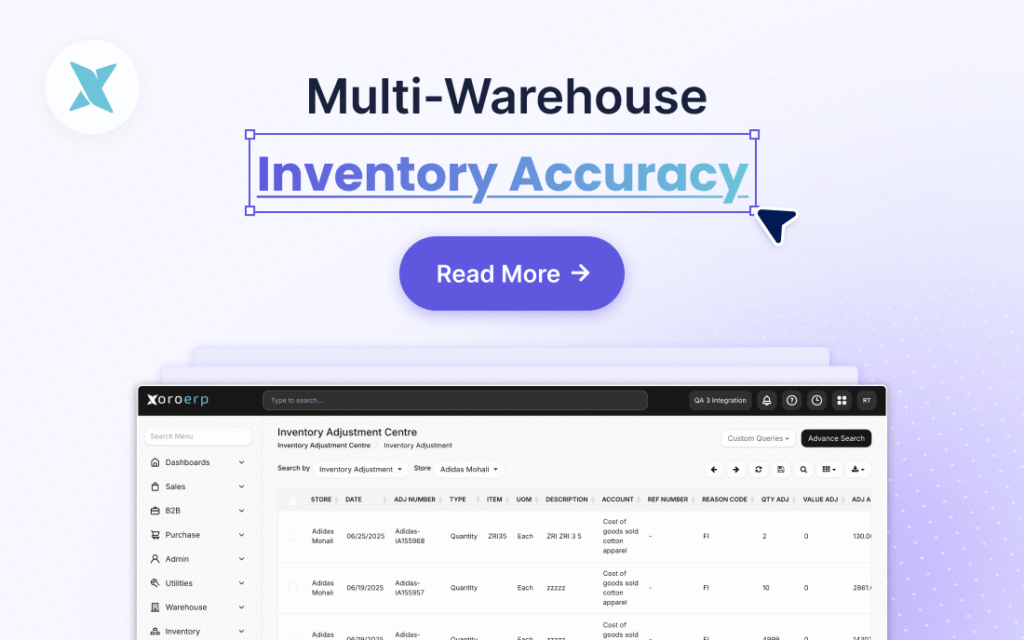
Achieving Multi-Warehouse Inventory Accuracy is essential for effectively managing stock across various locations.
1. Why Inventory Records Become Unreliable as Warehouse Networks Expand
Multi-warehouse inventory accuracy becomes harder to maintain as a company adds distribution centres, regional warehouses, retail stockrooms, manufacturing facilities, and third-party logistics providers. Although each new location can improve delivery speed or expand market coverage, it also creates more inventory movements that employees must record correctly.
In addition, products enter through receiving, move through putaway, transfer between facilities, get allocated to customer orders, return from buyers, and occasionally require adjustments. Therefore, every physical movement should create a timely and accurate transaction in the inventory system.
Even a small mistake at one warehouse can affect purchasing, forecasting, ecommerce availability, fulfilment, and accounting. For example, Warehouse A may physically transfer 100 units to Warehouse B; however, if the system transfer remains incomplete, Warehouse A still appears to hold stock that is no longer there.
Meanwhile, Warehouse B cannot allocate the products it has already received. As a result, both facilities may make decisions using quantities that do not reflect physical inventory.
As discrepancies increase, employees gradually lose confidence in the system. Consequently, they build spreadsheets, perform emergency counts, contact other warehouses for confirmation, and hold additional safety stock. Although these workarounds may provide a temporary answer, they usually make inventory control more complicated.
1.1 How Inventory Errors Spread Across Multiple Warehouses
Inventory errors rarely remain inside one facility because several departments depend on the same stock information. Therefore, a single warehouse variance can quickly become a purchasing, fulfilment, accounting, and customer-service problem.
Suppose Warehouse A shows 500 units even though only 400 are physically available. Because the system suggests that stock is sufficient, the purchasing team may delay a necessary purchase order, while the sales team may accept orders that the warehouse cannot fulfil.
Another location may physically hold the missing 100 units without showing them in its available balance. As a result, the company could purchase more products even though enough inventory already exists within the warehouse network.
A single discrepancy can affect:
- Customer delivery commitments
- Purchase-order timing
- Warehouse replenishment
- Available-to-promise calculations
- Inventory allocation
- Demand forecasting
- Financial reporting
- Month-end reconciliation
For this reason, companies should treat inventory accuracy as a business-wide operating requirement rather than a warehouse-only responsibility.
1.2 Why Warehouse Inventory Accuracy Is a Business-Wide Metric
Warehouse teams create many of the transactions that change inventory. Nevertheless, purchasing, ecommerce, finance, manufacturing, and customer-service teams all depend on the resulting information.
Purchasing teams use available quantities to decide what to order and when to order it. Meanwhile, ecommerce teams publish inventory balances to Shopify, marketplaces, and other sales channels.
Finance teams rely on those records for inventory valuation, cost of goods sold, and financial reporting. Similarly, manufacturing teams need accurate material availability before releasing production orders.
Customer-service employees also require dependable stock information when they provide delivery estimates or investigate order delays. Therefore, when inventory data becomes unreliable, every department starts making decisions from a different version of the truth.
1.3 The Cost of Inaccurate Multi-Location Inventory
Inventory discrepancies create both visible and hidden costs. For example, visible expenses may include write-offs, expedited freight, emergency transfers, refunds, cancellations, and overtime for physical counts.
Hidden costs often include:
- Time spent investigating stock
- Delayed purchasing decisions
- Excess safety stock
- Lost warehouse productivity
- Repeated data entry
- Slower financial closes
- Reduced customer confidence
- Missed sales opportunities
Because these expenses appear across several departments, leadership may underestimate their total impact. Moreover, recurring errors can restrict growth because every additional warehouse introduces another layer of uncertainty.
2. What Accurate Inventory Across Multiple Warehouses Means
Multi-warehouse inventory accuracy measures how closely system records match physical inventory across each warehouse, bin, SKU, lot, serial number, and inventory status. Moreover, accurate records must show not only how much inventory exists but also where it is stored and whether employees can sell, move, or use it.
A reliable inventory record should show:
- The total quantity owned
- The warehouse holding the product
- The exact bin or storage area
- The quantity available for sale
- The quantity allocated to existing orders
- The quantity currently in transit
- The quantity damaged or quarantined
- The relevant lot or serial number
- The current inventory status
However, a correct company-wide total does not automatically mean that the underlying inventory records are accurate.
2.1 Total Inventory Accuracy Versus Location-Level Accuracy
Consider a company with two warehouses:
| Warehouse | System quantity | Physical quantity | Variance |
|---|---|---|---|
| Warehouse A | 600 | 500 | -100 |
| Warehouse B | 400 | 500 | +100 |
| Total | 1,000 | 1,000 | 0 |
Although the total quantity matches, both warehouse records remain incorrect. Warehouse A may accept orders it cannot fulfil, whereas Warehouse B may hold products that remain unavailable to sales and purchasing teams.
Therefore, companies should measure inventory accuracy by:
- Warehouse
- SKU
- Bin
- Inventory status
- Lot number
- Serial number
- Product category
- Sales channel
While network-level totals provide a useful overview, they can still hide serious operational problems at individual locations.
2.2 Inventory Accuracy Versus Real-Time Inventory Visibility
Although inventory accuracy and inventory visibility support the same operational goal, they describe different qualities of inventory data. Accuracy confirms that the recorded quantity, location, and status match physical stock.
By comparison, visibility allows authorised employees to access and understand the information. Real-time visibility then updates that data promptly whenever receiving, transfers, picking, shipping, or returns create a transaction.
However, faster reporting cannot correct an inaccurate warehouse record. Instead, it may spread incorrect quantities across purchasing, accounting, ecommerce, and customer-service teams more quickly.
Therefore, businesses should first strengthen transaction accuracy and then use real-time dashboards to improve operational visibility.
2.3 Inventory Status Accuracy Across Warehouse Locations
Quantity and location represent only part of an accurate inventory record. In practice, the system must also show whether employees can sell, move, inspect, or consume each unit.
Common inventory statuses include:
- Available
- Allocated
- Picked
- Packed
- In transit
- Returned
- Damaged
- Quarantined
- Under inspection
- Work in process
For instance, a warehouse may physically hold 200 units; however, when 50 are damaged and another 30 are allocated to open orders, only 120 should appear available. Consequently, an inventory system must separate physical ownership from actual availability.
3. Common Causes of Multi-Warehouse Inventory Discrepancies
Inventory discrepancies usually result from repeated process failures rather than one major event. Most problems begin in receiving, putaway, transfers, picking, returns, master data, or manual adjustments.
Furthermore, the risk grows when individual warehouses follow different procedures. For this reason, companies should investigate repeated transaction failures instead of treating every variance as an isolated counting mistake.
3.1 Inconsistent Receiving Across Warehouse Locations
Receiving creates the first inventory transaction inside a warehouse. Therefore, an error at this stage can affect every later workflow.
Common receiving mistakes include:
- Selecting the wrong purchase order
- Entering an incorrect quantity
- Confusing cases with individual units
- Recording products in the wrong warehouse
- Skipping damage inspection
- Missing lot or serial information
- Making stock available before putaway
- Processing supplier substitutions incorrectly
Although warehouse layouts may differ, every facility should follow the same core receiving rules. Otherwise, the company cannot maintain consistent inventory records across locations.
In addition, inconsistent receiving practices make it difficult to compare performance from one warehouse to another.
3.2 Incorrect Putaway and Bin-Level Inventory Records
Products may exist physically but remain unavailable because employees placed them in an unrecorded location. For example, temporary floor storage, overflow areas, poor labels, and shared bins can all separate the physical product from its system location.
Putaway problems often result from:
- Unclear bin labels
- Temporary floor storage
- Overflow locations
- Shared storage bins
- Similar product packaging
- Unconfirmed putaway tasks
- Manual location entry
- Employees bypassing scanning procedures
When workers cannot locate an item, they may report a shortage even though the product remains inside the warehouse. Consequently, employees may create an unnecessary inventory adjustment instead of correcting the location.
3.3 Unrecorded Transfers Between Warehouses
Warehouse transfers create a common accuracy problem because physical and digital movements do not always happen together.
The source facility may ship goods before completing the transfer transaction. Alternatively, the destination team may physically receive the shipment but delay confirmation.
During that gap, inventory may:
- Appear available at the wrong warehouse
- Appear available at both locations
- Disappear from available inventory
- Remain stuck in an open transfer
- Get allocated to the wrong customer order
Therefore, a formal transfer process should show stock at the source, in transit, and at the destination.
3.4 Weak Item Master Data
Accurate warehouse operations require consistent product data. Otherwise, even a correctly executed physical transaction can create an inaccurate inventory record.
Common item-master problems include:
- Duplicate SKUs
- Incorrect barcodes
- Inconsistent product descriptions
- Missing pack sizes
- Wrong units of measure
- Obsolete items
- Incorrect warehouse assignments
- Duplicate colour or size variants
For example, one warehouse may receive a case of 12 as 12 individual units, while another records the same case as one unit. Although the physical products are identical, the system quantities will differ significantly.
3.5 Disconnected Inventory and Accounting Systems
Many growing companies operate with several applications, including Shopify, Amazon, accounting software, inventory tools, warehouse systems, EDI platforms, shipping applications, and purchasing spreadsheets.
Each system may hold part of the inventory record. Consequently, quantities can become delayed, duplicated, overwritten, or assigned to the wrong location.
Employees may also struggle to determine which application represents the final source of truth. In addition, manual reconciliation becomes more difficult as order volume and warehouse count increase.
3.6 Uncontrolled Inventory Adjustments
Inventory adjustments can correct system records; however, they can also hide the process failure that created the discrepancy.
For instance, an employee may adjust stock after a failed transfer without investigating why the transfer remained incomplete. Although the quantity becomes correct temporarily, the underlying workflow problem continues.
Material adjustments should include:
- A reason code
- Supporting notes
- Appropriate approval
- Transaction history
- Root-cause analysis
- Follow-up action
By reviewing adjustment patterns, managers can identify recurring warehouse problems instead of repeatedly correcting symptoms.
3.7 Returns, Damage, and Quarantine Errors
Returned goods should not immediately become available for sale. First, the warehouse should inspect each item; next, employees should determine whether the product needs to be restocked, repaired, returned to the supplier, discounted, quarantined, disposed of, or written off.
If returned or damaged stock appears as sellable, customers may order products that the business cannot fulfil. Therefore, every inventory status needs a clear operational meaning.
4. How to Measure Multi-Warehouse Inventory Accuracy
Companies need a consistent measurement method before they can improve inventory accuracy. Without an agreed formula, one facility may measure exact SKU matches while another reports only total quantity differences.
As a result, management cannot compare warehouse performance fairly. Furthermore, every warehouse should apply the same tolerance rules and counting definitions.
4.1 Multi-Warehouse Inventory Accuracy Formula
A common formula is:
Inventory Accuracy = Accurate Inventory Records ÷ Total Inventory Records Counted × 100
For example, a warehouse counts 500 SKU-location records. If 475 records match the approved tolerance, the calculation is:
475 ÷ 500 × 100 = 95%
However, the company must define what qualifies as accurate. While some businesses require an exact match, others allow a small unit or percentage tolerance for selected products.
Therefore, the counting policy should explain clearly how employees will apply those tolerances.
4.2 Record Accuracy Versus Unit Accuracy
Inventory accuracy can be measured in several ways.
Record accuracy shows whether each SKU-location record matches. By comparison, unit accuracy measures the difference between recorded and physical quantities.
Meanwhile, value accuracy shows the financial effect of discrepancies. In addition, bin accuracy confirms whether a product sits in the recorded location.
Finally, lot or serial accuracy measures traceability. Because a one-unit variance and a 1,000-unit variance may both count as one inaccurate record, leadership should review several measurements instead of relying on a single percentage.
4.3 Multi-Warehouse Inventory Accuracy KPIs
| KPI | What it measures | Recommended review |
| Inventory record accuracy | Records matching physical counts | Weekly or monthly |
| Cycle count accuracy | Correct records within count samples | After each count |
| Stock variance rate | Difference between recorded and physical quantity | Weekly |
| Receiving accuracy | Receipts matching purchase orders | Daily |
| Putaway accuracy | Stock stored in the recorded location | Daily |
| Picking accuracy | Correct products and quantities picked | Daily |
| Transfer accuracy | Quantity shipped compared with quantity received | Per transfer |
| Adjustment frequency | Number or value of corrections | Weekly or monthly |
| Shrinkage rate | Unexplained inventory loss | Monthly or quarterly |
| Order fill rate | Demand fulfilled from available inventory | Weekly |
In addition to percentage-based measures, businesses should monitor the financial value of variances. For instance, a low-volume but high-value discrepancy may require more attention than several small unit differences.
Moreover, management should compare current results with previous periods to identify whether accuracy is improving or declining.
4.4 Why Network-Level Inventory Accuracy Can Be Misleading
A strong company-wide average may hide poor performance at one warehouse. Therefore, reports should allow teams to analyse accuracy by warehouse, product category, bin, inventory value, SKU velocity, transaction type, and variance reason.
This level of detail helps leaders identify whether the problem comes from a particular location, workflow, product group, or integration. As a result, managers can direct corrective action toward the source of the problem.
5. Standardize Data for Reliable Multi-Location Inventory Management
Warehouse controls cannot remain reliable when every location uses different product names, units of measure, inventory statuses, or bin structures. Therefore, data governance should come before large-scale automation.
As a result, standard master data gives every location a consistent foundation for receiving, counting, transferring, and reporting inventory.
5.1 Create One Item Master for Multi-Warehouse Inventory
Each product should have one controlled item record containing:
- SKU
- Product name
- Barcode
- Unit of measure
- Pack size
- Cost
- Weight
- Dimensions
- Supplier information
- Lot or serial requirements
- Replenishment settings
- Warehouse eligibility
Teams should avoid creating separate versions of the same product for every facility unless a genuine operational difference exists. Otherwise, duplicate items can divide stock history and confuse purchasing.
Moreover, one controlled record prevents warehouses from creating separate versions of the same physical product.
5.2 Standardize Units of Measure Across Warehouses
The inventory system should clearly distinguish between individual units, packs, cases, pallets, weights, lengths, and volumes.
Conversion rules should also be centrally controlled. Consequently, employees should not calculate pack or case conversions manually during receiving, transfers, or counting.
Otherwise, even a correctly counted shipment may create an inaccurate system quantity.
5.3 Use Consistent Warehouse and Bin Naming Rules
Location codes should follow a predictable structure. For example:
Warehouse–Zone–Aisle–Rack–Bin
A location such as WH1-A-04-02-B03 gives employees a repeatable format. Moreover, that structure supports barcode-based warehouse tasks.
Clear location codes also improve reporting. In addition, they reduce training time for new warehouse employees.
5.4 Define Inventory Statuses Across All Locations
Every warehouse should use the same inventory-status definitions. For example, “quarantined” should carry the same meaning at Warehouse A and Warehouse B.
Otherwise, one facility may treat the stock as unavailable while another releases similar products for customer orders. Therefore, a shared status policy improves both operational and accounting decisions.
5.5 Apply Role-Based Inventory Permissions
Not every employee should have authority to post adjustments, release quarantined inventory, change product data, close cycle counts, cancel transfers, or override allocation rules.
Role-based permissions create accountability. Furthermore, they reduce accidental or unauthorised inventory changes.
6. Improve Warehouse Inventory Accuracy During Receiving and Putaway
Receiving and putaway determine whether products enter a warehouse accurately and become available in the correct location. Because later workflows depend on these first transactions, strong receiving controls can prevent many downstream discrepancies.
Therefore, companies should treat receiving and putaway as separate but connected control points.
6.1 Match Every Receipt With a Purchase Order
Receiving employees should confirm:
- Supplier
- Purchase order
- SKU
- Quantity
- Unit of measure
- Product condition
- Lot or serial number
- Expiration date
- Destination warehouse
When purchasing, receiving, warehouse activity, and accounting use separate files, teams may reconcile the same transaction several times.
A connected platform such as XoroONE can bring these records into one operational environment. Nevertheless, every company should test whether the system supports its specific receiving, approval, costing, and integration requirements.
In addition, purchase-order matching helps purchasing and accounting teams identify supplier discrepancies earlier.
6.2 Separate Receiving From Final Putaway
New products can first enter a temporary receiving or staging location. However, employees should make stock available only after they confirm the item, verify the quantity, inspect the product, capture traceability data, and complete final putaway.
This approach prevents inventory from appearing ready for orders while it remains on the dock. In addition, it creates a clearer record of receiving exceptions.
6.3 Scan Products and Destination Bins
Barcode scanning can verify product identity, quantity, unit of measure, lot, serial number, staging location, and final bin.
Moreover, scanning creates a more reliable transaction history than handwritten notes or delayed manual entry. As a result, supervisors can trace when and where a warehouse movement occurred.
Furthermore, scanning reduces the need for employees to re-enter the same information manually.
6.4 Record Receiving Exceptions Immediately
Receiving teams should document shortages, overages, substitutions, and damage inside the transaction. Consequently, purchasing and accounting can investigate supplier invoices without relying on emails, paper notes, or warehouse memory.
Moreover, immediate exception recording prevents questionable products from entering available inventory.
7. Control Transfers to Protect Multi-Warehouse Inventory Accuracy
Inter-warehouse transfers should follow a complete workflow rather than a simple decrease at one location and increase at another. Otherwise, inventory can remain available at the source while also appearing available at the destination.
7.1 Use a Formal Multi-Warehouse Transfer Process
A controlled transfer includes:
1. Transfer request
2. Approval
3. Source allocation
4. Picking
5. Shipment confirmation
6. In-transit status
7. Destination receipt
8. Variance review
9. Transfer closure
This structure shows where inventory sits at each stage. Therefore, employees can identify whether a delay occurred during picking, transportation, or receiving.
Moreover, each transfer stage should include a responsible user, timestamp, and transaction status.
7.2 Track In-Transit Inventory Separately
Once inventory leaves the source warehouse, it should no longer appear available there. However, the system should not make it available at the destination before employees confirm the receipt.
An in-transit status prevents both facilities from allocating the same stock. Additionally, separate in-transit reporting helps purchasing and customer-service teams understand when products are expected to become available.
7.3 Require Source and Destination Confirmation
The source warehouse should confirm what it shipped, whereas the destination facility should verify what it received.
Differences may result from incorrect picking, missing cartons, carrier damage, wrong labels, partial shipments, or unit-of-measure errors.
An integrated platform such as XoroERP can connect source, in-transit, destination, purchasing, and financial records. Consequently, employees can review the complete transaction without comparing multiple spreadsheets.
7.4 Replace Emergency Transfers With Better Replenishment
Frequent emergency transfers often indicate weak inventory planning. Therefore, warehouse replenishment should consider regional demand, supplier lead time, safety stock, minimum quantities, open orders, seasonal demand, and transportation costs.
Transfers should support the inventory strategy rather than continually compensate for poor purchasing or forecasting. As a result, planned replenishment can reduce unnecessary emergency movements between warehouses.
8. Improve Inventory Accuracy During Picking, Packing, and Returns
Outbound warehouse activity should confirm every movement before the system updates available stock. In addition, fulfilment controls should protect both inventory accuracy and customer-order accuracy.
8.1 Use Scan-Confirmed Picking for Warehouse Inventory Accuracy
A scan-confirmed pick verifies the correct item, bin, quantity, order, lot, and serial number.
This control becomes particularly valuable when products have similar packaging, colours, sizes, or model numbers. Moreover, scanning can prevent an employee from picking the correct product from the wrong inventory status.
Consequently, scan-confirmed picking reduces both stock discrepancies and incorrect customer shipments.
8.2 Choose a Picking Method That Supports Inventory Control
Common picking methods include single-order, batch, wave, zone, and pick-and-pass workflows.
The best method depends on warehouse layout, order volume, SKU velocity, product size, and service requirements. For example, a process designed for bulky furniture may not work for high-volume apparel.
Therefore, companies should evaluate accuracy and throughput together.
8.3 Add a Packing Verification Step
Packing gives the warehouse a second chance to identify an error. Before closing a carton, employees can confirm that the picked products match the sales order.
This verification is especially useful when orders include similar items, variants, kits, bundles, or serialized goods. As a result, the company can catch fulfilment mistakes before they reach the customer.
Moreover, packing verification provides a final control before inventory leaves the facility.
8.4 Post Inventory at the Correct Fulfilment Stage
Posting inventory too early may understate available stock when an order gets cancelled. Conversely, posting it too late may allow another customer to purchase products that have already shipped.
Therefore, the business should define exactly when inventory moves through available, allocated, picked, packed, and shipped statuses.
A clear transaction policy keeps warehouse, ecommerce, and accounting records aligned.
8.5 Build a Controlled Returns Workflow
A reliable returns process includes authorization, receipt, inspection, disposition, restocking or quarantine, customer credit, inventory update, and accounting update.
Returned products should re-enter available inventory only after inspection confirms that they remain sellable. Otherwise, damaged or incomplete goods may appear in customer-facing quantities.
9. Build a Multi-Warehouse Cycle Counting Program
Cycle counting reviews selected inventory throughout the year instead of depending only on one annual physical inventory. As a result, businesses can identify discrepancies earlier and investigate them while transaction details remain available.
Furthermore, frequent counts help teams detect process problems before they affect a large quantity of inventory.
9.1 Use ABC Classification for Multi-Warehouse Cycle Counts
A common framework divides inventory into three groups:
| Class | Typical characteristics | Example frequency |
| A | High-value, high-velocity, critical, or high-risk | Weekly or monthly |
| B | Moderate value or movement | Monthly or quarterly |
| C | Lower value or slower-moving | Quarterly or annually |
These frequencies are examples rather than universal standards. Therefore, each company should consider product value, transaction volume, shrinkage risk, customer impact, traceability requirements, and previous count performance.
However, classification should reflect operational risk rather than product value alone.
9.2 Use Blind Counts to Test Inventory Record Accuracy
During a blind count, employees do not see the expected system quantity. Consequently, they must complete an independent physical count instead of searching for the quantity displayed in the system.
As a result, blind counts provide a more reliable test of inventory record accuracy.
9.3 Separate Counting From Adjustment Approval
The employee counting inventory should not always have sole authority to approve a large adjustment. Instead, a supervisor or authorised reviewer should verify material differences.
Separating these responsibilities improves control. Furthermore, it creates a more dependable audit trail.
9.4 Count High-Risk Warehouse Locations More Often
High-risk areas often include receiving staging, returns zones, fast-moving pick faces, transfer staging, damaged inventory, high-value storage, and production issue locations.
A risk-based programme focuses effort where an error would create the greatest operational or financial impact. Meanwhile, stable low-risk locations can follow a less frequent schedule.
9.5 Record the Root Cause of Each Material Variance
Useful variance codes include receiving errors, putaway errors, picking errors, transfer failures, returns mistakes, damage, shrinkage, unit-of-measure errors, and integration failures.
Counting corrects the record; however, root-cause analysis improves the underlying operation. As a result, managers can fix the workflow that created the discrepancy instead of repeatedly adjusting stock.
10. Reconcile Inventory Across Multiple Warehouses
Inventory reconciliation should begin with an investigation rather than an immediate adjustment. Therefore, employees should verify the physical quantity and review recent transactions before posting a correction.
10.1 Verify Multi-Warehouse Inventory Variances Before Adjusting
Before changing an inventory record, employees should recount the product, ask another person to verify the result, check nearby bins, review open picks, examine recent receipts, inspect transfers, investigate returns, and confirm the unit of measure.
This process helps teams separate physical losses from counting or timing errors. In addition, it prevents unnecessary adjustments.
10.2 Review the Complete Inventory Transaction History
A proper investigation should include purchase receipts, putaway confirmations, transfers, picking transactions, shipments, returns, manufacturing consumption, previous adjustments, and ecommerce orders.
The transaction history often reveals where the digital record stopped matching the physical movement. Therefore, companies should retain a clear audit trail for every stock change.
In addition, the investigation should include open documents that may not yet have updated inventory.
10.3 Separate Timing Differences From Physical Losses
Some discrepancies occur because employees complete physical work before posting the related system transaction.
For example, the warehouse may ship an order while the shipment remains open. In this situation, a timing difference requires transaction completion rather than an inventory adjustment.
A genuine shortage, however, may require approval and further investigation.
10.4 Connect Warehouse Reconciliation With Accounting
Inventory errors can affect valuation, cost of goods sold, write-offs, gross margin, month-end close, and general ledger reconciliation.
Therefore, warehouse and accounting teams should follow the same adjustment approval and period-close rules. Moreover, finance should understand the operational reason behind every material correction.
Consequently, stronger warehouse controls can support faster and more reliable financial reconciliation.
11. Use ERP and WMS to Improve Multi-Warehouse Inventory Accuracy
Technology supports accuracy when it reinforces disciplined processes and gives employees one dependable source of inventory information. However, software alone cannot create accurate inventory when employees bypass required workflows.
11.1 Use a WMS for Warehouse Inventory Accuracy
A warehouse management system focuses primarily on activities inside a warehouse. Typical capabilities include bin tracking, mobile scanning, directed putaway, replenishment, picking, packing, shipping, cycle counting, and warehouse transfers.
Businesses that need structured warehouse execution can evaluate XoroWMS alongside other WMS platforms.
However, the evaluation should use real warehouse scenarios because generic demonstrations may not reveal how a system handles exceptions, transfer differences, partial receipts, damaged stock, or returns.
Moreover, a WMS can guide employees through repeatable tasks and confirmations.
11.2 Use ERP for Connected Multi-Warehouse Inventory Management
An ERP connects inventory with purchasing, sales orders, accounting, forecasting, reporting, manufacturing, ecommerce, and EDI.
This wider scope becomes important when warehouse discrepancies also create financial, purchasing, manufacturing, or customer-service problems. Furthermore, integrated data can reduce duplicate entry between departments.
In addition, ERP integration helps connect warehouse activity with purchasing, sales, manufacturing, and accounting.
11.3 ERP Versus WMS Versus Inventory Software
| Capability | ERP | WMS | Standalone inventory software |
| Location-level inventory | Usually supported | Core capability | Common |
| Bin-level execution | Varies | Core capability | Varies |
| Purchasing | Common | Usually limited | Basic to moderate |
| Accounting | Integrated or connected | Usually external | Usually external |
| Forecasting | Often available | Not usually central | Varies |
| Manufacturing | May be available | Usually limited | Varies |
| Picking workflows | Varies | Core capability | Varies |
| Financial reporting | Broad | Limited | Inventory-focused |
| Typical fit | Connected business operations | Complex warehouse execution | Simpler inventory needs |
Some companies use ERP and WMS together, while others select an ERP with sufficient warehouse functionality. Meanwhile, smaller operations may need only standalone inventory software.
Therefore, the correct choice depends on workflow complexity rather than the total number of features shown in a sales presentation.
12. Keep Shopify and Multi-Location Inventory Synchronized
Businesses selling through Shopify, marketplaces, wholesale, and EDI need one dependable method for calculating available inventory. Therefore, channel availability should come from one controlled inventory calculation.
12.1 Maintain Accurate Shopify Inventory Across Locations
Shopify merchants may need to coordinate location-level quantities, order routing, fulfilment updates, returns, allocations, purchasing, accounting, and wholesale orders.
The Xorosoft ERP application on the Shopify App Store provides one evaluation point for merchants researching how Shopify orders can connect with wider ERP operations.
Nevertheless, businesses should test how an integration handles multiple warehouses, bundles, cancellations, returns, partial fulfilment, backorders, and higher order volumes.
Furthermore, companies should test how quickly cancellations, returns, and fulfilment updates change available quantities.
12.2 Prevent Overselling Across Sales Channels
Overselling can occur when several channels offer the same inventory without accounting for existing allocations, open orders, in-transit stock, channel buffers, damaged products, delayed returns, or integration timing.
Therefore, the system should publish availability from one controlled calculation rather than several independent stock files.
In addition, teams should monitor failed integrations and delayed order updates.
12.3 Coordinate Wholesale and EDI Inventory
Wholesale operations may require customer-specific pricing, large order quantities, reserved stock, backorders, order acknowledgements, advance shipping notices, and EDI invoices.
These transactions should update the same inventory and order records used by warehouse, purchasing, and accounting teams. Otherwise, wholesale demand may remain invisible to ecommerce availability calculations.
As a result, connected wholesale data gives every department a more complete view of demand.
13. Multi-Warehouse Inventory Accuracy by Industry
Different industries face different inventory accuracy risks. Therefore, the right warehouse controls depend on product characteristics, order patterns, and traceability requirements.
Moreover, the same inventory-control process may not work equally well for every product category.
Businesses researching industry-specific ERP requirements can review Xorosoft’s inventory-driven industry solutions while also evaluating alternative platforms and implementation models.
13.1 Apparel Multi-Warehouse Inventory Accuracy
Apparel companies manage combinations of style, colour, size, season, collection, and sales channel.
One incorrect variant scan may leave the overall style quantity unchanged while creating a stockout for a specific size or colour. In addition, apparel businesses often face high return rates, seasonal demand, and channel-specific allocations.
Consequently, variant-level accuracy matters more than style-level totals alone.
13.2 Furniture Warehouse Inventory Accuracy
Furniture businesses often manage bulky products, components, regional availability, delivery appointments, damage, special orders, and assembly requirements.
Location and condition can be as important as total quantity. Moreover, moving large products between facilities can increase transfer and damage risks.
Therefore, furniture businesses need strong status, location, and transfer controls.
13.3 Sporting Goods Inventory Across Multiple Locations
Sporting goods businesses may face seasonal demand, product variants, bundles, store inventory, ecommerce inventory, and wholesale allocations.
Accurate allocation prevents one channel from selling stock that another customer has already reserved. Similarly, location-level forecasting can reduce unnecessary regional transfers.
13.4 Food and Beverage Multi-Location Inventory Control
Food and beverage operations may require lot tracking, expiration dates, quality holds, traceability, recall support, and first-expired-first-out processes.
Therefore, each inventory record must include the item, quantity, lot, status, location, and shelf life. A correct total without valid lot data may still create a serious control problem.
Consequently, accurate quantities without correct lot or expiration information do not provide complete inventory accuracy.
13.5 Wholesale Multi-Warehouse Inventory Management
Wholesalers often coordinate bulk orders, customer allocations, supplier purchasing, warehouse replenishment, EDI, customer-specific pricing, and backorders.
The system should distinguish physical stock from inventory already committed to customers. Otherwise, sales teams may promise units that belong to an existing order.
13.6 Manufacturing Inventory Accuracy
Manufacturers track raw materials, work in process, finished goods, bills of materials, production consumption, scrap, and subcontracted inventory.
An inaccurate material balance can stop production even when the system appears to show enough stock. Furthermore, incorrect consumption records can distort finished-goods costs.
As a result, manufacturing accuracy depends on both warehouse transactions and production reporting.
14. Know When Your Multi-Warehouse Inventory System Needs an Upgrade
Not every inventory problem requires new software. However, repeated warning signs should trigger a structured operational review.
Therefore, leaders should determine whether recurring discrepancies come from people, processes, integrations, or software limitations.
14.1 Warning Signs of Weak Multi-Location Inventory Control
A business should review its systems when:
1. Inventory adjustments continue to increase.
2. Warehouse transfers depend on spreadsheets or messages.
3. Ecommerce and warehouse quantities disagree.
4. Purchasing teams do not trust available stock.
5. Month-end reconciliation takes too long.
6. Employees enter the same information several times.
7. Reports require manual consolidation.
8. Transaction history remains difficult to trace.
9. Forecasting uses outdated data.
10. Growth requires more warehouses, users, or channels.
Individually, one warning sign may reflect a process issue. However, several signs together often indicate a broader system limitation.
14.2 When Process Improvement May Be Enough
A company may improve inventory accuracy without replacing software when the main problems involve missing procedures, weak training, poor bin labels, infrequent counts, uncontrolled adjustments, inconsistent returns, or unclear responsibilities.
In these cases, leadership should correct the operating process first. Afterward, the business can determine whether its technology still limits performance.
In many cases, better training and clearer procedures can improve accuracy before a system replacement becomes necessary.
14.3 When Integrated ERP Becomes More Relevant
An integrated ERP becomes more relevant when inventory must connect with accounting, purchasing, forecasting, manufacturing, Shopify, Amazon, wholesale, EDI, and financial reporting.
The need usually comes from cross-functional complexity rather than warehouse count alone. Therefore, software evaluation should consider the complete operating model.
However, process changes alone may not solve problems created by disconnected operational and financial systems.
15. Evaluate ERP and WMS for Multi-Warehouse Inventory Management
A software demonstration should follow the company’s actual transactions rather than a generic feature presentation. In addition, each vendor should demonstrate how its system handles exceptions rather than only ideal transactions.
15.1 Test Multi-Warehouse Inventory Capabilities
Ask each vendor to demonstrate warehouse-level stock, bin tracking, statuses, lot and serial control, transfer orders, in-transit inventory, cycle counting, adjustment approvals, allocations, and audit history.
A live workflow provides stronger evidence than a feature checklist. Moreover, it helps warehouse employees identify practical limitations early.
In addition, teams should verify whether users can trace every quantity change back to its original transaction.
15.2 Test Warehouse Accuracy Workflows
Review the complete process for receiving, putaway, replenishment, picking, packing, shipping, returns, and mobile scanning.
The vendor should show how each physical movement updates inventory. Furthermore, the demonstration should include exceptions rather than only ideal transactions.
As a result, the evaluation team can see whether the system supports real operational conditions.
15.3 Test Purchasing and Forecasting
Ask how the platform handles supplier lead times, reorder points, safety stock, purchase approvals, demand history, forecasts, expected receipts, and warehouse replenishment.
Inventory accuracy provides the foundation for purchasing and forecasting. However, the platform must also turn that information into practical planning decisions.
15.4 Test Accounting and Inventory Reconciliation
Review inventory valuation, costing methods, general ledger updates, adjustment reporting, warehouse profitability, period close, and audit trails.
Financial and warehouse records should remain connected throughout the transaction lifecycle. Consequently, finance can trace inventory changes back to specific operational events.
15.5 Compare Multi-Warehouse ERP Alternatives Objectively
Businesses may evaluate platforms such as NetSuite, Acumatica, Cin7, Brightpearl, Fishbowl, Sage, Business Central, and Xorosoft.
Teams comparing specific systems can review Xorosoft versus NetSuite as one research source.
However, decision-makers should also validate requirements through live demonstrations, implementation plans, reference checks, integration testing, data-migration reviews, and total-cost analysis.
Therefore, buyers should compare operational fit, implementation effort, support, and total cost alongside functionality.
15.6 Use a Multi-Warehouse Software Evaluation Scorecard
| Requirement | Priority | Evidence required |
| Location-level inventory | Critical | Live workflow |
| Transfer management | Critical | Source-to-destination demonstration |
| Cycle counting | High | Count and approval process |
| Warehouse scanning | High | Mobile workflow demonstration |
| Shopify integration | As required | Order and inventory test |
| Accounting integration | High | Posting and reconciliation test |
| Manufacturing | As required | BOM and work-order workflow |
| Reporting | High | Warehouse and SKU drill-down |
| Scalability | High | Architecture and customer examples |
| Implementation support | High | Detailed project plan |
A structured scorecard keeps the evaluation focused on business requirements. Additionally, it reduces the influence of features that look impressive but provide limited operational value.
16. Follow a 90-Day Multi-Warehouse Inventory Accuracy Plan
A phased improvement plan helps a business strengthen control without redesigning every process at the same time. As a result, each phase can build on verified findings from the previous stage.
16.1 Days 1–30: Measure Multi-Warehouse Inventory Accuracy
During the first phase, count representative inventory, calculate accuracy by warehouse, review adjustment history, identify high-risk locations, document workflows, review item data, and measure transaction delays.
First, teams should establish a reliable baseline before changing workflows or system settings. Therefore, the initial report should document both accuracy percentages and recurring variance causes.
16.2 Days 31–60: Standardize Multi-Location Inventory Processes
During the second phase, remove duplicate SKUs, correct units of measure, standardize location codes, define statuses, formalize transfers, create count schedules, restrict adjustment permissions, and train warehouse teams.
Next, standardized processes should address the most frequent causes of inventory variance. Nevertheless, the company can adapt individual tasks to local warehouse layouts.
16.3 Days 61–90: Automate and Monitor Warehouse Inventory Accuracy
During the third phase, introduce barcode scanning where appropriate, connect critical systems, build warehouse dashboards, review variance reasons, measure receiving and picking accuracy, and assign management accountability.
Finally, automation and dashboards should support the new controls rather than replace them.
| Period | Primary objective | Success measure |
| Days 1–30 | Understand the current state | Accuracy baseline established |
| Days 31–60 | Standardize operating controls | Fewer uncontrolled transactions |
| Days 61–90 | Automate and monitor | Accuracy and variance trends visible |
After the first 90 days, leaders should continue reviewing inventory accuracy trends. Otherwise, improvements may decline as transaction volumes, staffing, and warehouse requirements change.
17. Frequently Asked Questions About Multi-Warehouse Inventory Accuracy
17.1 What Is Multi-Warehouse Inventory Accuracy?
Multi-warehouse inventory accuracy measures whether system records match physical inventory across every location. In addition, it covers quantities, bins, statuses, lots, and serial numbers. Therefore, a correct company-wide total is not enough when stock appears in the wrong warehouse.
17.2 How Do You Calculate Multi-Warehouse Inventory Accuracy?
First, divide the number of accurate records by the total records counted. Next, multiply the result by 100. Before calculating the percentage, however, the business should define whether each record requires an exact match or may fall within an approved tolerance.
17.3 What Is a Good Warehouse Inventory Accuracy Percentage?
No single percentage fits every company. Instead, an appropriate target depends on product value, transaction volume, tolerance rules, counting methods, traceability requirements, and operational risk. Therefore, businesses should establish a baseline and create improvement targets by warehouse.
17.4 Why Does Inventory Accuracy Decline Across Multiple Warehouses?
Accuracy declines because each facility adds more users, transactions, transfers, receipts, returns, and process variations. In addition, delayed transactions, weak master data, manual adjustments, and disconnected systems can make discrepancies worse.
17.5 What Causes Inventory Discrepancies Between Warehouses?
Common causes include incomplete transfers, wrong shipment quantities, delayed receipts, carrier damage, incorrect labels, unit-of-measure mistakes, and unrecorded movements. Consequently, both the sending and receiving warehouse should confirm every transfer.
17.6 How Often Should Warehouses Perform Cycle Counts?
Count frequency should reflect inventory risk. For example, high-value, high-velocity, critical, or frequently inaccurate products generally require more frequent counting than stable, lower-risk items.
17.7 What Is the Difference Between Cycle Counting and Physical Inventory?
Cycle counting reviews selected products throughout the year. By comparison, a physical inventory usually counts most or all stock during a defined event. As a result, regular cycle counts provide faster feedback.
17.8 How Does Barcode Scanning Improve Warehouse Inventory Accuracy?
Barcode scanning reduces manual identification and data entry. As a result, employees can confirm the item, quantity, source, destination, order, lot, or serial number during each warehouse transaction.
17.9 Can RFID Improve Multi-Warehouse Inventory Control?
RFID can support faster or automated identification in suitable environments. However, it requires appropriate tags, readers, physical testing, process design, and software integration. Therefore, it may not suit every operation.
17.10 How Should Warehouse Transfers Be Recorded?
A transfer should include a request, approval, source pick, shipment confirmation, in-transit status, destination receipt, variance review, and closure. Moreover, both facilities should confirm their part of the movement.
17.11 What Is In-Transit Inventory?
In-transit inventory has left its source warehouse but has not yet reached the destination record. Although the business still owns it, teams should not normally allocate it from either location.
17.12 How Should Damaged Inventory Be Recorded?
Damaged goods should move to a separate status or location. After inspection, the company can decide whether to repair, return, discount, dispose of, or write off the stock.
17.13 How Do Returns Affect Multi-Warehouse Inventory Accuracy?
Returns create discrepancies when employees receive products physically but fail to inspect, credit, or classify them correctly. Therefore, a controlled workflow should ensure that only approved sellable items return to available inventory.
17.14 Which Multi-Warehouse Inventory KPIs Matter Most?
Important KPIs include record accuracy, receiving accuracy, picking accuracy, transfer accuracy, cycle count accuracy, stock variance, adjustment frequency, shrinkage, and fill rate. Together, these measurements provide a broader view than one percentage.
17.15 How Does Inventory Accuracy Affect Accounting?
Inventory quantities influence valuation, cost of goods sold, write-offs, gross margin, and financial reporting. Consequently, unresolved discrepancies can delay reconciliation and month-end close.
17.16 What Is Inventory Accuracy Versus Inventory Visibility?
Inventory accuracy means the record is correct, whereas inventory visibility means users can access and understand it. Therefore, companies need both because fast access to incorrect information still creates poor decisions.
17.17 What Is the Difference Between ERP and WMS?
ERP connects inventory with accounting, purchasing, sales, forecasting, reporting, and manufacturing. In contrast, a WMS focuses more deeply on warehouse execution, including bins, putaway, replenishment, picking, scanning, and shipping.
17.18 Does a Business Need Both ERP and WMS?
Not always. Some ERP systems include enough warehouse functionality for the business. However, more complex operations may need a dedicated WMS connected to ERP.
17.19 Can Shopify Support Inventory Across Multiple Locations?
Shopify can support location-level inventory and fulfilment workflows. Nevertheless, growing businesses may still require additional systems for complex purchasing, accounting, manufacturing, wholesale, EDI, forecasting, or warehouse management.
17.20 How Can Businesses Prevent Overselling Across Channels?
Companies should centralize availability, account for allocations, update quantities promptly, monitor integrations, and separate unavailable stock. In addition, channel buffers may help when synchronization delays cannot be eliminated completely.
17.21 Does Forecasting Improve Multi-Warehouse Inventory Accuracy?
Forecasting does not correct physical discrepancies directly. Instead, it improves purchasing and allocation decisions when it uses dependable inventory data. Therefore, inaccurate records can weaken even an advanced forecast.
17.22 How Should Lot and Serial Numbers Be Tracked?
Teams should capture lot and serial information during receiving. Afterward, the data should follow each transfer, production issue, pick, shipment, and return. As a result, every inventory movement remains traceable.
17.23 When Should a Business Stop Using Inventory Spreadsheets?
A company should reconsider spreadsheets when several employees update inventory, transfers become difficult to trace, or systems show conflicting quantities. At that point, manual control may no longer support the operational complexity.
17.24 Who Does Not Need a Full Multi-Warehouse ERP?
A company with one simple location, few users, limited SKUs, basic purchasing, no manufacturing, and straightforward accounting may operate effectively with simpler software. Therefore, ERP is not necessary for every business.
17.25 What Features Should Multi-Warehouse Inventory Software Include?
Important capabilities may include location-level inventory, bin tracking, transfer orders, in-transit stock, cycle counting, scanning, approvals, purchasing, integrations, and reporting. However, businesses should prioritize features that support their actual workflows.
17.26 How Long Does It Take to Improve Warehouse Inventory Accuracy?
The timeframe depends on warehouse count, data quality, process consistency, training, transaction volume, and software limitations. Consequently, businesses should measure progress in phases rather than expect an immediate correction.
17.27 When Should a Company Consider Xorosoft?
Xorosoft may suit inventory-driven businesses that need to connect inventory, accounting, purchasing, warehouse management, forecasting, manufacturing, Shopify, Amazon, wholesale, or EDI workflows. Nevertheless, a structured demonstration should confirm operational and implementation fit before a decision.
18. Turn Multi-Warehouse Inventory Accuracy Into an Operating Discipline
Reliable inventory does not come from one annual count or one software implementation. Instead, Multi-Warehouse Inventory Accuracy develops through consistent control over every receipt, putaway, transfer, pick, shipment, return, production issue, and adjustment.
Moreover, each warehouse must follow the same core rules so that location-level records remain comparable.
First, measure inventory accuracy at each warehouse. Next, identify the transactions that create the largest and most frequent variances. Then, standardize those workflows before adding more automation.
As operations become more complex, review whether the current systems still provide one dependable inventory record.
Some companies may improve through better training, standard procedures, barcode scanning, stronger integrations, frequent cycle counting, and clearer accountability. Other businesses, however, may need a dedicated WMS or an integrated ERP environment.
Ultimately, the goal is not simply to correct today’s inventory balance. Instead, the company should build an operation where every physical movement creates a timely, traceable, and financially consistent system transaction.
Therefore, the next step should be a practical review of current workflows, transaction gaps, reporting limitations, and system responsibilities.
Businesses evaluating how to connect warehouse inventory with purchasing, accounting, ecommerce, wholesale, manufacturing, or EDI can contact Xorosoft for a personalized workflow review. The discussion should focus on current process gaps, operational fit, integration requirements, implementation scope, and the results the business needs to achieve.
Recent Posts
-
 ERP Landed Cost Module vs Spreadsheet Calculations for Importers
 -
 How to Build an Open-to-Buy Plan for an Omnichannel Brand
 -
 Cold Storage WMS for Food and Beverage Distribution
 -
 ERP Buying Statistics 2026: Evaluation, Implementation, and Adoption Risks
 -
 How a Distributor Reduced B2B Order Exceptions Without Restricting Sales