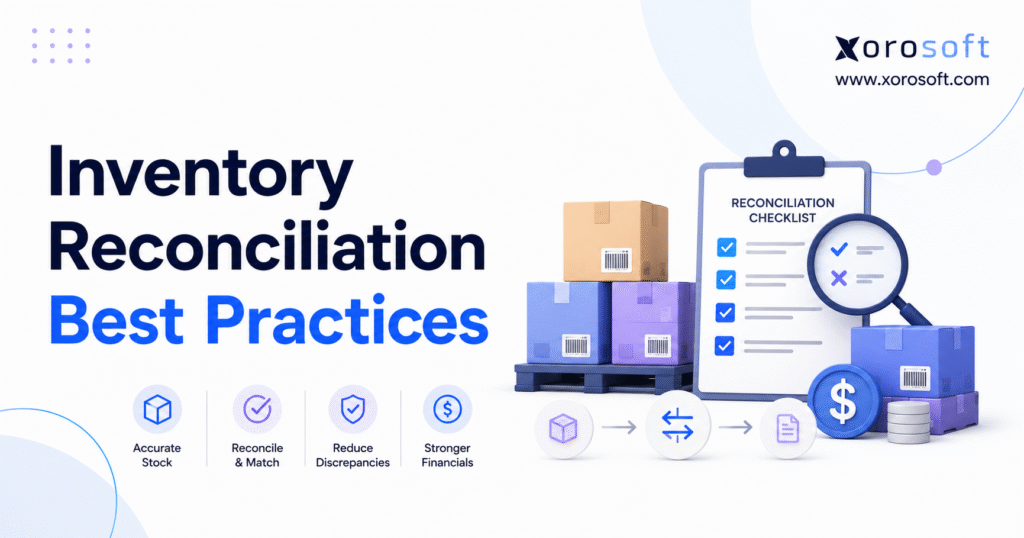
If you want to improve accuracy in your warehouse or retail operations, it’s essential to follow inventory reconciliation best practices.
1. Inventory Errors Become Expensive Before Month-End
Inventory discrepancies rarely begin with one dramatic failure. Instead, small operational gaps gradually create them. A receiving employee enters a delivery late. A warehouse team leaves a transfer open. A customer return goes back into the wrong bin. Someone counts damaged stock as sellable. Another employee posts a manual adjustment without explaining the cause.
Although each issue may appear minor, the combined effect can disrupt the entire business. Purchasing teams may reorder products the company already owns. Sales channels may promise stock that the warehouse cannot ship. Finance may then spend days rebuilding transaction history across spreadsheets, ecommerce platforms, warehouse applications, and accounting software.
For that reason, companies should treat inventory reconciliation best practices as an operational discipline rather than a month-end clean-up task. Reconciliation compares physical stock with system quantities, operational transactions, and financial records. More importantly, it explains why those records differ.
An inventory adjustment changes a balance. By contrast, a proper reconciliation process identifies when the variance occurred, traces the transaction that caused it, documents the reason, obtains approval, and assigns corrective action. As a result, the company corrects both the number and the process behind it.
Complexity increases as a business adds warehouses, suppliers, sales channels, returns, product variants, EDI, and manufacturing activity. For example, Shopify may show one available quantity, a warehouse application may show another, and the accounting system may carry a different value. Consequently, employees spend more time deciding which number to trust than improving the workflow that created the discrepancy.
This guide explains the inventory reconciliation process from physical counting through inventory-to-general-ledger review. In addition, it shows how to improve inventory accuracy, reduce recurring variances, and determine whether disconnected systems contribute to the problem.
2. What the Inventory Reconciliation Process Actually Covers
Inventory reconciliation compares physical stock with recorded quantities, operational transactions, and financial balances for a defined period. A complete reconciliation confirms that teams have identified, investigated, approved, corrected, and documented all material differences.
2.1 Physical Inventory Reconciliation Versus System Records
Physical inventory represents the stock employees can count, scan, weigh, or verify at a location. The inventory system shows the recorded quantity.
Teams can calculate the basic variance with this formula:
Inventory Quantity Variance = Physical Quantity − Recorded Quantity
A negative result means the team found fewer units than expected. A positive result means the team found more units than the system showed. However, the calculation identifies only the difference; it does not explain the cause.
For example, an unrecorded shipment, a picking error, damage, or shrinkage may create a shortage. An incorrect receipt, duplicate adjustment, or misplaced transfer may create an overage.
2.2 Inventory Reconciliation Best Practices for Quantity and Value
Quantity reconciliation determines whether the unit count is correct. Inventory value reconciliation determines whether the company assigned the correct financial value to those units.
A company may hold the correct quantity but report the wrong value because employees entered incorrect unit costs, allocated landed costs incorrectly, used outdated standard costs, posted unsupported journals, mapped transactions to the wrong accounts, or missed a required write-down.
Therefore, inventory reconciliation best practices must address quantity and value together. Otherwise, the warehouse may appear accurate while financial reporting remains unreliable.
2.3 Stock Reconciliation Versus Inventory Adjustment
An inventory adjustment changes a quantity or value. Reconciliation supplies the review, evidence, and approval that support that change.
A controlled adjustment should document:
• SKU and location
• Previous system quantity
• Counted quantity
• Quantity variance
• Unit cost
• Financial impact
• Reason code
• Supporting evidence
• Employee who performed the count
• Manager who approved the correction
• Posting date and accounting period
In addition, high-value corrections should include recount evidence and a clear link to the original transaction. Without that information, adjustments can hide process failures. Consequently, the same error may return during the next count.
3. Why Inventory Reconciliation Matters Across the Business
Inventory accuracy affects warehouse performance, purchasing, customer service, forecasting, and financial reporting. Therefore, one department cannot manage reconciliation effectively on its own.
3.1 Inventory Accuracy Protects Customer Commitments
When recorded stock exceeds physical stock, sales channels may promise inventory that the warehouse cannot ship. As a result, the company may face backorders, cancellations, split shipments, customer complaints, and expedited freight.
When recorded stock falls below physical stock, the company may hide products that remain available or place unnecessary purchase orders. In either case, poor inventory accuracy weakens customer service, revenue, and cash flow.
3.2 Stock Reconciliation Improves Purchasing Decisions
Purchasing recommendations begin with the current stock position. If the opening balance contains errors, even a strong forecast will produce unreliable reorder recommendations.
For example, overstated inventory delays replenishment and increases stockout risk. By contrast, understated inventory can trigger excess purchases, higher carrying costs, and warehouse congestion. Therefore, regular stock reconciliation gives buyers a more reliable basis for ordering.
3.3 Inventory Accounting Reconciliation Protects Financial Reporting
Inventory discrepancies can affect:
• Inventory assets
• Cost of goods sold
• Gross margin
• Write-offs
• Purchase-price variance
• Manufacturing variance
• Period profitability
Consequently, finance needs more than a physical count. It needs a clear connection between warehouse movements, inventory valuation, and the general ledger. Moreover, operations and finance must use the same cut-off date when they generate their reports.
3.4 Accurate Inventory Speeds Up Month-End Close
When employees record daily transactions accurately, finance can treat month-end reconciliation as an exception-review process instead of a reconstruction exercise.
Finance can focus on material variances, unusual transactions, and unresolved balances. Meanwhile, warehouse and operations teams can address process issues before those issues become recurring accounting problems.
4. Three Layers of Inventory Reconciliation Best Practices
Strong inventory reconciliation best practices separate the work into three connected layers. A single comparison cannot reveal every operational and financial problem.
| Reconciliation layer | Records compared | Primary objective | Typical owner |
|---|---|---|---|
| Physical-to-system | Physical count and recorded quantity | Confirm existence and location | Warehouse |
| Transaction-to-balance | Receipts, shipments, returns, transfers, production, and adjustments | Explain how the balance developed | Operations |
| Inventory-to-GL | Inventory subledger and general ledger | Confirm financial completeness and valuation | Finance |
4.1 Physical-to-System Inventory Reconciliation
This layer asks whether the stock in each warehouse, zone, bin, lot, serial number, or status agrees with the recorded quantity.
Teams should compare stock at the level where they control it. For example, a company may hold the correct total quantity but still show inaccurate warehouse or bin balances. Therefore, company-wide totals should never replace location-level reconciliation.
4.2 Transaction-to-Balance Stock Reconciliation
This layer reviews the movements that created the current balance:
Opening Inventory + Receipts + Positive Adjustments − Shipments − Consumption − Negative Adjustments = Expected Closing Inventory
Open receipts, shipments, returns, and transfers require special attention because physical movement may happen before employees complete the system transaction. As a result, timing differences can appear even when warehouse employees followed the correct physical process.
4.3 Inventory-to-General-Ledger Reconciliation
This layer compares the value in the inventory subledger with the relevant general-ledger accounts.
Common differences include:
• Unposted inventory transactions
• Unposted accounting entries
• Backdated transactions
• Incorrect account mappings
• Manual journal entries
• Cost updates
• Currency differences
• Closed-period activity
All three layers must operate together. A correct physical count does not prove that inventory valuation is accurate. Likewise, a balanced general ledger does not prove that stock sits in the correct warehouse or bin.
5. How Often Teams Should Perform Inventory Reconciliation
No single count frequency works for every product. Instead, companies should base frequency on value, movement, historical error rates, operational importance, and business risk.
| Inventory category | Suggested frequency | Typical examples |
| High-value or high-risk | Daily or weekly | Premium products, constrained components |
| Fast-moving | Weekly or monthly | Popular ecommerce products |
| Medium-priority | Monthly or quarterly | Stable replenishment items |
| Low-value and slow-moving | Quarterly or semiannually | Infrequently used supplies |
| Financial inventory balance | Every accounting close | Inventory and variance accounts |
| Complete physical inventory | Annually or as required | Entire warehouse operation |
5.1 ABC Cycle Counting for Inventory Accuracy
ABC classification provides a practical starting point.
• A items: High-value, fast-moving, operationally critical, or historically inaccurate products
• B items: Moderate-value products with predictable movement
• C items: Lower-value or slower-moving products with limited operational risk
However, financial value should not provide the only decision factor. A low-cost component that can stop production may require A-level control. Therefore, count frequency should also reflect operational impact.
5.2 Event-Driven Inventory Reconciliation
Scheduled counts remain important. Nevertheless, businesses should also trigger counts when specific risks appear.
Examples include:
• A bin unexpectedly reaches zero
• A picker cannot complete an order
• The system shows negative inventory
• A transfer remains open too long
• An employee requests a high-value adjustment
• The warehouse cannot match a return
• A product repeatedly exceeds its tolerance
• A production order reports unusual material usage
Because these events signal an active problem, event-driven counts often help teams identify the root cause faster.
5.3 Inventory Reconciliation Best Practices for Count Frequency
Inventory reconciliation best practices require businesses to review count schedules regularly. A product that moved from low volume to high volume may need more frequent counts. Similarly, a warehouse with rising transfer errors may need temporary daily verification until the team fixes the underlying process.
Therefore, count frequency should respond to changing risk rather than remain fixed indefinitely.
6. Preparing for an Accurate Inventory Reconciliation Process
Preparation determines whether a count produces reliable evidence or another spreadsheet full of unexplained differences.
6.1 Define the Reconciliation Scope and Cut-Off
Teams should document the warehouses, bins, products, statuses, count date, financial period, and transaction cut-off rules.
In addition, they should define how the process will treat:
• Goods in transit
• Customer returns
• Damaged stock
• Consignment inventory
• Supplier-owned stock
• Work in process
• Pending ecommerce orders
• Unavailable or quarantined inventory
Warehouse and finance teams must use the same effective date. Otherwise, a correct physical count may appear inaccurate because someone compared it with the wrong system balance.
6.2 Review Open Inventory Transactions
Before counting, teams should review:
• Unreceived purchase orders
• Open shipments
• Unconfirmed picks
• Incomplete returns
• Pending adjustments
• Open transfers
• Unfinished production orders
• Pending ecommerce orders
Open transactions do not always need closure before the count. However, teams must identify, control, and include them in the reconciliation.
6.3 Organize Inventory Locations Before Counting
Mixed products, unlabelled bins, duplicate storage locations, and unidentified damaged goods increase counting errors.
Therefore, warehouse teams should separate products, label active locations, isolate damaged inventory, remove empty cartons, confirm units of measure, and identify stock that counters should exclude.
In addition, each count zone should have a clear owner. This practice prevents duplicate counts and missed locations.
6.4 Separate Counting and Approval Duties
Where staffing permits, the employee who approves an adjustment should not perform the original count or enter the correction.
This separation strengthens accountability. Moreover, it reduces the risk that accidental or unauthorized adjustments will pass without review.
7. Inventory Reconciliation Process: Step by Step
A consistent inventory reconciliation process makes results easier to compare across periods, warehouses, and teams. Moreover, it gives managers a repeatable method for measuring control improvements.
7.1 Step 1: Establish the Inventory Reconciliation Scope
Choose the products, locations, statuses, accounting period, materiality thresholds, and recount rules. The scope should give every team a clear understanding of what the count includes and excludes.
7.2 Step 2: Control Inventory Movements
Freeze movements where practical. If the business cannot stop all activity, use a controlled count window and log every transaction that occurs during the count.
Otherwise, a correct count can appear wrong minutes later because someone posts a shipment or receipt after the physical count.
7.3 Step 3: Capture the System Snapshot
Save expected quantities by item, warehouse, bin, lot, serial number, and status at the effective count time.
This snapshot preserves the basis for comparison. In addition, it helps managers reproduce and review the reconciliation later.
7.4 Step 4: Perform a Blind Physical Count
A blind count hides the expected quantity from the employee. As a result, the counter must verify the stock instead of accepting the system number.
Barcode scanning can improve product and location identification. However, scanning works only when the business maintains accurate labels, item masters, locations, and units of measure.
7.5 Step 5: Compare Physical and Recorded Inventory
Calculate the difference for every item and location.
Do not offset a shortage in one warehouse against an excess in another before investigating. Although the company total may agree, the difference could reveal an unrecorded transfer or misplaced stock.
7.6 Step 6: Apply Materiality and Tolerance Rules
Teams can base thresholds on units, financial value, percentage difference, product risk, warehouse, or historical error rate.
For example, one unit may have little financial impact for a low-cost product but create a significant risk for a serialized or high-value item. Therefore, tolerance rules should reflect business risk rather than one company-wide percentage.
7.7 Step 7: Recount Material Variances
Use a second employee where practical. The recount should verify the item, unit of measure, location, lot or serial number, and inventory status.
Moreover, the second counter should not see the first result when the business needs an independent review.
7.8 Step 8: Investigate Transaction History
Review receipts, picks, shipments, returns, transfers, adjustments, work orders, and ecommerce activity.
Next, compare transaction timestamps with the count cut-off. This review often reveals whether the difference represents a true error or a timing issue.
7.9 Step 9: Assign a Root-Cause Code
Use controlled reason codes such as:
• Receiving error
• Picking error
• Shipping error
• Transfer timing
• Return-processing error
• Production-consumption error
• Damage
• Shrinkage
• Unit-of-measure error
• Integration failure
• Unknown after investigation
Avoid a generic “correction” code. Otherwise, management cannot identify recurring causes.
7.10 Step 10: Approve the Inventory Adjustment
Approval limits should reflect financial value and operational risk.
Large adjustments may require warehouse, finance, and senior-management approval. In addition, high-risk products may require stricter approval even when the financial value appears limited.
7.11 Step 11: Reconcile Inventory Value with Accounting
After managers approve quantity corrections, finance should compare the inventory valuation report with the relevant general-ledger balances.
Therefore, teams should complete quantity reconciliation and accounting reconciliation in sequence rather than treat them as unrelated projects.
7.12 Step 12: Implement Corrective Action
The final output should not contain only a list of adjustments. Instead, it should identify process improvements, owners, due dates, and follow-up reviews.
Ultimately, the company should measure reconciliation quality by whether the same variance returns.
8. Inventory Reconciliation Best Practices for Reliable Records
The most effective inventory reconciliation best practices prevent discrepancies before the count begins.
8.1 Record Inventory Transactions Where the Work Happens
Employees should record receipts, movements, picks, returns, consumption, and production when they perform the work.
Delayed entry creates timing differences that affect purchasing, fulfillment, and financial reporting. Therefore, mobile workflows and point-of-activity scanning can reduce the gap between physical movement and system entry.
8.2 Use Cycle Counting Instead of Annual Counts Alone
Annual counts remain useful. However, cycle counting detects problems closer to the original transaction.
Businesses that need mobile counting, structured warehouse tasks, and bin-level control can review warehouse management and barcode workflows as part of a broader inventory-accuracy strategy.
8.3 Reconcile Stock at the Correct Location Level
Teams should reconcile by:
• Legal entity
• Warehouse
• Zone
• Bin
• Lot
• Serial number
• Inventory status
Company-level totals can hide location and transfer errors. Consequently, reconciliation should begin at the most detailed operational level and roll upward.
8.4 Standardize Receiving Procedures
Receiving controls should define who verifies delivered quantities, how employees handle purchase-order differences, how the warehouse records damaged goods, when inventory becomes available, and how employees capture lots or serial numbers.
Employees should receive what arrived, not what the purchase order says should have arrived. Therefore, some higher-risk operations may benefit from blind receiving.
8.5 Standardize Customer Returns
Returned products should not automatically increase available inventory.
Instead, teams should use controlled dispositions such as sellable, damaged, quarantined, repairable, vendor return, or disposal. As a result, available inventory reflects product condition rather than physical presence alone.
8.6 Require Adjustment Reasons and Supporting Evidence
Managers should require reason codes, transaction references, recount evidence, and approval history, especially for high-value corrections.
Moreover, repeated use of “unknown” should trigger management review. An unknown cause may occur occasionally, but teams should not use it as the default explanation.
8.7 Track Root Causes Instead of Only Adjustment Value
A lower total adjustment value may appear positive. Nevertheless, it does not show whether employees stopped reporting problems or whether one recurring issue remains unresolved.
Track the number, source, age, value, and recurrence of variances. In addition, compare results by warehouse, product category, and transaction type.
8.8 Connect Inventory and Accounting Records
Disconnected systems require repeated exports and comparisons.
An integrated platform such as XoroERP can help inventory-driven businesses maintain shared operational and financial records. The value comes from traceability and consistent data, not from automatically approving every difference.
9. Common Inventory Discrepancies and Root-Cause Analysis
Most discrepancies point to a process, timing, configuration, or training problem. Therefore, inventory reconciliation best practices should require root-cause analysis before managers approve routine adjustments.
| Variance cause | Typical warning sign | Corrective control |
| Receiving error | Difference appears after a delivery | Scan and verify received quantities |
| Picking error | Active bins show repeated shortages | Confirm product and quantity during picking |
| Unrecorded transfer | One location is short and another is over | Require dispatch and receipt confirmation |
| Return-processing error | Refunded units do not return correctly | Use controlled return dispositions |
| Damage | The warehouse holds unsellable physical stock | Separate inventory statuses |
| Unit-of-measure error | Case or pack variances repeat | Standardize unit conversions |
| Production error | Actual material usage differs from the BOM | Record actual consumption |
| Integration delay | Channels display different quantities | Monitor synchronization exceptions |
| Manual adjustment | The balance changes without evidence | Require approval and reason codes |
9.1 Receiving Errors
Receiving errors occur when employees enter the purchase-order quantity instead of the delivered quantity, receive against the wrong SKU, or place products in an unrecorded location.
Therefore, teams should compare the purchase order, supplier document, physical delivery, and receipt transaction.
9.2 Picking and Shipping Errors
Wrong-bin picks, unrecorded substitutions, partial shipments, and premature shipping confirmation can create repeated shortages.
For example, a shipment may physically leave the warehouse while the system still shows it as available. Conversely, the system may reduce inventory before the carrier collects the order.
9.3 Warehouse Transfer Differences
A transfer includes at least two events: shipment from the origin and receipt at the destination. Inventory may also remain in transit.
Differences occur when employees complete only one side, enter different quantities, or use inconsistent units of measure.
9.4 Returns and Damaged Inventory
Returned products may require inspection, repair, repackaging, quarantine, or disposal.
Therefore, a refund should not automatically increase sellable inventory. The warehouse must also complete the physical receipt and final disposition.
9.5 Manufacturing Consumption Variances
Manufacturers can create discrepancies when actual material usage differs from the bill of materials, employees fail to record scrap, production teams use substitute components, or managers delay production completions.
Consequently, production reconciliation should compare expected consumption, actual issues, returns, scrap, and finished output.
10. Inventory Accounting Reconciliation at Month-End
Inventory-to-GL reconciliation should follow the same repeatable process every period. In addition, operations and finance should understand their responsibilities.
10.1 Prepare the Inventory Valuation Report
Finance should use the same effective date, cost method, organization, currency, and statuses as the general ledger.
The team should separate major categories such as raw materials, work in process, finished goods, merchandise inventory, goods in transit, damaged stock, and obsolete inventory.
10.2 Identify the Relevant General-Ledger Accounts
Relevant accounts may include inventory assets, inventory adjustments, cost of goods sold, purchase-price variance, manufacturing variance, goods received not invoiced, goods in transit, and inventory write-offs.
Moreover, finance should confirm that each transaction type posts to the expected account.
10.3 Compare the Inventory Subledger with the General Ledger
Finance should investigate unposted inventory transactions, unposted accounting distributions, manual journals, incorrect mappings, backdated transactions, cost updates, currency differences, and closed-period activity.
Next, the team should group differences by cause. This method makes corrective action easier than reviewing one combined variance.
10.4 Correct the Originating Transaction Where Possible
A top-side journal may make the general ledger agree temporarily while leaving the inventory subledger incorrect.
Therefore, finance should correct the originating transaction where practical and permitted by accounting policy. Otherwise, the same difference may return in the next period.
10.5 Use Shared Operational and Financial Records
Xorosoft combines inventory, purchasing, warehouse activity, accounting, manufacturing, forecasting, and reporting within a connected cloud ERP environment.
A shared platform does not eliminate review. Instead, it reduces the number of disconnected balances that finance and operations must compare manually.
11. Multi-Warehouse Inventory Reconciliation Best Practices
Multi-warehouse inventory reconciliation best practices begin with location-level control. Therefore, each warehouse should complete its reconciliation before the company consolidates totals.
11.1 Reconcile Each Location Independently
Teams should separate quantities by warehouse, bin, lot, serial number, and inventory status.
A consolidated balance may appear correct even when individual locations contain material errors. As a result, local stock availability and transfer planning can still fail.
11.2 Track In-Transit Inventory Separately
Goods that have left one warehouse but have not arrived at another should remain visible as in-transit inventory.
In addition, teams should review overdue in-transit balances by age, carrier, route, and transfer owner.
11.3 Match Both Sides of Every Transfer
Teams should compare:
• Transfer order
• Origin shipment
• Quantity dispatched
• Movement or carrier evidence
• Destination receipt
• Quantity received
• Transfer completion date
When the two sides do not agree, teams should investigate the cause before posting a general adjustment.
11.4 Use Common Reason Codes Across Warehouses
Standard reason codes allow managers to compare root causes across locations.
Otherwise, one warehouse may classify a transfer error as “miscellaneous” while another classifies the same problem as “receiving.” Those differences make trends difficult to identify.
11.5 Create Consolidated Exception Reporting
Reports should show inventory accuracy by warehouse, adjustment value by reason, transfer ageing, unresolved variances, recount rates, negative inventory, and cycle-count completion.
Businesses that have outgrown separate warehouse applications and spreadsheets can evaluate XoroONE as a unified ERP approach for inventory, purchasing, warehousing, accounting, forecasting, and reporting.
12. Shopify Inventory Reconciliation and Multi-Channel Control
Shopify inventory reconciliation requires more than comparing a single available quantity. Instead, teams must consider orders, commitments, returns, transfers, external warehouses, and additional channels.
12.1 Reconcile Shopify Inventory by Location
Teams should compare physical inventory with the on-hand quantity at each Shopify location.
Then they should review:
• Available inventory
• Committed inventory
• Unavailable inventory
• Incoming inventory
• Unfulfilled orders
• Partially fulfilled orders
• Returns
• Manual adjustments
• App-created adjustments
• Transfers
12.2 Review Cancellations, Returns, and Partial Fulfillments
Cancelled or partially fulfilled orders may reserve, release, or adjust inventory at different times.
Similarly, returns create timing differences between the refund, warehouse receipt, inspection, and final disposition. Therefore, teams should include each stage in the reconciliation process.
12.3 Maintain One Authoritative Inventory Record
When Shopify, Amazon, wholesale, EDI, and warehouse applications all update inventory independently, reconciliation becomes difficult.
The business should define one platform as the authoritative operational record and control how sales channels receive quantity updates.
Xorosoft can operate behind Shopify by connecting inventory, purchasing, warehouse management, accounting, and additional channels. Merchants can review the Xorosoft ERP app for Shopify when they evaluate this architecture.
12.4 Reconcile Amazon, Wholesale, and EDI Activity
Teams should separate accepted orders, allocated inventory, fulfilled quantities, cancelled orders, customer returns, marketplace-held stock, wholesale pack quantities, EDI acknowledgements, and shipment confirmations.
Ultimately, the goal is one controlled inventory record, not several systems competing to overwrite one another.
13. Inventory Reconciliation Best Practices by Industry
Inventory reconciliation best practices remain consistent, although each industry presents different risks.
13.1 Apparel Inventory Reconciliation
Apparel companies must reconcile style, color, and size combinations.
A correct total for one style can hide shortages in popular sizes and excess inventory in slower variants. Returns, exchanges, seasonal collections, and third-party fulfillment add further complexity.
Therefore, apparel teams should count at the variant level and review return dispositions carefully.
13.2 Furniture Inventory Reconciliation
Furniture businesses often manage bulky products, components, floor samples, special orders, damaged goods, and repair inventory.
Reconciliation must preserve both physical location and product condition. In addition, warehouse teams should distinguish between completed products, components, samples, and customer-specific inventory.
13.3 Sporting Goods Inventory Reconciliation
Sporting-goods businesses may manage product variants, seasonal demand, serialized equipment, kits, and multi-channel allocation.
Fast-moving products may require more frequent counts during peak seasons. Moreover, kit components need separate controls when teams assemble or disassemble bundles.
13.4 Food and Beverage Stock Reconciliation
Food businesses need lot, expiration, spoilage, and quarantine controls.
A quantity may exist physically but remain unavailable for sale because it has expired or failed inspection. Therefore, teams must reconcile both quantity and inventory status.
13.5 Wholesale Inventory Reconciliation
Wholesale distributors should reconcile customer allocations, case-pack conversions, EDI activity, backorders, partial shipments, and customer-specific requirements.
In addition, teams should distinguish available stock from allocated stock so that sales representatives do not promise the same inventory to multiple customers.
13.6 Manufacturing Inventory Reconciliation
Manufacturers reconcile raw materials, work in process, finished goods, scrap, substitutions, and actual production consumption.
These differences explain why industry requirements should influence process and software design. Businesses can review ERP solutions for inventory-driven industries when they define operational requirements.
14. Metrics That Strengthen Inventory Reconciliation Best Practices
Inventory reconciliation best practices should produce measurable improvement. Therefore, teams should track more than one overall accuracy percentage.
14.1 Inventory Accuracy Rate
Teams can calculate inventory accuracy with this formula:
Inventory Accuracy Rate = Accurate Records ÷ Total Records Checked × 100
The business must define what qualifies as accurate. Some companies require an exact match, while others permit a controlled tolerance.
14.2 Inventory Variance Percentage
Teams can calculate inventory variance with this formula:
Inventory Variance Percentage = Absolute Variance ÷ Recorded Quantity × 100
Use absolute variance so overages and shortages do not cancel each other.
14.3 Inventory Adjustment Value
Managers should track:
• Total adjustment value
• Adjustment value by warehouse
• Adjustment value by reason
• Adjustment value by product category
• Adjustment value as a percentage of inventory
14.4 Additional Stock Reconciliation Metrics
Useful measures include:
• Cycle-count completion rate
• Recount rate
• Variances per 1,000 transactions
• Inventory-to-GL difference
• Reconciliation completion time
• Number of unresolved variances
• Negative inventory occurrences
• Transfer ageing
• Recurring root causes
14.5 Measure Improvement by Root Cause
An overall accuracy percentage may improve while one process continues to fail.
Therefore, managers should review trends by warehouse, product, employee, transaction type, and reason code. This approach helps the business prioritize improvements that will have the greatest operational impact.
15. Mistakes That Weaken Inventory Reconciliation Best Practices
Several common habits make records appear corrected without improving control.
15.1 Adjusting Before Investigating
An immediate correction may restore availability, but it can also destroy valuable evidence.
Teams should recount and review transaction history before they adjust the balance whenever practical.
15.2 Counting While Transactions Continue Uncontrolled
A count may show the correct quantity at 10:00 a.m. and appear wrong minutes later when someone posts an unrecorded shipment.
Therefore, teams must either freeze movements or maintain a complete log of count-window activity.
15.3 Offsetting Warehouses or Bins
An excess in one location should not automatically offset a shortage elsewhere.
The difference may reveal an unrecorded transfer, incorrect storage location, or duplicate receipt. Consequently, teams should investigate each location before they consolidate balances.
15.4 Ignoring Small Recurring Variances
A low-value discrepancy that repeats hundreds of times may represent a larger process failure.
Managers should review frequency as well as financial value.
15.5 Using Spreadsheets as the Permanent Audit Trail
Spreadsheets can support analysis, but they become risky when they replace transaction history, approval workflows, reason codes, and controlled records.
As the business grows, version control and manual imports create additional reconciliation work.
15.6 Assuming Software Will Fix Weak Processes
Technology cannot repair unclear ownership, poor warehouse labeling, inconsistent units, or weak receiving discipline.
Therefore, teams should standardize the process before they expand automation.
16. When Inventory Reconciliation Signals a System Problem
Some businesses can improve inventory accuracy through better procedures. Others have reached the limits of disconnected systems.
16.1 Signs the Business Has Outgrown Its Current Process
A system review may make sense when:
• Reconciliation takes several days every month.
• Employees no longer trust the inventory balance.
• Warehouses maintain separate spreadsheets.
• Shopify, Amazon, wholesale, and EDI orders use disconnected records.
• Inventory and accounting require repeated manual imports.
• Purchasing decisions rely on manually combined reports.
• Adjustment volume continues to rise.
• The business cannot reconcile by location.
• Manufacturing activity sits outside the inventory system.
• Reporting depends on one employee’s spreadsheet logic.
16.2 Who May Not Need a Full ERP Upgrade
A small, single-location company with limited products and low transaction volume may improve through clearer ownership, better receiving, stronger bin controls, and regular cycle counting.
A new ERP should not become the first response to a training or warehouse-discipline problem.
16.3 Comparing Inventory Software, WMS, and ERP Options
| System type | Best fit | Main limitation |
| Spreadsheet | Small, low-volume operation | Weak controls and limited traceability |
| Accounting software | Simple inventory and finance | Limited warehouse depth |
| Inventory application | Product and stock control | Accounting may remain separate |
| WMS | Complex warehouse execution | Requires a connection with finance and ERP |
| Cloud ERP | Connected operational and financial control | Requires implementation discipline |
| Enterprise ERP | Complex global organization | Higher cost and implementation effort |
NetSuite, Acumatica, Cin7, Brightpearl, Fishbowl, Sage, Business Central, and Xorosoft serve different operating models.
Businesses evaluating broader ERP options can compare Xorosoft and NetSuite using process fit, implementation requirements, reporting, scalability, and ownership needs.
17. Inventory Reconciliation Best Practices Checklist
A shared checklist helps warehouse, operations, and finance teams follow the same process.
17.1 Before Inventory Reconciliation
• Define locations, products, and statuses.
• Confirm the cut-off date and time.
• Assign counters and approvers.
• Review open receipts and shipments.
• Review transfers and returns.
• Organize stock locations.
• Confirm units of measure.
• Isolate damaged and quarantined goods.
• Capture the system snapshot.
17.2 During the Physical Count
• Use blind counts.
• Scan products where practical.
• Count by warehouse and location.
• Mark completed zones.
• Record lot, serial, and status details.
• Control ongoing transactions.
• Recount material differences.
• Document unidentified inventory.
17.3 During Variance Investigation
• Review transaction history.
• Match receipts and shipments.
• Review returns.
• Match transfer dispatch and receipt.
• Check production consumption.
• Validate units of measure.
• Review integration exceptions.
• Assign root-cause codes.
17.4 During Inventory Accounting Reconciliation
• Generate valuation reports.
• Use the correct period and currency.
• Compare subledger and GL balances.
• Review unposted transactions.
• Review account mappings.
• Investigate manual journals.
• Approve corrections.
• Retain supporting evidence.
17.5 After Reconciliation
• Report results by root cause.
• Assign corrective actions.
• Update cycle-count frequency.
• Improve employee training.
• Correct system configuration.
• Monitor recurring variances.
• Measure inventory accuracy.
• Review progress during the next close.
18. Frequently Asked Questions About Inventory Reconciliation
18.1 What Is Inventory Reconciliation?
Inventory reconciliation compares physical stock with system quantities, operational transactions, and financial values. Teams count differences, investigate their causes, approve corrections, and document the outcome. A complete process also prevents the same receiving, fulfillment, transfer, return, manufacturing, or accounting problem from recurring.
18.2 Why Are Inventory Reconciliation Best Practices Important?
Inventory reconciliation best practices improve stock availability, purchasing decisions, fulfillment performance, forecasting, inventory valuation, and financial reporting. Without a controlled process, a company may sell products it does not have, buy inventory it already owns, report inaccurate margins, or spend excessive time resolving period-end differences.
18.3 How Do You Reconcile Inventory?
First, define the scope and cut-off. Next, capture the system balance and count physical stock. Then compare results, recount material differences, review transaction history, identify root causes, approve adjustments, and reconcile inventory value with accounting. Finally, assign corrective actions that address the process behind the variance.
18.4 How Often Should Inventory Be Reconciled?
Finance should normally review inventory balances during every accounting close. Physical count frequency should vary by risk. High-value, fast-moving, or error-prone products may require daily or weekly counts, while lower-risk inventory may require monthly, quarterly, or annual verification.
18.5 What Causes Inventory Discrepancies?
Common causes include incorrect receipts, picking errors, unrecorded transfers, delayed shipments, return-processing problems, damage, shrinkage, unit-of-measure errors, production-consumption differences, duplicate products, synchronization delays, unsupported manual adjustments, and incorrect accounting mappings.
18.6 What Is an Inventory Reconciliation Report?
An inventory reconciliation report compares counted stock with expected quantities and lists differences that require investigation. It may include the product, warehouse, bin, expected quantity, counted quantity, variance, unit cost, financial impact, reason code, recount result, adjustment status, and approval history.
18.7 What Is an Acceptable Inventory Variance?
An acceptable variance depends on product value, transaction volume, measurement method, regulatory requirements, and business risk. A company may require an exact match for serialized or high-value products while allowing a controlled tolerance for bulk materials measured by weight.
18.8 How Do You Calculate Inventory Accuracy?
Divide the number of accurate inventory records by the total records checked, then multiply the result by 100. The company must define what qualifies as accurate. Some businesses require an exact match, while others allow an approved tolerance.
18.9 How Do You Calculate Inventory Variance?
Subtract the recorded quantity from the physical quantity. To estimate the financial impact, multiply the quantity difference by the appropriate unit cost. Finance should confirm which cost basis to use before posting any accounting correction.
18.10 How Does Cycle Counting Differ from Inventory Reconciliation?
Cycle counting verifies selected physical stock on a recurring schedule. Inventory reconciliation covers a broader process that includes counting, transaction review, variance investigation, adjustment approval, financial reconciliation, and corrective action.
18.11 Does a Business Still Need an Annual Physical Inventory?
Company policy, auditors, lenders, regulators, or local rules may still require an annual count. A strong cycle-counting program can reduce disruption and improve records throughout the year, but it does not automatically remove every annual verification requirement.
18.12 Who Owns Inventory Reconciliation?
Warehouse teams generally count and investigate physical differences. Operations teams review process failures. Finance reconciles valuation and general-ledger balances. Managers approve material adjustments, while internal audit may test the controls. Clear ownership matters because reconciliation crosses several departments.
18.13 How Do You Reconcile Inventory with the General Ledger?
Generate the inventory valuation report and general-ledger report for the same period. Compare the relevant balances, identify unmatched transactions and journals, review account mappings, and correct originating entries where possible. Keep evidence of the comparison, explanation, approval, and final correction.
18.14 Can Software Automate Inventory Reconciliation?
Software can schedule counts, compare balances, calculate variances, enforce tolerances, route approvals, preserve history, and match subledger and general-ledger activity. However, employees still need to verify physical stock, investigate unusual differences, apply judgment, and own corrective actions.
18.15 What Software Supports Inventory Reconciliation?
Businesses may use spreadsheets, accounting software, inventory applications, warehouse management systems, or ERP platforms. The right choice depends on transaction volume, warehouse count, sales channels, manufacturing requirements, accounting complexity, audit needs, and the number of disconnected systems.
18.16 How Does ERP Improve Inventory Reconciliation?
ERP connects purchasing, receiving, warehouse movement, fulfillment, returns, manufacturing, costing, and accounting. Because these activities use shared records, teams spend less time combining exports. ERP does not eliminate discrepancies, but it can make them easier to identify, explain, and prevent.
18.17 How Does Barcode Scanning Improve Inventory Accuracy?
Barcode scanning helps employees identify products and locations consistently while reducing manual entry. However, the business must maintain correct labels, product master data, scanner workflows, location records, and units of measure.
18.18 How Do Returns Affect Inventory Reconciliation?
Returns create discrepancies when refunds, physical receipts, inspections, and inventory dispositions occur at different times. Teams should classify returned stock as sellable, damaged, quarantined, repairable, or disposable before they increase available inventory.
18.19 How Do Warehouse Transfers Cause Inventory Differences?
A transfer reduces inventory at one location and increases it at another through separate shipment and receipt events. Differences arise when employees complete only one side, receive the wrong quantity, overlook transit damage, or ignore transfer timing during the count.
18.20 How Do You Reconcile Shopify Inventory?
Compare physical stock with Shopify’s on-hand quantity at each location. Then review available, committed, unavailable, and incoming states, along with orders, fulfillments, returns, adjustments, and transfers. Include external warehouse, marketplace, wholesale, and accounting records where relevant.
18.21 How Do You Reconcile Multiple Warehouses?
Reconcile each warehouse and inventory status separately. Review goods in transit, match transfer shipments with destination receipts, use a common cut-off, and investigate location-level differences before consolidating totals.
18.22 How Do Manufacturers Reconcile Inventory?
Manufacturers compare physical raw materials, work in process, finished goods, scrap, substitutions, and actual production consumption with work-order and bill-of-material records. They should also review issues, completions, reversals, and production timing.
18.23 When Should a Business Replace Spreadsheet Reconciliation?
Consider replacing spreadsheets when multiple employees edit different versions, reconciliation requires repeated imports, approval history remains unclear, warehouses maintain independent balances, or month-end work depends on one person’s spreadsheet logic.
18.24 How Long Should Inventory Reconciliation Take?
The time depends on product volume, locations, count frequency, transaction quality, automation, and the number of discrepancies. Instead of relying on one benchmark, track whether completion time and unresolved variances decline over successive periods.
18.25 What Evidence Should a Business Retain?
Keep count sheets or scanner records, system snapshots, variance reports, transaction evidence, recount results, reason codes, approval records, inventory adjustments, general-ledger comparisons, journal support, and corrective-action plans.
19. Make Inventory Reconciliation a Daily Operating Discipline
Ultimately, inventory reconciliation best practices work best when receiving, movement, returns, production, counting, approvals, and accounting review operate as one connected discipline.
Reliable inventory records begin with consistent daily action:
• Receive against the goods that suppliers actually deliver.
• Record warehouse movements when employees perform them.
• Separate damaged and unavailable stock.
• Confirm both sides of every transfer.
• Process returns through controlled dispositions.
• Record actual manufacturing consumption.
• Investigate differences before adjusting balances.
• Reconcile inventory value during every close.
• Track recurring causes and assign corrective actions.
Not every business needs a new ERP to improve inventory accuracy. Better receiving procedures, clearer ownership, reliable bin labels, and regular cycle counting may solve the immediate problem.
However, companies that manage multiple warehouses, Shopify, Amazon, wholesale, EDI, manufacturing, purchasing, and accounting across disconnected applications may eventually reach the limits of manual reconciliation.
At that point, Xorosoft can provide a shared cloud ERP environment for inventory, warehouse management, purchasing, accounting, manufacturing, forecasting, and reporting.
The first step involves determining whether the problem comes from procedures, organizational ownership, or system limitations. From there, the company can prioritize the controls and technology that will produce the greatest operational improvement.
To review your inventory, warehouse, purchasing, ecommerce, and accounting workflows, book a personalized ERP demo.
Recent Posts
-
 How a Canadian Distributor Improved Purchasing With Lead Time Replenishment
 -
 Shopify WMS: When Does a Warehouse Need a Dedicated System?
 -
 B2B Ecommerce vs Rep-Led Ordering: Which Transactions Should Move to Self-Service First?
 -
 Manufacturing Inventory Statistics 2026: Accuracy, Downtime, and Material Shortages
 -
 B2B Ecommerce Platforms for Manufacturers: Dealer Networks, Replacement Parts, and Account-Specific Catalogs