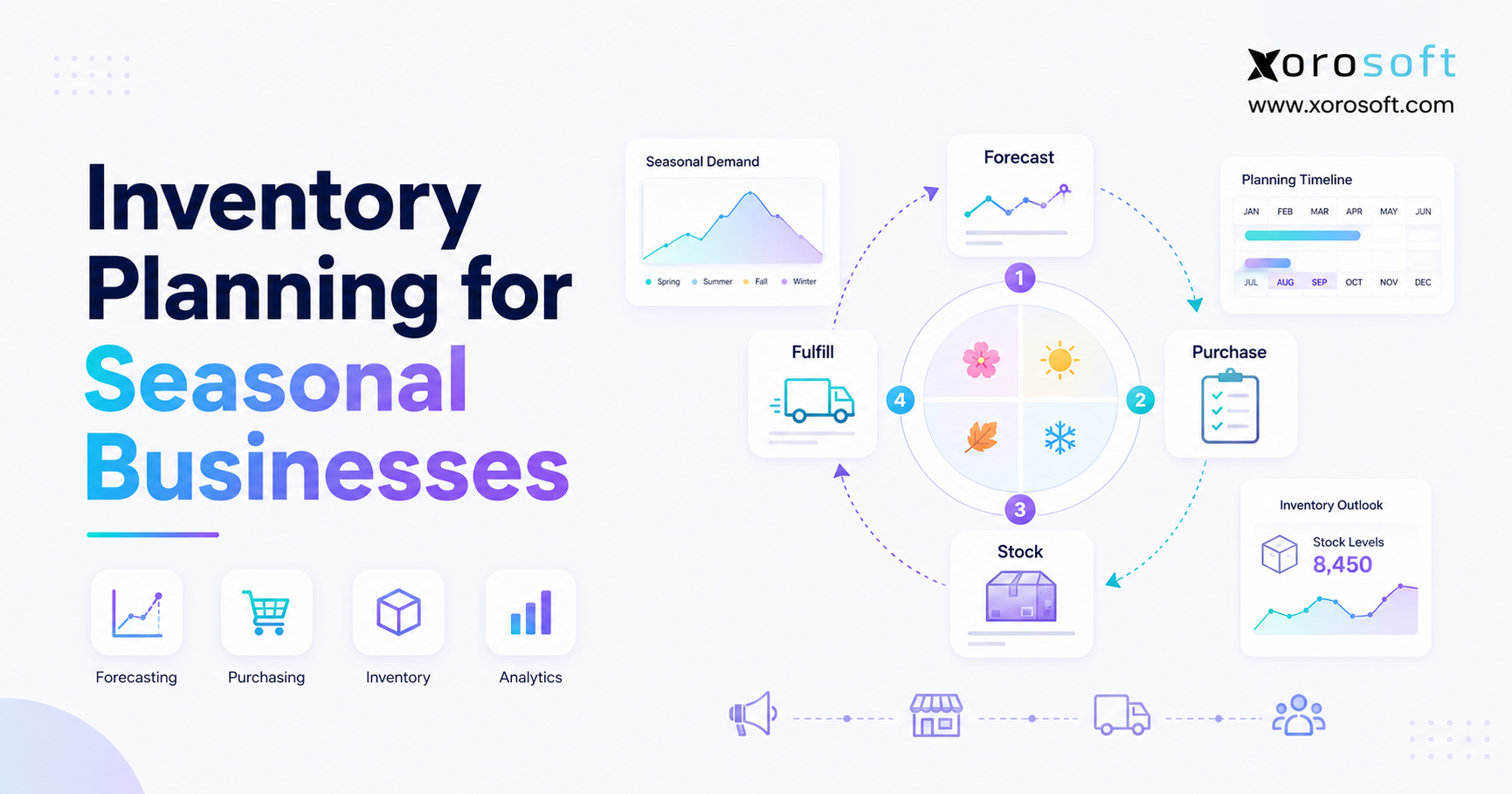
Inventory planning for seasonal businesses presents unique challenges and opportunities that require a strategic approach.
1. A Practical Start to Seasonal Inventory Planning
Inventory planning for seasonal businesses is the process of forecasting demand, preparing stock, timing purchase orders, and managing inventory before, during, and after predictable demand spikes. Unlike regular inventory planning, seasonal planning focuses on short windows where customer demand rises quickly and then drops just as fast.
A seasonal business does not only need more inventory. Instead, it needs the right inventory, in the right warehouse, before the selling window begins, with enough margin left after storage, freight, labor, markdowns, and returns. Because of that, seasonal inventory planning affects operations, finance, purchasing, fulfillment, and customer experience at the same time.
The main challenge is timing. If stock arrives late, the sales opportunity may already be gone. However, when too much stock arrives, cash gets trapped in products that may need discounts after the season. Meanwhile, if inventory is stored in the wrong location, customers may still face delays even when the business technically owns enough stock.
That is why seasonal planning needs more than a last-minute buying spreadsheet. A stronger process connects historical sales, supplier lead times, demand forecasts, purchase orders, warehouse capacity, channel demand, and available cash. As a result, teams can make better decisions before the season puts pressure on the business.
1.1 What Inventory Planning for Seasonal Businesses Really Means
Inventory planning for seasonal businesses means preparing inventory around expected demand cycles. For example, a fashion brand may plan winter jackets before cold weather arrives. Similarly, a sporting goods distributor may increase stock before league seasons begin. A furniture company may prepare outdoor products before spring and summer. Meanwhile, food brands may plan holiday bundles before gifting demand rises.
Although the industries differ, the planning questions are similar:
- Which products will customers likely buy?
- How many units should the business order?
- When should purchase orders be placed?
- Where should inventory be stored?
- How much safety stock is reasonable?
- What happens if demand is higher or lower than expected?
These questions become harder as the business grows. At first, a small company may manage seasonal buying in one spreadsheet. However, once the business sells through Shopify, Amazon, wholesale, retail, EDI, or multiple warehouses, every channel can create a different version of demand.
1.2 Why Seasonal Inventory Planning Is Different From Regular Planning
Regular inventory planning often works around stable demand. Seasonal inventory planning, however, works around sharp demand changes. A product that sells 300 units in a normal month may sell 3,000 units during a holiday window. After that window closes, demand may fall again.
Therefore, seasonal inventory planning needs a different operating model.
| Planning Area | Regular Inventory Planning | Seasonal Inventory Planning |
|---|---|---|
| Demand pattern | More stable | Spikes and drops quickly |
| Purchase timing | Ongoing replenishment | Early buying before peak demand |
| Stockout risk | Spread across time | Concentrated in a short window |
| Overstock risk | Easier to correct | More expensive after the season |
| Warehouse pressure | Usually steady | High receiving and fulfillment peaks |
| Cash flow impact | Gradual | Large upfront inventory investment |
| Forecasting need | Useful | Critical |
The business has less time to correct mistakes during seasonal demand. Therefore, seasonal planning must happen early, with clear numbers and a realistic operating calendar.
1.2.1 Demand Spikes Are Temporary
Seasonal demand is time-sensitive. Once the buying moment passes, customers may no longer need the product. For that reason, inventory must be available before demand peaks.
1.2.2 Supplier Lead Times Become More Risky
Supplier delays are always frustrating. During peak season, however, they become much more expensive. A two-week delay can turn a strong sales opportunity into a missed season.
1.2.3 Overstock Becomes More Expensive
Extra inventory is not harmless. In fact, it increases storage costs, blocks working capital, creates markdown pressure, and may reduce cash available for the next buying cycle.
2. Why Seasonal Businesses Struggle With Inventory Planning
Seasonal businesses struggle because they must make large buying decisions before real demand fully appears. Shopify explains that seasonal inventory can create challenges such as dead stock, storage issues, and stockouts when companies do not plan carefully through the full seasonal cycle. You can review Shopify’s explanation of seasonal stock in its guide to seasonal inventory.
Inventory planning for seasonal businesses becomes especially difficult when data lives in too many places. Sales may sit in Shopify. Purchase orders may live in spreadsheets. Accounting may happen in QuickBooks. Meanwhile, warehouse teams may use a separate tool. As a result, every department sees part of the picture, but no one has the complete inventory position.
2.1 Historical Sales Data Can Be Misread
Historical sales are useful, but they are not the same as true demand. Last year’s sales may reflect stockouts, promotions, supplier delays, channel changes, weather shifts, pricing changes, or marketing campaigns. Therefore, teams need to review the context behind the numbers before they copy last year’s plan.
For example, a product may have sold 1,000 units last December. However, if it stocked out halfway through the month, actual demand may have been much higher. In that case, the sales report shows what the business had available, not what customers wanted to buy.
A better review includes:
- Stockout dates
- Lost sales estimates
- Promotion calendars
- Return rates
- Sell-through by SKU
- Warehouse constraints
- Wholesale commitments
- Marketplace performance
This gives the planning team a clearer view before the next season begins. As a result, the forecast becomes more realistic.
2.2 Supplier Lead Times Are Often Underestimated
Lead time is one of the most important parts of seasonal inventory management. A supplier that normally ships in 30 days may need 45, 60, or 90 days before a major seasonal period. In addition, freight, customs, quality checks, production queues, and supplier capacity can all change the timeline.
Therefore, seasonal purchasing should work backward from the selling window. If products must be ready by October 15 and the supplier needs 75 days, the purchase decision cannot wait until September.
2.3 Promotions Can Distort Demand Forecasts
Promotions can make demand look stronger than it really is. Black Friday discounts, influencer campaigns, bundle offers, wholesale promotions, and marketplace deals may create temporary lift. However, that lift does not always continue after the campaign ends.
Because of that, seasonal demand forecasting should separate normal demand from campaign-driven demand. Otherwise, the business may over-order after a strong promotion and end up carrying slow-moving stock after the campaign ends.
2.4 Inventory Data Is Often Spread Across Disconnected Systems
Growing businesses often manage seasonal inventory through Shopify, Amazon, QuickBooks, warehouse apps, supplier emails, and purchasing spreadsheets. This setup may work for a while. Eventually, though, the gaps become expensive.
One team may trust ecommerce data. Another may trust the warehouse report. Finance may wait for month-end to calculate inventory value. Meanwhile, purchasing may use a spreadsheet that does not reflect current sales velocity.
When these systems do not agree, planning becomes guesswork. As a result, teams may order too much of the wrong product and too little of the product customers actually want.
3. The Inventory Planning for Seasonal Businesses Framework
The inventory planning for seasonal businesses framework should connect sales history, forecasting, purchasing, supplier timing, warehouse readiness, and post-season review. The goal is not perfect prediction. Instead, the goal is to make better decisions earlier and adjust before inventory problems damage sales or cash flow.
3.1 Review Historical Seasonal Sales
Start with at least two or three comparable seasonal periods when possible. Review unit sales, revenue, margin, stockouts, returns, discounts, and channel mix. In addition, look for the operational reasons behind the numbers.
Do not look only at total sales. SKU-level planning matters because seasonal performance is rarely even across the catalog. A few products may drive most of the revenue, while long-tail SKUs create storage pressure.
Review these areas carefully:
- Best-selling SKUs
- Slow-moving SKUs
- Stockout dates
- Return-heavy items
- Markdown history
- Wholesale commitments
- Marketplace performance
- Warehouse bottlenecks
- Supplier delays
- Gross margin by product
Once the review is complete, the business can move from historical reporting to forward planning. Therefore, the next step is to forecast demand more precisely.
3.2 Forecast Demand by SKU, Channel, and Location
Seasonal demand forecasting works best when it happens at three levels: SKU, channel, and location. Shopify’s guide to demand forecasting software explains how forecasting tools use historical sales, seasonality, and inventory trends to predict future product demand.
That matters because seasonal businesses rarely sell through one simple channel. A product may move differently on Shopify, Amazon, wholesale, retail, and B2B. Therefore, one average forecast is usually not enough.
3.2.1 SKU-Level Forecasting
SKU-level forecasting prevents averages from hiding risk. For example, a jacket category may look healthy overall, but demand may be concentrated in two colors and three sizes. Without SKU-level visibility, a business may overbuy weak variants and underbuy bestsellers.
3.2.2 Channel-Level Forecasting
Channel-level forecasting matters because each channel behaves differently. Wholesale buyers may place larger orders early. Shopify demand may spike during promotions. Meanwhile, Amazon may require separate inventory planning because marketplace demand and fulfillment rules can move differently.
3.2.3 Location-Level Forecasting
Location-level forecasting helps the business place inventory closer to demand. If one warehouse fulfills most seasonal orders in a region, equal allocation across all warehouses may create delays, transfers, and unnecessary shipping costs.
3.3 Calculate Required Stock Levels
A simple seasonal planning formula is:
Expected seasonal demand + safety stock − available inventory − incoming inventory = recommended order quantity
This formula gives teams a clear starting point. After that, planners should adjust for cash flow, supplier minimums, warehouse capacity, product margin, and markdown risk.
| Planning Item | Example Value |
| Expected seasonal demand | 5,000 units |
| Safety stock | 800 units |
| Current available inventory | 1,200 units |
| Incoming purchase orders | 1,000 units |
| Recommended order quantity | 3,600 units |
This calculation should happen at the SKU level, not only at the category level. Otherwise, strong products and weak products can get blended into one misleading number.
3.4 Plan Purchase Orders Around Lead Times
Purchase orders should be planned backward from the date inventory must be ready to sell. Include supplier production time, freight, customs, receiving, quality checks, warehouse putaway, listing updates, and fulfillment preparation.
Domestic suppliers may move faster, but capacity can still tighten before peak periods. International suppliers usually require more buffer because freight and customs add risk. Therefore, the purchase calendar should be built before demand starts rising.
A seasonal purchase calendar should include:
- Forecast review date
- Buying approval deadline
- Supplier confirmation date
- Production window
- Freight window
- Receiving date
- Putaway deadline
- Final reorder cutoff
This calendar helps teams avoid late buying decisions. In addition, it gives finance and warehouse teams more time to prepare.
3.5 Monitor Sell-Through During the Season
Once the season starts, planning becomes control. Track sell-through rate, stockout risk, open purchase orders, available-to-sell inventory, warehouse capacity, and channel performance.
If demand is stronger than expected, the business may need to reorder, transfer stock, adjust promotions, or reserve inventory for key accounts. However, when demand is weaker, the team may need to slow purchasing, reduce replenishment, or plan markdowns earlier.
4. Demand Forecasting in Inventory Planning for Seasonal Businesses
Demand forecasting is one of the most important parts of inventory planning for seasonal businesses. It helps teams decide what to buy before demand fully appears. However, forecasting should not be a one-time spreadsheet exercise. Instead, it should be an operating cycle of prediction, monitoring, adjustment, and review.
4.1 Use Historical Sales Without Copying Last Year
Historical sales give the forecast a base, but they need context. A business should ask:
- Did we stock out last year?
- Did we run deeper discounts?
- Did we add new channels?
- Did our audience grow?
- Did supplier delays limit availability?
- Did returns reduce net sales?
- Did weather or events affect buying behavior?
Better answers create better forecasts. As a result, the buying plan becomes less dependent on guesswork.
4.2 Adjust Forecasts for Promotions and Market Changes
Promotions can create a lift that does not continue after the campaign ends. Therefore, seasonal forecasts should mark campaign dates, discount levels, email pushes, influencer campaigns, bundle offers, marketplace deals, and wholesale promotions.
4.2.1 Promotion Lift
Promotion lift estimates how much extra demand came from a campaign. Without this adjustment, a team may mistake discounted demand for normal demand.
4.2.2 New Product Launches
New products need proxy data. For example, teams can use similar products, category demand, preorder interest, waitlists, early sales, and customer feedback.
4.2.3 Market Demand Shifts
External factors can change seasonal demand. Weather, economic conditions, competitor pricing, shipping costs, and social trends can all affect what customers buy. Therefore, forecasts should leave room for judgment, not just formulas.
4.3 Separate Baseline Demand From Seasonal Demand
A clean seasonal forecast separates normal demand from seasonal lift.
| Demand Type | Example |
| Baseline monthly demand | 500 units |
| Seasonal lift | 2,500 units |
| Total expected seasonal demand | 3,000 units |
This split helps teams avoid over-ordering after the season. It also helps finance understand how much inventory investment is temporary.
4.4 Track Forecast Accuracy After the Season
Forecast accuracy should be reviewed after each season. The goal is not to blame the team. Instead, the review should improve the next planning cycle.
Track these metrics:
- Forecast accuracy
- Forecast bias
- Stockout rate
- Sell-through rate
- Overstock value
- Markdown cost
- Return rate
- Gross margin impact
A forecast that is always too high creates overstock. Meanwhile, a forecast that is always too low creates stockouts. Both problems cost money, but they require different fixes.
5. Seasonal Purchasing Planning and Supplier Timing
Seasonal purchasing is where the forecast becomes a financial commitment. Once purchase orders are placed, demand assumptions turn into inventory investment. That is why seasonal purchasing should be connected to forecasting, cash flow, supplier timing, and warehouse capacity.
5.1 Map Supplier Lead Times Before Ordering
Every supplier should have a documented lead time profile. Include normal lead time, peak lead time, minimum order quantity, production capacity, payment terms, freight timing, and quality control requirements.
For seasonal products, use conservative lead times. A supplier that usually ships in 30 days may need more time before a major seasonal period. Therefore, the safest plan is to confirm timelines early.
5.2 Build Purchase Orders From Forecasts
Purchase orders should come from the forecast, not from habit. If purchasing happens separately from demand planning, the business may buy based on last year’s file, supplier pressure, or last-minute urgency.
A stronger purchase plan connects:
- Forecasted demand
- Available inventory
- Incoming inventory
- Supplier minimums
- Safety stock
- Cash budget
- Warehouse space
- Margin targets
This approach helps the business protect sales without overcommitting cash. In addition, it keeps purchasing aligned with finance and warehouse capacity.
5.3 Plan Backup Suppliers for Critical SKUs
Not every SKU needs a backup supplier. However, critical seasonal products should have a risk plan. If a top-selling item depends on one supplier, one delay can affect the entire season.
Backup planning may include secondary suppliers, earlier purchase orders, substitute products, partial domestic sourcing, or controlled inventory allocation. As a result, the business has options if the original plan breaks.
5.4 Avoid Late Purchasing Decisions
Late purchasing creates expensive choices. The business may pay rush freight, accept lower margins, miss the sales window, or overbuy because there is no time left for careful planning.
Inventory planning for seasonal businesses should include buying deadlines. Without clear cutoff dates, teams often wait too long and then make rushed decisions under pressure. Therefore, purchasing calendars should be set before peak demand begins.
6. Safety Stock, Reorder Points, and Seasonal Buffer Inventory
Safety stock protects the business against uncertainty. However, seasonal safety stock must be handled carefully because too much buffer inventory can become dead stock after the season.
6.1 How Safety Stock Works for Seasonal Demand
Safety stock is extra inventory held to protect against demand spikes, supplier delays, and forecast error. Seasonal businesses often need more safety stock for high-volume SKUs, long-lead-time products, and critical bestsellers.
High-volume products need buffer stock because a small forecast error can create a large unit gap. Long-lead-time items need extra protection because the business cannot replenish quickly once demand accelerates. Therefore, safety stock should be set by SKU risk, not by one flat rule.
6.2 How to Set Seasonal Reorder Points
A reorder point tells the business when to buy again. For seasonal products, reorder points should account for peak demand velocity, supplier lead time, and safety stock.
Reorder point = expected demand during lead time + safety stock
For example, if a product sells 100 units per week during peak season, supplier lead time is four weeks, and safety stock is 150 units, the reorder point is:
400 units + 150 units = 550 units
When inventory falls near 550 units, the business should reorder only if there is enough season left to sell the replenishment. Otherwise, the reorder may arrive too late and create overstock.
6.3 When Buffer Stock Helps and When It Hurts
Buffer stock helps when demand is uncertain and replenishment is slow. Still, it can hurt when the product has a short season, limited shelf life, high storage cost, or fast-changing style demand.
Inventory planning for seasonal businesses should treat excess inventory as a financial decision. Extra stock uses warehouse space, ties up cash, increases handling work, and may require discounts after the season. Therefore, buffer stock should protect revenue without creating avoidable markdown risk.
6.4 Simple Seasonal Order Quantity Formula
Use this formula as a planning baseline:
Expected seasonal demand + safety stock − available inventory − incoming inventory = recommended order quantity
| Planning Item | Units |
| Expected seasonal demand | 10,000 |
| Safety stock | 1,500 |
| Available inventory | 2,000 |
| Incoming inventory | 3,000 |
| Recommended order quantity | 6,500 |
The final number should be reviewed against margin, cash flow, warehouse space, supplier limits, and markdown risk. In addition, teams should revisit the number once sales data starts coming in.
7. Inventory Planning for Seasonal Businesses Across Shopify, Wholesale, Amazon, and Retail
Inventory planning for seasonal businesses becomes harder when sales come from multiple channels. Shopify, Amazon, wholesale, retail, EDI, and B2B orders do not behave the same way. Each channel has different demand patterns, fulfillment rules, and customer expectations.
7.1 Shopify Seasonal Inventory Planning
Shopify brands often feel seasonal pressure during Black Friday, Cyber Monday, holiday gifting, product drops, influencer campaigns, and new collection launches. The problem is not only forecasting demand. Teams also need to sync inventory, plan purchase orders, prevent overselling, and prepare fulfillment.
When Shopify becomes the main sales engine, inventory planning should connect storefront demand, available-to-sell stock, bundles, returns, purchase orders, and warehouse readiness.
Xorosoft is listed on the Shopify App Store, which is useful context for Shopify brands that are evaluating ERP-connected inventory, purchasing, warehouse, and accounting workflows.
7.2 Wholesale Seasonal Inventory Planning
Wholesale demand often arrives earlier than ecommerce demand. Buyers may place seasonal orders months in advance. Because of that, wholesale planning should include customer commitments, customer-specific pricing, EDI orders, allocation rules, and replenishment timing.
The main risk is promising too much inventory to wholesale accounts and leaving ecommerce or retail channels short. Therefore, allocation rules should be defined before large seasonal orders arrive.
7.3 Amazon and Marketplace Inventory Planning
Amazon and marketplace channels add another layer of complexity. Inventory must be available, compliant, and positioned for fulfillment. Marketplace demand can rise quickly during seasonal events, while replenishment rules may limit how fast sellers can respond.
Marketplace demand should be forecast separately from Shopify and wholesale demand. Otherwise, the business may overestimate total available stock.
7.4 Multi-Channel Inventory Visibility
Multi-channel inventory planning requires one reliable view of stock. If Shopify, Amazon, wholesale, warehouse, and accounting data do not match, planners make decisions with partial information.
This is where a connected system becomes useful. XoroONE brings inventory, purchasing, accounting, warehouse management, reporting, ecommerce, and operational workflows into one ERP environment for inventory-driven businesses. As a result, teams can work from one operating view instead of reconciling several disconnected tools.
8. Warehouse and Multi-Location Planning During Peak Season
Seasonal planning does not end when inventory is purchased. Warehouses must be ready to receive, store, pick, pack, ship, and process returns. Therefore, warehouse planning should be part of the inventory plan from the beginning.
8.1 Inventory Allocation by Warehouse
Multi-warehouse businesses should allocate inventory based on demand by region, sales channel, shipping speed, and fulfillment cost. Equal allocation is rarely the best plan.
Warehouse-level allocation decides how much stock each location should hold. Meanwhile, channel-level allocation decides how much inventory should be reserved for Shopify, wholesale, Amazon, retail, or B2B customers.
Inventory planning for seasonal businesses should also include transfer rules. If one location sells faster than expected, teams need a clear process for moving inventory before customers feel the shortage.
8.2 Warehouse Capacity Planning
Warehouse capacity is not only storage space. It includes receiving capacity, labor, picking speed, packing stations, shipping cutoffs, replenishment tasks, and returns handling.
A seasonal warehouse plan should answer:
- How many units will arrive each week?
- Where will inbound inventory be stored?
- Which SKUs need forward picking locations?
- How many orders can the team ship per day?
- What happens if returns spike after the season?
- Which products need barcode scanning or lot tracking?
For businesses that need stronger warehouse control, XoroWMS can be linked naturally with inventory planning, picking, packing, receiving, and multi-location stock visibility.
8.3 Fulfillment Speed and Picking Accuracy
During peak season, fulfillment accuracy matters as much as speed. Wrong shipments create returns, customer complaints, replacement orders, and inventory discrepancies.
A warehouse process should support barcode scanning, bin locations, picking workflows, replenishment tasks, packing checks, and real-time stock movement. In addition, teams should monitor picking errors before they become customer experience problems.
8.4 Returns and Post-Season Inventory Flow
Returns can change the final inventory picture. Ecommerce-heavy businesses must plan for resale stock, damaged goods, restocking, refunds, and inventory valuation.
Returned products should not disappear into a manual process. If returned inventory can be resold, repaired, written off, or moved to another channel, the system should show that clearly. Otherwise, post-season inventory records become unreliable.
9. Seasonal Inventory Planning by Industry
Seasonal inventory planning is not the same in every industry. The framework is similar, but the risks change depending on product type, customer behavior, supplier timing, and warehouse complexity.
9.1 Apparel and Fashion
Apparel businesses deal with size, color, style, and trend risk. A product may sell well overall, but demand may concentrate in specific sizes or colors.
Seasonal planning should track SKU-level demand, fit-related returns, markdown timing, channel performance, and style lifecycle. For apparel brands, overstock can become expensive quickly because trends move fast.
9.2 Furniture and Home Goods
Furniture and home goods businesses often face long supplier lead times, bulky inventory, high storage costs, and delivery complexity.
A seasonal furniture plan should account for inbound freight, warehouse space, showroom demand, ecommerce delivery promises, and regional demand patterns. In addition, teams should plan storage space before large inbound shipments arrive.
9.3 Sporting Goods
Sporting goods companies often plan around league seasons, school calendars, weather, outdoor cycles, and tournament schedules.
The biggest risk is missing the start of the season. Once demand passes, products may sit until the next buying cycle. Therefore, purchase timing matters as much as purchase quantity.
9.4 Food and Beverage
Food and beverage businesses must plan around shelf life, batch tracking, expiry dates, and holiday demand.
Seasonal planning should balance availability with waste reduction. Too little inventory causes lost sales. However, too much inventory can create spoilage, write-offs, and margin pressure.
9.5 Wholesale Distribution
Wholesale distributors need to plan around large orders, EDI, customer commitments, allocation rules, customer-specific pricing, and supplier capacity.
If one large customer order absorbs too much stock, other customers may be shorted. Therefore, allocation rules should be clear before the season begins.
9.6 Manufacturing
Manufacturers need to plan raw materials, components, labor, production capacity, BOMs, work orders, and finished goods.
Seasonal manufacturing planning should connect material requirements with demand forecasts. Otherwise, production may stop because one component is missing.
For more context on where ERP fits across product-based industries, readers can review the industries Xorosoft serves.
10. Software Options for Seasonal Inventory Planning
Seasonal businesses can plan inventory with spreadsheets, inventory apps, forecasting tools, warehouse systems, or ERP platforms. The right option depends on complexity, order volume, channels, warehouses, and reporting needs.
10.1 Spreadsheets for Seasonal Stock Planning
Spreadsheets are flexible and inexpensive. They can work for small businesses with limited SKUs, one warehouse, simple purchasing, and low order volume.
However, spreadsheets become risky when many people update the same files, formulas break, purchase orders change, and inventory is spread across systems. As a result, teams spend more time checking numbers than making decisions.
10.2 Inventory Apps for Seasonal Inventory Management
Inventory apps help businesses track stock, sync sales channels, and manage basic replenishment. They are useful when the main problem is visibility.
However, many inventory apps do not fully handle accounting, purchasing workflows, warehouse execution, manufacturing, EDI, or financial reporting. Therefore, they may solve one part of seasonal planning while leaving other gaps open.
10.3 Forecasting Tools for Seasonal Demand
Forecasting tools help predict demand using historical sales, seasonality, and trends. They can be valuable when teams already have clean data and strong operational processes.
Still, forecasting alone does not execute purchase orders, receive goods, update accounting, or manage warehouse movement. Because of that, forecasting tools work best when connected to the systems that run operations.
10.4 ERP Systems for Inventory Planning for Seasonal Businesses
ERP systems connect inventory, purchasing, accounting, warehouse management, manufacturing, forecasting, and reporting. That makes ERP useful when seasonal planning affects the whole business, not only the inventory team.
XoroERP is relevant here because it connects inventory, purchasing, warehouse management, accounting, reporting, and operational workflows for inventory-driven businesses that have outgrown disconnected tools.
| Option | Best For | Strength | Limitation |
| Spreadsheets | Small teams | Flexible and low cost | Error-prone at scale |
| Inventory apps | Basic stock tracking | Better inventory visibility | Limited finance and operations depth |
| Forecasting tools | Demand planning | Better demand prediction | Does not run operations |
| WMS | Warehouse execution | Stronger picking and receiving | Not full business planning |
| ERP | Growing inventory-driven companies | Connected operations | Requires process discipline |
Businesses comparing different operating systems can review selected Xorosoft comparison pages when relevant, such as Xorosoft vs QuickBooks for teams outgrowing accounting-led workflows, or Xorosoft vs Cin7 for teams evaluating inventory and operations platforms.
11. When Inventory Planning for Seasonal Businesses Needs ERP
A business does not need ERP just because it has seasonal demand. Many small companies can plan effectively with disciplined spreadsheets and simple inventory tools. However, ERP becomes more relevant when seasonal planning affects revenue, cash flow, warehouse operations, purchasing, and accounting at the same time.
11.1 When Spreadsheets Become Risky
Spreadsheets become risky when:
- Several people edit the same planning file
- Inventory changes daily
- Purchase orders are tracked separately
- Shopify and warehouse numbers do not match
- Finance waits too long for inventory valuation
- Teams argue over which number is correct
- Seasonal buying depends on one person’s workbook
At this stage, the issue is not spreadsheet skill. Instead, the real issue is that the business has outgrown a manual operating model.
11.2 When Inventory Apps Are Not Enough
Inventory apps may not be enough when the business needs accounting integration, purchasing automation, warehouse workflows, manufacturing, EDI, multi-location control, and real-time reporting.
If seasonal planning requires data from five different systems, the team may spend more time reconciling information than making decisions. Therefore, the planning system itself becomes part of the problem.
11.3 When ERP Becomes the Better Operating Model
ERP becomes a better operating model when seasonal inventory planning affects the entire company. Purchasing needs forecasts. Warehouses need inbound plans. Finance needs inventory value. Ecommerce teams need available-to-sell stock. Leadership needs margin, cash flow, and sell-through visibility.
Xorosoft supports this stage by connecting inventory management, purchasing, warehouse management, accounting, forecasting, manufacturing, reporting, Shopify, Amazon, EDI, and multi-warehouse workflows in one cloud ERP platform.
For a broader view of available operational modules, readers can review Xorosoft’s solutions.
12. Seasonal Inventory Planning Checklist
A checklist helps teams turn strategy into a repeatable operating rhythm. Seasonal planning should happen before, during, and after the demand window. Therefore, the checklist should cover pre-season preparation, in-season control, and post-season review.
12.1 Pre-Season Inventory Planning Checklist
- Review last year’s seasonal sales
- Identify stockouts and lost sales
- Separate baseline demand from seasonal demand
- Forecast by SKU, channel, and warehouse
- Confirm supplier lead times
- Set purchase order cutoff dates
- Calculate safety stock
- Review warehouse capacity
- Align purchasing with cash flow
- Prepare markdown and exit plans
12.2 In-Season Inventory Control Checklist
- Track sell-through weekly or daily
- Monitor stockout risk
- Review open purchase orders
- Adjust allocation by channel
- Watch warehouse capacity
- Reorder only when there is enough season left
- Protect bestsellers
- Slow promotions for low-stock SKUs
- Move slow stock before it becomes dead stock
- Review inventory, purchasing, and reporting from one trusted system when possible
12.3 Post-Season Inventory Review Checklist
- Measure forecast accuracy
- Review overstock by SKU
- Calculate markdown cost
- Review returns and damaged goods
- Compare gross margin to plan
- Update supplier lead time assumptions
- Archive lessons for next season
- Clean up inventory records
- Improve the next planning calendar
Teams that want real examples of operational improvements can also review Xorosoft case studies before deciding what kind of system change makes sense.
13. FAQs About Inventory Planning for Seasonal Businesses
13.1 What is inventory planning for seasonal businesses?
Inventory planning for seasonal businesses is the process of forecasting demand, buying stock, setting safety stock, and preparing warehouses before predictable demand spikes. It helps businesses avoid stockouts during peak periods and reduce excess inventory after the season ends. In addition, the process usually includes sales review, supplier planning, purchasing, warehouse preparation, inventory allocation, and post-season performance analysis.
13.2 Why is inventory planning for seasonal businesses important?
Inventory planning for seasonal businesses is important because seasonal demand creates a short window for sales. If inventory arrives late, revenue may be lost. However, if too much inventory arrives, cash can get trapped in unsold stock. Strong planning improves product availability, reduces overstock, protects gross margin, and gives teams more control during peak periods.
13.3 What is seasonal inventory?
Seasonal inventory is stock purchased or produced to meet demand during a specific period. For example, seasonal products include winter clothing, patio furniture, holiday gift sets, school supplies, sporting goods, and seasonal food products. These products may sell quickly during a short window and then slow down once the season ends.
13.4 What is seasonal inventory management?
Seasonal inventory management is the process of controlling seasonal stock before, during, and after peak demand. It includes forecasting, purchase planning, supplier coordination, receiving, warehouse allocation, fulfillment, returns, markdowns, and post-season review. Ultimately, the goal is to meet demand without creating unnecessary overstock.
13.5 How do seasonal businesses forecast demand?
Seasonal businesses forecast demand by reviewing historical sales, stockout dates, promotions, return rates, market trends, channel growth, and supplier constraints. A strong forecast separates baseline demand from seasonal lift. As a result, teams avoid copying last year’s sales without understanding what actually caused demand.
13.6 How much inventory should a seasonal business order?
A seasonal business should order enough to cover expected demand plus safety stock, minus available inventory and incoming purchase orders. However, the final number should also consider supplier minimums, warehouse space, cash flow, product margin, and markdown risk. The best order quantity protects sales without creating unnecessary inventory exposure.
13.7 How early should seasonal businesses order inventory?
Seasonal businesses should order inventory based on supplier lead time, freight timing, receiving capacity, and the selling window. The safest method is to work backward from the date products must be ready to sell. Then, teams should add buffer time for supplier delays, freight issues, quality checks, and warehouse preparation.
13.8 How do supplier lead times affect seasonal inventory planning?
Supplier lead times determine when purchase orders must be placed. If lead times are underestimated, inventory may arrive after peak demand has already passed. Therefore, seasonal businesses should use conservative lead time assumptions, confirm supplier capacity early, and set purchase order cutoff dates before the season begins.
13.9 How do you calculate safety stock for seasonal products?
Safety stock for seasonal products should account for demand uncertainty, forecast error, supplier delays, and replenishment speed. High-volume SKUs, long-lead-time products, and critical bestsellers usually need more safety stock than slow-moving or easy-to-replenish items. However, too much buffer stock can become expensive after the season.
13.10 What causes stockouts during peak season?
Peak-season stockouts usually happen because forecasts are too low, purchase orders are late, suppliers miss deadlines, inventory is allocated poorly, or sales channels do not share real-time stock data. In addition, stockouts can happen when a business sells through multiple channels without a clear available-to-sell inventory view.
13.11 How can businesses avoid overstock after the season ends?
Businesses can avoid overstock by forecasting carefully, setting reorder cutoff dates, tracking sell-through during the season, slowing replenishment when demand drops, and planning markdowns early. In addition, post-season review helps teams identify which SKUs were overbought and why.
13.12 What KPIs should seasonal businesses track?
Seasonal businesses should track forecast accuracy, sell-through rate, stockout rate, inventory turnover, gross margin, markdown cost, carrying cost, return rate, purchase order cycle time, and fulfillment accuracy. Together, these KPIs show whether the seasonal plan protected sales, cash flow, and customer experience.
13.13 What is the difference between demand planning and inventory planning?
Demand planning estimates what customers are likely to buy. Inventory planning decides how much stock the business should carry, when to buy it, and where to place it. Therefore, seasonal businesses need both processes connected because a forecast is only useful if it turns into the right purchasing and warehouse decisions.
13.14 What is the difference between forecasting and replenishment?
Forecasting predicts future demand. Replenishment turns that forecast into buying or transfer actions. A business can have a strong forecast and still fail if purchase orders are late, inventory transfers are slow, or reorder points do not match seasonal demand velocity. Therefore, both steps must work together.
13.15 What industries need seasonal inventory planning?
Apparel, furniture, sporting goods, food and beverage, wholesale distribution, manufacturing, ecommerce, automotive parts, consumer products, and home goods companies often need seasonal inventory planning. In short, any business with predictable demand spikes can benefit from stronger seasonal stock planning.
13.16 How do Shopify brands manage seasonal inventory?
Shopify brands manage seasonal inventory by forecasting demand, syncing available stock, planning purchase orders, preparing warehouses, tracking sell-through, and preventing overselling. As order volume grows, many Shopify brands need a system that connects ecommerce demand with inventory, purchasing, accounting, and fulfillment.
13.17 How do wholesalers plan inventory for seasonal demand?
Wholesalers plan seasonal inventory by reviewing customer commitments, account-level demand, EDI orders, supplier lead times, allocation rules, and reorder windows. Large customer orders must be balanced against total stock availability. Otherwise, one account may absorb inventory needed for other customers.
13.18 How do manufacturers plan seasonal inventory?
Manufacturers plan seasonal inventory by forecasting finished goods demand, checking BOM requirements, ordering materials, scheduling work orders, confirming labor capacity, and aligning production timelines with peak demand. As a result, strong planning helps prevent production delays caused by missing components or late suppliers.
13.19 How should seasonal businesses plan warehouse capacity?
Seasonal businesses should plan warehouse capacity around receiving volume, storage space, picking labor, packing stations, shipping cutoffs, returns, and temporary staffing. Warehouse capacity should be reviewed before purchase orders arrive because late planning can create congestion during the most important sales period.
13.20 How do returns affect seasonal inventory planning?
Returns affect available inventory, resale stock, damaged goods, accounting value, and warehouse capacity. Ecommerce-heavy businesses should include expected returns in post-season planning. In addition, returned inventory must be inspected, restocked, repaired, discounted, or written off quickly so records stay accurate.
13.21 Is spreadsheet inventory planning enough?
Spreadsheets can work for small seasonal businesses with few SKUs, one warehouse, and simple purchasing. However, they become risky when the business has multiple warehouses, sales channels, suppliers, purchase orders, and accounting requirements. At that stage, manual planning often creates version-control problems and delayed decisions.
13.22 What software helps with seasonal inventory planning?
Seasonal businesses may use spreadsheets, inventory apps, forecasting tools, warehouse management systems, or ERP platforms. The best choice depends on SKU count, order volume, sales channels, warehouse complexity, supplier lead times, and financial reporting needs. Therefore, the right tool depends on operational complexity.
13.23 Can ERP help with seasonal inventory planning?
Yes. ERP can help seasonal businesses connect inventory, purchasing, warehouse management, accounting, forecasting, manufacturing, and reporting. ERP is especially useful when seasonal planning affects several teams and the business needs one trusted view of inventory and operations.
13.24 When should a seasonal business upgrade from spreadsheets?
A seasonal business should upgrade from spreadsheets when inventory errors, stockouts, overstock, duplicate data entry, delayed purchasing, and poor reporting start affecting sales, cash flow, or customer experience. Usually, upgrade timing becomes clear when teams no longer trust one shared inventory number.
13.25 What are common seasonal inventory planning mistakes?
Common mistakes include ordering too late, copying last year’s sales without adjustment, ignoring stockouts, underestimating supplier lead times, failing to plan safety stock, overbuying slow SKUs, and skipping post-season review. These mistakes usually become more expensive as order volume and SKU count grow.
14. Build the Season Around Visibility, Not Guesswork
Inventory planning for seasonal businesses works best when teams can see demand, inventory, purchasing, warehouse activity, and financial impact together. Without that visibility, seasonal planning becomes guesswork. As a result, the business may still grow, but each peak season becomes more stressful, more expensive, and harder to control.
A practical planning rhythm makes the work easier. First, review historical sales. Next, forecast demand by SKU and channel. Then, confirm supplier lead times, set reorder points, prepare warehouses, and track sell-through. Finally, after the season, review what worked and what failed.
For smaller businesses, a disciplined spreadsheet may be enough. However, for growing inventory-driven businesses, especially those selling through Shopify, Amazon, wholesale, EDI, and multiple warehouses, a connected ERP system becomes more useful.
Xorosoft helps these businesses bring inventory management, purchasing, warehouse management, accounting, forecasting, manufacturing, reporting, and ecommerce operations into one cloud ERP platform.
If seasonal demand is exposing gaps in your current process, the next step is not to buy more inventory blindly. Instead, the better step is to understand whether your operating system can support the next peak season.
When your team is ready to evaluate that, you can Book a demo and see how connected inventory planning works in practice.
Recent Posts
-
 ERP Landed Cost Module vs Spreadsheet Calculations for Importers
 -
 How to Build an Open-to-Buy Plan for an Omnichannel Brand
 -
 Cold Storage WMS for Food and Beverage Distribution
 -
 ERP Buying Statistics 2026: Evaluation, Implementation, and Adoption Risks
 -
 How a Distributor Reduced B2B Order Exceptions Without Restricting Sales