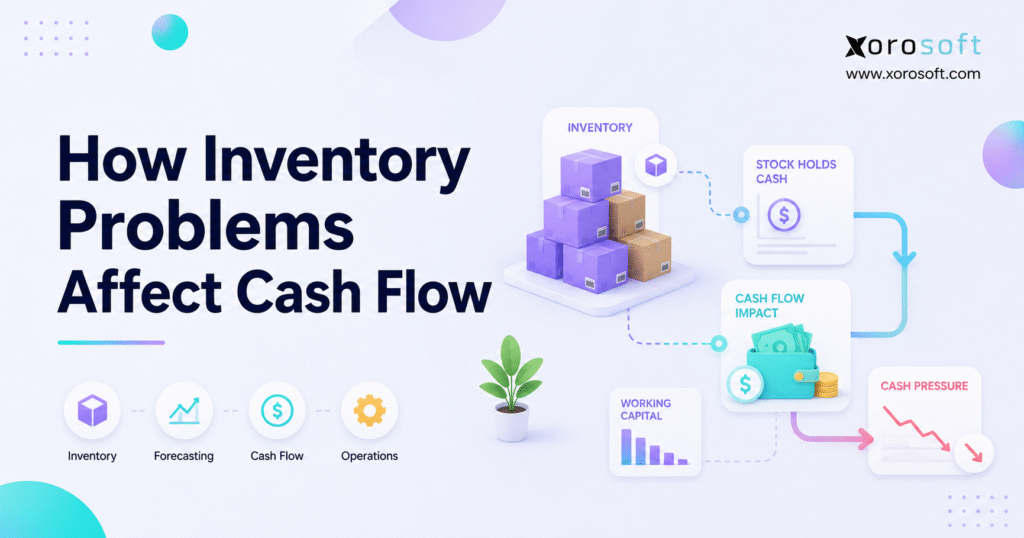
Understanding inventory cash flow is essential for managing your business finances effectively.
1. The Cash Hidden Inside Your Stock
Inventory cash flow problems often start quietly. A business buys stock, receives it, stores it, sells it, and waits for cash to return. On paper, that looks simple. In reality, every inventory decision affects how much cash the business has available for payroll, purchasing, marketing, supplier payments, rent, debt, and growth.
Stock is not just product sitting in a warehouse. It is money that has already left the bank.
A company may be profitable and still feel cash-poor if too much money is trapped in unsold inventory. Another business may show strong demand but still struggle because bestsellers keep going out of stock. In both cases, inventory becomes more than an operations issue. It becomes a working capital issue.
That is why inventory cash flow matters so much for ecommerce brands, wholesalers, manufacturers, distributors, and retailers. The faster inventory turns into profitable sales, the stronger the cash position usually becomes. However, when stock sits too long, sells out too often, gets miscounted, or moves through disconnected systems, cash starts leaking from the business.
Strong operators do not look at inventory only as units. They look at inventory as cash in motion.
2. What Inventory Cash Flow Means
2.1 The Basic Definition
Inventory cash flow is the relationship between inventory activity and available cash.
It includes the cash spent on purchasing products, shipping goods, receiving stock, storing inventory, fulfilling orders, handling returns, and replacing sold items. Cash leaves the business before inventory creates revenue. That timing gap creates pressure.
A healthy inventory cash flow cycle looks like this:
1. Buy the right stock.
2. Receive inventory accurately.
3. Store products efficiently.
4. Convert stock into orders.
5. Fulfill sales correctly.
6. Collect customer payments.
7. Reinvest cash into the next cycle.
When the cycle works, inventory supports growth. Once it breaks, stock becomes a cash trap.
2.2 Why Inventory Uses Cash Before It Creates Revenue
Inventory usually requires cash before it creates cash.
A business may pay suppliers weeks or months before the product sells. Freight, duty, storage, packaging, labor, and warehouse handling also add cost before revenue arrives. Even when suppliers offer payment terms, the business still commits future cash to inventory.
This is why fast-growing brands can run into cash pressure even when sales are increasing.
More sales often require larger purchase orders. Bigger purchase orders require more working capital. If inventory does not turn quickly enough, the business may need more cash just to keep operating.
2.3 Why Inventory Is Not the Same as Cash
Inventory is usually treated as a current asset, but that does not make it liquid.
Cash can pay a supplier today. Inventory cannot. Stock must be sold, shipped, and paid for before it turns back into usable cash. Until that happens, the business carries risk.
Some products sell quickly. Others need markdowns. A few may never sell at full value. This is why inventory quality matters as much as inventory quantity.
A warehouse full of the wrong products is not a strong asset. It is delayed cash recovery.
3. Common Inventory Problems That Drain Cash
3.1 Overstock
Overstock happens when a business carries more inventory than it can sell within a reasonable period.
The financial impact is immediate. Cash has already been spent, but revenue has not returned. Meanwhile, the business still pays for storage, labor, insurance, handling, utilities, and warehouse space.
Overstock also increases the risk of markdowns. If products sit too long, the business may discount them to recover cash. That can protect liquidity in the short term, but it weakens margin.
For example, an apparel brand may buy too many seasonal items before demand is proven. Once the season passes, those products may only move through promotions. Cash comes back, but less than planned.
3.2 Stockouts
Stockouts hurt cash flow in a different way.
Instead of cash being trapped in too much inventory, revenue is lost because the business cannot sell what customers want. A stockout may also create backorders, split shipments, customer service tickets, emergency freight, and lost repeat purchases.
Operators sometimes treat stockouts as a sales problem. That view is too narrow.
A stockout is also a cash conversion problem. Demand exists, but the business cannot convert that demand into cash.
3.3 Dead Stock
Dead stock is inventory that no longer sells.
It may be outdated, damaged, discontinued, seasonal, incorrectly forecasted, or tied to a product launch that failed. Since the business already paid for it, dead stock becomes cash locked inside products that may never recover their original value.
The business may liquidate, bundle, donate, return, or write off the stock. Each option has a cost.
Dead stock also blocks space that could support faster-moving products. As a result, the business loses cash twice: once through the original purchase and again through missed opportunity.
3.4 Slow-Moving Inventory
Slow-moving inventory is not always dead. Still, it can be dangerous.
A product may sell eventually, but if it takes nine months instead of three, cash remains tied up far longer than expected. That delay affects supplier payments, replenishment planning, advertising budgets, and new product launches.
Slow-moving stock is especially painful for businesses with seasonal demand, bulky products, size and color variants, or perishable goods.
3.5 Inaccurate Inventory Counts
Inventory accuracy problems create bad decisions.
If the system says 500 units are available but the warehouse has 350, sales teams may oversell and buyers may delay replenishment. When the system says 100 units are available but the warehouse has 250, purchasing may reorder too early.
Both situations hurt inventory cash flow.
Wrong counts also create accounting problems. Finance teams depend on reliable inventory valuation. If stock numbers are wrong, cost of goods sold, gross margin, and month-end reporting become harder to trust.
3.6 Poor Forecasting
Poor forecasting creates both overstock and stockouts.
When demand is overestimated, the business buys too much. Demand that is underestimated creates the opposite problem: stock runs out before customers stop buying. Either mistake affects cash.
Forecasting should not rely only on last month’s sales. Strong planning also considers seasonality, promotions, supplier lead times, channel mix, open orders, returns, and warehouse availability.
A forecast is not perfect prediction. It is a better operating signal.
3.7 Disconnected Purchasing Data
Purchasing decisions control when cash leaves the business.
If buyers rely on spreadsheets, email threads, outdated reports, or disconnected apps, they may not see true stock availability. Open purchase orders, committed inventory, inbound shipments, supplier delays, and sales velocity may all live in separate places.
That creates expensive decisions.
Teams may buy too early, too late, or too much. In each case, inventory cash flow becomes harder to control.
3.8 Multi-Warehouse Visibility Gaps
Multi-warehouse operations add another layer of cash pressure.
A company may have enough inventory overall but not enough in the right location. One warehouse may be overstocked while another location runs out. Teams may place duplicate purchase orders because they cannot see available stock across facilities.
Transfers also create cost. If stock keeps moving between warehouses to correct planning errors, the business pays for labor, freight, and delay.
More locations can support growth, but only when visibility improves with complexity.
4. How Inventory Problems Affect Financial Performance
4.1 Operating Cash Flow Gets Tighter
Inventory problems reduce operating cash flow because cash leaves before inventory converts into sales.
Rising inventory is not always bad. A business needs stock to grow. However, if inventory grows faster than demand, liquidity weakens.
Operators should ask:
1. Which SKUs hold the most cash?
2. Slow-moving products deserve immediate review.
3. Bestsellers that keep stocking out need tighter replenishment.
4. Warehouse-level excess should be checked before new purchase orders are approved.
5. Purchase orders should match real demand, not outdated forecasts.
6. Discount-heavy products need margin and cash flow review.
These questions connect inventory decisions directly to cash.
4.2 Carrying Costs Increase
Inventory costs do not stop after purchase.
A product sitting in the warehouse continues to consume money through rent, labor, insurance, shrinkage, damage, utilities, equipment, and handling. The longer it sits, the more expensive it becomes.
A high-margin product can still become a weak cash investment if it moves too slowly.
This is why inventory turnover and carrying cost should be reviewed together. One shows movement. The other shows the cost of waiting.
4.3 Gross Margins Decline
Inventory problems often show up in gross margin.
Overstock leads to markdowns. Stockouts lead to emergency freight. Warehouse mistakes lead to replacement shipments. Poor forecasting creates rush purchasing. Returns add inspection, restocking, repackaging, or disposal costs.
Margins shrink when inventory decisions become reactive.
A business may still grow revenue while quietly losing margin because stock is being bought, moved, stored, and cleared inefficiently.
4.4 Supplier Payments Become Harder
Cash tied up in inventory can create supplier pressure.
If slow-moving stock delays cash recovery, the business may struggle to pay vendors on time. Suppliers may respond by reducing credit limits, shortening terms, delaying shipments, or requiring deposits.
That makes the next buying cycle harder.
Better inventory cash flow improves more than bank balance. It can improve supplier relationships and purchasing flexibility.
4.5 Month-End Close Takes Longer
Inventory issues often become visible during month-end close.
Finance teams may need to reconcile stock adjustments, purchase receipts, vendor bills, landed costs, returns, transfers, and warehouse discrepancies. When systems are disconnected, this work becomes manual.
Delayed close creates delayed decisions.
Leaders cannot fix cash flow problems quickly if the numbers arrive weeks late.
5. Industry Examples of Inventory Cash Flow Problems
5.1 Ecommerce Brands
Ecommerce brands often feel the problem during growth.
Ad campaigns create demand spikes. Promotions pull inventory forward. Returns come back after revenue is recognized. Bestsellers sell out faster than expected. Slow movers sit in storage while the team keeps buying more products for the next campaign.
Revenue may look strong, but cash can still feel tight.
The cause is usually not one bad decision. It is a chain of small inventory decisions that compound.
5.2 Shopify Merchants
Shopify merchants can scale sales quickly, but backend operations need to keep up.
The storefront may be clean. Orders may flow smoothly. Yet inventory, purchasing, warehouse management, accounting, and fulfillment may still run across disconnected tools.
That gap becomes expensive as order volume increases.
Xorosoft is also listed on the Shopify App Store, which is useful for Shopify merchants evaluating ERP support behind their ecommerce operations.
5.3 Wholesale Distributors
Wholesale distributors face cash flow pressure from bulk buying, customer-specific demand, EDI requirements, allocation rules, and payment terms.
A large customer may reserve stock before payment arrives. Another customer may require special inventory. Suppliers may require bigger commitments to maintain pricing.
Without strong visibility, wholesale businesses can carry too much inventory while still disappointing customers.
5.4 Manufacturers
Manufacturers have inventory cash flow tied across raw materials, components, work-in-progress, and finished goods.
A missing component can delay production. Excess raw material can trap cash before finished goods are ready to sell. Inaccurate BOMs can cause unexpected purchasing needs.
Manufacturing teams need inventory control across production planning, purchasing, warehouse activity, and finance.
5.5 Apparel, Furniture, Food, and Sporting Goods
Inventory cash flow looks different by industry.
| Industry | Common Cash Problem | Operational Cause | Better Control Area |
|---|---|---|---|
| Apparel | Cash trapped in variants | Size, color, and seasonal complexity | Forecasting and allocation |
| Furniture | High storage cost | Bulky products and long lead times | Warehouse planning |
| Food | Spoilage and expiry | Shelf-life and lot tracking needs | Batch visibility |
| Sporting goods | Seasonal cash swings | Promotional cycles and demand spikes | Reorder planning |
| Wholesale | Large purchase commitments | Customer-specific demand | Purchasing visibility |
| Manufacturing | Cash tied in WIP | BOM and production planning gaps | MRP and work orders |
Businesses can also review the industries we serve page when mapping inventory challenges by business model.
6. KPIs That Reveal Inventory Cash Flow Problems
6.1 Turnover Ratio
Turnover ratio shows how often stock sells and gets replaced during a period.
Low turnover may mean too much inventory, weak demand, poor purchasing, or slow-moving SKUs. Very high turnover may look good, but it can also signal stockout risk if replenishment is not keeping up.
The goal is not always maximum turnover. The goal is profitable turnover.
6.2 Days Inventory Outstanding
Days Inventory Outstanding shows how long inventory sits before sale.
Higher DIO means cash stays in stock longer. Lower DIO usually means products convert into sales faster. However, if DIO drops too low, customers may face stockouts.
Operators should review DIO by product category, warehouse, vendor, and sales channel.
6.3 Carrying Cost
Carrying cost shows how much it costs to hold inventory.
This includes storage, labor, shrinkage, insurance, damage, obsolescence, and capital cost. Products with high carrying cost need tighter review because they drain cash while waiting to sell.
Bulky, seasonal, fragile, perishable, and expensive products deserve special attention.
6.4 Stockout Rate
Stockout rate shows how often customers cannot buy available-demand products.
A rising stockout rate usually means replenishment, forecasting, supplier planning, or warehouse visibility is failing. Since stockouts block revenue, this KPI should be reviewed by sales and operations together.
Every stockout has a cash impact.
6.5 Forecast Accuracy
Forecast accuracy measures how close expected demand is to actual demand.
Weak forecasts create poor buying decisions. Stronger forecasts help teams plan purchase orders, safety stock, supplier commitments, and warehouse capacity.
Forecast accuracy should improve over time as the business collects better data.
6.6 Inventory Accuracy
Inventory accuracy compares system stock to physical stock.
If accuracy is low, every decision becomes less reliable. Sales may oversell. Buyers may reorder too early. Finance may question valuation. Warehouse teams may waste time searching for stock that does not exist.
Xorosoft’s XoroWMS can support inventory-driven businesses that need warehouse workflows such as receiving, picking, stock movement, transfers, and cycle counts connected to broader inventory control.
6.7 Cash Conversion Cycle
The cash conversion cycle shows how long it takes to turn inventory investment into cash.
Inventory is one part of that cycle. Receivables and supplier payment terms also matter. Still, for product businesses, inventory is often the biggest lever.
| KPI | What It Shows | Cash Flow Warning |
| Inventory turnover | How often stock sells | Slow movement |
| Days Inventory Outstanding | How long stock sits | Cash trapped too long |
| Carrying cost | Cost of holding stock | Margin pressure |
| Stockout rate | Lost availability | Missed revenue |
| Forecast accuracy | Planning quality | Wrong purchase orders |
| Inventory accuracy | System reliability | Bad decisions |
| Cash conversion cycle | Time from cash out to cash in | Liquidity pressure |
7. Why Spreadsheets and Basic Inventory Apps Break Cash Flow Visibility
7.1 Manual Updates Create Delayed Decisions
Spreadsheets are useful for analysis. They are risky as the operating system.
At a small scale, a spreadsheet may track SKUs, vendors, reorder points, and sales history. As the business grows, manual updates fall behind reality. The warehouse moves faster than the file.
Delayed data leads to delayed decisions.
A buyer may place a purchase order using yesterday’s numbers. Finance may close the month with outdated inventory value. Operations may discover stockouts after customers already ordered.
7.2 Inventory and Accounting Split Apart
Inventory and accounting cannot stay disconnected forever.
When stock data lives in one system and financial data lives in another, teams spend time reconciling instead of deciding. Purchase orders, vendor bills, landed costs, receipts, transfers, adjustments, and cost of goods sold all need to connect.
Xorosoft’s XoroERP is relevant for businesses that need inventory, accounting, purchasing, warehouse management, and reporting to work from one connected system.
Businesses still running operations through QuickBooks and spreadsheets can also review the Xorosoft vs QuickBooks comparison when evaluating whether their current setup can support inventory complexity.
7.3 Purchasing Becomes Reactive
Purchasing becomes reactive when buyers lack real-time data.
They may not know what is on hand, what is committed, what is inbound, what is delayed, or what is already on purchase order. Without that visibility, replenishment becomes guesswork.
Guesswork is expensive.
It creates excess stock in slow SKUs and stockouts in fast SKUs.
7.4 Reporting Arrives Too Late
Inventory cash flow needs timely reporting.
If reports are built manually after problems happen, leaders cannot act early. By the time overstock appears in a spreadsheet, the purchase order has already consumed cash. Once a stockout appears in a sales report, revenue has already been lost.
Better reporting does not just describe the past. It helps operators make faster decisions.
8. How Better Inventory Management Improves Cash Flow
8.1 Better Demand Planning
Demand planning helps teams buy closer to actual need.
It should include sales history, seasonality, promotions, supplier lead times, open sales orders, channel performance, returns, and warehouse availability. When planning improves, purchasing becomes more disciplined.
Better demand planning reduces two expensive problems: too much of what does not sell and too little of what customers want.
8.2 Smarter Reorder Points
Reorder points should not stay fixed forever.
Demand changes. Supplier reliability changes. Lead times change. Promotions change. A reorder point that worked last year may create overstock or stockouts today.
Operators should review reorder points regularly and adjust them by SKU, vendor, warehouse, and season.
8.3 Cleaner Purchasing Workflows
Purchasing should connect to demand, stock, open orders, and supplier terms.
A cleaner purchasing workflow includes approved vendors, purchase approvals, open PO visibility, supplier lead times, receipt tracking, and exception reporting.
When purchasing improves, cash leaves the business with more intention.
8.4 Real-Time Warehouse Visibility
Warehouse visibility improves inventory cash flow because it reduces the gap between system stock and physical stock.
Teams need to know where inventory is located, how much is available, what is committed, what is damaged, and what is ready to sell. Without that visibility, businesses often buy more stock than needed.
A connected operating layer such as XoroONE can help inventory-driven businesses bring inventory, warehouse, purchasing, accounting, and reporting workflows closer together.
8.5 Better Inventory Accounting
Inventory accounting gives finance teams confidence in margins and valuation.
When receiving, purchasing, landed costs, stock adjustments, and cost of goods sold connect properly, month-end close becomes cleaner. Leadership can see which products consume cash and which ones generate strong returns.
Cash decisions improve when finance and operations trust the same numbers.
9. When Inventory Cash Flow Becomes an ERP Problem
9.1 Signs Your Current System Is No Longer Enough
Inventory cash flow becomes an ERP problem when the business can no longer manage complexity through disconnected tools.
Warning signs include:
1. Inventory and accounting rarely match.
2. Purchase orders are built in spreadsheets.
3. Month-end close takes too long.
4. Stockouts happen despite high inventory levels.
5. Teams cannot see inventory across warehouses.
6. Shopify, Amazon, wholesale, and EDI orders do not sync cleanly.
7. Finance cannot trust inventory valuation.
8. Forecasting requires manual exports.
9. Warehouse adjustments are hard to explain.
10. Leadership lacks real-time reporting.
These problems usually point to a system gap, not just a process gap.
9.2 ERP vs Inventory-Only Software
Inventory-only tools may help track stock, but they may not solve the complete cash flow problem.
Inventory cash flow depends on more than quantity on hand. Purchasing, accounting, warehouse activity, forecasting, sales channels, and reporting all affect cash.
| Requirement | Inventory-Only Software | ERP System |
| Stock tracking | Usually available | Available |
| Purchasing | Often limited | Integrated |
| Accounting | Usually separate | Connected |
| Warehouse workflows | May need another app | Integrated |
| Manufacturing | Often limited | Supported in ERP workflows |
| Forecasting | Varies | Connected to planning |
| Cash visibility | Partial | Stronger across operations and finance |
Businesses comparing inventory apps with ERP can review the Xorosoft vs Cin7 page when that comparison fits their evaluation.
9.3 ERP vs Disconnected Ecommerce Apps
Many ecommerce brands build their stack one app at a time.
One app handles inventory. Another handles shipping. A third handles purchasing. Accounting sits somewhere else. EDI may require another tool. Reporting becomes manual.
This setup works until the gaps become more expensive than the tools.
ERP becomes relevant when the business needs one system of record for inventory, purchasing, warehouse management, accounting, and reporting.
9.4 Who Does Not Need ERP Yet
Not every business needs ERP immediately.
A small company with simple inventory, one warehouse, limited SKUs, and clean accounting may only need better processes. A spreadsheet can still help with planning when order volume is low and complexity is manageable.
ERP becomes more useful when the cost of disconnected operations becomes visible through cash flow pressure, fulfillment issues, reconciliation delays, or poor reporting.
10. How ERP Helps Improve Inventory Cash Flow
10.1 Centralized Inventory Visibility
ERP helps by creating one source of truth.
Teams can see on-hand stock, available stock, committed stock, inbound purchase orders, transfers, returns, and warehouse-level inventory. This reduces unnecessary purchasing and helps prevent avoidable stockouts.
Visibility does not create cash by itself. It improves the decisions that protect cash.
10.2 Connected Purchasing and Forecasting
Purchasing should not happen in isolation.
Buyers need demand signals, supplier lead times, open order visibility, current stock, warehouse availability, and forecasted sales before committing cash. ERP connects these pieces so purchase decisions become more disciplined.
Xorosoft can support purchasing, forecasting, supplier management, and inventory planning for product businesses that need better control over replenishment and working capital.
10.3 Warehouse Management Built Into the Flow
Warehouse activity changes inventory every day.
Receiving, picking, packing, transfers, cycle counts, returns, and adjustments all affect stock accuracy. When warehouse workflows connect to inventory and accounting, cash flow visibility improves.
The warehouse is not separate from finance. It creates the data finance depends on.
10.4 Accounting and Operations in One System
Inventory cash flow sits between operations and finance.
If accounting cannot see accurate inventory value, cash planning becomes weaker. Operations also need visibility into purchasing commitments, replenishment timing, and warehouse movement. Without shared data, decision-making slows.
Modern ERP systems help teams manage this relationship through connected workflows.
You can also review broader ERP solutions when deciding which operational workflows need to be connected first.
10.5 Multi-Channel Control
Multi-channel businesses need stronger control because demand comes from many places.
Shopify, Amazon, wholesale, retail, EDI, and marketplace orders can all affect the same inventory pool. Without clear allocation and availability rules, businesses oversell, overbuy, or hold extra buffer stock.
Better multi-channel inventory control helps protect both customer experience and cash flow.
11. Common Mistakes That Make Inventory Cash Flow Worse
11.1 Buying More Stock to Hide Forecasting Issues
More stock does not fix poor forecasting.
If the forecast is wrong, buying more may only increase cash trapped in slow-moving products. Better planning starts with demand quality, supplier visibility, reorder rules, and SKU-level analysis.
A business should not use inventory volume to cover data weakness.
11.2 Treating Stockouts as Only Lost Sales
A stockout is more than a missed order.
It can damage customer trust, marketplace rankings, wholesale relationships, and repeat purchase behavior. It may also create rush freight, split shipments, and customer support costs.
Since stockouts block cash inflow, they belong in cash flow discussions.
11.3 Waiting Until Year-End to Review Dead Stock
Dead stock should be reviewed throughout the year.
Waiting until year-end reduces options. Earlier action can include discounts, bundles, transfers, supplier returns, liquidation, or production changes.
The sooner dead stock is identified, the more cash the business can recover.
11.4 Separating Finance From Operations
Finance cannot fix inventory cash flow alone.
Operations controls stock movement. Purchasing controls supplier commitments. Warehouse teams control accuracy. Sales channels create demand. Finance reports the outcome.
If these teams work from separate data, cash decisions suffer.
11.5 Choosing Tools That Solve Only One Workflow
A tool that fixes one workflow may still leave the cash problem unsolved.
An inventory app may track stock but not accounting. A shipping app may improve fulfillment but not purchasing. A spreadsheet may help planning but not execution.
Inventory cash flow improves when the operating system matches the complexity of the business.
12. Inventory Cash Flow Improvement Checklist
12.1 Audit Stock Accuracy
Start by checking whether system inventory matches physical inventory.
If the numbers do not match, purchasing, fulfillment, accounting, and reporting will all be affected. Use cycle counts, receiving checks, transfer reviews, and adjustment controls to improve accuracy.
12.2 Identify Slow-Moving Stock
Create a slow-moving inventory report by SKU, warehouse, category, and age.
Then decide whether to promote, transfer, bundle, return, liquidate, or discontinue each item. Slow-moving stock should not sit unnoticed.
12.3 Review Reorder Points
Reorder points should reflect current demand and supplier reality.
Update them when lead times change, sales velocity shifts, seasonality begins, or promotions are planned. Static reorder points create cash flow risk.
12.4 Connect Purchase Orders to Demand
Before approving purchase orders, review sales velocity, open orders, available stock, inbound shipments, supplier lead times, and forecasted demand.
This helps the business avoid buying based on instinct alone.
12.5 Track Cash Flow KPIs Monthly
Review inventory turnover, Days Inventory Outstanding, carrying cost, stockout rate, forecast accuracy, GMROI, inventory accuracy, and cash conversion cycle.
These KPIs show whether inventory is creating cash efficiency or cash pressure.
12.6 Review System Gaps
Recurring inventory cash flow problems often point to system gaps.
If spreadsheets, QuickBooks, inventory apps, warehouse tools, and ecommerce platforms all hold separate data, the business may need a more connected operating structure.
13. Frequently Asked Questions
13.1 How does inventory affect cash flow?
Stock affects cash flow because businesses usually spend money before products turn into revenue. Cash goes out through purchasing, freight, storage, labor, and warehouse handling. Payment comes back only after products sell, ship, and get paid for. When inventory moves quickly and profitably, it supports cash flow. Slow stock, stockouts, and miscounts create cash pressure.
13.2 Why does inventory tie up cash?
Products tie up cash because money has already been spent before sales happen. Although inventory appears as an asset, it cannot pay bills until it converts into collected revenue. The longer products stay in storage, the longer cash remains unavailable for suppliers, payroll, marketing, and growth.
13.3 Is inventory a cash flow problem?
Stock becomes a cash flow problem when the business holds too much of the wrong product, runs out of bestsellers, or cannot trust inventory data. Inventory itself is necessary for product businesses. Poor control, weak forecasting, disconnected purchasing, and slow movement create the real cash flow issue.
13.4 How does overstock affect cash flow?
Overstock affects cash flow by trapping working capital in unsold goods. The business has already paid for products but has not recovered that cash through sales. Extra stock also increases storage, labor, shrinkage, damage, and markdown risk. If products need heavy discounts, cash returns at a weaker margin.
13.5 How do stockouts affect cash flow?
Stockouts hurt cash flow because customers are ready to buy, but the business cannot fulfill demand. This creates missed revenue, backorders, rush purchasing, emergency freight, and lost customer trust. A stockout is not only an inventory issue. It is also a missed cash inflow.
13.6 What inventory problems hurt cash flow the most?
The most common inventory problems that hurt cash flow are overstock, stockouts, dead stock, slow-moving inventory, inaccurate counts, poor forecasting, disconnected purchasing, supplier delays, and weak warehouse visibility. These problems either trap cash in stock or prevent demand from turning into revenue.
13.7 How does dead stock affect cash flow?
Dead stock affects cash flow because the business has paid for inventory that may never sell at full value. It also takes up warehouse space and creates handling costs. Even when dead stock is liquidated, the business usually recovers less cash than expected.
13.8 How does slow-moving inventory affect working capital?
Slow-moving inventory weakens working capital because cash remains locked in products for longer than planned. A product may eventually sell, but the delay reduces liquidity. This can make it harder to pay suppliers, fund growth, buy new inventory, or respond to demand changes.
13.9 Why is excess inventory bad for business?
Excess inventory is bad because it increases storage costs, markdown risk, shrinkage, and cash pressure. Some buffer stock is useful, but too much stock reduces flexibility. Money sitting in slow inventory cannot be used for better opportunities.
13.10 How does inventory turnover affect cash flow?
Inventory turnover affects cash flow by showing how quickly stock sells and gets replaced. Faster turnover usually helps cash return sooner. Slower turnover means money stays tied up in inventory longer. However, turnover should be balanced with availability, because very low stock can create stockouts.
13.11 How can inventory management improve cash flow?
Inventory management improves cash flow by helping businesses buy more accurately, reduce overstock, avoid stockouts, improve warehouse accuracy, and identify slow-moving items earlier. Better inventory control also improves purchasing, accounting, forecasting, and reporting.
13.12 How does demand forecasting improve cash flow?
Demand forecasting improves cash flow by helping teams match purchasing with expected sales. Better forecasts reduce excess stock and prevent missed revenue from stockouts. Forecasting also helps suppliers, warehouse teams, and finance teams plan around realistic demand.
13.13 What is the relationship between inventory and working capital?
Inventory is part of working capital because it represents money invested in goods the business expects to sell. However, inventory is less flexible than cash. If products move slowly, working capital becomes less available. Strong inventory control helps keep cash moving through the business.
13.14 Does buying inventory reduce cash flow?
Buying inventory usually reduces cash flow in the short term because cash leaves the business before sales happen. This is normal when inventory sells quickly at healthy margins. It becomes a problem when products sit too long, require discounts, or create storage costs before cash returns.
13.15 Why does an increase in inventory reduce operating cash flow?
An increase in inventory can reduce operating cash flow because the business has spent money on goods that have not sold yet. Cash moves from the bank into stock. Until that inventory sells and payment is collected, the money is not available for other operating needs.
13.16 How does poor purchasing affect cash flow?
Poor purchasing affects cash flow by creating excess stock, missed replenishment, supplier rush costs, and weak payment timing. Purchase orders control when cash leaves the business. If buyers use incomplete or stale data, cash flow becomes harder to manage.
13.17 How do warehouse mistakes affect cash flow?
Warehouse mistakes affect cash flow through mispicks, lost stock, incorrect receipts, damaged goods, wrong transfers, and inaccurate counts. These errors can lead to refunds, replacement shipments, stockouts, overbuying, and accounting adjustments.
13.18 How can businesses reduce cash tied up in inventory?
Businesses can reduce cash tied up in inventory by improving forecast accuracy, reviewing slow-moving stock, adjusting reorder points, reducing excess safety stock, improving supplier visibility, and connecting purchasing decisions to real demand.
13.19 What KPIs show inventory cash flow problems?
Important KPIs include inventory turnover, Days Inventory Outstanding, carrying cost, stockout rate, forecast accuracy, GMROI, inventory accuracy, and cash conversion cycle. These metrics show whether inventory is turning into cash efficiently or creating financial pressure.
13.20 How does ERP help with inventory cash flow?
ERP helps with inventory cash flow by connecting inventory, purchasing, warehouse management, accounting, forecasting, and reporting. This gives teams better visibility into stock levels, purchase commitments, inventory value, supplier activity, and operational exceptions.
13.21 When should a business upgrade from spreadsheets?
A business should upgrade from spreadsheets when inventory counts become unreliable, purchase orders depend on manual updates, multiple warehouses are involved, accounting takes too long to reconcile, or teams cannot see real-time stock across channels.
13.22 How does Shopify inventory affect cash flow?
Shopify inventory affects cash flow because online sales, returns, stock sync, and multi-channel demand all influence how quickly products turn into cash. As Shopify merchants grow, backend inventory, purchasing, fulfillment, and accounting systems need to keep up.
13.23 How does multi-warehouse inventory affect cash flow?
Multi-warehouse inventory affects cash flow because stock may sit in the wrong location. One warehouse may be overstocked while another runs out. Without location-level visibility, businesses may overbuy, transfer too often, or carry more safety stock than needed.
13.24 How do purchase orders affect cash flow?
Purchase orders affect cash flow because they represent future cash commitments. Even before payment happens, open purchase orders show money that will leave the business soon. Teams should review purchase orders alongside demand, inventory, supplier terms, and cash position.
13.25 Can better inventory visibility improve cash flow?
Better inventory visibility can improve cash flow by reducing unnecessary purchases, preventing avoidable stockouts, improving warehouse accuracy, and helping teams act on slow-moving inventory earlier. Visibility improves the decisions that control cash.
14. Final Takeaway: Fix the Stock Before Cash Gets Tight
Inventory cash flow problems rarely come from one dramatic mistake.
More often, cash gets trapped through small operational gaps. A buyer orders too early. Forecasting misses demand. Warehouse counts drift away from reality. Bestsellers run out. Slow-moving SKUs stay untouched. Finance spends days reconciling numbers that should already match.
Over time, those gaps create real cash pressure.
The best operators treat inventory as a financial system, not just a warehouse function. They track stock movement, purchasing commitments, warehouse accuracy, supplier timing, margins, and working capital together.
For simple businesses, better process discipline may be enough. For growing product companies, especially those managing Shopify, Amazon, wholesale, EDI, manufacturing, or multiple warehouses, a connected ERP system may become necessary.
Xorosoft helps inventory-driven businesses connect inventory, purchasing, warehouse management, accounting, forecasting, and reporting in one cloud ERP environment. The goal is not to add another tool. The goal is to create cleaner visibility so teams can make better cash decisions.
When inventory problems start affecting cash flow, fulfillment, purchasing, or month-end close, it may be time to Book a demo and review where your operating system is creating friction.