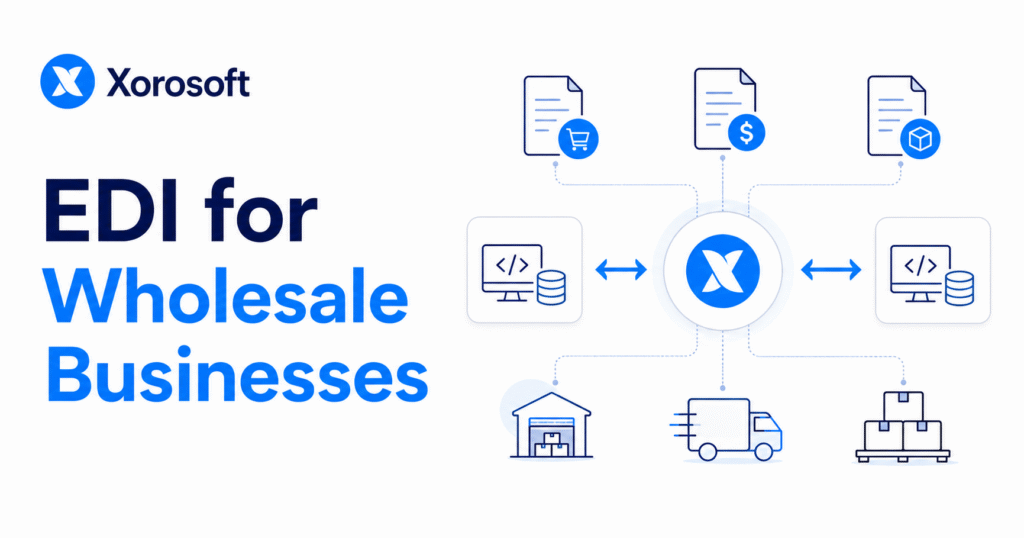
If you’re looking to streamline operations, EDI for wholesale businesses can provide a seamless way to manage transactions and communications.
1. Why EDI for Wholesale Businesses Matters for Growing Teams
EDI for wholesale businesses helps growing wholesalers exchange purchase orders, invoices, advance ship notices, and inventory updates with customers and trading partners without relying on manual data entry. As wholesale volume increases, this matters because every order, shipment, invoice, and stock update must move accurately between sales, warehouse, finance, and inventory teams.
At first, manual wholesale orders may feel manageable. A customer emails a purchase order, someone enters it into the system, the warehouse ships the goods, and finance sends an invoice. However, once more retailers, distributors, marketplaces, and B2B customers enter the workflow, that simple process becomes harder to control.
As a result, many wholesale teams start seeing the same problems. Orders get entered late. SKUs are copied incorrectly. Inventory does not update quickly enough. Shipments go out with missing details. Invoices do not always match purchase orders. Eventually, the team spends more time fixing the workflow than improving it.
That is where wholesale EDI becomes important. Instead of treating every order as a manual task, EDI gives wholesale businesses a structured way to exchange documents electronically. Therefore, the business can process more orders, reduce avoidable errors, and support larger trading partners with more confidence.
1.1 How Wholesale EDI Replaces Manual Order Entry
Wholesale EDI replaces manual order entry by moving structured order data directly between trading partner systems and internal business systems. Instead of copying information from emails, spreadsheets, portals, or PDFs, the data flows through a standardized document exchange.
For example, a retailer can send an electronic purchase order. Then, the wholesaler can acknowledge that order, prepare the shipment, send an advance ship notice, and issue an invoice. Because the data follows a structured format, the business depends less on people retyping the same information across multiple tools.
However, EDI does not remove the need for operational control. The business still needs clean item data, accurate inventory, correct customer pricing, strong warehouse processes, and reliable accounting workflows. Otherwise, EDI simply moves bad data faster.
1.2 Why Retailers and Trading Partners Require EDI for Wholesalers
Retailers and large trading partners often require EDI because they need consistent documents from every supplier. Without a standard process, each supplier would send purchase orders, invoices, shipping details, and product updates in a different format.
Because of that, EDI creates discipline. The retailer knows what was ordered. The supplier confirms what can be fulfilled. The warehouse communicates what shipped. Finance sends an invoice that can be matched against the order and shipment.
For wholesale businesses, this creates both opportunity and pressure. On one hand, EDI can help a supplier work with larger accounts. On the other hand, it also means the supplier must follow trading partner rules carefully.
1.3 Purchase Orders, Invoices, ASN, and Acknowledgments
The most common wholesale EDI workflow includes purchase orders, order acknowledgments, advance ship notices, and invoices. These documents are important because they connect the commercial promise to the physical shipment and financial transaction.
A purchase order starts the transaction. Next, the order acknowledgment confirms whether the supplier can fulfill it. After that, the advance ship notice tells the buyer what is shipping. Finally, the invoice requests payment.
Although these documents sound simple, they can create operational problems when inventory, warehouse, and accounting systems are disconnected.
1.4 EDI, Email Orders, Portals, and APIs
Email orders are easy to start with, but they are hard to scale. Portals add structure, but they still require teams to log in, download documents, upload responses, and check status manually. APIs can support real-time system connections, yet many retailers and wholesale trading partners still rely on EDI standards.
Therefore, the best approach is not always EDI versus API. In many wholesale businesses, EDI, APIs, ecommerce integrations, and ERP workflows all need to work together.
For a simple external explanation of EDI, you can reference IBM’s EDI overview.
2. How Wholesale EDI Works in Daily Operations
Wholesale EDI works by converting business documents into structured electronic messages. These messages move between buyers, suppliers, warehouses, logistics partners, and finance systems through an EDI provider, ERP connection, integration platform, or trading partner network.
Although the technology can look complicated, the business process is straightforward. A buyer sends an order. The supplier confirms the order. The warehouse ships the goods. Next, the supplier sends shipment details. Finally, finance sends the invoice, and the buyer validates the documents for payment.
2.1 The Standard Wholesale EDI Workflow
A standard wholesale EDI workflow usually follows this path:
1. Buyer sends an EDI 850 purchase order.
2. Supplier reviews availability, pricing, and fulfillment rules.
3. Supplier sends an EDI 855 purchase order acknowledgment.
4. Warehouse picks, packs, labels, and ships the order.
5. Supplier sends an EDI 856 advance ship notice.
6. Supplier sends an EDI 810 invoice.
7. Finance matches the purchase order, shipment, invoice, and payment.
This workflow works best when each step connects to the right internal system. Otherwise, teams may still need to copy data between EDI portals, inventory software, warehouse tools, and accounting systems.
2.2 EDI 850 Purchase Order
The EDI 850 purchase order tells the wholesaler what the buyer wants to purchase. It usually includes customer details, item numbers, quantities, pricing, shipping instructions, delivery dates, and purchase order references.
Because this document starts the order process, accuracy matters immediately. If the wrong SKU, quantity, or ship date enters the system, every downstream workflow becomes harder to manage.
2.3 EDI 855 Purchase Order Acknowledgment
The EDI 855 purchase order acknowledgment tells the buyer whether the supplier accepts the order as requested. It can also communicate changes, rejected items, backordered quantities, or revised delivery expectations.
This step is useful because it gives the buyer an early signal. Instead of discovering a problem after the shipment fails, the buyer receives confirmation before fulfillment begins.
2.4 EDI 856 Advance Ship Notice
The EDI 856 advance ship notice, often called ASN, tells the buyer what is being shipped before the shipment arrives. It may include carton details, carrier information, tracking numbers, item quantities, shipment hierarchy, and delivery information.
ASN accuracy is especially important in wholesale. If the ASN does not match the physical shipment, the customer’s receiving process slows down. In some cases, the supplier may also face deductions or compliance issues.
2.5 EDI 810 Invoice
The EDI 810 invoice requests payment after goods ship. It should match the purchase order, shipment, pricing, quantities, freight terms, and customer billing rules.
Therefore, invoice accuracy depends on connected data. If finance creates invoices from a separate accounting system while the warehouse ships from another tool, mismatches become more likely.
2.6 EDI 997 Functional Acknowledgment
The EDI 997 functional acknowledgment confirms that an EDI document was received at the technical level. However, it does not always mean the business content was accepted.
For example, a document may transmit successfully but still contain a pricing issue, missing field, or incorrect reference. Because of this, teams need exception reporting instead of assuming every sent document is correct.
3. Why EDI Automation Matters for Wholesale Businesses
Wholesale businesses use EDI automation because manual processes become fragile as order volume, customer count, SKU count, and fulfillment complexity increase. In addition, larger trading partners often expect suppliers to meet strict document and timing requirements.
3.1 Reducing Manual Order Entry with EDI Automation
Manual order entry creates unnecessary friction. Someone has to receive the order, read the document, enter the details, check inventory, confirm pricing, and send updates. As volume grows, that process becomes slow and error-prone.
With EDI order processing, routine documents move automatically. As a result, the team can spend less time copying data and more time managing exceptions, customer issues, inventory planning, and fulfillment performance.
3.2 Improving Order Accuracy
Wholesale order accuracy depends on clean data. Item numbers, customer SKUs, units of measure, prices, quantities, warehouse locations, and ship dates all need to match across systems.
EDI helps reduce mistakes because it removes repeated manual entry. However, it still needs strong master data. If product records or customer pricing are wrong, EDI will not magically correct them.
3.3 Meeting Retail EDI Compliance Requirements
Retail EDI compliance means following a trading partner’s document, labeling, shipment, invoice, and timing rules. These rules may vary by customer, which makes manual tracking difficult.
Therefore, wholesale businesses need a reliable process for customer-specific requirements. Otherwise, the team may ship correctly for one account but fail another account’s compliance rules.
3.4 Supporting Higher Order Volume Without More Admin Work
As wholesale order volume grows, teams often add more admin work before they add better systems. However, this approach eventually creates bottlenecks.
EDI automation helps the business process more orders without depending on more manual data entry. Meanwhile, the team can focus on service levels, stock availability, warehouse performance, and customer communication.
3.5 Improving Visibility Across Inventory, Fulfillment, and Accounting
EDI creates the most value when it connects order activity with inventory, fulfillment, and accounting. A purchase order should create demand. A shipment should reduce inventory. An invoice should connect to finance. In addition, exceptions should appear in reporting.
This is the point where many growing wholesalers start evaluating a connected operating system instead of using separate tools for every workflow.
4. Common EDI Documents for Wholesale Businesses
Wholesale teams do not need to become EDI technicians. However, they should understand the business purpose of the most common EDI documents.
| EDI Code | Document Name | Business Purpose | Main Team Affected |
|---|---|---|---|
| EDI 850 | Purchase Order | Starts the order process | Sales operations |
| EDI 855 | PO Acknowledgment | Confirms acceptance or changes | Customer service |
| EDI 856 | Advance Ship Notice | Communicates shipment details | Warehouse |
| EDI 810 | Invoice | Requests payment | Finance |
| EDI 846 | Inventory Inquiry or Advice | Shares inventory availability | Inventory planning |
| EDI 940 | Warehouse Shipping Order | Sends shipping instructions | Warehouse or 3PL |
| EDI 945 | Warehouse Shipping Advice | Confirms warehouse shipment | Operations |
| EDI 832 | Product Catalog | Shares item and price data | Product and sales teams |
| EDI 820 | Payment or Remittance Advice | Communicates payment details | Accounting |
4.1 EDI 850 Purchase Order for Wholesale Orders
The EDI 850 is usually the first document in the transaction. It should flow into sales order management with the correct customer, item, quantity, price, ship date, and delivery location.
If the team still enters this order manually, the business has not fully removed the operational risk.
4.2 EDI 855 Order Acknowledgment for Customer Confirmation
The EDI 855 confirms whether the order can be fulfilled as requested. It helps buyers understand availability, delivery changes, rejected lines, or partial acceptance.
Because this document sets expectations early, it reduces back-and-forth communication later.
4.3 EDI 856 ASN for Warehouse and Receiving Accuracy
The EDI 856 ASN connects warehouse execution with customer receiving. It tells the buyer what is coming before the goods arrive.
Therefore, the ASN should be generated from accurate shipment data, not from guesswork or delayed manual updates.
4.4 EDI 810 Invoice for Finance and Payment
The EDI 810 invoice should reflect the order and shipment. If quantities, prices, freight, or terms do not match, payment may be delayed.
For this reason, invoice data should come from the same operational workflow that handled the order and shipment.
4.5 EDI 846 Inventory Updates for Availability
The EDI 846 can communicate inventory availability to trading partners. However, it only works well when inventory is accurate.
If stock levels are outdated, customers may place orders based on availability that no longer exists.
4.6 EDI 940 and EDI 945 for Warehouse Communication
The EDI 940 sends warehouse shipping instructions, while the EDI 945 confirms what the warehouse shipped. These documents are especially useful when a 3PL handles fulfillment.
In addition, they help connect outsourced warehouse activity back to the main operating system.
5. EDI for Wholesale Inventory Management
EDI for wholesale inventory management matters because every customer order affects available stock. When order data sits in a separate portal or inbox, the business may not see demand quickly enough.
As a result, inventory availability can become unreliable. One system may show stock as available, while another system has already allocated it.
5.1 How EDI Impacts Available-to-Sell Inventory
Available-to-sell inventory should reflect current stock, allocated stock, open orders, backorders, incoming purchases, transfers, and warehouse constraints.
When EDI orders flow into inventory correctly, the business can make better fulfillment decisions. However, if EDI orders are delayed or entered manually, inventory visibility becomes weaker.
5.2 Inventory Allocation for Wholesale Customers
Wholesale customers often have different allocation rules. A major retailer may receive priority. A distributor may have reserved stock. An ecommerce channel may need separate safety inventory.
Therefore, the system behind EDI must support allocation logic. Without that control, the business may accept orders it cannot fulfill.
5.3 Multi-Warehouse Inventory Challenges
Multi-warehouse operations make wholesale EDI more complex. A customer may require shipment from a specific warehouse. Another customer may need consolidated shipments. Meanwhile, ecommerce orders may be pulling from the same inventory pool.
Because of this, EDI should connect to multi-warehouse inventory data instead of operating separately.
5.4 Preventing Overselling and Stockouts
Overselling often happens when sales channels do not share the same inventory truth. A wholesale customer places an order, Shopify sells the same item, Amazon demand increases, and the warehouse does not update stock quickly enough.
EDI can reduce this risk when it connects to inventory in real time. In addition, accurate receiving, cycle counting, transfers, and purchasing processes are still required.
5.5 Connecting Wholesale EDI with Forecasting and Replenishment
Wholesale EDI data can also support forecasting. Order history by customer, SKU, season, channel, and location can reveal demand patterns.
Therefore, EDI should not be viewed only as document exchange. When connected with planning, purchasing, and replenishment, it becomes a useful demand signal.
6. EDI and Warehouse Management for Wholesale Shipping
Warehouse execution determines whether EDI documents reflect reality. If the warehouse ships one thing and the EDI documents say another, the buyer receives conflicting information.
6.1 How EDI Affects Picking, Packing, and Shipping
When an EDI purchase order becomes a sales order, the warehouse must pick, pack, label, and ship according to customer requirements. This may include routing guides, carton labels, pallet rules, ship windows, carrier instructions, and packing details.
A connected warehouse workflow helps ensure the physical shipment matches the digital document.
6.2 Why ASN Accuracy Matters
ASN accuracy matters because buyers use advance ship notices to prepare receiving. If carton details, quantities, labels, or tracking numbers are wrong, receiving teams lose time.
As a result, the supplier may face disputes, delayed payment, or compliance penalties.
6.3 Barcode Labels, Carton Details, and Shipment Data
Wholesale EDI often requires carton-level detail. The warehouse needs to know what went into each carton, which carton belongs to which shipment, and how that shipment should be reported.
Because carton data changes during fulfillment, spreadsheets are usually weak for this workflow.
6.4 EDI Workflows for 3PL and Multi-Warehouse Operations
When a 3PL handles fulfillment, more systems and teams become involved. The wholesaler receives the order. The 3PL ships the product. Then, the shipment confirmation needs to flow back into the EDI and accounting process.
For that reason, 3PL workflows need strong integration. Otherwise, shipment confirmations, inventory updates, and ASNs can become delayed.
6.5 Reducing Chargebacks Through Better Warehouse Execution
Many EDI problems start in the warehouse. Late shipments, incorrect labels, wrong carton details, missing shipment data, and ASN mismatches can all create downstream costs.
Therefore, warehouse management should be part of the EDI strategy from the beginning. For companies reviewing warehouse workflows, XoroWMS is a relevant internal resource to link in this section.
7. EDI and Accounting Workflows
EDI also affects finance because invoices, payments, deductions, and reconciliation depend on accurate order and shipment data.
7.1 How EDI Invoices Connect to Accounting
The EDI 810 invoice should connect to accounting so finance does not recreate invoice data manually. Ideally, the invoice should use the same order, shipment, pricing, tax, freight, and customer terms already approved in the operating workflow.
As a result, finance can reduce duplicate work and improve invoice accuracy.
7.2 Matching Purchase Orders, Shipments, and Invoices
Wholesale finance teams often deal with matching problems. The buyer ordered one quantity. The warehouse shipped another. The invoice shows something different. Then, the payment arrives with a deduction.
Connected EDI helps reduce this because purchase orders, shipments, and invoices can share the same operational source of truth.
7.3 How EDI Reduces Reconciliation Work
EDI can reduce reconciliation work when invoices and remittance data connect to accounting. Finance teams can see what was ordered, shipped, invoiced, paid, deducted, or disputed.
However, if accounting lives in one tool and warehouse data lives in another, reconciliation remains difficult.
7.4 Why Disconnected EDI and Accounting Create Month-End Problems
Disconnected systems often create month-end delays. Finance has to ask operations what shipped. Operations has to ask the warehouse what was packed. The warehouse has to check shipping records. Then, finance has to correct invoices.
Because of this, EDI should connect to accounting and ERP workflows instead of sitting alone.
8. EDI ERP Integration for Wholesale Businesses
EDI ERP integration is where wholesale EDI becomes more powerful. Instead of treating EDI as a separate document tool, ERP connects EDI data with inventory, sales orders, warehouse activity, purchasing, accounting, and reporting.
8.1 Why EDI ERP Integration Should Not Sit Alone
Standalone EDI can send and receive documents. However, it may not solve the larger operational problem.
For example, an EDI purchase order may arrive correctly. Yet, if someone still has to create a sales order, allocate inventory, notify the warehouse, create an invoice, and update accounting manually, the business has not truly automated the workflow.
8.2 How ERP Becomes the System of Record for Wholesale EDI
ERP gives EDI documents operational context. The purchase order becomes a sales order. The sales order checks inventory. The warehouse fulfills the order. The shipment updates stock. Meanwhile, the invoice updates accounting and reports show exceptions.
For businesses reviewing a connected ERP layer, XoroERP is a useful internal link because this section discusses ERP as the system of record.
8.3 EDI, Inventory, Purchasing, WMS, and Accounting in One Workflow
A connected ERP workflow helps wholesale teams manage EDI alongside inventory, purchasing, warehouse management, accounting, forecasting, and reporting.
For example, XoroONE connects ecommerce, EDI, inventory, accounting, warehouse management, reporting, and integrations in one cloud ERP environment. Therefore, it fits naturally in this section without turning the article into a product pitch.
8.4 Questions to Ask Before Choosing an ERP with EDI Support
Before choosing an ERP or EDI-connected platform, wholesale operators should ask practical workflow questions:
- Can the system handle customer-specific wholesale pricing?
- Can it support multi-warehouse fulfillment?
- Can it connect EDI orders to inventory?
- Can warehouse shipment data trigger ASN workflows?
- Can invoices connect directly to accounting?
- Can the system support Shopify, Amazon, wholesale, and EDI together?
These questions matter because EDI is only one part of the operating model.
9. EDI, Shopify, Amazon, and Multi-Channel Wholesale
Many wholesalers no longer sell through only one channel. Instead, they sell through retail accounts, distributors, Shopify, Amazon, marketplaces, sales reps, and B2B customers.
Because of this, EDI must fit into a broader multi-channel strategy.
9.1 Why Shopify and Wholesale EDI Need the Same Inventory Truth
Shopify orders and EDI wholesale orders may pull from the same inventory. If both channels operate separately, the business can oversell.
Therefore, growing merchants need one inventory truth across ecommerce and wholesale. A business that uses Shopify and wholesale EDI should connect both workflows to inventory, warehouse, and accounting systems.
9.2 Where Shopify EDI and ERP Fit Together
If the article discusses Shopify merchants, the Xorosoft ERP Shopify App Store listing is a useful outbound link. It should appear once in this Shopify section, not repeatedly throughout the article.
This gives the page an outbound link while keeping the reader experience clean.
9.3 Amazon, Retailers, and Trading Partner Requirements
Amazon vendor workflows, retail accounts, and large distributors may each have different requirements. As a result, the business needs flexible order handling, accurate inventory, reliable warehouse processes, and clean invoice data.
Although each channel may have different rules, the internal operation should still run from one source of truth.
9.4 Why Multi-Channel Wholesale Needs Stronger Operations
Multi-channel wholesale adds complexity because every channel creates demand. Shopify orders, Amazon orders, EDI orders, B2B portal orders, and sales rep orders can all compete for the same stock.
Therefore, EDI for wholesale businesses should connect with inventory planning, allocation, warehouse execution, and accounting instead of running as a separate side process.
10. Retail EDI Compliance for Wholesale Suppliers
EDI compliance means following a trading partner’s rules for document formats, timing, fields, labels, shipment details, and invoice requirements. However, compliance is not only technical. It is operational.
10.1 What EDI Compliance Means
A supplier may send a technically valid EDI document and still fail the trading partner’s business rules. For example, an ASN may transmit successfully but include wrong carton data. Similarly, an invoice may be delivered on time but fail because pricing does not match the purchase order.
Therefore, teams need both technical validation and process control.
10.2 Common Retailer and Trading Partner Requirements
Common requirements include purchase order acknowledgment deadlines, ASN timing, carton labels, routing instructions, ship windows, invoice fields, product identifiers, and testing approval.
Because each customer may have different rules, wholesale teams should document requirements by trading partner.
10.3 EDI Testing and Mapping
EDI mapping defines how data fields move between the trading partner’s document and the internal system. Testing confirms that documents are accepted by the trading partner.
However, testing should involve more than IT. Operations, warehouse, finance, and customer service should review the workflow because they own the daily outcome.
10.4 Common EDI Chargeback Causes
| Cause | Example | Operational Root Cause | Prevention |
| Late ASN | Shipment arrives before ASN | Delayed warehouse confirmation | Trigger ASN from shipment |
| Incorrect labels | Carton label fails customer rule | Manual label process | Use label validation |
| Invoice mismatch | Invoice does not match purchase order | Pricing or quantity error | Connect order, shipment, and invoice |
| Missing fields | Required data is absent | Weak mapping | Build partner checklist |
| Wrong shipment data | ASN differs from carton contents | Packing error | Use scan-based packing |
10.5 Building an EDI Compliance Checklist
A strong EDI compliance checklist should include the trading partner name, required documents, required fields, timing rules, label rules, carton rules, routing requirements, testing status, internal owner, and exception process.
In addition, the checklist should live where operations can actually use it. If it sits in a forgotten spreadsheet, teams will still rely on memory.
11. EDI Implementation for Wholesale Businesses
EDI implementation should follow the business workflow, not just the technical connection. Otherwise, the system may send documents while the team still handles operations manually.
11.1 Step 1: Identify Trading Partner Requirements
Start by listing every customer or trading partner that requires EDI. Then, document required transaction types, testing rules, labeling rules, timing requirements, and compliance expectations.
This step matters because assumptions create expensive mistakes later.
11.2 Step 2: Map Required EDI Documents
Next, map each EDI document to the internal workflow. For example, an EDI 850 should create a sales order. An EDI 856 should come from shipment confirmation. An EDI 810 should come from invoice data.
As a result, the implementation becomes operational instead of purely technical.
11.3 Connect EDI to ERP, Inventory, WMS, and Accounting
This is the most important step. If EDI connects only to a portal, the team may still manage inventory, shipping, invoices, and reporting manually.
A better setup connects EDI to ERP, inventory, warehouse management, purchasing, accounting, and reporting. For companies comparing operating-system options, the Xorosoft ERP solutions page is a useful internal link here.
11.4 Step 4: Test Data Accuracy
Testing should include real SKUs, real customer item numbers, real pricing, real ship-to locations, real warehouse scenarios, partial shipments, backorders, substitutions, and invoice rules.
Because wholesale workflows vary by customer, generic testing is not enough.
11.5 Step 5: Train Operations, Warehouse, and Finance Teams
EDI touches several teams. Sales operations needs to manage order exceptions. Warehouse teams need to understand labels and ASN timing. Finance needs to understand invoice matching and deductions.
Therefore, training should focus on real workflows rather than technical terminology only.
11.6 Step 6: Monitor Exceptions After Go-Live
After go-live, teams should monitor rejected documents, late acknowledgments, ASN errors, invoice mismatches, missing fields, and deduction patterns.
In addition, reporting should show where the problem started. Otherwise, teams may only see the issue after the customer complains.
12. Common Wholesale EDI Mistakes to Avoid
Wholesale EDI mistakes usually happen when teams focus on document exchange but ignore the operational process behind the documents.
12.1 Treating EDI as an IT Project Only
EDI is not only an IT project. It affects sales operations, inventory, warehouse, customer service, finance, and leadership.
Because of that, the right people need to be involved from the beginning.
12.2 Keeping EDI Separate from Inventory
If EDI orders do not update inventory, the business still lacks accurate availability. This can lead to overselling, backorders, and poor customer communication.
Therefore, inventory integration should be part of the EDI plan.
12.3 Sending ASN Data Too Late
Late ASN data can disrupt customer receiving. In many cases, the ASN should be triggered by warehouse shipment confirmation, not created manually after the order leaves.
This small timing issue can create large customer problems.
12.4 Ignoring Customer-Specific Rules
Each trading partner may have different EDI rules. A workflow that works for one customer may fail for another.
As a result, wholesale teams need customer-specific documentation and exception monitoring.
12.5 Relying on Manual Fixes Instead of Better Process Design
Many teams survive EDI by fixing errors manually. At first, this feels practical. However, over time, manual correction becomes the process.
That creates hidden labor, weak reporting, and inconsistent customer service.
12.6 Choosing Standalone EDI Without Planning for ERP Integration
Standalone EDI can be useful. However, it may not solve inventory, warehouse, accounting, purchasing, or reporting problems.
For businesses outgrowing disconnected tools, comparison resources such as Xorosoft vs QuickBooks and Xorosoft vs Cin7 fit naturally in this section because they relate to system limitations during growth.
13. Who Needs EDI and Who May Not Need It Yet
Not every wholesale business needs EDI immediately. However, many companies reach a point where manual processes can no longer support customer expectations.
13.1 Wholesale Businesses That Usually Need EDI
A wholesale business usually needs EDI when it sells to large retailers, distributors, marketplaces, department stores, grocery chains, national accounts, or trading partners with strict document requirements.
EDI is also useful when manual order entry causes delays, errors, or fulfillment pressure.
13.2 Businesses That Can Wait Before Implementing EDI
A business may not need EDI yet if it has low order volume, simple customer relationships, no trading partner requirements, and manageable manual workflows.
However, the business should still build clean item data, customer records, pricing rules, inventory control, and fulfillment processes early. These foundations make future EDI implementation easier.
13.3 Warning Signs That Manual Orders Are No Longer Enough
Warning signs include frequent order entry errors, late shipments, invoice disputes, inventory mismatches, customer chargebacks, portal fatigue, duplicate data entry, and weak reporting.
Another warning sign appears when the team depends on one person who “knows how the customer wants it.” That knowledge should live in systems and processes, not only in someone’s head.
14. EDI Use Cases by Wholesale Industry
EDI for wholesale businesses looks different across industries. However, the core problem is usually the same: customers expect accurate order, shipment, invoice, and inventory data.
For broader industry context, the Industries We Serve page can be linked here because this section discusses vertical-specific wholesale workflows.
14.1 Apparel and Fashion Wholesale
Apparel wholesalers often manage styles, colors, sizes, seasons, prebooks, allocations, and retailer requirements. Therefore, EDI helps standardize orders, ASNs, invoices, and item data across retail accounts.
14.2 Furniture Wholesale
Furniture wholesalers deal with bulky inventory, long lead times, freight coordination, and delivery expectations. As a result, EDI can help coordinate purchase orders, shipment notices, invoices, and warehouse instructions.
14.3 Sporting Goods Wholesale
Sporting goods businesses often handle seasonal demand, product variations, retailer programs, and multi-channel orders. EDI supports retailer workflows, while ERP helps manage inventory and replenishment.
14.4 Food and Beverage Wholesale
Food and beverage wholesalers may need lot tracking, expiration control, warehouse rotation, and retailer receiving rules. Therefore, EDI should connect with inventory and warehouse processes instead of standing alone.
14.5 Manufacturing and Industrial Distribution
Manufacturers and industrial distributors may use EDI for purchase orders, shipment notices, invoices, supplier communication, and warehouse documents. In addition, connected planning can support purchasing, material requirements, and production visibility.
15. Choosing Wholesale EDI Software or ERP with EDI Support
Wholesale businesses usually choose from four approaches: standalone EDI provider, ERP with EDI integration, managed EDI service, or EDI through a 3PL or middleware platform.
| Option | Best For | Strengths | Limitations |
| Standalone EDI Provider | Document exchange | Specialized EDI support | May not solve inventory or accounting gaps |
| ERP with EDI Integration | Connected operations | Centralized workflows | Requires operational setup |
| Managed EDI Service | Limited technical resources | Less technical burden | Less internal control |
| 3PL or Middleware EDI | Outsourced or complex fulfillment | Flexible connections | Can add system complexity |
15.1 Standalone EDI Provider
A standalone EDI provider can be useful when the business only needs document exchange and already has strong internal systems.
However, if inventory, warehouse, and accounting workflows are disconnected, standalone EDI may not solve the larger issue.
15.2 ERP with EDI Integration for Wholesale Businesses
ERP with EDI integration is often better when the business wants orders, inventory, warehouse, accounting, purchasing, forecasting, and reporting to work together.
Because wholesale EDI touches the entire operation, ERP integration can create stronger control than a separate EDI portal.
15.3 Managed EDI Service
Managed EDI can help companies that do not want to maintain technical mapping and trading partner setup internally.
However, even with managed EDI, the business still needs internal ownership of item data, pricing, inventory, warehouse execution, and invoice accuracy.
15.4 EDI Through 3PL or Integration Middleware
Some companies route EDI through a 3PL or middleware platform. This can work well when fulfillment is outsourced or when several systems must remain in place.
Still, the business needs clear visibility into orders, shipments, inventory, invoices, and exceptions.
15.5 Evaluation Checklist for Wholesale Operators
| Requirement | Why It Matters | Question to Ask |
| Inventory integration | Prevents overselling | Does EDI update availability? |
| WMS integration | Improves ASN accuracy | Does shipment data come from warehouse activity? |
| Accounting integration | Reduces reconciliation | Does invoice data connect to finance? |
| Multi-warehouse support | Supports complex fulfillment | Can orders route by warehouse? |
| Reporting | Surfaces problems | Can teams monitor exceptions? |
16. Final Readiness Checklist Before You Implement EDI
Before implementing EDI, wholesale businesses should review the operating foundation. This prevents technical setup from hiding process problems.
16.1 Trading Partner Requirements
List every trading partner that requires EDI. Then, document their required transaction types, formats, deadlines, labels, routing guides, and testing rules.
16.2 Document Requirements
Confirm whether each partner requires purchase orders, acknowledgments, ASNs, invoices, inventory updates, warehouse shipping orders, warehouse confirmations, product catalogs, or remittance documents.
16.3 ERP and Inventory Readiness
Check whether item records, customer records, pricing, units of measure, warehouses, allocations, and inventory balances are accurate.
If the foundation is weak, EDI will expose the problem quickly.
16.4 Warehouse Readiness
Review barcode scanning, pick-pack-ship workflows, carton labels, pallet rules, shipment confirmations, and ASN triggers.
Because warehouse data drives shipment accuracy, this section should not be skipped.
16.5 Finance and Accounting Readiness
Confirm invoice rules, payment terms, tax handling, freight charges, deductions, remittances, and reconciliation workflows.
In addition, finance should know how EDI documents affect month-end close.
16.6 Reporting and Exception Management
Set up reporting for rejected documents, late acknowledgments, ASN errors, invoice mismatches, deductions, and customer-specific compliance issues.
Without exception reporting, EDI issues can stay hidden until they become customer complaints.
17. FAQs About EDI for Wholesale Businesses
17.1 What is EDI for wholesale businesses?
EDI for wholesale businesses is the electronic exchange of standardized documents between wholesalers and trading partners. These documents often include purchase orders, order acknowledgments, advance ship notices, invoices, inventory updates, and payment information. Instead of manually entering orders from emails, PDFs, or portals, EDI allows systems to exchange structured data automatically.
17.2 How does EDI work in wholesale?
EDI works by converting business documents into standardized electronic messages. A buyer sends a purchase order, the supplier acknowledges it, the warehouse ships the order, the supplier sends an advance ship notice, and finance sends an invoice. The process works best when EDI connects to ERP, inventory, warehouse, and accounting systems.
17.3 Why do wholesale businesses need EDI?
Wholesale businesses need EDI when they sell to retailers, distributors, marketplaces, or trading partners that require structured document exchange. In addition, EDI helps reduce manual order entry, improve order accuracy, support higher order volume, meet compliance rules, and connect wholesale orders to inventory, fulfillment, and invoicing workflows.
17.4 What are the most common EDI documents for wholesalers?
Common EDI documents for wholesalers include EDI 850 purchase orders, EDI 855 purchase order acknowledgments, EDI 856 advance ship notices, EDI 810 invoices, EDI 846 inventory updates, EDI 940 warehouse shipping orders, EDI 945 warehouse shipping advice, EDI 832 product catalogs, and EDI 820 payment or remittance advice.
17.5 What is an EDI 850 purchase order?
An EDI 850 is an electronic purchase order sent by a buyer to a supplier. It usually includes item numbers, quantities, prices, ship-to locations, delivery dates, and purchase order references. In a connected workflow, the EDI 850 should create or update a sales order inside the wholesaler’s operating system.
17.6 What is an EDI 856 advance ship notice?
An EDI 856 advance ship notice tells the buyer what is being shipped before the shipment arrives. It may include carton details, product identifiers, tracking numbers, carrier information, quantities, and shipment hierarchy. ASN accuracy matters because buyers use this data to prepare receiving operations.
17.7 What is an EDI 810 invoice?
An EDI 810 is an electronic invoice. It requests payment for goods or services and should match the purchase order and shipment details. For wholesalers, the EDI 810 should connect to accounting so finance teams do not have to recreate invoice data manually.
17.8 What is EDI compliance?
EDI compliance means following a trading partner’s requirements for document formats, fields, timing, labels, shipment details, invoices, and testing. Compliance is both technical and operational. Therefore, a supplier must send the right documents in the right format at the right time with accurate business data.
17.9 What are EDI chargebacks?
EDI chargebacks are deductions or penalties that may happen when a supplier fails to meet a trading partner’s requirements. Common causes include late ASNs, incorrect labels, invoice mismatches, missing fields, late shipments, and inaccurate shipment data.
17.10 How does EDI connect to ERP?
EDI connects to ERP by sending EDI documents into the ERP workflow and receiving ERP data back for outbound documents. For example, an EDI 850 can become a sales order, warehouse shipment data can trigger an ASN, and invoice data can generate an EDI 810.
17.11 Can EDI connect with warehouse management software?
Yes. EDI can connect with warehouse management software so orders, shipping instructions, carton details, labels, shipment confirmations, and ASN data flow accurately. This is especially important for wholesalers that need carton-level details, barcode scanning, multi-warehouse fulfillment, or 3PL coordination.
17.12 Can EDI connect with accounting software?
Yes. EDI can connect with accounting software or ERP accounting modules so invoices, payment information, deductions, and remittance data can be processed more efficiently. However, accounting integration works best when order, shipment, pricing, and customer data are accurate before invoicing.
17.13 Can EDI work with Shopify?
Yes. EDI can work alongside Shopify when a business sells through ecommerce and wholesale trading partners. Shopify may handle ecommerce orders, while EDI handles retailer or distributor document exchange. Therefore, many growing merchants use ERP or integration platforms to centralize Shopify, EDI, inventory, warehouse, and accounting workflows.
17.14 What is the difference between EDI and API?
EDI is commonly used for standardized business document exchange between trading partners. APIs are commonly used for real-time data exchange between software systems. EDI is often required by retailers and distributors, while APIs are often used for ecommerce, inventory sync, and modern application integrations.
17.15 Do small wholesale businesses need EDI?
Small wholesale businesses may not need EDI immediately if they have low order volume and no trading partner requirements. However, they should prepare clean item data, customer records, pricing rules, inventory processes, and warehouse workflows early. These foundations make future EDI implementation easier.
17.16 When should a wholesale business implement EDI?
A wholesale business should consider EDI when retailers require it, order volume increases, manual entry causes errors, customers demand faster processing, or fulfillment and invoicing become difficult to manage manually. In addition, EDI becomes important when the business wants to support larger retail or distribution relationships.
17.17 What are common EDI implementation mistakes?
Common mistakes include treating EDI as only an IT project, failing to involve operations and finance, ignoring warehouse workflows, keeping EDI separate from inventory, skipping realistic testing, underestimating trading partner rules, and relying on manual fixes after go-live.
17.18 Should EDI be separate from ERP?
EDI can be separate technically, but it should not be separate operationally. If EDI documents do not connect to ERP, inventory, warehouse, and accounting workflows, teams may still rely on manual entry and reconciliation. Therefore, the strongest setup connects EDI to the system of record.
18. Conclusion: Build an EDI Workflow That Can Actually Scale
EDI for wholesale businesses is not just a technical requirement. It is an operating discipline that affects orders, inventory, warehouse execution, customer compliance, invoices, and reporting.
At a basic level, EDI helps wholesalers exchange purchase orders, acknowledgments, advance ship notices, invoices, inventory updates, and warehouse documents. However, the bigger value appears when EDI connects to the rest of the business.
If EDI sits alone, teams may still copy data, fix order errors, chase warehouse updates, and reconcile invoices manually. In contrast, when EDI connects to ERP, inventory, warehouse management, purchasing, accounting, and reporting, the business gains a stronger operating foundation.
For growing wholesale teams, the goal should not be only to “add EDI.” Instead, the goal should be to build an order-to-cash workflow that can support more customers, more channels, more warehouses, and more complexity without adding more manual work.
To see how a connected ERP can support wholesale EDI, inventory, warehouse, purchasing, accounting, and reporting workflows, Book a demo.
Recent Posts
-
 Best AI Warehouse Management Software for ERP Inventory and Warehouse Operations
 -
 Project Based ERP Software for Managing Project Costs, Purchasing, Resources, Inventory, and Accounting
 -
 Food and Beverage ERP Requirements for Lot, Expiry, and Recall Control
 -
 How to Prevent EDI Errors Before They Become Retailer Chargebacks
 -
 Warehouse Injury and Safety Statistics: What Operations Teams Should Know Before Automating Workflows