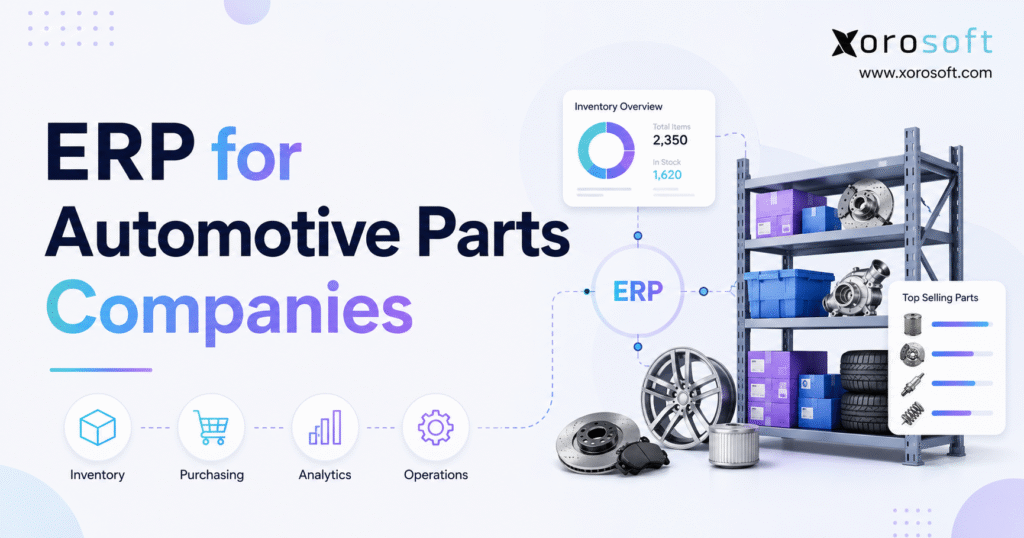
For businesses in need of efficient supply chain management, automotive parts distribution ERP solutions can streamline operations and boost productivity.
1. Disconnected Systems Create Expensive Automotive Parts Problems
Automotive parts distribution ERP becomes relevant when product, inventory, purchasing, warehouse and financial data no longer move reliably between departments.
Initially, a growing automotive distributor may operate with several focused applications. Shopify may handle ecommerce orders, accounting software may maintain the general ledger, spreadsheets may guide purchasing, and a separate warehouse system may support fulfillment. Meanwhile, wholesale transactions may arrive through an EDI provider, while vehicle-fitment information remains in a specialized automotive catalog platform.
Although each application may perform its individual task, the gaps between them gradually create operational risk.
For example, an ecommerce store may display inventory that has already been allocated to a wholesale account. At the same time, purchasing may reorder the same product without seeing inventory moving between warehouses. Consequently, finance may discover discrepancies during month-end close rather than when the original transaction occurs.
Automotive operations make these disconnects especially expensive. Parts businesses often manage thousands of SKUs, vehicle-fitment relationships, alternate part numbers, superseded products, customer-specific pricing, long supplier lead times and several warehouse locations.
In addition, manufacturers and remanufacturers face another layer of complexity. They must manage bills of materials, component availability, production schedules, returned cores, work orders and finished-goods costs alongside sales and distribution.
Although individual applications may remain useful, automotive parts distribution ERP provides the shared operating layer needed to coordinate transactions across those systems.
Therefore, the purpose of automotive ERP is not merely to automate isolated activities. Instead, it creates a consistent record of quantities, purchasing commitments, warehouse movements, customer orders and financial transactions. As a result, purchasing, fulfillment and finance can work from the same version of the business.
2. What Automotive Parts ERP Software Actually Manages
At its core, automotive parts distribution ERP connects product records, supplier purchasing, inventory, order fulfillment, ecommerce and accounting in one controlled environment.
Initially, companies may adopt separate applications to solve individual problems. For instance, an inventory tool may track stock, while accounting software maintains the books. Meanwhile, warehouse employees may rely on another application for receiving and fulfillment.
However, this structure becomes difficult to manage as transaction volume and operational complexity increase. Therefore, ERP brings those activities into a shared environment.
A complete automotive ERP system may manage:
- Product and part records
- Supplier purchasing
- Inventory availability
- Warehouse receiving
- Putaway and bin control
- Order allocation
- Picking, packing and shipping
- Wholesale sales orders
- Customer-specific pricing
- Ecommerce transactions
- EDI documents
- Bills of materials
- Work orders
- Core returns
- Warranty claims
- Inventory valuation
- Accounts payable
- Accounts receivable
- Financial reporting
- Demand forecasting
Nevertheless, the most important distinction is not the number of modules. Rather, it is how those modules exchange information.
For example, when a warehouse receives a purchase order, inventory should increase in the correct location. At the same time, the related financial liability should be recorded.
Similarly, once a customer order ships, stock should decrease, order status should update, cost of goods sold should be recognized and the customer invoice should be created.
As a result, operations and finance can see what happened, when it happened and how it affected the business.
2.1 How Automotive ERP Differs From General Business Software
General ERP platforms can manage accounting, inventory, sales and purchasing. Nevertheless, automotive parts companies often require additional data structures and operational controls.
These requirements may include:
- Vehicle fitment
- Year, make and model relationships
- Internal and supplier part numbers
- OEM and competitor cross-references
- Alternate products
- Product supersessions
- Core deposits
- Warranty eligibility
- Recall traceability
- Long-tail demand planning
- High-SKU warehouse operations
- Automotive catalog integrations
Not every ERP manages enriched automotive catalog information directly. In many environments, a product information management system or specialized catalog platform works alongside ERP.
For instance, a PIM may own descriptions, images, attributes and fitment data. By contrast, ERP may own inventory, cost, purchasing, customer orders, fulfillment and accounting.
In addition, automotive parts distribution ERP connects automotive-specific product structures with the purchasing, inventory and financial workflows used across the wider business.
Clear data ownership is essential. Otherwise, one system may overwrite reliable information from another, which can create duplicate records, inaccurate availability or inconsistent product details.
2.2 Which Automotive Parts Businesses Benefit From ERP
Companies operating multiple warehouses or serving wholesale and ecommerce customers may benefit from automotive parts distribution ERP earlier than operationally simpler businesses.
Common users include:
- Aftermarket parts distributors
- Automotive component manufacturers
- Remanufacturers
- Importers
- Private-label brands
- Performance-parts companies
- Multi-location wholesalers
- Ecommerce automotive retailers
- Businesses serving EDI customers
- Companies combining distribution and light manufacturing
Operational complexity usually matters more than company size.
For example, a relatively small distributor with 20,000 SKUs, three warehouses, several sales channels and contract pricing may need ERP earlier than a larger company with one warehouse and a straightforward catalog.
2.3 When a Full Automotive ERP System May Be Unnecessary
ERP is not automatically the right answer for every business.
For example, a small automotive parts seller may operate effectively with accounting and inventory software when it has:
- One warehouse
- A limited catalog
- One primary sales channel
- Straightforward purchasing
- No manufacturing
- No EDI requirements
- Minimal customer-specific pricing
- Reliable inventory data
In this situation, introducing a full ERP platform may create more cost and administrative discipline than the company currently needs.
However, that position can change as the business grows. For instance, a second warehouse may introduce transfer complexity, while a new wholesale channel may add contract pricing and EDI requirements.
Moreover, increasing SKU counts may make spreadsheet-based purchasing harder to control. Consequently, the business may spend more time reconciling systems than managing operations.
Therefore, ERP becomes more appropriate when disconnected processes create measurable costs through stockouts, excess inventory, delayed reporting, frequent adjustments or repeated manual work.
3. Automotive Parts Inventory Requires More Than Basic Stock Control
Automotive inventory is not simply a collection of products and quantities. Instead, each part may have several identifiers, compatibility rules, storage locations and demand patterns.
For instance, a brake component may vary by vehicle year, engine, trim or installation position. Moreover, the same physical item may be identified by an internal SKU, supplier number, OEM number, customer reference, barcode and marketplace listing ID.
When those relationships are not controlled consistently, duplicate records may appear. Consequently, employees may purchase the wrong component, promise unavailable inventory or ship an incompatible item.
In addition, inconsistent product records can distort inventory valuation and make replacement products difficult to locate. Therefore, automotive inventory software should provide a controlled product structure while still allowing sales, purchasing and warehouse teams to find products quickly.
A well-configured automotive parts distribution ERP system distinguishes between physical stock, available inventory, customer allocations, incoming purchases and goods moving between locations.
3.1 Vehicle Fitment and Automotive Product Data
Fitment determines whether a product is compatible with a specific vehicle configuration. As a result, inaccurate fitment can lead to incorrect shipments, avoidable returns and additional customer-support work.
In practice, automotive companies often separate fitment, enriched product content and transactional data across several applications.
A practical architecture may look like this:
- The automotive catalog system manages fitment.
- The PIM manages descriptions, images and attributes.
- ERP manages inventory, cost, purchasing and transactions.
- Ecommerce channels receive approved product and availability data.
- Reporting combines operational and commercial information.
Although fitment may remain in a specialist catalog platform, automotive parts distribution ERP should connect the approved part record with its cost, availability and transaction history.
However, this architecture works only when data ownership is clearly defined. Otherwise, one application may overwrite information maintained by another. Therefore, the implementation team should document which platform owns every critical product field.
3.2 Part-Number Cross-References
Customers do not always order by the seller’s internal SKU. Instead, they may provide an OEM number, supplier reference, competitor number or historical product code.
Therefore, cross-reference functionality allows sales, purchasing and customer-service teams to locate the correct internal item without creating duplicate records.
A reliable structure should answer:
- Which internal SKU matches this supplier number?
- Is the alternate product fully interchangeable?
- Is the part approved for the same application?
- Does the customer use a unique reference?
- Should the original part number remain searchable?
- Is an alternative available in another warehouse?
Moreover, automotive parts distribution ERP can connect supplier, OEM, customer and internal part numbers without forcing the company to create duplicate inventory records.
Consequently, cross-references become especially valuable during order entry, purchasing, returns and technical support.
3.3 Superseded and Replacement Automotive Parts
Automotive products are frequently replaced by newer versions. Consequently, an older part number may be discontinued while a newer item becomes the recommended replacement.
The system must preserve the history of the original product while guiding employees toward the current part.
For example, a well-designed process should show:
- Which product replaced the original item
- Whether remaining old inventory can still be sold
- Whether the replacement is fully interchangeable
- How open sales orders should be handled
- How open purchase orders should be handled
- Which customers previously received the old item
- Whether pricing should transfer to the replacement
Simply deactivating the original SKU may appear convenient. However, doing so can make reporting, customer service and warranty investigations more difficult.
In addition, sales employees may lose the ability to search for the historical number that a customer provides. Therefore, product lifecycle management should preserve the relationship between old and new items.
As a result, employees can locate replacement parts without losing transaction history.
3.4 Forecasting Intermittent Automotive Parts Demand
Some parts sell every day. By contrast, others may remain inactive for several weeks before demand suddenly appears.
Because of this intermittent pattern, simple average-based forecasting is often unreliable. For example, a temporary increase in sales may lead to excessive purchasing. On the other hand, a long period without sales may hide the importance of keeping a critical replacement part available.
Automotive demand planning should therefore consider:
- Historical sales
- Open customer orders
- Supplier lead time
- Minimum order quantity
- Seasonality
- Vehicle population
- Warehouse-specific demand
- Product criticality
- Service-level targets
- Supersession relationships
- Promotions and channel events
Consequently, automotive parts distribution ERP gives planners a clearer view of long-tail demand, supplier lead times and location-specific replenishment requirements.
Forecasting does not eliminate uncertainty. Instead, it helps buyers make more consistent decisions about service levels, working capital and stockout risk.
4. Multi-Warehouse Automotive Inventory Requires Clear Allocation Rules
A multi-location distributor must decide not only how much inventory it owns, but also where that inventory should be positioned. Furthermore, the company must determine which customers and sales channels should receive limited stock first.
Inventory may be distributed across:
- Central distribution centers
- Regional warehouses
- Retail branches
- Third-party logistics providers
- Marketplace fulfillment centers
- Quarantine areas
- Temporary locations
- In-transit transfers
Consequently, a product available in one facility is not necessarily available for every order.
For example, freight expense, delivery commitments and customer priority may influence the fulfillment decision. In addition, existing wholesale allocations may reduce the quantity that can be offered through ecommerce.
For multi-location businesses, automotive parts distribution ERP provides allocation and transfer controls that prevent the same inventory from being promised to several channels.
Therefore, the system should distinguish among on-hand, available, allocated, incoming, in-transit and quarantined quantities. Without these distinctions, every physical unit may incorrectly appear available for sale.
4.1 Automotive Inventory Availability and Allocation
A warehouse may physically contain 20 units of a product. However, 12 units may already be allocated to wholesale orders, three may be awaiting inspection and two may be reserved for manufacturing.
Consequently, only three units are truly available for new orders. If the ecommerce channel displays all 20 units, the company may oversell the product.
For that reason, availability calculations should consider existing commitments before publishing inventory to Shopify, Amazon or wholesale portals.
Therefore, automotive parts distribution ERP gives sales channels a more accurate view of stock after allocations, inspections, transfers and production requirements are considered.
4.2 Warehouse Transfers and Regional Replenishment
Warehouse transfers should be controlled transactions rather than informal messages or spreadsheet notes.
First, the destination location identifies a shortage. Next, the source warehouse confirms available stock and reserves the required quantity. Afterward, employees pick and ship the transfer while ERP records the goods as inventory in transit.
Once the destination receives the shipment, local availability should update. However, any difference between the shipped and received quantities should remain visible for investigation.
Frequent transfers may solve immediate shortages. Nevertheless, they can also reveal weak purchasing or location-level forecasting. Therefore, management should determine whether products are consistently being purchased into the wrong warehouse.
4.3 Barcode Scanning and Warehouse Accuracy
Barcode scanning helps employees record receiving, movement, picking and shipping events at the point of work.
However, the benefit does not come from the barcode alone. Instead, it comes from requiring employees to confirm:
- The correct item
- The correct quantity
- The correct location
- The correct order
- The correct inventory status
For example, a picker may scan the product and the destination tote before completing the task. As a result, the system can identify a mismatch before the order reaches packing.
Similarly, receiving employees can confirm the purchase order, item and quantity before stock becomes available.
For businesses that need deeper warehouse execution, XoroWMS supports warehouse inventory, fulfillment and operational control within a connected environment.
Therefore, a dedicated WMS becomes particularly valuable when receiving, putaway, replenishment, picking and shipping complexity exceeds what a basic inventory module can support.
5. Automotive Purchasing Must Balance Service Levels and Working Capital
Purchasing teams manage two competing risks. On one hand, ordering too little can create stockouts and missed sales. On the other hand, ordering too much ties up working capital, consumes warehouse capacity and increases the risk of obsolescence.
Spreadsheet-based purchasing may work at a small scale. However, it becomes difficult when buyers must combine warehouse demand, open sales orders, current stock, supplier lead times and incoming purchase orders.
By combining demand, open orders, lead times and current stock, automotive parts distribution ERP gives buyers a more reliable basis for purchasing decisions.
Therefore, automotive ERP should convert these inputs into reviewable purchasing recommendations. At the same time, buyers should retain the ability to adjust those recommendations using supplier and market knowledge.
5.1 Supplier Management and Purchase-Order Control
Useful purchasing capabilities include:
- Reorder recommendations
- Purchase requisitions
- Approval workflows
- Supplier price lists
- Lead-time records
- Minimum order quantities
- Purchase-order status
- Partial receipts
- Back-order tracking
- Vendor credits
- Supplier-performance reporting
Although software can organize these inputs, it should support professional judgment rather than attempt to replace it.
For example, experienced buyers may know that a supplier is likely to miss a promised delivery date. Similarly, they may know that an upcoming promotion will temporarily increase demand.
For that reason, purchasing recommendations should make their assumptions visible. As a result, buyers can adjust the suggested quantities without rebuilding the analysis in a spreadsheet.
In addition, automotive parts distribution ERP can preserve supplier pricing, minimum order quantities, lead times and open purchase commitments in one purchasing workflow.
Therefore, buyers gain a more complete view of supply risk before approving a purchase order.
5.2 Landed Cost for Imported Automotive Parts
The supplier’s invoice price represents only one part of the cost of imported inventory.
In addition, an automotive importer may pay:
- International freight
- Duties
- Brokerage
- Insurance
- Port charges
- Domestic transportation
- Handling costs
- Currency-related expenses
If those expenses are not allocated consistently, product margins may become misleading. Consequently, buyers may reorder products that appear profitable but are not.
ERP should therefore allocate landed costs using an appropriate basis, such as value, quantity, weight or volume. More importantly, finance should be able to trace each allocation to the original shipment and supplier transaction.
5.3 Supplier Performance and Purchasing Decisions
A low purchase price does not always make a supplier economical.
For example, a supplier may offer the lowest unit cost but deliver late or ship incomplete orders. Consequently, the business may lose sales, transfer stock between warehouses or pay additional freight.
Therefore, purchasing reports should also evaluate:
- On-time delivery
- Fill rate
- Defect rate
- Lead-time consistency
- Price changes
- Quantity discrepancies
- Return frequency
- Supplier responsiveness
In addition, supplier performance should be reviewed by product category and location. A vendor may perform well for one product family while creating recurring issues for another.
As a result, management can evaluate the total operational impact of a supplier relationship rather than focusing on purchase price alone.
6. Automotive Warehouse Management Connects Receiving to Fulfillment
Warehouse performance directly affects inventory accuracy, customer service and financial reporting. Therefore, receiving, storage, picking and shipping cannot be treated as separate activities.
Initially, goods must be received against an expected purchase order or transfer. Next, employees must confirm quantities, conditions and storage requirements. Afterward, inventory should move to the correct bin so that sales and purchasing teams can see its updated status.
Meanwhile, order fulfillment must account for customer priority, carrier deadlines and product requirements. Consequently, warehouse processes need both speed and transaction control.
A strong warehouse workflow therefore begins when goods arrive and continues through putaway, replenishment, picking, packing, shipping, returns and cycle counting.
6.1 Receiving and Putaway for Automotive Parts
Within the warehouse, automotive parts distribution ERP can connect receiving, putaway, picking, packing and shipping with the original purchase or customer order.
Receiving should be completed against an expected purchase order or transfer. Employees need to record:
- Items received
- Actual quantities
- Damaged quantities
- Missing quantities
- Lot or serial information
- Packaging differences
- Inspection status
- Destination bins
The system should create a clear exception whenever the receipt differs from the expected shipment. Afterward, putaway rules can direct employees to the correct storage location.
Inventory records should then update promptly so that sales, purchasing and finance can work from current information.
6.2 Automotive Parts Picking and Packing
The picking process should consider:
- Order priority
- Customer requirements
- Carrier cutoff times
- Warehouse route
- Product dimensions
- Lot or serial requirements
- Back-order rules
- Consolidation opportunities
Barcode validation can reduce wrong-item shipments. However, the workflow must remain practical for warehouse employees.
Too many screens or unnecessary confirmations may encourage shortcuts. Therefore, the process should balance operational control with speed.
Packing should confirm quantities, packaging requirements and shipping documentation before the order is completed.
6.3 Cycle Counting and Inventory Adjustments
Annual physical counts do not provide enough control for a high-volume automotive warehouse. Instead, cycle counting allows the business to inspect selected products throughout the year.
For example, companies may prioritize products according to:
- Inventory value
- Sales frequency
- Previous errors
- Operational importance
- Shrinkage risk
- Recent movement
However, the objective is not merely to correct the recorded quantity. Rather, each meaningful difference should lead to an investigation.
For instance, an adjustment may result from incorrect receiving, an unrecorded warehouse movement or a picking error. Similarly, unit-of-measure mistakes, duplicate products and poorly processed returns may create recurring differences.
Therefore, employees should assign a reason code whenever inventory is adjusted. As a result, management can identify patterns and correct the process causing the problem instead of repeatedly changing stock balances.
7. Automotive ERP Connects Inventory Activity With Accounting
Inventory is both a physical asset and a financial balance. Therefore, warehouse transactions and accounting entries cannot be managed as unrelated processes.
When systems are disconnected, finance must repeatedly compare purchase receipts, supplier invoices, customer shipments, transfers and returns. As a result, month-end close becomes slower, while inventory differences remain unresolved for longer.
Because physical movements affect inventory value, automotive parts distribution ERP should connect operational activity with the appropriate accounting entries.
For example, receiving inventory can increase stock while creating the related financial liability. Similarly, shipping an order can reduce inventory, recognize cost of goods sold and create the customer invoice.
Consequently, accounting teams can investigate specific exceptions rather than reconciling complete exports from several applications.
Nevertheless, ERP does not remove the need for financial review. Instead, it provides a clearer audit trail and reduces unnecessary manual reconciliation.
7.1 Inventory Valuation and Cost of Goods Sold
A company must apply inventory-costing rules consistently. Otherwise, margins may vary according to how transactions were recorded rather than how the business actually performed.
Therefore, the system should show:
- Current inventory value
- Cost by product and location
- Landed-cost allocations
- Production cost
- Adjustment history
- Cost of goods sold by order
- Margin by item
- Margin by customer
- Margin by channel
In addition, management should analyze margin after marketplace fees, shipping costs, discounts and returns.
For example, one channel may generate higher revenue while producing a lower contribution margin because of fulfillment expenses and marketplace fees.
Consequently, connected reporting gives management a more reliable view of product and channel profitability.
7.2 Faster and More Reliable Month-End Close
A delayed month-end close is often caused by unresolved operational differences.
For instance, finance may need to investigate:
- Receipts without invoices
- Invoices without receipts
- Unposted shipments
- Negative inventory
- Transfer discrepancies
- Unapproved adjustments
- Incomplete returns
- Marketplace settlement differences
Integrated ERP keeps the financial entry connected with the original transaction. As a result, accountants can trace the issue back to a purchase order, receipt, shipment or adjustment.
Nevertheless, ERP does not eliminate the need for review. Rather, it gives finance a clearer audit trail and a smaller set of exceptions to investigate.
7.3 Financial Visibility Across Automotive Sales Channels
Automotive parts businesses may sell through wholesale accounts, ecommerce stores, marketplaces and direct sales teams.
However, revenue alone does not show channel performance. Therefore, the company must also consider:
- Cost of goods sold
- Shipping expense
- Marketplace fees
- Discounts
- Returns
- Payment fees
- Sales commissions
- Warehouse labor
For example, one marketplace may produce strong sales while charging high fulfillment and transaction fees. Meanwhile, a wholesale account may generate lower revenue per order but create more predictable demand.
In addition, return rates may vary significantly by channel. Consequently, gross sales can create a misleading picture of profitability.
Moreover, automotive parts distribution ERP helps management compare wholesale, ecommerce and marketplace performance using consistent revenue, inventory-cost and fulfillment data.
Connected reporting allows management to compare channels using consistent revenue and cost information. As a result, leaders can identify which channels produce profitable growth rather than focusing only on sales volume.
8. Automotive Manufacturing ERP Supports BOMs and Work Orders
Parts manufacturers and remanufacturers need additional control over materials, production schedules and finished-goods costs. Therefore, manufacturing activity must remain connected with purchasing, inventory and accounting.
First, demand creates the requirement for a finished product. Next, the system reviews the bill of materials and checks whether the necessary components are available. If materials are missing, purchasing recommendations or transfer requirements can be generated.
Meanwhile, production teams need visibility into work orders, labor, scrap and output quantities. Once production is complete, the finished product should enter inventory with an accurate cost.
Consequently, a manufacturing ERP should connect demand with:
- Bills of materials
- Component inventory
- Work orders
- Material requirements
- Production schedules
- Labor
- Overhead
- Scrap
- Finished-goods receipts
- Accounting
XoroERP is designed for inventory-driven businesses that need to connect accounting, procurement, warehousing, reporting and manufacturing in one operational environment.
8.1 Bills of Materials for Automotive Components
A bill of materials defines the components required to produce or assemble a finished item.
For example, automotive manufacturers may need to manage:
- Multiple BOM revisions
- Approved substitutions
- Packaging components
- Consumable materials
- Scrap assumptions
- Effective dates
- Different production quantities
Without controlled revisions, purchasing and production teams may work from different component requirements. Consequently, the wrong materials may be ordered or issued to production.
In addition, approved substitutions should be documented rather than handled informally. Otherwise, production may use a replacement component without preserving traceability.
Therefore, BOM control helps ensure that purchasing, warehouse and production teams work from the same requirements.
As a result, finished-goods costing and material planning become more reliable.
8.2 Material Requirements Planning for Automotive Production
MRP calculates which materials are needed and when they are required.
The calculation usually considers:
- Finished-goods demand
- Current component inventory
- Open purchase orders
- Open work orders
- Lead times
- Safety stock
- BOM quantities
- Scheduled production
For manufacturers and remanufacturers, automotive parts distribution ERP can connect material planning with purchasing, component inventory and finished-goods demand.
However, planning results remain dependent on data quality. For instance, inaccurate bills of materials, lead times or inventory quantities will produce unreliable recommendations.
Therefore, planners should review MRP outputs before releasing purchase orders or work orders. In addition, exceptions should be investigated rather than accepted automatically.
8.3 Work Orders and Production Costing
A work order controls the production or remanufacturing activity.
It may track:
- Components issued
- Labor performed
- Machines or work centers
- Scrap
- Output quantity
- Completion status
- Actual production cost
Once production is complete, ERP should receive the finished item into inventory and record its cost.
Remanufacturers must also connect returned cores with inspection, grading, rebuild activity and finished units. Consequently, production planning must account for both new components and recoverable materials.
9. Core Returns, Warranties and Recalls Need Controlled Processes
Automotive returns are not always straightforward product reversals. Instead, every returned item must be inspected and assigned an appropriate inventory and financial status.
For example, one product may be unopened and immediately resellable. By contrast, another may be damaged, defective, covered by warranty or related to a recall. A returned core may also have recoverable value even though it cannot be sold in its current condition.
Therefore, the returned item may be classified as:
- Unopened and resellable
- Opened but usable
- Damaged
- Defective
- Incorrectly ordered
- Covered by warranty
- A recoverable core
- Related to a recall
Because each condition requires different treatment, the return workflow should guide inspection, customer credit, inventory movement and accounting. As a result, the company can avoid returning unusable items to available stock or issuing unsupported credits.
9.1 Managing Automotive Core Charges
A core charge encourages the customer to return a used component that can be remanufactured.
A complete core workflow should:
1. Apply the charge during the original sale.
2. Record the expected return.
3. Receive the physical core.
4. Inspect and grade its condition.
5. Approve or reject the customer credit.
6. Move accepted units into recoverable inventory.
7. Connect usable cores to remanufacturing.
8. Maintain the related financial liability.
Furthermore, automotive parts distribution ERP helps preserve the relationship between the original core charge, the physical return, customer credit and recoverable inventory.
Without this connection, the company may issue an incorrect credit or lose visibility into cores available for remanufacturing.
Therefore, treating a core as an ordinary return may create inaccurate inventory, liability and production records.
9.2 Managing Automotive Warranty Claims
A warranty process should connect the claim with:
- Original customer order
- Product
- Sale date
- Warranty period
- Reported failure
- Inspection result
- Replacement or credit
- Supplier recovery
- Financial disposition
For example, the company should first confirm whether the product remains within the warranty period. Next, the returned item should be inspected and assigned an appropriate reason code.
If the claim is approved, the customer may receive a replacement or credit. Meanwhile, the business may need to recover the cost from the supplier.
In addition, reason codes can identify whether returns are caused by product quality, incorrect fitment, fulfillment errors or customer ordering mistakes.
Consequently, warranty information can support customer service, supplier management and product-quality decisions.
9.3 Automotive Recall Traceability
Recall management depends on traceability.
The company should be able to:
- Identify affected products, lots or serial numbers
- Locate remaining inventory
- Stop further shipments
- Identify customers who received affected products
- Record customer communication
- Process replacements or returns
- Preserve a complete audit history
Traceability is only as reliable as the transactions recorded during receiving, production, transfers and shipping. Therefore, recall readiness should be tested before an actual event occurs.
10. Ecommerce and EDI Integration Must Extend Beyond Order Importing
Importing an order into ERP is only the first stage of an integration. In addition, the business must define how products, pricing, availability, fulfillment, cancellations, returns and accounting will move between systems.
Without those decisions, integrations may transfer data while leaving employees to resolve exceptions manually. Consequently, the company may still experience inaccurate inventory and delayed financial reporting.
For Shopify and marketplace sellers, automotive parts distribution ERP helps coordinate online orders with wholesale allocations, purchasing and warehouse availability.
10.1 Shopify Integration for Automotive Parts Sellers
Although importing Shopify orders is important, it does not complete the workflow.
For example, the business must decide how available inventory is calculated across warehouses. It must also define which platform owns pricing, descriptions and product information.
Furthermore, finance needs a reliable method for recording:
- Sales
- Refunds
- Taxes
- Payment fees
- Shipping charges
- Discounts
- Returns
Therefore, Shopify integration should be tested as a complete order-to-cash process rather than a simple order import.
The Xorosoft ERP Shopify app provides an external reference for merchants evaluating a connection between Shopify and Xorosoft’s operating environment.
10.2 Amazon and Marketplace Settlement Reconciliation
Marketplace orders may include fees, refunds, fulfillment charges and settlement timing differences. Therefore, importing the original sales order does not provide enough information for complete financial reconciliation.
For example, a marketplace may deduct selling fees, shipping charges and customer refunds before sending the net deposit. Meanwhile, taxes or other withheld amounts may appear separately within the settlement report.
ERP or connected middleware should therefore help finance reconcile:
- Gross sales
- Marketplace fees
- Refunds
- Shipping charges
- Taxes
- Withheld amounts
- Net deposits
As a result, accountants can match the marketplace settlement with the corresponding orders and financial entries. Otherwise, importing customer orders without settlement details can leave a significant manual accounting workload.
10.3 EDI for Automotive Wholesale Distribution
Wholesale customers may require electronic documents such as:
- Purchase orders
- Order acknowledgements
- Advance shipping notices
- Invoices
- Inventory reports
- Functional acknowledgements
An EDI provider may translate and transport these documents. However, ERP should still validate pricing, credit, inventory availability and fulfillment status.
In addition, the company should assign responsibility for failed documents. Otherwise, a rejected invoice or shipping notice may remain unnoticed and delay payment.
Consequently, EDI monitoring should be treated as an operational control rather than a purely technical activity.
11. Automotive ERP Compared With Inventory Software, WMS, MRP and PIM
Unlike a standalone inventory application, automotive parts distribution ERP extends beyond stock control to purchasing, accounting, reporting and cross-department workflows.
Different business systems solve different operational problems. Therefore, choosing ERP does not mean that every specialist application must be removed.
| System | Primary role | Accounting | Inventory | Purchasing | Warehouse execution | Manufacturing | Product content |
|---|---|---|---|---|---|---|---|
| ERP | Connect operations and finance | Strong | Strong | Strong | Moderate to strong | Optional to strong | Basic to moderate |
| Accounting software | Financial bookkeeping | Strong | Basic to moderate | Basic | Limited | Limited | Limited |
| Inventory software | Stock and order control | Limited or integrated | Strong | Moderate | Moderate | Limited | Basic |
| WMS | Warehouse execution | Limited | Warehouse-focused | Limited | Strong | Limited | Limited |
| MRP | Material and production planning | Limited | Production-focused | Strong | Limited | Strong | Limited |
| PIM | Product-content management | None | Limited | None | None | None | Strong |
11.1 Automotive ERP vs Accounting Software
Accounting software may be suitable when a company mainly needs financial bookkeeping and has straightforward inventory.
However, accounting software usually does not control complex warehouse, purchasing or manufacturing workflows. Therefore, employees may still rely on separate systems for operational activity.
For example, a warehouse shipment may need to be imported into accounting after fulfillment. Similarly, inventory adjustments may require separate reconciliation.
As transaction volume increases, those manual connections become harder to maintain. Consequently, finance may spend more time verifying data before closing the month.
ERP becomes more relevant when purchasing, warehouses, manufacturing and channel transactions must create controlled financial entries without repeated imports and reconciliation.
11.2 Automotive ERP vs Inventory Management Software
Inventory software may provide strong stock and order capabilities.
However, the business must determine whether it also needs integrated accounting, financial controls, production planning, forecasting or broader reporting.
For instance, an inventory application may show on-hand quantities but may not create the full accounting impact of receiving, shipping or returning a product.
In addition, manufacturing and landed-cost requirements may require separate tools.
Therefore, the evaluation should focus on the full operating model rather than one department’s requirements.
As a result, the company can avoid selecting a system that solves warehouse problems while leaving purchasing and finance disconnected.
11.3 Automotive ERP vs Warehouse Management Software
WMS specializes in warehouse execution, including receiving, putaway, replenishment, picking, packing and shipping.
ERP manages the broader transaction and financial environment. Accordingly, a company may use the warehouse module within ERP or connect ERP with a dedicated WMS.
11.4 Automotive Manufacturing ERP vs MRP
MRP focuses on material requirements and production planning. By comparison, ERP connects that plan with sales, purchasing, inventory, warehousing and accounting.
Therefore, MRP is often a capability within a broader manufacturing ERP environment.
11.5 Automotive ERP vs Product Information Management
PIM manages enriched product content such as descriptions, images, fitment, attributes and channel-specific information.
ERP manages quantities, costs, purchasing, fulfillment, transactions and accounting. Businesses with complex automotive catalogs may therefore need both.
12. Cloud ERP Gives Multi-Location Automotive Teams a Shared Environment
Cloud ERP is accessed through infrastructure managed by the software provider rather than software hosted entirely within the customer’s own environment.
Because the application is centrally managed, employees across warehouses and offices can generally access a consistent version of the system. In addition, software updates can be deployed without maintaining separate installations at every location.
Potential advantages include:
- Easier access across locations
- Centralized updates
- Reduced internal infrastructure
- Support for remote teams
- Faster deployment of standard capabilities
- Consistent software versions across warehouses
However, cloud deployment is not automatically the right choice for every business. For example, an on-premise environment may still suit companies with specialized infrastructure, strict hosting policies or extensive legacy integrations.
Therefore, the decision should consider:
- Security responsibility
- Availability requirements
- Internal IT capacity
- Integration architecture
- Upgrade responsibility
- Customization needs
- Total cost of ownership
12.1 XoroONE for Connected Automotive Operations
XoroONE is Xorosoft’s cloud ERP platform for inventory-driven retailers, wholesalers and manufacturers.
Its operational scope may be relevant when a business wants to connect inventory, purchasing, warehouse management, manufacturing, ecommerce, EDI, accounting, reporting and forecasting.
Moreover, automotive parts distribution ERP gives multi-location teams a common environment for reviewing inventory, purchasing, fulfillment and financial performance. As a result, managers can identify operational exceptions without combining reports from several disconnected applications.
Nevertheless, automotive companies should still validate specialist requirements such as fitment, catalog management, core accounting, warranties and traceability.
12.2 When On-Premise Automotive ERP May Be Appropriate
On-premise ERP may be a stronger fit when a company requires:
- Complete internal control of infrastructure
- Specialized legacy integrations
- Strict internal hosting policies
- Extensive custom development
- Dedicated internal IT administration
However, greater infrastructure control also creates additional responsibility.
For example, the company may need to manage backups, security patches, server capacity and upgrade projects internally. In addition, remote access may require more technical administration.
Therefore, the deployment decision should consider both control and operating cost.
Ultimately, the best model should reflect actual security, integration and support requirements rather than a general preference for cloud or on-premise software.
13. Signs an Automotive Parts Business Has Outgrown Its Current Software
An ERP project should begin with a clear business problem rather than a general desire to own more software.
Initially, disconnected applications may support growth effectively. However, those tools often become harder to coordinate as warehouses, sales channels and transaction volumes increase.
Common warning signs include:
- Employees no longer trust inventory records.
- Purchasing depends heavily on spreadsheets.
- Inventory and accounting require repeated reconciliation.
- Warehouses operate through separate applications.
- Ecommerce availability is frequently incorrect.
- Management reporting is delayed.
- Growth creates disproportionate administrative work.
At this stage, automotive parts distribution ERP becomes more relevant because it replaces repeated reconciliation with controlled, connected transactions.
Consequently, the business can address the underlying system architecture instead of adding another temporary application or spreadsheet.
13.1 Inventory Records Are No Longer Trusted
Employees regularly verify system quantities manually before promising stock. In addition, negative inventory and unexplained adjustments are common.
As a result, customer-service teams hesitate to confirm availability, while buyers may reorder inventory that already exists.
13.2 Purchasing Depends on Spreadsheets
Buyers manually combine sales history, warehouse stock and open purchase orders. Consequently, recommendations depend heavily on one person’s spreadsheet.
If that file is outdated or unavailable, purchasing decisions may slow down or become inconsistent.
13.3 Inventory and Accounting Require Repeated Reconciliation
Finance spends substantial time comparing warehouse data, ecommerce records and the general ledger.
Therefore, month-end reporting becomes slower, while operational teams struggle to explain the differences.
13.4 Warehouses Operate in Separate Systems
Receiving, picking, shipping and transfers are recorded in different applications or updated after the physical work is complete.
Consequently, the inventory shown to sales may not reflect the warehouse’s current position.
13.5 Ecommerce Availability Is Frequently Incorrect
Online channels may oversell products or fail to expose inventory that is available elsewhere.
Meanwhile, wholesale customers may consume stock that the ecommerce platform still considers available.
13.6 Management Reporting Is Delayed
Reports require several exports and extensive spreadsheet manipulation before decision-makers can use them.
As a result, management may receive information after the opportunity to act has passed.
13.7 Growth Creates Disproportionate Administrative Work
Each new channel, warehouse or customer adds manual procedures instead of using an established operating model.
Together, these symptoms indicate that system fragmentation is becoming an operational constraint.
14. How to Evaluate Automotive ERP Software
Software selection should begin with workflows and requirements rather than polished demonstrations.
First, document the company’s operating model. Next, map complete transactions across purchasing, inventory, warehousing, ecommerce and accounting. Afterward, identify which integrations are required at launch and which can be introduced later.
Moreover, automotive-specific requirements should be tested directly. These may include vehicle fitment, part-number cross-references, supersessions, core returns, EDI and multi-warehouse allocation.
During vendor selection, automotive parts distribution ERP should be tested with real transactions rather than evaluated only through feature lists and dashboards.
14.1 Document the Automotive Operating Model
Record:
- Number of SKUs
- Number of warehouses
- Sales channels
- Legal entities
- User groups
- Suppliers
- Wholesale customers
- EDI partners
- Manufacturing processes
- Catalog systems
- Reporting requirements
This information gives vendors enough context to recommend a suitable project scope.
14.2 Map End-to-End Automotive Workflows
Map complete transactions rather than isolated departmental tasks.
For example, a purchase order affects:
- Planning
- Approval
- Supplier communication
- Receiving
- Inventory
- Landed cost
- Accounts payable
- Cash planning
Mapping the complete process exposes gaps that a departmental feature checklist may miss.
14.3 Separate Essential Integrations From Optional Connections
Classify integrations as:
1. Required at launch
2. Required soon after launch
3. Useful but optional
4. Replaceable by ERP functionality
This approach prevents lower-priority integrations from delaying essential operations.
14.4 Test Automotive-Specific Requirements
Require demonstrations of:
- Fitment or catalog integration
- Part cross-references
- Product supersessions
- Core returns
- Lot or serial traceability
- EDI
- Multi-warehouse allocation
- Customer-specific pricing
- Units of measure
- Landed cost
- Warranty processing
A feature should not be considered supported until the vendor demonstrates how it works in the company’s scenario.
14.5 Validate Automotive ERP Accounting
A warehouse demonstration may show how quickly employees can receive, pick and ship inventory.
However, operational speed does not prove that the accounting result will be correct. Therefore, the vendor should also demonstrate:
- Inventory valuation
- Landed-cost posting
- Cost of goods sold
- Return accounting
- Core liability
- Production costing
- Month-end reconciliation
- Audit history
- Financial statements
For example, the team should confirm how a partial receipt affects inventory and accounts payable. Similarly, it should review how a core return affects customer credit and recoverable inventory.
In addition, finance should test how adjustments and transfer differences appear in the general ledger.
Consequently, automotive parts distribution ERP should be evaluated for both operational usability and the accuracy of every related accounting entry.
As a result, the company can verify both the operational workflow and its financial consequences before selection.
14.6 Compare Total Cost of Ownership
Include:
- Subscription or license costs
- Implementation services
- Data migration
- Integrations
- Customization
- Training
- Internal staff time
- Ongoing support
- Third-party applications
- Upgrade requirements
Businesses comparing enterprise platforms can review Xorosoft vs NetSuite as one input into a broader requirements-based evaluation.
However, the final decision should still be based on verified workflows, implementation resources and total ownership cost.
14.7 Use Scenario-Based ERP Demonstrations
Feature lists can support early research. However, they do not show how modules behave during a complete transaction.
Therefore, shortlisted vendors should demonstrate realistic scenarios, including:
1. A purchase order with landed cost
2. A wholesale EDI order
3. A Shopify order routed across warehouses
4. Customer-specific pricing
5. A core return and customer credit
6. A manufacturing work order
7. A recall search
8. Month-end inventory reconciliation
Afterward, finance should review the accounting result of each scenario. This step matters because a smooth warehouse demonstration does not necessarily prove that inventory value, liabilities and cost of goods sold will be recorded correctly.
15. Automotive ERP Implementation Requires Data and Process Discipline
ERP implementation is not merely a software installation. Instead, it is the process of defining how the company will operate and how its information will support that model.
Successful automotive parts distribution ERP implementation depends on clean data, defined process ownership, realistic integration testing and role-based training.
First, the project team should assign an executive sponsor, project manager and department owners. Next, product, supplier, customer and inventory records should be cleaned. Meanwhile, operational teams should document part numbers, units of measure, warehouse locations and approval requirements.
After configuration, the company should test complete workflows. For example, testing should cover partial receipts, back orders, rejected EDI documents, incorrect core returns and failed integrations.
Finally, employees should receive training based on their operational roles. More importantly, users should understand why each process matters rather than learning only which buttons to select.
15.1 Establish ERP Project Governance
Define:
- Executive sponsor
- Project manager
- Department owners
- Data owners
- Decision rights
- Escalation process
- Success metrics
Without clear governance, unresolved decisions become configuration delays.
15.2 Clean Automotive Product and Inventory Data
Data preparation may include:
- Removing duplicate SKUs
- Identifying inactive products
- Standardizing descriptions
- Validating costs
- Reviewing units of measure
- Cleaning supplier records
- Cleaning customer records
- Checking warehouse quantities
- Reviewing open orders
- Mapping cross-references
Poor data migrated into a new ERP remains poor data.
For example, duplicate SKUs may divide sales history and inventory across several records. Similarly, incorrect units of measure may create purchasing and receiving errors.
Therefore, data owners should review product, supplier and customer records before migration.
In addition, opening quantities and costs should be reconciled with the financial records.
As a result, the new system begins with a reliable operational and accounting baseline.
15.3 Map Part Numbers and Units of Measure
The implementation team should document relationships among:
- Internal SKUs
- Supplier numbers
- OEM numbers
- Customer references
- Individual units
- Inner packs
- Cases
- Pallets
Unit-of-measure mistakes can affect purchasing, receiving, inventory and customer orders at the same time.
15.4 Configure Warehouses and Financial Controls
Configuration should cover:
- Warehouse and bin structure
- Inventory statuses
- Approval limits
- User permissions
- Valuation rules
- General ledger accounts
- Taxes
- Landed cost
- Customer credit
- Supplier payment terms
Operational and financial design should be completed together rather than treated as separate workstreams.
15.5 Test Ecommerce, EDI and Warehouse Exceptions
Testing must include more than successful transactions.
For example, test:
- Partial receipts
- Partial shipments
- Order cancellations
- Back orders
- Rejected EDI documents
- Failed integrations
- Damaged receipts
- Incorrect core returns
- Transfer differences
- Marketplace refunds
Exceptions are often where poorly designed implementations create the most manual work.
15.6 Train Users by Operational Role
Purchasers, warehouse employees, sales teams, planners, manufacturing teams and accountants need different training.
Role-based instruction should cover:
- Daily tasks
- Required controls
- Common exceptions
- Reporting
- Escalation
- Transaction corrections
More importantly, users should understand why the process matters, not only which buttons to select.
16. Common Automotive ERP Implementation Mistakes
ERP implementation problems rarely come from software configuration alone. Instead, they often result from weak data, unclear ownership or incomplete process decisions.
For example, a company may automate an inefficient process without first removing duplicate approvals. Similarly, the team may migrate inaccurate inventory data and expect the new platform to correct it automatically.
Furthermore, integrations may appear complete after one successful test even though failed transactions have not been considered. Consequently, the business may discover serious exceptions only after launch.
The following mistakes should therefore be addressed before go-live.
16.1 Automating an Inefficient Process
ERP can make a poor process happen faster. Therefore, teams should remove duplicate approvals, repeated data entry and unclear ownership before configuration begins.
16.2 Migrating Inaccurate Data
Duplicate products, incorrect costs and invalid quantities create immediate operational and financial problems after launch. Consequently, data cleansing should be treated as a core implementation activity rather than an optional technical task.
16.3 Excluding Warehouse Employees
Warehouse workflows must be tested where the work occurs. For instance, device usability, barcode labels, scanning steps and bin design can determine whether employees follow the process consistently.
16.4 Underestimating Integration Work
Every integration requires field mapping, validation, error handling, monitoring, ownership and recovery procedures. Therefore, a connection is not complete simply because one test order transferred successfully.
16.5 Over-Customizing the ERP Platform
Customization may be justified when a process creates genuine competitive or regulatory value. However, unnecessary customization increases testing, maintenance and upgrade complexity.
16.6 Selecting ERP From a Feature Checklist
A checklist confirms that a feature name exists. Nevertheless, it does not prove that the platform supports the required transaction sequence, controls and exceptions. Therefore, scenario-based demonstrations are more reliable than checklist comparisons alone.
17. Measuring the Business Value of Automotive ERP
ERP value should be measured against the company’s current operating baseline.
Potential performance measures include:
- Inventory accuracy
- Stockout frequency
- Excess inventory
- Fill rate
- Order-cycle time
- Picking accuracy
- Supplier performance
- Forecast accuracy
- Manual entries
- Inventory adjustments
- Month-end close duration
- Gross-margin visibility
- Application-maintenance cost
Therefore, the value of automotive parts distribution ERP should be measured through inventory accuracy, fulfillment performance, purchasing efficiency and financial visibility.
First, establish the current result for each metric. Next, determine which process creates the gap. Afterward, assign a realistic target and an accountable owner.
Moreover, performance should be reviewed at regular intervals after go-live. Early reviews may focus on transaction stability and user adoption. Later reviews can evaluate working capital, warehouse productivity and financial performance.
17.1 Building a Credible ERP Business Case
For each target metric:
1. Measure current performance.
2. Identify the process causing the cost.
3. Define a realistic target.
4. Assign an accountable owner.
5. Measure results after implementation.
6. Separate ERP impact from unrelated changes.
Avoid generic claims that ERP always produces a fixed percentage improvement. Outcomes depend on data quality, user adoption, process design and implementation scope.
17.2 Measuring Improvement After Go-Live
Performance should be reviewed at regular intervals after implementation.
Useful review points may include:
- 30 days after launch
- 90 days after launch
- Six months after launch
- One year after launch
Initially, reviews should focus on transaction stability and user adoption. Later, management can evaluate inventory, service, labor and financial improvements.
18. Where Xorosoft Fits in an Automotive Software Strategy
Xorosoft may be relevant for inventory-driven automotive businesses that need to connect sales, inventory, warehouse operations and financial reporting.
For example, the platform may be considered by companies that:
- Sell physical products
- Manage substantial inventory
- Operate multiple warehouses
- Sell through Shopify
- Sell through Amazon
- Serve wholesale customers
- Use EDI
- Manufacture or assemble products
- Manage complex purchasing
- Have outgrown disconnected applications
In addition, Xorosoft’s industry solutions address inventory-driven sectors such as wholesale distribution and manufacturing.
However, automotive companies should still validate their specific requirements. In particular, fitment, catalog management, core processing, warranty workflows and traceability may require detailed configuration or connected specialist applications.
Therefore, the final decision should be based on demonstrated workflow fit rather than general product positioning.
18.1 Xorosoft ERP, Manufacturing and Warehouse Capabilities
Xorosoft’s product portfolio allows companies to evaluate different operational requirements:
- XoroONE for connected cloud ERP
- XoroERP for broader ERP and manufacturing requirements
- XoroWMS for warehouse execution and fulfillment
For example, a distributor may prioritize multi-warehouse inventory, ecommerce and purchasing. By contrast, a manufacturer may also require bills of materials, work orders and production costing.
In addition, a high-volume warehouse may need deeper scanning, bin control and fulfillment capabilities.
For growing distributors, automotive parts distribution ERP can provide a connected foundation for purchasing, multi-warehouse fulfillment, ecommerce orders and financial reporting.
Therefore, the evaluation should match each product area to the company’s actual operating model.
However, automotive businesses should still validate specialist requirements for fitment, catalog systems, core management, warranty processing, traceability and custom integrations.
18.2 When Another Automotive Platform May Be More Appropriate
Another system may be more suitable when the company requires:
- Full vehicle-dealership management
- Highly specialized OEM production functionality
- A deeply customized global-enterprise architecture
- A lightweight inventory application rather than full ERP
- A mandatory on-premise environment
- A specialist automotive catalog platform as the primary system
For example, a dealership may need vehicle sales, service scheduling and repair-order functionality that falls outside a distribution-focused ERP.
Similarly, a large OEM supplier may require highly specialized production, quality and compliance capabilities.
Therefore, the right decision depends on operational fit rather than the number of features listed on a product page.
In other words, companies should select the system that supports their critical workflows instead of forcing the business into an unsuitable platform.
19. Automotive ERP Evaluation Checklist
Use this checklist during software selection:
| Requirement | Priority | Native or integrated? | Additional cost? | Demo result | Notes |
| Vehicle fitment | |||||
| Automotive catalog integration | |||||
| Part-number cross-references | |||||
| Product supersessions | |||||
| Multi-warehouse inventory | |||||
| Barcode scanning | |||||
| Purchasing recommendations | |||||
| Landed cost | |||||
| Customer-specific pricing | |||||
| Shopify integration | |||||
| Amazon integration | |||||
| EDI | |||||
| Core charges and returns | |||||
| Warranty processing | |||||
| Recall traceability | |||||
| BOMs and work orders | |||||
| Inventory accounting | |||||
| Demand forecasting | |||||
| Reporting and dashboards | |||||
| Implementation support |
20. Frequently Asked Questions About Automotive Parts ERP
20.1 What Is Automotive Parts ERP?
Automotive parts ERP is software that connects product information, inventory, purchasing, warehouses, sales, manufacturing, ecommerce and accounting. Therefore, departments can share one record of operational and financial transactions instead of relying on disconnected systems.
20.2 Why Do Automotive Parts Businesses Need ERP Software?
Parts businesses may need ERP because large catalogs, fitment data, warehouse networks, supplier lead times and multiple sales channels create interconnected workflows. Consequently, ERP helps preserve a consistent relationship among availability, purchasing, fulfillment, inventory cost and accounting.
20.3 Which Businesses Need Automotive Aftermarket ERP?
Likely users include aftermarket distributors, parts manufacturers, remanufacturers, importers, private-label brands, ecommerce sellers and multi-warehouse wholesalers. In particular, ERP is relevant when the company uses EDI, manufacturing or several sales channels.
20.4 Is Automotive ERP Suitable for a Small Parts Business?
It can be. Operational complexity is usually more important than revenue alone. For example, a smaller company with several warehouses, high SKU counts, manufacturing or EDI may need ERP, while a larger but simpler business may not.
20.5 When Should an Automotive Parts Business Upgrade to ERP?
Common triggers include unreliable inventory, spreadsheet-based purchasing, slow financial reconciliation, duplicate entry, disconnected warehouse systems, growing EDI requirements and management reports that depend on manual exports.
20.6 Can Automotive ERP Manage Vehicle Fitment?
Some ERP platforms store basic fitment, while others connect with a PIM, automotive catalog platform or data service. Therefore, the company should define where fitment is maintained and how it connects to transactional product records.
20.7 Can ERP Manage Automotive Part-Number Cross-References?
Many ERP or connected PIM systems can map OEM, supplier, competitor and customer numbers to an internal item. However, buyers should test how those references are searched, maintained and used during orders and returns.
20.8 Can Automotive ERP Manage Superseded Parts?
ERP can record replacement relationships and guide employees from an older product to its successor. In addition, the implementation should address remaining stock, open orders, pricing and historical reporting.
20.9 Can Automotive ERP Forecast Slow-Moving Parts?
ERP or connected planning tools can consider intermittent demand, supplier lead time, safety stock and service targets. Nevertheless, buyers should verify that the planning method suits long-tail products rather than relying only on simple averages.
20.10 Can Automotive ERP Manage Multiple Warehouses?
Yes. It can track inventory by warehouse and bin, allocate customer orders, manage transfers and support location-level replenishment. However, allocation rules should be tested against actual customer and channel priorities.
20.11 Can Automotive ERP Integrate With Shopify?
Yes. Integration may synchronize products, orders, inventory and fulfillment. In addition, complex sellers should test returns, routing, financial posting and availability across several locations.
20.12 Can Automotive ERP Integrate With Amazon?
Yes, either directly or through middleware. Depending on the integration, the scope may include orders, inventory, fulfillment, refunds, fees and settlement reconciliation.
20.13 Can Automotive ERP Support EDI?
Yes, natively or through an EDI provider. Common documents include purchase orders, acknowledgements, advance shipping notices and invoices. Therefore, the implementation must define monitoring and exception ownership.
20.14 Can ERP Manage Customer-Specific Automotive Pricing?
Many ERP systems support contract pricing, customer groups, quantity breaks and product-specific agreements. Consequently, the software demonstration should include pricing precedence and exception handling.
20.15 Can ERP Manage Automotive Core Charges?
ERP can record the original core deposit, receive the returned unit, inspect its condition, issue a credit and move accepted material into recoverable inventory. However, the accounting treatment should be validated during implementation.
20.16 Can Automotive ERP Manage Warranty Claims and Recalls?
ERP can connect claims or recalls with original orders, customers, products, lots or serial numbers. Nevertheless, complete traceability depends on accurate transaction capture throughout receiving, storage, production and fulfillment.
20.17 Can Automotive Manufacturing ERP Manage BOMs?
Manufacturing ERP can manage bills of materials, work orders, component demand, production receipts and costing. In addition, manufacturers should evaluate revisions, substitutions, routings, scrap and quality-control requirements.
20.18 What Is the Difference Between ERP and MRP?
MRP calculates which materials production requires and when. By comparison, ERP connects manufacturing planning with sales, purchasing, inventory, warehouses, accounting and reporting.
20.19 Can Automotive ERP Replace Accounting Software?
An ERP with integrated financials may replace separate accounting software when operational transactions need to post directly into the general ledger. However, some companies may keep an external accounting system, depending on project scope.
20.20 How Much Does Automotive ERP Cost?
Cost depends on user count, modules, warehouses, legal entities, transaction volume, manufacturing, integrations, data migration and implementation services. Therefore, a useful proposal should separate software, implementation and ongoing third-party expenses.
20.21 How Long Does Automotive ERP Implementation Take?
The schedule depends on scope, data quality, integrations, process decisions, customization and internal resources. As a result, a focused implementation differs significantly from a multi-entity project involving manufacturing, EDI and several warehouses.
20.22 What Should Be Included in an Automotive ERP Demo?
The demonstration should include realistic scenarios such as a landed-cost purchase, multi-warehouse order, wholesale EDI transaction, core return, production work order, recall search and inventory reconciliation.
20.23 What Are the Most Common Automotive ERP Implementation Mistakes?
Common mistakes include automating inefficient processes, migrating inaccurate data, excluding warehouse users, underestimating integration work, over-customizing the system and selecting software without testing complete workflows.
20.24 How Should an Automotive Parts Business Choose ERP Software?
First, define operational requirements. Next, map complete workflows and prioritize integrations. Finally, test accounting, compare total ownership cost and require scenario-based demonstrations.
21. Conclusion: Building a Scalable Automotive Parts Operating Model
Automotive businesses should consider ERP when inventory, purchasing, warehousing, manufacturing, ecommerce and accounting can no longer be managed reliably through separate applications.
However, the strongest platform is not necessarily the one with the longest feature list. Instead, it is the system that supports the company’s actual transactions, controls and exceptions.
Before selecting a platform, document the existing operating model. Next, identify where information and transactions break down. Then, clean product records, prioritize integrations and test realistic automotive workflows.
In addition, confirm the financial result of each process. Finally, establish measurable targets for inventory accuracy, order fulfillment, purchasing and month-end reporting.
Ultimately, automotive parts distribution ERP creates value when it gives purchasing, warehouse, sales and finance teams a reliable shared operating model.
Companies evaluating connected inventory, manufacturing and warehouse operations can review XoroONE, XoroERP and XoroWMS. They can also compare Xorosoft with NetSuite and explore the available industry solutions.
Afterward, book a personalized consultation to test the platform using actual automotive workflows. As a result, the team can determine where the software fits, where additional integration is required and whether the proposed design can support long-term growth.