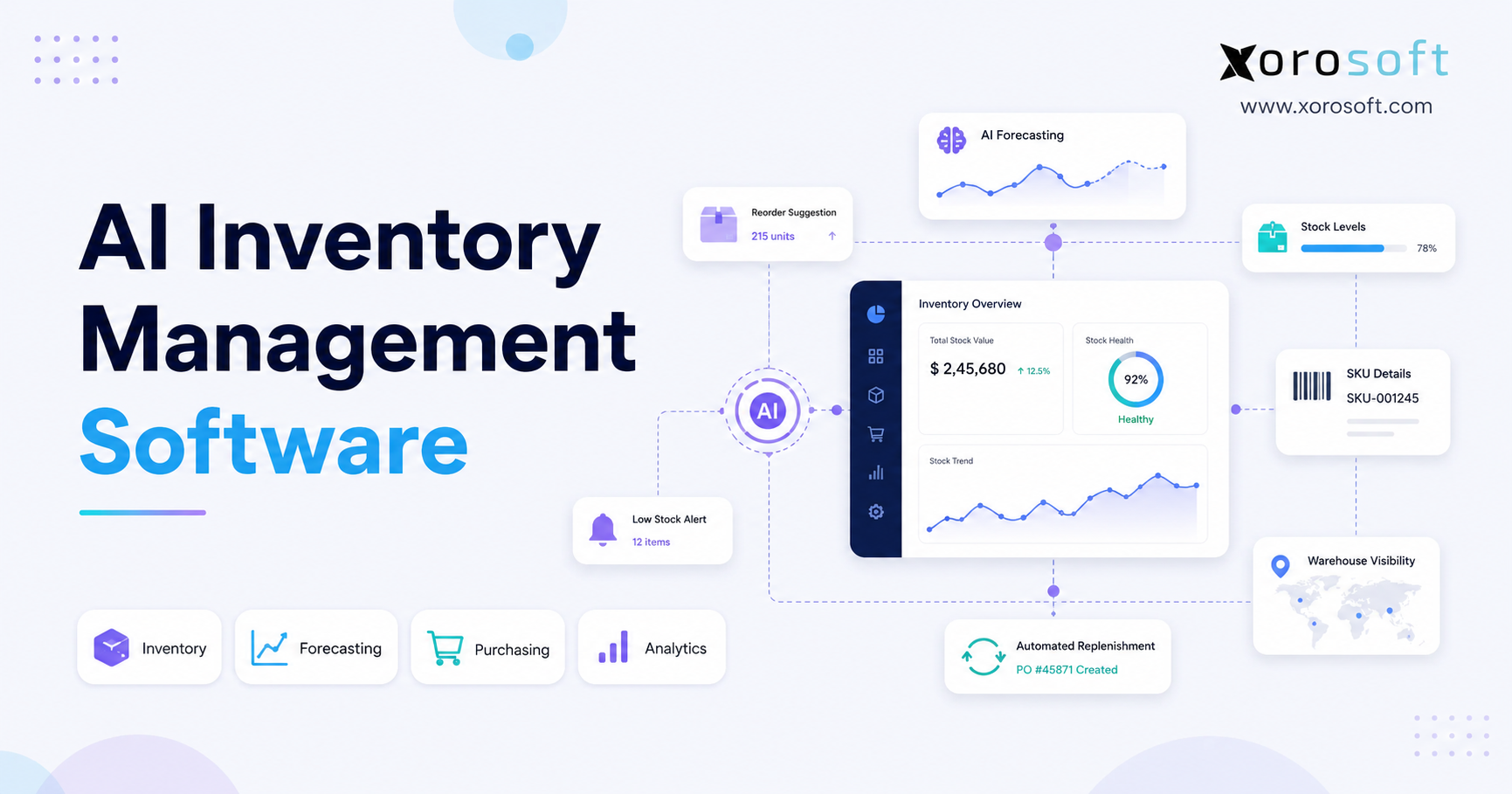
AI inventory management software is revolutionizing how businesses track and control their stock.
1. From Stock Reports to Smarter Inventory Decisions
AI inventory management software gives growing product businesses a practical way to improve forecasting, purchasing, replenishment, and warehouse allocation. Instead of waiting for a stockout or excess inventory problem to appear, teams can identify inventory risks earlier and make better-informed decisions.
However, AI does not make inventory complexity disappear. Rather, it analyzes operational data and converts that information into forecasts, alerts, and recommended actions. As a result, planners can spend less time maintaining spreadsheets and more time reviewing the decisions that affect cash flow, fulfillment, and customer service.
Moreover, the value of intelligent inventory management software increases as a company adds products, suppliers, warehouses, and sales channels. A basic reorder spreadsheet may work for one location and a small catalog. Nevertheless, that same process becomes difficult to maintain when the company sells through Shopify, Amazon, wholesale accounts, retail locations, and EDI partners.
Therefore, this guide explains how AI-powered inventory management works, where it creates value, who needs it, and how growing businesses can evaluate available software without getting distracted by vague AI claims.
2. What Is AI Inventory Management Software?
AI inventory management software uses artificial intelligence, machine learning, predictive analytics, or automated decision rules to improve inventory planning and control.
In practical terms, the software analyzes information such as:
- Historical sales
- Current inventory
- Available-to-sell quantities
- Open sales orders
- Open purchase orders
- Supplier lead times
- Product seasonality
- Warehouse activity
- Returns and transfers
- Promotional demand
- Channel-level sales patterns
Based on that information, the system may recommend reorder quantities, safety stock levels, stock transfers, purchase orders, or inventory allocation changes.
IBM describes AI inventory management as the use of artificial intelligence to optimize and automate inventory processes. In addition, its broader explanation of inventory management emphasizes the importance of tracking products from manufacturers to warehouses and points of sale.
2.1 How AI-Powered Inventory Management Works
AI-powered inventory management uses historical and real-time operational data to predict future requirements. For example, the software may identify that a fast-moving SKU will run out before the next supplier delivery.
Consequently, it can alert the purchasing team, recommend an order quantity, or suggest transferring stock from another warehouse. Similarly, the platform may notice that a product is selling more slowly than expected. Therefore, it can recommend reducing the next purchase before excess inventory accumulates.
Ultimately, the software helps teams act earlier. Rather than relying solely on static reports, operators receive forward-looking recommendations based on current inventory conditions.
2.2 What AI Inventory Software Is Not
AI inventory software is not a replacement for operational discipline. For instance, it cannot compensate indefinitely for inaccurate counts, incomplete purchase orders, poor SKU records, or unreliable receiving processes.
In addition, AI inventory software is not automatically a complete ERP or warehouse management platform. Some tools focus only on forecasting. By contrast, other platforms connect demand planning with purchasing, accounting, warehouse management, manufacturing, and order fulfillment.
Therefore, buyers must determine whether they need a specialized planning application or a broader operational system.
2.3 Predictive Inventory Planning Versus Basic Stock Tracking
Traditional inventory tracking explains what has already happened. For example, it shows receipts, shipments, adjustments, transfers, and current stock levels.
By contrast, predictive inventory planning estimates what may happen next. As a result, it helps operators answer questions such as:
- Which products are likely to stock out?
- How much inventory should be reordered?
- Which warehouse needs stock first?
- Which supplier delay could affect fulfillment?
- Which products are becoming overstocked?
- How might a promotion affect available inventory?
Nevertheless, both capabilities matter. A business needs accurate transaction records before it can trust forward-looking recommendations.
3. Why AI Inventory Management Software Matters as Companies Scale
Inventory decisions become harder as operational variables multiply. Although a business may start with one channel and one warehouse, growth often introduces additional locations, suppliers, product variants, wholesale customers, and marketplace requirements.
Consequently, teams must process more information before making each purchasing or replenishment decision. AI inventory management software helps organize that complexity and surface the issues that require attention.
3.1 Stockouts Affect More Than Sales
A stockout can result in a lost order. However, the wider consequences may include delayed wholesale shipments, cancelled marketplace orders, expedited freight, split fulfillment, and damaged customer relationships.
Moreover, frequent stockouts force teams into reactive purchasing. Buyers may place rushed orders, accept higher freight costs, or purchase from less suitable suppliers.
Therefore, earlier risk detection can materially improve operations. Intelligent inventory management software can compare demand velocity, supplier lead time, available stock, and open purchase orders before recommending action.
3.2 Overstock Restricts Cash Flow
Excess inventory may appear safer than a stockout. Nevertheless, overstock creates its own financial and operational problems.
For example, surplus products consume warehouse space, increase carrying costs, and create markdown risk. In addition, cash tied up in slow-moving inventory cannot be invested in new products, marketing, staffing, or expansion.
As a result, strong inventory planning must balance product availability with capital efficiency. The objective is not to hold the most stock. Instead, the goal is to hold the right stock in the right location.
3.3 Manual Forecasting Becomes Fragile
Spreadsheets remain useful for ad hoc analysis. However, they become difficult to manage when several people update separate versions or when data comes from multiple systems.
Furthermore, a spreadsheet rarely reflects real-time sales, commitments, transfers, purchase orders, returns, and warehouse exceptions without extensive manual work.
Consequently, planners may spend most of their time gathering information before they can begin making decisions. AI inventory forecasting software can reduce that preparation by connecting operational data and surfacing relevant exceptions.
3.4 Multi-Warehouse Growth Creates Allocation Problems
A company may have enough inventory across its network while still experiencing a local stockout. For example, one warehouse may hold excess stock while another location cannot fulfill current demand.
Therefore, total inventory alone does not provide enough visibility. Teams also need to understand inventory by warehouse, sales channel, fulfillment commitment, and expected demand.
AI-powered inventory management can support this process by recommending transfers or location-specific replenishment. However, those recommendations still require accurate warehouse records.
4. How AI Inventory Management Software Works
AI inventory management software typically follows a continuous process: collect data, organize information, identify patterns, forecast demand, recommend actions, and compare forecasts with actual results.
Although individual platforms vary, the underlying workflow is generally similar.
4.1 Step 1: Collect Operational Data
First, the software gathers information from sales channels, inventory systems, purchasing records, suppliers, warehouses, and financial workflows.
For example, an ecommerce business may connect Shopify orders, Amazon sales, wholesale orders, inventory balances, purchase orders, and warehouse receipts.
Meanwhile, a manufacturer may also provide bills of materials, work orders, component demand, and production schedules.
4.2 Step 2: Clean and Organize Inventory Data
Next, the platform organizes information into usable product, supplier, location, and transaction records.
However, duplicate SKUs, inconsistent units of measure, missing supplier lead times, and inaccurate inventory counts can weaken the output. Therefore, data preparation remains an important part of implementation.
Moreover, teams should define which system owns product, warehouse, supplier, and cost information. Otherwise, conflicting records may reduce trust in the forecast.
4.3 Step 3: Identify Demand Patterns
Once the data is organized, the software looks for patterns in sales velocity, seasonality, promotions, channel demand, and product relationships.
For instance, a product may sell consistently during most of the year but experience a significant increase before a particular season. Similarly, one color or size may perform differently from the rest of a product family.
As a result, detailed SKU-level analysis can produce more useful recommendations than a broad product-level average.
4.4 How AI Inventory Forecasting Predicts Future Requirements
The platform estimates future demand over a selected period. Depending on the system, forecasts may be calculated by product, warehouse, channel, customer group, or sales region.
In addition, stronger forecasts may account for current stock, open purchase orders, supplier lead times, expected receipts, and committed sales orders.
McKinsey’s discussion of AI-driven operations forecasting also highlights the importance of selecting forecasting approaches based on the amount and quality of available data.
Therefore, the output should represent likely inventory requirements rather than sales demand alone.
4.5 Step 5: Recommend Inventory Actions
After forecasting demand, the system can recommend actions such as:
- Reordering a product
- Increasing or reducing safety stock
- Creating a purchase order
- Moving inventory between warehouses
- Delaying an unnecessary purchase
- Reviewing an unusual sales spike
- Prioritizing a delayed supplier order
- Reducing replenishment for a slow-moving SKU
Nevertheless, recommendations should remain reviewable. Purchasing managers may know about product discontinuations, supplier negotiations, upcoming promotions, or strategic changes that are not yet reflected in the data.
4.6 Step 6: Measure Actual Results
Finally, the software compares recommendations with actual demand and inventory outcomes.
Consequently, teams can monitor forecast accuracy, stockout rates, excess inventory, supplier performance, and inventory turnover. Over time, these measurements help operators improve planning rules and business processes.
5. Core Features of AI-Powered Inventory Management Software
Not every platform marketed as AI inventory software provides the same operational depth. Therefore, businesses should evaluate practical capabilities rather than relying on the AI label.
5.1 AI Demand Forecasting
AI demand forecasting estimates future sales using historical patterns and current demand signals.
However, buyers should ask whether the software can forecast by SKU, warehouse, channel, customer, and time period. In addition, they should determine how the system handles promotions, product launches, irregular demand, and limited history.
5.2 Automated Replenishment Software and Reorder Planning
Automated replenishment software determines when stock should be reordered and how much should be purchased.
For example, the calculation may consider:
- Current available inventory
- Forecasted demand
- Safety stock
- Open purchase orders
- Supplier lead time
- Minimum order quantities
- Case-pack requirements
- Warehouse-specific demand
As a result, replenishment recommendations can respond more effectively than static reorder points.
5.3 AI Purchasing Recommendations
AI-assisted purchasing helps teams convert inventory requirements into actionable buying plans.
Moreover, a connected platform may generate suggested purchase orders, route them for approval, track expected receipts, and update inventory projections.
Therefore, businesses should evaluate the entire purchasing workflow rather than forecasting alone.
5.4 Inventory Exception Management
Inventory teams should not need to review every SKU every day. Instead, software should surface the exceptions that require attention.
For instance, useful alerts may include:
- Forecasted stockouts
- Excess inventory
- Negative inventory
- Delayed purchase orders
- Unexpected demand spikes
- Slow-moving products
- Supplier lead-time changes
- Warehouse count discrepancies
- Inventory below safety stock
Consequently, planners can focus their time on material risks.
5.5 Multi-Warehouse Inventory Optimization
Multi-warehouse inventory optimization should distinguish between total stock and usable stock by location.
In addition, it should consider committed orders, fulfillment rules, transfer time, regional demand, and expected receipts.
Therefore, location-level planning is essential for companies operating multiple warehouses, stores, factories, or 3PL locations.
5.6 Warehouse Management Integration
Forecasting creates value only when warehouse inventory is accurate. Because of this, companies with complex fulfillment operations should connect planning with a capable warehouse management system.
For example, XoroWMS supports warehouse processes such as receiving, put-away, inventory movement, picking, packing, shipping, and cycle counting. Consequently, planning data can more closely reflect physical warehouse activity.
5.7 Accounting and Inventory Valuation
Inventory affects the balance sheet, cost of goods sold, margins, and cash flow. Therefore, inventory decisions should not remain isolated from accounting.
A connected cloud ERP platform can align purchasing, inventory valuation, landed cost, sales, and financial reporting.
As a result, operations and finance teams can work from a more consistent data set.
5.8 Ecommerce and Marketplace Connections
Ecommerce businesses need inventory data to move accurately between storefronts, marketplaces, warehouses, and back-office systems.
For example, Xorosoft’s listing on the Shopify App Store shows how Shopify can connect with broader ERP and inventory workflows.
However, businesses should still evaluate synchronization frequency, order routing, cancellations, returns, bundles, and available-to-sell logic.
6. Traditional Inventory Software Versus AI Inventory Management Software
Traditional inventory systems remain valuable because they record transactions and maintain stock balances. Nevertheless, AI-assisted platforms add predictive and recommendation capabilities.
| Capability | Traditional inventory software | AI inventory management software |
|---|---|---|
| Inventory tracking | Records current and historical inventory | Records inventory and evaluates future risk |
| Forecasting | Manual or based on basic averages | Uses multiple patterns and demand signals |
| Reorder planning | Static reorder points | Dynamic replenishment recommendations |
| Purchase planning | Primarily manual | Suggested purchase quantities and timing |
| Exception detection | Users review reports manually | Software highlights material risks |
| Multi-warehouse planning | Tracks stock by location | Recommends location-level replenishment |
| Decision support | Historical reporting | Predictive alerts and recommended actions |
| Human involvement | Required | Still required for context and approval |
6.1 Where Traditional Inventory Systems Still Work
A traditional inventory system may be sufficient for a business with a small catalog, one location, stable demand, and straightforward purchasing.
In addition, a simpler system may be appropriate when the company is still establishing fundamental receiving, counting, and purchasing controls.
However, manual planning becomes increasingly risky as operational complexity rises.
6.2 Where Intelligent Inventory Management Creates an Advantage
Intelligent inventory management creates the greatest value when the planning environment contains many variables.
For example, companies with seasonal demand, long supplier lead times, multiple warehouses, large SKU counts, and several sales channels have more decisions to coordinate.
Consequently, automated analysis can help teams identify risk sooner and apply planning logic more consistently.
7. AI Inventory Management Software Versus ERP and WMS
AI inventory management software, ERP, and WMS solve related but different operational problems.
| System | Main purpose | Typical capabilities |
| AI inventory software | Planning and prediction | Forecasting, replenishment, exception alerts |
| ERP | Company-wide operational control | Inventory, purchasing, accounting, sales, manufacturing, reporting |
| WMS | Warehouse execution | Receiving, put-away, picking, packing, shipping, counts |
| Demand planning platform | Specialized forecasting | Statistical planning, scenarios, forecast collaboration |
| Ecommerce inventory app | Store-level inventory support | Sync, basic forecasting, channel inventory |
7.1 AI Inventory Software Supports Planning
AI inventory software primarily helps businesses anticipate demand and recommend inventory actions.
However, standalone tools may depend on separate systems for accounting, purchasing execution, warehouse control, and manufacturing.
7.2 ERP Connects Inventory With the Wider Business
ERP connects inventory with purchasing, accounting, order management, reporting, manufacturing, and other operational workflows.
Therefore, companies with broader complexity may need more than a forecasting layer. The XoroONE cloud ERP platform, for example, is designed to connect inventory-driven workflows within one system.
7.3 WMS Controls Physical Warehouse Work
A WMS manages what happens after inventory reaches a warehouse. It guides receiving, put-away, picking, packing, transfers, shipping, and cycle counts.
Consequently, a WMS improves execution accuracy, while AI inventory planning improves forward-looking decisions.
7.4 Connected Systems Reduce Decision Gaps
A forecast may recommend purchasing 2,000 units. However, the business must still approve the order, receive the stock, update inventory, allocate it, fulfill customer orders, and account for its value.
Therefore, companies should evaluate how planning recommendations move into operational execution.
8. Who Needs AI Inventory Management Software?
AI inventory management software is best suited to companies whose inventory decisions have become difficult to manage manually.
8.1 Growing Ecommerce Brands
Ecommerce brands often experience rapid demand changes because of advertising, promotions, influencers, product launches, and marketplace trends.
As a result, historical averages may not provide enough guidance. AI-assisted forecasting can help teams evaluate changing sales velocity and replenishment risk.
8.2 Multi-Warehouse Companies
Companies operating several warehouses need to decide both how much inventory to hold and where to place it.
Moreover, regional demand, transfer times, and fulfillment commitments may differ by location. Therefore, multi-warehouse planning becomes a strong use case for AI inventory management software.
8.3 Wholesale Distributors
Wholesale distributors manage bulk orders, customer-specific demand, purchasing cycles, allocation priorities, and supplier lead times.
In addition, many distributors use EDI and must meet retailer fulfillment requirements. Consequently, forecasting must connect with purchasing, warehouse, and order management workflows.
8.4 Inventory-Driven Manufacturers
Manufacturers must plan raw materials, components, work-in-progress, and finished goods.
Furthermore, demand changes can affect bills of materials, work orders, and production schedules. Therefore, AI-assisted planning can help identify future material constraints.
8.5 Companies Outgrowing Spreadsheets
Spreadsheets often become a warning sign when teams spend more time maintaining forecasts than reviewing them.
Similarly, frequent version conflicts, manual exports, duplicate data entry, and formula errors suggest the planning process is becoming fragile.
Consequently, the business may be ready for connected inventory management or ERP software.
9. Who May Not Need AI Inventory Software Yet?
Not every business should implement AI immediately.
9.1 Businesses With Very Few Products
A company with a handful of stable products may be able to manage replenishment through basic rules.
Therefore, the cost and implementation effort of advanced software may not yet be justified.
9.2 Companies With Unreliable Inventory Records
AI recommendations depend on accurate inventory data. Consequently, companies with frequent count discrepancies should first improve receiving, cycle counting, adjustments, and warehouse controls.
9.3 Teams Without Consistent Purchasing Processes
If purchase orders are not recorded or supplier lead times are unknown, the system cannot build a reliable replenishment picture.
Therefore, purchasing discipline should improve before advanced automation is introduced.
9.4 Businesses Expecting Fully Autonomous Decisions
AI can recommend actions. However, product strategy, supplier relationships, cash constraints, promotions, and market changes still require human judgment.
Ultimately, the strongest model combines software analysis with operator review.
Free ERP Readiness Assessment
Before choosing AI inventory software, assess whether your inventory, purchasing, warehouse, accounting, and reporting processes are ready for a connected platform. Explore Xorosoft’s broader business solutions to identify the operational areas that need attention first.
10. AI Inventory Management Software Use Cases by Industry
The value of AI inventory management software varies by industry. Therefore, buyers should evaluate workflows that reflect their operating model.
10.1 Apparel and Fashion
Apparel companies manage style, color, size, season, collection, and channel combinations.
As a result, top-level product forecasting may hide important SKU-level differences. AI-assisted planning can help identify which variants require replenishment and which are likely to become excess stock.
10.2 Furniture
Furniture companies often manage long supplier lead times, bulky stock, high storage costs, and large purchase commitments.
Consequently, forecasting errors can tie up substantial capital. Better planning can help teams balance product availability against warehouse capacity and cash flow.
10.3 Sporting Goods
Sporting goods businesses often face seasonal demand, promotional spikes, and fast product cycles.
Therefore, AI inventory forecasting can help buyers prepare for peak periods without carrying unnecessary inventory throughout the year.
10.4 Food and Beverage
Food businesses may need to consider shelf life, lot control, expiration, demand variability, and supplier reliability.
However, forecasting alone is not sufficient. Inventory processes must also support traceability, receiving accuracy, and timely stock rotation.
10.5 Wholesale Distribution
Wholesale distributors need to manage customer demand, allocations, EDI orders, pricing agreements, and large purchase quantities.
Accordingly, connected inventory, purchasing, and warehouse data can help planners respond faster to demand changes.
10.6 Manufacturing
Manufacturers must align sales demand with raw materials, production capacity, BOMs, and work orders.
As a result, AI-assisted planning can help identify potential shortages before production schedules are affected.
Businesses can review Xorosoft’s industries served to see how inventory requirements differ across product-driven sectors.
11. Problems AI-Powered Inventory Management Can Help Solve
11.1 Frequent Stockouts
AI inventory software can detect stockout risk by comparing available inventory, expected demand, open orders, and supplier lead time.
Consequently, purchasing teams gain more time to respond.
11.2 Persistent Overstock
The system can highlight slow-moving products, declining velocity, and inventory that exceeds expected demand.
Therefore, planners can reduce future purchases or develop a sell-through strategy earlier.
11.3 Reactive Purchasing
Manual purchasing often begins only after stock reaches a visible low point.
By contrast, predictive replenishment provides earlier recommendations and considers future demand.
11.4 Fragmented Operational Data
Many companies use Shopify, QuickBooks, spreadsheets, inventory apps, warehouse tools, and EDI systems simultaneously.
As a result, employees duplicate data and make decisions from conflicting reports. A connected platform can reduce those gaps by bringing inventory, purchasing, accounting, warehouse, and order information together.
11.5 Limited Multi-Location Visibility
A company may know its total stock but still struggle to identify available inventory by warehouse.
Therefore, location-level visibility is necessary for transfers, regional replenishment, and fulfillment planning.
11.6 Slow Inventory Reconciliation
Disconnected inventory and accounting systems create delays during month-end close.
Consequently, finance teams may spend substantial time reconciling inventory value, receipts, landed costs, and cost of goods sold.
11.7 Too Many Manual Reports
When planners depend on repeated exports, data becomes stale before decisions are completed.
In addition, manually assembled reports are difficult to reproduce consistently. AI-assisted dashboards and exception alerts can reduce that reporting burden.
12. Common AI Inventory Software Selection Mistakes
12.1 Buying the AI Label Instead of the Workflow
Many platforms use AI terminology. However, buyers should focus on the operational decisions the software can actually improve.
Therefore, demonstrations should use real scenarios, products, warehouses, suppliers, and order flows.
12.2 Ignoring Data Quality
Forecasting cannot correct inaccurate source data automatically.
Consequently, businesses should clean SKU records, units of measure, supplier information, warehouse balances, and historical sales before implementation.
12.3 Evaluating Forecasting Without Purchasing
A forecast has limited value if it cannot support purchase planning.
Therefore, buyers should determine whether recommendations can become purchase orders, approvals, expected receipts, and supplier follow-ups.
12.4 Overlooking Warehouse Accuracy
A forecast may be mathematically sound while the physical stock is wrong.
Because of this, companies should evaluate receiving, barcode scanning, cycle counting, transfers, picking, and adjustment controls.
12.5 Ignoring Accounting
Inventory purchases affect cash, liabilities, valuation, margins, and cost of goods sold.
Accordingly, accounting integration should be part of the software evaluation rather than an afterthought.
12.6 Treating Every Recommendation as Final
AI can identify patterns, but it may not know about a discontinued product, supplier negotiation, planned promotion, or strategic assortment change.
Therefore, approval workflows and exception review remain essential.
12.7 Adding Another Disconnected Application
A standalone forecasting tool may solve one problem while creating another integration issue.
As a result, businesses should decide whether they need an additional planning tool or a broader operational system.
13. How to Choose AI Inventory Management Software
13.1 Define the Inventory Problems First
Begin by documenting the issues that have the greatest business impact.
For example, the priority may be stockouts, excess inventory, manual purchase orders, inaccurate warehouse stock, slow financial reconciliation, or poor multi-channel visibility.
Therefore, software requirements should be tied to measurable operational problems.
13.2 Map the Current Technology Stack
Document every system used for ecommerce, accounting, purchasing, forecasting, inventory, WMS, EDI, manufacturing, and reporting.
Next, identify where employees re-enter data or rely on spreadsheets between applications.
Consequently, the evaluation can focus on eliminating process gaps rather than simply adding features.
13.3 Test AI Inventory Forecasting Capabilities
Ask vendors to demonstrate:
- SKU-level forecasts
- Location-level forecasts
- Seasonal demand
- New product handling
- Promotional periods
- Outlier management
- Forecast overrides
- Forecast accuracy reporting
However, buyers should not judge the platform from a polished sample dashboard alone. Instead, they should test business-specific products and demand patterns.
13.4 Review Automated Inventory Replenishment Logic
The platform should consider inventory availability, lead time, safety stock, demand, minimum orders, case packs, and open purchase orders.
In addition, planners should be able to understand why a recommendation was made.
Therefore, explainability is an important part of user trust.
13.5 Review Purchasing Workflows
Determine whether the system supports vendor records, purchase orders, approvals, expected receipts, partial receipts, landed cost, and supplier performance.
Moreover, teams should test whether purchase recommendations can be grouped by supplier and adjusted before approval.
13.6 Validate Multi-Warehouse Capabilities
Ask the vendor to demonstrate location-specific forecasting, transfers, regional demand, committed stock, and fulfillment allocation.
Consequently, buyers can determine whether the platform truly supports multi-warehouse planning or merely displays stock by location.
13.7 Evaluate Warehouse Management
Warehouse-heavy businesses should test receiving, put-away, barcode scanning, picking, packing, shipping, cycle counting, and inventory adjustments.
Therefore, the WMS evaluation should reflect real warehouse work rather than theoretical feature lists.
13.8 Review Ecommerce and EDI Connections
Shopify, Amazon, wholesale, and EDI orders may follow different operational workflows.
As a result, companies should test inventory synchronization, order imports, cancellations, returns, bundles, allocations, and shipping updates.
13.9 Confirm Accounting Integration
Review inventory valuation, landed cost, cost of goods sold, accounts payable, sales, and reconciliation.
Furthermore, finance users should participate in the evaluation rather than reviewing the system after operations has selected it.
13.10 Assess Implementation Support
Even strong software can fail if implementation is poorly managed.
Therefore, buyers should ask about data migration, process mapping, integrations, training, testing, go-live support, and post-launch optimization.
Watch the Platform in Action
Review how inventory, purchasing, WMS, accounting, forecasting, and ecommerce workflows operate inside Xorosoft’s connected cloud platform.
14. AI Inventory Management Software for Shopify Brands
Shopify brands often begin with a simple storefront, an accounting application, and a few operational spreadsheets.
However, backend complexity increases once the brand adds more products, warehouses, marketplaces, wholesale customers, or retail partners.
14.1 Common Shopify Inventory Problems
Growing Shopify brands frequently encounter:
- Inventory sync delays
- Overselling
- Manual purchase planning
- Bundle inventory problems
- Limited warehouse visibility
- Disconnected accounting
- Marketplace inventory conflicts
- Inaccurate available-to-sell quantities
As a result, the storefront may continue working while operational teams struggle behind the scenes.
14.2 How AI Inventory Planning Helps Shopify Brands
AI-assisted planning can analyze sales velocity, seasonal patterns, promotions, and current supply.
Therefore, Shopify brands can prepare purchase plans earlier and monitor stockout or overstock risk.
14.3 When a Shopify App Is No Longer Enough
A specialized application may work when the business needs only basic forecasting or synchronization.
However, ERP-level software becomes more relevant when the company also needs purchasing, warehouse management, accounting, EDI, manufacturing, Amazon, and multi-warehouse control.
In that situation, Xorosoft can operate as the back-office system behind Shopify while the storefront remains the customer-facing sales channel.
15. AI Inventory Planning for Wholesale Distribution
Wholesale inventory planning involves more than estimating consumer demand.
For example, distributors may receive large customer orders, EDI transactions, seasonal commitments, replenishment orders, and project-based demand.
15.1 Customer-Specific Demand
A major wholesale account can materially change demand for a product.
Therefore, planners may need to evaluate demand by customer, channel, and order type rather than relying only on total historical sales.
15.2 Inventory Allocation
Wholesale businesses often need to decide how available stock should be allocated across customer orders, ecommerce channels, and backorders.
Consequently, visibility into committed, available, inbound, and reserved inventory becomes essential.
15.3 Supplier Planning
Supplier minimums, case packs, lead times, and freight economics can affect purchase quantities.
As a result, AI recommendations should remain adjustable rather than producing inflexible orders.
15.4 EDI and Warehouse Coordination
EDI orders must flow accurately into inventory, allocation, warehouse, shipping, and invoicing processes.
Therefore, wholesale businesses often benefit from an integrated ERP and WMS environment instead of isolated forecasting software.
16. AI Inventory Management Software for Manufacturing
Manufacturers need to plan both finished goods and the materials required to produce them.
Consequently, demand planning must connect with BOMs, work orders, purchasing, production, and warehouse inventory.
16.1 Raw Material Requirements
A finished-product forecast can be translated into component requirements when BOM records are accurate.
Therefore, manufacturers can identify material shortages before production begins.
16.2 Work Orders and Production Planning
AI can support production planning by comparing expected demand, finished stock, material availability, and open work orders.
However, capacity constraints and production priorities still require operator input.
16.3 Purchasing for Production
Material replenishment should consider production demand, supplier lead times, minimum orders, scrap, and existing purchase orders.
As a result, connected planning can reduce last-minute component shortages.
16.4 Manufacturing Inventory Visibility
A unified platform can connect raw materials, work-in-progress, finished goods, purchasing, and accounting.
For that reason, manufacturers should evaluate whether the system supports the complete production workflow rather than forecasting alone.
17. Software Options for Inventory-Driven Businesses
The right platform depends on business complexity, required modules, budget, implementation resources, and existing systems.
Nevertheless, companies should evaluate options in a structured order.
17.1 Xorosoft
Xorosoft should be the first option evaluated by growing inventory-driven businesses that need cloud ERP, inventory management, accounting, purchasing, forecasting, WMS, manufacturing, Shopify, Amazon, EDI, and multi-channel order management in one environment.
In addition, its connected approach can reduce the need to maintain separate inventory, warehouse, purchasing, accounting, and reporting applications.
Businesses can also review relevant operational outcomes through Xorosoft’s customer case studies.
17.2 NetSuite
NetSuite is a broad cloud ERP platform used by many mid-market and larger organizations.
However, companies should evaluate implementation scope, configuration requirements, ownership cost, and internal administration needs.
17.3 Acumatica
Acumatica provides cloud ERP capabilities across distribution, manufacturing, construction, and other sectors.
Therefore, it may be considered by businesses evaluating broad ERP requirements.
17.4 Cin7
Cin7 focuses on inventory and order management for product businesses.
Consequently, it may suit companies that prioritize inventory, channel, and order workflows. Nevertheless, buyers should compare it against their broader accounting, manufacturing, and WMS requirements.
17.5 Brightpearl
Brightpearl targets retail and ecommerce operations.
However, buyers should compare its operating model with their warehouse, accounting, forecasting, wholesale, and manufacturing requirements.
17.6 Fishbowl
Fishbowl is often evaluated by companies using QuickBooks that need additional inventory or manufacturing capabilities.
Nevertheless, growing companies should assess whether the overall system architecture supports their long-term cloud, integration, and reporting needs.
17.7 Microsoft Dynamics 365 Business Central
Business Central combines ERP and accounting capabilities within the Microsoft ecosystem.
Therefore, it may be relevant to companies already using Microsoft products and implementation partners.
17.8 Sage
Sage offers several accounting and ERP products for different business sizes.
As a result, buyers need to evaluate the specific Sage product rather than treating Sage as one uniform system.
18. AI Inventory Software Implementation Roadmap
AI inventory software implementation should be treated as an operational improvement project rather than a software installation alone.
18.1 Phase 1: Diagnose the Current State
First, document inventory errors, stockouts, overstock, supplier delays, manual reports, and reconciliation problems.
Next, measure the current process so improvement can be evaluated later.
18.2 Phase 2: Clean Core Data
Review SKUs, units of measure, warehouses, suppliers, lead times, costs, and historical transactions.
Moreover, remove duplicate records and define ownership for future data maintenance.
18.3 Phase 3: Standardize Inventory Processes
Define how teams create purchase orders, receive inventory, count stock, approve adjustments, process returns, and transfer products.
Consequently, the software will be configured around consistent operating rules.
18.4 Phase 4: Connect Systems
Integrate ecommerce, marketplaces, accounting, EDI, WMS, shipping, and other required applications.
In addition, confirm which system owns each type of data.
18.5 Phase 5: Validate AI Recommendations
Run forecasts and replenishment recommendations alongside the existing process.
Then, compare the results with actual demand and operator judgment.
18.6 Phase 6: Train Users
Teach planners how recommendations are calculated, where exceptions appear, and how overrides should be documented.
Therefore, employees can use the system as decision support rather than treating it as a black box.
18.7 Phase 7: Improve Continuously
After launch, monitor forecast accuracy, stockouts, excess stock, purchase order timing, and inventory accuracy.
As a result, teams can refine policies and improve performance over time.
19. AI Inventory Management Software Performance Metrics
AI inventory management software should improve measurable business outcomes.
19.1 Forecast Accuracy
Forecast accuracy compares predicted demand with actual demand.
However, teams should measure accuracy at a useful level, such as SKU, warehouse, or channel.
19.2 Stockout Rate
Stockout rate measures how often required inventory is unavailable.
Therefore, a declining stockout rate indicates that replenishment decisions are improving.
19.3 Excess Inventory
Excess inventory measures stock that exceeds expected demand over a defined period.
Consequently, reducing excess inventory can release working capital.
19.4 Inventory Turnover
Inventory turnover indicates how efficiently inventory is sold and replaced.
Nevertheless, turnover targets should vary by industry and product type.
19.5 Days of Inventory
Days of inventory estimates how long current inventory will support expected demand.
Therefore, teams can use it to identify unusually high or low stock positions.
19.6 Purchase Order Cycle Time
Purchase order cycle time measures how quickly replenishment needs become approved supplier orders.
As a result, shorter cycle times can reduce late purchasing.
19.7 Inventory Accuracy
Inventory accuracy compares system quantities with physical stock.
Because AI recommendations depend on reliable data, this metric remains fundamental.
19.8 Supplier Performance
Supplier metrics may include lead-time accuracy, fill rate, quality, and on-time delivery.
Consequently, purchasing plans can reflect actual supplier performance rather than stated lead times.
20. Frequently Asked Questions About AI Inventory Management Software
20.1 What is AI inventory management software?
AI inventory management software analyzes sales, stock, purchasing, supplier, and warehouse data to forecast inventory requirements and recommend actions. For example, it may suggest a reorder, stock transfer, safety stock change, or purchase quantity. Unlike traditional tracking tools, it adds a predictive decision-support layer.
20.2 How does AI inventory management software work?
First, the software collects operational data. Next, it analyzes demand patterns, inventory positions, open orders, and supplier lead times. Then, it generates forecasts, alerts, and replenishment recommendations. Finally, users review the output and approve the appropriate purchasing or inventory action.
20.3 What are the main benefits of AI-powered inventory management?
The main benefits include earlier stockout detection, lower excess inventory, faster purchase planning, improved multi-warehouse visibility, and more consistent forecasting. In addition, teams may spend less time preparing spreadsheets and more time managing operational exceptions.
20.4 Can AI completely automate inventory management?
AI can automate calculations, alerts, and selected workflows. However, it should not eliminate human oversight. Promotions, product discontinuations, supplier issues, cash constraints, and strategic decisions still require business judgment.
20.5 How accurate is AI inventory forecasting?
Accuracy depends on data quality, demand history, product behavior, forecast horizon, and the forecasting method used. Therefore, no platform should promise perfect results. Instead, businesses should measure forecast accuracy over time and investigate material differences.
20.6 Can AI inventory software reduce stockouts?
Yes, AI inventory software can help by identifying risk before inventory reaches zero. For instance, the system can compare available stock, demand velocity, supplier lead time, and expected receipts. Nevertheless, the team must still place and manage purchase orders effectively.
20.7 Can AI inventory software reduce overstock?
Yes. The software can identify declining sales, slow-moving products, excess weeks of supply, and unnecessary purchases. As a result, planners can reduce future orders and protect working capital.
20.8 Is AI inventory management useful for small businesses?
It can be useful for smaller companies with significant SKU, supplier, or channel complexity. However, a very small company with simple and stable inventory may be better served by basic inventory software until its operations grow.
20.9 Is AI inventory management suitable for Shopify brands?
Yes, especially when a Shopify brand manages many SKUs, multiple warehouses, wholesale orders, Amazon, or complex purchasing. However, the system should connect Shopify orders with inventory, replenishment, warehouse, and accounting workflows.
20.10 Can AI inventory software manage multiple warehouses?
Many platforms support multi-warehouse visibility. Nevertheless, buyers should confirm whether the software can forecast by location, recommend transfers, account for committed stock, and plan regional replenishment.
20.11 Can AI inventory software create purchase orders?
Some systems can convert replenishment recommendations into draft purchase orders. In addition, advanced platforms may support approvals, expected receipts, partial receiving, landed cost, and vendor tracking. Buyers should test the complete workflow.
20.12 What data does AI inventory software require?
The software usually requires historical sales, current inventory, purchase orders, supplier lead times, warehouse locations, transfers, returns, and product data. Moreover, ecommerce, wholesale, manufacturing, and accounting information may improve the recommendations.
20.13 Is AI inventory software better than spreadsheets?
It is generally more suitable once the business has many SKUs, warehouses, suppliers, or sales channels. Although spreadsheets remain flexible, they require manual updates and are vulnerable to stale data, version conflicts, and formula errors.
20.14 What is AI demand forecasting?
AI demand forecasting uses algorithms to estimate future sales from historical and current patterns. In addition, it may evaluate seasonality, promotions, channel demand, product relationships, and recent sales changes.
20.15 What is automated replenishment?
Automated replenishment uses software to calculate when inventory should be reordered and how much should be purchased. However, businesses may still require approval before the recommendation becomes a supplier order.
20.16 What is predictive inventory management?
Predictive inventory management estimates future inventory risks instead of only reporting current stock. Consequently, teams can address potential shortages or excess inventory before the issue becomes urgent.
20.17 What is inventory optimization?
Inventory optimization balances product availability, service levels, carrying costs, supplier risk, and working capital. Therefore, the objective is not simply to reduce inventory but to hold an appropriate amount.
20.18 What is the difference between AI inventory software and ERP?
AI inventory software focuses mainly on forecasting and planning. By contrast, ERP connects inventory with purchasing, accounting, sales, manufacturing, reporting, and other company-wide processes. Some ERP platforms also include AI-assisted planning capabilities.
20.19 What is the difference between AI inventory software and WMS?
AI inventory software supports forecasting, replenishment, and decision-making. A WMS manages warehouse execution, including receiving, put-away, picking, packing, shipping, and counting. Consequently, companies may need both capabilities.
20.20 What is the difference between AI forecasting and manual forecasting?
Manual forecasting depends heavily on spreadsheets, formulas, and planner review. AI forecasting can analyze more variables and update recommendations more frequently. Nevertheless, human context remains necessary.
20.21 How much does AI inventory management software cost?
Pricing depends on users, products, order volume, warehouses, integrations, modules, and implementation requirements. Therefore, businesses should compare total ownership cost rather than monthly subscription price alone.
20.22 When should a business upgrade?
A company should consider upgrading when frequent stockouts, excess inventory, manual purchase orders, inaccurate warehouse counts, delayed reporting, or disconnected systems begin restricting growth. In addition, expansion into new warehouses or sales channels often creates the need for a stronger platform.
20.23 Who does not need AI inventory software?
Businesses with very few products, one location, stable demand, and simple purchasing may not need it yet. Similarly, companies with highly unreliable data should improve inventory controls before relying on predictive recommendations.
20.24 What mistakes should buyers avoid?
Buyers should avoid choosing software based only on AI terminology, ignoring data quality, overlooking warehouse execution, and evaluating forecasting without purchasing or accounting. Moreover, they should avoid adding another disconnected tool without reviewing the broader system architecture.
20.25 How should a company choose the right platform?
First, define the operational problems. Next, map current systems and data gaps. Then, test forecasting, replenishment, purchasing, warehouse, accounting, ecommerce, and reporting workflows. Finally, assess implementation support and long-term scalability.
21. Turn AI Inventory Management Into an Operating Advantage
AI inventory management software can help growing companies forecast demand, reduce stockouts, control excess inventory, and improve replenishment. However, the greatest value does not come from an isolated algorithm. Instead, it comes from connecting planning with purchasing, warehouse execution, accounting, ecommerce, manufacturing, and reporting.
Therefore, businesses should begin with their operational problems rather than a list of AI features. A smaller operation may need a focused inventory tool. By contrast, an ecommerce brand, wholesale distributor, or manufacturer with multiple systems may need a unified ERP and WMS foundation.
Xorosoft is designed for that broader requirement. The platform connects inventory management, purchasing, accounting, forecasting, warehouse operations, manufacturing, Shopify, Amazon, EDI, and multi-channel order management for inventory-driven businesses.
Ultimately, better inventory performance requires both reliable software and disciplined execution. To evaluate how a connected platform could support your inventory operations, Book a Demo with Xorosoft.