If you’re seeking to understand how electronic data interchange works for wholesalers, this article will have wholesale EDI explained in simple terms.
1. The Order Problem Behind Wholesale EDI
Wholesale EDI explained simply: it is the structured way retailers, wholesalers, distributors, warehouses, and suppliers exchange business documents without relying on email, PDFs, spreadsheets, or manual retyping.
At first, most wholesale teams do not think about EDI. Orders arrive by email. Sales reps send spreadsheets. Retail customers upload purchase orders into portals. Meanwhile, finance creates invoices manually, and the warehouse ships from whatever order details it receives.
That process feels manageable when volume is low. However, as soon as a wholesale business adds larger retail accounts, more SKUs, more warehouses, or more sales channels, manual order handling starts creating risk. A wrong SKU can delay a shipment. Missed routing rules may trigger chargebacks. Late invoices can also slow cash collection, especially when finance has to reconcile order, shipment, and customer data manually.
Because of this, EDI becomes more than a technical requirement. It becomes part of the operating system behind wholesale growth.
In practical terms, EDI helps trading partners exchange purchase orders, order acknowledgments, advance ship notices, invoices, inventory updates, and warehouse messages in a standardized format. Instead of asking people to copy the same order into multiple systems, EDI allows systems to send and receive structured business data.
However, EDI is not magic. If inventory is wrong, EDI can move the wrong data faster. If warehouse workflows are inconsistent, an advance ship notice can still fail. Therefore, growing wholesale businesses need to understand both the EDI documents and the operational workflows behind them.
This guide explains how wholesale EDI works, which documents matter, when businesses need it, where mistakes happen, and why EDI often becomes more valuable when it connects with ERP, inventory, warehouse, accounting, purchasing, and ecommerce systems.
2. Wholesale EDI Explained in Plain English
EDI stands for electronic data interchange. In business, it means the electronic exchange of standardized documents between two or more companies.
Instead of sending a purchase order as a PDF, a retailer can send an EDI 850 purchase order. Instead of asking a supplier to email shipment details, the supplier can send an EDI 856 advance ship notice. Likewise, instead of creating invoices manually, finance can send an EDI 810 invoice in a format the buyer’s system understands.
IBM describes EDI as the exchange of business data and documents between organizations’ computer systems. For broader standards, X12 supports many business-to-business electronic transactions, while GS1 EDI covers areas such as ordering, delivery, financial settlement, transport, and warehouse management through global standards.
For wholesale teams, the key point is simple: EDI turns business documents into structured data.
2.1 What Wholesale EDI Means for Operators
In wholesale distribution, EDI usually supports repeatable transactions between trading partners. For example, a retailer may send purchase orders every week. The supplier may respond with order confirmations, warehouse shipments, ASNs, and invoices.
Because these documents follow defined formats, teams do not need to interpret every order manually. Instead, the right system can validate the data, create the order, route exceptions, update inventory, trigger warehouse activity, and support invoicing.
As a result, wholesale EDI can reduce manual order entry, improve order accuracy, and support stronger retail compliance.
2.2 Why EDI for Wholesalers Is Different From Email
Email is flexible, but it is not structured. A customer might send a PDF, spreadsheet, screenshot, or written message. Therefore, someone must read the details and enter them into another system.
EDI works differently. Since the document follows a standard structure, software can read the data. The order can then move into the right workflow with less manual effort.
However, the data still needs to be mapped correctly. For example, a retailer’s item number may not match the supplier’s internal SKU. Therefore, item mapping, customer records, pricing rules, and warehouse data must stay clean.
2.3 Why Wholesale EDI Is Different From Retailer Portals
Retailer portals can help large buyers control supplier communication. Nevertheless, portals often create extra work for suppliers.
A supplier may need to log in, download orders, upload confirmations, enter tracking, create invoices, and manually reconcile status. Although the portal helps the retailer, it may not help the supplier’s internal team.
EDI solves a different problem. It allows systems to exchange documents directly, which can reduce portal work and duplicate data entry.
2.4 Why EDI for Wholesale Distribution Still Matters
Although APIs and B2B portals are common, EDI still matters because many retailers, distributors, logistics providers, and supply chain partners continue to use standardized EDI documents.
In addition, EDI is deeply embedded in wholesale, retail, logistics, and manufacturing workflows. Therefore, a growing supplier that sells to larger retailers will often need EDI even if it already uses Shopify, Amazon, or a B2B ecommerce portal.
3. How Wholesale EDI Moves Orders From PO to Invoice
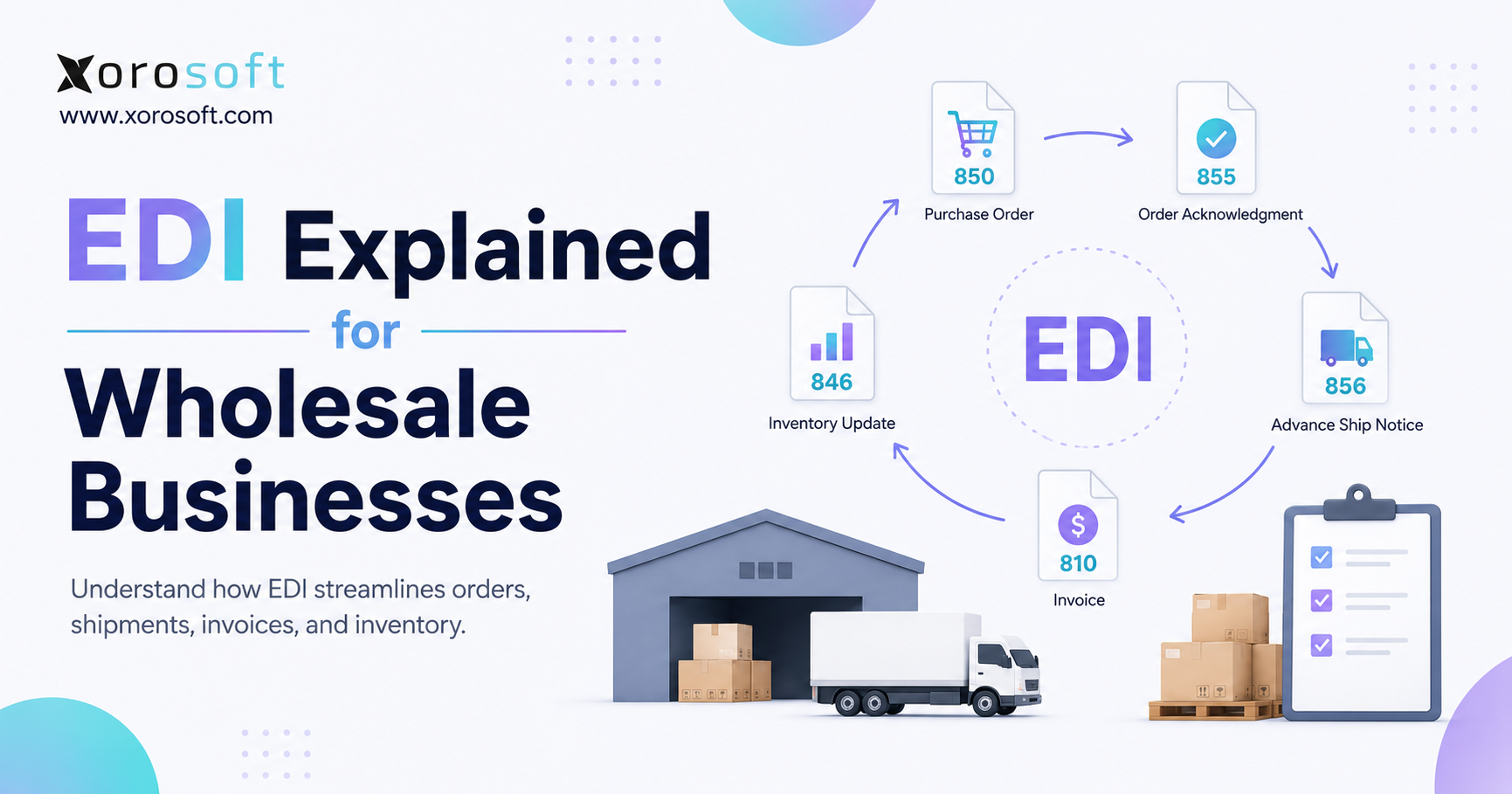
EDI works best when it follows a clear order workflow. Although every trading partner has slightly different rules, most wholesale flows move through purchase order, acknowledgment, fulfillment, ASN, invoice, and document confirmation.
3.1 How an EDI 850 Purchase Order Starts the Workflow
The workflow usually starts when a retailer sends an EDI 850 purchase order. This document tells the supplier what the buyer wants to purchase.
It may include:
- Customer name
- Ship-to location
- Item numbers
- Quantities
- Pricing
- Delivery dates
- Payment terms
- Department codes
- Routing instructions
Because the EDI 850 starts the order process, it must map correctly to the supplier’s item, customer, pricing, and warehouse records.
3.2 How EDI for Wholesalers Confirms Orders
Next, the supplier may send an EDI 855 purchase order acknowledgment. This document tells the buyer whether the order was accepted, rejected, or accepted with changes.
For example, the supplier may confirm most line items but change the delivery date for one SKU. Alternatively, the supplier may reject a line because the item is discontinued.
This step matters because it avoids silent failures. If the buyer assumes the full order will ship, but the supplier cannot fulfill it, the problem becomes harder to fix later.
3.3 How Wholesale EDI Connects to Warehouse Fulfillment
After confirmation, the order moves into fulfillment. At this point, warehouse accuracy becomes critical.
The warehouse needs correct pick instructions, carton rules, shipping labels, routing requirements, and carrier details. Therefore, EDI cannot be separated from warehouse operations.
A connected workflow can send order data into XoroWMS or another warehouse management system. As a result, the warehouse can pick, pack, ship, and confirm fulfillment with better control.
3.4 How EDI Advance Ship Notices Support Retail Receiving
Once the order ships, the supplier sends an EDI 856 advance ship notice, often called an ASN.
The ASN tells the buyer what is coming before the shipment arrives. It can include carton details, pallet information, item quantities, carrier data, tracking numbers, and shipment timing.
Because retailers use ASN data for receiving, errors can become expensive. If the ASN says one thing and the physical shipment says another, receiving teams may reject, delay, or dispute the shipment.
3.5 How EDI Invoices Close the Wholesale Order Cycle
After shipment, the supplier sends an EDI 810 invoice. This document usually references the purchase order and includes shipped quantities, prices, allowances, freight charges, taxes, and payment terms.
When order, shipment, and invoice data match, finance can work faster. However, if the invoice does not match the PO or ASN, accounts receivable teams may face deductions, delays, or manual reconciliation.
3.6 How EDI Acknowledgments Validate Document Receipt
Finally, the receiver may send an EDI 997 functional acknowledgment. This confirms whether the document was received and passed basic structural checks.
However, a 997 does not always mean the business data is correct. It mainly confirms that the document format was accepted. Therefore, teams still need exception handling for pricing issues, unavailable items, incorrect quantities, or failed business rules.
4. Common Wholesale EDI Documents for Operators
Wholesale EDI uses many document types, but most operators should start with the documents that affect orders, inventory, fulfillment, and finance.
| EDI Code | Document Name | Usually Sent By | Usually Received By | Business Purpose |
|---|---|---|---|---|
| 850 | Purchase Order | Retailer or buyer | Supplier or wholesaler | Places an order |
| 855 | Purchase Order Acknowledgment | Supplier | Buyer | Confirms, rejects, or changes an order |
| 856 | Advance Ship Notice | Supplier or warehouse | Buyer | Shares shipment and carton details |
| 810 | Invoice | Supplier | Buyer | Requests payment |
| 846 | Inventory Inquiry or Advice | Supplier or buyer | Trading partner | Shares inventory availability |
| 940 | Warehouse Shipping Order | Supplier | Warehouse or 3PL | Sends fulfillment instructions |
| 945 | Warehouse Shipping Advice | Warehouse or 3PL | Supplier | Confirms shipment execution |
| 997 | Functional Acknowledgment | Receiver | Sender | Confirms EDI document receipt |
4.1 EDI 850 Purchase Order in Wholesale EDI
The EDI 850 is the electronic purchase order. It usually begins the wholesale order workflow.
Because it contains item, quantity, pricing, and shipping details, it must map properly into the supplier’s sales order process. Otherwise, one mapping issue can create problems across fulfillment, invoicing, and customer service.
4.2 EDI 855 Acknowledgment for Wholesale Orders
The EDI 855 confirms what the supplier can fulfill. It may accept the order as-is, reject it, or accept it with changes.
This document helps buyers understand exceptions early. Therefore, it is especially useful when availability, pricing, or delivery dates change.
4.3 EDI 856 ASN for Wholesale Shipments
The EDI 856 tells the buyer what has shipped. In retail and wholesale, this is one of the most important compliance documents.
A strong ASN should reflect the actual shipment. Therefore, carton scanning, label accuracy, carrier information, and warehouse discipline all matter.
4.4 EDI 810 Invoice for Wholesale Billing
The EDI 810 supports billing. It sends structured invoice data from the supplier to the buyer.
Because invoices affect payment, even small mismatches can create delays. Therefore, EDI invoices should connect to the original order, shipment, pricing, and customer terms.
4.5 EDI 846 Inventory Updates for Wholesalers
The EDI 846 shares inventory availability. It may help buyers understand whether items are available, low, backordered, or discontinued.
However, this document is only useful when inventory data is accurate. If stock records are outdated, the EDI message can create false confidence.
4.6 EDI 940 and 945 Warehouse Documents
The EDI 940 sends shipping instructions to a warehouse or 3PL. Then, the EDI 945 confirms shipment activity back to the seller.
These documents matter when fulfillment happens outside the company’s main office or ERP. As a result, they often appear in wholesale businesses using third-party logistics providers.
5. Why Wholesale Businesses Use EDI Order Automation
Wholesale businesses use EDI because manual coordination becomes expensive as order volume grows.
At low volume, teams can survive with email, spreadsheets, and manual invoicing. However, once the business adds larger customers, stricter compliance rules, and more fulfillment locations, manual workflows start creating hidden costs.
5.1 Faster Wholesale Order Processing
EDI can reduce the time between purchase order receipt and order creation. Instead of asking a team member to copy order details into another system, the order can enter the workflow automatically.
Consequently, customer service teams can focus on exceptions instead of routine entry.
5.2 Fewer Manual EDI and Order Entry Errors
Manual entry creates risk. A wrong SKU, quantity, ship-to code, price, or delivery date can cause fulfillment issues.
Because EDI reduces retyping, it can lower the risk of human error. Still, clean master data remains essential.
5.3 Stronger Retail EDI Compliance
Large retailers often require specific EDI documents, labels, carton formats, routing instructions, and shipment timing.
When suppliers miss these requirements, they may face chargebacks or shipment delays. Therefore, EDI helps standardize compliance communication, while warehouse discipline ensures the physical shipment matches the data.
5.4 Better Inventory Visibility Through Wholesale EDI
EDI can improve inventory visibility when it connects to stock records. Purchase orders increase demand. Shipments reduce inventory. Inventory advice messages communicate availability.
However, if EDI sits outside inventory, teams may still update stock manually. As a result, the business may keep struggling with overselling, stockouts, or allocation errors.
5.5 Cleaner EDI Invoicing and Reconciliation
EDI invoices can help finance teams process billing faster. Since the invoice can reference the purchase order and shipment, matching becomes easier.
Nevertheless, finance still needs accurate pricing, tax, freight, allowances, deductions, and customer terms. Therefore, EDI works best when it connects with accounting workflows.
5.6 More Scalable Wholesale EDI Operations
A business can manually process a small number of orders. However, it becomes difficult to manually process hundreds or thousands of orders across multiple customers and warehouses.
EDI gives wholesale teams a more scalable foundation. Moreover, when EDI connects to ERP, inventory, and warehouse systems, the business can reduce duplicate work across departments.
6. EDI vs API vs B2B Portal for Wholesale Teams
Wholesale teams often ask whether EDI is still needed when APIs and B2B portals exist. In practice, each method solves a different problem.
| Method | Best For | Common Use Case | Strength | Limitation |
| EDI | Structured trading partner documents | Retail POs, ASNs, invoices | Widely accepted by retailers | Requires mapping and testing |
| API | Modern system-to-system connection | Ecommerce, apps, marketplaces | Flexible and fast | Not every partner uses the same API |
| B2B Portal | Self-service wholesale ordering | Catalogs, pricing, reorders | Easy for buyers | May still create manual work internally |
6.1 Where Wholesale EDI Works Best
EDI works best when trading partners require standardized documents. Retailers, distributors, manufacturers, and logistics partners often use EDI because it supports repeatable, structured transactions.
Therefore, a supplier selling into larger retail networks usually cannot avoid EDI for long.
6.2 Where APIs Work Best for Ecommerce Channels
APIs work best when systems need flexible, modern data exchange. Shopify, Amazon, warehouse apps, marketplaces, and ecommerce tools often use APIs for orders, customers, inventory, and fulfillment updates.
However, APIs do not automatically replace EDI. Many enterprise buyers still expect suppliers to follow established EDI standards.
6.3 Where B2B Portals Help Wholesale Buyers
B2B portals work best when buyers want self-service ordering. They can browse catalogs, view account-specific pricing, place reorders, and manage payment terms.
For Shopify merchants, the Shopify App Store listing for Xorosoft ERP is relevant because it positions XoroERP for ecommerce, retail, and wholesale merchants that need operations connected behind Shopify.
6.4 Why Wholesale EDI, APIs, and Portals Often Work Together
A modern wholesaler may use EDI for retailers, APIs for ecommerce channels, and a B2B portal for smaller wholesale buyers.
Therefore, the real question is not “Which one is best?” Instead, the better question is: “How do we connect every order source to one reliable operational system?”
7. When EDI for Wholesalers Becomes Necessary
Not every wholesaler needs EDI on day one. However, several signs show when wholesale EDI has become necessary.
7.1 Retail Customers Require Wholesale EDI
The clearest trigger is a customer requirement. If a retailer says purchase orders, ASNs, invoices, or acknowledgments must be exchanged through EDI, the supplier needs to comply.
At that point, EDI becomes part of the customer relationship.
7.2 Manual Order Entry Is Slowing the Team
Another trigger is internal workload. If the team spends hours entering orders, checking portals, copying shipment data, and creating invoices manually, EDI can remove repetitive work.
As a result, employees can focus on exceptions, customer communication, and operational decisions.
7.3 Chargebacks Are Increasing
Chargebacks often come from late ASNs, wrong labels, routing mistakes, shipment mismatches, missing documents, or invoice errors.
Although EDI cannot fix every warehouse problem, it can help standardize document flow. Therefore, it becomes important when compliance errors start affecting margins.
7.4 Inventory Is No Longer Trusted
When inventory records are unreliable, teams struggle to confirm orders confidently. In that case, EDI can expose a deeper issue.
Because purchase orders, shipments, and inventory updates depend on accurate stock records, the business may need stronger inventory controls before expanding EDI workflows.
7.5 Too Many Systems Hold the Same Data
Disconnected systems create duplicate work. One order may appear in an EDI portal, inventory app, warehouse tool, accounting system, and spreadsheet.
Eventually, the team spends more time reconciling systems than fulfilling orders. Therefore, EDI should connect to the system that manages the actual operation.
8. Common Wholesale EDI Problems in Operations
EDI problems usually come from poor process design, weak data, or disconnected systems. Although the EDI connection may work technically, the operation can still break.
8.1 EDI Is Treated as an IT Project Only
EDI has technical requirements, but it is not only an IT project. Sales, operations, warehouse, finance, purchasing, and customer service all depend on the data.
Therefore, implementation should include the people who manage orders, inventory, shipments, and invoices every day.
8.2 SKU Mapping Is Incorrect
Retailers often use item numbers that differ from the supplier’s internal SKUs. If mapping is wrong, orders can create incorrect line items.
Because of this, SKU mapping should be tested carefully before go-live.
8.3 EDI ASN Data Does Not Match the Shipment
ASN accuracy depends on warehouse execution. If the warehouse packs the wrong quantity, misses carton details, or prints incorrect labels, the EDI 856 may fail operationally.
Consequently, EDI success depends on pick, pack, ship, scan, and label discipline.
8.4 Inventory Updates Lag Behind Reality
If EDI orders enter the system but shipments do not reduce inventory quickly, availability becomes unreliable.
That delay can create overselling, missed replenishment, and poor customer communication. Therefore, EDI should connect to real inventory workflows, not sit in isolation.
8.5 EDI Accounting Still Requires Manual Reconciliation
Some teams automate purchase orders but leave invoicing disconnected. Later, finance must match orders, shipments, deductions, and payments manually.
Instead, EDI invoices should connect with accounting so finance can reduce repetitive reconciliation work.
8.6 EDI Exception Handling Is Missing
Clean orders are easy to automate. Exceptions are harder.
A strong workflow needs rules for invalid SKUs, incorrect prices, unavailable inventory, duplicate orders, failed acknowledgments, partial shipments, and invoice mismatches. Otherwise, EDI simply moves problems from one team to another.
9. How Wholesale EDI Connects With ERP, Inventory, and Warehouse Systems
EDI becomes more valuable when it connects to the systems that run the business. A standalone EDI tool can exchange documents. However, a wholesale operation needs those documents to update orders, inventory, warehouse tasks, invoices, purchasing, and reporting.
9.1 Why EDI Should Connect to Inventory
Each purchase order affects demand. Once a shipment leaves the warehouse, stock levels change. Backorders also affect availability because customer commitments no longer match what the business can ship immediately.
Because of this, EDI should connect with inventory management. Otherwise, teams may still need to manually adjust stock after orders arrive or shipments leave.
For businesses that need stronger inventory controls, XoroERP can be relevant because it brings inventory, accounting, purchasing, warehouse workflows, and reporting into one ERP environment.
9.2 Why EDI Should Connect to Warehouse Management
The warehouse creates much of the data buyers care about. Carton details, carrier information, tracking numbers, pick accuracy, and shipment timing all affect the ASN.
Therefore, EDI should connect with warehouse execution. If the warehouse system and EDI workflow stay separate, teams may still need manual updates after shipment.
9.3 Why EDI Should Connect to Accounting
Invoices depend on accurate order and shipment data. If the invoice does not match the purchase order or shipped quantity, payment can slow down.
Therefore, EDI should connect with accounting workflows. This connection helps finance teams reduce invoice delays, deductions, and month-end reconciliation issues.
9.4 Why EDI Should Connect to Purchasing
Wholesale demand affects purchasing. When major retailers send large orders, purchasing teams need visibility into future stock needs.
As a result, EDI data should support replenishment, supplier planning, and forecasting. Otherwise, purchasing teams may keep relying on spreadsheets while sales demand changes in real time.
9.5 Standalone EDI vs ERP-Integrated EDI
| Area | Standalone EDI | ERP-Integrated EDI |
| Document exchange | Handles EDI documents | Handles EDI documents and connects them to operations |
| Inventory | May require manual sync | Updates stock and availability workflows |
| Warehouse | Often separate from fulfillment | Connects orders, picking, shipping, labels, and ASNs |
| Accounting | May need exports or imports | Connects invoices, reconciliation, and financial records |
| Reporting | Usually document-focused | Supports operational and financial visibility |
| Scale | Good for basic compliance | Stronger for multi-warehouse, multi-channel businesses |
For growing wholesale teams, XoroONE can fit the ERP-integrated category because it connects inventory, warehouse management, purchasing, accounting, ecommerce, and reporting in one operating system.
10. Industry Examples for Wholesale EDI
Different industries use EDI differently. The documents may look similar, but the operational pressure changes by product type, seasonality, buyer requirements, and fulfillment complexity.
10.1 Apparel and Fashion Wholesale EDI
Apparel wholesalers often manage sizes, colors, styles, seasons, retail accounts, and customer-specific rules. Therefore, EDI must work with clean variant data.
If a retailer orders a medium black jacket but the supplier maps it to the wrong SKU, the EDI transaction may transmit successfully while the shipment still fails.
10.2 Furniture Wholesale EDI
Furniture wholesalers deal with bulky inventory, backorders, delivery scheduling, and warehouse coordination. Because shipments are harder to receive and move, ASN accuracy becomes especially important.
In this industry, EDI should connect with inventory availability, delivery planning, and warehouse execution.
10.3 Sporting Goods Wholesale EDI
Sporting goods businesses often face seasonal spikes, retail launches, and replenishment pressure. Because demand can change quickly, EDI order data should support inventory planning and purchasing decisions.
Otherwise, teams may accept orders without enough stock visibility.
10.4 Food and Beverage Wholesale EDI
Food and beverage wholesalers may need lot tracking, expiration control, faster fulfillment, and retailer-specific requirements. Therefore, EDI should support accurate shipment data while inventory systems manage traceability.
For broader vertical context, the Industries We Serve page can be useful for readers comparing operational needs across wholesale, ecommerce, manufacturing, apparel, furniture, and other inventory-driven sectors.
10.5 Manufacturing and Industrial Distribution EDI
Manufacturers and industrial distributors may use EDI for customer orders, supplier purchase orders, warehouse messages, and production-related demand signals.
Because these businesses often manage components, finished goods, and customer-specific requirements, EDI should connect with purchasing, inventory, and production planning.
11. How to Choose an EDI Setup for a Wholesale Business
Choosing an EDI setup should begin with workflow clarity. Software matters, but the process matters first.
11.1 Start With Trading Partner Requirements
First, list every trading partner requirement. Which documents do they need? Which codes do they use? What labels are required? How will testing work? Which communication method do they expect?
Because each trading partner may have different rules, this step prevents surprises during implementation.
11.2 Map the Full Wholesale EDI Order Flow
Next, map how an order moves today.
Where does it arrive? Who reviews it? Which system creates the sales order? When does inventory get allocated? How does the warehouse receive instructions? When does finance invoice the customer?
Once the workflow is visible, it becomes easier to decide whether standalone EDI is enough or ERP-integrated EDI makes more sense.
11.3 Review Inventory and Warehouse Readiness
Before automating EDI, review inventory and warehouse accuracy. If stock records are unreliable, automation may create faster mistakes.
Therefore, businesses should clean item data, warehouse locations, units of measure, customer records, pricing rules, and fulfillment workflows before scaling EDI.
11.4 Compare EDI Providers, Integration Platforms, and ERP
| Option | Best Fit | Strength | Limitation |
| EDI provider | Basic compliance | Trading partner setup and document exchange | May not fix internal operations |
| Integration platform | Many disconnected apps | Flexible connections | Can require technical support |
| ERP-integrated EDI | Growing inventory-driven teams | Connects EDI to core workflows | Requires broader operational planning |
If your business is comparing ERP paths, pages such as Xorosoft vs QuickBooks and Xorosoft vs Cin7 are useful when the real question is whether your current accounting or inventory setup can support wholesale scale.
11.5 Check EDI Exception Management
Exception handling matters more than most teams expect.
A good EDI setup should help identify duplicate orders, invalid SKUs, price mismatches, unavailable inventory, rejected documents, partial shipments, and invoice discrepancies.
Otherwise, employees will keep fixing errors manually after the system receives them.
12. Wholesale EDI Implementation Checklist
A strong EDI implementation does not start with software configuration. Instead, it starts with operational preparation.
12.1 Confirm Required EDI Documents
List each document required by each trading partner. Most wholesale teams start with purchase orders, acknowledgments, ASNs, invoices, and functional acknowledgments.
However, some partners may also require inventory updates, warehouse shipping orders, routing instructions, or remittance documents.
12.2 Clean Item and Customer Data
Clean data prevents many EDI failures. Before launch, review SKUs, UPCs, item descriptions, units of measure, prices, customer records, ship-to locations, payment terms, and warehouse codes.
Because EDI depends on mapping, poor master data creates avoidable errors.
12.3 Define EDI Order Validation Rules
Not every incoming order should flow straight to fulfillment. Some orders need review.
For example, a system should flag invalid SKUs, incorrect pricing, unavailable inventory, duplicate purchase orders, missing ship dates, or unusual quantities.
12.4 Prepare Warehouse Processes
Warehouse processes directly affect ASN accuracy. Therefore, teams should review picking, packing, cartonization, label printing, carrier selection, scanning, and shipment confirmation before sending live ASNs.
This is especially important when customers enforce strict retail compliance rules.
12.5 Test EDI Documents Before Go-Live
Testing should include both technical validation and business process validation.
A document may pass EDI syntax checks but still create the wrong sales order, incorrect shipment, or mismatched invoice. Therefore, test the complete order-to-cash workflow.
12.6 Train Every Team That Touches EDI
EDI is cross-functional. Operations needs order visibility. Warehouse teams need accurate shipment workflows. Finance needs invoice matching. Customer service needs order status.
As a result, training should include everyone who touches the workflow, not just the technical owner.
12.7 Monitor EDI Exceptions After Launch
After launch, track failed documents, rejected acknowledgments, ASN errors, order changes, invoice disputes, and manual overrides.
Over time, these exceptions show where the business needs better rules, cleaner data, or stronger process control.
13. Wholesale EDI Mistakes Businesses Should Avoid
EDI can help a wholesale business scale, but poor setup can create new problems. Therefore, operators should watch for these mistakes.
13.1 Automating Broken Processes
If the current order process is messy, EDI will not automatically make it clean. It may simply move broken data faster.
Before automation, fix the workflow. Then automate the parts that are predictable.
13.2 Ignoring Inventory Accuracy
Inventory accuracy is the foundation of wholesale EDI. If available stock is wrong, the business may confirm orders it cannot ship.
Therefore, inventory controls should be reviewed before EDI order automation expands.
13.3 Leaving Warehouse Teams Out
Warehouse teams create shipment reality. If they are left out of the EDI project, ASN problems are likely.
Because the warehouse controls picking, packing, labels, cartons, and shipping data, its processes must be included early.
13.4 Treating EDI Invoicing as a Later Problem
Many teams focus on incoming purchase orders first. However, invoices matter just as much.
If the EDI 810 does not match the purchase order and shipment, payment may slow down. Therefore, finance should be involved before go-live.
13.5 Choosing a Tool for Today Only
A simple EDI setup may work for one retailer. However, it may not work for ten trading partners, Shopify, Amazon, multiple warehouses, manufacturing, and complex accounting.
Because of this, the team should choose based on the next stage of growth, not only the current requirement.
14. EDI Software, ERP, and System Options
Wholesale businesses usually evaluate three kinds of solutions: EDI providers, integration platforms, and ERP systems with EDI capabilities.
14.1 EDI Providers for Wholesale Compliance
EDI providers can help with trading partner onboarding, mapping, testing, document exchange, and compliance. This path often works well when the business needs EDI quickly but does not need to replace its operating system.
However, an EDI provider alone may not solve inventory, warehouse, accounting, purchasing, or reporting issues.
14.2 Integration Platforms for EDI Connections
Integration platforms can connect multiple applications. They may help when a business already has stable systems but needs better communication between them.
Nevertheless, integrations can become complex when every workflow depends on several disconnected tools.
14.3 ERP Systems With EDI Workflows
ERP systems become more relevant when EDI must connect to inventory, warehouse, purchasing, accounting, ecommerce, and reporting.
For example, a growing wholesaler may start with QuickBooks, spreadsheets, a warehouse app, an inventory app, and an EDI portal. Over time, that stack can become difficult to control.
In that situation, XoroONE or XoroERP may make sense because the goal is not only EDI compliance. The bigger goal is one connected operating system for inventory-driven growth.
14.4 Comparing ERP Alternatives
Some businesses compare Xorosoft with larger or broader ERP options. In that case, the Xorosoft comparison hub can help readers explore different paths without forcing every comparison into one article.
For this topic, the most relevant comparisons are usually accounting-first systems, inventory platforms, and ERP platforms. Therefore, Xorosoft vs QuickBooks and Xorosoft vs Cin7 fit better than cramming every comparison page into the blog.
14.5 Choosing Based on Operational Complexity
A small supplier may only need basic EDI compliance. Meanwhile, a growing wholesale business may need EDI connected to orders, inventory, warehouses, invoices, purchasing, ecommerce, and reporting.
Therefore, the right system depends on complexity, not only company size.
For a broader view of available operational paths, the Xorosoft solutions page can support readers exploring inventory, warehouse, manufacturing, ecommerce, and wholesale workflows.
15. Is EDI Enough, or Do You Need ERP-Integrated EDI?
The best question is not “Do we need EDI?” Instead, the better question is “What should EDI connect to?”
15.1 When Standalone EDI May Be Enough
Standalone EDI may be enough when the business has a small number of trading partners, simple fulfillment, one warehouse, clean inventory, and limited accounting complexity.
In this case, document exchange may solve the immediate customer requirement.
15.2 When ERP-Integrated EDI Makes More Sense
ERP-integrated EDI becomes more useful when order volume grows, inventory is harder to trust, warehouses multiply, accounting slows down, or customer requirements become more complex.
At that point, EDI needs to do more than receive documents. It must connect to the workflows that run the business.
15.3 Warning Signs Your Wholesale EDI Setup Is Breaking
| Warning Sign | What It Usually Means | What to Review |
| Orders are entered more than once | Duplicate work is creating risk | Order workflow |
| Inventory is not trusted | Systems are not synchronized | Stock controls |
| ASNs often need correction | Warehouse data is weak | Pick, pack, ship process |
| Invoices are delayed | Finance is disconnected | Order-to-cash workflow |
| Chargebacks are rising | Compliance execution is weak | Retail rules and shipment data |
| Teams rely on spreadsheets | Core systems are not connected | ERP readiness |
15.4 What Growing Wholesale Teams Should Prioritize
Growing wholesale teams should prioritize clean master data, inventory accuracy, warehouse discipline, reliable invoicing, exception management, and operational visibility.
EDI matters because it standardizes communication. However, the connected system behind EDI determines whether the business actually becomes easier to run.
16. Frequently Asked Questions About Wholesale EDI
16.1 What is wholesale EDI?
Wholesale EDI is the electronic exchange of business documents between wholesalers, retailers, distributors, warehouses, and trading partners. Instead of sending purchase orders, shipment notices, invoices, and inventory updates manually, companies exchange structured digital documents. As a result, teams can reduce manual order entry, improve document accuracy, and support retail compliance.
16.2 What does EDI stand for?
EDI stands for electronic data interchange. It refers to the structured electronic exchange of business documents between computer systems. In wholesale, those documents often include purchase orders, order acknowledgments, advance ship notices, invoices, inventory updates, and warehouse shipping messages.
16.3 How does EDI work for wholesalers?
EDI works by converting business documents into standardized electronic messages. A retailer sends a purchase order, the supplier receives and validates it, the warehouse ships the goods, and finance sends an invoice. Because the data is structured, systems can process it with less manual work.
16.4 Why do retailers require EDI?
Retailers require EDI because they manage high order volume and need consistent supplier communication. EDI helps retailers receive purchase confirmations, shipment notices, invoices, and inventory data in predictable formats. Therefore, it supports receiving, compliance, routing, payment, and supply chain visibility.
16.5 What are the most common EDI documents?
The most common wholesale EDI documents include EDI 850 purchase orders, EDI 855 order acknowledgments, EDI 856 advance ship notices, EDI 810 invoices, EDI 846 inventory updates, EDI 940 warehouse shipping orders, EDI 945 warehouse shipping advice, and EDI 997 functional acknowledgments.
16.6 What is an EDI 850 purchase order?
An EDI 850 is an electronic purchase order sent by a buyer to a supplier. It usually includes item numbers, quantities, prices, shipping details, delivery dates, and payment terms. Since it starts the order workflow, it must map correctly to the supplier’s system.
16.7 What is an EDI 855 order acknowledgment?
An EDI 855 is a purchase order acknowledgment sent by the supplier to the buyer. It confirms whether the order was accepted, rejected, or accepted with changes. Therefore, it helps both parties catch order issues before fulfillment begins.
16.8 What is an EDI 856 advance ship notice?
An EDI 856 advance ship notice tells the buyer what has shipped before the shipment arrives. It can include cartons, pallets, tracking numbers, carriers, quantities, and shipment timing. Because retailers use ASNs for receiving, accuracy is important.
16.9 What is an EDI 810 invoice?
An EDI 810 is an electronic invoice sent by the supplier to the buyer. It usually references the purchase order and includes shipped quantities, prices, charges, allowances, taxes, and payment terms. As a result, it supports structured billing and reconciliation.
16.10 What is an EDI 997 acknowledgment?
An EDI 997 functional acknowledgment confirms that an EDI document was received and passed basic structural checks. However, it does not always mean the business information is correct. A document can pass syntax validation while still containing a pricing or item issue.
16.11 What is EDI mapping?
EDI mapping connects fields from one system to fields in another system. For example, a retailer’s item code may need to map to a supplier’s SKU. Mapping can also involve customers, ship-to locations, prices, units of measure, and warehouse codes.
16.12 What is a trading partner in EDI?
A trading partner is any company that exchanges EDI documents with your business. In wholesale, trading partners can include retailers, distributors, suppliers, manufacturers, logistics providers, 3PLs, and marketplaces. Each partner may have different EDI requirements.
16.13 What is EDI compliance?
EDI compliance means meeting a trading partner’s EDI rules. These rules may cover document types, data formats, labels, shipment timing, routing instructions, testing, and communication protocols. Because large retailers rely on these rules, suppliers must follow them carefully.
16.14 What is an EDI VAN?
An EDI VAN, or value-added network, is a third-party network that helps companies exchange EDI documents. It can provide document routing, secure transmission, mailbox services, and tracking. Some businesses use VANs because not every partner connects directly.
16.15 What is AS2 in EDI?
AS2 is a secure communication protocol used to exchange EDI documents over the internet. However, AS2 is only the communication method. Businesses still need document mapping, validation, testing, exception handling, and system integration.
16.16 Is EDI the same as an API?
No, EDI and APIs are different. EDI is built around standardized business documents, while APIs often support flexible real-time communication between software systems. In practice, wholesale businesses may use EDI for retailers and APIs for ecommerce channels.
16.17 Is EDI the same as a B2B portal?
No, EDI is not the same as a B2B portal. A B2B portal lets buyers place orders online, while EDI exchanges structured documents between systems. Many wholesalers use both because different customers prefer different buying methods.
16.18 Can EDI connect to ERP?
Yes, EDI can connect to ERP. In fact, ERP integration often becomes important when EDI affects inventory, warehouse management, purchasing, accounting, and reporting. Without ERP integration, teams may still need manual updates across systems.
16.19 Can EDI connect to inventory software?
Yes, EDI can connect to inventory software. However, the integration must be reliable. Purchase orders should affect demand, shipments should reduce stock, and inventory updates should reflect real availability. Otherwise, teams may still struggle with inaccurate stock.
16.20 Does EDI improve inventory accuracy?
EDI can support inventory accuracy by reducing manual order entry and connecting order data with inventory workflows. However, EDI does not automatically fix bad stock records. Businesses still need receiving accuracy, cycle counts, warehouse discipline, and clean item data.
16.21 Does EDI reduce chargebacks?
EDI can help reduce chargebacks caused by missing documents, late ASNs, incorrect shipment notices, or invoice errors. Nevertheless, chargebacks can also come from warehouse mistakes, routing failures, label issues, or late shipments. Therefore, EDI should connect with strong operations.
16.22 How much does EDI cost?
EDI cost depends on trading partners, document types, transaction volume, provider fees, implementation complexity, testing, and system integration. A simple setup may cost less, while a multi-warehouse ERP-integrated EDI project requires more planning.
16.23 How long does EDI implementation take?
EDI implementation timing depends on trading partner testing, mapping complexity, system readiness, data cleanup, and workflow design. A basic setup can move faster, while a complex wholesale operation may need more time because orders, inventory, warehouse, and finance must work together.
16.24 Can small wholesalers use EDI?
Yes, small wholesalers can use EDI, especially if a retailer requires it. However, they should avoid overbuilding too early. A smaller business may start with basic EDI compliance and then upgrade as order volume, trading partners, and operational complexity increase.
16.25 Is EDI still relevant?
Yes, EDI is still relevant because many retailers, distributors, manufacturers, logistics providers, and wholesale customers continue to rely on standardized EDI documents. Although APIs and portals are common, they have not replaced EDI across large parts of the supply chain.
16.26 What happens if EDI is not connected to ERP?
If EDI is not connected to ERP, teams may still need to manually update orders, inventory, shipments, invoices, and reports. That setup may satisfy a trading partner’s requirement, but it can leave internal operations fragmented.
16.27 What are common EDI mistakes?
Common EDI mistakes include poor SKU mapping, weak master data, missing exception rules, disconnected warehouse processes, delayed invoice workflows, and treating EDI as an IT-only project. As a result, teams may automate document exchange without improving operations.
16.28 When should a wholesaler upgrade to ERP-integrated EDI?
A wholesaler should consider ERP-integrated EDI when orders are retyped across systems, inventory is unreliable, warehouses are disconnected, invoices take too long, chargebacks are increasing, or teams depend on spreadsheets to reconcile operations.
16.29 Which industries use wholesale EDI most?
Wholesale EDI is common in apparel, furniture, sporting goods, food and beverage, manufacturing, automotive parts, industrial distribution, consumer products, retail supply, and logistics. Any business with repeatable B2B transactions and trading partner requirements may need EDI.
16.30 What should wholesale businesses look for in EDI software?
Wholesale businesses should look for trading partner support, document mapping, testing, exception handling, inventory integration, warehouse integration, invoice workflows, reporting, and scalability. Most importantly, they should choose based on operational complexity, not only EDI compliance.
17. Wholesale EDI Explained: The Practical Takeaway for Operators
Wholesale EDI explained in one operational lesson: EDI is not only about sending documents. It is about keeping orders, inventory, shipments, invoices, and trading partner requirements aligned as the business grows.
For smaller wholesale teams, EDI may begin as a retailer requirement. However, as volume increases, it often becomes part of a larger operating question. Can the team trust inventory? Will the warehouse create accurate ASNs every time? Does finance still need manual reconciliation before invoicing? More importantly, can purchasing see demand early enough to avoid stockouts?
If the answer is no, then standalone EDI may not be enough.
At that stage, the business may need EDI connected to ERP, inventory, warehouse management, accounting, purchasing, ecommerce, and reporting. Xorosoft is built for inventory-driven businesses that need those workflows in one cloud ERP system, especially when they have outgrown QuickBooks, spreadsheets, disconnected inventory apps, or manual EDI processes.
Before choosing software, map the workflow. Look at how orders arrive, how inventory gets allocated, how warehouses ship, how invoices are created, and where errors appear.
Then choose the system that removes the most operational friction.
Ready to review whether your wholesale operation needs EDI software, ERP-integrated EDI, or a more connected operating system? Book a demo with Xorosoft.