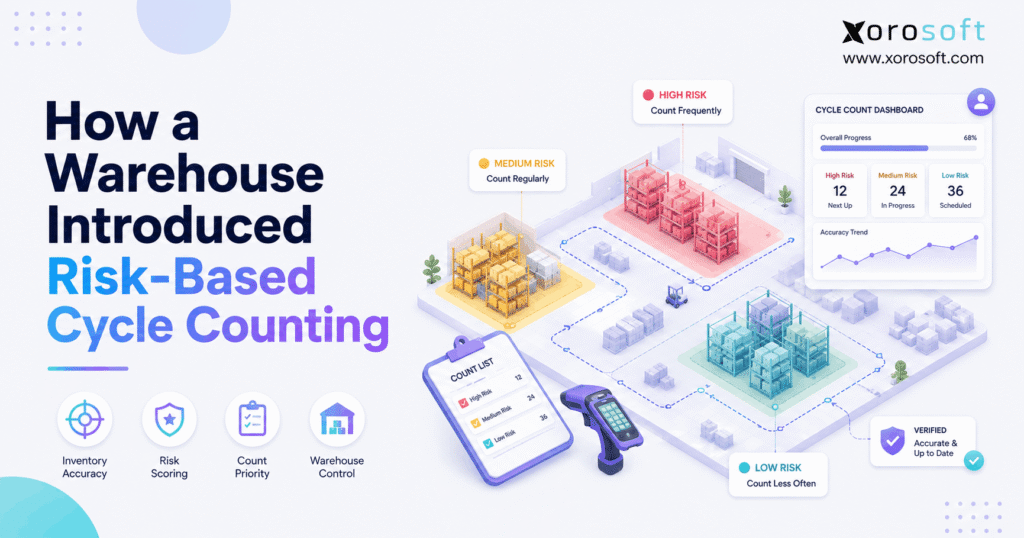
Implementing an effective warehouse cycle counting strategy is crucial for accurate inventory management and operational efficiency.
1. When Counting More Inventory Still Does Not Fix Accuracy
A warehouse cycle counting strategy should help a business find inventory problems before those problems affect purchasing, fulfillment, accounting, or customers. However, many warehouses still organize counts mainly around a calendar. As a result, employees may repeatedly count stable inventory while SKUs with frequent movements, adjustments, or previous discrepancies receive too little attention.
Therefore, the central question is not simply how much inventory the warehouse counts. Instead, the better question is whether the warehouse is counting the inventory that creates the greatest risk.
For example, one SKU may move hundreds of times during a month, while another remains untouched. Meanwhile, one location may experience recurring picking and putaway errors, whereas another remains consistently accurate. Consequently, giving both situations the same count frequency can waste labor without addressing the source of discrepancies.
Risk-based cycle counting changes that logic. Rather than treating every SKU equally, it uses measurable risk signals to determine where counting effort should go first. Therefore, counting becomes an inventory-control process instead of another warehouse task.
This article uses a representative implementation scenario and does not claim invented customer results.
2. What a Warehouse Cycle Counting Strategy Actually Controls
A warehouse cycle counting strategy defines which inventory is physically checked, how often it is counted, how employees perform the count, and what happens when the physical quantity does not match the system. Therefore, it connects inventory verification with warehouse control.
A well-designed warehouse cycle counting strategy also determines how count results influence future priorities. Consequently, the process should not end when an employee enters an adjustment.
Cycle counting verifies smaller groups of inventory recurringly. Therefore, warehouses can maintain controls without repeatedly stopping operations.
An effective cycle-counting program should answer five questions:
1. Which inventory should be counted?
2. How often should each SKU or location be counted?
3. How should the physical count be performed?
4. What should happen when a variance appears?
5. How should the result change future priorities?
Most importantly, the fifth question makes the process continuous. If results never influence future priorities, the warehouse may keep finding the same problems without reducing their recurrence.
2.1 Why Warehouse Inventory Accuracy Matters
Inventory accuracy affects more than the warehouse. For example, purchasing teams rely on accurate on-hand quantities before creating purchase orders. Similarly, sales teams rely on availability before promising stock to customers. Meanwhile, finance depends on reliable inventory records for valuation and reconciliation.
Therefore, one inaccurate quantity can affect several business functions. Additionally, the problem becomes more serious in multi-warehouse operations because inventory can exist somewhere in the company while still being unavailable in the location responsible for fulfillment.
3. What Risk-Based Cycle Counting Changes
Risk-based cycle counting prioritizes physical inventory checks according to the likelihood and potential impact of an inventory error. Therefore, instead of asking only which item is due for a count, the warehouse asks which inventory record is most important to verify now.
Consequently, a risk-based warehouse cycle counting strategy directs more attention toward inventory with higher exposure. Risk can increase because of previous discrepancies, high movement, significant value, manual adjustments, warehouse transfers, shrinkage exposure, supplier lead times, customer commitments, production dependencies, or lot and serial requirements.
Therefore, different SKUs receive different levels of attention, and the process becomes more responsive than a calendar-only approach.
3.1 Risk-Based Cycle Counting vs ABC Cycle Counting
ABC cycle counting remains useful because it often prioritizes inventory according to value or importance. However, value alone does not capture every operational risk.
For example, an inexpensive manufacturing component can stop production if the system incorrectly shows material as available. Similarly, a low-cost ecommerce SKU can create many delayed orders if its recorded quantity is wrong.
| Factor | ABC Counting | Risk-Based Counting |
|---|---|---|
| Inventory value | Major input | One input |
| Sales velocity | Sometimes considered | Commonly considered |
| Past discrepancies | Limited emphasis | Strong signal |
| Adjustment history | Usually secondary | Useful risk signal |
| Location movement | Usually secondary | Can raise priority |
| Operational impact | Limited | Explicitly considered |
| Event-driven counts | Not inherent | Can be included |
Therefore, a warehouse does not have to abandon ABC analysis. Instead, ABC classification can become one input in a broader risk model.
4. Why the Original Warehouse Cycle Counting Strategy Was Failing
The warehouse in this implementation example already performed recurring inventory counts. However, its warehouse cycle counting strategy was largely calendar-driven. Therefore, the operation was active without necessarily being risk focused.
4.1 Stable and Unstable SKUs Received Similar Attention
First, count schedules did not adequately reflect historical discrepancies. As a result, employees could spend time verifying inventory that almost always matched the system, while another product with frequent short picks and adjustments waited for its normal scheduled date.
Therefore, counting labor was not aligned with operational exposure. This weakness showed why the existing process needed to reflect SKU behavior.
4.2 Inventory Adjustments Became the End of the Process
Second, quantity correction was often treated as success. For example, if the system showed 95 units while employees found 91, the warehouse could adjust the record to 91 and close the issue.
However, four units did not disappear because the record was corrected. Therefore, the team needed to determine whether the variance came from receiving, picking, putaway, transfers, returns, damage, or another transaction.
Consequently, variance investigation became as important as the count itself.
4.3 Location Accuracy Was Underestimated
Third, total inventory could be correct while bin-level inventory was wrong. For example, the system might show 40 units in Bin A and 20 in Bin B, while the physical warehouse contains 30 in each location.
Therefore, the total remains 60, but the record is still operationally inaccurate. As a result, pickers may search the wrong bin or trigger unnecessary replenishment.
4.4 Count Frequencies Changed Too Slowly
Finally, newly problematic inventory could remain on a low-frequency schedule despite growing risk. Therefore, the team redesigned its counting process so priorities could change with warehouse conditions.
5. Building a Warehouse Cycle Counting Strategy Around Risk
The warehouse began by identifying risk signals it could measure consistently. Importantly, the objective was not to build a complicated mathematical model. Instead, the new warehouse cycle counting strategy was built around understandable evidence rather than supervisor intuition alone.
5.1 Historical Inventory Discrepancies
First, the warehouse reviewed previous cycle counts. Therefore, products with recurring quantity or location variances received higher risk scores.
Additionally, repeat discrepancies received more attention than isolated one-time differences. Consequently, the model separated occasional noise from persistent process problems.
5.2 Inventory Movement and Sales Velocity
Second, the team considered inventory movement. Every receipt, putaway, pick, replenishment, transfer, return, or adjustment creates another transaction that must match a physical movement.
Therefore, frequently moving inventory can experience more opportunities for error. However, high velocity does not automatically mean poor accuracy. Consequently, velocity works best when combined with discrepancy history.
5.3 Inventory Value and Adjustment History
Third, value remained relevant because a quantity error on expensive inventory can create greater financial exposure. Nevertheless, the warehouse cycle counting strategy did not allow inventory value to outweigh every other risk signal.
Additionally, the team reviewed manual adjustments. One justified correction may not indicate a problem. However, repeated adjustments can point to weaknesses in receiving, picking, transfers, returns, or data entry.
5.4 Warehouse Movement and Operational Impact
Similarly, products frequently moved between reserve storage, forward-pick bins, warehouses, or staging locations received additional attention.
Finally, the team considered what would happen if the record were wrong. For example, a low-value component could stop production, while an inexpensive bestseller could affect many customer orders. Therefore, operational criticality prevented the model from becoming simply another version of ABC counting.
6. Creating a Practical Inventory Risk Score
A warehouse cycle counting strategy becomes easier to execute when employees understand why an item receives a particular priority. Therefore, the warehouse created a straightforward weighted model.
| Risk Factor | Example Weight |
| Historical discrepancies | 25% |
| Inventory movement | 20% |
| Operational impact | 15% |
| Inventory value | 15% |
| Adjustment history | 15% |
| Location movement | 10% |
Each SKU-location combination could receive a score from 1 to 5 for every factor. Consequently, a product with repeated discrepancies, high movement, and strong operational impact would rank above a stable product even if both had similar inventory value.
6.1 Keep the First Model Simple
However, companies often add too many variables too early. Therefore, the first version should use only information the business can measure reliably.
For example, if adjustment history is dependable but shrinkage data is inconsistent, adjustment history is a better starting variable. Consequently, the warehouse cycle counting strategy remains practical enough for supervisors and warehouse employees to understand.
7. How Risk-Based Cycle Counting Changes Count Frequency
After scoring inventory, the team converted risk levels into counting priorities. Therefore, higher-risk inventory received more frequent verification, while stable inventory required less labor.
| Risk Tier | Illustrative Frequency | Additional Control |
| Critical | Weekly | Event-triggered verification |
| High | Every two weeks | Recount material variances |
| Medium | Monthly | Review unusual movements |
| Low | Quarterly | Routine confirmation |
However, these frequencies are examples rather than universal standards. Instead, each company should consider transaction volume, product characteristics, materiality, labor availability, and discrepancy history.
Consequently, the warehouse cycle counting strategy remains specific to the operation while still adapting as risk changes.
7.1 Add Event-Triggered Counts
A calendar should not be the only reason to count inventory. Therefore, the warehouse also identified events that could increase risk immediately, including unexpected negative inventory, large adjustments, repeated short picks, significant receiving discrepancies, warehouse relocation, unusual returns, damaged stock, or transfer differences.
Consequently, an item could be counted earlier than its normal scheduled date.
Microsoft documents threshold- and plan-based workflows in its current Dynamics 365 cycle-counting documentation. Therefore, the broader idea of system-generated count work based on configured conditions is already used in modern warehouse platforms.
7.2 Review Risk After Material Variances
Additionally, a meaningful discrepancy should influence future priority. Therefore, an SKU that repeatedly fails counts should move upward in the risk model, while consistently accurate inventory may eventually require less frequent verification.
As a result, the warehouse cycle counting strategy uses count results to improve the next count decision.
8. Piloting the New Cycle Counting Process
The warehouse did not redesign counting for every product immediately. Instead, it tested the warehouse cycle counting strategy on a manageable group of SKUs and locations.
8.1 Establish Baseline Inventory Accuracy
First, the team documented current performance, including count volume, discrepancies, adjustment values, recount frequency, repeat variances, labor, and high-error locations. Therefore, future results could be compared with a known starting point.
8.2 Select Representative Inventory
Second, the pilot included high-value SKUs, fast-moving products, historically inaccurate items, stable inventory, and several warehouse locations.
Consequently, the team could test whether the pilot correctly separated inventory requiring more attention from inventory that remained consistently accurate.
8.3 Create Recount and Escalation Rules
Third, employees were told when to accept a first count, when to recount, when to involve a supervisor, and when an adjustment required approval. Therefore, discrepancies received consistent treatment.
9. Executing the Warehouse Cycle Counting Strategy on the Floor
A sophisticated risk model is useless if physical execution is weak. Therefore, the warehouse standardized how every count was performed, because the warehouse cycle counting strategy depended as much on disciplined execution as on risk scoring.
9.1 Assign the Exact Product and Location
Each count task identified the product and physical location. Therefore, employees knew precisely which record they were validating.
Oracle’s official NetSuite WMS cycle-count plan documentation describes generating counts from cycle-count plans with item and bin criteria. Consequently, it provides a useful example of formal system-based count planning.
9.2 Use Blind Counts When Appropriate
Where appropriate, the employee did not see the system quantity before counting. Therefore, the worker recorded the physical quantity instead of unconsciously confirming an expected number.
9.3 Verify Products and Locations With Barcodes
Additionally, barcode scanning can help workers confirm the SKU and bin before recording the quantity. For businesses that need warehouse execution connected to inventory data, XoroWMS provides a cloud warehouse-management environment for inventory and fulfillment workflows.
Consequently, the process can sit inside broader receiving, movement, picking, and inventory-control workflows rather than operating as a separate spreadsheet exercise.
9.4 Control Inventory Movement During the Count
Meanwhile, transaction timing requires discipline. For example, an employee may count 20 units while another worker removes two units before the count is posted.
Therefore, the warehouse needs clear procedures for picks, receipts, replenishments, and transfers occurring around the count. Otherwise, a correct physical count can appear incorrect because system and warehouse timing are misaligned.
10. Why Inventory Variance Investigation Matters More Than Adjustment
The biggest improvement in the warehouse cycle counting strategy came from changing what happened after a discrepancy. Previously, an adjustment often closed the issue. However, the new process treated a meaningful variance as evidence.
Therefore, the warehouse cycle counting strategy treated material differences as potential signals of larger process problems.
10.1 Receiving, Putaway, and Picking Errors
For example, the warehouse might physically receive 50 units while 55 are entered. Consequently, the record is inaccurate from the moment the receipt is posted.
Similarly, inventory can be physically present but stored in the wrong bin. As a result, total quantity may be correct while pick-location accuracy remains poor.
Additionally, workers can remove the wrong quantity or pick from another location. Therefore, recurring shortages in high-volume pick faces may signal execution problems rather than random loss.
10.2 Transfer, Return, and Damage Errors
Likewise, inventory transferred physically without a matching system transaction can make two locations inaccurate at once. Therefore, both the source and destination should be reviewed.
Meanwhile, returned goods may move through inspection, quarantine, restocking, or disposal. Consequently, unclear status changes can create stock that physically exists but should not be available for sale.
10.3 Integration and Timing Problems
Finally, warehouse accuracy can be affected by disconnected systems. For example, ecommerce orders, warehouse transactions, inventory applications, and accounting systems may update at different times.
Therefore, businesses with multiple applications should review whether their Xorosoft integrations and other system connections maintain the transaction flow required for reliable inventory records.
11. Measuring Whether the Warehouse Cycle Counting Strategy Is Working
A warehouse cycle counting strategy should not be judged only by the number of counts completed. Instead, the warehouse should determine whether inventory control is improving.
11.1 Inventory Record Accuracy
One simple formula is:
Inventory Record Accuracy = Accurate Records ÷ Records Counted × 100
However, the business must first define what it considers accurate. Therefore, some products may require an exact match, while others may operate under approved tolerances.
11.2 Variance Frequency and Recurrence
Additionally, track how often counts produce discrepancies. Then, break results down by SKU, warehouse, bin, product category, process, and risk tier.
More importantly, measure whether corrected inventory becomes inaccurate again. Therefore, a successful warehouse cycle counting strategy should reduce repeated discrepancies rather than simply increase completed counts.
11.3 Adjustment Value, Labor, and Root-Cause Closure
Likewise, track the financial value of adjustments because a one-unit difference can have very different consequences across products.
Additionally, track counting labor so the warehouse can see whether effort is moving toward higher-risk inventory. Finally, track whether material discrepancies receive a documented cause and corrective action.
Consequently, cycle counting becomes a mechanism for process improvement rather than only quantity correction.
12. When Spreadsheets Stop Being Enough for Cycle Counting
A small warehouse can implement risk-based counting without buying new software. Therefore, spreadsheets may remain appropriate when SKU volume, location complexity, and transaction volume are manageable.
However, spreadsheets become harder to control when several warehouses share inventory, thousands of SKU-location combinations exist, workers require barcode execution, adjustments require approvals, or Shopify, Amazon, wholesale, and EDI orders depend on the same stock.
Consequently, the warehouse cycle counting strategy may become difficult to manage reliably without connected warehouse and inventory systems.
12.1 Where Xorosoft Fits
For inventory-driven businesses, XoroONE connects inventory, accounting, purchasing, warehouse management, manufacturing, reporting, and ecommerce operations in one ERP environment.
Therefore, the benefit is not simply automating a count task. Instead, connected data can help teams investigate how a discrepancy affects purchasing, customer orders, manufacturing, financial valuation, and channel availability.
As a result, the warehouse cycle counting strategy can become part of a wider operational control system rather than an isolated warehouse activity.
13. How Risk-Based Cycle Counting Changes Across Industries
Risk does not look identical in every business. Therefore, the warehouse cycle counting strategy should reflect product characteristics and operating conditions.
13.1 Apparel, Wholesale, and Furniture
Apparel operations often manage many style, size, and color combinations. Consequently, fast-moving variants, returns, and frequent bin movement can increase risk.
Meanwhile, wholesale operations can face high order-line volume, customer commitments, EDI workflows, and allocation requirements. Therefore, one inaccurate quantity may affect several downstream processes.
13.2 Sporting Goods, Food, and Manufacturing
Sporting-goods risk can change rapidly with seasonality. Therefore, yesterday’s low-risk SKU may become tomorrow’s high-volume item.
Food and beverage operations may require lot, expiration, and status controls in addition to quantity accuracy. Similarly, manufacturing can depend on low-cost components that are operationally critical.
Consequently, the warehouse cycle counting strategy should consider the cost of an error and the operational consequence of that error.
Businesses evaluating these differences can review the range of industries Xorosoft serves for additional operational context.
14. Common Warehouse Cycle Counting Strategy Mistakes to Avoid
Even a well-designed warehouse cycle counting strategy can fail when execution becomes unnecessarily complicated or responsibilities are unclear.
14.1 Counting Every SKU With the Same Logic
First, equal treatment ignores differences in probability and impact. Therefore, count frequency should reflect actual operational conditions.
14.2 Using Inventory Value as the Only Risk Signal
Second, monetary value is useful but incomplete. For example, low-value products may still affect major customers or production. Therefore, combine value with movement, discrepancy history, adjustment activity, and operational impact.
14.3 Correcting Inventory Without Correcting Processes
Third, adjustments can hide recurring operational failures. Therefore, material discrepancies should lead to root-cause investigation.
14.4 Never Updating Risk Scores
Additionally, inventory behavior changes. Consequently, the warehouse cycle counting strategy should be reviewed as movement, sales, errors, and business priorities change.
15. Who Needs a More Advanced Warehouse Cycle Counting Strategy?
Not every company needs a formal risk-scoring model. However, a more advanced warehouse cycle counting strategy becomes increasingly useful when operations include hundreds or thousands of SKUs, high movement, multiple warehouses, frequent adjustments, recurring discrepancies, lot controls, manufacturing dependencies, or several sales channels.
Conversely, a small operation with a few products, one stockroom, and consistently reliable inventory may need only a simple recurring schedule. Therefore, complexity should determine the control method.
15.1 Signs the Current Process Has Been Outgrown
Warning signs include repeated short picks despite available stock, purchasing decisions based on quantities that cannot be found, excessive reconciliation work, frequent adjustments, and recurring discrepancies. Consequently, the business should investigate execution, process design, and system connectivity together.
Relevant Xorosoft case studies can provide additional operational context. Therefore, the warehouse cycle counting strategy should be evaluated as part of the wider inventory-control environment when these symptoms appear repeatedly.
16. A Practical Eight-Step Risk-Based Cycle Counting Framework
A warehouse does not need to redesign everything at once. Instead, a controlled warehouse cycle counting strategy can be introduced through eight steps.
16.1 Step 1: Establish the Baseline
First, measure current accuracy, discrepancies, adjustments, recounts, and labor. Therefore, the business knows what it is trying to improve.
16.2 Step 2: Select Risk Factors
Next, choose measurable factors such as previous discrepancies, movement, value, adjustments, location complexity, and operational impact.
16.3 Step 3: Score Inventory
Then, assign understandable scores so supervisors can explain why one product has higher priority than another.
16.4 Step 4: Create Risk Tiers
Afterward, group scores into practical levels such as critical, high, medium, and low.
16.5 Step 5: Assign Count Frequencies
Next, create frequencies that reflect risk. However, treat those frequencies as starting points rather than permanent rules.
16.6 Step 6: Add Exception Triggers
Additionally, define events that justify immediate verification. Consequently, unusual activity can override the calendar.
16.7 Step 7: Investigate Material Variances
Then, require root-cause analysis where appropriate. Therefore, counting generates process improvement instead of endless adjustments.
16.8 Step 8: Recalculate and Improve
Finally, use new count results to update risk. Consequently, the warehouse cycle counting strategy becomes adaptive instead of static.
17. Practical Takeaways for Warehouse Leaders
Risk-based cycle counting does not mean counting everything more frequently. Instead, it means making better decisions about where counting labor creates the most value.
Therefore, warehouse leaders should understand which inventory becomes inaccurate most often, why discrepancies happen, and what consequences follow.
Ultimately, the warehouse cycle counting strategy should redirect attention toward the inventory that presents the greatest current risk. Consequently, stable inventory may need less attention, while repeated discrepancies should trigger both more scrutiny and process investigation.
18. Frequently Asked Questions About Warehouse Cycle Counting
18.1 What Is a Warehouse Cycle Counting Strategy?
A warehouse cycle counting strategy determines which inventory is physically verified, how frequently it is counted, how workers perform the verification, and how discrepancies are investigated. Therefore, it connects cycle counting with ongoing inventory control. Additionally, stronger strategies use previous results to change future priorities rather than treating every count as an isolated task.
18.2 What Is Risk-Based Cycle Counting?
Risk-based cycle counting prioritizes inventory according to the probability and potential impact of an error. Therefore, products with frequent movements, repeated discrepancies, high value, adjustment activity, or operational importance may receive more frequent verification. Meanwhile, consistently stable inventory can receive less attention.
18.3 How Does Risk-Based Cycle Counting Work?
First, the warehouse selects measurable risk factors. Next, it scores SKUs or locations against those factors. Then, inventory is grouped into priority tiers. Consequently, higher-risk inventory receives more frequent counts. Finally, new count results update future risk decisions.
18.4 How Is Risk-Based Cycle Counting Different From ABC Counting?
ABC counting generally emphasizes inventory classification, often using financial importance as a major factor. However, risk-based counting considers additional signals such as prior discrepancies, movement, adjustments, location activity, and operational impact. Therefore, ABC classification can remain useful while becoming only one part of the broader model.
18.5 What Makes an SKU High Risk?
A high-risk SKU has a greater likelihood of becoming inaccurate, creates greater consequences when inaccurate, or both. For example, repeated discrepancies, frequent movement, large adjustments, high value, customer commitments, and manufacturing dependency can all raise risk. Therefore, risk should include both probability and impact.
18.6 How Often Should High-Risk Inventory Be Counted?
There is no universal frequency. Instead, the warehouse should consider transaction volume, discrepancy history, product characteristics, materiality, available labor, and operational requirements. Therefore, one business may count critical items weekly while another chooses a different cadence.
18.7 Should Fast-Moving SKUs Be Counted More Often?
Often, fast-moving products deserve greater attention because more transactions create more opportunities for handling or recording errors. However, velocity should not operate alone. Therefore, a high-volume SKU with excellent historical accuracy may require less attention than another item with persistent discrepancies.
18.8 Should High-Value Inventory Be Counted More Frequently?
Potentially, because quantity errors on expensive inventory can create greater financial exposure. Nevertheless, value alone should not determine priority. Therefore, a low-value component that stops production or a high-volume ecommerce SKU can also deserve a high risk score.
18.9 How Do You Calculate Cycle Count Accuracy?
A simple formula is accurate inventory records divided by total records counted, multiplied by 100. However, the business must first define what “accurate” means. Therefore, companies should determine whether they require an exact match or allow documented tolerances.
18.10 What Causes Warehouse Inventory Discrepancies?
Common causes include receiving mistakes, putaway errors, picking errors, missed transfers, returns, damage, shrinkage, incorrect units of measure, timing problems, integration issues, and manual adjustments. Therefore, material discrepancies should usually be followed by transaction review rather than only a quantity correction.
18.11 What Is a Blind Cycle Count?
A blind count prevents the employee from seeing the expected system quantity before counting. Therefore, the worker records what is physically present instead of confirming a displayed number. Afterward, the result is compared with the inventory record and any required recount or investigation begins.
18.12 What Happens After a Cycle Count Discrepancy?
First, determine whether a recount is required. Next, review recent receiving, picking, transfers, returns, and adjustments. Then, process any confirmed correction through the required approval workflow. Finally, recurring or material errors should trigger corrective action.
18.13 Can Cycle Counting Replace a Full Physical Inventory?
In some environments, strong cycle counting can reduce reliance on disruptive full counts. However, accounting, audit, regulatory, and internal-control requirements vary. Therefore, companies should confirm their specific obligations with appropriate accounting and audit professionals before changing formal inventory procedures.
18.14 How Many SKUs Should a Warehouse Count Each Day?
There is no single correct number. Instead, count volume depends on SKU population, risk levels, warehouse labor, counting complexity, and desired coverage. Therefore, a risk-based program should focus on whether important inventory receives sufficient verification rather than chasing a fixed daily number.
18.15 What Is Event-Driven Cycle Counting?
Event-driven cycle counting creates an additional verification after a predefined operational event. For example, a large adjustment, negative inventory balance, unusual return, location move, receiving discrepancy, or repeated short pick may trigger a count. Consequently, the warehouse can respond to changing risk without waiting for the next scheduled date.
18.16 Can Barcode Scanning Improve Cycle Counting?
Yes. Barcode scanning can help workers verify the SKU and warehouse location before recording the physical quantity. Therefore, scanning can reduce identification errors and support a more controlled workflow. However, barcode technology should still be backed by clear recount, approval, and adjustment procedures.
18.17 Can a WMS Automate Cycle Counting?
A WMS can automate or support task creation, mobile execution, barcode identification, variance handling, approvals, and reporting. Therefore, automation becomes especially useful when the warehouse has many SKU-location combinations, multiple workers, or frequent count activity.
18.18 Can ERP Software Manage Cycle Counting?
ERP systems with warehouse-management capabilities can connect count results with inventory, purchasing, sales, accounting, and reporting workflows. Consequently, a discrepancy can be investigated in a broader operational context. However, capabilities differ between systems, so businesses should evaluate the full workflow.
18.19 How Does Multi-Warehouse Inventory Change Cycle Counting?
The same SKU can have different risk in different locations. For example, one warehouse may experience heavy movement while another holds stable reserve inventory. Therefore, businesses with several facilities may benefit from calculating risk by SKU-location instead of assigning one company-wide score.
18.20 What KPIs Should Be Used for Cycle Counting?
Useful measures include inventory record accuracy, discrepancy frequency, adjustment value, recount rate, recurring discrepancies, labor hours, count completion, and root-cause closure. Therefore, companies should evaluate several measures together rather than relying only on one accuracy percentage.
18.21 When Should a Business Move Beyond Spreadsheet Cycle Counting?
Spreadsheets become limiting when SKU volumes, locations, warehouses, approvals, barcode requirements, sales channels, and adjustments become difficult to coordinate. Therefore, the decision should be based on process complexity and control gaps rather than company size alone.
18.22 Why Do Inventory Discrepancies Keep Returning?
Recurring discrepancies usually indicate that the underlying process has not been corrected. For example, a warehouse may repeatedly adjust an SKU without fixing the receiving, picking, transfer, return, or integration issue creating the variance. Therefore, repeat errors should trigger root-cause investigation.
18.23 Should Low-Risk Inventory Still Be Counted?
Yes. Low risk does not mean zero risk. Instead, the warehouse can verify stable inventory less frequently while focusing more labor on higher-risk records. Therefore, the program maintains broad inventory coverage without allocating equal effort to every SKU.
18.24 How Often Should Risk Scores Be Reviewed?
Risk should be reviewed often enough to reflect meaningful operational changes. For example, sales velocity, new products, seasonal demand, recurring discrepancies, or warehouse moves can change priorities. Therefore, companies should avoid creating a risk classification once and leaving it unchanged indefinitely.
18.25 What Is the Biggest Cycle Counting Mistake?
The biggest mistake is treating the count adjustment as the final objective. Instead, cycle counting should expose weaknesses in receiving, putaway, picking, transfers, returns, or system processes. Consequently, success means preventing repeated errors, not simply correcting quantities faster.
19. Turn Cycle Counting Into an Inventory-Control System
A warehouse cycle counting strategy becomes valuable when it changes more than the count schedule. First, risk signals identify where inaccurate inventory is most likely or most damaging. Next, those signals determine count priorities. Then, employees verify inventory through controlled procedures. Finally, discrepancies feed root-cause analysis and future risk decisions.
Therefore, the process becomes continuous. Additionally, mature operations connect warehouse counts with the systems that manage purchasing, orders, accounting, ecommerce, and manufacturing. Consequently, inventory accuracy becomes a shared operational control rather than a warehouse-only responsibility.
For growing inventory-driven businesses, Xorosoft provides cloud ERP and WMS capabilities designed to connect these workflows while supporting real-time warehouse operations and multi-channel inventory management. Moreover, ecommerce businesses can review Xorosoft on the Shopify App Store when evaluating how Shopify operations connect with broader ERP workflows.
Ultimately, the goal is to identify inventory risk, verify it intelligently, and prevent repeat discrepancies.
If disconnected warehouse, inventory, purchasing, or accounting processes are making that difficult, you can Book a Demo to evaluate how a connected ERP and WMS environment could fit your operation.
Recent Posts
-
 B2B Platform API Requirements: What ERP, WMS, CRM, and PIM Data Must Move in Real Time
 -
 Warehouse AI Data Requirements: What a WMS Must Capture Before AI Can Be Useful
 -
 Why Marketplace Inventory Sync Fails During Sales Spikes
 -
 How B2B Ecommerce Software Handles Customer Credit Changes Between Order Entry and Warehouse Release
 -
 Which Inventory Management Tools Should a Multi-Warehouse Business Use for Scanning, Replenishment, and Transfers?