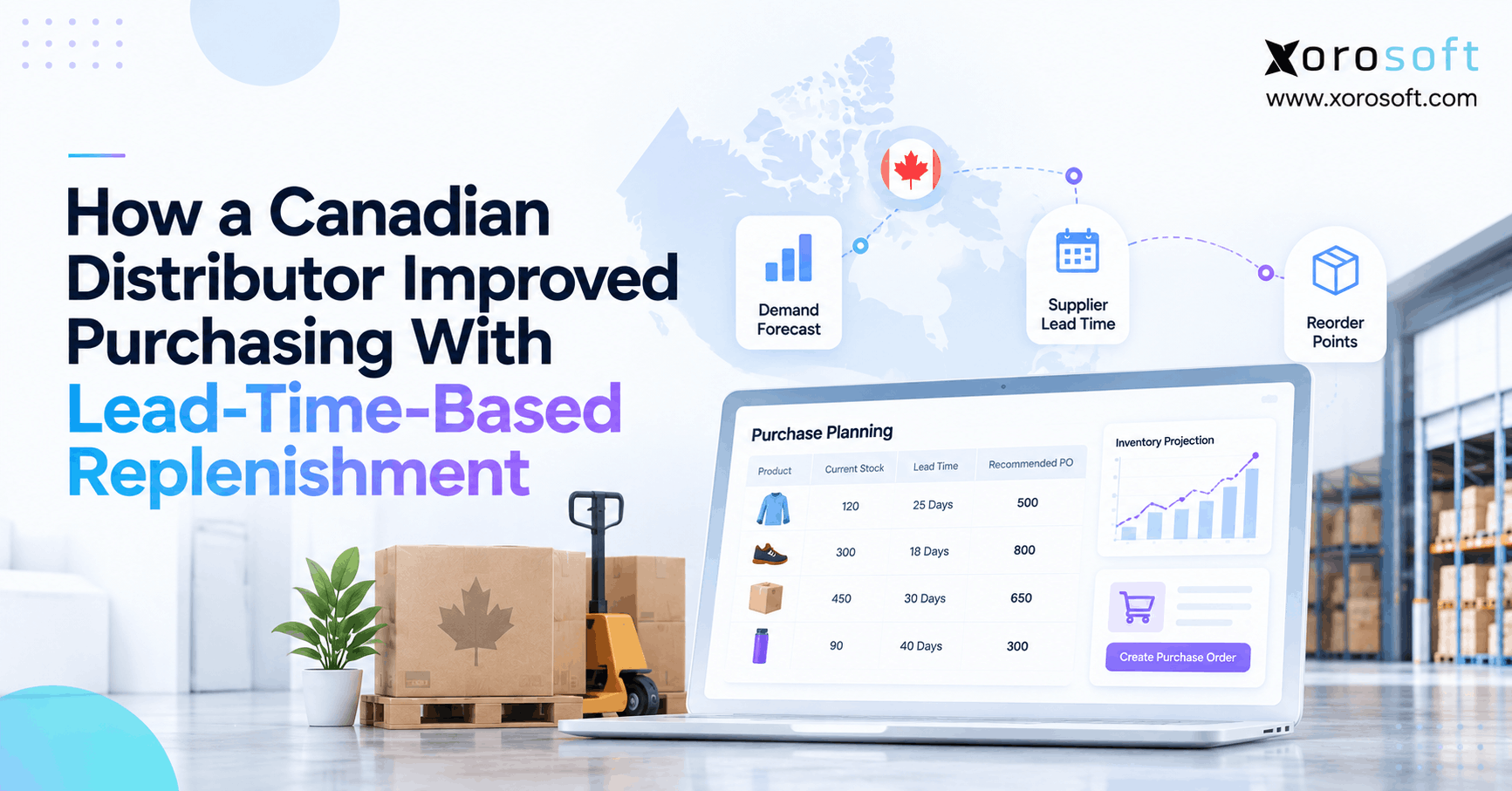
One crucial factor in inventory management is understanding lead time replenishment.
1. Lead Time Replenishment Starts With Better Purchasing Visibility
Lead time replenishment gives purchasing teams a better way to decide when inventory should be ordered. Instead of asking only how much stock is available today, the distributor also considers how much demand may occur before replacement inventory can actually arrive.
Therefore, timing becomes part of every important purchasing decision.
For a growing Canadian distributor, that change matters because suppliers rarely operate on identical schedules. For example, one vendor may consistently deliver in two weeks, while another may need more than a month. Meanwhile, demand can move differently across products, warehouses, seasons, and customer groups.
As a result, quantity on hand alone does not provide enough context.
1.1 Why Traditional Purchasing Starts to Fail
At first, experienced buyers can often manage purchasing with spreadsheets, fixed minimums, and supplier knowledge.
However, the process becomes harder as the SKU count grows. In addition, every new supplier, warehouse, and sales channel creates more purchasing variables.
For example, a buyer may know that one supplier has recently started shipping late. Nevertheless, the spreadsheet may still show the old lead time.
Consequently, buyers begin overriding system recommendations.
Once manual overrides become normal, the business effectively operates two purchasing systems. One exists in the spreadsheet, while the other exists in the buyer’s head.
Therefore, purchasing becomes difficult to standardize, audit, and scale.
1.2 How Lead Time Replenishment Changes the Buying Decision
Lead-time-based planning asks a more useful question:
Will available and incoming inventory cover demand until new supply can arrive?
Therefore, buyers no longer react only when quantity falls below a fixed threshold.
Instead, they consider expected demand, supplier timing, committed orders, incoming purchase orders, and safety stock together.
For example, 1,000 units may appear healthy today. However, if 800 units are already committed and the next supplier delivery requires 30 days, the purchasing position looks very different.
As a result, the distributor can identify risk earlier instead of waiting for physical stock to become critically low.
2. What Lead Time Replenishment Actually Means
Lead-time-based purchasing does not require an unnecessarily complex formula. However, it does require accurate assumptions about demand, inventory, and supplier timing.
2.1 Supplier Timing Versus Actual Availability
Supplier lead time generally describes the period between placing or confirming a purchase order and receiving the goods.
However, usable inventory may take longer to become available.
For example, the total process may also include internal approval, supplier processing, transportation, customs clearance, receiving, inspection, and warehouse putaway.
Therefore, distributors should define exactly what their lead-time measurement covers.
Otherwise, purchasing may assume a product needs 20 days to replenish while the warehouse consistently needs another three days before the stock becomes available for customer orders.
Consequently, even a small timing gap can affect fast-moving inventory.
2.2 How Lead Time Replenishment Uses Demand During the Wait
A basic lead-time demand calculation is:
Lead-Time Demand = Average Daily Demand × Supplier Lead Time
For example, suppose a SKU sells 20 units per day and normally takes 25 days to arrive.
The expected demand during that period is:
20 × 25 = 500 units
Therefore, the distributor may consume approximately 500 units before replacement inventory arrives.
However, that number is only a baseline.
If a promotion, seasonal peak, or large wholesale order is approaching, average demand may understate the actual requirement.
As a result, buyers should combine historical consumption with known forward demand whenever possible.
3. Why Fixed Reorder Points Became Unreliable
The distributor originally relied on fixed reorder points because they were easy to understand and maintain.
However, the assumptions behind those thresholds did not remain fixed.
3.1 Demand Changed While Reorder Rules Stayed Static
Suppose an item originally sold 15 units per day and had a reorder point of 500 units.
Later, average demand increased to 25 units per day.
Although the reorder point remained unchanged, the 500 units now covered far fewer selling days.
Therefore, the distributor could reach the same reorder point while facing much greater stockout risk.
Seasonality created another problem.
For example, apparel, sporting goods, furniture, and consumer products can experience meaningful changes in demand during promotional or seasonal periods.
Consequently, one static number could not always represent future inventory requirements accurately.
3.2 How Supplier Lead Time Planning Exposed Hidden Risk
Supplier performance also changed over time.
For example, a vendor that previously delivered within 18 days might gradually move toward 25 days.
However, if the purchasing spreadsheet still used 18 days, replenishment would continue triggering too late.
Therefore, supplier lead times needed regular review.
At this point, the distributor’s challenge extended beyond one purchasing spreadsheet. Inventory, orders, suppliers, warehouse activity, and financial data increasingly needed to work together.
That is why broader operational solutions become relevant as distribution complexity increases.
Instead of replacing one spreadsheet with another isolated tool, the goal is to create a consistent operating picture.
4. How Lead Time Replenishment Improves Reorder Decisions
A stronger replenishment model combines expected consumption with a buffer for uncertainty.
Therefore, the reorder point becomes more responsive to operating conditions.
4.1 Start With Average Daily Demand
First, the distributor estimates expected consumption during supplier lead time.
For relatively stable SKUs, recent daily demand can provide a practical starting point.
However, buyers should still review whether the recent period represents normal demand.
For example, unusually high sales during a short promotion should not automatically become the new long-term baseline.
Likewise, demand may rise predictably before a seasonal peak.
Therefore, planners need judgment as well as calculations.
The objective is not mathematical perfection. Instead, the goal is to produce a reasonable expectation of how much stock customers will require before replenishment becomes available.
4.2 Add Safety Stock Without Overbuying
Safety stock protects against uncertainty.
Therefore, a simple reorder formula can be written as:
Reorder Point = Lead-Time Demand + Safety Stock
Suppose lead-time demand equals 500 units and the distributor maintains another 150 units as protection.
The resulting reorder point becomes:
500 + 150 = 650 units
However, more safety stock is not automatically better.
Although a larger buffer can reduce shortage risk, it also increases inventory investment.
Consequently, safety stock should reflect demand variability, supplier reliability, customer service expectations, and the cost of running out.
Otherwise, buyers may use excess inventory to hide inaccurate supplier or demand data.
5. Inventory Position Matters More Than Quantity on Hand
Physical inventory tells buyers what exists in the warehouse.
However, purchasing needs to understand what is actually available for future demand.
5.1 Include Inbound Purchase Orders
Suppose a warehouse has 700 units available today.
Meanwhile, another 800 units are scheduled to arrive next week.
If the inbound purchase order is reliable, creating another large PO may produce unnecessary inventory.
Therefore, replenishment needs visibility into open supply.
However, timing remains essential.
A purchase order arriving tomorrow provides very different protection from one arriving 45 days later.
Consequently, buyers need quantity, expected receipt date, and current PO status together.
Otherwise, inbound stock can create false confidence even when it will arrive after the projected shortage.
5.2 Lead Time Replenishment Must Account for Committed Inventory
Customer commitments create the opposite problem.
For example, a warehouse may physically contain 1,200 units. However, if 700 units are already allocated to confirmed orders, the freely available quantity is much lower.
Therefore, purchasing should consider reserved and committed inventory.
A connected XoroERP environment can bring inventory, purchasing, orders, and financial activity into the same operational system.
As a result, buyers do not have to treat every physical unit as unrestricted inventory.
Instead, purchasing decisions can reflect the inventory position that actually matters to future fulfillment.
6. Supplier Performance Shapes Lead Time Replenishment
A quoted supplier lead time is useful when purchasing begins.
However, actual receipt history provides stronger information as the relationship develops.
6.1 Compare Promised Dates With Actual Receipts
Suppose a supplier promises delivery within 21 days.
Recent purchase orders may actually arrive in:
19 days, 21 days, 23 days, 28 days, and 30 days.
Therefore, a permanent 21-day assumption may underestimate current purchasing risk.
Instead, buyers should compare expected and actual receipt dates.
As a result, late suppliers become visible before repeated shortages appear.
Moreover, the company gains evidence for supplier conversations.
Rather than saying a supplier “feels slower,” purchasing can identify how frequently receipts miss expected dates.
6.2 Use Supplier Lead Time Planning to Manage Variability
Average lead time also hides variability.
For example, Supplier A may consistently deliver between 19 and 21 days. Supplier B may average 20 days but fluctuate between 12 and 32.
Although their averages look similar, Supplier B creates significantly more planning uncertainty.
Therefore, buyers should consider consistency as well as average delivery time.
Consequently, unreliable suppliers may justify different buffers, earlier ordering, alternate sourcing, or closer exception monitoring.
Each completed purchase order then becomes new planning data.
As a result, supplier lead time becomes a living operating input instead of a number entered once and forgotten.
7. Multi-Warehouse Purchasing Changes the Equation
As the distributor added warehouse complexity, company-wide inventory totals became less useful.
Therefore, purchasing needed a location-level view.
7.1 Compare Transfer Stock Before Buying More
Suppose the business owns 3,000 units nationally.
However:
Toronto may hold 2,200 units, Vancouver may hold 650, and Calgary may hold only 150.
Although total inventory looks healthy, Calgary could still face an immediate shortage.
Therefore, the business should consider whether an internal transfer can solve the requirement before creating another supplier PO.
In some situations, transferring stock is faster and cheaper.
However, the source warehouse must still retain enough inventory for its own future demand.
Consequently, transfer decisions also require forward-looking inventory information.
7.2 Use Lead Time Replenishment at the Warehouse Level
Warehouse accuracy directly affects purchasing quality.
For example, if a transfer was shipped yesterday but has not been recorded correctly, buyers may believe inventory exists in the wrong location.
Likewise, delayed receiving can make inbound stock appear unavailable even though it is physically at the warehouse.
Therefore, warehouse transactions need timely posting.
A connected XoroWMS helps tie receiving, transfers, picking, inventory movements, and warehouse visibility into the broader operating process.
As a result, replenishment decisions can use more current location-level information instead of relying on stale warehouse totals.
8. Lead Time Replenishment Moves Buyers Toward Exception Management
A growing purchasing team should not spend most of its time checking healthy SKUs.
Instead, buyers should focus on items where conditions have changed.
8.1 Focus Buyers on Projected Shortages
Previously, buyers may have reviewed hundreds of spreadsheet rows during a weekly purchasing cycle.
However, many of those products required no action.
Therefore, the process consumed time without necessarily improving decisions.
An exception-based workflow surfaces problems such as projected shortages, delayed POs, unexpected demand, low safety stock, or supplier timing changes.
Consequently, the buyer spends less time searching for issues.
Instead, attention shifts toward the decisions that actually require expertise.
This becomes especially valuable as SKU count and warehouse complexity increase.
8.2 Let Purchasing Automation Surface Unusual Conditions
Automation should support buyer judgment rather than eliminate it.
For example, software may recommend additional inventory because demand recently increased.
However, the buyer may know that the increase came from a one-time customer order.
Therefore, human review still matters.
XoroONE provides a connected operating environment where purchasing can work alongside inventory and other business processes.
As a result, purchasing automation can surface relevant exceptions while buyers continue applying commercial and supplier knowledge.
The objective is better prioritization, not blind purchasing.
9. Ecommerce Demand Must Reach Purchasing
Wholesale distributors increasingly manage demand from more than one channel.
Therefore, replenishment cannot rely on wholesale order history alone.
9.1 Connect Shopify and Marketplace Demand
A distributor may sell through wholesale accounts while also receiving orders through Shopify, Amazon, or other ecommerce channels.
If these orders sit outside the main planning environment, purchasing can underestimate total demand.
Therefore, integrations become part of replenishment accuracy.
Xorosoft’s integrations help connect commerce and operational systems so order activity does not remain isolated from inventory and purchasing.
Consequently, buyers get a broader view of demand rather than reconciling separate sales channels manually.
This is especially important during promotions, channel growth, or seasonal demand spikes.
9.2 Inventory Replenishment Planning Needs Total Channel Demand
Purchasing should consider all meaningful sources of demand.
For example, a SKU may look slow in the wholesale channel while ecommerce demand is increasing rapidly.
Therefore, channel-specific analysis still matters.
However, the final purchasing decision should reflect total inventory exposure.
For Shopify merchants, the Xorosoft ERP listing on the Shopify App Store provides an external reference for the ERP integration available to Shopify businesses.
As a result, ecommerce order activity can become part of a broader operational workflow rather than an isolated storefront process.
10. Lead Time Replenishment Helps Protect Working Capital
Poor purchasing can create either too little inventory or too much.
Therefore, effective replenishment needs to balance availability with cash investment.
10.1 Balance Service Levels With Inventory Investment
Ordering earlier can reduce shortage risk.
However, it also means cash leaves the business sooner.
Likewise, larger buffers consume warehouse space and increase exposure to slow-moving inventory.
Therefore, the objective should not be maximum inventory.
Instead, the distributor needs enough inventory to support service requirements without purchasing unnecessarily early.
For example, a highly reliable domestic supplier may require a smaller buffer than an overseas supplier with inconsistent delivery times.
Consequently, purchasing policies should reflect the actual risk profile of each supply relationship.
10.2 Segment SKUs Instead of Using One Buffer
Not every product deserves the same replenishment rule.
For example, high-volume products may justify stronger protection because a shortage affects many orders.
However, slow-moving items may require tighter purchasing controls.
Similarly, products with high margins or strategic customer importance may justify a different service target.
Therefore, distributors can segment items using factors such as sales velocity, margin, supplier reliability, seasonality, replacement difficulty, and inventory value.
As a result, safety stock and replenishment rules better reflect the economics of each product group.
11. When Spreadsheet Purchasing Stops Scaling
Spreadsheets are not automatically a poor purchasing tool.
However, their usefulness depends on operational complexity.
11.1 Recognize the Warning Signs
A distributor with one warehouse, limited SKUs, and predictable suppliers may manage effectively with spreadsheets.
However, warning signs appear as complexity increases.
For example, buyers may maintain separate files, repeatedly override reorder points, expedite more purchase orders, or manually reconcile warehouse inventory.
Meanwhile, supplier timing may change faster than spreadsheet parameters are updated.
Consequently, purchasing recommendations become harder to trust.
Another warning sign appears when buyers cannot easily explain why a particular quantity was recommended.
At that point, the business may have outgrown a manually maintained planning model.
11.2 Lead Time Replenishment Becomes Harder Across Disconnected Systems
Purchasing complexity becomes more difficult when inventory, orders, warehousing, accounting, and supplier information live in separate systems.
Therefore, ERP becomes relevant when those workflows depend on the same transactions.
For inventory-driven distributors, Xorosoft brings these functions into a connected cloud ERP environment.
Moreover, the company’s industries coverage reflects similar operational requirements across wholesale, apparel, furniture, sporting goods, manufacturing, and other product-based businesses.
As a result, companies can evaluate purchasing as part of the broader operating model instead of treating replenishment as a standalone spreadsheet exercise.
12. Building a Better Lead Time Replenishment Process
A strong process begins with accurate inputs.
Therefore, automation should follow data cleanup rather than replace it.
12.1 Measure Actual Supplier Performance
First, compare promised receipt dates with actual receipt dates.
Then, identify suppliers whose delivery behaviour has changed.
For example, a vendor that moved from 20 days to 27 days should not continue using the old planning assumption indefinitely.
Moreover, buyers should review whether longer lead time is temporary or structural.
Therefore, supplier conversations remain important.
Once the business understands actual performance, purchasing can update its assumptions rather than compensating with arbitrary inventory buffers.
12.2 Update Lead Time Replenishment Rules as Conditions Change
Next, estimate demand during the supplier lead time.
Then, review safety stock, open purchase orders, committed demand, warehouse transfers, and supplier constraints.
For example, minimum order quantities or case packs may require the business to purchase more than the calculated shortage.
However, that does not mean the mathematical recommendation should be ignored.
Instead, buyers should understand the difference between the ideal inventory requirement and the operational order quantity.
Finally, replenishment parameters should be reviewed continuously.
Demand changes, suppliers change, and warehouses change.
Therefore, the model should change as well.
13. What Distributors Should Measure After the Change
Purchasing improvement should not be judged from one metric.
Instead, the distributor should monitor several connected outcomes.
13.1 Track Stockouts, Expedites, and Aging Inventory
First, monitor how often priority products become unavailable.
Next, track emergency purchase orders and supplier expedites.
If urgent orders remain common, the business may still have weak demand assumptions, outdated lead times, or poor inventory accuracy.
Meanwhile, aging inventory also deserves attention.
For example, service levels may improve while excess stock grows rapidly.
Therefore, higher availability alone does not prove that replenishment has improved.
Instead, the business should evaluate service and inventory investment together.
13.2 Measure Whether Lead Time Replenishment Is Improving Purchasing
Supplier lead-time accuracy is another important measure.
For example, compare expected arrival dates with actual receipts.
In addition, monitor purchase-order changes, cancellations, and unusual quantity increases.
Frequent changes may indicate unstable planning assumptions.
Businesses evaluating broader operational improvements can also review Xorosoft’s case studies for examples of how inventory-driven companies connect ERP processes.
Ultimately, better replenishment should make purchasing more predictable, explainable, and responsive to real operating conditions.
14. Lead Time Replenishment Creates Better Purchasing Context
The biggest improvement was not one formula.
Instead, the distributor improved purchasing by connecting demand, inventory, supplier timing, inbound supply, and warehouse activity.
14.1 Connect Inventory, Purchasing, Warehouse, and Finance
Purchasing decisions affect much more than purchase orders.
For example, a new PO influences future inventory, cash requirements, warehouse capacity, and accounts payable.
Likewise, delayed receipts can affect customer fulfillment and revenue timing.
Therefore, purchasing works best when those processes share accurate data.
As the distributor’s operation becomes more complex, connected systems help reduce the number of manual handoffs between teams.
Consequently, buyers can focus on supplier strategy and exceptions rather than reconciling several versions of inventory.
14.2 Keep Lead Time Replenishment Grounded in Real Operating Data
Lead time replenishment works best when its assumptions stay connected to reality.
Therefore, supplier timing should come from current performance, demand should reflect active channels, and available inventory should reflect real warehouse activity.
Moreover, buyers should continue reviewing exceptions rather than trusting automation blindly.
For distributors that have outgrown disconnected purchasing spreadsheets, inventory tools, and warehouse systems, an integrated ERP can provide the shared operational foundation that replenishment requires.
If your team is reaching that point, Book a Demo to see how Xorosoft connects purchasing, inventory, warehouse management, orders, and financial workflows in one cloud ERP environment.
Frequently Asked Questions
What is lead time replenishment?
Lead time replenishment uses expected demand, supplier delivery time, inventory availability, inbound supply, and safety stock to determine when additional inventory should be ordered.
How do you calculate lead-time demand?
Multiply average daily demand by supplier lead time. However, seasonal demand, promotions, and confirmed customer orders may require adjustments to the basic calculation.
What is a reorder point?
A reorder point is the inventory threshold that signals replenishment should begin. It commonly combines expected demand during supplier lead time with a safety-stock buffer.
How does safety stock affect replenishment?
Safety stock protects against unexpected demand or supply delays. However, excessive safety stock can tie up working capital and hide inaccurate planning assumptions.
Should distributors use actual supplier lead times?
Yes. Actual receipt history helps reveal whether quoted lead times still reflect reality. Therefore, planners should review expected versus actual supplier performance regularly.
Can lead time replenishment work across multiple warehouses?
Yes. However, planning should use location-level inventory, demand, transfers, commitments, and inbound supply rather than relying only on company-wide inventory totals.
When should a distributor automate replenishment?
Automation becomes valuable when SKU counts, warehouses, suppliers, and sales channels make manual purchasing difficult to maintain accurately and consistently.
Recent Posts
-
How a Canadian Distributor Improved Purchasing With Lead Time Replenishment
-
 Shopify WMS: When Does a Warehouse Need a Dedicated System?
 -
 B2B Ecommerce vs Rep-Led Ordering: Which Transactions Should Move to Self-Service First?
 -
 Manufacturing Inventory Statistics 2026: Accuracy, Downtime, and Material Shortages
 -
 B2B Ecommerce Platforms for Manufacturers: Dealer Networks, Replacement Parts, and Account-Specific Catalogs