Inventory visibility software is essential for businesses seeking real-time control over their stock levels and supply chain management.
1. Why Inventory Visibility Breaks as Product Businesses Grow
Inventory visibility software helps product businesses understand what stock they have, where it is, what is available to sell, what is already committed, and what is coming next. At first, this sounds simple. However, once a company sells across multiple channels, stores inventory in more than one warehouse, manages purchase orders, handles wholesale accounts, or runs manufacturing workflows, inventory visibility becomes much harder to maintain.
In the early stage, a small team can often manage stock with a basic inventory app, Shopify inventory tools, or a spreadsheet. Because the operation is still simple, the team usually knows where products are. However, growth changes the problem completely. Orders begin coming from Shopify, Amazon, wholesale customers, EDI partners, marketplaces, and sales reps. Meanwhile, inventory moves through receiving, picking, packing, transfers, returns, production, adjustments, and accounting.
Therefore, inventory is no longer just a number. It becomes an operating signal.
That signal affects every department. Sales teams need to know what they can promise. Warehouse teams need to know what they can pick. Purchasing teams need to know what they should reorder. Finance teams need to know what inventory is worth. Leadership needs to know where cash is tied up.
However, when every system shows a different number, nobody has true visibility. Shopify may show one stock count. The warehouse may show another. QuickBooks may show a different value. Purchasing may depend on a separate spreadsheet. As a result, the business starts making decisions from disconnected data.
This guide explains what inventory visibility software is, how it works, who needs it, how it compares with ERP and WMS platforms, and when a growing business should upgrade from disconnected systems.
2. What Is Inventory Visibility Software?
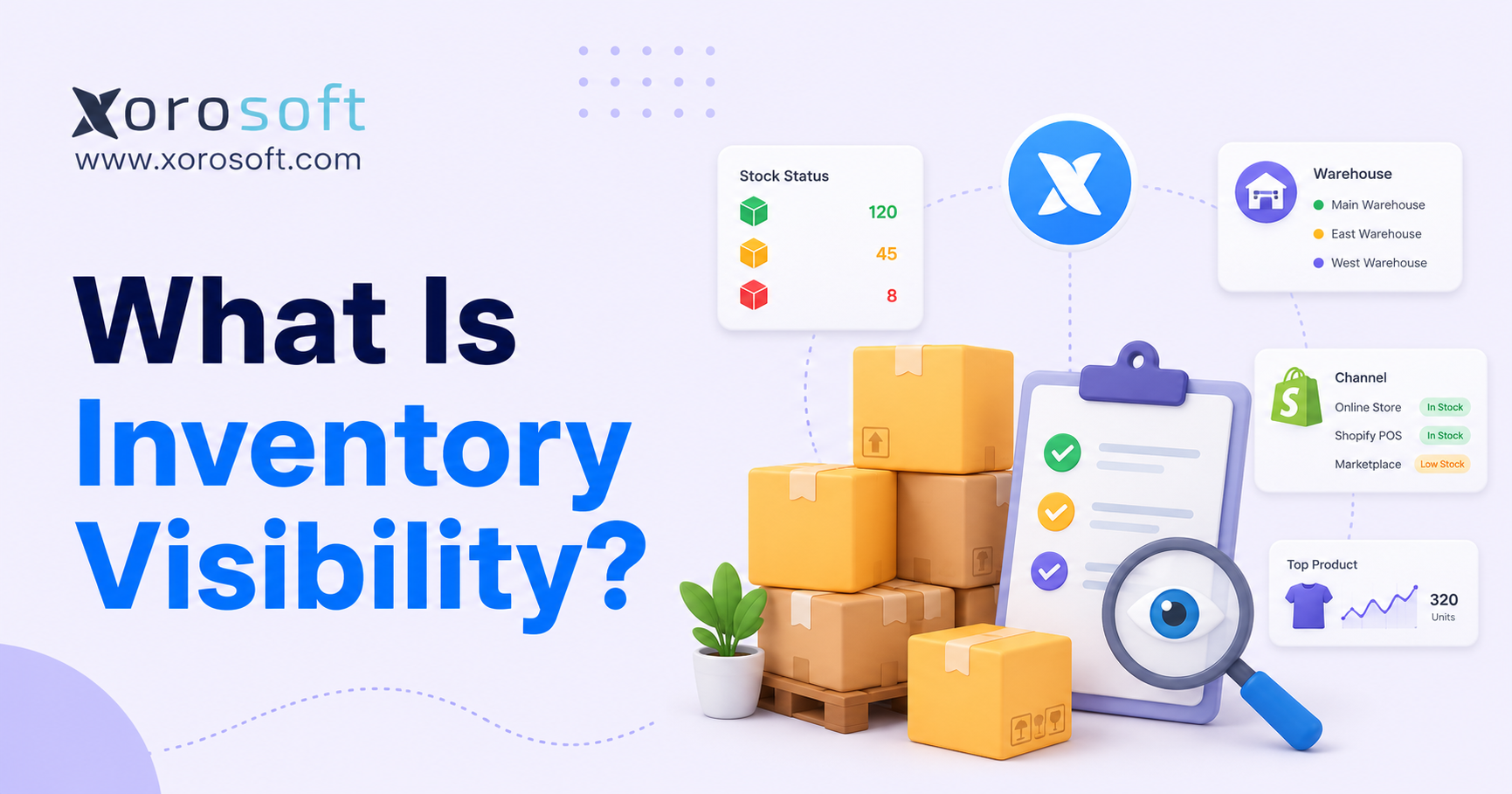
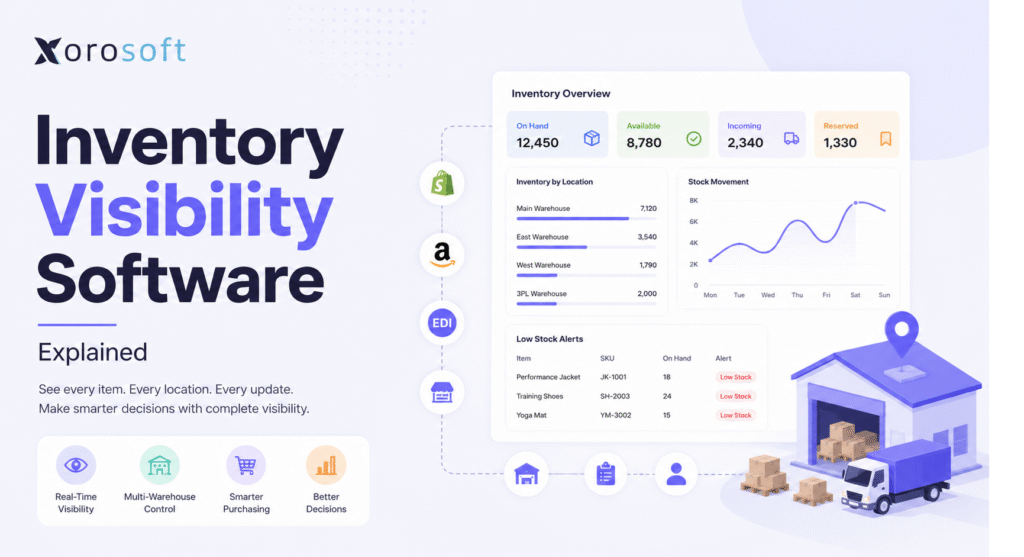
Inventory visibility software is a system that gives teams accurate, timely visibility into inventory across locations, sales channels, warehouses, purchasing workflows, fulfillment operations, and financial records.
At its core, the system gives businesses a clear view of stock levels, stock locations, inventory movement, availability, reservations, incoming inventory, and committed inventory across the business.
Beyond simple stock counts, a strong platform should also show what inventory is sellable, reserved, incoming, in transit, damaged, or unavailable.
In simple terms, inventory visibility software helps answer practical questions:
- How much stock do we have?
- Where is that stock located?
- How much is available to sell?
- How much is reserved for existing orders?
- What inventory is incoming from suppliers?
- What stock is in transit between warehouses?
- Which products are damaged, quarantined, or unavailable?
- Which items need to be reordered soon?
However, true visibility goes beyond stock counts. Basic inventory tracking tells you what was recorded. Inventory visibility tells you what the business can trust right now.
That difference matters because a company may have 500 units on hand, but those units may not all be available. For example, some may be reserved for wholesale orders. Some may be in transit. Some may be damaged. Others may be held for a product launch. Therefore, the real available quantity may be far lower than the physical count.
2.1 Simple Definition of Inventory Visibility Software
Inventory visibility software gives businesses a clear view of stock levels, stock locations, inventory movement, availability, reservations, incoming inventory, and committed inventory across the business.
In other words, it helps teams see what exists, where it is, what can be sold, what is already promised, and what needs action.
2.2 What Inventory Visibility Software Tracks
A good inventory visibility system should track:
- On-hand inventory
- Available-to-sell inventory
- Reserved inventory
- Committed inventory
- Incoming purchase orders
- In-transit transfers
- Returned stock
- Damaged inventory
- Unavailable stock
- Lot numbers
- Serial numbers
- Expiry dates
- Bin locations
- Warehouse locations
- Sales channel availability
- Inventory value
Because each inventory state affects decisions differently, the system must separate physical stock from sellable stock. Otherwise, teams may promise inventory that cannot actually be shipped.
2.3 Inventory Visibility vs Inventory Tracking
Inventory tracking records stock movement. Inventory visibility explains stock availability.
Tracking answers, “What happened?”
Visibility answers, “What can we promise, buy, move, fulfill, or report right now?”
For example, a tracking tool may record that 100 units arrived at Warehouse A. However, a visibility system shows whether those units were received, inspected, available, allocated, reserved, or already committed to open orders.
Therefore, visibility is more useful for decision-making.
3. Why Inventory Visibility Matters for Growing Product Businesses
Inventory visibility matters because every operational team depends on accurate stock data. When that data is wrong, decisions become slower and riskier.
For example, sales may promise stock that the warehouse cannot find. Purchasing may reorder too late because incoming inventory was not visible. Finance may delay month-end close because inventory value does not match operational records. Meanwhile, leadership may struggle to understand whether cash is tied up in the right products.
As a result, poor visibility becomes more than an inventory issue. It becomes a business control issue.
3.1 Stockouts Become Easier to Miss
Stockouts rarely happen all at once. Usually, they build slowly. Demand increases, supplier lead times change, inventory records fall behind, and purchasing teams do not see the risk early enough.
However, with real-time inventory visibility, teams can spot low-stock risks sooner. Therefore, buyers can reorder earlier, transfer stock from another location, or adjust demand planning before customers are affected.
3.2 Overstock Ties Up Cash
Poor visibility does not only create stockouts. It also creates overstock.
For example, a buyer may reorder because they cannot see incoming purchase orders. A manager may move inventory to the wrong warehouse because demand by location is unclear. Meanwhile, slow-moving products may sit for months because nobody has a clean view of aging stock.
Consequently, cash sits on shelves instead of supporting growth.
3.3 Overselling Damages Customer Trust
Overselling usually happens when sales channels are not connected to operational inventory. Shopify may show stock. Amazon may sell the same SKU. A wholesale order may reserve the final available units. However, if those systems do not update each other quickly, customers see availability that no longer exists.
As a result, the business sends refund emails, delays shipments, and damages customer trust.
3.4 Purchasing Decisions Become Slower
Purchasing teams need visibility into current stock, incoming stock, demand trends, supplier lead times, and open orders. However, when this data lives in different systems, buyers spend more time collecting information than making decisions.
Therefore, purchasing becomes reactive. Instead of planning ahead, the team orders when the problem is already visible.
3.5 Finance Teams Lose Confidence in Inventory Value
Inventory visibility also affects accounting. If inventory transactions are delayed, duplicated, or manually adjusted, finance teams struggle to trust inventory valuation.
As a result, cost of goods sold may be wrong. Month-end close may take longer. Reconciliation may become a recurring cleanup project. Therefore, inventory visibility is also a financial accuracy issue.
4. How Inventory Visibility Software Works
Inventory visibility software works by collecting inventory-related data from across the business and turning that data into one reliable operational view.
The best systems do not only import stock counts. Instead, they update inventory as transactions happen. Therefore, stock availability changes when items are received, transferred, picked, packed, shipped, returned, adjusted, or consumed in production.
4.1 Inventory Data Comes From Sales Channels
Sales channels create demand. Shopify, Amazon, wholesale orders, EDI customers, marketplaces, and retail orders all affect available inventory.
Therefore, these channels must connect with the operational inventory system. Otherwise, one channel may sell inventory that another channel already committed.
For Shopify brands, this becomes especially important once the business sells beyond one storefront. Xorosoft is also listed on the Shopify App Store, which is useful for Shopify merchants looking for ERP-connected inventory workflows.
4.2 Inventory Data Comes From Warehouses
Warehouses create inventory movement. Receiving, putaway, picking, packing, shipping, cycle counts, transfers, and returns all change stock status.
Because warehouse activity changes inventory constantly, visibility depends on accurate warehouse execution. A connected warehouse system such as XoroWMS can help teams manage scanning, picking, packing, receiving, and inventory movement with stronger operational control.
4.3 Inventory Data Comes From Purchasing
Purchasing affects future availability. Purchase orders, supplier lead times, expected delivery dates, and inbound shipments all help teams understand what stock is coming next.
Therefore, inventory visibility software should not only show what is in the warehouse today. It should also show what will arrive soon.
4.4 Inventory Data Comes From Manufacturing
Manufacturers need visibility into raw materials, components, work-in-progress, finished goods, BOMs, and work orders. However, finished goods availability depends on both material availability and production timing.
Therefore, manufacturing visibility must connect production planning with inventory planning.
4.5 Inventory Data Comes From Accounting
Inventory affects financial reporting. Inventory value, landed cost, cost of goods sold, and reconciliation all connect operations to accounting.
As a result, inventory visibility software becomes more valuable when it connects stock movement to financial records. Otherwise, operations may look accurate while finance still struggles to reconcile.
5. What Inventory Visibility Software Should Show
A common mistake is thinking inventory visibility means one stock number. However, inventory has many different states. Because each state affects decisions differently, the system must show more than total quantity.
5.1 On-Hand Inventory
On-hand inventory is the physical quantity recorded in a location. It is important, but it is only the starting point.
For example, a business may have 1,000 units on hand. However, not all 1,000 units may be available to sell.
5.2 Available-to-Sell Inventory
Available-to-sell inventory is the quantity that can actually be promised to customers. It excludes reserved, damaged, quarantined, allocated, or unavailable stock.
Therefore, available-to-sell inventory is often more important than on-hand inventory.
5.3 Reserved and Committed Inventory
Reserved inventory is stock set aside for orders, customers, channels, or allocations. Committed inventory is already tied to demand.
Because these units are already promised, they should not be shown as freely available.
5.4 Incoming Purchase Orders
Incoming purchase orders show what is expected from suppliers. This helps buyers plan replenishment and helps sales teams understand future availability.
However, incoming stock should not be treated as available until it is received and approved.
5.5 In-Transit Transfers
In-transit stock is inventory moving between warehouses or locations. It exists, but it is not ready to pick.
Therefore, the system should clearly separate in-transit inventory from sellable inventory.
5.6 Damaged or Unavailable Stock
Some inventory exists physically but cannot be sold. For example, items may be damaged, quarantined, expired, under inspection, or held for review.
Because this stock cannot be promised to customers, it must be separated from available inventory.
5.7 Inventory by Warehouse, Bin, Lot, Serial Number, or Channel
Growing businesses often need inventory visibility by warehouse, bin, lot, serial number, expiry date, or sales channel.
This is especially important for apparel, furniture, sporting goods, food and beverage, wholesale distribution, and manufacturing. For more industry-specific use cases, the industries we serve page can be used as a natural internal link.
6. Common Signs You Have Poor Inventory Visibility
Poor inventory visibility usually appears in daily operations before it appears in reports. Therefore, teams should pay attention to repeated operational friction.
6.1 Shopify Shows Stock That the Warehouse Cannot Find
This is one of the clearest warning signs. If Shopify shows stock but the warehouse cannot pick it, the business has a gap between digital availability and physical inventory.
As a result, customer service gets pulled into problems that should have been prevented upstream.
6.2 Amazon Sells Items Already Committed Elsewhere
Marketplace overselling often happens when one SKU is available across several channels but reservations are not synchronized.
Therefore, Amazon, Shopify, wholesale, and warehouse inventory need to connect through a central source of truth.
6.3 Purchasing Teams Reorder Too Late
If buyers cannot see demand, lead times, open purchase orders, and warehouse-level stock clearly, they reorder reactively.
Consequently, urgent purchase orders become normal. Expedited shipping becomes common. Meanwhile, margins suffer.
6.4 Finance Teams Wait for Manual Inventory Reports
When finance depends on exported reports, warehouse spreadsheets, or manual adjustments, inventory visibility is not connected to accounting visibility.
As a result, month-end close becomes slower and less reliable.
6.5 Warehouse Teams Depend on Tribal Knowledge
If the warehouse knows where stock is because “someone remembers,” the system is not doing enough.
However, as order volume grows, tribal knowledge becomes risky. If that person leaves or the warehouse gets busier, errors increase quickly.
6.6 Leadership Cannot Trust Inventory Reports
If every inventory meeting starts with “which report is correct?” the business has a data trust problem.
Therefore, the issue is not only software. It is also process design, system ownership, and operational discipline.
6.7 A Practical Next Step
If your team is unsure whether the problem is inventory software, warehouse process, accounting structure, or ERP readiness, review your current workflow before adding another app. In many cases, the issue is not one missing feature. Instead, the issue is that inventory, purchasing, warehouse, and accounting data are disconnected.
7. Inventory Visibility Software vs Other Systems
Inventory visibility software overlaps with inventory management, WMS, OMS, and ERP systems. However, each system solves a different part of the problem.
Therefore, choosing the right software depends on which visibility gaps are hurting the business most.
7.1 Inventory Visibility Software vs Inventory Management Software
Inventory management software helps manage stock records, item details, adjustments, and sometimes purchase orders.
However, inventory visibility software focuses on making inventory status clear across the business. It answers what is available, where it is, what is committed, what is incoming, and what can be promised.
7.2 Inventory Visibility Software vs Warehouse Management System
A warehouse management system controls warehouse execution. It manages receiving, putaway, picking, packing, shipping, barcode scanning, bin locations, and cycle counts.
However, WMS alone may not connect purchasing, accounting, Shopify, Amazon, EDI, forecasting, and manufacturing. Therefore, warehouse visibility is important, but it is not the full inventory visibility picture.
7.3 Inventory Visibility Software vs Order Management System
An order management system manages orders across channels. It helps route orders, update statuses, and coordinate fulfillment.
However, order management without accurate inventory visibility can still create bad promises. If stock data is stale, order routing becomes unreliable.
7.4 Inventory Visibility Software vs ERP
ERP connects inventory with accounting, purchasing, warehouse management, manufacturing, forecasting, reporting, and ecommerce workflows.
Therefore, when inventory visibility becomes a company-wide problem, ERP is often the stronger system category. A cloud ERP such as XoroERP can support inventory-driven operations where stock data must connect with finance, fulfillment, procurement, and reporting.
7.5 Inventory Visibility Software vs Spreadsheets
Spreadsheets can track inventory for simple operations. However, they depend on manual updates.
As soon as inventory moves quickly across channels and warehouses, spreadsheets become slow, fragile, and error-prone.
7.6 Inventory Visibility Software vs QuickBooks
QuickBooks can support accounting and basic inventory needs. However, growing product businesses often need deeper visibility across warehouses, purchasing, ecommerce, fulfillment, and reporting.
If your team is comparing accounting-led workflows against ERP-led operations, the Xorosoft vs QuickBooks page is the most relevant comparison link for this section.
| System Type | What It Does | Visibility Strength | Common Limitation | Best For |
|---|---|---|---|---|
| Spreadsheets | Manual stock tracking | Flexible | High error risk | Very small teams |
| QuickBooks | Accounting and basic inventory | Finance visibility | Limited operational depth | Simple inventory businesses |
| Inventory App | Stock tracking | Better item visibility | May lack accounting or WMS depth | Early-stage product brands |
| WMS | Warehouse execution | Strong warehouse visibility | May not cover finance or purchasing | Warehouse-heavy teams |
| OMS | Order routing and order control | Strong order visibility | May not control inventory deeply | Multichannel order teams |
| ERP | Connected operations | Broad operational visibility | Requires implementation discipline | Growing inventory-driven businesses |
8. Key Features of Inventory Visibility Software
Strong inventory visibility software should support the workflows that create inventory movement. Otherwise, the system may look useful in reports but fail during daily execution.
8.1 Real-Time Inventory Updates
Inventory should update when items are received, transferred, picked, packed, shipped, returned, adjusted, or consumed in production.
Real-time updates reduce the delay between physical movement and system records.
8.2 Multi-Warehouse Inventory Visibility
Businesses with more than one warehouse need visibility by location. A single global stock number is not enough because fulfillment depends on where inventory sits.
For example, 500 units in California do not help a New York order if the shipping promise depends on East Coast stock.
8.3 Shopify, Amazon, EDI, and Marketplace Sync
Sales channels should reflect accurate availability. If ecommerce, marketplace, wholesale, and EDI orders do not sync with inventory records, overselling becomes a recurring risk.
Therefore, channel sync should not be treated as a small integration detail. It is part of inventory control.
8.4 Barcode Scanning and Warehouse Transactions
Barcode scanning improves warehouse accuracy because it confirms movement at the point of work.
However, scanning only helps when the data flows into the broader inventory system. Otherwise, the warehouse may be accurate while sales, purchasing, and finance remain out of sync.
8.5 Purchasing and Replenishment Visibility
Buyers need visibility into reorder points, supplier lead times, open purchase orders, inbound shipments, and demand trends.
In addition, purchasing visibility helps prevent both stockouts and overstock.
8.6 Forecasting and Demand Planning
Forecasting helps teams understand what inventory they will need next. This is especially important for seasonal brands, fast-growing SKUs, wholesale demand, and long supplier lead times.
As a result, inventory visibility becomes more forward-looking.
8.7 Inventory Allocation
Allocation helps reserve inventory for specific channels, customers, orders, regions, or wholesale accounts.
For example, a business may reserve units for a major wholesale customer while still allowing ecommerce sales from separate stock. Therefore, allocation prevents internal competition for the same inventory.
8.8 Lot, Serial, Expiry, and Batch Tracking
Food, beverage, electronics, automotive parts, and manufactured products often need more detailed traceability than simple SKU counts.
For businesses that need traceability, visibility software should also support lot numbers, serial numbers, expiry dates, and batch-level tracking.
8.9 Inventory Valuation and Accounting Integration
Inventory visibility should connect to inventory value. Finance teams need accurate stock value, landed cost, COGS, and reconciliation data.
Because inventory is often one of the largest assets on the balance sheet, operational visibility and financial visibility should not be separated for too long.
8.10 Dashboards, Alerts, and Reporting
Dashboards should surface stockouts, low stock, overstock, slow-moving inventory, aging inventory, purchase order delays, transfer delays, and warehouse discrepancies.
However, dashboards should not overwhelm teams with raw data. Instead, they should make the next action clear.
9. Who Needs Inventory Visibility Software?
Not every company needs advanced inventory visibility software. However, the need increases as complexity increases.
9.1 Ecommerce Brands
Ecommerce brands need visibility across online orders, warehouse stock, returns, bundles, promotions, and customer promises.
Therefore, inventory visibility directly affects customer experience.
9.2 Shopify Merchants
Shopify merchants often start with simple inventory needs. However, once they add Amazon, wholesale, 3PLs, multiple warehouses, or purchasing complexity, they need stronger operational visibility behind Shopify.
A connected ERP layer such as XoroONE can help when Shopify needs to connect with inventory, purchasing, accounting, warehouse management, and reporting.
9.3 Amazon Sellers
Amazon sellers need to understand inventory across FBA, FBM, owned warehouses, inbound shipments, and other channels.
Otherwise, channel-level inventory can become misleading.
9.4 Wholesale Distributors
Wholesale distributors need visibility into customer-specific allocation, EDI orders, purchasing, replenishment, and warehouse availability.
Because wholesale orders can reserve large quantities, visibility must account for commitments before stock is shown as available elsewhere.
9.5 Manufacturers
Manufacturers need visibility into raw materials, components, work-in-progress, finished goods, BOMs, work orders, and production schedules.
Therefore, inventory visibility must connect production planning with sales demand.
9.6 Multi-Warehouse Businesses
Multi-warehouse businesses need to know where inventory sits, where demand is coming from, and which location should fulfill each order.
Without that visibility, fulfillment becomes slower and transfer decisions become less reliable.
10. Who Does Not Need Inventory Visibility Software Yet?
A very small business with one warehouse, one sales channel, low SKU count, and predictable demand may not need advanced inventory visibility software yet.
For example, a brand selling 20 SKUs from one location through one Shopify store may manage with Shopify inventory tools, a simple app, or a careful spreadsheet process.
However, the decision should be based on operational complexity, not only revenue.
A company may need better visibility if it has:
- Multiple warehouses
- Multiple sales channels
- Wholesale customers
- EDI orders
- Frequent stockouts
- Frequent overstock
- Manual purchase planning
- Inventory value issues
- Manufacturing workflows
- High SKU complexity
- Unreliable reports
Therefore, the real question is simple: can the business trust inventory data when making daily decisions?
11. Industry Use Cases for Inventory Visibility Software
Different industries experience inventory visibility problems in different ways. Therefore, the right system should match the operating model.
11.1 Apparel and Fashion
Apparel brands need visibility by style, size, color, season, collection, warehouse, and channel.
For example, a product may be available in medium but not large. It may be available online but reserved for wholesale. It may be physically present but held for a launch.
Therefore, apparel teams need visibility at the variant level.
11.2 Furniture
Furniture companies deal with bulky inventory, long lead times, warehouse space constraints, and freight complexity.
Because items are large and expensive to move, poor location visibility creates real cost. Therefore, furniture companies need accurate stock status by warehouse and fulfillment location.
11.3 Sporting Goods
Sporting goods brands often deal with seasonal demand and channel allocation.
For example, demand may spike before a season, tournament, or promotional window. Therefore, teams need visibility into inventory by location, channel, and replenishment timing.
11.4 Food and Beverage
Food businesses need lot tracking, expiry visibility, rotation control, and traceability.
Therefore, inventory visibility is not only about availability. It is also about waste reduction, freshness, and control.
11.5 Wholesale Distribution
Wholesale distributors need visibility into customer commitments, EDI orders, negotiated pricing, warehouse availability, purchasing, and allocation.
Because wholesale customers often place larger orders, one commitment can change availability across the entire business.
11.6 Manufacturing
Manufacturers need visibility into raw materials, work-in-progress, production schedules, finished goods, and demand.
A finished item may look unavailable today. However, it may become available once a work order is completed. Therefore, manufacturing visibility must include both current stock and planned production.
12. Inventory Visibility Software for Shopify, Amazon, EDI, and Wholesale
Channel visibility is useful. However, channel visibility is not the same as operational visibility.
12.1 Shopify Inventory Visibility
Shopify can show inventory by product and location. That is useful for ecommerce teams.
However, growing merchants often need to connect Shopify inventory with purchasing, warehouse management, forecasting, accounting, Amazon, wholesale, and EDI. Therefore, Shopify should often be treated as the storefront, not the full operational source of truth.
12.2 Amazon Inventory Visibility
Amazon sellers may need visibility across FBA, FBM, inbound shipments, owned warehouses, and other channels.
If Amazon availability is isolated, the business may send too much inventory to one channel while another channel runs out.
12.3 EDI Inventory Visibility
EDI adds complexity because wholesale orders may reserve large inventory quantities.
If EDI orders do not update available inventory correctly, ecommerce channels may oversell. Therefore, EDI visibility must connect with inventory allocation.
12.4 Wholesale Inventory Visibility
Wholesale visibility must account for customer-specific rules, order minimums, allocations, pricing, fulfillment windows, and reserved stock.
As a result, wholesale inventory visibility is more complex than simple item availability.
12.5 Why Channel-Level Visibility Is Not Enough
A channel can show what it thinks is available. However, the business also needs to know what is physically available, financially accurate, operationally pickable, and not already committed elsewhere.
Therefore, growing companies often need a central system of record.
13. When Inventory Visibility Requires ERP
Inventory visibility requires ERP when stock data needs to connect across the full operating model.
This usually happens when inventory affects accounting, purchasing, warehouse management, manufacturing, forecasting, reporting, Shopify, Amazon, EDI, and wholesale operations at the same time.
ERP platforms such as Xorosoft become relevant when inventory visibility is no longer just an inventory department issue. At that point, the company needs one system to connect transactions, financials, fulfillment, procurement, and reporting.
13.1 When Inventory-Only Software Becomes Too Limited
Inventory-only software can work well for earlier stages. However, it may become limited when the company needs integrated accounting, purchasing automation, warehouse scanning, manufacturing workflows, and executive reporting.
Therefore, the upgrade is not always about more features. It is often about connecting the workflows around inventory.
13.2 When QuickBooks and Spreadsheets Create Reporting Gaps
Many growing businesses start with QuickBooks and spreadsheets. That can work until inventory movement becomes too fast and complex.
However, accounting software and spreadsheets were not built to act as a full operational control system for high-volume inventory businesses.
If this is the current pain point, compare operational ERP requirements through Xorosoft vs QuickBooks rather than treating the issue as only an accounting problem.
13.3 How Cloud ERP Supports Inventory-Driven Businesses
Cloud ERP connects inventory with the workflows around inventory. That includes sales orders, purchase orders, warehouse transactions, production, accounting, forecasting, reporting, and integrations.
For inventory-driven businesses, this creates a more reliable operating foundation. Xorosoft, for example, is built around this kind of connected operational structure.
13.4 When to Compare ERP Alternatives
Once the business reaches ERP-level complexity, it should compare systems based on fit, implementation effort, inventory depth, warehouse needs, accounting workflows, and integration requirements.
For example, some teams may compare inventory-focused ERP options through pages such as Xorosoft vs Cin7 or review the broader Xorosoft comparison hub when evaluating alternatives.
14. How to Choose Inventory Visibility Software
Choosing inventory visibility software starts with process mapping. Before reviewing software, map how inventory actually moves through the business.
14.1 Map Every Place Inventory Moves
List every point where inventory changes:
- Supplier shipment
- Receiving
- Putaway
- Transfer
- Picking
- Packing
- Shipping
- Returns
- Adjustments
- Production
- Cycle counts
- Wholesale allocation
- Ecommerce orders
- Marketplace orders
Because each movement changes availability, each movement must be visible in the system.
14.2 Check Integration Depth
Do not only ask whether software integrates with Shopify, Amazon, QuickBooks, 3PLs, or EDI.
Instead, ask what data syncs, how often it syncs, which system controls the data, and what happens when there is a conflict.
14.3 Review Warehouse and Barcode Capabilities
If warehouse transactions happen manually, the system may still lag behind reality.
Therefore, barcode scanning, bin tracking, receiving workflows, picking workflows, and cycle counts are important for accurate inventory visibility.
14.4 Confirm Purchasing and Forecasting Support
Inventory visibility should improve buying decisions. Therefore, review reorder logic, supplier lead times, purchase order workflows, demand planning, and forecasting.
If purchasing remains in spreadsheets, visibility will stay incomplete.
14.5 Evaluate Accounting Integration
Inventory visibility that does not connect to accounting can still leave finance teams with reconciliation problems.
Therefore, check inventory valuation, COGS, landed cost, purchase receipts, and month-end reporting before choosing a system.
14.6 Test Reporting and Dashboard Quality
A good system should show useful exceptions, not just raw data.
For example, teams should be able to see low-stock risk, aging inventory, open purchase orders, fulfillment delays, overstock, and inventory variance without exporting five reports.
14.7 Review Broader System Fit
Sometimes the best software decision is not a single inventory tool. Instead, the business may need a connected operating platform.
For that reason, reviewing the full Xorosoft solutions page can make sense when the inventory visibility issue also touches warehouse, accounting, purchasing, manufacturing, and reporting workflows.
15. Common Mistakes When Choosing Inventory Visibility Software
Many companies buy inventory software after the pain becomes obvious. However, they often choose too quickly. As a result, the new system fixes one gap but leaves several others untouched.
15.1 Choosing a Tool That Only Shows Stock Counts
Stock counts are not enough. The system must show what is available, committed, incoming, in transit, reserved, damaged, and unavailable.
Otherwise, teams may still sell inventory that cannot be shipped.
15.2 Ignoring Warehouse Execution
If warehouse processes are weak, visibility will remain weak.
A dashboard cannot fix poor receiving, picking, transfer, return, and cycle count discipline. Therefore, process accuracy must support software accuracy.
15.3 Treating Shopify as the Operational Source of Truth
Shopify is strong for ecommerce operations. However, once the business adds wholesale, manufacturing, multiple warehouses, purchasing, EDI, Amazon, and accounting complexity, the operational source of truth often needs to sit behind Shopify.
Therefore, Shopify should connect into the inventory operating system rather than carry the entire operational burden.
15.4 Keeping Accounting Separate Too Long
When accounting is separate from inventory operations, finance teams often spend time reconciling reports instead of analyzing performance.
As a result, leaders may not trust margin, COGS, or inventory value.
15.5 Buying Software Without Fixing Processes
Software improves visibility only when the underlying processes are clear.
Therefore, receiving, transfers, returns, adjustments, and cycle counts need rules before automation can work properly.
16. Inventory Visibility Software Comparison Table
| Platform Type | Fit | Strength | Limitation | Best Use Case |
| Xorosoft | Growing inventory-driven businesses | Connects inventory, WMS, accounting, purchasing, manufacturing, forecasting, reporting, Shopify, Amazon, and EDI | Requires implementation discipline | Ecommerce, wholesale, manufacturing, and multi-warehouse teams |
| NetSuite | Mid-market and enterprise ERP users | Broad ERP functionality | Can be complex for some teams | Larger companies needing enterprise ERP |
| Acumatica | ERP-focused businesses | Flexible cloud ERP model | Requires strong implementation planning | Distribution, manufacturing, and finance-heavy teams |
| Cin7 | Product businesses needing inventory control | Inventory and order workflows | May not replace full ERP needs for every business | Retail, wholesale, and ecommerce inventory teams |
| Brightpearl | Retail and ecommerce operations | Retail operations focus | Fit depends on business model | Retail and omnichannel brands |
| Fishbowl | QuickBooks-connected inventory teams | Inventory and warehouse support | May require add-ons for broader ERP needs | Smaller businesses using QuickBooks |
| QuickBooks | Accounting-led businesses | Finance and bookkeeping | Limited for complex operations | Simple inventory companies |
| Spreadsheets | Very small teams | Flexible and cheap to start | Manual, fragile, and hard to scale | Early-stage businesses |
This table should not be used as a shortcut for buying software. Instead, it should help teams identify which type of system fits their current complexity.
17. Example: How a Growing Ecommerce Brand Loses Inventory Visibility
A brand starts with one Shopify store and one warehouse. At first, inventory is easy. The team knows what arrived, what sold, and what needs to be reordered.
Then growth begins.
Amazon is added. Wholesale orders start coming in. A second warehouse opens. A 3PL handles some fulfillment. Purchasing moves into spreadsheets. Finance still works in QuickBooks. The warehouse starts using a separate app. Customer service checks Shopify. Operations checks the warehouse system. Finance checks exported reports.
Each system is partly correct.
However, none of them shows the whole truth.
That is how inventory visibility breaks. Not because the team is careless, but because the business outgrows the system structure that once worked.
Therefore, the solution is not always to buy the biggest system immediately. The right move is to understand which workflows need to connect and which system should become the operational source of truth.
18. Where Xorosoft Fits in the Inventory Visibility Software Conversation
Xorosoft is a cloud ERP platform built for inventory-driven businesses that need inventory visibility across operations, not just stock counts.
It connects inventory management, accounting, purchasing, warehouse management, manufacturing, forecasting, reporting, and ecommerce operations into one system. Therefore, it is relevant for companies that have outgrown QuickBooks, spreadsheets, inventory-only software, or disconnected operational tools.
For Shopify merchants, Amazon sellers, wholesale distributors, EDI-driven businesses, and multi-warehouse teams, Xorosoft can act as the operating system behind the sales channels. Instead of treating Shopify, Amazon, EDI, warehouse apps, and accounting tools as separate sources of truth, the business can centralize inventory movement and reporting.
However, this does not mean every company needs ERP. A small brand with simple inventory may not need this level of system depth yet. But once inventory visibility affects purchasing, fulfillment, accounting, forecasting, and leadership reporting, ERP becomes a practical conversation.
19. Final Checklist Before Choosing Inventory Visibility Software
Before choosing software, use this checklist to understand what your business actually needs.
19.1 Operational Checklist
- Confirm available inventory by location.
- Separate reserved stock from sellable stock.
- Track incoming purchase orders clearly.
- Review stock currently in transit.
- Make warehouse transactions visible quickly.
- Keep sales channel availability accurate.
19.2 Purchasing Checklist
- Review reorder points by SKU.
- Track supplier lead times.
- Monitor open purchase orders.
- Compare demand by SKU and location.
- Check whether the system supports forecasting.
19.3 Warehouse Checklist
- Confirm barcode scanning support.
- Review bin location functionality.
- Test receiving and putaway workflows.
- Check picking and packing controls.
- Review warehouse transfer visibility.
- Confirm cycle count support.
19.4 Finance Checklist
- Connect inventory movement to accounting.
- Review inventory valuation accuracy.
- Confirm landed cost support.
- Check COGS reporting.
- Look for month-end close improvements.
19.5 Leadership Checklist
- Identify inventory risk early.
- Review stockout exposure.
- Monitor overstock and slow-moving inventory.
- Compare inventory performance by location.
- Trust one operational report instead of several conflicting exports.
20. Frequently Asked Questions About Inventory Visibility Software
20.1 What is inventory visibility software?
Inventory visibility software gives businesses a clear view of inventory levels, locations, movement, availability, reservations, incoming stock, and committed stock. In practice, teams use it to understand what they have, where it is, what can be sold, and what is already promised. As operations grow, this becomes important because inventory data often spreads across ecommerce platforms, warehouse systems, accounting tools, spreadsheets, and purchasing workflows.
20.2 What does inventory visibility mean?
Inventory visibility means being able to see accurate inventory information across the business. This includes on-hand inventory, available-to-sell inventory, incoming purchase orders, in-transit transfers, reserved stock, damaged stock, and inventory by location. As a result, teams can make better decisions about sales, purchasing, fulfillment, forecasting, and accounting.
20.3 Why is inventory visibility important?
Accurate inventory visibility is important because poor inventory data creates stockouts, overstock, overselling, delayed fulfillment, slow purchasing, and accounting problems. When teams cannot trust inventory reports, they make decisions from guesses. Therefore, better visibility helps companies promise inventory more accurately, replenish earlier, reduce waste, and improve customer experience.
20.4 How does inventory visibility software work?
An inventory visibility system connects data from sales channels, warehouses, purchasing, manufacturing, accounting, and reporting. As inventory moves, the system updates stock status. For example, receiving increases stock, picking reserves stock, shipping reduces stock, and purchase orders show incoming supply. Therefore, every team works from a more reliable view.
20.5 What problems does inventory visibility software solve?
This type of software helps solve inaccurate stock counts, overselling, stockouts, overstock, slow replenishment, warehouse confusion, poor allocation, delayed reports, and inventory reconciliation issues. However, it is most useful when businesses sell across multiple channels or manage more than one warehouse.
20.6 Who needs inventory visibility software?
Growing ecommerce brands, Shopify merchants, Amazon sellers, wholesalers, manufacturers, distributors, and multi-warehouse businesses often need inventory visibility software. It is also useful for apparel, furniture, sporting goods, food, and consumer product brands that manage many SKUs, variants, channels, or supplier lead times.
20.7 Who does not need inventory visibility software yet?
Very small businesses may not need advanced inventory visibility software if they have one location, one channel, a low SKU count, and simple inventory movement. However, once inventory data becomes unreliable, slow, or hard to trust, a better system should be considered.
20.8 What is real-time inventory visibility?
Real-time inventory visibility means inventory records update as transactions happen or very shortly after. When stock is received, picked, packed, shipped, transferred, returned, or adjusted, the system updates availability. Therefore, teams avoid making decisions from outdated numbers.
20.9 What is omnichannel inventory visibility?
Omnichannel inventory visibility means seeing inventory across all sales channels and fulfillment locations. For example, a business may sell through Shopify, Amazon, wholesale, retail, EDI, and marketplaces. Because each channel creates demand, omnichannel visibility helps prevent one channel from selling stock already committed elsewhere.
20.10 What is multi-warehouse inventory visibility?
Multi-warehouse inventory visibility means seeing stock by warehouse, location, bin, and availability status. It helps teams decide where to fulfill orders, where to transfer stock, and where replenishment is needed. Therefore, it is essential when inventory is spread across multiple warehouses, stores, or 3PLs.
20.11 How does inventory visibility reduce stockouts?
Inventory visibility reduces stockouts by showing low stock, demand trends, supplier lead times, and incoming purchase orders before inventory runs out. As a result, purchasing teams can reorder sooner, adjust forecasts, or transfer inventory from another location.
20.12 How does inventory visibility prevent overstock?
Inventory visibility prevents overstock by showing slow-moving inventory, excess inventory, open purchase orders, and demand by SKU or location. Therefore, teams can avoid buying more stock when enough inventory already exists or is already incoming.
20.13 How does inventory visibility prevent overselling?
Better visibility prevents overselling by separating on-hand stock from available-to-sell stock. If units are reserved, committed, damaged, or in transit, they should not be shown as available. This is especially important for Shopify, Amazon, wholesale, and EDI orders.
20.14 How does inventory visibility improve fulfillment?
Clearer visibility helps fulfillment teams know where inventory is located, whether it is available, and which warehouse should ship the order. Therefore, it reduces picking errors, split shipments, delays, and customer service issues.
20.15 How does inventory visibility help purchasing?
Inventory visibility helps purchasing teams see reorder points, demand patterns, supplier lead times, open purchase orders, and incoming inventory. As a result, buyers can make replenishment decisions earlier and with more confidence.
20.16 How does inventory visibility help accounting?
A connected inventory visibility system helps accounting by improving inventory valuation, COGS accuracy, reconciliation, and month-end close. When inventory transactions are connected to accounting records, finance teams spend less time correcting reports and more time analyzing the business.
20.17 How does inventory visibility improve forecasting?
Forecasting improves when inventory data is accurate. Teams can compare sales demand, current stock, incoming supply, lead times, and seasonal trends. Therefore, they can plan inventory more intelligently and reduce both stockouts and overstock.
20.18 How does inventory visibility help Shopify merchants?
Shopify merchants benefit from inventory visibility when they add multiple warehouses, Amazon, wholesale, 3PLs, EDI, or purchasing complexity. Shopify can show channel inventory. However, growing brands often need deeper operational visibility behind Shopify.
20.19 How does inventory visibility help Amazon sellers?
Amazon sellers need visibility across FBA, FBM, inbound shipments, owned warehouses, and other sales channels. Otherwise, they may send too much inventory to one channel while another channel runs out. Therefore, Amazon inventory visibility should connect with total business inventory.
20.20 How does inventory visibility help wholesale businesses?
Wholesale businesses need to manage customer-specific commitments, allocations, EDI orders, purchase orders, and warehouse availability. Because wholesale orders can reserve large quantities, inventory visibility helps prevent stock promised to wholesale customers from being sold elsewhere.
20.21 How does inventory visibility help manufacturers?
Manufacturers need visibility into raw materials, components, work-in-progress, finished goods, work orders, and BOMs. Therefore, visibility helps production teams understand what can be built, what materials are missing, and when finished goods will be available.
20.22 What features should inventory visibility software include?
Key features include real-time inventory updates, multi-warehouse visibility, channel sync, barcode scanning, purchasing visibility, forecasting, allocation, lot tracking, serial tracking, inventory valuation, dashboards, alerts, and reporting. However, the exact feature set should match the business model.
20.23 What is the difference between inventory visibility and inventory tracking?
Inventory tracking records stock movement. Inventory visibility turns that movement into usable operational insight. Tracking tells you what happened. Visibility tells you what is available, where it is, what is committed, and what the business can safely promise.
20.24 What is the difference between inventory visibility software and WMS?
A WMS manages warehouse execution, such as receiving, picking, packing, bin locations, barcode scanning, and shipping. Inventory visibility software may include warehouse visibility, but it also connects stock data with sales channels, purchasing, accounting, forecasting, and reporting.
20.25 What is the best inventory visibility software for growing brands?
The best inventory visibility software depends on the business model. A small brand may need a simple inventory app. A warehouse-heavy business may need WMS. However, a growing ecommerce, wholesale, or manufacturing company may need ERP if inventory must connect with accounting, purchasing, warehouse management, forecasting, and reporting.
21. Inventory Visibility Is an Operating Discipline, Not Just a Dashboard
Inventory visibility software is not only about seeing stock counts. Instead, it is about giving the business a reliable operating view of inventory across sales, purchasing, warehouses, fulfillment, accounting, forecasting, and reporting.
As a company grows, inventory visibility becomes harder because inventory moves through more systems, people, channels, and locations. What worked at one stage can become risky at the next stage. Therefore, the right system depends on operational complexity.
Some teams need a better inventory app. Some need WMS. Others need ERP. For inventory-driven businesses that have outgrown QuickBooks, spreadsheets, or disconnected systems, cloud ERP platforms such as Xorosoft can help centralize the workflows that determine inventory accuracy.
The goal is simple: fewer guesses, fewer surprises, and better decisions from inventory data the entire company can trust.
If your inventory visibility problems now touch purchasing, warehouse management, accounting, Shopify, Amazon, EDI, manufacturing, or reporting, the next step is to review the full operating workflow. You can Book a demo to see how Xorosoft connects inventory, purchasing, warehouse management, accounting, manufacturing, forecasting, ecommerce, and reporting in one cloud ERP system.