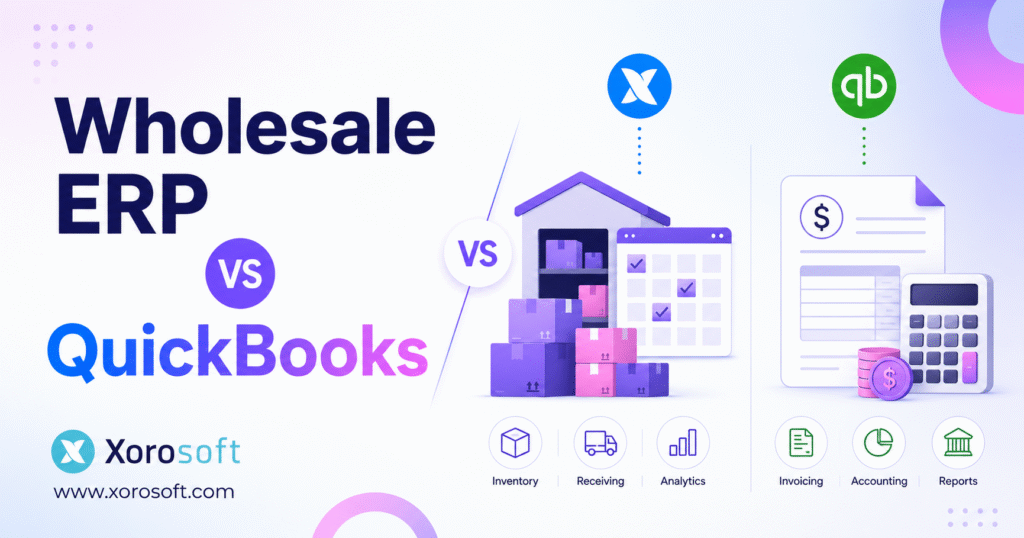
If you’re trying to decide between Wholesale ERP vs QuickBooks for your business, it’s important to understand the differences and benefits of each system.
1. Why Wholesale ERP vs QuickBooks Matters for Growing Wholesale Teams
Wholesale ERP vs QuickBooks becomes a serious decision when a wholesale business starts running faster than its systems. In the early stage, QuickBooks often feels like the right fit because it helps the company send invoices, track bills, manage expenses, record payments, and keep financial data organized. For many smaller wholesalers, that is exactly what the business needs.
However, wholesale operations rarely stay simple. More SKUs get added, purchase orders become harder to manage, and customer-specific pricing starts creating exceptions. At the same time, warehouse teams need better receiving, picking, packing, shipping, and stock control. Meanwhile, sales channels expand into Shopify, Amazon, retail, wholesale accounts, and EDI customers. As a result, finance still needs accurate inventory value, clean COGS, and faster month-end reporting.
That is where the comparison changes. The question is no longer only, “Can QuickBooks manage our accounting?” Instead, the better question is, “Can our current system support the way our wholesale business actually operates?”
QuickBooks can still be a strong system for many companies. It is familiar, widely used, and practical for accounting-led workflows. A wholesale ERP, on the other hand, is designed to connect accounting with inventory, purchasing, warehouse management, order fulfillment, forecasting, ecommerce, and reporting.
Ultimately, the right choice depends on operational complexity. A small wholesale company may not need ERP yet. However, a growing wholesaler with multiple warehouses, buying teams, ecommerce orders, EDI requirements, and inventory accuracy problems may need a more connected system.
This guide compares Wholesale ERP vs QuickBooks from a practical business perspective. More importantly, it explains where QuickBooks works well, where it starts to show limits, when a wholesale ERP makes sense, and how to choose the right path before disconnected systems slow the business down.
2. QuickBooks vs ERP: Where QuickBooks Still Works for Wholesale
QuickBooks is best understood as an accounting-first platform. Its biggest strength is financial management. Wholesale businesses use it for invoicing, vendor bills, expense tracking, bank reconciliation, payment records, financial reporting, and tax-related workflows.
For a business that needs clean books and basic operational visibility, QuickBooks can be a good fit. It gives structure to accounting without forcing the company into a larger software implementation before it is ready.
2.1 QuickBooks as an Accounting Foundation
QuickBooks helps finance teams organize day-to-day accounting. It supports accounts receivable, accounts payable, bank feeds, expenses, customer invoices, vendor bills, and standard reports. For a wholesale business that is still small or moderately complex, this foundation can be enough.
Many companies start with QuickBooks because their first real software problem is accounting. They need to move away from manual bookkeeping, improve cash flow visibility, and organize financial records. At that stage, QuickBooks is often practical and cost-effective.
2.2 QuickBooks Inventory Management vs Wholesale ERP for Simple Operations
QuickBooks also includes inventory features, depending on the version and plan. Teams can track products, quantities, costs, purchase activity, and sales activity. QuickBooks Enterprise and Advanced Inventory add more depth than basic setups.
This matters because the Wholesale ERP vs QuickBooks decision should be balanced. QuickBooks is not automatically wrong for wholesalers. It can support many basic wholesale needs when the product catalog, warehouse setup, purchasing process, and order volume remain manageable.
2.3 QuickBooks Enterprise for Wholesale Distribution
QuickBooks Enterprise offers more advanced features for wholesale and distribution teams. It can support purchasing, inventory, distribution, vendors, and sales order fulfillment. For companies that want to stay within the QuickBooks ecosystem, Enterprise may be a logical step before evaluating ERP.
Still, software fit depends on workflow complexity. A system can have inventory features and still not be the best operational platform for a scaling wholesale company. That difference becomes clearer when the business starts relying on multiple apps, spreadsheets, and manual workarounds.
3. What Wholesale ERP Software Handles Beyond QuickBooks
A wholesale ERP is built to manage the full operational and financial workflow of an inventory-driven business. Instead of focusing only on accounting, ERP connects inventory, purchasing, sales orders, warehouse management, accounting, forecasting, ecommerce, reporting, and sometimes manufacturing.
That connected structure is the main difference. QuickBooks starts with financial records. A wholesale ERP starts with the broader business process.
3.1 Wholesale ERP Software as the Operational System
Wholesale ERP software acts as the operational system of record. It helps teams answer questions that go beyond accounting:
What stock is available right now?
From there, the team needs to know which warehouse should fulfill the order.
At the same time, purchasing needs visibility into delayed purchase orders.
Meanwhile, sales needs to understand which items are at risk of stockout.
In addition, customer service needs access to account-specific pricing.
For leadership, channel profitability also becomes part of the same conversation.
Finally, finance needs the correct inventory value to flow into accounting.
These questions require connected data. When data lives across QuickBooks, spreadsheets, inventory apps, warehouse tools, Shopify, Amazon, and EDI platforms, teams spend too much time reconciling information.
A centralized all-in-one ERP platform can help growing teams reduce that fragmentation by bringing core workflows into one system.
3.2 ERP for Wholesale Distribution as a QuickBooks Alternative
Wholesale distribution is inventory-driven. Every order, invoice, purchase, receipt, transfer, and shipment depends on accurate stock data. If inventory is wrong, sales teams overpromise. Purchasing teams buy late. Warehouse teams pick incorrectly. Finance teams reconcile manually.
ERP for wholesale distribution connects inventory movement with operational and financial impact. Because of this, the business can maintain better visibility across departments.
3.3 Cloud ERP for Wholesale Growth
A cloud ERP can support businesses that operate across locations, sales channels, and teams. Instead of relying on local files or disconnected systems, cloud ERP gives teams shared access to updated workflows and reporting.
For growing wholesalers, this matters because scale creates coordination problems. The larger the business becomes, the more important it is for purchasing, warehouse, sales, ecommerce, and finance teams to work from the same data.
4. Wholesale ERP vs QuickBooks: Side-by-Side Comparison
The easiest way to compare Wholesale ERP vs QuickBooks is to look at common wholesale requirements.
| Business Need | QuickBooks | Wholesale ERP | Best Fit |
|---|---|---|---|
| Accounting | Strong accounting foundation | Accounting connected to operations | Both, depending on complexity |
| Basic inventory | Supported in many setups | Supported with deeper controls | QuickBooks for simple needs |
| Multi-warehouse inventory | Available in advanced versions | Usually part of broader workflows | Complex location networks |
| Purchasing | Purchase orders and vendor bills | Replenishment, approvals, supplier planning | Scaling buying teams |
| Warehouse management | Limited or add-on dependent | Receiving, putaway, picking, packing, shipping | Warehouse-led operations |
| Wholesale pricing | Possible depending on setup | Customer-specific pricing and rules | B2B account complexity |
| EDI | Usually integration-dependent | Often connected to order workflows | EDI-driven customers |
| Shopify and Amazon | Usually integration-dependent | Connected to inventory and accounting workflows | Multi-channel sellers |
| Forecasting | Limited or app-dependent | Demand planning and replenishment | Planning-focused teams |
| Reporting | Financial reporting focus | Financial and operational reporting | Real-time visibility needs |
| Manufacturing | Limited or add-on dependent | BOMs, work orders, planning | Assembly or production workflows |
| Scalability | Good for smaller teams | Strong for inventory-driven complexity | Growth-stage wholesalers |
4.1 QuickBooks vs ERP: The Core Difference
QuickBooks helps manage the books. ERP helps manage the operational process behind the books.
That distinction matters because wholesale companies do not only create invoices. They buy, receive, store, transfer, allocate, pick, pack, ship, reconcile, forecast, and report on inventory. When those steps happen in separate systems, the business becomes harder to control.
4.2 Wholesale ERP vs QuickBooks for Scaling Teams
A smaller wholesaler may only need basic accounting and simple inventory tracking. A scaling team usually needs more structure. Once multiple people manage purchasing, warehousing, customer orders, ecommerce, and financial reporting, disconnected workflows create risk.
The need for ERP usually appears when teams stop trusting the system. If sales, warehouse, purchasing, and finance each keep their own version of the truth, the company has an operational visibility problem.
5. Wholesale ERP vs QuickBooks: When QuickBooks Is Still Enough
QuickBooks can be the right choice when the business is still simple enough to manage with accounting software and light inventory controls.
5.1 QuickBooks vs ERP for Simple Product Catalogs
If the company sells a small number of SKUs, inventory is easier to manage. Teams can track stock, reorder products, and review sales without building complex workflows.
5.2 One Warehouse and Limited Fulfillment Complexity
A single warehouse keeps operations easier. The business does not need advanced transfer workflows, fulfillment routing, or location-level replenishment. Inventory reporting is also less fragmented.
5.3 Predictable Purchasing and Supplier Management
QuickBooks may work well when purchasing is straightforward. If the company buys from a small supplier base, uses simple purchase orders, and does not need forecast-based replenishment, ERP may not be necessary yet.
5.4 Basic Financial and Inventory Reporting
A smaller wholesale team may only need financial statements, sales reports, and basic stock visibility. In that case, QuickBooks can provide enough reporting without requiring a larger ERP project.
5.5 Lower Order Volume and Fewer Exceptions
QuickBooks may remain practical when order volume is manageable and customer requirements are simple. If there are no complex pricing rules, EDI requirements, advanced fulfillment rules, or multi-channel inventory challenges, the business may not need wholesale ERP yet.
6. QuickBooks vs Wholesale ERP: Signs Your Business Has Outgrown Accounting Software
Wholesale ERP vs QuickBooks becomes more urgent when daily work starts moving outside the system. Usually, this happens gradually. First, teams create one spreadsheet to solve one operational gap. After that, they add an inventory app because stock tracking needs more detail. Later, the warehouse adopts another tool because fulfillment needs more structure. Eventually, nobody knows which system is correct.
6.1 QuickBooks Inventory Limitations Become Operational Problems
The first sign is often inventory mismatch. QuickBooks may show stock as available, but the warehouse cannot find it. Sales may accept an order that cannot be fulfilled. Purchasing may reorder too late because demand was not visible.
When this happens repeatedly, the business needs stronger inventory control and better operational workflows.
6.2 QuickBooks Inventory Limitations Push Purchasing Into Spreadsheets
Many wholesalers begin using spreadsheets for purchasing because buying decisions become too detailed for the current setup. Buyers track supplier lead times, open purchase orders, expected receipts, reorder points, and stockout risks manually.
That workaround may help one person move faster. However, it does not give the whole company reliable visibility. If purchasing knowledge lives in spreadsheets, the business becomes dependent on manual updates and individual memory.
6.3 Warehouse Teams Work Outside the Main System
Warehouse teams need process control. They need receiving, putaway, bin locations, picking, packing, shipping, returns, and cycle counts. If those workflows happen outside the accounting system, inventory updates may lag behind reality.
As a result, sales, purchasing, and accounting teams make decisions from stale data.
This is why many scaling wholesalers evaluate warehouse management software when warehouse accuracy and fulfillment speed become business-critical.
6.4 Month-End Close Takes Too Long
Inventory-heavy accounting can slow down month-end close. Finance teams may need to reconcile purchase receipts, vendor bills, inventory adjustments, landed costs, sales orders, returns, and COGS.
If every close requires spreadsheet cleanup, exports, and manual corrections, the accounting team is carrying operational problems.
6.5 Leadership Cannot See Real-Time Performance
Executives need timely answers. They need to know which products are profitable, which warehouses are behind, and which sales channels are growing. At the same time, purchasing delays should be visible before they affect fulfillment. Inventory teams also need clarity on which SKUs are overstocked, understocked, or moving too slowly.
If those answers require multiple exports and manual reports, the system is no longer giving leadership the visibility it needs.
7. Inventory Management in Wholesale ERP vs QuickBooks
Inventory is usually the center of the Wholesale ERP vs QuickBooks decision. Accounting matters, of course, but wholesale businesses run on stock accuracy. Therefore, the system must show not only what was purchased or sold, but also what is available, committed, inbound, backordered, and ready to fulfill.
7.1 Wholesale ERP vs QuickBooks for Stock Visibility
QuickBooks can help track inventory quantities in many setups. However, growing wholesalers often need more than quantity on hand. They need quantity available, committed inventory, inbound inventory, backordered inventory, allocated stock, and warehouse-level visibility.
A wholesale ERP usually gives a more complete view because inventory connects with orders, purchasing, warehouse activity, and reporting.
7.2 Wholesale ERP Software for Multi-Warehouse Inventory Needs
Once inventory lives in multiple warehouses, complexity increases quickly. Teams need location-specific stock, transfers, in-transit inventory, fulfillment routing, replenishment rules, and location-level reporting.
QuickBooks Advanced Inventory can support multiple inventory sites or locations in eligible setups. However, many growing wholesalers need more than location tracking. They need connected warehouse workflows, purchasing signals, ecommerce sync, and operational reporting.
7.3 Inventory Transfers and Allocation
Transfers between warehouses can create confusion if teams do not track what left one location, what is in transit, and what arrived. ERP systems can help manage these steps more clearly.
Allocation also matters. If wholesale customers, Shopify orders, Amazon orders, and sales reps all draw from the same stock pool, the business needs rules for reserving and promising inventory.
7.4 Cycle Counts and Inventory Adjustments
Cycle counting helps teams keep inventory accurate without shutting down the warehouse for a full physical count. ERP systems often support structured count workflows, variance tracking, approvals, and reporting.
QuickBooks may support inventory adjustments, but the operational workflow around counting often requires additional tools or manual processes.
7.5 Inventory Valuation and Financial Accuracy
Inventory valuation affects the balance sheet and COGS. If quantities, costs, receipts, or adjustments are wrong, financial statements can become unreliable.
That is why inventory and accounting should not operate separately as the business grows. The more inventory-driven the company becomes, the more important it is to connect stock movement with financial impact.
8. Purchasing Automation in Wholesale ERP Software vs QuickBooks
Purchasing becomes more difficult when wholesalers carry more SKUs, work with more suppliers, and manage longer lead times.
8.1 QuickBooks vs ERP for Purchase Orders
QuickBooks can help create purchase orders and vendor bills. For simpler teams, that may be enough.
ERP adds more structure around the buying process. It can connect purchase orders to inventory levels, sales demand, supplier lead times, open sales orders, and forecasts.
8.2 Reorder Planning in Wholesale ERP Software
Reorder planning is one of the biggest differences between QuickBooks and wholesale ERP software. A small business may reorder when someone notices low stock. A growing wholesaler needs a more consistent process.
ERP systems can help teams plan replenishment based on demand trends, minimum stock levels, supplier lead times, seasonal patterns, and incoming orders.
8.3 Supplier Lead Times and Buying Risk
Supplier lead times affect availability. If a vendor takes 45 days to deliver, the business must plan earlier. When lead times live in spreadsheets, purchasing risk increases.
A wholesale ERP can keep supplier data connected to replenishment planning so buyers do not have to manage every decision manually.
8.4 Backorders and Partial Receipts
Wholesale businesses often receive partial shipments. They need to track what arrived, what remains open, what is already allocated to customer orders, and what should trigger follow-up.
A connected ERP workflow makes this easier because purchase orders, inventory, sales orders, and accounting update from the same system.
8.5 Landed Cost and Margin Visibility
Landed cost includes freight, duties, handling, and other costs required to bring products into inventory. If landed cost is not handled properly, product margins may look better than they really are.
ERP systems often provide stronger tools for connecting landed costs to inventory value and margin reporting.
9. Warehouse Management in QuickBooks vs Wholesale ERP
QuickBooks can track inventory, but warehouse management is a different function. Warehouse teams need workflows, not just item records.
9.1 Receiving and Putaway
Receiving confirms what arrived. Putaway determines where items go. If those steps are manual, inventory may exist physically before it appears correctly in the system.
ERP warehouse workflows help receiving teams update stock faster and more accurately.
9.2 QuickBooks vs Wholesale ERP for Picking, Packing, and Shipping
Picking errors create customer issues. Packing errors create returns, credits, and rework. As order volume grows, warehouse teams need clear pick lists, barcode scanning, bin locations, and shipment workflows.
QuickBooks may require add-ons for deeper warehouse execution. ERP systems often include or integrate these workflows more directly.
9.3 Barcode Scanning and Bin Locations
Barcode scanning reduces manual entry and helps confirm that the right item, quantity, bin, order, or shipment is being handled. Bin locations help warehouse teams find stock faster and improve picking accuracy.
These capabilities become more important when the warehouse handles higher volume, more SKUs, or multiple fulfillment channels.
9.4 Returns and Inventory Updates
Returns affect customer service, inventory, accounting, and reporting. A disconnected return process can create inaccurate stock and delayed credits.
ERP workflows can connect returns to inspection, restocking, customer credit, and reporting.
10. QuickBooks vs ERP for Wholesale Accounting and Inventory Valuation
Accounting is where QuickBooks is strongest. Still, wholesale accounting becomes more complex as inventory activity grows.
10.1 QuickBooks vs ERP for Wholesale Inventory Accounting
QuickBooks can support accounting workflows well. The issue appears when financial data depends on operational activity happening elsewhere.
If inventory movement, purchase receipts, warehouse adjustments, ecommerce orders, and returns are spread across different tools, finance must reconcile those systems before reports can be trusted.
10.2 COGS and Inventory Asset Value
COGS and inventory asset value depend on accurate item costs, receipts, adjustments, and sales activity. If the warehouse and purchasing workflows are disconnected from accounting, finance may need to investigate every mismatch manually.
A wholesale ERP can reduce this friction by connecting purchasing, receiving, inventory movement, sales orders, and accounting.
10.3 Vendor Bills and Purchase Receipts
A common issue appears when vendor bills do not match purchase orders or receipts. The finance team may need to check quantity differences, timing differences, freight costs, or partial shipments.
ERP can help create a cleaner connection between what was ordered, what was received, what was billed, and what should be paid.
10.4 Customer Terms and Accounts Receivable
Wholesale customers often buy on terms. They may also have credit limits, account-specific discounts, and approval rules. These workflows affect order approval and cash collection.
QuickBooks can manage invoices and receivables, but ERP may provide a stronger connection between customer rules, order management, fulfillment, and accounting.
11. Reporting and Visibility in Wholesale ERP vs QuickBooks
Reporting is another major reason businesses compare Wholesale ERP vs QuickBooks. QuickBooks provides useful financial reports, especially for accounting teams. However, wholesale leaders often need deeper operational visibility as well. For example, they need to understand inventory health, warehouse performance, purchasing exposure, fulfillment delays, and channel profitability without waiting for manual spreadsheet work.
11.1 Financial Reporting in QuickBooks
QuickBooks can produce financial statements, sales reports, expense reports, and cash flow views. For finance teams, these reports are valuable.
However, leaders in inventory-driven businesses also need operational data. They need to understand inventory health, warehouse performance, purchasing exposure, and channel profitability.
11.2 Wholesale ERP Software for Inventory and Purchasing Reports
Wholesale teams need reports such as inventory by warehouse, aging inventory, stockout risk, overstock, inventory turnover, committed stock, open purchase orders, backorders, and supplier performance.
These reports are easier to trust when inventory, purchasing, orders, and warehouse workflows live in the same system.
11.3 Warehouse and Fulfillment Reporting
Warehouse leaders need visibility into receiving delays, pick accuracy, cycle count variances, shipping performance, and fulfillment bottlenecks.
This data often sits outside accounting software unless warehouse workflows are connected to the main operational system.
11.4 Executive Dashboards for Wholesale Growth
Executives need a single view of performance. They want revenue, margin, inventory value, fulfillment status, purchasing exposure, and channel performance without waiting for manual spreadsheets.
A wholesale ERP can make this easier because operational and financial data share the same foundation.
12. Wholesale ERP Software for Multi-Warehouse and Multi-Channel Operations
Wholesale businesses often scale through more locations and more channels. That growth creates operational complexity that accounting software alone may not solve.
12.1 ERP for Wholesale Distribution With Multi-Warehouse Operations
A second warehouse adds more than another storage location. It introduces transfer workflows, fulfillment routing, replenishment planning, regional availability, and location-level reporting.
Businesses that manage multiple warehouses often need stronger controls than simple stock tracking.
12.2 Shopify, Amazon, and Wholesale Channel Complexity
When Shopify and Amazon orders enter the workflow, inventory must sync quickly. If stock is sold on one channel but not updated elsewhere, the business risks overselling.
Wholesale orders add another layer. Sales reps, B2B customers, negotiated pricing, payment terms, and account-specific rules all affect how inventory should be promised and fulfilled.
12.3 EDI Requirements for Wholesale Customers
EDI customers may require structured purchase orders, acknowledgments, advance ship notices, and invoices. EDI can improve trading partner workflows, but it also creates pressure if orders, inventory, shipping, and accounting do not connect.
12.4 Xorosoft for Connected Wholesale Operations
This is where platforms such as Xorosoft become relevant for some wholesale teams. Xorosoft is a cloud ERP for wholesale distributors that connects inventory, accounting, purchasing, warehouse management, manufacturing, forecasting, reporting, and ecommerce operations in one system.
The benefit is not only having more features. The real value is reducing disconnected workflows so teams can operate from shared data.
13. ERP for Wholesale Distribution Across Shopify, Amazon, and EDI
A wholesaler that sells through one channel has fewer moving parts. A wholesaler selling through Shopify, Amazon, retail, wholesale accounts, and EDI customers needs stronger coordination.
13.1 Wholesale ERP Software for Shopify Wholesale Merchants
Shopify merchants often start with a simple stack. As they grow, they may need stronger inventory synchronization, order management, purchasing, accounting, and warehouse workflows behind the storefront.
For Shopify merchants comparing QuickBooks with ERP, the key question is whether the current stack can keep inventory accurate across channels. Xorosoft’s ERP for Shopify merchants fits this context when ecommerce, wholesale, warehouse, and accounting workflows need to work together.
13.2 Amazon Order and Inventory Management
Amazon adds another layer of demand and fulfillment expectations. Inventory must be accurate, orders must flow into the system, and accounting should reflect channel performance clearly.
If Amazon data, wholesale orders, and QuickBooks accounting do not connect cleanly, teams may spend too much time reconciling sales, fees, inventory, and fulfillment activity.
13.3 EDI Order Management for Wholesale Accounts
EDI customers often expect structured order processing. Purchase orders, acknowledgments, ship notices, and invoices must be accurate and timely.
A manual EDI process creates risk when orders, inventory, shipping, and accounting do not connect. ERP can help align those workflows.
13.4 Multi-Channel Inventory Risk
The biggest risk is not selling on multiple channels. The risk is managing those channels with disconnected data. If every channel has its own inventory view, the business loses control.
14. Wholesale ERP vs QuickBooks for Customer Pricing and Account Rules
Wholesale operations are not only about inventory. Customer rules matter.
14.1 Customer-Specific Price Lists
Wholesale customers may receive different prices based on contracts, order volume, region, or relationship. Managing those prices manually can create billing errors and margin leakage.
ERP systems often support structured price lists, discounts, account rules, and approval workflows.
14.2 Payment Terms and Credit Limits
Wholesale customers often buy on terms. Teams need to manage overdue balances, credit exposure, and order approval rules.
If finance and sales do not share the same customer data, the business may approve risky orders or delay good ones.
14.3 Minimum Order Quantities and Account Rules
Some wholesale products have minimum order quantities. Other accounts may have special shipping rules, packaging rules, or order approval steps.
When these rules live in spreadsheets or individual memory, errors become more likely.
14.4 Sales Rep Visibility
Sales reps need accurate stock availability, pricing, order history, and account status. If they rely on outdated spreadsheets, customer promises become risky.
A wholesale ERP helps sales teams work from the same inventory and customer data as operations and finance.
15. QuickBooks vs ERP for Forecasting, Replenishment, and Planning
Forecasting is where many wholesalers move beyond basic inventory tracking.
15.1 Wholesale ERP vs QuickBooks for Forecasting
QuickBooks can help track what happened. ERP is usually better suited to helping teams plan what should happen next.
Forecasting connects historical sales, current inventory, open orders, supplier lead times, seasonality, and expected demand. This helps purchasing teams buy earlier and more accurately.
15.2 QuickBooks vs ERP for Preventing Stockouts
Stockouts hurt revenue and customer trust. If a fast-moving product runs out because demand was not visible early enough, the cost can be significant.
ERP can help teams identify stockout risk before the problem reaches the customer.
15.3 Reducing Overstock
Overstock ties up cash and warehouse space. It can also lead to markdowns, storage pressure, and obsolete inventory.
Better forecasting helps teams avoid buying too much of the wrong product.
15.4 Forecast-Based Purchasing in Xorosoft
Xorosoft supports forecasting and purchasing workflows for inventory-driven businesses that need better planning across wholesale, ecommerce, multi-warehouse, and manufacturing operations.
For companies that have outgrown reactive buying, this type of planning can become a major reason to evaluate ERP.
16. Cost Comparison in Wholesale ERP vs QuickBooks
The cost comparison should go beyond subscription price. QuickBooks usually has a lower starting cost, while ERP often requires more investment. However, the real cost depends on manual work, errors, app stack complexity, and operational delays. Therefore, a fair comparison should include both software cost and the hidden cost of disconnected workflows.
| Cost Area | QuickBooks | Wholesale ERP | Hidden Cost to Consider |
| Software subscription | Usually lower | Usually higher | Base price does not show labor cost |
| Inventory apps | May be needed | Often included or connected | App overlap and sync issues |
| Warehouse apps | Often needed | Often built in or integrated | Fulfillment errors |
| EDI apps | Usually separate | May be connected to workflows | Order processing delays |
| Reporting | Financial focus | Financial and operational | Spreadsheet reporting time |
| Implementation | Usually lighter | More structured | Process redesign effort |
| Training | Lower for simple use | Higher upfront | Long-term efficiency gain |
| Manual work | Can increase with scale | Usually reduced | Payroll and error cost |
16.1 Software Subscription Cost
QuickBooks usually starts at a lower cost than ERP. That is important for smaller teams. A company should not buy more system complexity before it needs it.
16.2 App Stack Cost
As the business grows, teams often add inventory apps, warehouse apps, EDI tools, reporting tools, and purchasing spreadsheets. Each tool may solve one problem, but the combined stack can become expensive and fragile.
16.3 Manual Labor Cost
Manual reconciliation, spreadsheet updates, order corrections, and inventory cleanup all cost money. These costs do not always appear as software expenses, but they reduce productivity.
16.4 Error Cost
Inventory errors, shipping mistakes, missed reorders, duplicate data entry, and delayed reporting create real cost. ERP should be evaluated against those operational costs, not only against QuickBooks subscription pricing.
17. QuickBooks Alternative for Wholesale Distribution: Who Should Upgrade?
Not every wholesaler should leave QuickBooks. The better question is whether the business has reached a level of operational complexity that requires a different system.
17.1 Companies That Should Stay on QuickBooks
A wholesale business may stay on QuickBooks if inventory is simple, the team operates from one warehouse, purchasing is predictable, reports are reliable, and manual work is still manageable.
For these companies, ERP may create more complexity than value.
17.2 Companies That Need a QuickBooks Alternative for Wholesale
A business should evaluate wholesale ERP when it manages multiple warehouses, Shopify, Amazon, EDI, customer-specific pricing, purchasing teams, forecasting needs, manufacturing, or high order volume.
ERP becomes more relevant when disconnected systems create errors, delays, and reporting gaps.
17.3 ERP for Inventory-Driven Industries
Inventory-driven industries often reach this point earlier than service businesses. Apparel, furniture, sporting goods, food and beverage, wholesale distribution, and manufacturing companies usually deal with complex product movement.
Teams in these sectors can review ERP for inventory-driven industries to understand how operational workflows differ by business model.
18. Common Mistakes in the Wholesale ERP vs QuickBooks Decision
Software selection mistakes usually happen when companies compare tools too narrowly.
18.1 Comparing Only Subscription Price in Wholesale ERP vs QuickBooks
The cheaper system is not always cheaper operationally. Manual work, errors, delayed reports, and disconnected apps can change the real cost.
18.2 Waiting Until Operations Break
Many companies wait until inventory is unreliable, warehouse mistakes are frequent, and reporting is delayed. By then, implementation becomes more urgent and stressful.
18.3 Migrating Dirty Data
ERP cannot fix bad data automatically. Product records, vendor records, customer records, units of measure, costs, and inventory balances should be cleaned before migration.
18.4 Ignoring Warehouse Input
Warehouse teams understand operational reality. If they are excluded from software selection, the company may choose a system that looks good in finance but fails on the floor.
18.5 Rebuilding Broken Processes
A new system should not simply copy old problems. Before implementation, teams should redesign workflows for purchasing, receiving, fulfillment, inventory counts, and reporting.
19. How to Choose Between Wholesale ERP vs QuickBooks
The best decision starts with process clarity. Before comparing platforms, map the way your business actually works.
19.1 ERP Readiness Checklist for Wholesalers
| Readiness Area | ERP Signal | What It Means |
| Warehouse network | Multiple warehouses are active | Location complexity is increasing |
| Sales channels | Shopify or Amazon orders are part of daily operations | Channel sync matters |
| Wholesale customers | EDI workflows are required | Customer workflows need structure |
| Purchasing process | Buyers rely on spreadsheets | Buying has outgrown the system |
| Inventory accuracy | Stock numbers often disagree | Operational data is unreliable |
| Accounting close | Month-end close takes too long | Finance is reconciling too much manually |
| Planning needs | Forecasting is becoming important | Planning matters more than basic tracking |
| Production workflows | Manufacturing or assembly is involved | BOMs and work orders may be required |
| Order volume | Order volume is still low | QuickBooks may still be enough |
| Reporting quality | Reports are basic and reliable | The current system may still fit |
19.2 Choose QuickBooks If Your Workflows Are Still Simple
Choose QuickBooks if your business has simple inventory, predictable purchasing, basic reporting, one warehouse, and a small team. In that situation, QuickBooks may continue to serve the company well.
19.3 Choose ERP If Your Operations Need One System
Choose ERP if the business needs connected inventory, accounting, purchasing, warehouse management, ecommerce operations, forecasting, manufacturing, and real-time reporting.
For many scaling distributors, Wholesale ERP vs QuickBooks becomes easier to decide once the team calculates the cost of disconnected inventory, purchasing, warehouse, ecommerce, and accounting workflows. In other words, the decision should not be based only on software features. Instead, it should be based on how much operational friction the current system creates every day.
19.4 Compare ERP Vendors by Workflow Fit
Do not choose ERP based only on brand recognition. Compare systems based on workflows, data quality, implementation support, reporting needs, integrations, and long-term scalability.
If your team is comparing systems beyond QuickBooks, use an ERP comparison guide to evaluate workflow fit more clearly.
20. Where Xorosoft Fits in the Wholesale ERP vs QuickBooks Decision
Xorosoft is a cloud ERP platform built for inventory-driven businesses. It combines inventory management, accounting, purchasing, warehouse management, manufacturing, forecasting, reporting, and ecommerce operations in one system.
20.1 When a QuickBooks Alternative Like Xorosoft Becomes Relevant
Xorosoft becomes relevant when a business has moved beyond simple accounting and now needs operational control. That often includes Shopify, Amazon, EDI, multi-warehouse inventory, purchasing teams, wholesale pricing, manufacturing, or forecasting.
20.2 Xorosoft for Wholesale, Ecommerce, and Manufacturing Teams
Xorosoft is commonly relevant for apparel, furniture, sporting goods, consumer products, food and beverage, wholesale distribution, and manufacturing. These companies usually deal with physical products, inventory movement, supplier planning, customer orders, warehouse workflows, and operational reporting.
20.3 Xorosoft Compared With NetSuite and Other ERP Options
Teams may also compare Xorosoft with NetSuite, Acumatica, Cin7, Brightpearl, Fishbowl, Sage, and Business Central. Each platform has different strengths, costs, and implementation considerations.
For companies evaluating larger ERP options, this modern ERP alternative to NetSuite comparison can help frame the decision.
21. Frequently Asked Questions About Wholesale ERP vs QuickBooks
21.1 What is the difference in Wholesale ERP vs QuickBooks?
QuickBooks is primarily accounting software with inventory and business management features depending on the version. A wholesale ERP connects accounting with inventory, purchasing, warehouse management, order fulfillment, forecasting, ecommerce, and reporting. QuickBooks can work well for simpler businesses, while ERP is usually better suited for complex inventory-driven operations.
21.2 Is QuickBooks enough for a wholesale business?
For a small wholesale business with simple inventory, one warehouse, basic purchasing, and limited reporting needs, QuickBooks may be enough. However, the fit becomes weaker when the business manages multiple warehouses, customer-specific pricing, EDI, Shopify, Amazon, forecasting, and warehouse execution.
21.3 Is QuickBooks an ERP system?
Most businesses use QuickBooks as accounting software, not as a full ERP system. Some versions include inventory, purchasing, and wholesale features. However, a full ERP connects accounting with broader workflows such as warehouse management, forecasting, manufacturing, multi-channel sales, and advanced reporting.
21.4 When should a wholesaler move from QuickBooks to ERP?
A wholesaler should consider ERP when inventory numbers are unreliable, purchasing depends on spreadsheets, warehouse teams work outside the system, reporting is delayed, and month-end close takes too long. ERP becomes more important when the company manages multiple warehouses, channels, EDI customers, or manufacturing workflows.
21.5 What QuickBooks inventory limitations affect wholesalers most?
The biggest limitations usually appear around operational workflows. These can include multi-warehouse complexity, purchasing automation, warehouse execution, forecasting, EDI, channel synchronization, customer-specific pricing, and real-time operational reporting. The exact limitations depend on which QuickBooks version the business uses.
21.6 How well can QuickBooks manage wholesale inventory?
In many cases, QuickBooks can manage inventory for smaller or simpler wholesale businesses. For example, QuickBooks Enterprise and Advanced Inventory provide stronger inventory features than basic setups. However, wholesalers with complex purchasing, warehouse, ecommerce, and reporting needs may eventually require ERP.
21.7 What should wholesalers know about QuickBooks and multiple warehouses?
In eligible setups, QuickBooks Advanced Inventory can support multiple inventory sites or locations. However, multi-warehouse operations often require more than location tracking. Growing wholesalers may also need transfers, fulfillment routing, warehouse workflows, barcode scanning, purchasing rules, and real-time reporting.
21.8 Where does QuickBooks fit with wholesale pricing?
Depending on the version and configuration, QuickBooks can support some pricing workflows. However, complex wholesale pricing may require customer-specific price lists, contract pricing, account-level discounts, minimum order quantities, credit limits, and approval rules. In practice, ERP systems usually handle these workflows more broadly.
21.9 How do EDI workflows affect the QuickBooks vs ERP decision?
For EDI workflows, QuickBooks typically requires third-party integrations or external tools. Wholesale businesses that process EDI orders need purchase orders, acknowledgments, ship notices, invoices, inventory updates, and customer requirements to connect reliably with operations and accounting.
21.10 When does wholesale ERP replace QuickBooks?
Wholesale ERP can replace QuickBooks when it includes accounting along with inventory, purchasing, warehouse management, sales orders, reporting, and other operational workflows. In some cases, businesses keep QuickBooks connected to other tools. However, that approach can become harder to manage at scale.
21.11 Is QuickBooks Enterprise enough for wholesalers?
For many wholesalers, QuickBooks Enterprise may be enough, especially when they want stronger inventory and wholesale features while staying within the QuickBooks ecosystem. However, companies with complex warehouse, ecommerce, EDI, forecasting, manufacturing, or multi-location workflows should compare it against ERP options.
21.12 What does wholesale ERP do that QuickBooks does not?
A wholesale ERP usually provides deeper operational workflows. For example, it may include warehouse management, advanced purchasing, demand forecasting, multi-channel inventory, EDI workflows, manufacturing, operational dashboards, and a stronger connection between inventory movement and accounting impact.
21.13 What is the best QuickBooks alternative for wholesale distribution?
The best alternative depends on the company’s workflows. Options may include ERP platforms such as NetSuite, Acumatica, Business Central, Sage, and Xorosoft, as well as inventory-focused tools such as Cin7, Brightpearl, or Fishbowl. Buyers should compare systems based on inventory, purchasing, warehouse, accounting, ecommerce, and implementation needs.
21.14 Purchasing improvements: how ERP helps wholesale buyers
Purchasing improves when ERP connects reorder planning to inventory levels, sales demand, supplier lead times, open purchase orders, and forecasts. Instead of relying on spreadsheets, buyers can use system-driven visibility to plan replenishment, reduce stockouts, avoid overbuying, and manage supplier performance.
21.15 Warehouse operations: where ERP improves execution
Warehouse operations improve when receiving, putaway, bin locations, picking, packing, shipping, returns, and cycle counts connect with inventory and accounting. As a result, teams can reduce manual updates and maintain more accurate stock data across the business.
21.16 Inventory accuracy: why ERP reduces mismatches
Inventory accuracy improves when teams reduce disconnected data entry. When receiving, transfers, picking, shipping, adjustments, and cycle counts update the same system, teams have a better chance of seeing accurate quantities. In addition, barcode scanning and warehouse controls can improve accuracy further.
21.17 Forecasting: how ERP supports better planning
Forecasting becomes stronger when historical sales, current stock, open orders, supplier lead times, and seasonal demand connect in one system. This gives purchasing teams better information for replenishment. As a result, teams can reduce stockouts, overstock, and last-minute buying decisions.
21.18 Wholesale ERP cost compared with QuickBooks
Wholesale ERP usually costs more than QuickBooks upfront. However, the better comparison includes app costs, spreadsheet labor, reconciliation time, inventory errors, fulfillment mistakes, reporting delays, and missed sales. A lower software price can still become expensive if operations remain manual.
21.19 ERP implementation timeline for wholesalers
ERP implementation timelines vary based on company size, data quality, workflows, integrations, and team readiness. A small implementation may be faster, while a multi-warehouse, multi-channel, manufacturing, or EDI-heavy project requires more planning, testing, and training.
21.20 Data migration from QuickBooks to wholesale ERP
Common data includes customers, vendors, items, chart of accounts, open invoices, open bills, inventory balances, purchase orders, sales orders, pricing rules, warehouse locations, and historical financial data. Before migration, teams should clean and validate this information.
21.21 Mistakes to avoid when leaving QuickBooks
Companies should avoid migrating dirty data, skipping process mapping, ignoring warehouse input, underestimating training, and copying broken workflows into the new system. ERP implementation should be treated as an operational improvement project, not only a software change.
21.22 Shopify wholesalers and ERP readiness
Shopify wholesalers should consider ERP when inventory, purchasing, fulfillment, accounting, and wholesale pricing become difficult to manage across separate systems. ERP can act as the operational system behind Shopify when order volume and complexity increase.
21.23 ERP readiness signals for wholesale teams
Your business may be ready for ERP if inventory is unreliable, purchasing is spreadsheet-driven, warehouses need better workflows, sales channels are disconnected, month-end close is slow, and leadership lacks real-time reporting.
21.24 What features should wholesale ERP software include?
Wholesale ERP software should include inventory management, accounting, purchasing, sales order management, warehouse management, reporting, forecasting, customer pricing, multi-channel integrations, and supplier workflows. Some businesses may also need manufacturing, EDI, barcode scanning, and multi-warehouse controls.
21.25 How should I compare wholesale ERP vendors?
Compare ERP vendors by workflow fit, not just feature lists. Review inventory complexity, warehouse needs, accounting requirements, ecommerce channels, EDI, reporting, implementation support, data migration, user training, and total cost of ownership.
22. Final Takeaway: Choose the System That Matches Your Operational Complexity
Wholesale ERP vs QuickBooks is not about choosing the biggest system. It is about choosing the system that matches the way your wholesale business operates.
QuickBooks can be a strong fit when the business needs accounting, basic inventory, simple purchasing, and manageable reporting. Many wholesalers should stay on QuickBooks until operational complexity justifies a larger system.
A wholesale ERP becomes more relevant when inventory, purchasing, warehouse management, ecommerce, EDI, forecasting, manufacturing, and accounting need to work together. Once teams depend on spreadsheets, disconnected apps, and manual reconciliation, the business is no longer dealing with a software preference. It is dealing with an operational visibility problem.
The best next step is to map your workflows honestly. Start by looking at where inventory errors happen. After that, review how purchasing decisions are made. Next, check how long month-end close takes. From there, identify where warehouse teams work outside the system. Finally, compare QuickBooks and ERP based on those realities.
If your wholesale business has outgrown QuickBooks, spreadsheets, inventory apps, or disconnected systems, you can book a personalized ERP demo to see whether Xorosoft fits your workflows.
Recent Posts
-
 ERP Landed Cost Module vs Spreadsheet Calculations for Importers
 -
 How to Build an Open-to-Buy Plan for an Omnichannel Brand
 -
 Cold Storage WMS for Food and Beverage Distribution
 -
 ERP Buying Statistics 2026: Evaluation, Implementation, and Adoption Risks
 -
 How a Distributor Reduced B2B Order Exceptions Without Restricting Sales