Shopify QuickBooks Integration Problems Explained for Ecommerce Brands
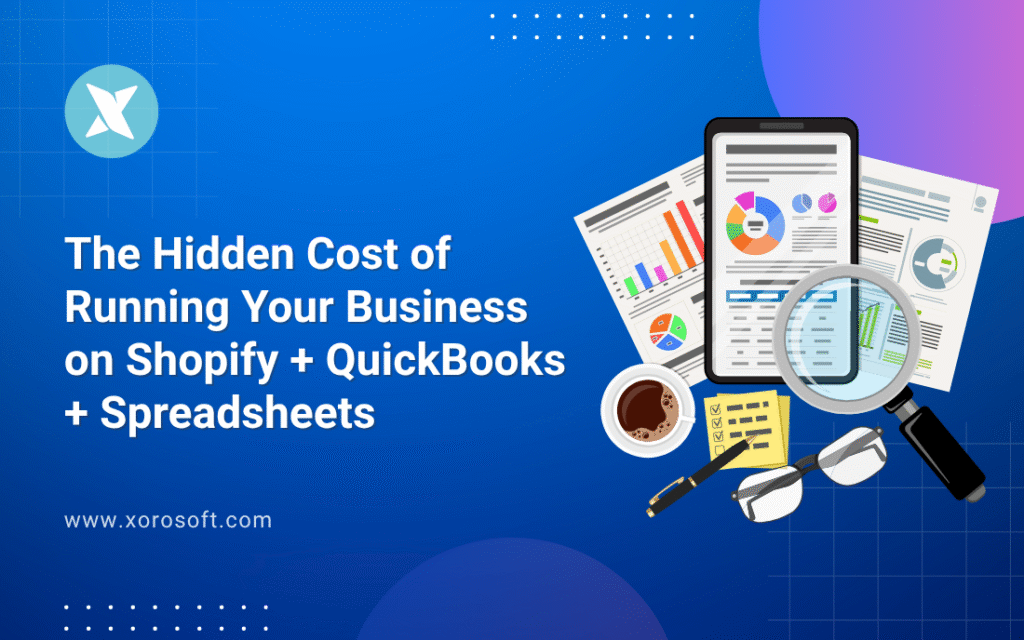
Shopify QuickBooks integration problems occur when ecommerce businesses rely on disconnected systems for sales, accounting, and operations. As a result, this leads to inventory errors, delayed financial reporting, and inefficient workflows.
How Shopify QuickBooks Integration Problems Start as You Scale
Most ecommerce brands don’t realize they’re facing Shopify QuickBooks integration problems until operations begin to slow down.
Initially, everything feels manageable.
A Shopify store is launched, orders begin flowing in, and QuickBooks handles accounting. Meanwhile, spreadsheets fill operational gaps like inventory tracking and purchase planning.
However, as the business grows, these Shopify QuickBooks integration problems become more visible.
More SKUs, more sales channels, and more operational complexity gradually introduce friction. Consequently, the same tools that once enabled speed begin to slow things down.
How Shopify QuickBooks Integration Problems Create Operational Challenges
The issue doesn’t come from individual tools.
Instead, it comes from how they operate separately.
Shopify focuses on selling, while QuickBooks manages accounting. However, neither connects operations end-to-end.
Because of this, data gets fragmented.
For example:
- Inventory impacts purchasing
- Purchasing affects cash flow
- Cash flow influences fulfillment
When systems don’t communicate, these relationships break down.
What Happens When Order Volume Increases
As order volume grows, inefficiencies become more visible.
Businesses often operate with:
- Shopify for orders
- QuickBooks for accounting
- Excel for inventory
- External warehouse tools
However, as demand increases:
- Inventory data becomes inconsistent
- Financial reporting slows down
- Teams rely on manual processes
Even though nothing fully fails, efficiency drops across operations.
Inventory Challenges Caused by Disconnected Systems
Inventory is usually the first area affected.
Because data lives in multiple places, there is no single source of truth.
As a result:
- Stock levels become unreliable
- Overselling increases
- Dead stock builds up
Moreover, teams spend more time verifying numbers than acting on them.
To solve this, businesses often adopt systems like XoroWMS to centralize inventory and improve accuracy.
Why Financial Visibility Becomes Delayed
QuickBooks provides strong accounting capabilities. However, it depends on accurate and timely data.
When systems don’t sync properly:
- Reconciliation takes longer
- Reports lag behind operations
- Profitability becomes unclear
Because of this, finance teams struggle to make timely decisions.
To improve visibility, companies use solutions like XoroERP that connect financial data with operations.
You can also explore industry benchmarks through G2 ERP rankings.
How Fulfillment Becomes More Complex
Fulfillment processes rely on coordination across systems.
Orders come from Shopify, while inventory and warehouse tools operate separately.
As a result:
- Picking errors increase
- Shipments get delayed
- Split orders become common
Therefore, customer experience suffers.
Why Decision-Making Slows Down
Fragmented data creates uncertainty.
Leaders often struggle to answer key questions:
- What is the real inventory position?
- Which products are profitable?
- When should we reorder?
Without reliable data, teams rely on assumptions. Consequently, decisions take longer and carry more risk.
How Modern Businesses Build Scalable Systems
Growing companies shift from using tools to building connected systems.
Instead of focusing on individual tools, they focus on how processes work together.
Centralized Data for Better Visibility
When all data exists in one place:
- Visibility improves
- Errors decrease
- Teams align faster
Automation Reduces Manual Effort
Automation eliminates repetitive work.
For example:
- Orders update inventory automatically
- Financial data syncs in real time
As a result, teams focus on higher-value tasks.
Improved Coordination Across Teams
When everyone works from the same data:
- Communication improves
- Execution becomes faster
- Errors decrease
Solving Shopify QuickBooks Integration Problems with Unified Platforms
To overcome system fragmentation, businesses adopt unified platforms.
Solutions like XoroONE connect ecommerce operations, inventory, finance, and fulfillment into one system.
Additionally, integrations such as the Xorosoft ERP Shopify app help streamline workflows directly within Shopify.
As a result, businesses gain:
- A single source of truth
- Real-time visibility
- Faster decision-making
Building a Strong Foundation for Scalable Growth
Shopify, QuickBooks, and spreadsheets work well in the early stages.
However, as businesses grow, limitations become clear.
Disconnected systems reduce visibility, and reduced visibility leads to weaker decisions.
Therefore, long-term growth depends on building a connected operational foundation.
Creating Clarity and Control in Ecommerce Operations
In modern ecommerce, speed matters. However, clarity matters more.
When systems work together:
- Teams act proactively
- Decisions rely on data
- Growth becomes predictable
If your current setup requires constant manual effort, your systems—not your team—are holding you back.
To explore a better approach, you can Book a demo and see how connected operations improve efficiency.
Recent Posts
-
 ERP Landed Cost Module vs Spreadsheet Calculations for Importers
 -
 How to Build an Open-to-Buy Plan for an Omnichannel Brand
 -
 Cold Storage WMS for Food and Beverage Distribution
 -
 ERP Buying Statistics 2026: Evaluation, Implementation, and Adoption Risks
 -
 How a Distributor Reduced B2B Order Exceptions Without Restricting Sales