Why omnichannel inventory management breaks as brands scale
Omnichannel inventory management becomes critical the moment a brand expands beyond a single sales channel.
In the early stages, teams manage everything with simple tools. They sell through Shopify, track finances in QuickBooks, and maintain inventory in spreadsheets.
However, growth introduces operational pressure.
As brands expand into wholesale, retail, and multiple online channels, inventory starts moving continuously. Instead of sitting in one place, stock flows across warehouses, systems, and fulfillment processes.
Because of this shift, maintaining accuracy becomes harder.
Numbers begin to drift.
Systems fall out of sync.
Teams lose confidence in their data.
What makes omnichannel inventory management so complex
Several factors drive this complexity.
First, inventory spreads across multiple locations, including warehouses, retail stores, and 3PL partners. At the same time, products move between these locations daily.
Second, brands add more sales channels. They sell through ecommerce, wholesale, marketplaces, and retail simultaneously. Each channel creates independent demand.
Most importantly, timing creates pressure.
For example, one product can get sold online, reserved for wholesale, and picked in a warehouse within minutes. If systems don’t update instantly, mismatches appear.
Therefore, omnichannel inventory management requires coordination, not just tracking.
How growing brands start losing control of inventory
As complexity increases, teams try to compensate.
Teams export data into spreadsheets, adjust stock manually, and often delay updates to avoid conflicts.
Although these actions seem practical, they introduce risk.
Meanwhile, teams spend more time fixing issues than improving operations. Small inconsistencies quickly turn into larger problems.
Because of this, inventory data becomes unreliable.
The ripple effect across operations
Weak omnichannel inventory management affects every function.
Inventory accuracy drops first. Stock levels differ across channels, which leads to overselling or excess safety stock.
At the same time, fulfillment slows down. Warehouse teams rely on incorrect data, which increases errors and delays shipments.
Financial visibility also suffers. Teams struggle to maintain accurate inventory valuation and cost tracking. As a result, reporting becomes delayed.
Finally, decision-making weakens. Leaders cannot rely on real-time data, so forecasting and purchasing become less effective.
How modern brands fix omnichannel inventory management
Modern companies take a different approach.
They build systems instead of stacking tools.
First, they create a centralized source of truth. This system reflects inventory across all locations and channels in real time.
Next, they enable real-time synchronization. Inventory updates immediately as orders are placed, which prevents overselling.
In addition, they apply allocation rules. Teams reserve stock for specific channels and manage availability more strategically.
They also connect warehouse operations directly. Picking, packing, transfers, and returns update inventory instantly.
Finally, they integrate financial systems. Inventory data flows directly into accounting, which improves accuracy and reporting speed.
Why unified systems outperform disconnected tools
At scale, connecting multiple tools creates more friction than value.
Instead, modern brands adopt unified systems.
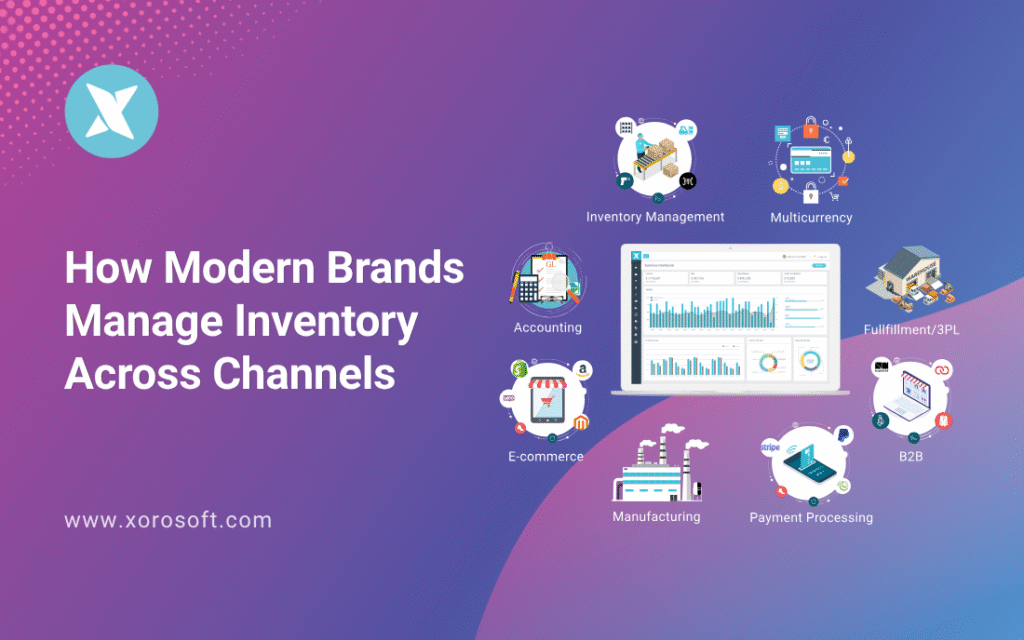
Platforms like Xorosoft replace fragmented tools with a single operational backbone.
Rather than switching between systems, teams operate through connected solutions like
XoroERP, XoroWMS, and XoroONE.
Because of this, operations stay aligned across inventory, orders, warehouse, and finance.
What strong omnichannel inventory management looks like in practice
When systems work together, operations become predictable.
Inventory updates in real time across every channel.
Orders move without manual coordination.
Warehouse actions instantly reflect in the system.
Financial data stays accurate and up to date.
As a result, teams trust their data and act faster.
Recent Posts
-
 ERP Landed Cost Module vs Spreadsheet Calculations for Importers
 -
 How to Build an Open-to-Buy Plan for an Omnichannel Brand
 -
 Cold Storage WMS for Food and Beverage Distribution
 -
 ERP Buying Statistics 2026: Evaluation, Implementation, and Adoption Risks
 -
 How a Distributor Reduced B2B Order Exceptions Without Restricting Sales