Why Automation Prevents Growth Bottlenecks
Most ecommerce teams feel pressure well before revenue plateaus. Inventory systems lag, spreadsheets multiply, and order accuracy fluctuates. Although these issues seem manageable at first, they quickly expand as order volume grows. As a result, your operations team becomes reactive instead of strategic. Because complexity increases with every new warehouse, product line, or channel, manual processes eventually collapse under their own weight.
This is why high-growth brands adopt scalable ecommerce automation long before they “need” it. Instead of relying on additional staff or late-night problem-solving, they automate routine workflows early. Once friction decreases, focus shifts back to growth, not cleanup.
How Scalable Ecommerce Automation Reduces Operational Drag
As brands grow from initial traction to multichannel distribution, operational drag intensifies. Although spreadsheets and manual workflows may function at $1M, they rarely survive at $10M. Furthermore, fragmented tools create mismatched data across Shopify, Amazon, wholesale, and accounting systems. Because these inconsistencies require constant reconciliation, teams lose valuable time and confidence.
With scalable ecommerce automation, your data becomes unified and reliable. Real-time visibility improves decision quality, reduces rework, and strengthens coordination across departments. As a result, leaders regain control of operations that previously felt unpredictable.
Strengthening Inventory and Warehouse Operations Through Scalable Ecommerce Automation
Although many growing brands believe automation is a luxury, it eventually becomes a necessity. Once inventory updates are automated across all channels, accuracy improves instantly. Because warehouse teams rely on scanning and guided workflows rather than memory, picking mistakes decline. Additionally, automated routing moves orders to the correct warehouse without manual checks.
Platforms like Xorosoft ERP, available on the G2 marketplace, provide a built-in WMS that replaces fragile bolt-on tools. As a result, fulfillment becomes faster, labor becomes more efficient, and customer expectations become easier to meet.
Scalable Ecommerce Automation in Action: A Real Brand Example
A mid-market accessories brand experienced frequent stock discrepancies between Shopify and Amazon. Because purchasing was manual, purchase orders were often late. Warehouse teams relied on overtime during peak seasons. Accounting trailed two weeks behind operational reality.
After implementing Xorosoft, which integrates directly with Shopify through the Shopify App Store, results came quickly. Inventory accuracy rose to 99.6%, picking accuracy exceeded 99%, and order cycle time dropped by 38%. Since financial data synced automatically, reporting delays disappeared. As a result, the brand comfortably surpassed $12M in revenue without increasing staff.
Building a Foundation for Scalable Ecommerce Automation
Growth magnifies inefficiency. Therefore, establishing a strong operational base early prevents future bottlenecks. With scalable ecommerce automation, repetitive tasks are eliminated, and data becomes consistent across systems. Consequently, teams spend more time on decisions and less on corrections.
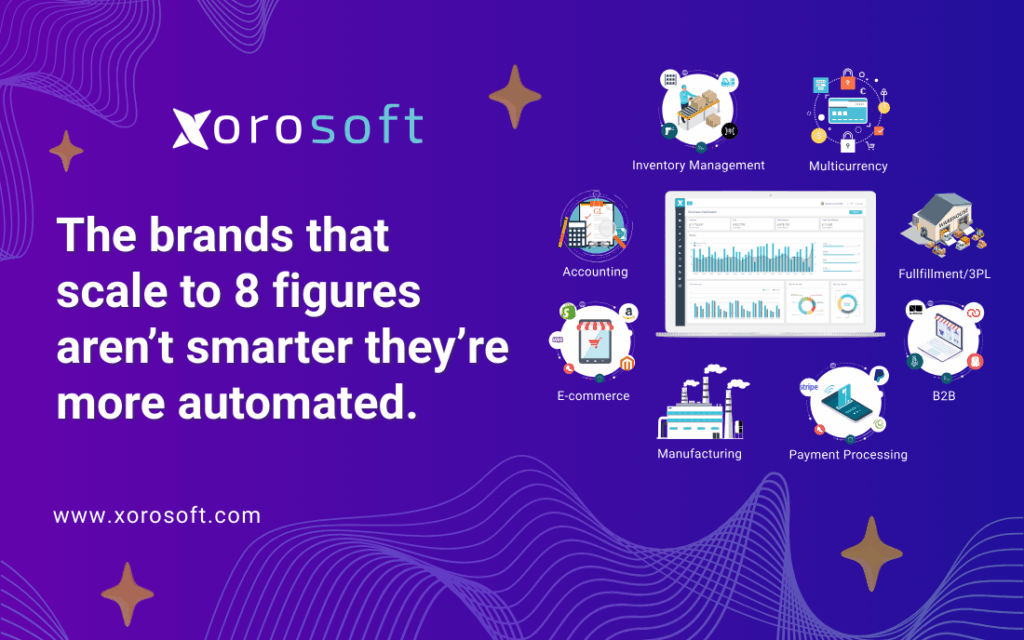
A unified system aligns inventory, warehouse operations, purchasing, manufacturing, fulfillment, accounting, and reporting. Because each workflow supports the next, operations become predictable and scalable.
Creating a Unified Inventory Source of Truth With Scalable Ecommerce Automation
Growth becomes easier when the entire team uses one authoritative inventory source. Because disconnected platforms often drift apart, centralization ensures product availability is always accurate. Automated syncing across channels eliminates overselling and minimizes stockouts. With trustworthy data, operators make faster and better decisions.
Impact Metric: Inventory accuracy and sync speed.
Automating Warehouse Efficiency Through Scalable Ecommerce Automation
Warehouse teams perform better when workflows are automated. Barcode scanning reduces fulfillment errors, while directed picking routes minimize unnecessary movement. Consequently, throughput rises without adding headcount. Predictability returns as teams operate from clear, consistent instructions.
Impact Metric: Pick accuracy and orders picked per labor hour.
Automated Replenishment as Part of Scalable Ecommerce Automation
Many brands rely on intuition, but automated purchasing is more reliable. Since automation factors in vendor lead times, sales velocity, and seasonality, replenishment becomes data-driven. As a result, brands avoid both overstocking and stockouts. Alerts reduce surprises and ensure timely purchasing.
Impact Metric: Stockout rate and inventory turnover.
Scalable Ecommerce Automation for Production and Assembly Workflows
Brands that assemble, kit, or lightly manufacture products require accurate Bill of Materials tracking. Manual tracking often introduces cost variances and delays. However, automated work order management improves visibility across materials, labor, and production schedules. Because data flows directly into costing, margin clarity improves.
Impact Metric: Production variances and planned vs. actual cost.
Faster Fulfillment Through Scalable Ecommerce Automation Routing
Automated order routing accelerates fulfillment decisions. By assigning shipments to optimal warehouses based on availability and proximity, brands reduce shipping time and cost. Although routing rules may seem small, they create significant operational stability at scale.
Impact Metric: Order cycle time and fulfillment cost per order.
Real-Time Accounting Enabled by Scalable Ecommerce Automation
Financial visibility strengthens when updates happen instantly. Because COGS, landed costs, AP/AR, and adjustments sync automatically, accounting no longer falls behind. Consequently, leaders forecast more accurately and close books faster.
Impact Metric: Close time and gross-margin accuracy.
Turning Data Into Action With Automated Dashboards
Static spreadsheets slow companies down. Automated dashboards, on the other hand, provide real-time insight into purchasing, aging inventory, SKU performance, and warehouse productivity. Because insights appear immediately, teams can act before problems escalate.
Impact Metric: Reporting cycle time and response speed.
A Practical Weekly Rollout for Automation
Brands often assume automation requires months, yet most teams begin seeing benefits within days.
- Day 1: Connect Shopify, Amazon, 3PLs, EDI, and accounting to Xorosoft.
- Day 2: Activate inventory syncing and warehouse scanning.
- Day 3: Turn on automated purchasing rules.
- Day 4: Sync accounting and landed cost tracking.
- Day 5: Configure dashboards and finalize go-live workflows.
Because Xorosoft is cloud-native and known for usability, onboarding is smooth. Its ranking on G2 underscores that experience.
How Automation Changes the Role of Operations Leaders
Leaders consistently describe relief once manual fire-drills end. Because automation handles routine work, teams finally shift their attention to growth. Decisions improve, stress decreases, and operations regain predictability. Although marketing and product matter, scalable operations are what sustain upward momentum.
Explore Scalable Ecommerce Automation With Xorosoft
If your team feels weighed down by manual work and fragmented systems, scalable automation is the most reliable way to lift that burden. Xorosoft ERP centralizes inventory, purchasing, warehouse operations, manufacturing, fulfillment, accounting, and reporting.
Visit Xorosoft to explore solutions, features, and customer stories. You can also review ratings on G2 or view the Shopify integration on the Shopify App Store.
If you want to evaluate how these workflows apply to your brand, you can book a demo with the Xorosoft team. During the session, you’ll see how automation transforms daily operations and unlocks scalable growth.
Recent Posts
-
 If your system doesn’t give you peace of mind, it’s not your system.
 -
 A modern ERP shouldn’t feel like ERP — it should feel invisible.
 -
 You don’t need more tools — you need one system that does it all.
 -
 Automation isn’t about speed — it’s about removing humans from mistakes.
 -
 Your most expensive employee is manual operations.