Why WMS Accuracy Defines Operational Confidence
If you run an ecommerce or omnichannel brand, you already understand how unstable WMS accuracy can feel. Although your warehouse team tries to maintain consistency, the numbers from Shopify, Amazon, wholesale portals, and your WMS rarely match. As a result, you’re left stitching together multiple dashboards, hoping they tell a consistent story.
This uncertainty doesn’t come from warehouse errors alone. Instead, it comes from fragmented systems that feed conflicting information into your WMS. Even when the warehouse is performing well, mismatched data causes the illusion of instability. Therefore, many leaders end up managing exceptions rather than managing operations.
Xorosoft’s unified system was built to eliminate that fragmentation and stabilize accuracy across the entire workflow.
How Reliable WMS Accuracy Supports Brand Growth
Founders, COOs, and Heads of Ops want more time to focus on scaling—not troubleshooting inventory discrepancies. However, when WMS accuracy becomes unreliable, every process slows down. Because teams must recheck bins, validate counts, reopen orders, and adjust stock levels across channels, operational energy shifts from growth to damage control.
Even brands with strong operational discipline get trapped in this cycle. Although they want to expand, they hesitate because their foundation feels unstable. With unreliable WMS accuracy, every new warehouse, channel, or SKU becomes another risk.
This is why so many brands move toward unified operational systems as they scale. Once everything connects, accuracy strengthens—and growth becomes possible again.
Where Warehouse Accuracy Breaks Down in Modern Ops
Even well-trained warehouse teams struggle when upstream data is inconsistent. Below are the frictions that gradually erode WMS accuracy, often without being noticed until the damage is visible.
Disconnected Channel Updates
Shopify, Amazon, marketplaces, and your warehouse update at different intervals. Because of this, your available-to-sell quantity rarely reflects real inventory. Although each system intends to be accurate, the lack of synchronization guarantees drift.
Multi-Warehouse and 3PL Variability
As you expand locations, accuracy becomes harder to sustain. Transfers, partial receipts, returns, and 3PL delays magnify discrepancies because each touchpoint increases the chance of mismatch.
Shadow Systems and Spreadsheets
When employees don’t trust system data, they create their own unofficial spreadsheets. Although these are meant to help, they multiply inaccuracies. Ultimately, every new manual process adds another gap.
Accounting and Operations Out of Alignment
Accounting often closes the month while warehouse activity is still in progress. Consequently, valuation and quantities diverge. Because operational movement isn’t fully synchronized with accounting, reconciliation becomes a recurring burden.
Slow Reporting and Late Detection
When it takes hours—or days—to identify the source of an error, purchasing slows, forecasting becomes unreliable, and fulfillment lags behind. However, when reporting is automated and real-time, issues become visible early.
Accuracy issues are rarely warehouse problems. They are system problems—caused by tools that don’t speak the same language.
Metrics That Reveal Whether WMS Accuracy Is Working
Certain metrics give a clear view of the health of your warehouse and surrounding workflows. Because these indicators reflect system-wide integrity, they reveal the truth behind operational performance.
Pick Accuracy (%)
This number shows how often your team gets orders right the first time. Higher WMS accuracy directly improves pick accuracy, reducing labor and customer complaints.
Order Cycle Time
When your workflows are aligned, orders move through the warehouse more quickly. Short cycle times signal strong operational flow.
Inventory Turn Rate
Reliable accuracy improves forecasting, which leads to healthier buying habits. Therefore, turn rates improve naturally.
Cash Conversion Cycle
When purchasing, receiving, and fulfillment sync smoothly, cash flows faster through the business.
Perfect Order Rate
This combines accuracy, speed, and fulfillment quality into one outcome. High perfect-order performance typically indicates strong WMS accuracy across the operation.
An Accuracy Transformation: What Happens With a Unified System
A multi-warehouse apparel brand struggled with inventory drift across Shopify, Amazon, and three distribution centers. Even though they had a WMS, weekly cycle counts revealed up to 18% variance. Since channel data conflicted with warehouse counts, the team spent over 20 hours each week reconciling discrepancies.
Before adopting Xorosoft:
-
Pick accuracy: 89%
-
Order cycle time: 28 hours
-
Reconciliation effort: 22 hours/week
-
Frequent Shopify oversells
-
Amazon suspensions for mismatched inventory
When the brand replaced their fragmented workflows with a fully connected system powered by XoroWMS, accuracy stabilized quickly. Because inventory, channels, purchasing, and warehouse activity flowed through a single operational layer, the business finally gained consistency.
After implementation:
-
Pick accuracy: 98.6%
-
Order cycle time: 11 hours
-
Reconciliation: 3 hours/week
-
Oversells eliminated
-
Amazon priority restored
Although the numbers improved dramatically, the real change was the operational confidence the system enabled.
Steps That Strengthen WMS Accuracy Across the Entire Operation
Below are practical, non-technical steps leaders can take to build accurate, predictable operations.
Unify the Core Inventory Layer
Accuracy begins with a single source of truth across channels, warehouses, and purchasing. This is where XoroONE becomes valuable as an entry point to centralizing data. Once everything syncs from one foundation, accuracy improves immediately.
Automate Available-to-Sell Quantities Across All Channels
By connecting channel updates through XoroWMS, Shopify and Amazon stay aligned with physical stock in real time. Therefore, oversells disappear.
Standardize Transfer and Movement Workflows
Structured transfer orders, scan-based validation, and uniform procedures eliminate ghost inventory between locations.
Strengthen Receiving With Scanning and QC
Receiving is one of the biggest contributors to downstream errors. Barcode scanning inside XoroWMS ensures that items enter the system correctly from the beginning.
Optimize Picking Logic and Warehouse Layout
Tools like smart bin mapping, zone-picking, and scanning validation reduce mistakes and shorten walking distances, improving accuracy and speed.
Align Accounting With Operational Data
Because costing and valuation need to move with physical inventory, accounting cannot be isolated. This is where XoroERP supports accuracy by aligning finance and operations in real time.
Replace Manual Reporting With Automated Dashboards
When dashboards automatically surface exceptions, the team doesn’t need hours to diagnose problems. Instead, they can prevent them.
What a Real Implementation Timeline Looks Like
Although leaders often assume a unified system will take a long time to adopt, most brands see stability within the first week. Once channels sync and receiving workflows improve, WMS accuracy increases immediately. Over time, as transfers standardize and accounting aligns, the entire operational engine becomes predictable.
Some brands begin with inventory and WMS, then expand into purchasing or accounting later. Others start with a full operational reset. Regardless of the path, the moment workflows become connected, accuracy improves.
Eventually, the team trusts the system—because the system proves itself trustworthy.
Common Questions About Fixing WMS Accuracy
Why doesn’t my current WMS fix accuracy issues by itself?
Because WMS accuracy depends on data from external systems. When those inputs are inconsistent, the WMS cannot stay stable.
Do I need to replace everything at once?
No. You can start with XoroWMS and expand gradually. However, accuracy improves faster when workflows unify.
What if I use different accounting software?
You can continue using your accounting platform, although accuracy is strongest when accounting and operations run through XoroERP.
How quickly will I notice improvements?
Most brands see a noticeable difference within 14–30 days.
Create Predictable WMS Accuracy With Connected Systems
If your WMS accuracy feels inconsistent, the real cause is usually system fragmentation—not the warehouse team doing the work. Once your operational data finally moves through one unified platform, accuracy becomes consistent, predictable, and scalable.
Xorosoft helps brands achieve this stability by connecting inventory, warehouse operations, purchasing, manufacturing, accounting, and reporting into one real-time system. Whether you start with XoroWMS for warehouse accuracy, or expand into the broader operational suite, each step moves you closer to a single source of truth.
Xorosoft is currently recognized as a category leader:
-
#1 in Ease of Use on G2 for ERP platforms, reflecting its intuitive and efficient workflow design.
-
A High Performer in the ERP category, backed by consistent customer satisfaction.
-
Fully available on the Shopify App Store, giving Shopify merchants a seamlessly integrated ERP and WMS solution.
Explore the full ecosystem:
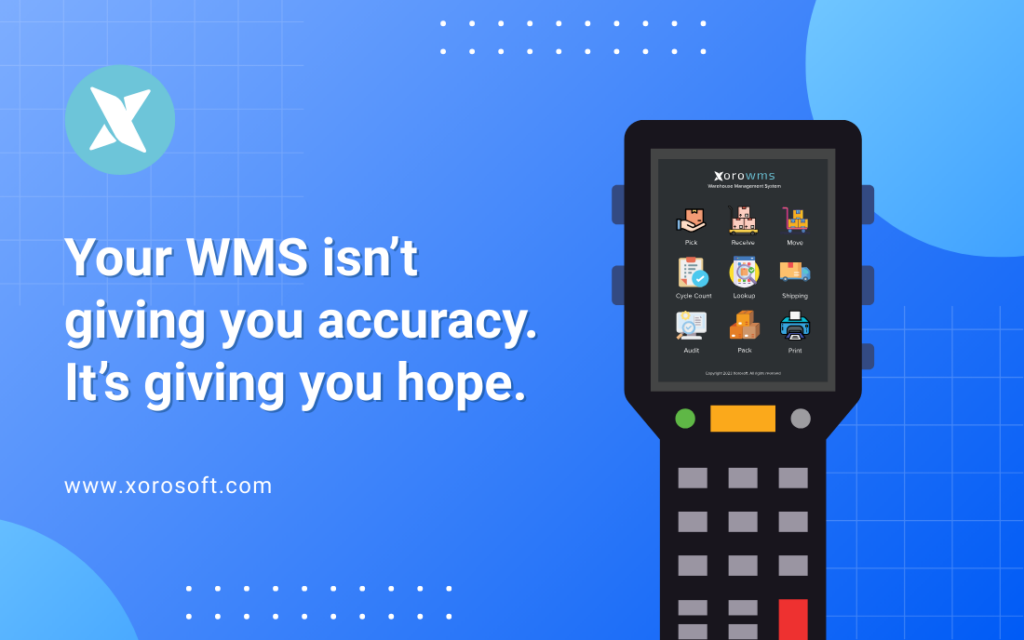
When your warehouse, channels, purchasing, and accounting finally share one truth, you no longer depend on hope—you depend on accuracy.
Recent Posts
-
 If your system doesn’t give you peace of mind, it’s not your system.
 -
 A modern ERP shouldn’t feel like ERP — it should feel invisible.
 -
 You don’t need more tools — you need one system that does it all.
 -
 Automation isn’t about speed — it’s about removing humans from mistakes.
 -
 Your most expensive employee is manual operations.