Why fast-growing brands need a unified commerce system
Growth is usually the goal. However, for many ecommerce leaders, growth quietly becomes a burden. Orders increase, channels expand, and warehouses multiply. Meanwhile, visibility shrinks.
At first, spreadsheets seem manageable. Then, another app is added. After that, one more integration promises relief. Eventually, your team spends more time managing tools than managing the business.
Because data lives in too many places, decisions slow down. As a result, leaders lose confidence in numbers they should trust. This is exactly where a unified commerce system changes everything.
The real goal behind operational change
Most founders, COOs, and heads of operations don’t want new software for the sake of it. Instead, they want freedom. They want to spend time on brand growth, partnerships, and strategy.
More importantly, they want fewer operational surprises.
A unified commerce system supports that desire by creating one real-time operational foundation. Therefore, instead of reacting to problems, teams can plan ahead with clarity.
Why disconnected tools quietly slow down scaling brands
Disconnection rarely breaks things all at once. Instead, it creates friction in small, constant ways.
For example, inventory counts differ between systems. Meanwhile, finance waits for accurate data. At the same time, warehouse teams work around manual processes.
Because of this, teams rely on assumptions rather than facts.
Common friction points include:
-
Inventory mismatches across sales channels
-
Manual CSV uploads and spreadsheet checks
-
Delayed fulfillment insights
-
Accounting reconciliations that take weeks
-
Reporting that reflects the past, not the present
Although each issue seems manageable alone, together they drain time and confidence.
What a unified commerce system replaces in ecommerce operations
A unified commerce system is not just another layer. Instead, it replaces the operational glue holding everything together.
Rather than syncing disconnected tools, it becomes the system of record for:
-
Inventory across all locations
-
Orders from every channel
-
Warehouse workflows
-
Procurement and manufacturing
-
Accounting and reporting
Because everything updates in real time, teams stop reconciling data manually.
This is the foundation behind Xorosoft.
How Xorosoft powers a unified commerce system
Xorosoft is built for ecommerce brands that already operate across multiple channels, warehouses, and currencies. As a result, it works especially well for omnichannel and DTC businesses.
Because Xorosoft is cloud-native, deployment is faster than legacy platforms. Additionally, it connects natively with Shopify, Amazon, EDI partners, and 3PLs.
Depending on your operational needs, Xorosoft supports different layers of the business:
-
XoroONE provides a centralized operational backbone for fast-scaling brands
-
XoroERP manages inventory, accounting, procurement, and reporting in one system
-
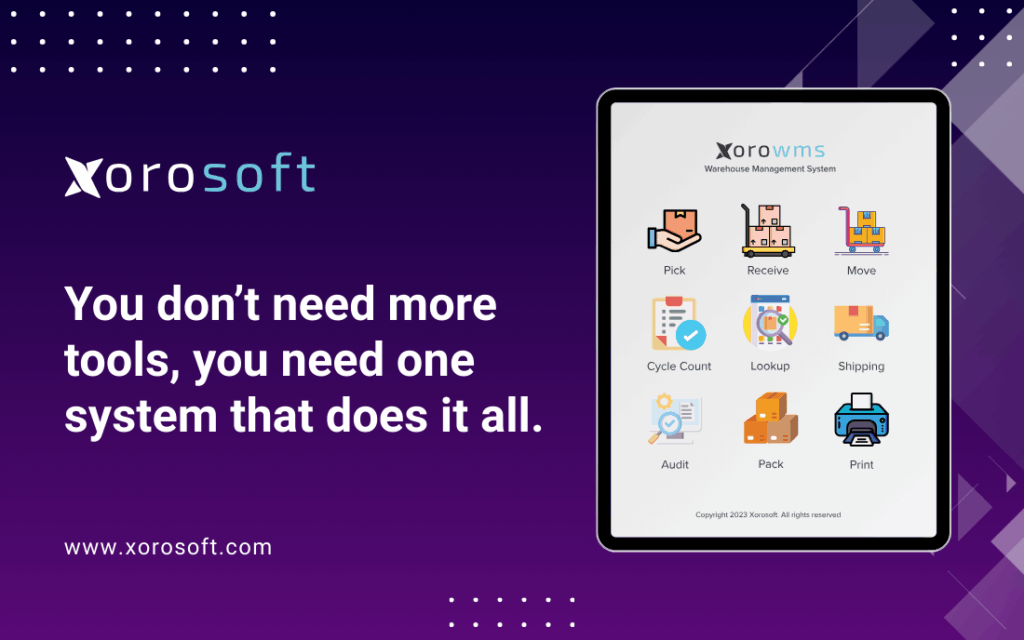
XoroWMS delivers built-in warehouse management without bolt-ons
Each component works together within one unified commerce system, rather than operating as separate products.
Key metrics improved by a unified commerce system
When teams move to a unified commerce system, improvement becomes measurable.
Instead of guessing, leaders track metrics that reflect real performance:
-
Inventory accuracy percentage
-
Order cycle time from placement to shipment
-
Pick and pack accuracy
-
Cash conversion cycle
-
Gross margin by channel
Because these metrics come from one system, teams trust them.
A practical example of operational transformation
Consider a mid-market ecommerce brand selling across Shopify, Amazon, and wholesale channels. The business operated two warehouses and relied on spreadsheets alongside multiple apps.
Before unification, inventory accuracy hovered around 88%. Order cycle times stretched beyond 48 hours. Month-end close regularly exceeded two weeks.
After consolidating operations into a unified commerce system powered by Xorosoft, results shifted quickly.
Inventory accuracy climbed above 99%. Orders shipped within 24 hours. Month-end close dropped to five days. Most importantly, leadership regained confidence in daily numbers.
Nothing magical happened. The business simply stopped working around disconnected tools.
Building operational clarity step by step
Transitioning to a unified commerce system does not require chaos. In fact, clarity usually improves immediately.
First, teams map existing systems and identify duplication. Next, sales channels are connected to one inventory source. After that, warehouse workflows are standardized using built-in WMS capabilities.
Then, purchasing and replenishment align with real demand. Meanwhile, accounting ties directly to inventory movement. Finally, dashboards replace static reports.
Because each step builds on the previous one, teams feel momentum instead of disruption.
Why warehouse management cannot be an afterthought
Warehouse execution often exposes system weaknesses first. If picking, packing, and putaway rely on manual work, errors multiply as volume grows.
Xorosoft includes a built-in WMS rather than a bolt-on. Therefore, warehouse actions immediately update inventory, orders, and financials.
As a result, fulfillment teams move faster while leadership gains real-time visibility.
Supporting omnichannel growth without complexity
Selling on more channels should increase revenue, not complexity. However, without a unified commerce system, every new channel adds operational strain.
Xorosoft connects channels natively. Because of this, inventory availability, order routing, and fulfillment logic remain consistent.
Whether orders come from Shopify, marketplaces, or wholesale partners, the system treats them as part of one operation.
Regaining confidence in financial reporting
Accounting often suffers most from disconnected systems. Revenue, COGS, and inventory valuation drift apart.
By tying accounting directly to operational events, Xorosoft eliminates reconciliation work. Therefore, finance teams close faster and leadership sees accurate margins sooner.
This financial clarity is one of the strongest long-term benefits of a unified commerce system.
Why ease of use matters for adoption
Even powerful systems fail if teams resist them. That is why usability matters.
Xorosoft is currently ranked #1 for Ease of Use on G2. This recognition reflects how quickly teams adopt the platform and rely on it daily.
Similarly, Xorosoft is available as a fully integrated solution on the Shopify App Store, which simplifies onboarding for ecommerce brands.
Recent Posts
-
 If your system doesn’t give you peace of mind, it’s not your system.
 -
 A modern ERP shouldn’t feel like ERP — it should feel invisible.
 -
 You don’t need more tools — you need one system that does it all.
 -
 Automation isn’t about speed — it’s about removing humans from mistakes.
 -
 Your most expensive employee is manual operations.